

Global Industrial Vacuum Cleaner Market Size & Forecast:
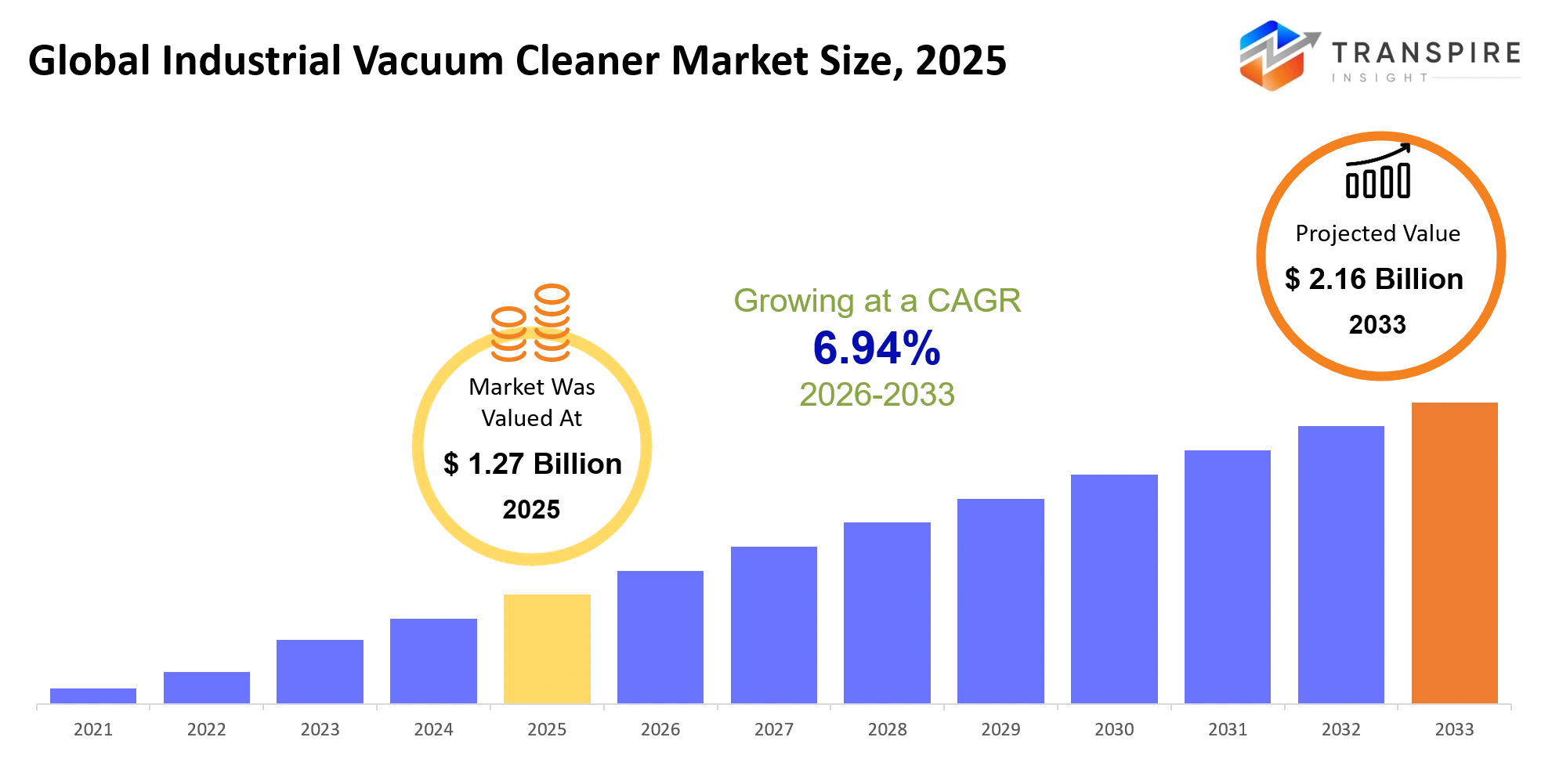
- Global Industrial Vacuum Cleaner Market Size 2025: USD 1.27 Billion
- Global Industrial Vacuum Cleaner Market Size 2033: USD 2.16 Billion
- Global Industrial Vacuum Cleaner Market CAGR: 6.94%
- Global Industrial Vacuum Cleaner Market Segments: By Product (Dry Vacuum Cleaners, Wet & Dry Vacuum Cleaners, Explosion-proof Vacuum Cleaners, Centralized Systems, Pneumatic Systems, Battery-powered Systems, Others); By Power Source (Electric, Pneumatic, Battery, Others); By End User (Manufacturing, Food & Beverage, Pharmaceuticals, Chemicals, Construction, Others); By Capacity (Below 20L, 20-50L, Above 50L, Others); By Distribution (Direct, Dealers, Online, Others).
Global Industrial Vacuum Cleaner Market Summary:
As per Transpire Insight Analysis, the Global Industrial Vacuum Cleaner Market size is estimated at USD 1.27 Billion in 2025 and is anticipated to reach USD 2.16 Billion by 2033, growing at a CAGR of 6.94% from 2026 to 2033.
The global industrial vacuum cleaner market is really important for keeping environments clean and safe. This includes places like manufacturing plants, warehouses and food processing units, pharmaceutical facilities and construction sites. These machines are made to pick up dust and debris, hazardous particles and liquid waste. They do this so that businesses can make their workplaces safer and their equipment works better. They can make more things. In recent years, people have started to like automated, battery-powered and energy-efficient cleaning solutions. This is because industries are trying to modernise the way they do things.
One big change is that people are adding monitoring features and cordless technologies to these machines. This makes them easier to move, and they do not need as much maintenance. At the time, there were stricter rules about workplace safety and industrial hygiene. This is why businesses are using vacuum systems instead of old cleaning methods. The global industrial vacuum cleaner market is growing because manufacturing is getting bigger, there is automation, and people care more about employee safety. This means that companies that make industrial vacuum cleaners have a lot of opportunities to grow.
Key Market Insights:
The international industrial vacuum cleaner market is undergoing constant changes because of growing awareness among companies of safety, efficiency, and compliance with regulations. In addition, producers are developing intelligent, energy-efficient, and specialised cleaners to accommodate the changing demands of industrial customers.
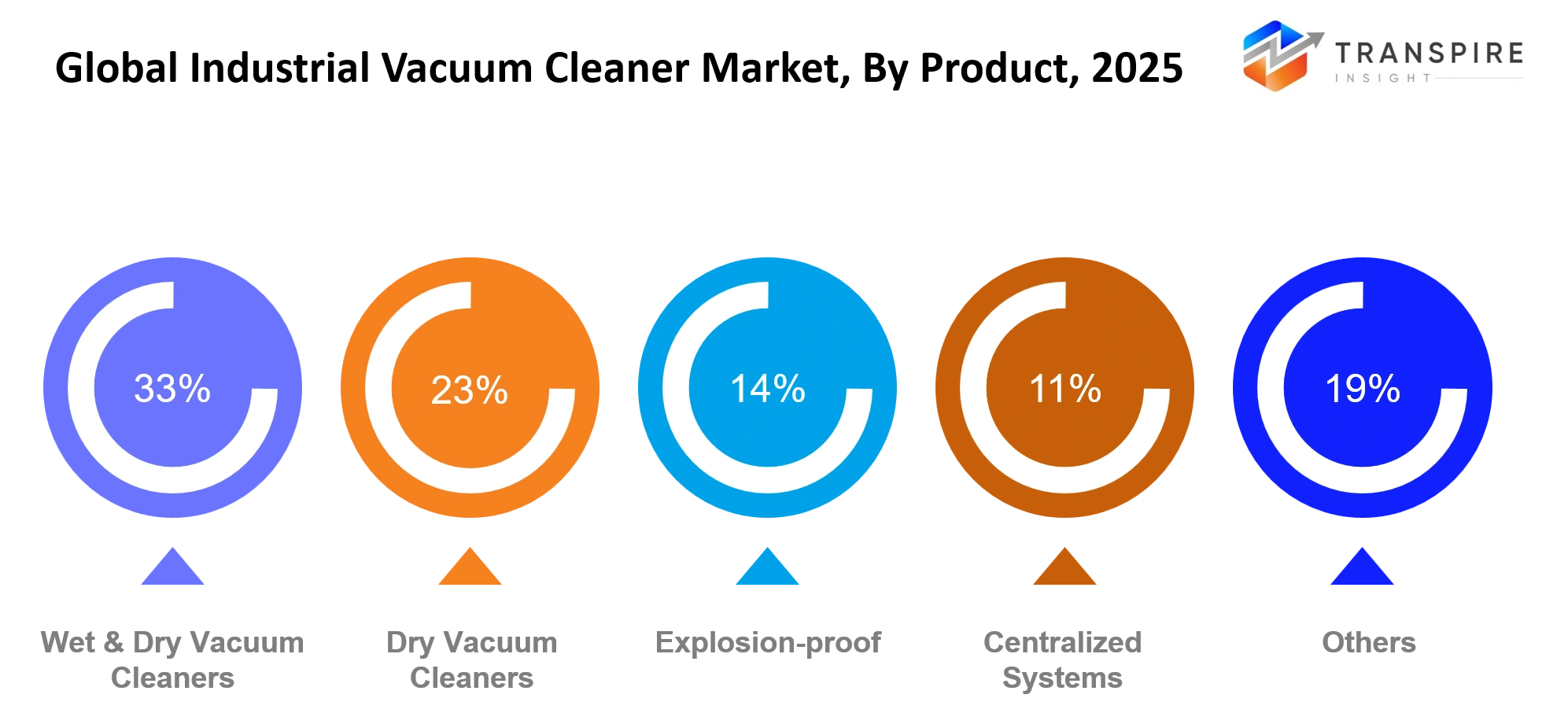
- The Wet & Dry Vacuum Cleaners segment constitutes 33% of the market because these vacuum cleaners are widely used in manufacturing, construction, and food processing industries due to their capability to clean up both wet and dry waste.
- Dry Vacuum Cleaners make up 23% of the market, owing to the high demand for facilities requiring effective elimination of dust and dry particles.
- Explosion-proof Vacuum Cleaners comprise about 14% of market revenue because more facilities become interested in hazardous dust management systems in such industries as chemical, pharmaceutical, and oil & gas production.
- Centralised Vacuum Systems constitute about 11% of the market as a result of increased investments in industrial facilities in permanent cleaning equipment to increase efficiency.
- Battery-powered systems are the fastest-growing product type, with a CAGR being 13.6%. Such an increase is driven by growing interest in cordless and highly mobile cleaning machines.
What are the Key Drivers, Restraints, and Opportunities in the Global Industrial Vacuum Cleaner Market?
Drivers
The international market for industrial vacuum cleaners is primarily fueled by the increasing focus on workplace safety, industrial hygiene, and environmental safety regulations in manufacturing, pharmaceuticals, the food industry, and the chemicals industry. The stringent standards in regard to environment safety and occupational safety led to an increased demand for more sophisticated industrial vacuums capable of removing dust, dangerous particles, and liquid residue from the premises. Moreover, with the development of automation and smart manufacturing technologies, there is a greater demand for efficient cleaning technologies that reduce the risk of equipment downtimes. With the increasing interest in operational efficiency and improvements, the demand for equipment is constantly increasing.
Restraints
High costs of the advanced vacuum systems, especially those that feature HEPA filters, explosion-proof mechanisms, and monitoring systems, are one of the main restraints on the growth of the industrial vacuum cleaner market. Small and medium-sized companies tend to delay upgrading due to limited budgets and maintenance costs.
Opportunities
An important area of development would be the increasing demand for battery-operated and intelligent industrial vacuum cleaners. Many manufacturers are coming up with more and more cordless devices that have IoT-enabled monitoring capabilities, predictive maintenance and efficient energy usage. The increasing industrialisation of developing countries and investments in sustainable manufacturing plants are likely to provide many growth opportunities in this field.
What Has the Impact of Artificial Intelligence Been on the Global Industrial Vacuum Cleaner Market?
AI technologies have helped enhance the performance of industrial vacuum-cleaning systems through intelligent operations and maintenance practices. Currently, the most modernised industrial vacuum cleaners have smart sensors that monitor airflow, filter conditions, dust collection, and machine performance at all times. This helps identify problems and avoid machine malfunctions and subsequent unnecessary maintenance. In addition, AI enables effective planning of the cleaning operations based on usage and workplace condition patterns. Cleaning becomes more efficient as cleaning operations are carried out only when it is necessary.
The use of robots for carrying out the task is another benefit of using vacuum cleaning systems powered by AI technology. The cleaning machines and robots can be used simultaneously in an industrial setting, such as an automated production facility, to clean the place without human labour input. Predictive analytics is useful in helping to maintain equipment reliability and prolong its service life through timely maintenance. However, the implementation of such vacuums comes with certain difficulties in terms of the relatively high cost of purchase, along with some difficulties with integrating AI systems into an existing industrial system. Due to the financial limitations of many small and medium companies, as well as due to the necessity for further training of workers, there is still room for improvement regarding the spread of the use of AI technology. In March 2025,iRobot launched an innovative generation of AI-based robots with advanced PrecisionVision AI, LiDAR guidance, and intelligent object recognition. The use of artificial intelligence in such applications is increasing the efficiency of autonomous cleaning and reflects how artificial intelligence is revolutionising modern vacuum cleaning technology.
Key Market Trends
Trends in the worldwide industrial vacuum cleaners market include more automation, energy efficiency, and increased emphasis on workplace safety. The focus by manufacturers of the current trend includes more intelligent, efficient, and application-specific industrial vacuum cleaners.
- There is a gradual shift in industrial sectors towards the use of automated and intelligent industrial vacuum cleaners, which increase productivity by eliminating human interventions.
- The demand for battery-operated industrial vacuum cleaners has risen rapidly in recent times due to the requirement for more mobility, flexibility, and easier operations by businesses.
- IoT connectivity in industrial vacuum cleaners and real-time performance monitoring has helped users keep an eye on their equipment health and improve maintenance.
- There has been a rise in demand for HEPA filters and dust control systems to maintain workplace safety and to comply with increasing environmental regulations.
- Industrial vacuum cleaners, which are energy efficient, are being preferred by companies because it reduces electricity bills and ensure company sustainability.
- The trend towards smarter factories and automation of production lines has prompted businesses to deploy cleaning systems.
Global Industrial Vacuum Cleaner Market Segmentation
By Product
The Wet & Dry Vacuum Cleaners segment commands the highest market share at 33% in terms of overall revenue generated by the industrial vacuum cleaners market on a global scale. This can be attributed to its capability of sucking both wet spills and dry material, which makes it fit for use in different kinds of sectors, including manufacturing, food and beverage, construction, and pharmaceuticals. The Dry Vacuum Cleaners segment has 23% of the overall market share and is still extensively used in plants where there is dust and other dry particles to deal with. Explosion-proof Vacuum Cleaners have a share of 14%, fueled by rising demands from the chemical, mining, and oil & gas sectors that require explosion-proof systems due to hazardous conditions of work. The share of the Centralised Systems segment comes to 11%, whereas other product segments account for 19%. However, the fastest growing segment is the one for the Battery-powered Systems, with a 13.6% CAGR.
By Power Source
Considering the power source, electric industrial vacuum cleaners are likely to retain their dominance on account of reliable performance, powerful suction capacity, and suitability for continuous industrial operations. Pneumatic vacuum cleaners continue to be highly significant for dangerous conditions wherein the use of electrical equipment may pose certain safety hazards. The growing preference for battery-operated equipment is likely to result in increased use of cordless industrial vacuum cleaners owing to higher mobility and reduced maintenance.
By End User
When looking at the end user, the segment of manufacturing accounts for the major proportion of consumption on account of the requirement for maintaining clean industrial environments and protection of costly equipment against dust accumulation. The food & beverage industry and the pharmaceutical industry have been showing growth in their usage of industrial vacuum cleaners owing to the increasing requirements related to hygiene and compliance with regulations. The chemical industry and construction industry are the other prominent sectors that account for major consumption, along with other industrial uses.
By Capacity
With regards to Capacity, vacuum cleaners having a capacity between 20L and 50L contribute to a significant share in market demands due to their balanced nature in terms of volume, mobility, and efficiency. Products with a capacity of more than 20L are used for light industrial jobs, while those with a capacity of more than 50L are ideal for heavier industrial cleaning jobs in big manufacturing industries, warehouses, and construction yards with considerable amounts of waste production.
By Distribution
Considering Distribution channels, the direct sales channel is still more favoured when it comes to providing customised machinery along with consultation and maintenance services. The importance of the dealer channel should not be overlooked, as it enables increased product reach within the regional market. In addition, online purchases are on the increase in comparison due to the ease with which buyers are able to compare and purchase industrial products online.
What are the Key Use Cases Driving the Global Industrial Vacuum Cleaner Market?
The use of industrial vacuum cleaners for keeping the environment clean and safe is common practice within the manufacturing sector, where the most popular type is Wet & Dry Vacuum Cleaners, which occupy a 33% share of the market and ensure removal of dust, metal scraps, liquids and other residues of the production process in an efficient way.
Another sector where the demand is growing is that of food & beverage, pharmaceuticals, chemicals, and construction, where it is important to maintain hygiene and keep hazardous particles under control. Industrial vacuum systems allow avoiding contamination of products, ensuring the safety of the employees and meeting all required regulations during uninterrupted production. The new areas of application include automated warehouses, smart factories, and logistics hubs, where the demand for portable battery-operated industrial vacuum cleaners grows. The investments in automation and sustainable practices will lead to increased usage of intelligent vacuum systems.
|
Report Metrics |
Details |
|
Market size value in 2025 |
USD 1.27 Billion |
|
Market size value in 2026 |
USD 1.35 Billion |
|
Revenue forecast in 2033 |
USD 2.16 Billion |
|
Growth rate |
CAGR of 6.94% from 2026 to 2033 |
|
Base year |
2025 |
|
Historical data |
2021 - 2024 |
|
Forecast period |
2026 - 2033 |
|
Report coverage |
Revenue forecast, competitive landscape, growth factors, and trends |
|
Regional scope |
United States; Canada; Mexico; United Kingdom; Germany; France; Italy; Spain; Denmark; Sweden; Norway; China; Japan; India; Australia; South Korea; Thailand; Brazil; Argentina; South Africa; Saudi Arabia; United Arab Emirates |
|
Key company profiled |
Nilfisk, Kärcher, Tennant, Delfin, Tiger-Vac, Goodway, Ruwac, VAC-U-MAX, Numatic, Nederman, Depureco, Pullman Ermator, EXAIR, Bosch, Makita. |
|
Customization scope |
Free report customization (country, regional & segment scope). Avail customized purchase options to meet your exact research needs. |
|
Report Segmentation |
By Product (Dry Vacuum Cleaners, Wet & Dry Vacuum Cleaners, Explosion-proof Vacuum Cleaners, Centralized Systems, Pneumatic Systems, Battery-powered Systems, Others); By Power Source (Electric, Pneumatic, Battery, Others); By End User (Manufacturing, Food & Beverage, Pharmaceuticals, Chemicals, Construction, Others); By Capacity (Below 20L, 20-50L, Above 50L, Others); By Distribution (Direct, Dealers, Online, Others). |
Which Regions are Driving the Global Industrial Vacuum Cleaner Market Growth?
North America
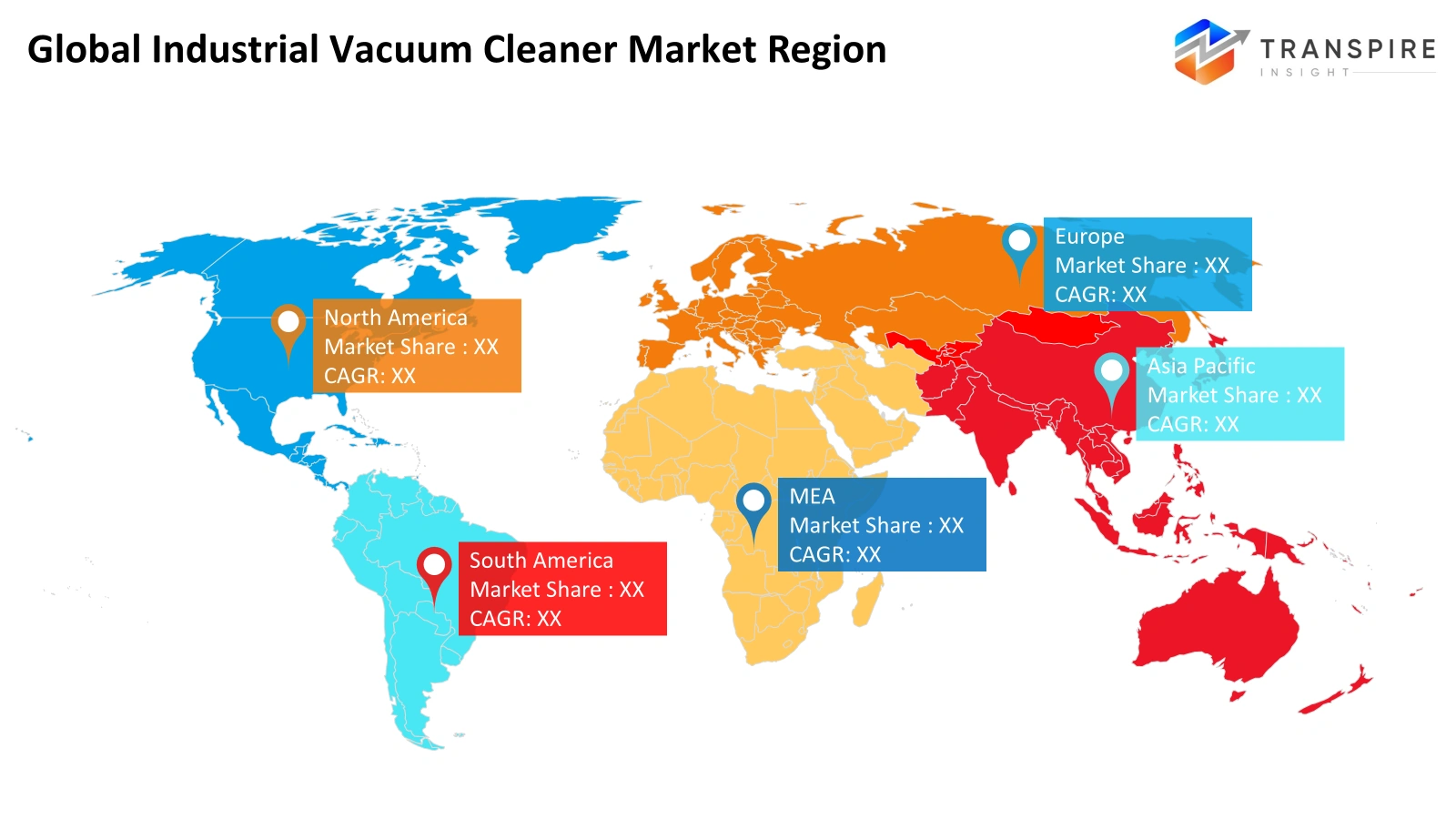
North America holds a 26% share in the world market and continues to contribute significantly to the world's industrial vacuum cleaner market, owing to its advanced industrial infrastructure and adoption of automated industrial cleaning processes. Sectors such as manufacturing, aerospace, logistics, and healthcare are some of the prominent investors in advanced vacuum systems. InJune 2025, Tennant Company collaborated with L&T Technology Services to set up an Offshore Development Centre in India to speed up the development of future sustainable industrial cleaning equipment that includes innovative vacuum and floor cleaning machines for global industrial customers.
Europe
Europe is at the forefront of the world's industrial vacuum cleaner market, contributing to 35% of the overall revenue generation. Factors like Europe's strong manufacturing sector, stringent occupational safety laws, and increasing adoption of automation in industries have contributed to Europe's dominant position in the market. The sectors of automobiles,
pharmaceuticals, food processing, and chemicals continue to be key contributors, investing in new technologies for enhanced efficiency and compliance with environmental norms. InJuly 2025,Kärcher unveiled its first line of professional cordless vacuum cleaners of the LVS series (18V and 36V models) aimed at commercial and industrial applications. The introduction enriches Kärcher’s range of professional cleaning machines and promotes Europe's leading position in innovative industrial cleaning technologies.
Asia Pacific
Asia Pacific constitutes 29% of the total market share and is the fastest-growing region with a compound annual growth rate (CAGR) of 14.8%. Factors that are fueling market growth include fast-paced industrialisation, increased manufacturing processes, and growing investment in the production of electronics, automobiles, and pharmaceuticals. Governmental and private industry bodies are enhancing workplace safety regulations while simultaneously automating factories. This creates ample opportunities for industrial vacuum cleaners powered by batteries. In October 2025, Kärcher India released locally produced WD 3-17L wet and dry vacuum cleaners to increase local production and to satisfy growing industrial and commercial cleaning demands in India, which ensures fast development of the Asia-Pacific industrial vacuum cleaner market.
Who are the Key Players in the Global Industrial Vacuum Cleaner Marketand how do they Compete?
The global industrial vacuum cleaners market is highly competitive, with manufacturers emphasising innovation, efficiencies, and industry-based solutions in an effort to increase their market presence. The competitive edge for the manufacturers is mainly due to technological innovations, product dependability, energy efficiency, and wide distribution channels. Manufacturers are further investing in smart cleaning technologies, efficient filtration systems, and sustainable product development to satisfy the ever-changing needs of their industrial clients.
Key manufacturers like Nilfisk, Alfred Kärcher SE & Co. KG, Delfin Industrial Vacuums, Tiger-Vac Inc., and Ruwac Industriesauger GmbH place a strong emphasis on innovation by introducing high-performance vacuum systems with HEPA filtration, explosion-proof design, and IoT monitoring. The strategies of the key manufacturers are mainly geared towards innovation of application-based products to increase workplace safety, decrease maintenance costs, and increase operational efficiency. Other key players such as Goodway Technologies, VAC-U-MAX, EXAIR Corporation, Depureco Industrial Vacuums, and American Vacuum Company distinguish themselves with customised options for industrial uses. These companies compete by offering flexible product lines, reliable after-sales service, and customer-friendly approaches. The majority of companies have begun entering new markets, investing in research and development, and introducing electric, energy-efficient industrial vacuum cleaners.
Global Industrial Vacuum Cleaner Market companies
- Nilfisk
- Kärcher
- Tennant
- Delfin
- Tiger-Vac
- Goodway
- Ruwac
- VAC-U-MAX
- Numatic
- Nederman
- Depureco,
- Pullman Ermator
- EXAIR,
- Bosch,
- Makita
Recent Development News
In February 2025, Nilfisk released its new generation of VP300, VP400, and VU200 professional vacuum cleaners with improved ergonomic design, increased energy efficiency, and improved cleaning effectiveness. This release helped to further diversify the product portfolio of the company and meet the increasing market need for professional cleaning products.
Source: https://www.nilfisk.com/global/
In July 2025, Alfred Kärcher SE & Co. KG announced the release of the new LVS cordless vacuum cleaner line, which represented the first professional cordless vacuum cleaner series by the company.
Source: https://www.kaercher.com/int/
What Strategic Insights Define the Future of the Global Industrial Vacuum Cleaner Market?
The global industrial vacuum cleaners industry is increasingly adopting smart, internet-enabled, and energy-efficient devices owing to continued automation of work areas in the manufacturing environment and improvements in the standards of worker safety. Increased development of electric devices, intelligent monitoring, and filtration systems will influence the decision-making in the purchase of products in the manufacturing, pharmaceutical, food processing, and chemicals industries. One of the risks not many people are aware of is the cost of advanced industrial vacuums that come with intelligent sensors, automation, and explosion-proofing. This could limit the uptake of such machines by small and medium enterprises that operate with limited budgets.
There is an opportunity for manufacturers to explore regions of the world where rapid industrialisation and automation have led to a need for better cleaning equipment. There is a need for companies to focus on innovations in their products, develop strong distribution systems in different parts of the world and improve digital service.
Key Segmentations are:
By Product
- Dry Vacuum Cleaners
- Wet & Dry Vacuum Cleaners
- Explosion-proof Vacuum Cleaners
- Centralized Systems
- Pneumatic Systems
- Battery-powered Systems
By Power Source
- Electric
- Pneumatic
- Battery
By End User
- Manufacturing
- Food & Beverage
- Pharmaceuticals
- Chemicals
- Construction
By Capacity
- Below 20L
- 20-50L
- Above 50L
By Distribution
- Direct
- Dealers
- Online
Regional Outlook
North America
- United States
- Canada
- Mexico
Europe
- Germany
- United Kingdom
- France
- Spain
- Italy
- Rest of Europe
Asia Pacific
- Japan
- China
- Australia & New Zealand
- South Korea
- India
- Rest of Asia Pacific
South America
- Brazil
- Argentina
- Rest of South America
Middle East & Africa
- Saudi Arabia
- United Arab Emirates
- South Africa
- Rest of the Middle East & Africa
Frequently Asked Questions
Find quick answers to common questions.
The global industrial vacuum cleaner market size was valued at USD 1.27 Billion in 2025 and is poised to reach USD 2.16 Billion by 2033, expanding at a 6.94% CAGR.
Key segments for the global industrial vacuum cleaner market are By Product (Dry Vacuum Cleaners, Wet & Dry Vacuum Cleaners, Explosion-proof Vacuum Cleaners, Centralized Systems, Pneumatic Systems, Battery-powered Systems, Others); By Power Source (Electric, Pneumatic, Battery, Others); By End User (Manufacturing, Food & Beverage, Pharmaceuticals, Chemicals, Construction, Others); By Capacity (Below 20L, 20-50L, Above 50L, Others); By Distribution (Direct, Dealers, Online, Others).
Growth is primarily driven by greater industrial automation, higher emphasis on workplace safety and hygiene, increasing demand for effective removal of dust and dangerous materials, an increase in manufacturing operations, and greater use of energy-efficient cleaning machines.
The global market is led by major manufacturers including Nilfisk, Kärcher, Tennant, Delfin, Tiger-Vac, Goodway, Ruwac, VAC-U-MAX, Numatic, Nederman, Depureco, Pullman Ermator, EXAIR, Bosch, Makita.
Europe constitutes 35% of the total industrial vacuum cleaner market owing to the strict safety and environmental policies, strong presence of manufacturing industries, and use of sophisticated industrial cleaning machinery in the automotive, food processing, pharmaceutical, and metal industries.
The global industrial vacuum cleaner market offers strong commercial opportunities through rising demand for automated cleaning solutions, expanding industrial and warehouse infrastructure, increasing adoption of battery-powered and smart vacuum systems, and growing investments in workplace safety and regulatory compliance across emerging economies.
- Nilfisk
- Kärcher
- Tennant
- Delfin
- Tiger-Vac
- Goodway
- Ruwac
- VAC-U-MAX
- Numatic
- Nederman
- Depureco,
- Pullman Ermator
- EXAIR,
- Bosch,
- Makita
About the Authors

Avinash Kumar
I’m Avinash Kumar, a Senior Research Analyst at Transpire Insight, with expertise in the Electronics and Semiconductor and Energy & Power industry. My work focuses on analyzing emerging technologies, market trends, industry developments, and innovation across these sectors. I specialize in transforming complex technical and market insights into clear, research-backed content that helps professionals, businesses, and decision-makers stay informed. Through continuous industry research and data-driven analysis, I strive to deliver accurate, reliable, and practical perspectives on the latest advancements shaping the semiconductor and energy landscape.

Chakradhar Khansole
Chakradhar serves as the Research Director at Transpire Insight, bringing over 8 years of experience in technology, innovation, and strategic market intelligence. He specializes in transforming complex market data into actionable business insights that enable organizations to make informed, growth-oriented decisions. Recognized for his strategic vision and analytical expertise, Chakradhar leads high-impact research initiatives, delivering comprehensive market assessments, competitive intelligence, and forward-looking industry analysis.
Recently Published Reports
-
Apr 2026
Fiber Optic Faceplates Market
Fiber Optic Faceplates Market Size, Share & Analysis Report By Type (< 300 mm2, 300-350 mm2, and > 350 mm2, By Application (Night Vision, Holographic Imaging, Medical, and Others), and Geography (North America, Europe, Asia-Pacific, Middle East and Africa, South and Central America), 2021 - 2031
-
Apr 2026
High Temperature Superconductors Market
High Temperature Superconductors Market Size, Share & Analysis Report By Type (1G HTS, and 2G HTS), By Application (Power Cable, Fault Current Limiter, and Transformer), and Geography (North America, Europe, Asia-Pacific, Middle East and Africa, South and Central America), 2021 - 2031
-
Apr 2026
Industrial Plugs and Socket Market
Industrial Plugs and Socket Market Size, Share & Analysis Report By Type (Industrial Plugs, Industrial Sockets), By Current (Up to 32 A, 32 to 125 A, Above 125 A), By Protection (Dustproof and Splash Proof, Waterproof, Explosion Proof), By End User (Heavy Industries, Oil and Gas, Chemicals and Pharmaceuticals, Power Generation, Others), and Geography (North America, Europe, Asia-Pacific, Middle East and Africa, South and Central America), 2021 - 2031
-
Apr 2026
InGaAs Avalanche Photodiodes Market
InGaAs Avalanche Photodiodes Market Size, Share & Analysis Report By Type (1100 - 1700 nm, and 1000 - 1600 nm), By Application (Missile Warning System, Muzzle Flash Detection, Wafer Defect Inspection, Laser Rangefinders, and Others), and Geography (North America, Europe, Asia-Pacific, Middle East and Africa, South and Central America), 2021 - 2031