

Europe Vacuum Cleaner Market Size & Forecast:
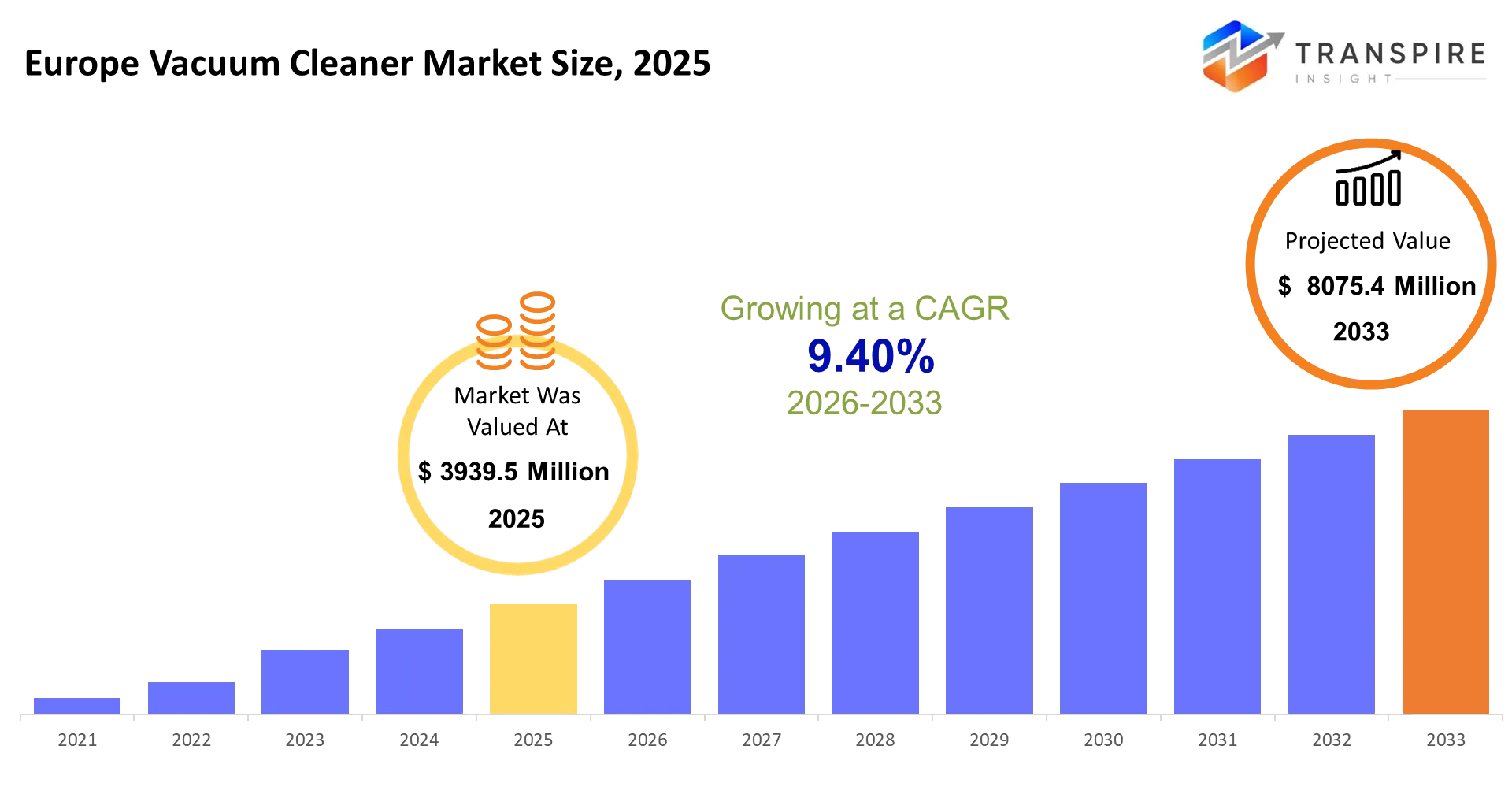
- Europe Vacuum Cleaner Market Size 2025: USD 3939.5 Million
- Europe Vacuum Cleaner Market Size 2033: USD 8075.4 Million
- Europe Vacuum Cleaner Market CAGR: 9.40%
- Europe Vacuum Cleaner Market Segments: By Type (Canister, Upright, Robotic, Handheld, Others); By Application (Residential, Commercial, Industrial, Others); By End-User (Households, Offices, Hotels, Industrial Sector, Others); By Distribution (Online, Retail, Specialty Stores, Others)
To learn more about this report,  Download Free Sample Report
Europe Vacuum Cleaner Market Summary
The Europe Vacuum Cleaner Market was valued at USD 3939.5 Million in 2025. It is forecast to reach USD 8075.4 Million by 2033. That is a CAGR of 9.40% over the period.
Vacuum cleaners function as essential cleaning equipment throughout European countries because people use them to clean their homes and offices and hospitality businesses and industrial sites for hygiene maintenance and allergen control and to achieve the cleanliness standards that regulations and customers demand. The current market has changed from its earlier preference for basic corded machines to its present interest in cordless battery-powered and robotic systems that use smart navigation technology to minimize manual work. The past five years have witnessed a significant transformation because people now use lithium-ion powered cordless and connected vacuum systems instead of traditional plug-in vacuum models. Manufacturers have developed new products because EU ecodesign and energy efficiency standards demand that they create items which consume less energy while delivering improved operational results. The COVID-19 pandemic created a real-world situation because it caused people to demand better sanitation practices for residential areas and commercial buildings. The premium products experienced increased adoption because of electronic component supply chain interruptions which led to companies needing to replace their products more frequently while their revenue increased through higher selling prices and service-based business models.
Key Market Insights
- The European Vacuum Cleaner Market sees Western Europe as its principal market because the region will hold 42% share until 2025, which Germany, UK, and France will control through their household vacuum usage.
- The fastest growth area for Eastern Europe between 2026 and 2032 will result from urban development and increasing consumer spending power and the expansion of smart appliance retail businesses.
- Households in urban areas now adopt smart home systems that use ic vacuum cleaners as their second most common household item.
- The European Vacuum Cleaner Market grants its leading market position to Wet & dry industrialCordless vacuum cleaners which achieve 38% market share through their portable design and implementation of lithium-ion battery technology.
- The demand for automated commercial cleaning operations makes robot vacuum systems the fastest growing market segment until 2032.
- The European Vacuum Cleaner Market sees its highest share from residential applications which account for 65% of the market because people want to maintain cleanliness while enjoying convenient access to products.
- The hospitality industry recovery and public facility sanitation enforcement drive commercial cleaning services to become the fastest growing sector.
- Household consumers keep their position as the primary user group because they make up more than 60% of the market through their adoption of smart appliances.
- The implementation of automated cleaning solutions enables industrial and facility management users to achieve both labor cost savings and operational efficiency enhancements.
- SharkNinja increases its market presence through the introduction of budget-friendly robotic vacuum products and its dedicated efforts to expand its online sales operations.
What are the Key Drivers, Restraints, and Opportunities in the Europe Vacuum Cleaner Market?
The development of the European Vacuum Cleaner Market results from three main factors which include faster technology growth and increased operational expenses and changing automated cleaning capabilities for residential and commercial spaces. The primary driver is the rapid shift toward cordless and robotic cleaning systems enabled by lithium-ion battery efficiency improvements and smart sensor integration. The transition began when battery production expenses decreased and European Union energy efficiency standards compelled manufacturers to create new designs for their high-power motor systems. The Europe Vacuum Cleaner Market experienced increased adoption in urban residential areas and high-end business environments which led to higher sales through increased product prices and faster product replacement rates.
The main barrier prevents advanced robotic and cordless models from entering the market because their high initial costs remain fixed because of the expenses required to produce their components and to conduct research and development work. The solution to this problem requires time because the industry depends on semiconductors and precision motor production which exists in restricted supply environments. The market adoption of newer vacuum technologies in Southern and Eastern European regions faces challenges from price-sensitive customers which results in reduced adoption and postponed replacement of traditional vacuum systems. This situation restricts immediate revenue growth potential.
Artificial intelligence (AI) enabled autonomous cleaning systems that work with smart home systems present a major business possibility for enterprises. The manufacturers Dyson and Robert Bosch GmbH allocate funds towards developing navigation systems based on machine learning and creating platforms for controlling devices through mobile applications. The increasing adoption of smart home technology in Germany France and the Nordics creates a business expansion opportunity that will redefine premium product segments while delivering lasting market value for Europe Vacuum Cleaners.
What Has the Impact of Artificial Intelligence Been on the Europe Vacuum Cleaner Market?
Scrubber performance systems in the Europe Vacuum Cleaner Market experience improvements through digitalization and artificial intelligence which create better operational accuracy and longer equipment lifetime performance. AI-based control systems now enable automatic suction control and filter tracking and energy management for different surface materials and contamination levels in commercial and industrial cleaning machines. Facility managers use fleet-level IoT dashboards to monitor multiple machines in real time which helps them maintain hygiene schedules while they reduce the need for manual monitoring.
Machine learning models are also being deployed for predictive maintenance, where vibration sensors and motor telemetry detect early signs of wear in turbines and brush systems. Large-scale commercial deployments achieve equipment uptime improvements between 10 and 20 percent because the solution reduces unplanned downtime. AI technology helps optimize performance in advanced exhaust gas cleaning systems that industrial vacuum systems use by controlling airflow and filtration cycles to achieve stable efficiency during changing load conditions.
The presence of high integration expenses together with incomplete digital systems at smaller businesses prevents them from using new technology. Many systems still lack standardized data formats, limiting model accuracy and cross-device learning. The European Vacuum Cleaner Market faces challenges in testing predictive algorithms because real-world operational environments create different conditions from testing environments which directly affect their success.
Key Market Trends
- The adoption of cordless vacuums reached its highest point after 2021 because manufacturers reduced their traditional corded vacuum production when lithium-ion battery prices decreased throughout Europe.
- The percentage of households using robotic vacuums grew from 18% in 2020 to more than 30% in 2025 because urban households adopted smart home technology.
- The European Union implemented energy efficiency standards for 2022 which required manufacturers to develop new motor designs that achieved power consumption reductions of approximately 25%.
- The post-2020 semiconductor component supply disruptions required manufacturers to establish domestic production facilities because of international trade obstacles.
- Dyson introduced new premium cordless products after 2023 which redirected industry attention toward high-profit technological cleaning methods.
- Commercial cleaning operators increasingly adopted IoT-enabled fleet monitoring systems between 2022 and 2025 to improve compliance and opera tnd diversify sourcing strategies across Europe.
- Robert Bosch GmbH developed AI-powered vacuum optimization tools which enhanced vacuum energy usage and suction strength during actual operational conditions.
- Replacement cycles for premium products decreased from seven years to almost five years because technological advancements made existing features obsolete and manufacturers developed new features.
- Eastern European markets experienced quicker digital growth after 2023 because retail stores expanded their smart appliance offerings while citizens' disposable income increased.
- The competitive environment became more intense when mid-tier companies introduced budget-friendly robotic products to challenge the market control of premium Western European brands.
Europe Vacuum Cleaner Market Segmentation
By Type:
The European vacuum cleaner market shows strong support for canister vacuum cleaners which maintain their dominance through their ability to clean both standard home spaces and light commercial areas. Western European countries still use upright vacuum cleaners because these devices provide effective cleaning power in homes that contain many carpets. Urban users now prefer cleaning methods that bring them convenience, which has resulted in the fast growth of both robotic and handheld product categories.
Robotic systems experience their fastest growth because they work together with smart home systems and provide automatic scheduling functions which help users reduce their work requirements. Handheld devices operate effectively in compact urban environments where people need to clean their spaces rapidly, particularly in apartments and small offices. Buyers show a growing interest in canister vacuum cleaners because they need better cleaning automation solutions which provide more flexible use options than traditional vacuum power.
The forecast period will see robotic vacuum cleaners lead the market through their AI navigation systems which improve their operating efficiency while making them more affordable. Manufacturers will focus on hybrid models combining suction power with automation. Investors prefer to invest in robotic and cordless innovations rather than traditional canister vacuum systems.

To learn more about this report, Download Free Sample Report
By Application:
Residential applications dominate the Europe Vacuum Cleaner Market, supported by high household penetration and increasing hygiene expectations in urban housing environments. The commercial segment of the market follows the residential segment because hospitality companies and retail businesses and office spaces need reliable cleaning services which meet hygiene standards. Industrial applications remain smaller but stable due to specialized use in manufacturing and logistics facilities.
The rising adoption of cordless and robotic systems which require less manual work and match contemporary living patterns is driving residential development. The commercial sector requires cleaning services which professional facility management companies provide to optimize their workforce. The industrial sector faces challenges in equipment acquisition because of high prices and specific operational needs.
The ongoing development of products in residential and commercial sectors will focus on modern automation systems and energy-saving technologies. Industrial facilities will begin using advanced filtration systems together with heavy-duty equipment. Product developers will increasingly design dual-use models to serve both residential and light commercial needs.
By End-User:
The European vacuum cleaner market has its largest end-user segment from households which own vacuum cleaners and replace them frequently because of technological advancements. The second major category consists of offices and hotels which depend on dependable cleaning methods to sustain their service standards and meet regulatory cleanliness requirements. Industrial users account for a smaller share but require high-durability systems.
The growing popularity of smart cleaning devices together with compact cordless devices designed for urban environments drives household demand. Hotels and offices need to schedule their cleaning processes intelligently while maintaining efficient operations so they implement cleaning systems within their facility management systems. Industrial users prioritize high durability together with powerful suction capabilities instead of automatic machine functions.
Households will increasingly adopt smart home technology and AI-driven cleaning systems. The hospitality and office sectors will start using fleet-based management systems for their operations. The industry will shift towards modular product designs which fulfill both home and professional cleaning needs.
By Distribution:
The Europe Vacuum Cleaner Market experiences substantial retail store presence because consumers prefer to test products in person before making their purchase decision. Online channels have expanded rapidly, particularly after 2020, supported by e-commerce growth and direct-to-consumer strategies. Specialty stores maintain a stable niche for premium and industrial-grade equipment.
Consumers now use online distribution as their primary shopping method because they want to examine product details and prices and consumer reviews before making purchases. Retail channels remain important for high-touch products where demonstration and in-store assistance influence decisions. Technical consultation and service support needs of professional buyers create advantages for specialty stores.
Online platforms will dominate future growth as logistics and return systems improve across Europe. Retailers will increasingly integrate digital and in-store hybrid experiences to maintain relevance. Manufacturers will prioritize direct online sales to improve margins and customer data access.
What are the Key Use Cases Driving the Europe Vacuum Cleaner Market?
The European Vacuum Cleaner Market primarily serves residential cleaning needs because urban apartments and suburban homes require daily cleaning to maintain their hygiene standards. The market for this segment experiences constant demand for product replacement because of three factors which include their need for regular cleaning and their need to control allergens and their growing preference for cordless and robotic cleaning equipment.
Facility management companies across offices and hotels and retail spaces have implemented automated cleaning schedules to comply with hygiene standards which helps them decrease their need for manual labor. Transportation hubs and healthcare facilities now depend more on high-efficiency filtration systems to achieve their sanitation requirements.
The smart home cleaning systems which combine cleaning robots with energy management systems and Internet of Things devices represent a new use case for cleaning technology. The industrial sector is now starting to implement autonomous cleaning machines which allow them to clean extensive areas while they operate in areas with heavy foot traffic.
|
Report Metrics |
Details |
|
Market size value in 2025 |
USD 3939.5 Million |
|
Market size value in 2026 |
USD 4305.9 Million |
|
Revenue forecast in 2033 |
USD 8075.4 Million |
|
Growth rate |
CAGR of 9.40% from 2026 to 2033 |
|
Base year |
2025 |
|
Historical data |
2021 - 2024 |
|
Forecast period |
2026 - 2033 |
|
Report coverage |
Revenue forecast, competitive landscape, growth factors, and trends |
|
Regional scope |
Europe (Germany, United Kingdom, France, Italy, Spain, Rest of Europe) |
|
Key company profiled |
Dyson, Philips, Bosch, Electrolux, Panasonic, Samsung, LG, Miele, SharkNinja, Bissell, Hoover, Eureka, iRobot, Nilfisk, Numatic |
|
Customization scope |
Free report customization (country, regional & segment scope). Avail customized purchase options to meet your exact research needs. |
|
Report Segmentation |
By Type (Canister, Upright, Robotic, Handheld, Others); By Application (Residential, Commercial, Industrial, Others); By End-User (Households, Offices, Hotels, Industrial Sector, Others); By Distribution (Online, Retail, Specialty Stores, Others) |
Which Regions are Driving the Europe Vacuum Cleaner Market Growth?
The Europe Vacuum Cleaner Market reaches its highest point in Western Europe because consumers in that region have strong buying power while energy efficiency standards are strictly enforced and smart home technologies are widely adopted. The advanced retailing and e-commerce systems of Germany France and the United Kingdom enable those countries to quickly implement new products. The EU ecodesign directives receive regulatory enforcement which forces manufacturers to develop products with high-efficiency motors and low-energy designs. The presence of a mature service ecosystem that includes after-sales support and product financing options drives ongoing demand in both residential and commercial markets.
The stable market in Northern Europe generates high-value returns because of consistent household spending and strong environmental compliance among its residents despite its smaller population base. The markets in Sweden Denmark and the Netherlands lead the way in sustainability which results in their early adoption of energy-efficient and low-noise vacuum systems. The region experiences less unstable growth compared to Western Europe because its market expansion depends on product replacements which occur through long product lifecycles and regular upgrade intervals. The retail industry has undergone complete digital transformation which results in stable customer demand patterns that remain unchanged during economic downturns.
Eastern Europe shows the fastest market growth among all regions because urban areas expand and middle-class incomes rise and retail operations modernize at a rapid pace. The combination of recent investments in housing infrastructure and increased international appliance brand distribution has resulted in a faster adoption rate since 2023. Governments have also enhanced consumer access to financing options for durable goods which has resulted in higher household appliance sales. The period between 2026 and 2033 will provide strong entry opportunities for manufacturers who want to expand their operations in this region.
Who are the Key Players in the Europe Vacuum Cleaner Market and How Do They Compete?
The European Vacuum Cleaner Market shows moderate consolidation because a few global companies control high-end and mid-range products while regional companies and budget-focused businesses compete directly through pricing wars. The existing companies protect their market position by developing new products at fast pace, which includes advancements in cordless technologies and robotic systems and motor technology that meets European Union standards. The current competitive environment now requires businesses to use technology-based product features and intelligent product features as their competitive advantage instead of using price-based strategies.
Dyson operates in the market through technological innovation because it develops high-quality cordless vacuum systems which combine advanced cyclone technology and digital motor capabilities to create products that sell at high prices. The company's growth strategy depends on its ability to introduce new products continuously through its direct customer sales channels which help build its brand presence throughout Europe. The company establishes its brand identity through its reliable engineering standards while providing products that integrate with smart home systems used in Germany and Central Europe. The company uses retail partnerships and IoT platform collaborations to grow its business because it does not rely on setting low prices to attract customers.
Electrolux uses its diverse product portfolio to create energy-efficient products, which help budget-conscious consumers, while creating sustainable product lines for environmentally friendly homes. Philips increases its market share through health-focused cleaning products, which include advanced filtration systems that help consumers with allergy problems. The company extends its market presence through commercial agreements and durable cleaning equipment, which it develops specifically for facility management, thus sustaining its strong position in professional and industrial cleaning markets.
Company List
- Dyson
- Philips
- Bosch
- Electrolux
- Panasonic
- Samsung
- LG
- Miele
- SharkNinja
- Bissell
- Hoove
- Eureka
- iRobot
- Nilfisk
- Numatic
Recent Development News
In 04 2026, Freudenberg Home and Cleaning Solutions GmbH completed its takeover of Nilfisk Holding A/S. The German cleaning technology group finalized its public acquisition offer for Danish vacuum and professional cleaning equipment manufacturer Nilfisk after receiving all required regulatory approvals in Europe.https://www.freudenberg.com
In 04 2026, Arçelik A.Ş. sold its stake in the Arçelik Hitachi Home Appliances joint venture following Nojima Corporation’s acquisition of Hitachi’s consumer appliances business. The transaction included operations manufacturing household appliances such as vacuum cleaners for international markets outside Japan.https://www.arcelikglobal.com
What Strategic Insights Define the Future of the Europe Vacuum Cleaner Market?
The European vacuum cleaner industry is moving away from traditional cleaning methods toward intelligent cleaning technologies which use automated systems and energy-efficient designs as their core cleaning solution. The upcoming 5 to 7 years will see value creation focus on connected cordless and robotic systems because consumers now consider automatic cleaning systems to be more valuable than traditional manual cleaning methods. The industry will experience a slow decline of older corded products which will result in decreased market competition that benefits companies using software-based product differentiation.
Manufacturers face hidden dangers because their rising semiconductor and lithium-ion battery supply chain dependence creates vulnerability to price fluctuations and production interruptions during times of political unrest or material shortages. The vacuum system implementation into comprehensive home energy management systems creates a new business opportunity as cleaning equipment links with smart grid technology and energy management systems used in homes particularly in Northern Europe which has strong digital infrastructure.
The market requires companies to establish supply relationships which give them complete control over their components while they develop artificial intelligence systems that lengthen their products useful life beyond their physical components. Companies that adapt to service-oriented business models and develop predictive maintenance systems will achieve better customer retention and profit sustainability.
Europe Vacuum Cleaner Market Report Segmentation
By Type
- Canister
- Upright
- Robotic
- Handheld
- Others
By Application
- Residential
- Commercial
- Industrial
- Others
By End-User
- Households
- Offices
- Hotels
- Industrial Sector
- Others
By Distribution
- Online
- Retail
- Specialty Stores
- Others
Frequently Asked Questions
Find quick answers to common questions.
The Europe Vacuum Cleaner Market size is USD 8075.4 Million in 2033.
Key segments for the Europe Vacuum Cleaner Market are By Type (Canister, Upright, Robotic, Handheld, Others); By Application (Residential, Commercial, Industrial, Others); By End-User (Households, Offices, Hotels, Industrial Sector, Others); By Distribution (Online, Retail, Specialty Stores, Others).
Major Europe Vacuum Cleaner Market players are Dyson, Philips, Bosch, Electrolux, Panasonic, Samsung, LG, Miele, SharkNinja, Bissell, Hoover, Eureka, iRobot, Nilfisk, Numatic.
The Europe Vacuum Cleaner Market size is USD 3939.5 Million in 2025.
The Europe Vacuum Cleaner Market CAGR is 9.40% from 2026 to 2033.
- Dyson
- Philips
- Bosch
- Electrolux
- Panasonic
- Samsung
- LG
- Miele
- SharkNinja
- Bissell
- Hoove
- Eureka
- iRobot
- Nilfisk
- Numatic
Recently Published Reports
-
Apr 2026
Healthcare Polymer Packaging Market
Healthcare Polymer Packaging Market Size, Share & Analysis Report By Packaging Type (Syringes, IV Bottles and Pouches, Clamshells, Blisters, Bottles & Jars, Containers, Tubes, IV Parental Packaging, Others), By Type (Regulated, Non-regulated), By Polymer Type (LDPE (Low-Density Polyethylene), HDPE (High-Density Polyethylene), Homo-polymer (Homo), Random Copolymer (Random), Block Copolymer (Block), PET, Polystyrene, Polyvinyl Chloride, Polyamide/EVOH, Others), and Geography (North America, Europe, Asia-Pacific, Middle East and Africa, South and Central America), 2021 - 2031
-
Apr 2026
Hydrophilic Tape (Waterstop) Market
Hydrophilic Tape (Waterstop) Market Size, Share & Analysis Report By Type (Bentonite-Based Hydrophilic Tape, Rubber-Based Hydrophilic Tape), By Application (Residential Buildings, Commercial Buildings, Infrastructure Projects), and Geography (North America, Europe, Asia-Pacific, Middle East and Africa, South and Central America), 2021 - 2031
-
Apr 2026
Metalens Market
Metalens Market Size, Share & Analysis Report By Type (Visible Light Metalens, and Infrared Metalens), By Application (Consumer Electronics, Automotive Electronics, Industrial, Medical, and Others), and Geography (North America, Europe, Asia-Pacific, Middle East and Africa, South and Central America), 2021 - 2031
-
Apr 2026
PBT Resin Market
PBT Resin Market Size, Share & Analysis Report By Type (Reinforced PBT Resin, Unreinforced PBT Resin), By Processing Method (Injection Molding, Extrusion, Blow Molding, Others), By End-User (Automotive, Electrical & Electronics, Consumer Appliances, Industrial Machinery, Medical Devices, Packaging, Others), and Geography (North America, Europe, Asia-Pacific, Middle East and Africa, South and Central America), 2021 - 2031