

Global Additive Manufacturing Market Size & Forecast:
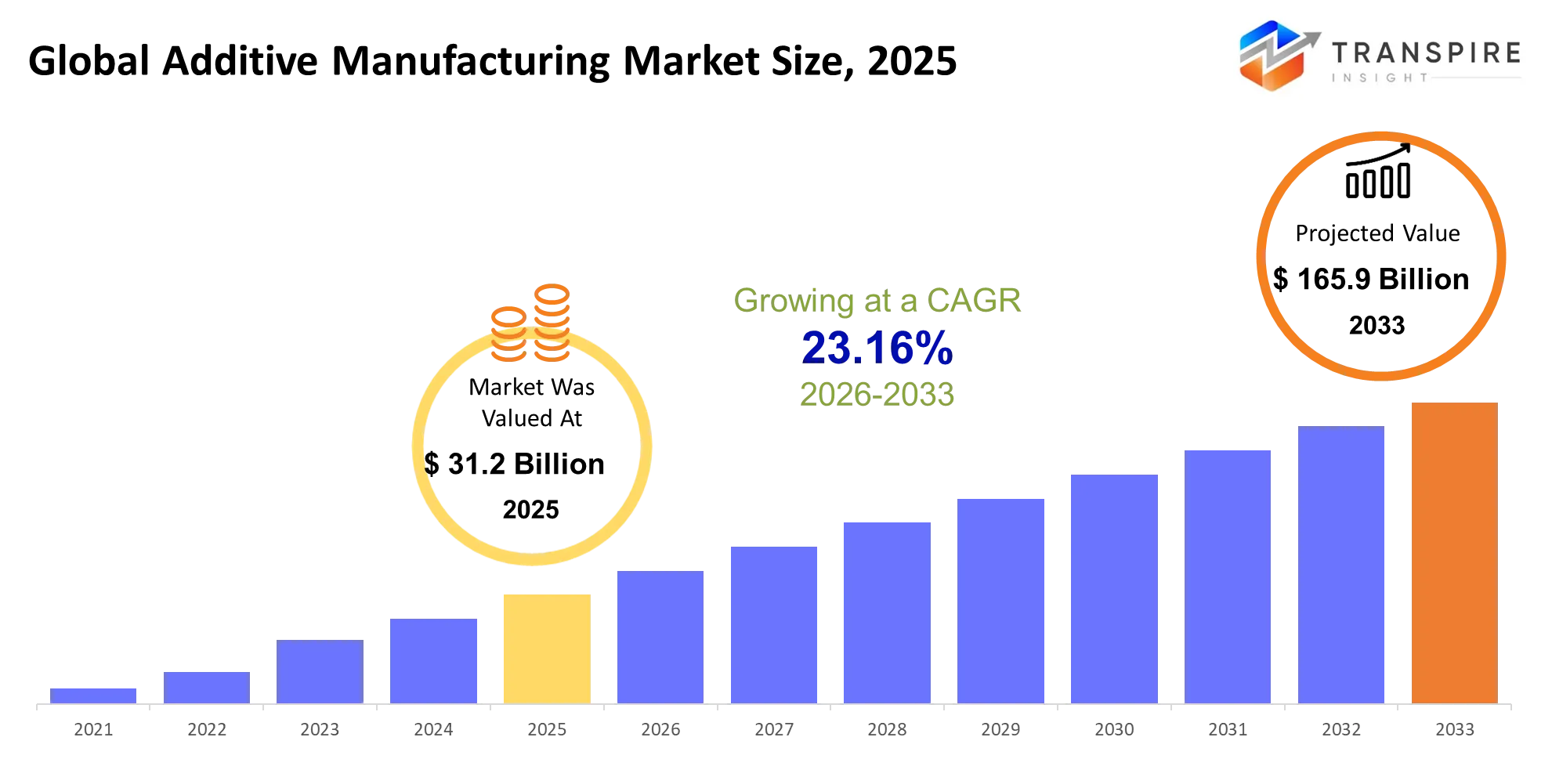
- Global Additive Manufacturing Market Size 2025: USD 31.2 Billion
- Global Additive Manufacturing Market Size 2033: USD 165.9 Billion
- Global Additive Manufacturing Market CAGR: 23.16%
- Global Additive Manufacturing Market Segments: By Type (3D Printing Systems, Metal Additive Manufacturing, Polymer Additive Manufacturing, Ceramic Additive Manufacturing, Hybrid Manufacturing, Others); By Application (Aerospace, Automotive, Healthcare, Consumer Products, Industrial Manufacturing, Others); By End-User (OEMs, Research Institutes, Industrial Manufacturers, Others); By Technology (FDM, SLA, SLS, DMLS, Binder Jetting, Others)
Global Additive Manufacturing Market Summary
As per Transpire Insight Analysis, the global additive manufacturing market size is valued at USD 31.2 Billion in 2025 and is anticipated to reach USD 165.9 Billion by 2033, growing at a CAGR of 23.16% from 2026 to 2033. This market centres on fabricating structural - three-dimensional components layer-by-layer directly from digital design blueprints, utilizing high-powered lasers, electron beams, and precision material extrusion to bind metals, polymers, and ceramics into complex geometries. Over the past three years, the industry experienced a sharp structural shift as industrial operations transitioned from using 3D printing for superficial prototyping to deploying it for high-volume end-use parts. A major real-world trigger for this expansion has been the severe vulnerability exposed in centralized global supply chains, combined with aggressive localized manufacturing initiatives. This direct operational pressure forces a critical cause-and-effect loop - by adopting advanced metal and polymer printing systems, heavy industries completely bypass rigid subtractive tooling and long-lead forge casting, allowing aerospace, automotive, and medical OEMs to manufacture flight-ready brackets, lightweight automotive parts, and customized patient implants locally to eliminate warehousing overheads.
Key Market Insights
The global additive manufacturing market is rapidly mutating from an isolated rapid-prototyping tool into an interconnected, multi-material factory production architecture designed to operate at maximum industrial throughput. Driven by aggressive tier-one supply chain localization and the massive deployment of high-powered laser powder beds, global industrial operators are fully transitioning toward software-managed print farms to eliminate traditional tool-and-die infrastructure costs.
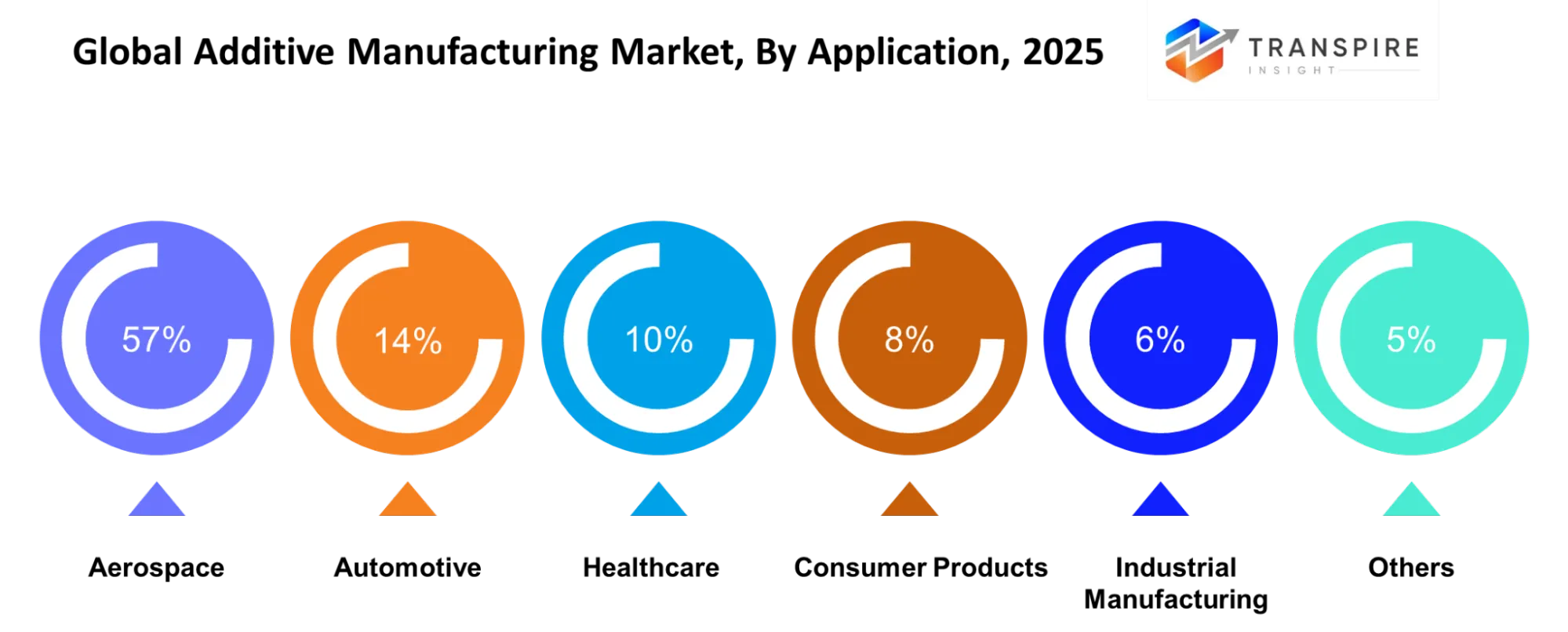
- Holding a dominant 57% market share, the aerospace segment is advancing flight-hardware fabrication by deploying Stratasys’ and GE Additive’s large-format printing platforms to consolidate complex engine components into singular, lightweight structures.
- Commanding a 39% market share, North America establishes global industry benchmarks as domestic defense and aviation entities incorporate 3D Systems' advanced material configurations into localized, ITAR-compliant digital manufacturing centers.
- Capturing a substantial 30% of global revenues, Europe anchors industrial machinery standards, leaning heavily on EOS GmbH’s multi-laser metal systems to automate tool-free casting replacements across heavy industrial manufacturing operations.
- Representing 23% of the international footprint, Asia-Pacific is expanding at a high velocity with an individual CAGR of 15.4%, driven by electronics and automotive conglomerates installing high-capacity automated production arrays from Nikon SLM Solutions.
- Securing a vital 14% market slice, the automotive sector is transitioning toward flexible serial production, utilizing specialized industrial binder jetting hardware from Desktop Metal and HP Inc. to accelerate the development of complex structural chassis parts.
- Accounting for 10% of total industry demand, the healthcare segment is expanding customized clinical care, leveraging Formlabs' and Materialise's biocompatible systems to print personalized anatomical guides and complex orthopedic implants.
- Representing 8% of total sector consumption, the consumer products application leverages rapid design cycles, utilizing agile manufacturing setups from Proto Labs to bring personalized electronics and custom footwear to market in record time.
- Sustaining a core 6% market presence, the industrial manufacturing segment is permanently replacing high-overhead warehouse inventories by deploying Renishaw's and Markforged's tool-steel printers directly onto active factory floors.
- Capturing the remaining 5% share, specialized edge applications are emerging across research institutes, where advanced platforms from Velo3D and Xometry are leveraged to test experimental multi-material geometries and radical topologies.
- Expanding at an overall market CAGR of 23.16%, the high-growth trajectory is anchored by metal additive manufacturing, which uses closed-loop melting monitoring to guarantee flawless microstructural density in high-stress applications.
What are the Key Drivers, Restraints, and Opportunities in the Global Additive Manufacturing Market?
Driver
The market is expanding exponentially due to a structural transition among industrial original equipment manufacturers (OEMs) away from centralized casting plants toward on-demand digital production. This pivot was triggered by intense global supply chain vulnerabilities and long forge-casting wait times, forcing companies to localize their parts production. The strategic shift drives massive hardware and software procurement revenues because tier-one industrial operations are rapidly adopting multi-laser powder bed systems to manufacture end-use components right on-site.
In March 2026, American propulsion leader GE Aerospace officially announced a further USD 1 billion investment across its U.S. manufacturing footprint and supplier infrastructure. A significant portion of this major capital deployment directly expands advanced 3D metal printing capabilities and infrastructure at its Cincinnati, Ohio headquarters to accelerate the high-volume fabrication of complex, flight-ready commercial and defense aircraft engine parts. [https://www.geaerospace.com/news/press-releases/ge-aerospace-invest-another-1b-us-manufacturing]
Restraint
Prohibitive up-front machinery costs and specialized post-processing labor requirements persistently restrict wide industrial adoption. Industrial metal 3D printers require massive capital outlays for setup, safety infrastructure, and raw powder materials, while post-printing steps such as hot isostatic pressing and support removal require rare, multi-disciplinary engineering expertise. This structural skill and capital bottleneck prevents medium-sized factories from replacing traditional tooling, keeping them dependent on subtractive casting systems.
Opportunity
The most lucrative commercial opportunity lies in deploying large-format spatial printing arrays optimized for continuous roll-to-roll or multi-axis assembly lines. Integrating real-time, AI-driven closed-loop melt pool monitoring software with high-temperature multi-toolhead extruders allows factory systems to instantly detect and fix microstructural flaws during the printing cycle. This technological capability unlocks high-margin revenue streams from defense, aerospace, and medical device networks requiring certified, defect-free parts without slow manual testing protocols.
What Has the Impact of Artificial Intelligence Been on the Additive Manufacturing Market?
Artificial intelligence is changing how industrial operations design, print, and check 3D parts. Instead of relying on endless trial-and-error runs, engineering teams use generative AI software to automatically determine the most efficient, lightweight shapes that can still handle heavy industrial loads.
Down on the active factory floor, smart machine vision models look at layer-by-layer camera feeds and temperature readings while the build is running. If the system detects an internal crack or a high-porosity spot forming, the automated software instantly adjusts the laser power or slows the printing head. This fast, real-time intervention keeps minor defects from ruining an entire multi-day print, which dramatically lowers scrap metal waste and speeds up part validation.
However, getting perfect accuracy out of these systems remains a big hurdle. AI quality tools require a massive amount of highly specific physics data to work right. Since every 3D printer model, gas environment, and powder batch acts a bit differently, an AI model trained on one machine cannot just be copied over to another without an expensive, time-consuming retraining process.
In June 2026, software-defined industrial automation leader Dyndrite Corporation was officially selected for the America Makes AIM-4AM program, a specialized development initiative aimed at advancing AI-driven material qualification. By building advanced deep-learning risk models and statistically informed allowable datasets, the platform streamlines the qualification burden for laser powder bed fusion (LPBF) 17-4PH stainless steel parts, enabling automated production lines to rapidly validate structural components without traditional destructive testing bottlenecks.
Key Market Trends
Instead of treating 3D printing as a niche tool for making cheap plastic models, factory supervisors are now installing multi-material print stations right next to standard assembly lines. This change cuts out the need to wait for expensive, single-use casting molds, replacing old-school cutting and drilling with multi-laser units that build finished parts from scratch.
- Teams are dropping brittle, low-grade plastics and picking up high-strength metal powders and rugged carbon fiber to print heavy-duty, field-ready hardware.
- Machine shops are replacing slow, single-laser printers with multi-laser powder beds that run several beams at once, majorly boosting daily part output.
- The broad push toward regional manufacturing means companies are building local digital inventory hubs, printing spare parts only when needed to escape massive warehouse storage fees.
- Drafting rooms are moving past blocky, solid designs to embrace generative AI software, which layouts complex, hollow lattice patterns that traditional drills could never carve out.
- To beat the old headache of lasers bouncing off shiny surfaces, machine operators are deploying blue and green lasers to cleanly melt and print tricky materials like pure copper.
- Post-processing departments are ditching dusty, manual hand-sanding for fully enclosed, robotic blasting and smoothing booths that save hours of manual labor.
- Inspectors are trading slow, destructive crush-testing for smart layer-by-layer camera feeds, scanning the metal pool in real time to fix microscopic flaws on the fly.
- Surgical suppliers are walking away from generic, catalog-ordered implants to run biocompatible printing lines, shaping custom bone plates from a patient's exact CT scan.
- The hassle of manually tweaking complex print settings by hand is over, replaced by smart slicing software that reads the CAD file and automatically creates the perfect toolpath.
Global Additive Manufacturing Market Segmentation
By Type
Metal Additive Manufacturing stands out as the ultimate financial powerhouse and dominant type, registering a highly specialized individual CAGR of 16.3%, while Polymer, Ceramic, Hybrid, and 3D Printing Systems hold the remaining industrial footprint. The unique growth logic here relies on a massive shift from low-stress cosmetic models to flight-ready, structural parts. While polymer printing remains a staple for rapid design adjustments and simple casings, heavy industries are pouring capital into metal systems because they allow engineers to fuse high-purity titanium, nickel, and aluminum alloys into highly intricate shapes that old-school drills simply cannot carve. Over the next few years - system manufacturers will stop selling isolated material platforms and start delivering hybrid systems that blend high-speed metal laser powder beds with multi-axis CNC milling tools in a single machine, creating a versatile, all-in-one manufacturing setup.
By Application
The Aerospace sector operates as the absolute heavyweight application pocket, commanding a massive 57% share of all global revenue - followed by Automotive at 14%, Healthcare at 10%, Consumer Products at 8%, Industrial Manufacturing at 6%, and Others at 5%. This heavy concentration remains rock-solid because commercial and military aviation brands face immense pressure to shave every single gram off aircraft weights to slash fuel burns and lower carbon emissions. The unique growth logic for this layout blends weight reduction with radical part consolidation, allowing engineers to turn complex assemblies made of dozens of individual welded fasteners into a single, light, printed component. Moving forward, the industry will split into two clear business lanes: supplying high-volume, automated binder jetting systems to the automotive and consumer fields for rapid part runs, while tailoring advanced, multi-laser metal systems for the ultra-strict safety standards of the aerospace and medical sectors.
By End-User
Original Equipment Manufacturers (OEMs) serve as the primary economic engine for machine procurement and long-term service contracts, closely followed by Industrial Manufacturers and specialized Research Institutes. The core growth logic driving this space is a structural transition away from traditional, rigid supply chains toward decentralized, digital part warehouses. Instead of keeping thousands of old, expensive physical spare parts sitting on dusty warehouse shelves for years, forward-thinking OEMs are moving to digital CAD blueprint files, printing components on demand right where they need them. In the coming years, market leaders will move past simply shipping raw hardware to clients. Sustainable commercial success will belong to companies that partner directly with large industrial OEMs to deliver complete digital ecosystems bundling the physical 3D printers together with real-time AI defect monitoring software, automated post-processing cells, and instant material traceability trackers.
By Technology
Laser-based systems like Direct Metal Laser Sintering (DMLS) and Stereolithography (SLA) serve as the main technical foundation for high-accuracy engineering, while Fused Deposition Modeling (FDM), Selective Laser Sintering (SLS), and Binder Jetting capture the high-volume production streams. The underlying growth logic focuses on balancing raw production speed against surface finish quality. FDM and SLS dominate the early design and durable plastic casing pipelines due to their lower operating costs, whereas DMLS and Binder Jetting are capturing heavy-duty industrial factory floors. Binder jetting, in particular, is expanding because it uses a liquid binding agent to glue powders together at speeds that leave traditional single-laser systems far behind. Looking ahead, technology providers will shift toward open-architecture slicing software and multi-toolhead configurations, allowing a single automated platform to run diverse material types simultaneously without triggering frequent cleanroom teardowns.
What are the Key Use Cases Driving the Additive Manufacturing Market?
Aerospace crews are using metal powder systems to print mission-critical jet engine parts, complex turbine blades, and fuel nozzles. By building these complex parts from scratch, engineers can merge dozens of tiny, separate pieces and fasteners into a single lightweight structure. This slashes the overall weight of the aircraft and drastically cuts down on fuel burn.
Outside of flight decks, automotive and consumer goods factories rely on fast binder jetting and laser sintering to run off custom manufacturing jigs, assembly tooling, and durable chassis brackets. Doing this helps production teams bypass the weeks of waiting typically required to machine hard steel molds, shrinking vehicle testing schedules from months to a few days.
Over in medical centers, surgeons use biocompatible resin systems to print custom orthopedic implants, skull plates, and exact dental guides. Because these medical devices are shaped directly from a patient’s unique CT scans, they fit perfectly on the first try, which cuts down on time spent under anesthesia and speeds up healing.
|
Report Metrics |
Details |
|
Market size value in 2025 |
USD 31.2 Billion |
|
Market size value in 2026 |
USD 38.6 Billion |
|
Revenue forecast in 2033 |
USD 165.9 Billion |
|
Growth rate |
CAGR of 23.16% from 2026 to 2033 |
|
Base year |
2025 |
|
Historical data |
2021 - 2024 |
|
Forecast period |
2026 - 2033 |
|
Report coverage |
Revenue forecast, competitive landscape, growth factors, and trends |
|
Regional scope |
United States; Canada; Mexico; United Kingdom; Germany; France; Italy; Spain; Denmark; Sweden; Norway; China; Japan; India; Australia; South Korea; Thailand; Brazil; Argentina; South Africa; Saudi Arabia; United Arab Emirates |
|
Key company profiled |
Stratasys, 3D Systems, EOS GmbH, Desktop Metal, HP Inc., GE Additive, Materialise, SLM Solutions, Renishaw, Markforged, Formlabs, Proto Labs, Velo3D, Xometry, Nikon SLM Solutions |
|
Customization scope |
Free report customization (country, regional & segment scope). Avail customized purchase options to meet your exact research needs. |
|
Report Segmentation |
By Type (3D Printing Systems, Metal Additive Manufacturing, Polymer Additive Manufacturing, Ceramic Additive Manufacturing, Hybrid Manufacturing, Others); By Application (Aerospace, Automotive, Healthcare, Consumer Products, Industrial Manufacturing, Others); By End-User (OEMs, Research Institutes, Industrial Manufacturers, Others); By Technology (FDM, SLA, SLS, DMLS, Binder Jetting, Others) |
Which Regions are Driving the Additive Manufacturing Market Growth?
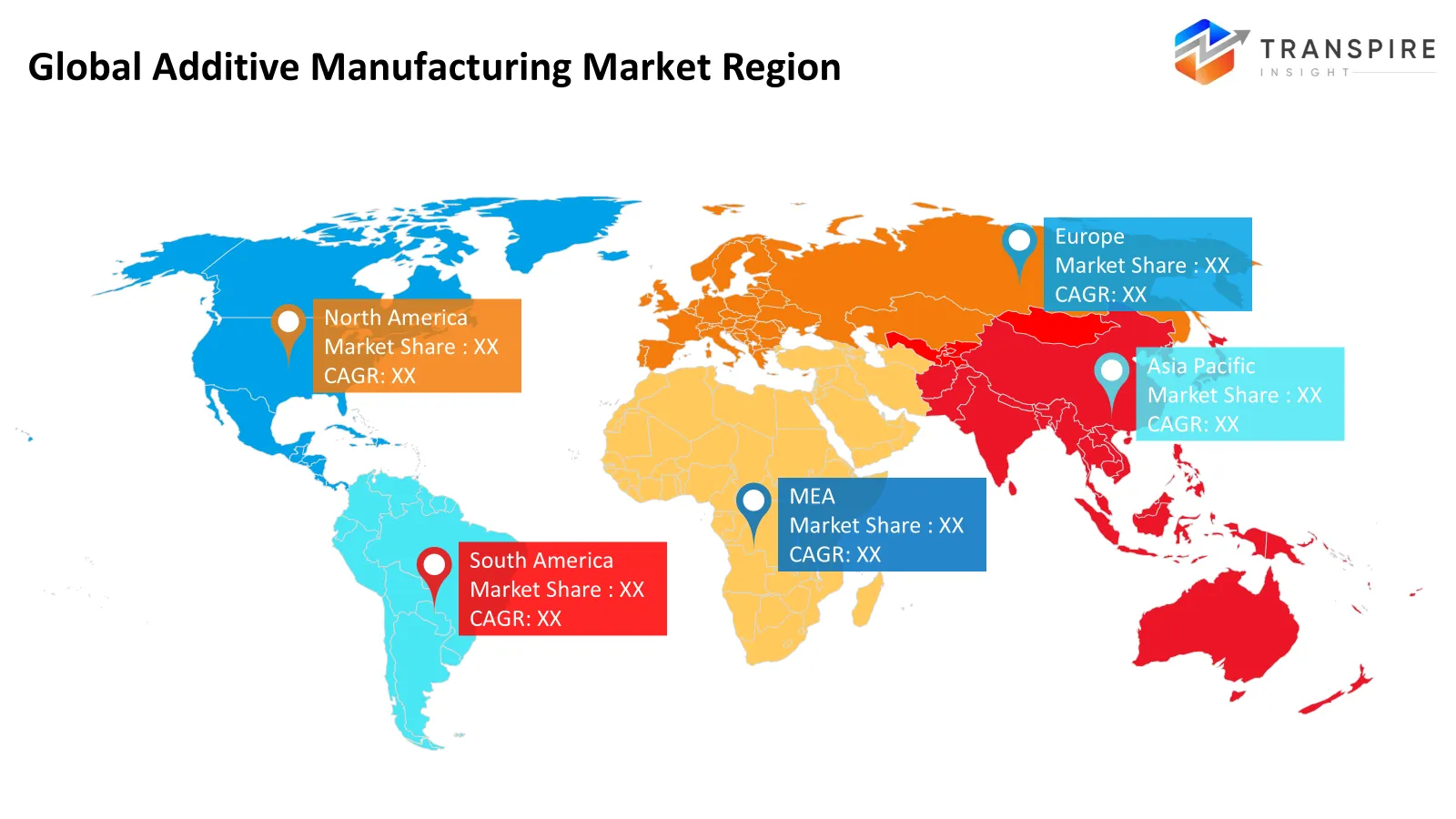
North America commands the largest slice of the additive manufacturing market, locking down an authoritative 39% of total global revenue. This leading position is heavily pushed by dense clusters of aerospace defense primes and commercial aviation giants who need high-performance parts. The regional ecosystem relies on strict ITAR-compliant digital networks and heavily backed government initiatives like America Makes to secure local supply chains. Consequently, North American companies are pouring massive capital into industrial print setups to bypass foreign part dependencies and speed up military hardware production.
Europe firmly establishes itself as a highly technical secondary pillar for the industry, securing a substantial 30% share of worldwide market revenue. While North America focuses heavily on aerospace defense networks and custom tooling, Europe’s market stability is anchored by its massive automotive bases and heavy machine tool sectors across Germany, Italy, and France. European manufacturing firms consistently buy up multi-laser metal powder bed units to run tool-free casting replacements right on their factory floor. This steady industrial adoption keeps regional production loops moving smoothly and cuts down on long-term factory floor maintenance overheads. In June 2026, German metal 3D printing pioneer Nikon SLM Solutions finalized a major North American partnership with industrial advisory firm NB Additive to expand serial production installations. The cross-regional alliance links Europe’s highly productive multi-laser printing hardware with advanced factory workflow integration, helping large manufacturers smoothly transition their heavy industrial machinery lines from single prototyping runs into repeatable, automated factory operations.
The Asia-Pacific corridor has quickly emerged as the fastest-growing market globally, expanding at an individual regional CAGR of 15.4% while holding 23% of the international revenue split. This explosive surge is fueled by rapid industrialization, massive automotive plants, and the broad modernization of massive electronics assembly hubs across India, China, and Japan. While Western regions focus on low-volume aerospace brackets, Asia-Pacific factories are adopting high-volume printing to run continuous, serial component batches. Looking ahead, future procurement in this booming territory will focus on setting up large, automated print farms to satisfy the soaring demand for custom electronics casings and high-performance electric vehicle parts. In March 2026, Japan’s Nikon Corporation deployed significant capital from its specialized NFocus Fund into a strategic partnership with aerospace pioneer Vast to scale advanced manufacturing setups. This cross-border investment accelerates the deployment of high-productivity laser powder bed systems, allowing regional tech suppliers to utilize next-generation metal 3D printing for rapid, high-precision component builds across booming global space and industrial hardware lines.
Who are the Key Players in the Additive Manufacturing Market and How Do They Compete?
The global additive manufacturing market plays out as a fast-moving, tech-driven battlefield where brands constantly fight over printing speeds, open material libraries, and software setups. Because modern factories want hands-free automation, the goal is shifting away from just selling standalone machines toward delivering complete, closed-loop printing setups that slot right into busy assembly lines. To keep ahead, the biggest names are constantly revamping their slicing software and scooping up smaller competitors to lock down regional footprints close to critical aviation and defense hubs.
Stratasys protects its market share by focusing entirely on polymer innovation, leaning heavily on high-margin, branded print materials and cloud-connected platforms like GrabCAD Print. The team maintains its industry edge by guarding a massive stack of over 1,700 patents covering its core Fused Deposition Modeling (FDM) and PolyJet technologies. When it comes to growing their footprint, they favor direct consolidation like their recent mid-2026 deal to buy Markforged to instantly add high-strength carbon fiber and accessible metal printing to their main product catalog.
Meanwhile, 3D Systems takes a completely application-first angle, shaping its industrial machinery directly around high-value, highly certified fields like aerospace and dental healthcare. They stand out by supplying an entire medical-grade pipeline, matching biocompatible plastics and titanium powders with smart, AI-driven surgical cutting guides. Instead of chasing raw sales volume, they grow by clearing incredibly strict industrial certifications. This allows them to install automated print clusters straight into hospitals and military labs long before general rivals can clear the legal hurdles.
Global Additive Manufacturing Market Companies
- Stratasys
- 3D Systems
- EOS GmbH
- Desktop Metal
- HP Inc.
- GE Additive
- Materialise
- SLM Solutions
- Renishaw
- Markforged
- Formlabs
- Proto Labs
- Velo3D
- Xometry
- Nikon SLM Solutions
Recent Development News
In April 2026 - tech giant HP officially launched its new Multi Jet Fusion 1200 3D Printer Solution at the RAPID+TCT industrial expo. This compact system brings industrial-grade polymer printing into smaller workspaces at a lower price point, allowing engineering teams to run off functional end-use parts right at their office desks without altering current factory floor workflows. [https://www.hp.com]
In March 2026 - healthcare printing leader 3D Systems successfully achieved full-scope European Union Medical Device Regulation (EU MDR) certification for its dental production lines. This regulatory milestone clears the way for the company to kick off a major European rollout of its NextDent Jetted Denture Solution, giving dental labs a faster, automated way to print durable, multi-material prosthetics that match a patient's exact anatomy. [https://www.3dsystems.com]
In May 2026 - specialized printing contractor i3D Manufacturing completed the strategic acquisition of Burloak Technologies from its parent company Samuel, Son & Co. This capital transaction immediately merges Burloak's technical leadership into i3D’s advanced manufacturing group, boosting their fleet capacity to supply heavy-duty, highly engineered metal parts for mission-critical space, defense, and energy programs. [https://www.metal-am.com]
What Strategic Insights Define the Future of the Additive Manufacturing Market?
The additive manufacturing market is steering toward a completely automated, "born-qualified" production ecosystem where 3D printers operate as smart nodes within fully connected digital factories.
A hidden risk threatening this expansion is the looming digital security gap. Moving proprietary CAD files across decentralized networks exposes corporate intellectual property to advanced cyber theft and unapproved cloning, creating severe legal liabilities if a tampered design file causes a mission-critical aerospace or medical part to fail in the field.
Conversely, an exceptional opportunity lies in the commercialization of multi-material volumetric printing. This emerging technology solidifies entire complex shapes all at once using intersecting light fields, slashing print times from hours to seconds.
To win long-term market share, providers must shift away from merely selling raw hardware. Strategists should instead build end-to-end ecosystems that bundle physical printers with blockchain-secured file encryption and automated, robotic post-processing setups.
Global Additive Manufacturing Market Segmentation
By Type
- 3D Printing Systems
- Metal Additive Manufacturing
- Polymer Additive Manufacturing
- Ceramic Additive Manufacturing
- Hybrid Manufacturing
- Others
By Application
- Aerospace
- Automotive
- Healthcare
- Consumer Products
- Industrial Manufacturing
- Others
By End-User
- OEMs
- Research Institutes
- Industrial Manufacturers
- Others
By Technology
- FDM
- SLA
- SLS
- DMLS
- Binder Jetting
- Others
Regional Outlook
North America
- United States
- Canada
- Mexico
Europe
- Germany
- United Kingdom
- France
- Spain
- Italy
- Rest of Europe
Asia Pacific
- Japan
- China
- Australia & New Zealand
- South Korea
- India
- Rest of Asia Pacific
South America
- Brazil
- Argentina
- Rest of South America
Middle East & Africa
- Saudi Arabia
- United Arab Emirates
- South Africa
- Rest of the Middle East & Africa
Frequently Asked Questions
Find quick answers to common questions.
The global additive manufacturing market size was valued at USD 31.2 Billion in 2025 and is poised to reach USD 165.9 Billion by 2033, expanding at a 23.16% CAGR.
Key segments for the global additive manufacturing market are Type (3D Printing Systems, Metal Additive Manufacturing, Polymer Additive Manufacturing, Ceramic Additive Manufacturing, Hybrid Manufacturing, Others), Application (Aerospace, Automotive, Healthcare, Consumer Products, Industrial Manufacturing, Others), End-User (OEMs, Research Institutes, Industrial Manufacturers, Others), and Technology (FDM, SLA, SLS, DMLS, Binder Jetting, Others).
Growth is primarily driven by a structural transition among industrial original equipment manufacturers (OEMs) away from centralized casting plants toward on-demand digital production. This pivot is accelerated by severe supply chain vulnerabilities and long forge-casting wait times, pushing companies to localize their parts production directly on-site using automated, high-output multi-laser powder bed platforms.
The global market is led by major manufacturers including Stratasys, 3D Systems, EOS GmbH, Desktop Metal, HP Inc., GE Additive, Materialise, SLM Solutions, Renishaw, Markforged, Formlabs, Proto Labs, Velo3D, Xometry, and Nikon SLM Solutions.
North America holds a dominant 39% share of the worldwide market, establishing itself as the largest regional footprint. This massive influence is sustained by dense clusters of aerospace defense primes and commercial aviation giants, alongside heavily backed government infrastructure initiatives like America Makes, which collectively drive large-scale capital investments into ITAR-compliant digital print farms.
The most lucrative opportunities lie in deploying large-format spatial printing arrays optimized for continuous roll-to-roll or multi-axis assembly lines. Integrating these systems with real-time, AI-driven closed-loop melt pool monitoring software allows automated platforms to detect and fix microstructural flaws during the print cycle, unlocking high-margin revenue streams from fields requiring certified, defect-free hardware.
- Stratasys
- 3D Systems
- EOS GmbH
- Desktop Metal
- HP Inc.
- GE Additive
- Materialise
- SLM Solutions
- Renishaw
- Markforged
- Formlabs
- Proto Labs
- Velo3D
- Xometry
- Nikon SLM Solutions
About the Authors

Pankaj Ghogare Patil
I am Pankaj Ghogare Patil, a Senior Research Analyst at Transpire Insight, specializing in the Pharmaceutical, Chemicals & Materials, Healthcare IT, and Biotechnology industry. My expertise lies in conducting comprehensive market research, analyzing industry trends, evaluating competitive landscapes, and translating complex data into actionable insights. At Transpire Insight, I closely follow emerging technologies, regulatory developments, and market innovations to create accurate, well-researched, and informative content that helps businesses and professionals make informed decisions. I am committed to producing credible, evidence-based articles that reflect industry best practices while making technical topics accessible and valuable for a broad audience.

Chakradhar Khansole
Chakradhar serves as the Research Director at Transpire Insight, bringing over 8 years of experience in technology, innovation, and strategic market intelligence. He specializes in transforming complex market data into actionable business insights that enable organizations to make informed, growth-oriented decisions. Recognized for his strategic vision and analytical expertise, Chakradhar leads high-impact research initiatives, delivering comprehensive market assessments, competitive intelligence, and forward-looking industry analysis.
Recently Published Reports
-
May 2026
Healthcare Polymer Packaging Market
Healthcare Polymer Packaging Market Size, Share & Analysis Report By Packaging Type (Syringes, IV Bottles and Pouches, Clamshells, Blisters, Bottles & Jars, Containers, Tubes, IV Parental Packaging, Others), By Type (Regulated, Non-regulated), By Polymer Type (LDPE (Low-Density Polyethylene), HDPE (High-Density Polyethylene), Homo-polymer (Homo), Random Copolymer (Random), Block Copolymer (Block), PET, Polystyrene, Polyvinyl Chloride, Polyamide/EVOH, Others), and Geography (North America, Europe, Asia-Pacific, Middle East and Africa, South and Central America), 2021 - 2031
-
Apr 2026
Hydrophilic Tape (Waterstop) Market
Hydrophilic Tape (Waterstop) Market Size, Share & Analysis Report By Type (Bentonite-Based Hydrophilic Tape, Rubber-Based Hydrophilic Tape), By Application (Residential Buildings, Commercial Buildings, Infrastructure Projects), and Geography (North America, Europe, Asia-Pacific, Middle East and Africa, South and Central America), 2021 - 2031
-
Apr 2026
Metalens Market
Metalens Market Size, Share & Analysis Report By Type (Visible Light Metalens, and Infrared Metalens), By Application (Consumer Electronics, Automotive Electronics, Industrial, Medical, and Others), and Geography (North America, Europe, Asia-Pacific, Middle East and Africa, South and Central America), 2021 - 2031
-
Apr 2026
PBT Resin Market
PBT Resin Market Size, Share & Analysis Report By Type (Reinforced PBT Resin, Unreinforced PBT Resin), By Processing Method (Injection Molding, Extrusion, Blow Molding, Others), By End-User (Automotive, Electrical & Electronics, Consumer Appliances, Industrial Machinery, Medical Devices, Packaging, Others), and Geography (North America, Europe, Asia-Pacific, Middle East and Africa, South and Central America), 2021 - 2031