
Europe Ceramic 3D Printing Market Size & Forecast:
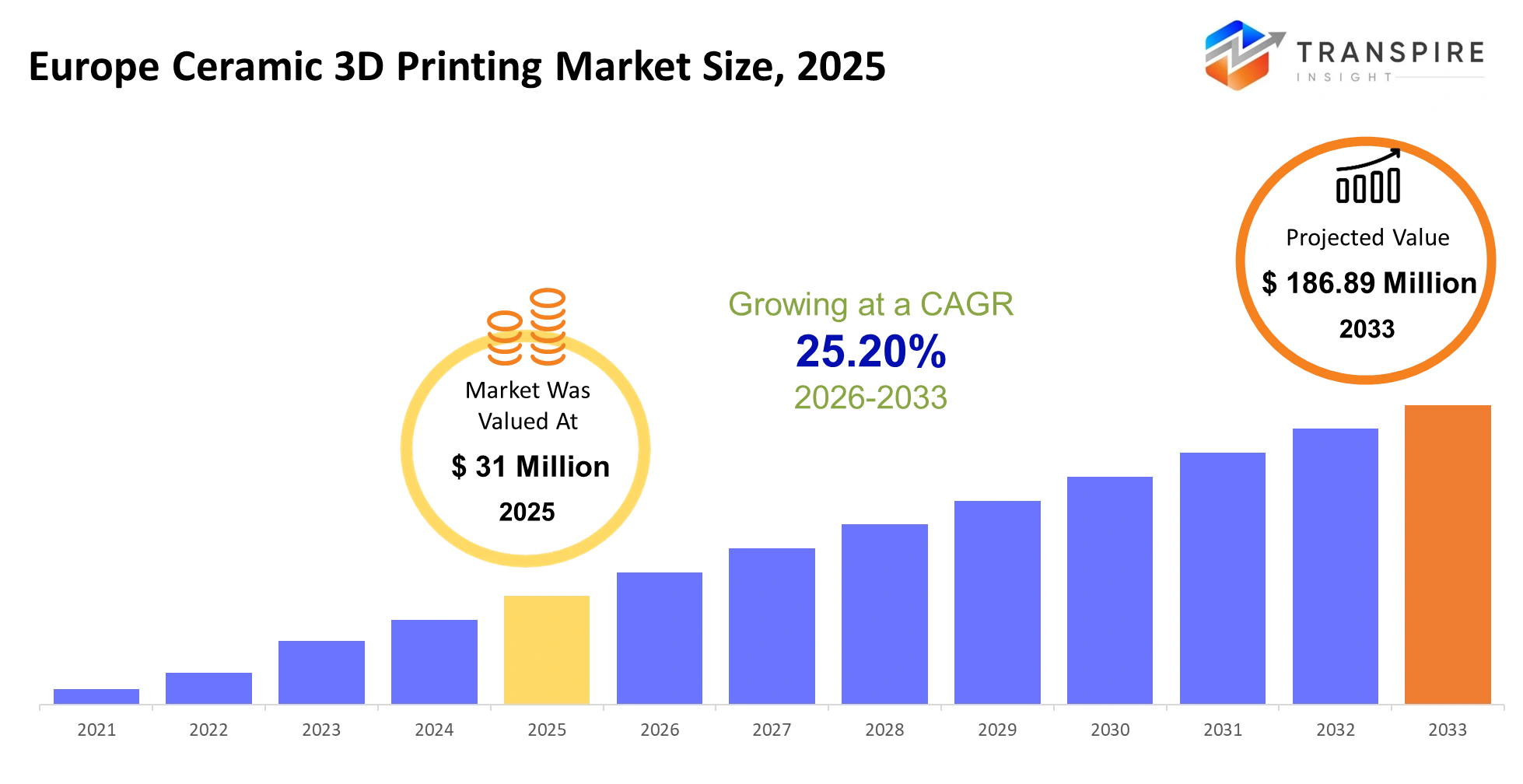
- Europe Ceramic 3D Printing Market Size 2025: USD 31 Million
- Europe Ceramic 3D Printing Market Size 2033: USD 186.89 Million
- Europe Ceramic 3D Printing Market CAGR: 25.20%
- Europe Ceramic 3D Printing Market Segments: By Type (Stereolithography, Binder Jetting, Material Extrusion, Others), By Application (Aerospace, Healthcare, Automotive, Electronics, Others), By End-User (Manufacturers, Research Institutes, Others), By Material (Oxides, Non-oxides, Others).
To learn more about this report,  Download Free Sample Report
Europe Ceramic 3D Printing Market Summary:
The Europe Ceramic 3D Printing Market size is estimated at USD 31 Million in 2025 and is anticipated to reach USD 186.89 Million by 2033, growing at a CAGR of 25.20% from 2026 to 2033. Europe uses ceramic 3D printing to create components which maintain performance in aerospace and energy and chemical processing applications, because traditional manufacturing methods cannot achieve such results. Engineers use the technology to design complex internal channel systems and lightweight lattice structures, which result in performance improvements and decreased material waste and shorter production times.
The market has changed from using prototypes to producing final products between 3 and 5 years because material reliability and process consistency have become more dependable. The supply chain problems which occurred during COVID-19 showed that Europe needed to rely on outside sources for vital parts. Additive manufacturing process changes required companies to move their manufacturing operations closer to their facilities.
Companies have begun to use ceramic 3D printing technology as a standard part of their main production operations. The business move creates new income streams because it produces high-value products which businesses need to protect through customized designs and strong materials which enable them to finish projects quickly.
Key Market Insights
- The German 3D Printing Market for ceramic products in Europe will reach more than 30% market share by 2025 because of its robust engineering capabilities and advanced manufacturing systems.
- The aerospace and defense sectors enable France and the UK to maintain their substantial market shares which together account for more than 35% of total regional revenues.
- The industrial digitization movement and cost-effective production centers make Eastern Europe the fastest expanding area until 2030.
- The hardware segment controls almost 50% of the market share in 2025 because industrial-grade ceramic 3D printers create high demand.
- The materials segment maintains the second-largest market share because advanced ceramics innovations such as alumina and zirconia develop new material capabilities.
- The services segment experiences the most rapid growth which will continue until 2030 because companies increasingly outsource work and require on-demand manufacturing solutions.
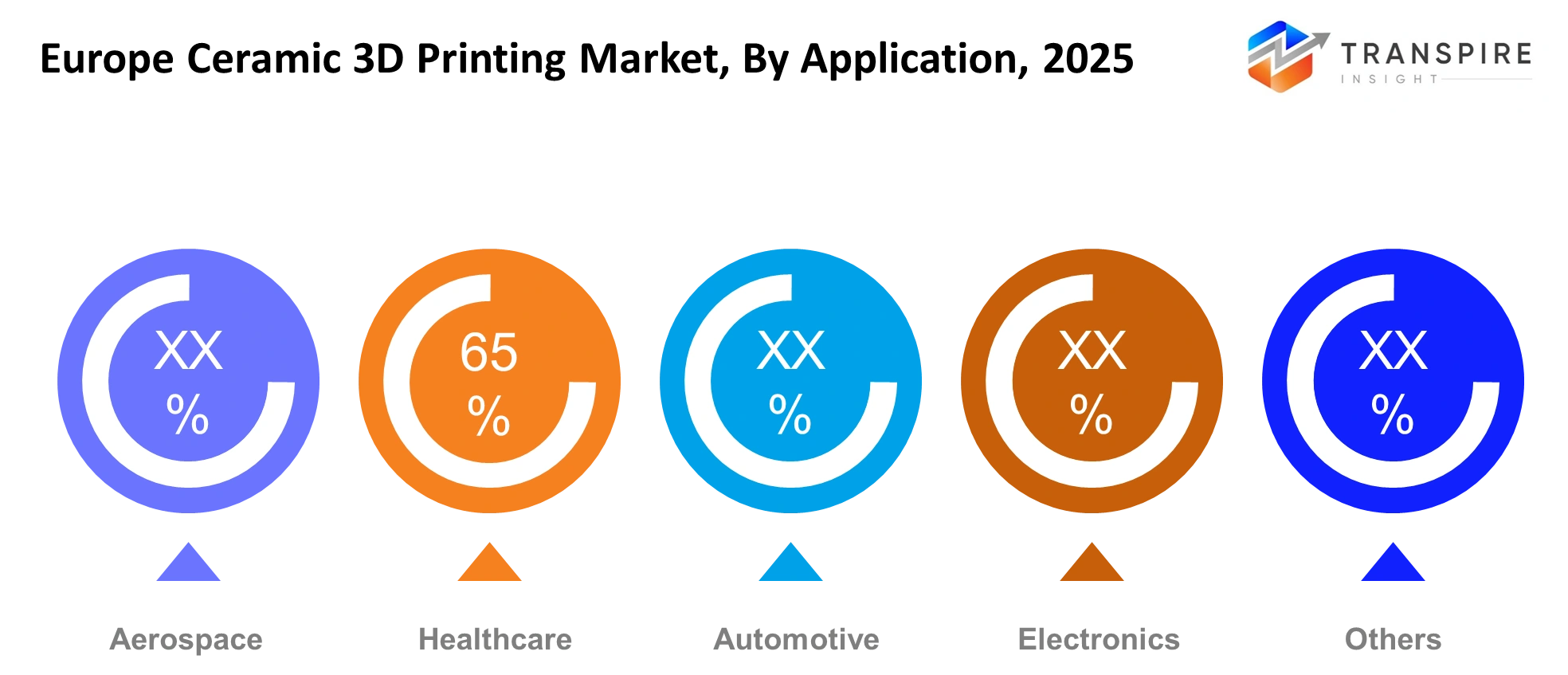
- Aerospace applications use more than 40% of total market share because they require ceramic materials to create lightweight structures that withstand high temperatures.
- The healthcare sector has emerged as the fastest growing sector because it requires biocompatible dental and orthopedic implants until 2030.
- Aerospace and defense lead the Europe Ceramic 3D Printing Market with approximately 35% share in 2025 because of their requirements for high-performance components.
- The medical device manufacturing industry represents the fastest expanding user segment because healthcare providers need precise customized products.
What are the Key Drivers, Restraints, and Opportunities in the Europe Ceramic 3D Printing Market?
The Europe Ceramic 3D Printing Market experiences rapid growth because manufacturers now prefer to establish nearby facilities that produce advanced products with high quality after their supply chain networks suffered disruptions during the COVID-19 pandemic. European aerospace and energy firms faced delays in sourcing heat-resistant ceramic components, which exposed the risks of offshore dependency. The manufacturing industry turned to ceramic 3D printing technology because it allowed them to create complex components through their own facilities which reduced their production wait times. The shift in production methods resulted in companies increasing their financial spending on industrial-grade printers while their service income expanded because businesses needed to maintain production and develop new designs.
The most significant barrier exists because businesses need to spend too much money while they require specialized equipment for ceramic materials and printing systems. The field of ceramics requires precise thermal processing methods which need specialized equipment and experienced staff for post-processing work to be completed. Companies face a structural constraint that prevents them from developing production capacity because they need to spend large amounts of money while hiring trained employees who need more time to acquire experience. The process of adoption gets delayed by small and mid-sized manufacturers which creates obstacles that prevent the market from reaching its complete potential and hinders revenue growth in sectors that generate high-value products.
The increasing demand for ceramic 3D printing in medical fields creates a significant business opportunity which includes dental and orthopedic implant procedures. Biocompatible ceramics and advanced precision printing technology enable the creation of personalized implants which doctors can use to match their patients unique anatomical structures. Digital healthcare manufacturing has become a key area of investment for both Germany and Switzerland which creates an environment that supports technology adoption. The combination of material science and healthcare requirements will create new revenue opportunities which will help the market grow beyond its existing industrial customer base.
What Has the Impact of Artificial Intelligence Been on the Europe Ceramic 3D Printing Market?
The implementation of artificial intelligence together with digital advanced technologies has started to transform ceramic additive manufacturing operations through its capacity to enhance process management and system dependability and production efficiency. AI control systems which operate in production settings track multiple factors including temperature changes and layer thickness measurements and sintering process parameters in continuous operation. The printing process needs automatic system adjustments because ceramic materials face two main defects which include warping and microcracking during their production process. The system achieves its automation goal by decreasing the need for operator involvement while delivering uniform results throughout different production periods.
The industry uses machine learning models to perform predictive maintenance work on 3D printing machinery. The models use printer and kiln sensor data to predict when components will wear out or break down so manufacturers can conduct maintenance before their equipment stops working. The organization achieved tangible benefits which included decreased equipment downtime and enhanced equipment efficiency especially within both the aerospace sector and the healthcare sector.
Digital simulation tools function as operational instruments to enhance performance through their ability to forecast the thermal and mechanical performance of ceramic components before the actual production process starts. The process helps to decrease material usage while product design approval times are shortened.
The primary obstacle which prevents organizations from using artificial intelligence technology in their manufacturing operations stems from the expensive nature and difficult process of combining AI systems with current production systems. The process of building predictive models faces challenges because there is insufficient historical data about ceramic production methods which leads to decreased model accuracy and makes it difficult to implement predictive models in practice.
Key Market Trends
- Aerospace manufacturers stopped using outsourcing for ceramic parts production in 2020 because they switched to 3D printing technology which now lets them create products in-house with 40 percent shorter lead times.
- The period from 2021 to 2025 saw a major increase in stereolithography-based ceramic printing adoption because its technology developed better precise printing capabilities for creating complex high-temperature components.
- European manufacturers began to evaluate local 3D printing operations for essential ceramic component production because supply chain disruptions occurred after the pandemic ended.
- Lithoz and XJet established new European alliances after 2022 because they wanted to enhance industrial adoption throughout the aerospace and medical industries.
- The development of new materials shifted toward zirconia and alumina material combinations after 2021 which produced better lasting strength to withstand demanding industrial operating conditions.
- Healthcare institutions started using ceramic 3D printing to create dental implants which shortened production time from weeks to a few days.
- European regulators established stronger environmental sustainability targets after 2022 which motivated manufacturers to implement additive manufacturing techniques that produce less material waste and decrease energy-consuming machining work.
- The period from 2022 to 2025 saw service-based business models grow because small manufacturers chose to outsource their ceramic printing needs instead of spending money on costly printing equipment.
- The period after 2021 saw manufacturers accelerate digital integration because they started using AI-powered monitoring systems which helped them decrease product defects and enhance ceramic production process control.
Europe Ceramic 3D Printing Market Segmentation
By Type
Stereolithography remains the leading 3D printing method because it achieves better resolution and creates dense ceramic parts which meet aerospace and medical requirements. Binder jetting serves as a strong second option because it enables faster construction of big components although users need to complete extensive finishing work. Material extrusion currently limits its application to basic shapes because it cannot produce accurate results with satisfactory surface quality.
The development of stereolithography technology has progressed because researchers created better photopolymer resins and improved sintering control systems which decreased defect occurrence. Binder jetting is becoming more popular because it offers businesses an economical solution for producing multiple items at once, even without achieving precise results. The upcoming development focuses on hybrid systems together with process optimization, which will lead to wider industrial acceptance and help manufacturers choose technology according to their specific performance needs and spending limitations.
By Application
The aerospace sector leads all other applications because it requires components that must maintain lightweight properties while providing heat resistance and durability under extreme operating conditions. The healthcare sector is developing into the fastest growing market because of the increasing need for custom dental and orthopedic implants which use biocompatible ceramics.
The automotive and electronics industries continue to adopt new technologies through their use of prototyping and specialized components which include sensors and insulating parts. Aerospace demand has been shaped by strict performance requirements and supply chain resilience strategies while healthcare growth stems from customization and shorter production cycles. The electronics industry gains advantages from miniaturization trends, yet its development remains restricted because of budget constraints. Future growth will create more diverse paths as industries establish reliable performance proof, which will drive system adoption in sectors beyond their current focus on valuable markets.
To learn more about this report, Download Free Sample Report
By End-User
Manufacturers control the market as the main users who implement ceramic 3D printing technology into their production processes. Research institutes represent a significant segment, driving material innovation and process development, particularly in collaboration with industrial partners. The user base now includes specialized service providers, as companies without in-house capabilities start using outsourcing as a viable solution.
Manufacturers have led adoption because they can control both production quality and intellectual property rights, while research institutes shape the development of upcoming innovations. Service providers become more important because equipment costs and expert workforce expenses remain high. The future will create a distributed ecosystem, which will enable industrial and research institutions to work together for faster product development and reduced entry obstacles for newcomers.
By Material
High-temperature and biomedical applications use alumina-based oxide ceramics and zirconia-based oxide ceramics as their main materials because these ceramics deliver dependable performance and they exist in large quantities. The market share of non-oxide ceramics which include silicon carbide and silicon nitride has increased because these materials offer better mechanical strength and thermal resistance when applied in severe working conditions. The other materials used in this field exist as niche products that only find use in research and special applications.
The oxides maintain their leading position because existing processing methods and current printing technologies support their production. The widespread industrial use of non-oxides remains limited because their manufacturing methods require complex processing and their production costs are extremely high. The upcoming market developments will lead to increased funding for advanced non-oxide materials which will create opportunities for high-performance applications and change competitive conditions in specialized industrial sectors.
What are the Key Use Cases Driving the Europe Ceramic 3D Printing Market?
Aerospace manufacturing utilizes ceramic 3D printing technology for turbine parts and thermal protection systems and lightweight materials which withstand extreme heat and pressure. These components enable aircraft engine manufacturers to reduce fuel consumption and weight which leads to decreased operational costs and environmental pollution. The certification process prefers additive ceramics because they create exact and consistent shapes which traditional machining methods cannot produce.
The healthcare and electronics sectors explore new applications for existing technologies through their current technological systems. Dental labs and medical device firms use ceramic printing for crowns, bridges, and orthopedic implants tailored to patient anatomy. The electronics industry depends on ceramic materials for their insulating substrates and sensor housings because these materials provide the necessary thermal stability and electrical resistance to ensure product functionality.
The energy and chemical processing industries begin to explore new applications of ceramic 3D printing technology which enables the production of custom components used in high-temperature reactors and systems designed to resist corrosion. The hydrogen production industry and advanced battery systems show early adoption which indicates potential future expansion in these fields.
|
Report Metrics |
Details |
|
Market size value in 2025 |
USD 31 Million |
|
Market size value in 2026 |
USD 38.75 Million |
|
Revenue forecast in 2033 |
USD 186.89 Million |
|
Growth rate |
CAGR of 25.20% from 2026 to 2033 |
|
Base year |
2025 |
|
Historical data |
2021 - 2024 |
|
Forecast period |
2026 - 2033 |
|
Report coverage |
Revenue forecast, competitive landscape, growth factors, and trends |
|
Regional scope |
Europe (Germany, United Kingdom, France, Italy, Spain and Rest of Europe) |
|
Key company profiled |
3D Systems, Stratasys, ExOne, Lithoz, Prodways, XJet, voxeljet, Formlabs, Renishaw, HP, EOS, GE Additive, Desktop Metal, CeramTec, Tethon 3D. |
|
Customization scope |
Free report customization (country, regional & segment scope). Avail customized purchase options to meet your exact research needs. |
|
Report Segmentation |
By Type (Stereolithography, Binder Jetting, Material Extrusion, Others), By Application (Aerospace, Healthcare, Automotive, Electronics, Others), By End-User (Manufacturers, Research Institutes, Others), By Material (Oxides, Non-oxides, Others). |
Which Regions are Driving the Europe Ceramic 3D Printing Market Growth?
The market exists under the dominance of Western Europe because Germany France and the United Kingdom show technological progress through their industrial policies and advanced manufacturing systems. Public funding programs and EU-backed innovation frameworks support research institutes and private firms working on ceramic additive technologies. High-performance ceramic components find steady demand through aerospace clusters in Germany and France which established supplier networks provide material and equipment access. The integrated ecosystem enables organizations to shift their research activities into production processes which helps the region maintain its leading position.
Southern Europe functions as a dependable market segment which Italy and Spain dominate through their expertise in specialized manufacturing and design-based production fields. The region achieves greater benefits through its various applications which include automotive and healthcare and industrial equipment compared to Western Europe’s heavy dependence on aerospace. The manufacturing sector receives constant funding from mid-sized manufacturers and family-owned businesses which results in steady market growth throughout the year. The region establishes itself as a dependable source of minor market expansions through its ongoing engagement with EU innovation programs which deliver economic support.
Eastern Europe has become the most rapidly developing area because industrial modernization efforts and cost-efficient manufacturing methods drive its growth. Western European supply chains now attract Polish and Czech Republic companies because they have boosted their investments in digital production technologies since 2022. The combination of decreased operational expenses and enhanced technical skills has opened doors for businesses to start using ceramic 3D printing technology. The region has become a profitable investment destination because it offers investors scalable production facilities which will expand between 2026 and 2033.
Who are the Key Players in the Europe Ceramic 3D Printing Market and How Do They Compete?
The industrial competition between specialized ceramic printing companies and additive manufacturing businesses with broader markets remains moderately divided into multiple factions. Buyers base their purchasing decisions on technology capabilities and material performance features which provide accurate results and consistent outcomes and dependable products for their needs. Established companies maintain their market position through exclusive printing technologies and verified material systems while new companies develop special markets through their adaptable service offerings. The market provides advantages to businesses which successfully transition from their initial design phase to producing validated products in large quantities.
Through its lithography-based ceramic manufacturing process Lithoz develops high-accuracy components which serve as the basis for its technological innovation. The capability establishes Lithoz as the main partner for aerospace and medical clients who need to meet their stringent performance requirements. XJet uses its nanoparticle jetting technology to create smoother surface results while enabling the production of intricate 3D models which require less post-processing work. The two companies establish partnerships with European industrial firms to develop production systems that will enable their systems to operate in real-world manufacturing settings.
The 3D Systems company uses its extensive collection of hardware and materials and software products to create solutions which various industries can use in complete operational processes. Materialise develops manufacturing solutions which enable customers to produce goods through its software-based optimization process without needing to invest in expensive equipment. Through its partnerships and material research Stratasys develops its ecosystem while preparing to meet upcoming market requirements for ceramic products used in industrial settings.
Company List
- 3D Systems
- Stratasys
- ExOne
- Lithoz
- Prodways
- XJet
- Voxeljet
- Formlabs
- Renishaw
- HP
- EOS
- GE Additive
- Desktop Metal
- CeramTec
- Tethon 3D
Recent Development News
In April 2026, 3D Systems Secures EU MDR Certification for NextDent Jetted Denture Platform: 3D Systems received Class IIa EU MDR certification for its NextDent Jetted Denture Solution, enabling a full commercial rollout across European markets ahead of schedule. The certification strengthens the company’s dental additive manufacturing footprint in Europe and expands access to digital denture production technologies across EU healthcare providers.
Source: https://www.nasdaq.com
In April 2026, KIT Unveils Multi-Material Ceramic 3D Printing System for Industrial Use: Researchers at Karlsruhe Institute of Technology introduced a new multi-material ceramic additive manufacturing platform under the CeraMMAM project in April 2026. The development enables high-performance ceramic components to be manufactured in a single printing process, targeting aerospace, medical, and industrial engineering applications in Europe.
Source: https://www.kit.edu
What Strategic Insights Define the Future of the Europe Ceramic 3D Printing Market?
The European Ceramic 3D Printing Market is heading toward integrated production-grade manufacturing because companies need to control their supply chains while creating advanced components. The market will experience growth over the next five to seven years because industrial certification requirements become more important than prototyping needs for aviation and medical industries. The new trend benefits businesses that can deliver complete systems integrating material science and process stability with digital workflow management.
The concentrated supply risk of advanced ceramic powders, including high-purity zirconia, presents a danger that remains hidden from view. The combination of restricted suppliers and essential quality standards will create production delays which will result in higher expenses and reduced expansion in industries that prioritize cost efficiency. Energy transition technologies, which include hydrogen systems and solid oxide fuel cells, create new business opportunities because ceramic components serve as fundamental elements for these systems.
Market participants should develop vertically integrated capabilities which include material development and post-processing to ensure supply reliability while creating distinct advantages in high-value applications.
Europe Ceramic 3D Printing Market Report Segmentation
By Type
- Stereolithography
- Binder Jetting
- Material Extrusion
- Others
By Application
- Aerospace
- Healthcare
- Automotive
- Electronics
- Others
By End-User
- Manufacturers
- Research Institutes
- Others
By Material
- Oxides
- Non-oxides
- Others
Frequently Asked Questions
Find quick answers to common questions.
The approximate Europe Ceramic 3D Printing Market size for the market will be USD 186.89 Million in 2033.
The key segments of the Europe Ceramic 3D Printing Market are By Type (Stereolithography, Binder Jetting, Material Extrusion, Others), By Application (Aerospace, Healthcare, Automotive, Electronics, Others), By End-User (Manufacturers, Research Institutes, Others), By Material (Oxides, Non-oxides, Others).
Major players in the Europe Ceramic 3D Printing Market are 3D Systems, Stratasys, ExOne, Lithoz, Prodways, XJet, voxeljet, Formlabs, Renishaw, HP, EOS, GE Additive, Desktop Metal, CeramTec, Tethon 3D.
The current market size of the Europe Ceramic 3D Printing Market is USD 31 Million in 2025.
The Europe Ceramic 3D Printing Market CAGR is 25.20%.
- 3D Systems
- Stratasys
- ExOne
- Lithoz
- Prodways
- XJet
- Voxeljet
- Formlabs
- Renishaw
- HP
- EOS
- GE Additive
- Desktop Metal
- CeramTec
- Tethon 3D
Recently Published Reports
-
Apr 2026
Healthcare Polymer Packaging Market
Healthcare Polymer Packaging Market Size, Share & Analysis Report By Packaging Type (Syringes, IV Bottles and Pouches, Clamshells, Blisters, Bottles & Jars, Containers, Tubes, IV Parental Packaging, Others), By Type (Regulated, Non-regulated), By Polymer Type (LDPE (Low-Density Polyethylene), HDPE (High-Density Polyethylene), Homo-polymer (Homo), Random Copolymer (Random), Block Copolymer (Block), PET, Polystyrene, Polyvinyl Chloride, Polyamide/EVOH, Others), and Geography (North America, Europe, Asia-Pacific, Middle East and Africa, South and Central America), 2021 - 2031
-
Apr 2026
Hydrophilic Tape (Waterstop) Market
Hydrophilic Tape (Waterstop) Market Size, Share & Analysis Report By Type (Bentonite-Based Hydrophilic Tape, Rubber-Based Hydrophilic Tape), By Application (Residential Buildings, Commercial Buildings, Infrastructure Projects), and Geography (North America, Europe, Asia-Pacific, Middle East and Africa, South and Central America), 2021 - 2031
-
Apr 2026
Metalens Market
Metalens Market Size, Share & Analysis Report By Type (Visible Light Metalens, and Infrared Metalens), By Application (Consumer Electronics, Automotive Electronics, Industrial, Medical, and Others), and Geography (North America, Europe, Asia-Pacific, Middle East and Africa, South and Central America), 2021 - 2031
-
Apr 2026
PBT Resin Market
PBT Resin Market Size, Share & Analysis Report By Type (Reinforced PBT Resin, Unreinforced PBT Resin), By Processing Method (Injection Molding, Extrusion, Blow Molding, Others), By End-User (Automotive, Electrical & Electronics, Consumer Appliances, Industrial Machinery, Medical Devices, Packaging, Others), and Geography (North America, Europe, Asia-Pacific, Middle East and Africa, South and Central America), 2021 - 2031