

Market Summary
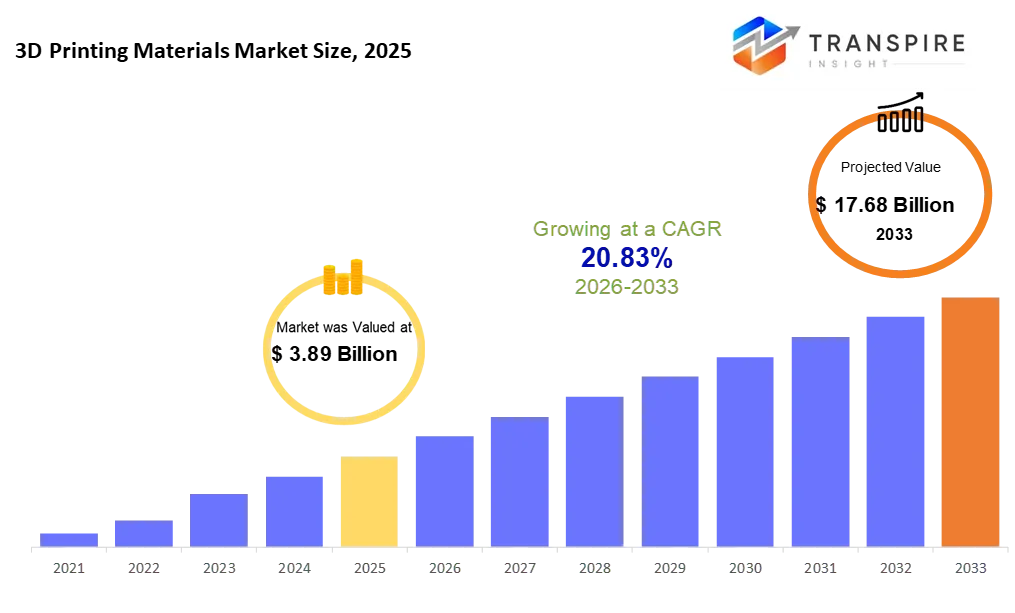
The global 3D Printing Materials market size was valued at USD 3.89 billion in 2025 and is projected to reach USD 17.68 billion by 2033, growing at a CAGR of 20.83% from 2026 to 2033.
Market Size & Forecast
- 2025 Market Size: USD 3.89 Billion
- 2033 Projected Market Size: USD 17.68 Billion
- CAGR (2026-2033): 83%
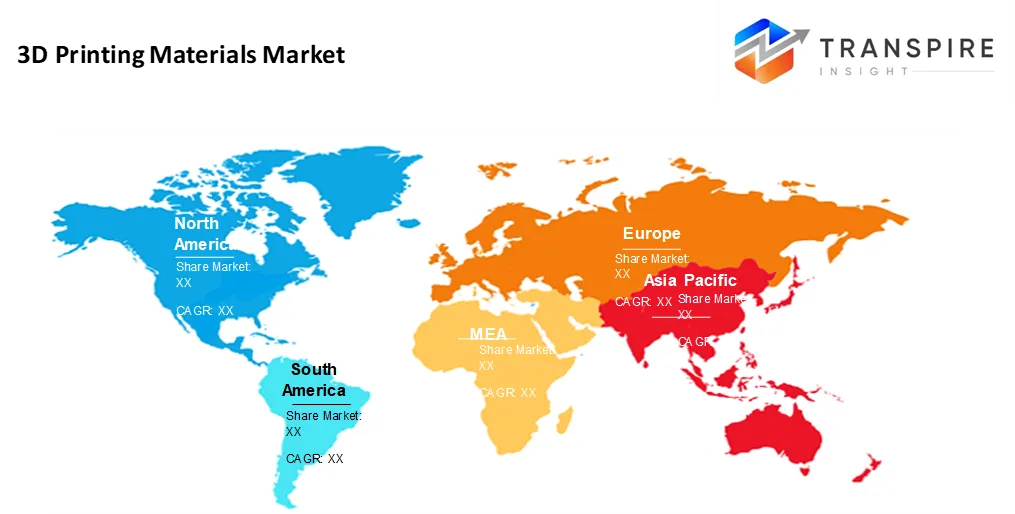
- North America: Largest Market in 2026
- Asia Pacific: Fastest Growing Market
To learn more about this report,  Download Free Sample Report
Key Market Trends Analysis
- North America market share estimated to be approximately 35% in 2026. Fueled by cutting-edge research, North America stays ahead. Its factories, plane builders, and car makers lean heavily on 3D printing tech. Progress here rides on robust innovation networks. Equipment and know-how spread widely across industries. This region moves fast, shaped by deep technical roots.
- Government programs help drive strong local demand in the United States. Early acceptance of approved materials shapes aerospace choices there. Defense sectors lead uptake thanks to established standards. Market activity stays high due to consistent policy backing. Progress here often sets the pace for nearby regions.
- Industrial growth surges across the Asia Pacific. Factories spread quickly, pushing production higher. New money flows into 3D printing tech. Materials innovation follows close behind.
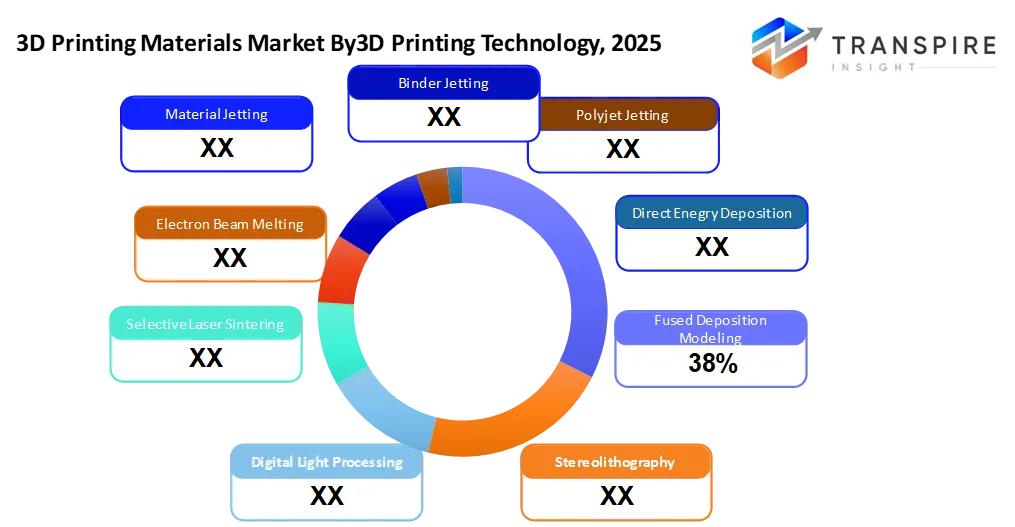
- Fused Deposition Modeling shares approximately 39% in 2026. Filament-based printing stands out because it saves money, works with many materials, and fits well into early design tests, along with small runs. Despite its simplicity, companies rely on it heavily when testing ideas before scaling up.
- Polymers' flexibility stands out. Processing them is straightforward, which helps a lot. These materials show up everywhere, from early models to finished tools. One reason they stick around is how easily they adapt. Different uses do not slow them down. Even complex jobs find a match here. That widespread fit makes a difference.
- Prototyping comes first. Companies now use 3D printing to test how things work before making them for real. Speed matters when turning sketches into hands-on models, so many fields stick with prototyping as their go-to move.
- Aerospace and Defense push ahead, lighter parts mean better speed, less fuel burned. Tough shapes once impossible now get printed straight into service. Efficiency jumps when every ounce counts during flight. No problem if the design adapts fast. Moving quickly beats waiting weeks for old-style builds.
Layer by layer, machines build things using stuff made around the world just for 3D printing. Polymers lead because they work well across many tools and do not cost much. Instead of lumping everything together, different kinds like metal, plastic, ceramic, mixtures, and even living matter are picked based on strength needs or heat resistance. Plastics are most often since printers like FDM and SLA easily. Each substance fits certain jobs depending on how it bends, melts, or holds up under stress. From labs to factories, these materials shape what additive methods can create.
More companies now want 3D printed materials because they are using them not just for models but for real working parts. Since moving beyond prototypes, fields like aircraft making, car building, medical tech, and factory work need pieces that are strong yet light and shaped in ways only additive methods allow. Efficiency matters too; making items layer by layer helps meet tight deadlines without waste. Custom designs made when needed have pushed demand higher. Saving money while producing better results has become a key reason many choose advanced printing materials.
Now things move faster because tech keeps changing what the market can do. New versions of heat-resistant plastics open doors nobody saw before. Carbon fiber mixes help build tougher products without adding weight. Metal dust turns into solid pieces through precise layering methods. Living tissue meets machine-made stuff in ways that fit inside bodies safely. Step by step, combining different materials unlocks stronger results. Heat used to break items now gets handled easily. Performance grows not just in labs but on factory floors. Real working parts come straight off printers more often these days.
North America, along with Europe, stays ahead because it has long had solid research systems, was quick to embrace high-tech production methods, plus host powerful car and aircraft industries. What stands out now is how fast Asia Pacific is rising, powered by booming factories, backing from national policies, and growing spending on 3D printing tech. In developing nations, fields like medical devices, gadgets, and vehicles are turning more toward printed materials just to speed up delivery, spend less, and tweak products more easily.
3D Printing Materials Market Segmentation
By 3D Printing Technology
- Fused Deposition Modeling
FDM printers show up everywhere because they cost less, work without fuss, and one material fits many jobs. Their popularity grows quietly, built on steady performance instead of flash.
- Stereolithography
Smooth surfaces, fine details, and stereolithography handle them well. When precision matters most, this method stands out clearly.
- Digital Light Processing
A single beam of light shapes the material layer by layer. Speed meets accuracy here. Precision stands out when working with resin-like substances. Fast results come through digital control of that light path. Each detail locks in place under focused exposure.
- Selective Laser Sintering
Fine powder layers build intricate shapes without extra supports laser heat fuses them into durable forms. These pieces handle stress well due to their dense structure.
- Electron Beam Melting
Flying beams of electrons melt metal, building solid components. These pieces work well where strength matters most - think of skies above or inside human bodies. Heat fuses powder into shapes that handle tough jobs. High performance hides in every layer made this way.
- Material Jetting
A splash of colors, different materials in one go, that happens here. Smooth finishes come out by default. The way it handles more than one substance at once.
- Binder Jetting
Delivers high throughput and cost-effective production, especially for metal and sand materials.
- PolyJet
Combines fine detail and multiple materials for prototypes with varying stiffness and realism.
- Direct Energy Deposition
That method heats the material right where it is needed. Layer by layer, fresh metal takes shape. Often chosen when size matters more than fine detail.
To learn more about this report, Download Free Sample Report
By Material
- Polymers
Flexible materials take the lead because they work well in many setups, cost little to produce, and fit smoothly into major 3D printing methods.
- Metals
Fueled by rising needs, metals see quick expansion in industrial parts. Aerospace demands push growth forward. Factories adapt as output climbs steadily.
- Ceramics
Ceramics step in when things get too hot for most materials. Their special traits shine under extreme conditions. Where others fail, these hold firm thanks to built-in abilities few shares.
- Composites
Stronger when combined, these materials handle tough jobs better than most. Built to resist heavy loads without bending too much. Their toughness comes from smart layering inside.
- Bio-Printing Materials
Enable customized tissues and medical models in healthcare and research.
By Application
- Prototyping
Fresh models spark quick checks before full rollout. Ideas move fast when teams can touch them early.
- Tooling
From a different angle, making jigs and fixtures takes less time when using tooling. Equipment helps speed up how fast support tools are built. With this method, production helpers come together more quickly than before.
- End-Use Parts
Pieces meant for actual use are now rolling out more often, due to advances in how factories adopt 3D printing.
- Medical
Supports custom implants, surgical guides, and anatomical models.
- Architectural Models
Miniature buildings show layout ideas clearly through precise size copies. These physical versions help visualize spaces before construction begins.
- Automotive Components
Lighter car bits come together through fast shaping methods that skip heavy tools. These pieces hold up under stress while speeding design changes one step at a time.
- Aerospace Components
Critical for lightweight, complex, and certified parts.
- Others
Besides these, find pieces in schools, galleries, homes, and even odd corners of manufacturing.
By End-Users
- Aerospace & Defense
Flying machines need stuff that weighs less but works better. Tough materials get picked when things have to last up there.
- Automotive & Transportation
Uses 3D printing for prototypes and functional components.
- Healthcare and Medical
Personalized tools in medicine grow alongside lab-made body tissues, shaping new paths in care. Devices tuned to individuals’ pair with biological replicas, shifting how treatments take form.
- Industrial
When it comes to industry, added substances go into tools, help during making things, and also final pieces that people actually use.
- Electronics & Consumer Goods
Produces custom housings and functional prototypes.
- Construction
Big pieces shape how parts go together when making buildings or scaled designs. These materials help form walls, frames, or mock-ups piece by piece.
- Others
- What is left includes fields such as teaching, studying, and creative work - speed in making things matters here.
Regional Insights
Right now, North America leads the world in sales of 3D printing materials, taking up a large chunk of total income because industries like aviation, cars, medicine, and general manufacturing rely on it heavily. What pushes the United States ahead is heavy spending on research, modern factory systems, and being one of the first to use additive techniques, especially with tough plastics and fine metal dust. Meanwhile, Canada and Mexico are stepping up too, finding more uses in factories while building stronger output abilities. Close behind comes Europe, where countries such as Germany, France, and Britain move fast due to solid industrial roots and rules that favor eco-friendly supplies plus printed part creation. There, funding flows into reusable plastic types, powdered metals, and body-safe liquid forms, helping spread usage mainly in aircraft work and health-related devices.
Out here, things move fast. Asia Pacific tops the chart for 3D printing materials, fueled by booming factories and strong backing from governments across China, Japan, and South Korea. While China pulls ahead in making and using polymer and metal powder supplies, Japan carves its space with high-end ceramics tied to electronic devices. Factories are not just building more stuff; they are shifting gears into new territory, like cars, gadgets you hold daily, and even medical tools. Because of that shift, this part of the world now shapes much of what happens in the wider market.
Growth ticks upward across Latin America as cash flows into 3D printing think car prototypes, medical tools, batch runs with Brazil and Mexico steering the charge. Smaller slice of global activity than North America or Asia Pacific, yet momentum builds through homegrown materials and fresh ideas in health tech and factories. Over in the Middle East and Africa, adoption lags, though curiosity grows around high-performance substances for buildings, hospitals, and military gear. Nations like the UAE and Saudi Arabia are laying the groundwork now, backing 3D printing systems to plant seeds for a future industry rise.
To learn more about this report, Download Free Sample Report
Recent Development News
- November 9, 2025 – Angstrom Group acquired Mantle to expand industrial 3D Printing for toolmaking.
- January 03, 2024 – Align Technology completed the acquisition of Cubicure, a pioneer in printing solutions for polymer additive manufacturing.
|
Report Metrics |
Details |
|
Market size value in 2025 |
USD 3.89 Billion |
|
Market size value in 2026 |
USD 4.70 Billion |
|
Revenue forecast in 2033 |
USD 17.68 Billion |
|
Growth rate |
CAGR of 20.83% from 2026 to 2033 |
|
Base year |
2025 |
|
Historical data |
2021 – 2024 |
|
Forecast period |
2026 – 2033 |
|
Report coverage |
Revenue forecast, competitive landscape, growth factors, and trends |
|
Regional scope |
North America; Europe; Asia Pacific; Latin America; Middle East & Africa |
|
Country scope |
United States; Canada; Mexico; United Kingdom; Germany; France; Italy; Spain; Denmark; Sweden; Norway; China; Japan; India; Australia; South Korea; Thailand; Brazil; Argentina; South Africa; Saudi Arabia; United Arab Emirates |
|
Key company profiled |
3D System Corporation, Stratasys Ltd, Voxeljet, BASF SE, Arkema S.A., Evonik Industries AG, Materialize NV, HP Inc., GE Additives, The ExOne Company, Hoganas AB, Royal DSM N.V., EOS GmbH Electro Optica; System, SLM Solution Group AG, CRP Technology, Renishaw, and others |
|
Customization scope |
Free report customization (country, regional & segment scope). Avail customized purchase options to meet your exact research needs. |
|
Report Segmentation |
By 3D Printing Technology (Fused Deposition Modeling, Stereolithography, Digital Light Processing, Selective Laser Sintering, Electron Beam Melting, Material Jetting, Binder Jetting, Polyjet, Direct Energy Deposition) By Material (Polymers, Metals, Ceramics, Composites, Bio-Printing Materials By Application (Prototyping, Tooling, End-Use Parts, Medical, Architectural Models, Automotive Components, Aerospace Components, Others), By End-Users Industry (Aerospace & Defense, Automotive & Transportation, Healthcare & Medical, Industrial, Electronics & Consumer Goods, Construction, Others) |
Key 3D Printing Materials Company Insights
Not many names stand out like Stratasys when it comes to 3D printing materials around the world. What sets them apart is a wide collection of tough polymer filaments and light-sensitive resins built for real jobs, planes, cars, medical gear, and factories. Long ago, they helped create FDM, a method now common in countless shops; today, they still push limits using things like ULTEM plastic and sharp-detail PolyJet liquids. Instead of chasing trends, they invest heavily in testing new ideas and growing their material range while teaming up closely with major industries. Because of that mix, they grab a large slice of income from printed materials globally. Factories rely on their output not just for mockups but for actual working pieces, flight-approved hardware, and even tools used in hospitals. Their mark shows clearly where tech moves next in making stuff layer by layer.
Key 3D Printing Materials Companies:
- 3D System Corporation
- Stratasys Ltd
- Voxeljet
- BASF SE
- Arkema S.A.
- Evonik Industries AG
- Materialize NV
- HP Inc.
- GE Additives
- The ExOne Company
- Hoganas AB
- Royal DSM N.V.
- EOS GmbH Electro Optica System
- SLM Solution Group AG
- CRP Technology
- Renishaw
Global 3D Printing Materials Market Report Segmentation
By 3D Printing Technology
- Fused Deposition Modeling
- Stereolithography
- Digital Light Processing
- Selective Laser Sintering
- Electron Beam Melting
- Material Jetting
- Binder Jetting
- Polyjet
- Direct Energy Deposition
By Material
- Polymers
- Metals
- Ceramics
- Composites
- Bio-Printing Materials
By Application
- Prototyping
- Tooling
- End-Use Parts
- Medical
- Architectural Models
- Automotive Components
- Aerospace Components
- Others
By Application
- Aerospace & Defense
- Automotive & Transportation
- Healthcare & Medical
- Industrial
- Electronics & Consumer Goods
- Construction
- Others
Regional Outlook
- North America
- United States
- Canada
- Europe
- Germany
- United Kingdom
- France
- Spain
- Italy
- Rest of Europe
- Asia Pacific
- Japan
- China
- Australia & New Zealand
- South Korea
- India
- Rest of Asia Pacific
- Latin America
- Brazil
- Mexico
- Rest of Latin America
- Middle East & Africa
- GCC
- South Africa
- Rest of the Middle East & Africa
Frequently Asked Questions
Find quick answers to common questions.
The approximate 3D Printing Materials Market size for the market will be USD 17.68 billion in 2033.
Key segments for the 3D Printing Materials Market are By 3D Printing Technology (Fused Deposition Modeling, Stereolithography, Digital Light Processing, Selective Laser Sintering, Electron Beam Melting, Material Jetting, Binder Jetting, Polyjet, Direct Energy Deposition), By Material(Polymers, Metals, Ceramics, Composites, Bio-Printing Materials), By Application (Prototyping, Tooling, End-Use Parts, Medical, Architectural Models, Automotive Components, Aerospace Components, Others), By End-Users Industry (Aerospace & Defense, Automotive & Transportation, Healthcare & Medical, Industrial, Electronics & Consumer Goods, Construction, Others).
Major 3D Printing Materials Market players are 3D Systems Corporation, Stratasys, Voxeljet, and BASF SE.
The North America region is leading the 3D Printing Materials market
The CAGR of 3D Printing Materials is 20.83%.
- 3D System Corporation
- Stratasys Ltd
- Voxeljet
- BASF SE
- Arkema S.A.
- Evonik Industries AG
- Materialize NV
- HP Inc.
- GE Additives
- The ExOne Company
- Hoganas AB
- Royal DSM N.V.
- EOS GmbH Electro Optica System
- SLM Solution Group AG
- CRP Technology
- Renishaw
Recently Published Reports
-
Apr 2026
Healthcare Polymer Packaging Market
Healthcare Polymer Packaging Market Size, Share & Analysis Report By Packaging Type (Syringes, IV Bottles and Pouches, Clamshells, Blisters, Bottles & Jars, Containers, Tubes, IV Parental Packaging, Others), By Type (Regulated, Non-regulated), By Polymer Type (LDPE (Low-Density Polyethylene), HDPE (High-Density Polyethylene), Homo-polymer (Homo), Random Copolymer (Random), Block Copolymer (Block), PET, Polystyrene, Polyvinyl Chloride, Polyamide/EVOH, Others), and Geography (North America, Europe, Asia-Pacific, Middle East and Africa, South and Central America), 2021 - 2031
-
Apr 2026
Hydrophilic Tape (Waterstop) Market
Hydrophilic Tape (Waterstop) Market Size, Share & Analysis Report By Type (Bentonite-Based Hydrophilic Tape, Rubber-Based Hydrophilic Tape), By Application (Residential Buildings, Commercial Buildings, Infrastructure Projects), and Geography (North America, Europe, Asia-Pacific, Middle East and Africa, South and Central America), 2021 - 2031
-
Apr 2026
Metalens Market
Metalens Market Size, Share & Analysis Report By Type (Visible Light Metalens, and Infrared Metalens), By Application (Consumer Electronics, Automotive Electronics, Industrial, Medical, and Others), and Geography (North America, Europe, Asia-Pacific, Middle East and Africa, South and Central America), 2021 - 2031
-
Apr 2026
PBT Resin Market
PBT Resin Market Size, Share & Analysis Report By Type (Reinforced PBT Resin, Unreinforced PBT Resin), By Processing Method (Injection Molding, Extrusion, Blow Molding, Others), By End-User (Automotive, Electrical & Electronics, Consumer Appliances, Industrial Machinery, Medical Devices, Packaging, Others), and Geography (North America, Europe, Asia-Pacific, Middle East and Africa, South and Central America), 2021 - 2031