
Global Household Induction Cooktops Market Size & Forecast:
- Global Household Induction Cooktops Market Size 2025: USD 19.7 Billion
- Global Household Induction Cooktops Market Size 2033: USD 34.2 Billion
- Global Household Induction Cooktops Market CAGR: 71.40%
- Global Household Induction Cooktops Market Segments: By Product (Built-in Cooktops, Portable Cooktops, Single Burner Cooktops, Double Burner Cooktops, Smart Cooktops, Commercial Grade Cooktops, Multi-Burner Cooktops, Others); By Power Rating (Below 1500W, 1500–2000W, 2000–2500W, Above 2500W, Low Power Models, Medium Power Models, High Power Models, Others); By Distribution Channel (Online Stores, Hypermarkets, Specialty Stores, Brand Stores, Electronics Stores, Direct Sales, E-commerce Platforms, Others); By End User (Urban Households, Rural Households, Apartments, Independent Homes, Rental Households, Students, Professionals, Others); By Technology (Conventional Induction, Smart IoT Cooktops, Voice-Enabled Cooktops, Touch-Control Cooktops, Sensor-Based Cooktops, Energy-Efficient Cooktops, AI-enabled Cooktops, Others).
Global Household Induction Cooktops Market Summary:
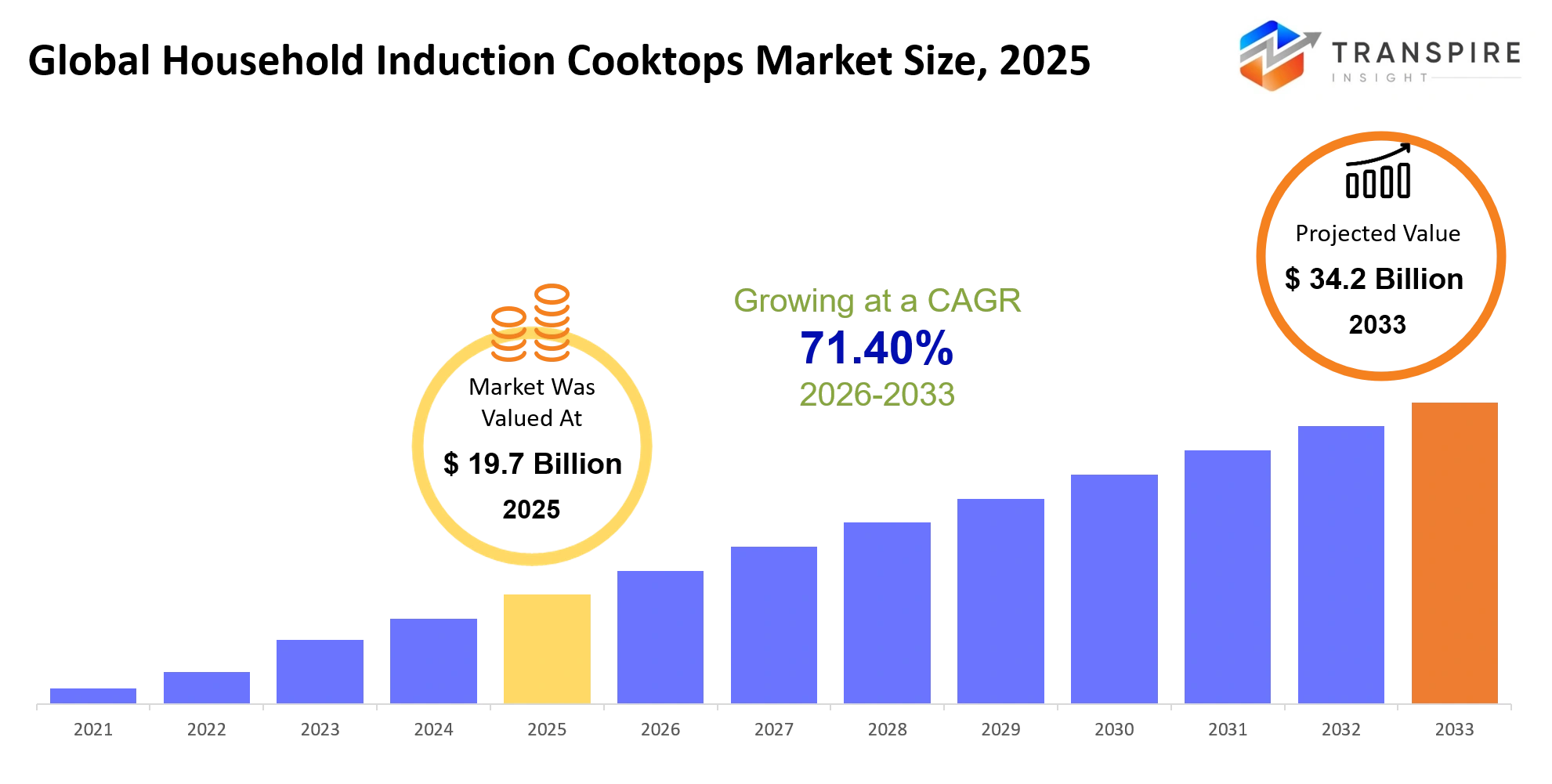
As per Transpire Insight Analysis, the Global Household Induction Cooktops Market size is estimated at USD 19.7 Billion in 2025 and is anticipated to reach USD 34.2 Billion by 2033, growing at a CAGR of 71.40% from 2026 to 2033.
Initially considered niche kitchen appliances, the demand for global household induction cooktops is gaining momentum from electricity efficiency trends, small spaces trend, the trend toward residential electric kitchen, and other driving factors. From simply providing heating capabilities, producers have evolved household induction cooktops to feature smart sensors, touch screens and control capabilities, remote connectivity, and real-time, precise temperature controls in a few years, establishing a complete smart kitchen ecosystem from a cooker. There has been a considerable and fundamental increase in household induction cooktops to establish smarter and connected kitchens as one part of smart homes with control from an individual's smartphone app. The impact of an electricity-based cooking scheme, together with strict energy-efficient directives, has created one major driving influence that sparks the sales of household induction cooktops. Household consumers desire low electrical consumption with faster cooking times, while they are increasingly conscious of kitchen safety.
Key Global Household Induction Cooktops Market Insights:
The market is moving from cooking appliances to intelligent, energy-efficient kitchen technology solutions that are more user-friendly and centralized. Businesses are introducing more smart technologies, smaller sizes, and eco-friendly attributes to appeal to contemporary households and apartment dwellers.
- Portable cooktops make up 42% of demand, and companies are now developing light sensor versions for mobile and rental homes.
- Smart IoT cooktops are growing at 13.9% CAGR, due to the app-based monitoring and cooking control features.
- Overall, over 55% of new premium products have touch-control interfaces, which is an indication of the increased consumer demand for easier operation.
- The energy-efficient models consume almost 20–30% less electricity, leading to brands highlighting their sustainable features.
- More than 40% of urban consumers are looking for safety locks and auto shut-off capabilities, thereby promoting the use of intelligent safety systems.
- Manufacturers are making an effort to incorporate multi-zone heating technologies, allowing for cooking versatility in small residences.
- In several developing markets, the contribution of online retail channels to the sales of appliances is more than 35%, driving digital-first product launches.
- As smart home penetration grows, voice assistance with cooking is growing in several flagship portfolios.
- Cooking presets that are aided by AI are becoming more common in flagship models, which automatically determine cooking time and temperature.
What are the Key Drivers, Restraints, and Opportunities in the Global Household Induction Cooktops Market?
Driver:
Residential electro-migration and eco-friendly cooking have become one of the major catalysts fuelling the market. Increased electricity access, urbanization of apartment dwellings, and higher mandated efficiency standards in appliances are facilitating consumers' move from gas-based appliances to induction-type cook-tops. The increased consumption of induction cookware has also been spurred on by consumer concern over cooking safety, minimizing the escape of heat, and better economics of cooking in the long run, and this has led to high consumer sales across premium and midrange product segments. In May 2026, Whirlpool launched the IWSL7320CP Induction Cooktop, featuring energy-efficient direct heat transfer technology that reduces electricity consumption and enhances rapid-boil safety for households shifting from gas to induction cooking.
Restraints:
The relatively high upfront cost for the cooktop, combined with the need for induction-compatible cookware, is still a drawback. While there is potential for more significant long-term savings through operational costs, this doesn’t help consumers with limited upfront budgets. This remains a problem since induction uses costly silicon and semiconductors and highly evolved heating technology. Also, the market’s slow embrace of such cooking technology in less urbanized and developing regions.
Opportunity:
Highest Potential in Ecosystem Integration; however, the biggest growth opportunity comes from integrating smart home ecosystems with cooking technologies. Smart temperature controls, voice user interfaces, and app-enabled kitchen appliances provide new avenues to drive increased sales for home appliance manufacturers. Emerging economies in Southeast Asia, Latin America, and certain African markets, and also the rollout of electricity in residential spaces, have opened a great potential for sales expansion of connected kitchens, and manufacturers that can bring smartly built products at reasonable prices will see substantial growth as the trend proliferates further.
What Has the Impact of Artificial Intelligence Been on the Global Household Induction Cooktops Market?
Artificial Intelligence is influencing the residential induction cooktops market by augmenting the cooking process, cutting power consumption, and driving more convenience in terms of usage. Existing induction cooktops featuring Artificial Intelligence are programmed to detect cooking-type behaviour, adjust their output power, along with temperature-intensity accordingly, so that power is used sparingly while providing even cooking. Emerging technologies make use of machine learning algorithms to control the temperature change, time, and food connoisseur.
It also boosts performance using predictive capabilities to take preventive measures in the case of overheating components or malfunctions, through methods like self-diagnostics and preventive maintenance to increase equipment service life and reduce costs associated with repairs. Product design and development also benefits from artificial intelligence, enabling manufacturers to make appliances like induction cooking ranges with better energy efficiency, better heating and improved user interactivity. Even though AI integration has some complications in manufacturing prices, in developing software and with smart household ecosystems, a growing pattern in the linked household and good house sector is expected to improve future AI deployment on home cooking appliances like the induction cooktop industry market.
Key Global Household Induction Cooktops Market Trends:
Beyond energy efficiency, it is now shifting from intelligent cooking systems to connected systems that allow for customized cooking experiences that fit into modern lifestyles. As manufacturers look to automation, connectivity and functionality for users, technology-driven differentiation is becoming more prevalent than price-based competition.
- Smart cooktop adoption has steadily grown in line with the transition from single appliances to smart home environments.
- Button systems are being phased out for touch-control systems, making kitchen use more user-friendly and stylish.
- As digital assistant adoption increases around the world, voice-controlled cooking functions are growing in high-end product lines.
- Adaptive heating is being adopted by manufacturers, which can adjust the power based on the cooktop and food being used.
- Portable induction tops the popularity chart with its expanding use in apartments and versatile cooking needs.
- Sustainability has promoted increased investment in low-energy-use designs and materials that can be recycled.
- E-commerce continues to grow in strength with brands moving towards direct-to-consumer digital engagement.
- Recipe guidance and cooking automation with AI are gaining significance in top-tier appliances.
Global Household Induction Cooktops Market Segmentation
By Product:
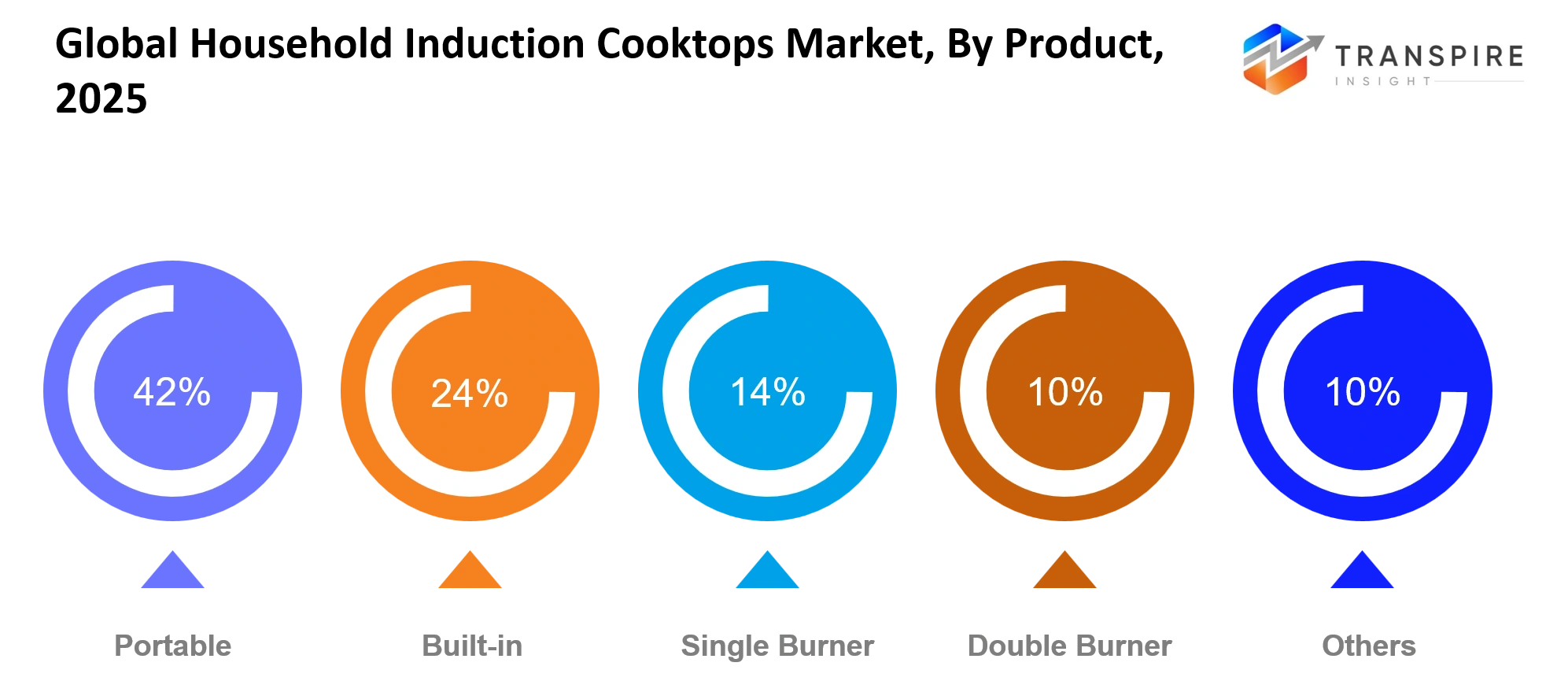
Market Share Portable cooktops dominate this segment at 42%, and attribute these gains to their economical price, manoeuvrability, and acceptance among urban families and consumers who occupy apartments, live in rented premises, or attend college/university. Integrated cooktops claim the second spot at 24%, owing to their rising significance in ultra-luxury modular kitchens and fully furnished homes. On the cooking front, Single-burner cooktops hold about 14% market share by their acceptance in tiny households; double-burner cooktops follow with 10% market share for their use by small nuclear families; however, smart, commercial-grade, multi-burner and others hold another 10%.
By Power Rating:
The 1500-2000 W segments still lead the demand, in which the optimum price and efficiency are satisfied. Below 1500W mainly target low-cost products as well as people using portable appliances, while those with the power between 2000-2500W and above 2500W gain in popularity, especially those with advanced needs such as rapid boiling. Low Power models focus on portability, Medium Power models mainly take up household kitchens, and High Power Models find more applications for experienced users who expect more precision.
By Distribution Channel:
Online Stores & E-commerce platforms are likely to be the fastest growing sales channel due to expanded assortments, price competitiveness and increasing online shopper activity. Hypermarkets, Specialty Stores, Brand Stores, Electronics Stores, Direct Sales and Others continue to maintain importance with their value proposition around product demonstrations, after-sales service, and in making buying decisions more confident.
By End User:
Large size, high degree of penetration of electric equipment, tiny living spaces, increasing use of modern kitchen appliances, as one of the biggest user base, Flats & Rental Household increasingly preferred Portable Induction cook-tops while professionals and Students, in pursuit of Convenience & Ease-of-Use; Adoption in Rural Household, Independent Homes & Others have increased with improved electricity access and awareness.
By Technology:
Smart IoT Cooktops are expected to record the highest CAGR of around 13.9% due to the growth of smart homes and consumers' demand for connected cooking. Traditional Induction Cooktops still have a larger market share among installations, as it has already established their presence. These cooktops are currently dominated by voice-enabled cooktops, touch-control cooktops, sensor-based cooktops, energy-efficient cooktops, AI-enabled cooktops and other cooktops that further improve the overall market with their automated features and efficient functions for the best culinary experiences.
What are the Key Use Cases Driving the Global Household Induction Cooktops Market?
The main target use cases are urban families adopting lightweight and permanent induction cooktops as their everyday cooking appliances. These kitchens demand the benefits offered by induction cooktops, like quick heating, temperature accuracy, and safety in apartment buildings and new homes. Other use cases include adoption in rental apartments, student housing and other similar living arrangements.
Lightweight and ease of installation make induction cooking ideal for space-constrained areas and houses that demand higher energy efficiency and portability.
Emerging uses in smarter kitchens, including the IoT, AI-enabled and voice-commanded induction cooktops, offer more possibilities of integration within connected households to track performance or personalize experiences in homes.
|
Report Metrics |
Details |
|
Market size value in 2025 |
USD 19.7 Billion |
|
Market size value in 2026 |
USD 21.1 Billion |
|
Revenue forecast in 2033 |
USD 34.2 Billion |
|
Growth rate |
CAGR of 71.40% from 2026 to 2033 |
|
Base year |
2025 |
|
Historical data |
2021 - 2024 |
|
Forecast period |
2026 - 2033 |
|
Report coverage |
Revenue forecast, competitive landscape, growth factors, and trends |
|
Regional scope |
United States; Canada; Mexico; United Kingdom; Germany; France; Italy; Spain; Denmark; Sweden; Norway; China; Japan; India; Australia; South Korea; Thailand; Brazil; Argentina; South Africa; Saudi Arabia; United Arab Emirates |
|
Key company profiled |
Philips, Panasonic, Whirlpool, LG, Samsung, Midea, Haier, Prestige, Bajaj, Bosch, Electrolux, Xiaomi, Sunflame, Pigeon, Kenwood. |
|
Customization scope |
Free report customization (country, regional & segment scope). Avail customized purchase options to meet your exact research needs. |
|
Report Segmentation |
By Product (Built-in Cooktops, Portable Cooktops, Single Burner Cooktops, Double Burner Cooktops, Smart Cooktops, Commercial Grade Cooktops, Multi-Burner Cooktops, Others); By Power Rating (Below 1500W, 1500–2000W, 2000–2500W, Above 2500W, Low Power Models, Medium Power Models, High Power Models, Others); By Distribution Channel (Online Stores, Hypermarkets, Specialty Stores, Brand Stores, Electronics Stores, Direct Sales, E-commerce Platforms, Others); By End User (Urban Households, Rural Households, Apartments, Independent Homes, Rental Households, Students, Professionals, Others); By Technology (Conventional Induction, Smart IoT Cooktops, Voice-Enabled Cooktops, Touch-Control Cooktops, Sensor-Based Cooktops, Energy-Efficient Cooktops, AI-enabled Cooktops, Others). |
Which Regions are Driving the Global Household Induction Cooktops Market Growth?
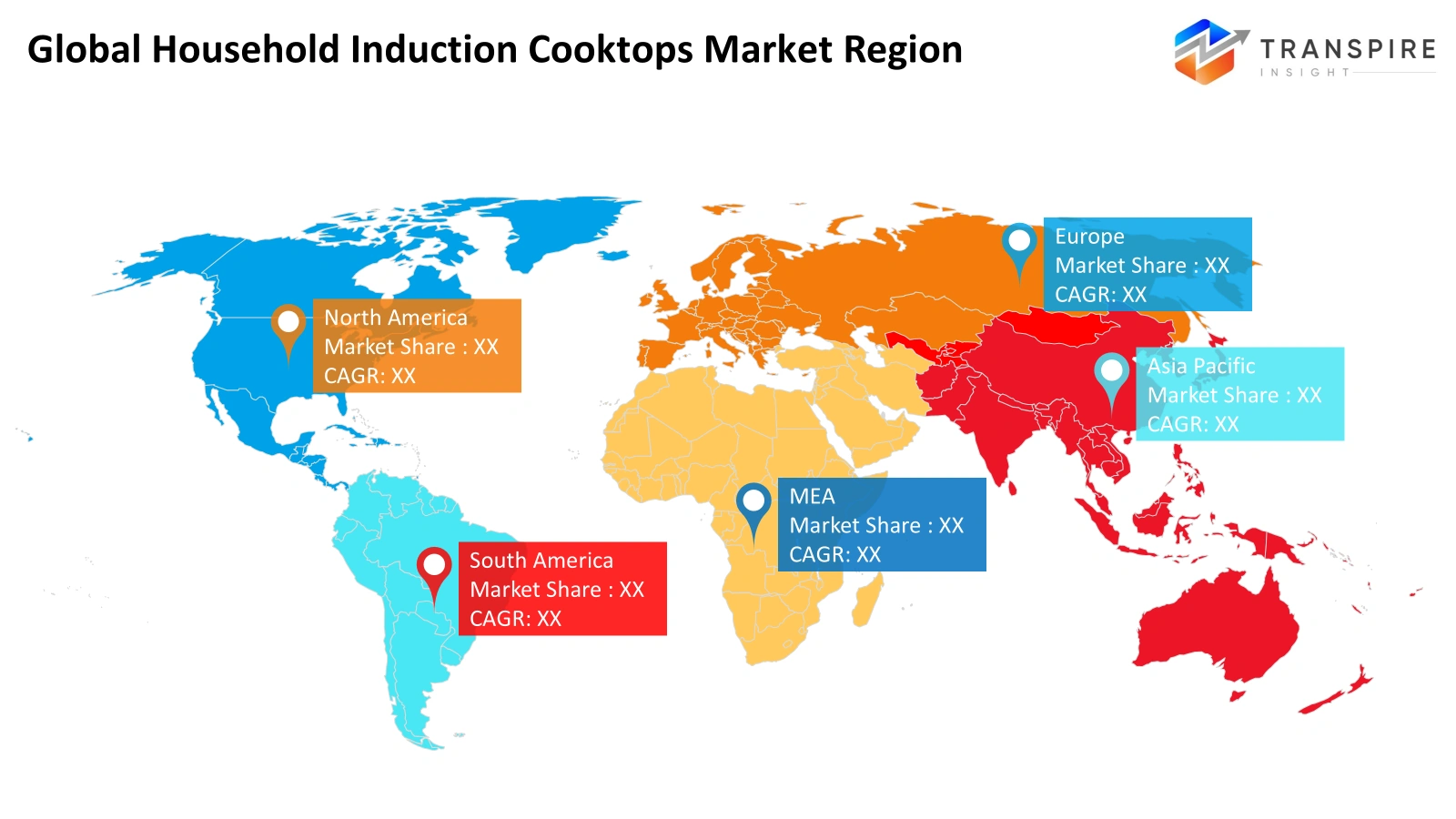
Asia Pacific represents a significant48% share of the worldwide market and remains the chief area in the market. Expanding urbanization, middle-class size and the development of residential electrification programmes still support development. Support for efficiency appliances from some nations and also from their energy efficient criteria and sustainability programmes can also reinforce the regional position. Wide, distributed retail networks and effective indigenous manufacturing bases give further territorial strength. In June 2026, the Andhra Pradesh Government partnered with Energy Efficiency Services Ltd. to deploy energy-efficient 1,200W induction cooking kits across 55,000 childcare centres, aiming to reduce traditional fuel use and cut annual CO₂ emissions by more than 28,000 tonnes.
The largest market is the second largest region in Europe, representing 21% of the market. More so than other regional markets, growth in this area of demand for household technologies is being driven by consumer demand for appliances that use energy responsibly, the trend towards upgrading kitchens, a widespread consumer base adopting smart home technology, and existing dominant manufacturers delivering new technologies in appliances.
Latin America's share stands at 7% of the market, growing at the highest CAGR of 12.6%. Recent efforts have supported appliance penetration – the region’s adoption growth is primarily driven by progress in rural household electricity availability, modern house-building across urban centres, and appliance affordability. E-commerce growth facilitates access to products throughout underpenetrated markets. This will be further supported with planned investment in modern residential energy-efficient infrastructure, and heightened consumer awareness will drive long-term gains from home appliance players. In May 2026, Midea expanded its presence in regional e-commerce markets by launching its Microcrystalline Glass Induction Series, offering affordable, scratch-resistant cooktops with auto-pan detection and low-voltage protection for rural and newly electrified households.
Who are the Key Players in the Global Household Induction Cooktops Market and how do they Compete?
Increasing focus is being placed on technology and energy-saving features, connection technologies and affordability for all in a competitive battle. Products are being diversified through smart features, design, tailored local offering and wide coverage rather than pricing alone.
Philips, Panasonic, LG, Samsung, Bosch, Electrolux, and Whirlpool concentrate on next-generation innovation by investing in strategies built around innovative smart functions, sensor-based cooking, superior safety standards, and smart home networking. Firms in this cluster differentiate on R&D ability and pursuing progress from the luxury of the brick-and- mortar space and e-commerce. Midea, Haier, Xiaomi, Prestige, Bajaj, Sunflame, Pigeon and Kenwood seek to combine price competitiveness and advanced functionality. The primary strategies of these businesses concentrate on minimalist designs, energy efficiency, and incorporating country-specific tastes. Xiaomi stands apart with smart ecosystems integration, as Prestige, Bajaj, Sunflame, and Pigeon bolster product awareness via substantial distribution networks and value-for-money goods, while Midea and Haier progressively gain international traction with the aid of their manufacturing volume and strategic associations. In conclusion, the sector has actually started financial investment in AI-driven cook aid, IOT gadgets, as well as ecological product advancements that keep companies ahead for the very long term.
Key Players are:
- Philips
- Panasonic
- Whirlpool
- LG
- Samsung
- Midea
- Haier
- Prestige
- Bajaj
- Bosch
- Electrolux
- Xiaomi
- Sunflame
- Pigeon
- Kenwood.
Recent Development News
In May 2026, Samsung launched its new Extractor Induction Hob featuring an integrated downdraft ventilation system. This combined product rollout directly addresses the global demand for space-saving luxury appliances, allowing high-performance induction cooking in space-constrained installations such as kitchen islands and condominium remodels without necessitating overhead hood space.
Source: https://servicemag.org
In March 2026, CUCKOO announced a strategic technology partnership with Renesas Electronics to commence mass production of its first AI-enabled induction range. This engineering collaboration integrates a specialized edge-intelligence framework for advanced boil-over detection.
Source: https://www.renesas.com
In February 2026, Zephyr launched the HyperCore™ Induction Cooktop powered by Impulse technology. This product rollout introduces four ultra-high-output heating elements backed by a built-in battery system, enabling home cooks to achieve peak professional-grade power outputs while remaining fully compatible with standard household electrical outlets.
Source: https://www.prnewswire.com
What Strategic Insights Define the Future of the Global Household Induction Cooktops Market?
The industry is also on its way to intelligent kitchens and will further grow with intelligent cooktops acting as connectable hubs in larger smart-home ecosystems. Going forward, the growth of induction cooktops will rely less on product performance and more on features such as software functionality, automation, power efficiency, and integration within various digital household ecosystems. Besides, there is an unseen but emerging risk of growing dependency on electronic components and the supply chains of semiconductors that might challenge prices or product availability.
While opportunities are also being unveiled, as AI-powered cooking assistants and proactive appliance service systems have strong revenue-generating capabilities.
Companies that successfully align affordable prices with sophisticated functionalities and present smart, eco-friendly, user-friendly inductive kitchen devices will lead this competitive field in established and underdeveloped regions in the future, hence investment in globalized production sites, software ecosystems and connectivity with other kitchen appliances will determine their success.
Key Segmentations are:
By Product
- Built-in Cooktops
- Portable Cooktops
- Single Burner Cooktops
- Double Burner Cooktops
- Smart Cooktops
- Commercial Grade Cooktops
- Multi-Burner Cooktops
- Others
By Power Rating
- Below 1500W
- 1500–2000W
- 2000–2500W
- Above 2500W
- Low Power Models
- Medium Power Models
- High Power Models
- Others
By Distribution Channel
- Online Stores
- Hypermarkets
- Specialty Stores
- Brand Stores
- Electronics Stores
- Direct Sales
- E-commerce Platforms
- Others
By End User
- Urban Households
- Rural Households
- Apartments
- Independent Homes
- Rental Households
- Students
- Professionals
- Others
By Technology
- Conventional Induction
- Smart IoT Cooktops
- Voice-Enabled Cooktops
- Touch-Control Cooktops
- Sensor-Based Cooktops
- Energy-Efficient Cooktops
- AI-enabled Cooktops
- Others
Regional Outlook
North America
- United States
- Canada
- Mexico
Europe
- Germany
- United Kingdom
- France
- Spain
- Italy
- Rest of Europe
Asia Pacific
- Japan
- China
- Australia & New Zealand
- South Korea
- India
- Rest of Asia Pacific
South America
- Brazil
- Argentina
- Rest of South America
Middle East & Africa
- Saudi Arabia
- United Arab Emirates
- South Africa
- Rest of the Middle East & Africa
Frequently Asked Questions
Find quick answers to common questions.
The global household induction cooktops market size was valued at USD 19.7 Billion in 2025 and is poised to reach USD 34.2 Billion by 2033, expanding at a 71.40% CAGR.
Key segments for the global household induction cooktops market are By Product (Built-in Cooktops, Portable Cooktops, Single Burner Cooktops, Double Burner Cooktops, Smart Cooktops, Commercial Grade Cooktops, Multi-Burner Cooktops, Others); By Power Rating (Below 1500W, 1500–2000W, 2000–2500W, Above 2500W, Low Power Models, Medium Power Models, High Power Models, Others); By Distribution Channel (Online Stores, Hypermarkets, Specialty Stores, Brand Stores, Electronics Stores, Direct Sales, E-commerce Platforms, Others); By End User (Urban Households, Rural Households, Apartments, Independent Homes, Rental Households, Students, Professionals, Others); By Technology (Conventional Induction, Smart IoT Cooktops, Voice-Enabled Cooktops, Touch-Control Cooktops, Sensor-Based Cooktops, Energy-Efficient Cooktops, AI-enabled Cooktops, Others).
Growth is primarily driven by rising residential electrification, increasing adoption of energy-efficient appliances, expanding urban housing developments, and growing demand for smart, safe, and low-emission cooking solutions.
The global household induction cooktops market is led by major manufacturers, including Philips, Panasonic, Whirlpool, LG, Samsung, Midea, Haier, Prestige, Bajaj, Bosch, Electrolux, Xiaomi, Sunflame, Pigeon, and Kenwood.
Asia Pacific holds 48% of the global market, supported by rapid urbanization, strong appliance manufacturing capacity, government energy-efficiency initiatives, and rising consumer adoption of modern kitchen technologies.
Key opportunities include AI-enabled and IoT-connected cooktops, expansion into emerging electrified markets, affordable smart appliance offerings, and integration with connected home ecosystems.
- Philips
- Panasonic
- Whirlpool
- LG
- Samsung
- Midea
- Haier
- Prestige
- Bajaj
- Bosch
- Electrolux
- Xiaomi
- Sunflame
- Pigeon
- Kenwood.
About the Authors

Chetan Dhatrak
I’m Chetan Dhatrak, a Senior Research Analyst at Transpire Insight, specializing in the Consumer Goods, Foods and Beverages industry. I focus on analyzing market trends, consumer behavior, competitive landscapes, and industry developments to deliver accurate, data-driven insights. My research at Transpire Insight is built on credible sources and in-depth analysis, helping businesses and readers better understand market dynamics, emerging opportunities, and evolving consumer preferences. I’m committed to creating reliable, well-researched content that supports informed decision-making and reflects the latest developments in the consumer goods and food & beverage sectors.

Chakradhar Khansole
Chakradhar serves as the Research Director at Transpire Insight, bringing over 8 years of experience in technology, innovation, and strategic market intelligence. He specializes in transforming complex market data into actionable business insights that enable organizations to make informed, growth-oriented decisions. Recognized for his strategic vision and analytical expertise, Chakradhar leads high-impact research initiatives, delivering comprehensive market assessments, competitive intelligence, and forward-looking industry analysis.
Recently Published Reports
-
Apr 2026
Bottled Water Market
Bottled Water Market Size, Share & Analysis Report By Product Type (Still Bottled Water, Carbonated Bottled Water, Functional Bottled Water, and Others), By Packaging (PET, Cans, and Others), By Sales Channel (Supermarkets/Hypermarkets, Convenience Stores/Drug Stores, Grocery Stores/Club Stores, Foodservice, and Others) and Geography (North America, Europe, Asia-Pacific, Middle East and Africa, South and Central America), 2021 - 2032
-
Apr 2026
Color Cosmetic Packaging Market
Color Cosmetic Packaging Market Size, Share & Analysis Report By Application (Mascara Packaging, Liquid Packaging, and Liquid Face), By Type (Tubes & Bottles, Pens & Markers, Compacts & Containers, and Droppers & Pumps), and Geography (North America, Europe, Asia-Pacific, Middle East and Africa, South and Central America), 2021 - 2031
-
Apr 2026
External Microphone For Camera Market
External Microphone For Camera Market Size, Share & Analysis Report By Type (Shotgun Microphone, Lavalier Microphone, and Others), By Application (Digital Camera, Professional Video Camera, and Others), and Geography (North America, Europe, Asia-Pacific, Middle East and Africa, South and Central America), 2021 - 2031
-
Apr 2026
Foot Orthotic Insoles Market
Foot Orthotic Insoles Market Size, Share & Analysis Report By Type (Pre-fabricated, and Custom-made), By Material (Thermoplastic, Composite Carbon Fiber, and Others), By Distribution Channel (Drug Stores, Hospitals & Clinics, and Others), and Geography (North America, Europe, Asia-Pacific, Middle East and Africa, South and Central America), 2021 - 2031