
South Korea Smart Home Appliance Market Size & Forecast:
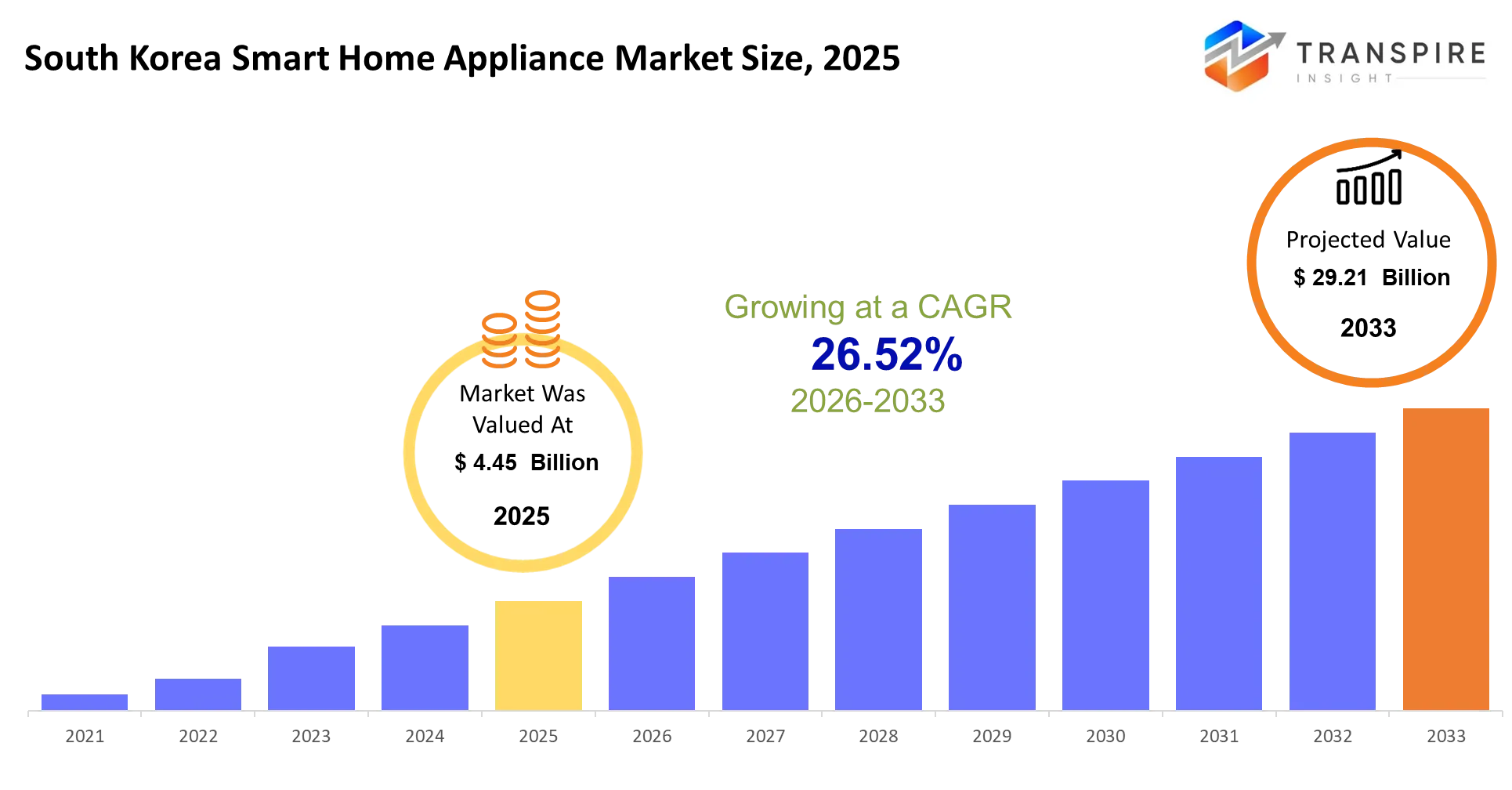
- South Korea Smart Home Appliance Market Size 2025: USD 4.45 Billion
- South Korea Smart Home Appliance Market Size 2033: USD 29.21 Billion
- South Korea Smart Home Appliance Market CAGR: 26.52%
- South Korea Smart Home Appliance Market Segments: By Product Type (Smart Refrigerators, Smart Washing Machines, Smart Air Conditioners, Smart Ovens, Others); By Technology (Wi-Fi-enabled Appliances, AI-enabled Appliances, Voice-controlled Appliances, Others); By Application (Home Automation, Energy Management, Remote Monitoring, Others); By Distribution Channel (Online Retail, Electronics Stores, Brand Outlets, Others)
To learn more about this report,  Download Free Sample Report
South Korea Smart Home Appliance Market Summary
The South Korea Smart Home Appliance Market was valued at USD 4.45 Billion in 2025. It is forecast to reach USD 29.21 Billion by 2033. That is a CAGR of 26.52% over the period.
The South Korea Smart Home Appliance Market works like this, a sort of linked home ecosystem, where appliances, air conditioners, refrigerators, washing machines, lighting systems, and security devices are not just standalone things but kind of coordinated network members. In real life, it cuts down on manual household chores because you can automate how energy is used, how security is watched, and even how daily routines get triggered, all via mobile and voice based interfaces. Over the past 3–5 years, the market has drifted away from those isolated smart gadgets and moved toward full platform ecosystems where compatibility between devices and cloud connectivity basically decide the product’s value. This kind of change was pushed even more during the pandemic period, when people spent more time at home and suddenly depended on remote control and automation features. At the same time, worldwide semiconductor supply disruptions forced manufacturers to rethink, so they started investing more into higher value connected appliances. So overall growth is now leaning more toward AI enabled ecosystem experiences, plus recurring service revenue models, instead of only one time appliance sales.
Key Market Insights
- In 2025 Seoul Capital Region will own a 65% close share of the South Korea Smart Home Appliance Market, mostly because the area has dense smart apartment setups and very early IoT takeup or something similar.
- Sejong and Gyeonggi kind of show up as the fastest movers now, pushed by smart city initiatives and those government-backed digital housing expansion programs.
- When you look at products, smart refrigerators plus AI air conditioners take the largest slice, about 40% in 2025.
- This happens as urban households keep asking for energy optimization options, every day, not just sometimes.
- For segments, smart security systems are the quickest growth through 2026–2033, as residential safety automation demand rises in those high rise apartments.
- Residential apartments bring in more than 70% share in the market, since compact urban living and centralized building systems are pretty normal there. Also, elderly care, assisted living type uses, are expanding rapidly.
- That growth is supported by South Korea’s aging population and the whole healthcare at home integration trend.
- On the competition side Samsung Electronics and LG Electronics pretty much lead via ecosystem control.
- SmartThings and ThinQ platforms are the main hooks for adoption. Meanwhile, Whirlpool, Bosch Home Appliances and Haier are gaining visibility through cost-competitive IoT appliances and they also lean into targeted mid tier product positioning strategies.
- Strategic partnerships between appliance brands and real estate developers are increasing too, they actually embed smart systems directly into new residential construction projects.
- And then AI driven predictive maintenance, plus energy optimization tech, can cut appliance operating costs by up to 25%, which strengthens long term consumer retention and also boosts service revenues.
What are the Key Drivers, Restraints, and Opportunities in the South Korea Smart Home Appliance Market?
In South Korea, what really drives things forward is the quick blend, like almost literally, of IoT enabled appliances into everyday housing, along with higher electricity expenses and a growing pull for automated energy tuning. Appliance makers have already stuffed sensors, plus cloud connectivity, into what people think of as basic tools, so households can look at consumption patterns and trim wastage. As a result, replacement cycles tend to speed up, and premium pricing has followed, because buyers are paying for the “smartness” side, more than just the physical device.
The main restraint is sort of two parts at once: the upfront expense for a truly integrated smart home setup, and the stubborn interoperability friction between brands. A lot of households buy devices bit by bit, not as one cohesive smart residence package, and that fragmented path tends to reduce system-wide efficiency. There is also data privacy anxiety , and the expectation of always-on connectivity, which pushes back older consumers. That hesitation can slow down full adoption, even when interest stays high, so revenue conversion takes longer than it could.
The biggest opportunity sits with AI powered home energy control platforms that plug into national smart grid systems, and also into aging population support services. These advanced platforms can juggle heating, cooling, and appliance timing in near real time, while enabling remote health monitoring for elderly residents. And as utility companies roll out more dynamic pricing models, connected homes become easier to justify financially, which then sustains demand across both dense urban apartments and newer residential neighborhoods.
What Has the Impact of Artificial Intelligence Been on the South Korea Smart Home Appliance Market?
Artificial intelligence is slowly reshaping the smart home appliances market in South Korea, by basically turning separate gadgets into adaptive systems that learn what a household is doing and then tune everything on the fly, real time. So in day to day automation, AI enabled air conditioners, refrigerators, and washing machines often change their operating cycles based on who is around, how they used the device before, and even what the weather is doing outside, which cuts down wasteful power use without someone having to set anything manually.
Then there is predictive maintenance, where the systems are reading vibration , temperature and other performance signals to catch early indicators of part fatigue. This helps reduce surprise breakdowns, and also limits those service interruptions people hate, especially when the issue shows up too late.
On the operational improvement side, households can see smaller electricity bills because the system does optimized load distribution. Manufacturers also tend to benefit, with fewer warranty claims and less frequent technician visits. AI scheduling can even boost appliance uptime by avoiding peak load stress and by stretching the useful life of the product.
Still, adoption is not fully smooth. High integration costs hold it back, and fragmented data environments cause headaches, since appliances from different brands produce datasets that do not match very well. Some residences also have limited edge connectivity, so real time processing can become hard. Plus, ongoing cybersecurity worries around connected household data make teams hesitate, which slows down full scale deployment.
Key Market Trends
- South Korean households kind of moved away from standalone smart gear, toward integrated ecosystems, and this has kinda sped up the platform based tussle between Samsung SmartThings and LG ThinQ lately, like over the recent years.
- In the past, AI enabled appliances were already getting better at energy savings, but in optimized homes they managed around 20–30�tter efficiency, and that nudge made makers embed predictive control systems starting in 2023.
- By 2025, smart home penetration in South Korea went past 60% in urban apartments, which shows how fast people took to it in high density residential infrastructure , not just in single homes.
- Samsung Electronics also expanded cross device connectivity, linking up vehicles and wearables, and so the whole fight is now more about automation across the ecosystem rather than fresh single product cycles.
- Meanwhile LG Electronics pushed harder on inverter based, plus AI compressor adoption, which in practice cut average appliance energy use by nearly 25�ross their premium product lines.
- Between 2021 and 2023, supply chain disruptions happened in a serious way, so manufacturers leaned into localizing semiconductor sourcing, and that helped local appliance production stay steadier.
- At the same time, many consumers started leaning into subscription style appliance services and remote diagnostics, so there was less dependence on the old one time purchase model.
- Also, government backed smart city efforts expanded in Sejong and Gyeonggi , and this accelerated embedded appliance rollouts in newly built residential complexes.
- Competition got sharper too, because Xiaomi and Haier rolled out lower cost IoT appliances, pushing Korean brands to separate themselves with ecosystem lock in strategies.
- And after 2024, the adoption of data driven predictive maintenance grew notably, which lowered appliance failure rates and made after sales service operations more efficient across major brands.
South Korea Smart Home Appliance Market Segmentation
By Product Type
Smart Refrigerators kinda keep a leading position in the appliance landscape, mainly because they’re already well planted in premium urban households, plus people are early adopters of connected kitchen ecosystems . Their deep integration with AI driven inventory tracking and energy optimization features kinda makes them even more central inside connected home systems, especially across dense residential neighborhoods. Smart Washing Machines sit as the second-largest segment, where water efficiency plus automated wash-cycle personalization really lines up with apartment living that’s more compact and time constrained. Smart Air Conditioners are still getting more attention in high-usage seasonal settings, where energy optimization directly affects household costs. Meanwhile Smart Ovens and a few other appliances stay kinda niche, because replacement cycles are slower, and the discretionary adoption barriers are higher.
For momentum, Smart Refrigerators keep moving forward by joining up with wider home automation platforms, linking food management with energy monitoring . Washing machines also get a boost from the growing need for automated upkeep reminders and less manual hassle for busy urban routines. Air conditioners are gaining traction thanks to inverter based efficiency improvements and AI led temperature regulation tech. Over the forecast period, Smart Air Conditioners are expected to grow faster, because electricity pricing sensitivity is rising and climate variability is reshaping cooling demand patterns, in a pretty noticeable way.
By Technology
Wi-Fi enabled appliances are basically dominating the market, because that foundational connectivity step stays the first thing people do when they start using a smart home, especially in mid-income households. They also match up well with the existing broadband setup and mobile apps, so it feels easy for a lot of consumers to jump in and keep adopting. AI-enabled appliances are turning into the second largest segment, not surprising really, since manufacturers are embedding machine learning models for predictive control, plus energy optimization, little details like that. Voice-controlled appliances are still smaller overall, but they are growing, and it mostly comes from digital assistant integration, and the whole hands free comfort sort of scenario.
Wi-Fi based systems keep expanding, mainly because they don’t ask for a lot of infrastructure change and they’re usable right away across different customer groups. AI-enabled systems are getting more traction too, due to better automation accuracy and also adaptive learning that comes from user behavior trends. Voice-controlled systems are helped by multilingual assistant capabilities getting better, and by improved natural language processing tie ins inside consumer electronics. Through the forecast period, AI-enabled appliances should move faster than the other technologies, since intelligent automation is becoming the default expectation instead of a kind of premium add on.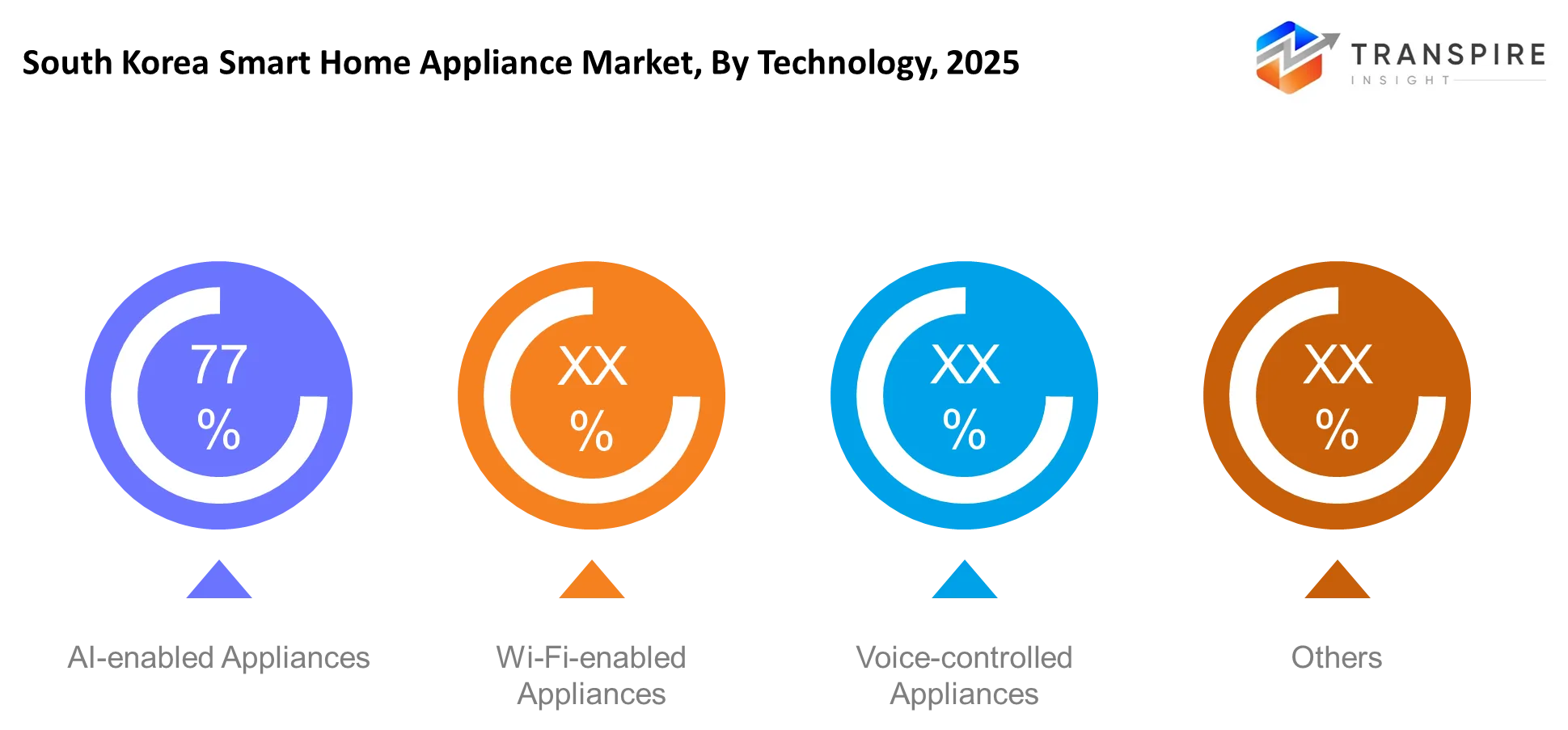
To learn more about this report, Download Free Sample Report
By Application
Home Automation seems to hold the dominant place, because households more and more bring several devices under one roof, kind of unified control platforms for lighting, climate, and appliance handling. Also, high urban density plus compact housing layouts push demand for centralized controls, so people do less manual back and forth. Energy Management comes in as the second biggest chunk , mainly due to higher electricity costs and a clear wish for optimized consumption across those same appliances. Remote Monitoring is still pushing forward at a steady pace, since users keep moving toward mobile control and diagnostic style alerts, while the other ideas stay a bit narrow, mostly for specific use scenarios.
For demand, Home Automation gets extra support from ecosystem tie-ins across appliance brands and even real estate developers, who embed smart infrastructure in new builds. Energy Management gets a boost from tariff based pricing schemes that basically invite real time tuning of home electricity usage. Remote Monitoring continues gaining momentum, driven by mobile first daily life and predictive maintenance notifications that pop up before things go wrong. Through the forecast window, Energy Management should grow quicker , as utility-linked smart home setups get more common across households.
By Distribution Channel
Electronics Stores still hold the leading position, mainly because people often like to check the physical product first, and then look at in-store technical demonstrations, before they actually purchase. Brand Outlets come in as the second-largest channel, since manufacturers push stronger direct engagement, kind of to grow ecosystem-based appliance networks. Online Retail is also expanding quickly, because it’s convenient, pricing feels more transparent, and it fits well with subscription oriented service models, while the other routes are more or less supplementary.
Electronics Stores keep their relevance since consumers really want to compare, hands-on, the feature rich smart appliances before they commit to high value buys. Brand Outlets help drive wider ecosystem adoption, by bundling different appliances into one unified platform style offer. Online Retail keeps accelerating from digital first buying habits, plus quite aggressive promotional price moves. Over the forecast period, Online Retail should be the fastest riser, because digital ecosystems are becoming more influential for both the way shoppers discover options, and how they decide at the final purchase stage, across the smart appliance market.
What are the Key Use Cases Driving the South Korea Smart Home Appliance Market?
Core demand kind of clumps around integrated home energy management in high density apartment complexes, where linked air conditioners, refrigerators, and washing machines are coordinated through a central platform. This use case keeps winning because it cuts electricity expenses right away and makes day to day household control feel easier in tight city living.
Secondary areas show up as smart security systems and assisted living offerings for older households, plus connected kitchen appliances in rentals. People seem to be adopting these more, especially urban renters and elderly residents, since they want convenience, plus remote monitoring in real time.
Emerging stuff includes AI enabled household robotics, subscription based appliance programs , and also connecting electric vehicle charging ecosystems inside smart residential communities.
|
Report Metrics |
Details |
|
Market size value in 2025 |
USD 4.45 Billion |
|
Market size value in 2026 |
USD 5.63 Billion |
|
Revenue forecast in 2033 |
USD 29.21 Billion |
|
Growth rate |
CAGR of 26.52% from 2026 to 2033 |
|
Base year |
2025 |
|
Historical data |
2021 - 2024 |
|
Forecast period |
2026 - 2033 |
|
Report coverage |
Revenue forecast, competitive landscape, growth factors, and trends |
|
Regional scope |
South Korea |
|
Key company profiled |
Samsung Electronics, LG Electronics, Whirlpool, Haier, Panasonic, Bosch Home Appliances, Electrolux, Midea Group, Sharp Corporation, Toshiba, Xiaomi, Philips, GE Appliances, Hisense, Hitachi |
|
Customization scope |
Free report customization (country, regional & segment scope). Avail customized purchase options to meet your exact research needs. |
|
Report Segmentation |
By Product Type (Smart Refrigerators, Smart Washing Machines, Smart Air Conditioners, Smart Ovens, Others); By Technology (Wi-Fi-enabled Appliances, AI-enabled Appliances, Voice-controlled Appliances, Others); By Application (Home Automation, Energy Management, Remote Monitoring, Others); By Distribution Channel (Online Retail, Electronics Stores, Brand Outlets, Others) |
Which Regions are Driving the South Korea Smart Home Appliance Market Growth?
The Seoul Capital Area, spanning Seoul, Gyeonggi, and Incheon, is kind of in the driver seat for the South Korea smart home appliance market, mainly because there’s a dense concentration of high-rise residential complexes and an early go-with-it attitude toward connected living. In other words, households around there tend to have solid purchasing power, so premium AI-enabled appliances and those subscription style home services move in faster. On top of that, the digital groundwork is already very developed, nationwide fiber connectivity , plus broad 5G coverage makes it easier to link multiple device ecosystems across apartments without too much fuss.
Meanwhile, the Busan–Ulsan–Gyeongsang corridor plays a more stable role but it’s different in structure. It doesn’t look like the Seoul area where demand is pushed mostly by a premium mindset. Instead, this corridor is shaped by industrial job centers and a longer term household steadiness that ties back to shipbuilding, automotive, and heavy manufacturing. Here, appliance adoption gets motivated by durability, energy efficiency, and replacement cycles, not necessarily by being first to test new tech. Also, with strong port connectivity and logistics infrastructure, imported smart appliances can be distributed in a steady way across southern Korea. That, in turn, gives manufacturers a more predictable revenue base, especially those aiming for mid-tier and value focused smart home product lines.
Sejong, along with nearby planned administrative and satellite cities, is showing up as the fastest-growing place for smart home appliance uptake. Recent growth in government backed smart city projects has raised demand for integrated housing infrastructure, where appliances are even embedded during the construction stage. New residential complexes in Daejeon, Sejong, and the neighboring provincial zones are now being built with IoT-enabled energy systems and centralized home automation requirements, which makes “plug and play” feel more natural later.
Who are the Key Players in the South Korea Smart Home Appliance Market and How Do They Compete?
South Korea's smart home appliance market is kind of moderately consolidated, like Samsung Electronics and LG Electronics do have real weight at home, while the global players end up chasing niche innovation, and also trying to stand out via price differentiation. Most of the fight is not really about standalone hardware pricing, it is more about technology integration, ecosystem compatibility, and the after-sales service capability, because people notice those things in real life. The domestic players defend their share using vertically integrated ecosystems that stitch appliances together with mobile platforms, whereas foreign brands tend to lean on cost efficiency and on targeted product categories, just to stay relevant.
Samsung Electronics leans heavily into ecosystem-led innovation, connecting its appliances with SmartThings based home automation platforms, so users get cross device control, plus subscription services that kind of keep them inside its digital environment. LG Electronics differentiates with AI powered energy optimization, and inverter tech that is advanced, it improves efficiency especially in the higher end appliance categories, and that supports its position in premium urban housing markets. Whirlpool and Electrolux compete with more reliable first mid-range offerings, aimed at households that value durability more than “ecosystem complexity” stuff. Haier and Midea Group apply a cost leadership approach, they expand pretty aggressively in price sensitive segments, supported by localized manufacturing and retail partnerships, so the shelves stay stocked. Xiaomi competes with aggressively priced IoT enabled appliances, and those fit into its broader smart device ecosystem, which makes it look like a disruptor for entry level connected home adoption, even if the feature depth can be mixed depending on the model.
Company List
- Samsung Electronics
- LG Electronics
- Whirlpool
- Haier
- Panasonic
- Bosch Home Appliances
- Electrolux
- Midea Group
- Sharp Corporation
- Toshiba
- Xiaomi
- Philips
- GE Appliances
- Hisense
- Hitachi
Recent Development News
In January 2026, Samsung Electronics unveiled its ‘Companion to AI Living’ ecosystem at CES 2026. Samsung Electronics showcased an integrated AI home ecosystem where appliances, TVs, and health systems operate as a unified intelligent environment. The launch reinforced ecosystem-led competition and increased focus on cross-device interoperability and ambient intelligence in smart homes.http://timesofindia.indiatimes.com
In September 2025, Samsung Electronics entered a partnership with Hyundai Motor Group. Samsung Electronics partnered with Hyundai Motor Group to integrate smart home systems with connected vehicles through IoT-based automation. The collaboration enables users to synchronize home appliances with car settings, expanding the smart home ecosystem into mobility use cases.http://telecom.economictimes.indiatimes.com
What Strategic Insights Define the Future of the South Korea Smart Home Appliance Market?
South Korea ’s smart home appliance market is kinda structurally moving toward fully integrated, AI-orchestrated living spaces where appliances act like one unified energy plus lifestyle control layer, not just stand alone devices. This change is being pushed by smart grid infrastructure coming together, higher city energy prices ,and platform based ecosystem rivalry among the big manufacturers. There’s also a less obvious risk that feels quieter at first, ecosystem concentration where only a few platforms could end up setting the device connectivity rules ,which might restrict interoperability and make the long term switching process more expensive for consumers. At the same time there’s a real emerging opening ,the merging of household appliances with distributed energy systems and EV charging networks in brand new residential complexes. Players in the market should lean into ecosystem interoperability deals with real estate developers and utility providers instead of looking only at hardware upgrades, because whoever gets control of the residential platform layer will basically shape how revenue is captured over the next ten years.
South Korea Smart Home Appliance Market Report Segmentation
By Product Type
- Smart Refrigerators
- Smart Washing Machines
- Smart Air Conditioners
- Smart Ovens
- Others
By Technology
- Wi-Fi-enabled Appliances
- AI-enabled Appliances
- Voice-controlled Appliances
- Others
By Application
- Home Automation
- Energy Management
- Remote Monitoring
- Others
By Distribution Channel
- Online Retail
- Electronics Stores
- Brand Outlets
- Others
Frequently Asked Questions
Find quick answers to common questions.
The Expected South Korea Smart Home Appliance Market size for the Market will be USD 29.21 Billion in 2033.
Key Segments for the South Korea Smart Home Appliance Market are By Product Type (Smart Refrigerators, Smart Washing Machines, Smart Air Conditioners, Smart Ovens, Others); By Technology (Wi-Fi-enabled Appliances, AI-enabled Appliances, Voice-controlled Appliances, Others); By Application (Home Automation, Energy Management, Remote Monitoring, Others); By Distribution Channel (Online Retail, Electronics Stores, Brand Outlets, Others).
Major South Korea Smart Home Appliance Market Players are Samsung Electronics, LG Electronics, Whirlpool, Haier, Panasonic, Bosch Home Appliances, Electrolux, Midea Group, Sharp Corporation, Toshiba, Xiaomi, Philips, GE Appliances, Hisense, Hitachi.
The Current South Korea Smart Home Appliance Market size is USD 38489.2 Million in 2025.
The South Korea Smart Home Appliance Market CAGR is 26.52% from 2026 to 2033.
- Samsung Electronics
- LG Electronics
- Whirlpool
- Haier
- Panasonic
- Bosch Home Appliances
- Electrolux
- Midea Group
- Sharp Corporation
- Toshiba
- Xiaomi
- Philips
- GE Appliances
- Hisense
- Hitachi
Recently Published Reports
-
Apr 2026
Bottled Water Market
Bottled Water Market Size, Share & Analysis Report By Product Type (Still Bottled Water, Carbonated Bottled Water, Functional Bottled Water, and Others), By Packaging (PET, Cans, and Others), By Sales Channel (Supermarkets/Hypermarkets, Convenience Stores/Drug Stores, Grocery Stores/Club Stores, Foodservice, and Others) and Geography (North America, Europe, Asia-Pacific, Middle East and Africa, South and Central America), 2021 - 2032
-
Apr 2026
Color Cosmetic Packaging Market
Color Cosmetic Packaging Market Size, Share & Analysis Report By Application (Mascara Packaging, Liquid Packaging, and Liquid Face), By Type (Tubes & Bottles, Pens & Markers, Compacts & Containers, and Droppers & Pumps), and Geography (North America, Europe, Asia-Pacific, Middle East and Africa, South and Central America), 2021 - 2031
-
Apr 2026
External Microphone For Camera Market
External Microphone For Camera Market Size, Share & Analysis Report By Type (Shotgun Microphone, Lavalier Microphone, and Others), By Application (Digital Camera, Professional Video Camera, and Others), and Geography (North America, Europe, Asia-Pacific, Middle East and Africa, South and Central America), 2021 - 2031
-
Apr 2026
Foot Orthotic Insoles Market
Foot Orthotic Insoles Market Size, Share & Analysis Report By Type (Pre-fabricated, and Custom-made), By Material (Thermoplastic, Composite Carbon Fiber, and Others), By Distribution Channel (Drug Stores, Hospitals & Clinics, and Others), and Geography (North America, Europe, Asia-Pacific, Middle East and Africa, South and Central America), 2021 - 2031