
South Korea Smart Clothing Market Size & Forecast:
- South Korea Smart Clothing Market Size 2025: USD 182.76 Million
- South Korea Smart Clothing Market Size 2033: USD 1357.84 Million
- South Korea Smart Clothing Market CAGR: 5.31%
- South Korea Smart Clothing Market Segments: By Product Type (Fitness Wear, Healthcare Wearables, Military Smart Clothing, Sports Apparel, Others); By Technology (Sensor-integrated Clothing, Bluetooth-enabled Clothing, AI-enabled Smart Fabrics, Others); By Application (Health Monitoring, Fitness Tracking, Industrial Safety, Entertainment, Others); By Distribution Channel (Online Retail, Specialty Stores, Brand Outlets, Others)
To learn more about this report,  Download Free Sample Report
South Korea Smart Clothing Market Summary
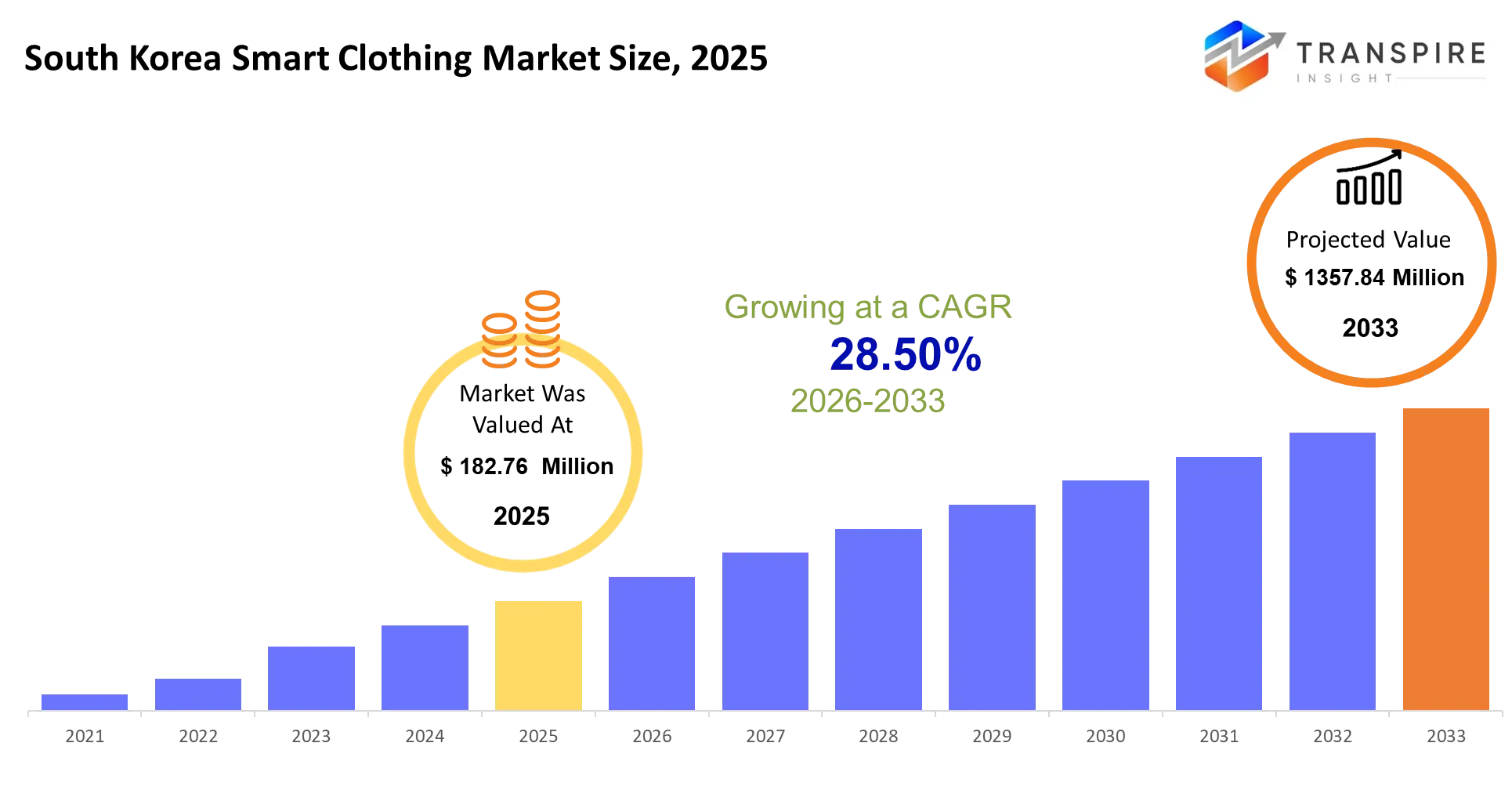
The South Korea Smart Clothing Market was valued at USD 182.76 Million in 2025. It is forecast to reach USD 1357.84 Million by 2033. That is a CAGR of 28.50% over the period.
The South Korea Smart Clothing Market is basically centered on garments that have sensors in them, plus conductive fabrics which can track body motion, vital signs, and even environmental exposure in real time. Practically speaking, these things get used for sports performance tracking, healthcare monitoring, industrial worker safety and defense training, where ongoing biometric cues help people make choices quicker and lower the overall risk , not just in theory but in daily operations. This topic is also becoming more and more important in workplaces, because fatigue sensing and injury prevention end up affecting both productivity and operational safety directly.
In the past three to five years there has been a noticeable structural change, from simpler wearable add-ons to more fully woven smart textiles that rely on flexible electronics and sensor systems that are washable. One big factor pushing that change was the COVID-19 pandemic, which sort of reinforced remote health monitoring and contactless patient care across South Korea’s healthcare network. So, clothing based biosensors became more common for continuous monitoring beyond classic clinical rooms. Because of that, manufacturers are now reporting steadier demand coming from hospitals, sports organizations, and industrial employers, which then supports higher-value product uptake , and also grows the commercialization of smart textile technologies.
Key Market Insights
- The South Korea Smart Clothing Market is kind of expanding now, via wearable biosensors IoT textiles, and real-time biometric monitoring across healthcare as well as industrial spaces.
- Growth through 2033 is being fueled by more and more remote patient monitoring setups, plus AI health analytics integration, you know.
- In terms of geography, Seoul and Gyeonggi end up dominating with 45%+ share in 2025, mainly because of better healthcare infrastructure and heavy smart textile research and development focus.
- Busan and Daegu are also showing up as the fastest moving regions during 2025–2033, pushed by industrial safety adoption and these pilot smart factory programs.
- When it comes to products, smart biometric shirts are leading with 50%+ share, because healthcare providers are adopting ongoing vital sign tracking solutions.
- Smart protective jackets still sit as the second-largest segment , and they’re being used more often in defense training plus high-risk industrial locations.
- E-textile embedded sensor systems are the quickest growing segment, driven by flexible electronics and the whole washable fabric innovation trend.
- For end use, healthcare applications dominate at 55%+ share, since hospitals are expanding remote monitoring and chronic condition management programs.
- Industrial safety and sports analytics are accelerating fast too, largely thanks to fatigue detection systems and AI performance tracking tools.
- Players like DuPont, Toray Industries, Sensoria, Adidas, Under Armour, and Samsung compete through smart fabrics, IoT connectivity, and biometric analytics innovation.
What are the Key Drivers, Restraints, and Opportunities in the South Korea Smart Clothing Market?
The main push behind the South Korea Smart Clothing Market is the quick uptake of wearable biosensors and IoT textiles into healthcare, sports, and even industrial safety. More and more hospitals are using “smart garments” to do continuous patient monitoring, particularly for chronic disease control and post-surgical recovery, and this helps with early risk spotting while also easing the hospital load. At the same time, factories and defense related groups are moving toward smart clothing for fatigue tracking and overall worker safety, and they do this with AI based analytics that support faster real time choices. So, this movement toward data led monitoring is really nudging up demand for higher value smart textile products, and it is opening fresh revenue chances for the manufacturers.
One big limitation is the cost of making these products, plus the technical difficulty of building sensor systems that remain durable, washable, and consistently accurate once they are inside fabric. Smart textiles need advanced materials, miniaturized electronics, and dependable power strategies, and all of that quietly raises production expenses which then makes it harder for mass buyers to afford. There is also a pause point from data privacy issues tied to constant biometric tracking, and in some healthcare settings and workplaces this can slow down adoption.
A major chance, though, is the growth of AI driven personalized health and performance ecosystems. South Korea has strong digital infrastructure, and it also carries a healthcare innovation network that tends to back new ideas, so smart clothing that connects textiles with cloud analytics and predictive health platforms has room to expand. As remote healthcare and smart industrial observation keep rising, companies that blend fabrics, sensors, and AI insights are set up to unlock the next market phase.
What Has the Impact of Artificial Intelligence Been on the South Korea Smart Clothing Market?
Artificial intelligence has, like really, changed the South Korea smart clothing market a lot. Instead of just making sensor-equipped garments that only monitor things, it now acts more like predictive and decision support systems, even if the result feels less “simple” than before. In healthcare, AI algorithms can sift through continuous biometric data coming from smart clothing, then flag early cues such as abnormal heart rhythm, unusual fatigue patterns, or respiratory troubles. That shift helps remote patient monitoring run more efficiently, and it also lowers how much clinicians need in-person checks. Especially for chronic disease care, and for post surgical recovery, the whole workflow becomes more streamlined. So hospitals have been folding AI-enabled smart clothing into telehealth programs more and more, which helps adoption spread across many medical institutions.
In industry and defense, AI adds even more practical value. Here smart clothing supports real-time risk forecasting and fatigue detection for people working in high exposure areas. Machine learning models interpret motion, temperature, and physiological signals to spot unsafe conditions before something actually happens. Because of that, factories, logistics sites, and defense training settings have started adopting these solutions faster. And since safety optimization directly touches productivity , and cost control, the business case keeps getting stronger.
AI has also sped up product innovation across the market. Manufacturers are leaning on AI-powered design tools to improve fabric-sensor fit, raise energy efficiency, and sharpen data accuracy inside wearable textile layers. In practice, development timelines get shorter and companies move from basic monitoring garments toward more connected smart textile ecosystems. Those ecosystems can combine the clothing itself, IoT platforms, and predictive analytics, which then serve both healthcare needs and industrial, use case demands, in a more integrated way.
Key Market Trends
- The South Korea Smart Clothing Market is moving, sort of, into an AI focused wearable ecosystem, mixing biosensors, IoT textiles, and real time analytics across a bunch of different industries.
- Starting around 2020, healthcare providers began swapping manual monitoring for smart clothing based remote patient tracking, so they could do continuous health assessment, not just check-ins.
- Then COVID-19, kinda forced the pace—telemedicine adopted smart garments more quickly and that pushed the need for home oriented chronic disease management solutions across South Korea.
- After 2021 industrial groups also expanded smart clothing use for fatigue detection and, you know, workplace safety compliance improvement programs.
- AI integration really ramped up after 2022, letting companies generate predictive health insights from ongoing biometric plus movement data streams.
- And when supply chains got shaky, disruption made local manufacturing look more appealing, so South Korean firms leaned harder into stronger domestic smart textile production capabilities.
- Sports and fitness also shifted toward real time biometric feedback systems since 2021, helping performance tracking along with injury prevention strategies.
- Companies such as Samsung, Adidas, and Under Armour expanded smart apparel development, using IoT connectivity and those more advanced sensor integration technologies.
- Meanwhile, regulatory pressure tied to industrial safety increased adoption of monitoring garments, especially in logistics, construction, and manufacturing environments across 2023–2025.
- So competition itself changed, moving away from standalone wearables, toward integrated ecosystems that bundle smart textiles, cloud platforms, and AI driven analytics services.
South Korea Smart Clothing Market Segmentation
By Product Type
Fitness wear pretty much dominates the South Korea Smart Clothing Market , since a lot of consumers are now leaning into sensor-embedded outfits for fitness tracking, plus plain day to day activity monitoring. The whole demand pattern moved away from basic sportswear to those connected garments that can give real time biological readouts and AI style performance guidance , kinda like more constant coaching. For healthcare wearables, that’s the second biggest chunk, pushed forward by hospitals and homecare providers, they’re rolling out remote patient monitoring systems more and more. Military smart clothing is also growing fast , powered by defense modernization programs and soldier safety measures. Sports apparel keeps evolving too, with advanced textile sensors used for performance tuning, while the “others” category stays smaller, covering more specific industrial use cases and a few experimental ideas.
Since 2020, product demand has shifted noticeably toward apparel solutions that are centered on wellness and data driven decision making. Fitness and healthcare are expected to keep leading , due to lifestyle changes and medical digitization. Meanwhile military and sports uses are speeding up as governments and institutions start investing more in enhancement tech for both performance and safety.
By Technology
Sensor-integrated clothing is basically running the market, not just because it looks good or anything but because embedded biometric sensors lets people track things like heart rate, body motion, and other physiological signals in a continuous way. It’s been gaining traction, especially when healthcare and fitness groups start putting more emphasis on real-time monitoring. At the same time Bluetooth-enabled clothing is still the second-largest slice, it keeps things moving smoothly with data transfers to phones and then further on into cloud platforms. Then there’s AI-enabled smart fabrics, they are actually the fastest-growing portion, and that seems tied to predictive analytics plus more “intelligent health” takeaways, while the others category covers experimental textile computing approaches.
Over time the technology evolution moved away from straightforward connectivity solutions, and more toward textile systems that feel smarter and self-learning. Since 2021, AI has changed smart clothing from being kind of passive data gatherers into predictive health and performance tools, and that shift has boosted adoption across multiple industries and use cases.
By Application
Health monitoring kinda dominates the application portion, because there is more and more need for remote patient tracking, and chronic disease management type solutions. Hospitals, as well as homecare providers, are relying more on smart clothing for continuous physiological information capture ,not just occasional checks. Fitness tracking is still the second-biggest chunk. It’s pushed along by people wanting personalized wellness approaches and also performance optimization. For industrial safety, that section grows the fastest, motivated by workplace surveillance, fatigue recognition, and mandatory regulatory compliance needs. Entertainment and other categories stay kind of niche, more like side lines than main streams.
The overall application demand has shifted a bit away from lifestyle centered usage toward mission critical healthcare functions and industrial safety tasks. Starting around 2020, the whole digital health transformation, plus workplace safety reforms, has expanded enterprise level uptake of smart clothing solutions in a pretty noticeable way.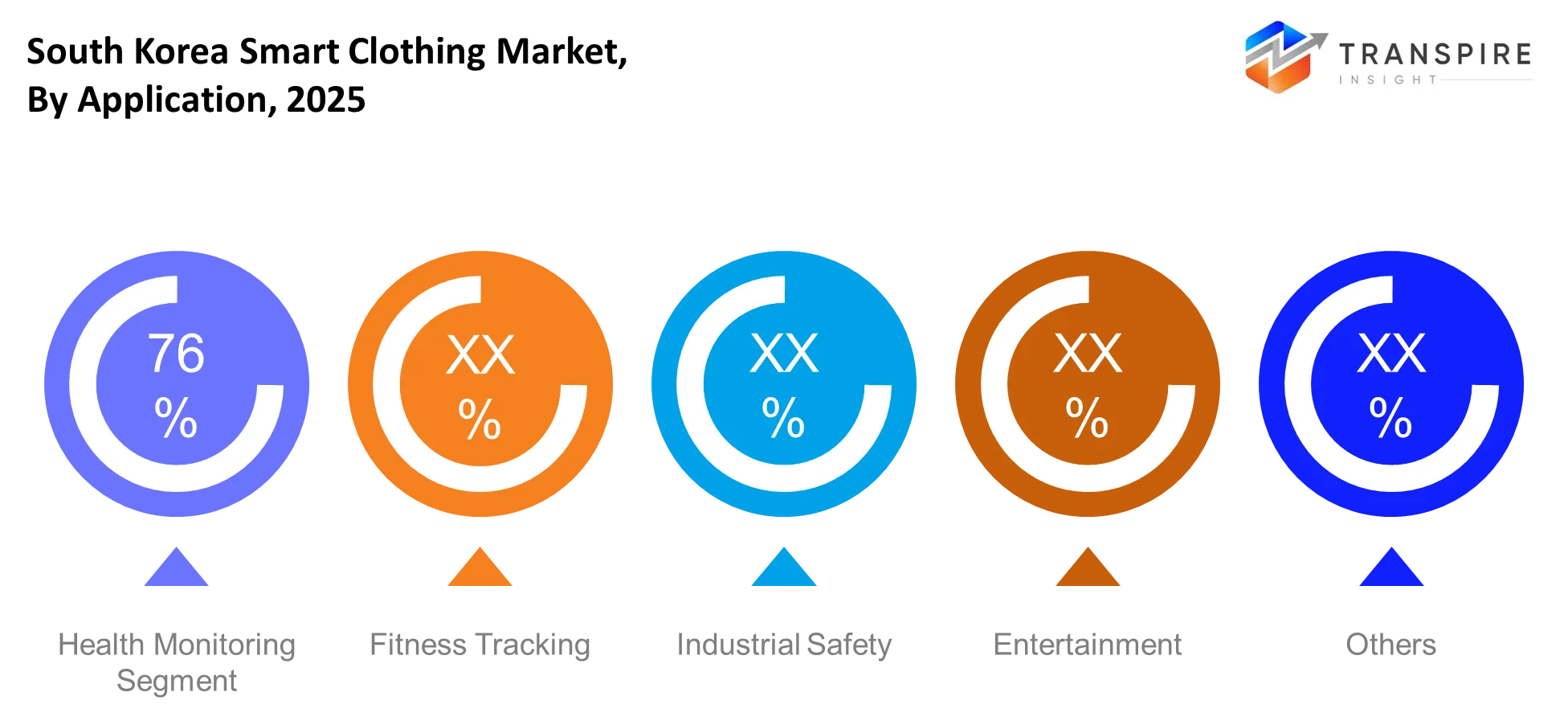
To learn more about this report, Download Free Sample Report
By Distribution Channel
Online retail pretty much dominates distribution, and consumers seem to increasingly go for direct-to-consumer buying pathways,especially for smart clothing products. The growth of e-commerce has boosted accessibility too, and it also sped up product awareness, across fitness and healthcare segments. Specialty stores are still the second-largest channel though, they provide personalized fitting with a bit more hands on product demonstrations, for advanced wearable textiles. Brand outlets are also expanding steadily, helped along by premium positioning strategies, while the “others” segment bundles institutional procurement and B2B purchasing routes.
In general, distribution trends have moved away from purely retail-centric models and more toward hybrid digital-first ecosystems. Since 2020, manufacturers have been leaning harder into online platforms and direct brand engagement, partly to strengthen customer adoption, and also to push smart clothing penetration further across South Korea.
What are the Key Use Cases Driving the South Korea Smart Clothing Market?
In South Korea, the smart clothing Market is mostly pulled along by health monitoring, like when garments have sensors in them and they can watch heart rate, breath patterns, body temperature and motion, more or less live. Hospitals, and also homecare teams use these outfits for long term condition control, tracking after surgery, and keeping an eye on elderly patients. As a result, there’s less need to rely on nonstop observation inside hospitals all the time. It also helps catch health threats earlier, so smart clothing feels more like a natural extension of digital health systems, not just some gadget you wear.
Then there is another big angle, fitness and sports performance tuning. Athletes, gyms, and even pro sports clubs are moving toward smart apparel to measure biomechanics, posture alignment, calorie burn, and fatigue state. Instead of only doing basic step or activity tracking, teams now want real time performance insights. That shift has boosted training effectiveness and tends to lower injury chances. So adoption keeps growing, especially within higher end sports ecosystems where performance matters a lot.
A rapidly expanding category is industrial safety and worker monitoring. Factories, logistics operators, and construction sites use smart clothing to flag things like fatigue, heat stress, and exposure to dangerous conditions. It supports stronger workplace safety rules and it cuts the risk of accidents, mainly in those high intensity environments where small mistakes can become big issues.
Also, military and defense applications are getting bigger, with smart uniforms that help with tracking soldier well being, checking environmental variables, and supporting mission readiness. Taken together, these use cases kind of move smart clothing away from just consumer wearables, and toward real tools for healthcare, safety, and performance management across South Korea’s industrial and institutional segments.
|
Report Metrics |
Details |
|
Market size value in 2025 |
USD 182.76 Million |
|
Market size value in 2026 |
USD 234.67 Million |
|
Revenue forecast in 2033 |
USD 1357.84 Million |
|
Growth rate |
CAGR of 28.50% from 2026 to 2033 |
|
Base year |
2025 |
|
Historical data |
2021 - 2024 |
|
Forecast period |
2026 - 2033 |
|
Report coverage |
Revenue forecast, competitive landscape, growth factors, and trends |
|
Regional scope |
South Korea |
|
Key company profiled |
Samsung Electronics, LG Electronics, Hexoskin, Sensoria, Athos, Xenoma, OMsignal, Under Armour, Nike, Adidas, Myant, AiQ Smart Clothing, Garmin, Polar Electro, Wearable X |
|
Customization scope |
Free report customization (country, regional & segment scope). Avail customized purchase options to meet your exact research needs. |
|
Report Segmentation |
By Product Type (Fitness Wear, Healthcare Wearables, Military Smart Clothing, Sports Apparel, Others); By Technology (Sensor-integrated Clothing, Bluetooth-enabled Clothing, AI-enabled Smart Fabrics, Others); By Application (Health Monitoring, Fitness Tracking, Industrial Safety, Entertainment, Others); By Distribution Channel (Online Retail, Specialty Stores, Brand Outlets, Others) |
Which Regions are Driving the South Korea Smart Clothing Market Growth?
The South Korea smart clothing market growth is mostly pushed forward by the Seoul metropolitan area, where advanced health care infrastructure, a solid consumer electronics ecosystem and fast take-up of IoT wearable devices sort of meet in one place. Seoul then works as the main pivot for smart textile innovation , with hospitals, universities , and technology firms working together on AI enabled wearable health monitoring and fitness style solutions. The nearby Gyeonggi Province helps reinforce this, mainly because it has a dense collection of electronics manufacturing units plus R&D centers that let companies prototype quickly, then commercialize smart clothing items with fewer delays.
Outside the capital region, Busan and Daegu are starting to look like faster growing little hubs in the South Korea smart clothing market. In Busan , there is rising interest in industrial safety wearables for logistics, shipbuilding, and manufacturing settings, where real time tracking of worker wellbeing and fatigue is getting more important. In a similar way, Daegu is building a sturdier textile plus smart manufacturing foundation, so e-textiles can be folded into older apparel production workflows more smoothly.
Also, regional industrial zones across southern South Korea are slowly adding to demand, especially via defense linked use cases and smart factory initiatives. As digital health services, industrial automation, and wearable technology adoption keep expanding, these local ecosystems together strengthen South Korea’s standing in the broader global smart clothing innovation scene.
Who are the Key Players in the South Korea Smart Clothing Market and How Do They Compete?
The South Korea smart clothing market kind of shaped by this combo of global sportswear giants, electronics leaders, textile innovators, plus wearable technology startups that keep pushing sensor integration with AI analytics, and then those connected apparel ecosystems , you know, the whole package. Main players often cited are Samsung Electronics and LG Electronics, then DuPont, Toray Industries, Adidas and Under Armour. they usually aim at mixing advanced textiles, IoT connectivity, and biometric sensing approaches, to roll out performance-led smart apparel for healthcare, sports, and even industrial use cases.
Lately the competition is moving away from just standalone wearable items , and more toward something like an end to end smart clothing ecosystem. Firms tend to stand out using AI-enabled biometric analytics, those flexible sensor fabrics, and cloud based health monitoring platforms that take raw physiological readings and turn them into practical insights. Samsung and LG basically lean on their electronics and IoT know-how to push smart textile work forward, while textile specialists such as Toray focus on high performance fiber engineering, plus durability.
Even the big sportswear names, Adidas and Under Armour, are competing through athlete centered innovation, adding motion tracking features and performance tuning elements into their apparel lines. At the same time, material science players like DuPont bring pressure through advanced conductive fabrics and smart fiber technologies. Overall, advantage in this market is getting defined less by any single component and more by the ability to blend textiles, electronics, and AI driven analytics into scalable connected smart clothing systems, all at once.
Company List
- Samsung Electronics
- LG Electronics
- Hexoskin
- Sensoria
- Athos
- Xenoma
- OMsignal
- Under Armour
- Nike
- Adidas
- Myant
- AiQ Smart Clothing
- Garmin
- Polar Electro
- Wearable X
Recent Development News
In August 2025, Sigachi Industries announced commencement of civil works for its new 12,000 MTPA microcrystalline cellulose manufacturing project at Dahej SEZ. The investment strengthened pharmaceutical excipient supply capacity across Asia-Pacific markets, including South Korean drug manufacturing networks.http://www.business-standard.com
What Strategic Insights Define the Future of the South Korea Smart Clothing Market?
The future of the South Korea Smart Clothing Market is likely to be defined by this kinda messy transition, from basic wearable apparel into AI integrated smart textile ecosystems that sort of merge biosensing, connectivity, and predictive analytics all together. And because healthcare systems are expanding remote monitoring, plus the whole aging population care need, smart clothing is being framed more and more as a frontline digital health instrument, not really a casual consumer accessory. So the demand keeps rising for garments that can do continuous biometric tracking, send real time alerts and also support cloud based health interpretation, particularly across hospitals, homecare, and related environments.
Another big strategic point is how industrial safety, defense modernization, and smart textile adoption are starting to blur into one another. In manufacturing, logistics, and construction, smart clothing is getting used to cut workplace incidents by monitoring fatigue and heat stress, and yeah it’s not just a “nice to have” anymore. Meanwhile defense programs are taking sensor enabled uniforms for soldier health monitoring, plus mission readiness, which then boosts institutional purchasing and also makes long term procurement agreements more likely.
Lastly the market seems more and more driven by technology integration, and ecosystem competition, rather than lone product invention. Players like Samsung, LG, DuPont, Toray Industries, Adidas, and Under Armour are competing by pairing advanced fabrics with IoT platforms and AI analytics. Whoever leads later will probably be the firms that can truly connect hardware software and data services into smart clothing ecosystems that produce actionable insights, not just collecting data and stopping there.
South Korea Smart Clothing Market Report Segmentation
By Product Type
- Fitness Wear
- Healthcare Wearables
- Military Smart Clothing
- Sports Apparel
- Others
By Technology
- Sensor-integrated Clothing
- Bluetooth-enabled Clothing
- AI-enabled Smart Fabrics
- Others
By Application
- Health Monitoring
- Fitness Tracking
- Industrial Safety
- Entertainment
- Others
By Distribution Channel
- Online Retail
- Specialty Stores
- Brand Outlets
- Others
Frequently Asked Questions
Find quick answers to common questions.
The Estimated South Korea Smart Clothing Market size for the Market will be USD 1357.84 Million in 2033.
Key Segments for the South Korea Smart Clothing Market are By Product Type (Fitness Wear, Healthcare Wearables, Military Smart Clothing, Sports Apparel, Others); By Technology (Sensor-integrated Clothing, Bluetooth-enabled Clothing, AI-enabled Smart Fabrics, Others); By Application (Health Monitoring, Fitness Tracking, Industrial Safety, Entertainment, Others); By Distribution Channel (Online Retail, Specialty Stores, Brand Outlets, Others).
Major South Korea Smart Clothing Market Players are Samsung Electronics, LG Electronics, Hexoskin, Sensoria, Athos, Xenoma, OMsignal, Under Armour, Nike, Adidas, Myant, AiQ Smart Clothing, Garmin, Polar Electro, Wearable X.
The Current South Korea Smart Clothing Market size is USD 182.76 Million in 2025.
The South Korea Smart Clothing Market CAGR is 28.50% from 2026 to 2033.
- Samsung Electronics
- LG Electronics
- Hexoskin
- Sensoria
- Athos
- Xenoma
- OMsignal
- Under Armour
- Nike
- Adidas
- Myant
- AiQ Smart Clothing
- Garmin
- Polar Electro
- Wearable X
Recently Published Reports
-
Apr 2026
Bottled Water Market
Bottled Water Market Size, Share & Analysis Report By Product Type (Still Bottled Water, Carbonated Bottled Water, Functional Bottled Water, and Others), By Packaging (PET, Cans, and Others), By Sales Channel (Supermarkets/Hypermarkets, Convenience Stores/Drug Stores, Grocery Stores/Club Stores, Foodservice, and Others) and Geography (North America, Europe, Asia-Pacific, Middle East and Africa, South and Central America), 2021 - 2032
-
Apr 2026
Color Cosmetic Packaging Market
Color Cosmetic Packaging Market Size, Share & Analysis Report By Application (Mascara Packaging, Liquid Packaging, and Liquid Face), By Type (Tubes & Bottles, Pens & Markers, Compacts & Containers, and Droppers & Pumps), and Geography (North America, Europe, Asia-Pacific, Middle East and Africa, South and Central America), 2021 - 2031
-
Apr 2026
External Microphone For Camera Market
External Microphone For Camera Market Size, Share & Analysis Report By Type (Shotgun Microphone, Lavalier Microphone, and Others), By Application (Digital Camera, Professional Video Camera, and Others), and Geography (North America, Europe, Asia-Pacific, Middle East and Africa, South and Central America), 2021 - 2031
-
Apr 2026
Foot Orthotic Insoles Market
Foot Orthotic Insoles Market Size, Share & Analysis Report By Type (Pre-fabricated, and Custom-made), By Material (Thermoplastic, Composite Carbon Fiber, and Others), By Distribution Channel (Drug Stores, Hospitals & Clinics, and Others), and Geography (North America, Europe, Asia-Pacific, Middle East and Africa, South and Central America), 2021 - 2031