

Global Embedded Systems Market Size & Forecast:
- Global Voice and Language Intelligence Market Size 2025: USD 120.7 Billion
- Global Voice and Language Intelligence Market Size 2033: USD 218.6 Billion
- Global Voice and Language Intelligence Market CAGR: 7.71%
- Global Voice and Language Intelligence Market Segments: By Component (Microcontrollers, Microprocessors, DSPs, ASICs, FPGAs, Memory Devices, Sensors, Others); By Software (RTOS, Embedded Linux, Android Embedded, Middleware, Device Drivers, Firmware, Bare Metal Systems, Others); By Application (Automotive, Consumer Electronics, Industrial Automation, Healthcare, Aerospace & Defense, Telecommunications, Energy, Others); By End User (OEMs, Enterprises, Government, Healthcare Providers, Telecom Operators, Manufacturers, Research Institutes, Others); By Connectivity (Wired, Wireless, IoT-enabled, Bluetooth, Wi-Fi, Zigbee, Cellular, Others).
Global Embedded Systems Market Summary:
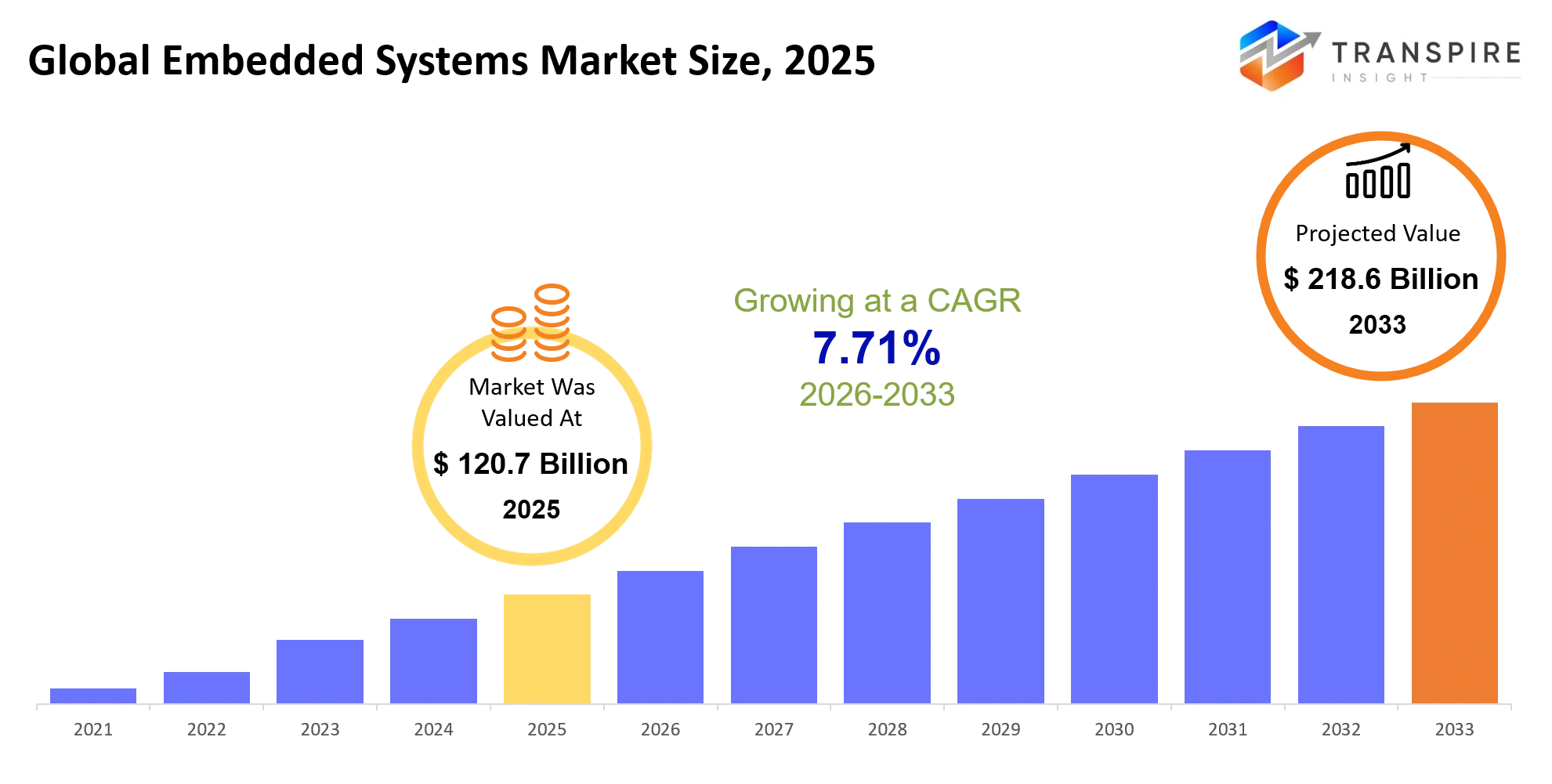
As per Transpire Insight Analysis, the Global Embedded Systems Market size is estimated at USD 120.7 Billion in 2025 and is anticipated to reach USD 218.6 Billion by 2033, growing at a CAGR of 7.71% from 2026 to 2033.
The global embedded systems market is changing from device-control-oriented devices to smart connected computing platforms for instant decision making across vehicles, industrial equipment, healthcare devices, telecom infrastructure, and consumer products that utilize these smart technologies. Companies today need to leverage embedded tech to boost productivity, reduce operating costs and take more advantage of processing at the network's edge instead of fully processing data on the cloud. Over the last five years, the industry has significantly transformed its structure towards AI-powered edge, which permits devices to analyze, infer, and act upon data autonomously with low latency. The market boom for embedded systems has been driven by extensive investments in the Industry and massive IoT deployments, which are accelerating connected device growth. Since speed, power efficiency, and automation requirements are rising, embedded systems will soon become an integral component of every industry’s technology stack. This change brings constant market growth with a continued increase in demand for MCUs, processors, networking modules and software platforms.
Key Global Embedded Systems Market Insights:
The market is moving away from the device-centric control system to intelligent edge-computing ecosystems that can be self-managed and self-analyzed. AI-powered processing, industrial digitization, and connected infrastructure are fundamentally changing the competitive landscape of embedded hardware and software markets.
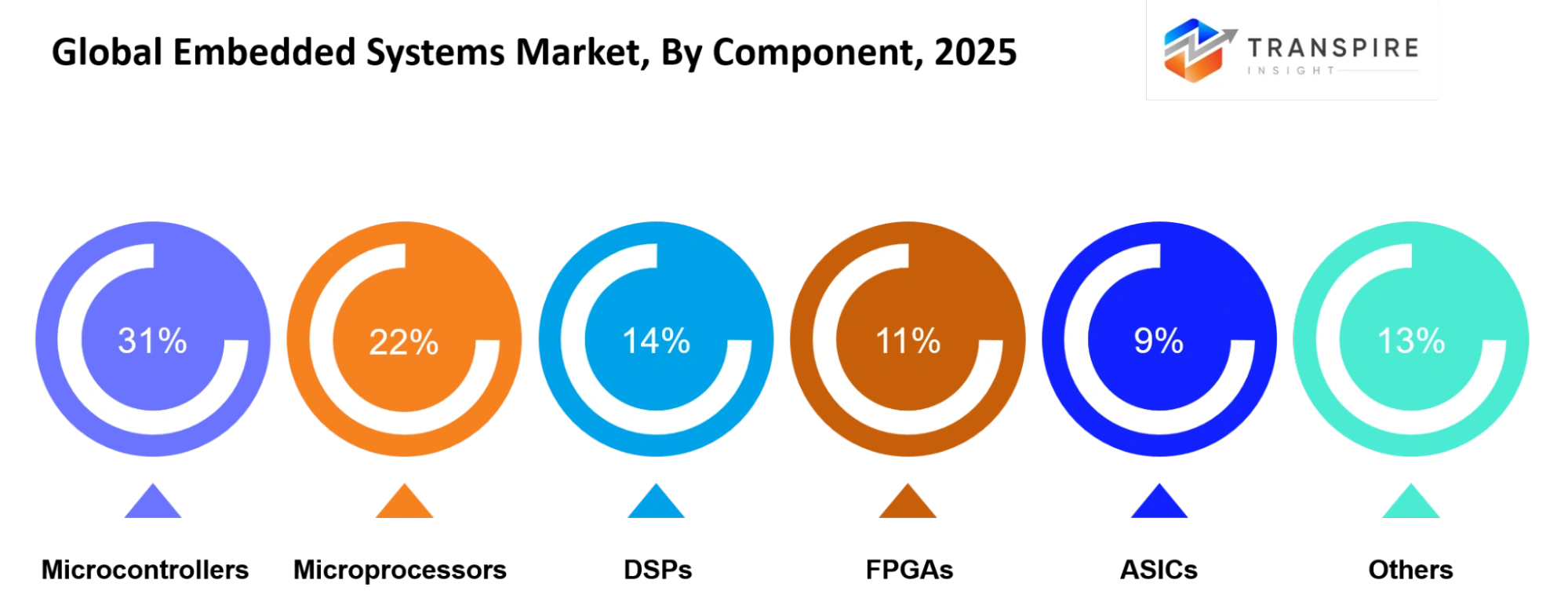
- 31% of systems are based on microcontrollers, and manufacturers are releasing ultra-low power architectures for battery-powered industrial and consumer devices.
- Embedded systems powered by AI are expected to grow at 19.6% CAGR, with on-device inference and edge intelligence adoption fuelled by the rapid growth of the industry.
- Growth in advanced automotive infotainment and autonomous control applications is driving the 22% share of embedded microprocessors.
- As telecom vendors introduce next-gen signal-processing platforms for high-bandwidth communication networks, 14% are using DSPs.
- FPGA adoption is at 11%—programmable architectures are starting to be more commonly deployed in aerospace, defence, and industrial automation workloads.
- ASIC solutions have a market share of 9%, with customized silicon development and energy-efficient computing.
- Industrial automation installations are still growing, and manufacturers are incorporating predictive maintenance into the embedded control platform.
- In response to rising cybersecurity concerns, semiconductor companies are continuing to build in security capabilities.
What are the Key Drivers, Restraints, and Opportunities in the Global Embedded Systems Market?
Driver:
Growth is primarily due to rapid smart connected infrastructure rollout by industries like automotive, consumer electronics, industrial automation, telecom and healthcare technology industries, triggered by a confluence of edge computing needs, IOT connectivity and analytics in real time for localized data processing, system reliability, and to mitigate reliance on the cloud. Hence, embedded solutions are built into industrial production equipment, connected vehicle infotainment/driver systems, smart devices for patients and in communications equipment- driving the need for component volumes as well as software license revenue.
In April 2026, Analog Devices, Inc. (ADI) partnered with automotive manufacturer XPENG to integrate intelligent, localized electrochemical impedance spectroscopy (EIS) into electric vehicle battery management platforms.
Restraint:
System design and lifecycle management challenges. Nowadays, an embedded system integrates hardware, firmware, operating system, connectivity components, cybersecurity protections, and AI features on the same hardware chip into a very condensed setup. This often leads to a long design cycle, more expensive verification costs and a lack of expertise, while lingering on-going challenges like semiconductor supply-chain dependency and integration issues make mass production, particularly with smaller businesses with few RnD personnel, an extremely demanding task.
Opportunity:
The increase of AI-native edge devices & Industrial Digital Transformation. Enterprises are pushing toward autonomous systems and making investments in products that allow machines and software to make data decisions in the edge device instead of all the data being sent back to servers for analysis. This includes smart factories deploying AI machine vision, Predictive Maintenance, robotic control products, where embedded software needs robust embedded hardware, including processors. Asian manufacturing centres and the growth of the new telecom generations (5G and beyond) are believed to generate significant long-term value streams.
In April 2026, NXP Semiconductors launched its eIQ Agentic AI Framework, extending its microprocessing software suite to handle autonomous, decision-making AI agents entirely at the chip level. This software rollout creates growth opportunities in smart factories by enabling edge hardware to optimize robotic operations and predictive maintenance locally without relying on centralized servers.
What Has the Impact of Artificial Intelligence Been on the Global Embedded Systems Market?
With growing adoption of AI, the embedded systems market is quickly shifting from simple programmable controllers to smart computing platforms with prediction, learning, and autonomous functions. Embedded AI processors, including image recognition, speech processing, anomaly detection, and machine learning inferencing, are deployed at the edge rather than the cloud to achieve low latency. In industry, embedded AI helps in proactive monitoring, performance, predictive maintenance, and process optimization. Embedded AI is finding use in auto manufacturing for ADAS, object recognition, and autonomous driving; in healthcare for patient monitoring, imaging diagnostics, and real-time analytics; and in telecom, for network optimization and intelligent traffic management. They bring in better efficiency, lower latency, better speed, reduced bandwidth usage, and less downtime due to real-time insights. However, the adoption of such processors is plagued by challenges such as costlier chips, integration difficulties, memory requirements, and power limitations. Ensuring accuracy and robustness across a wide range of ambient conditions is still necessary, especially in the areas of health, medical, safety, security and autonomy. In March 2026, Synopsys launched its open Electronics Digital Twin Platform designed to accelerate physical AI and intelligent embedded system development. This software rollout enables engineers to develop and test virtual hardware models, validating edge-AI applications and system performance before physical chip production.
Key Global Embedded Systems Market Trends:
Intelligent edge architectures are becoming the norm in the market, with AI processing, connectivity, and cybersecurity in small embedded platforms. Investments in technology are now directed toward autonomous operation, software-defined functionality and cloud-to-edge infrastructure scalability.
- The adoption of Edge AI has surged as businesses bring analytics closer to data to make decisions faster.
- Cybersecurity functions are becoming built-in and being integrated into connected device designs as standard.
- Industrial and commercial applications are moving from isolated control systems to wireless and IoT-architecture control systems.
- The demand for upgradeable embedded hardware and software is growing as software-defined automotive platforms proliferate.
- As many organizations look for flexible, open source development and scalability, embedded Linux adoption continues to grow.
- AI accelerators are being built into microcontrollers to help with local machine learning workloads by semiconductor vendors.
- As sustainability goals drive product development, energy-efficient embedded designs are becoming popular.
- Technology providers have new service-based revenue streams with cross-domain integration between cloud platforms and embedded devices.
Global Embedded Systems Market Segmentation
By Component:
Microcontrollers represent the largest segment at 31%, a position solidified by their low power, low cost and use in applications from automotive to consumer to industrial equipment. Microprocessors are a close second at 22%, driven by demand from the rise of connected equipment, including the automotive infotainment and office connectivity. The market also includes DSPs at 14%, primarily in telecom and media devices and applications needing lots of signal processing. The FPGAs at 11% market share contribute largely to aerospace and industrial automation, where design flexibility is important, and FPGAs can do the job of more ASICs.
By Software:
RTOS, for real-time predictability, continues to be vital to industrial and automotive applications. Embedded Linux has made a considerable splash because of the extendability and openness that open-source offers, and there has been a surge in development on Android embedded devices targeted at smart consumer devices. Device drivers, firmware, bare-metal embedded software, and other middleware pieces provide hardware-software integration within complex embedded systems.
By Application:
Automotive, with its focus on connected cars and driver assistance, continues to be a big area for adoption; consumer electronics also require huge volumes of connected devices and smart applications, and industrial automation adoption is being boosted by digitized factories. Sectors such as consumer healthcare, avionics and space, defence, telecommunications and energy are all demanding high-reliability embedded solutions for their critical systems.
By End-User:
OEMs represent the largest adoption base because embedded technologies are integrated directly into finished products. Enterprises, manufacturers, healthcare providers, telecom operators, government organizations, and research institutes continue expanding deployment across automation, communications, and digital infrastructure projects.
By Connectivity:
Wireless systems are finding increasing traction for portability needs, whereas in cases of reliability, wired infrastructure stays indispensable. IoT-based platforms with the backing of Bluetooth, Wi-Fi, Zigbee & cellular tech will continue gaining importance. With that, high growth prospects exist for intelligent connected devices and AI-enabled embedded systems, which are also estimated to grow with 19.6% CAGR in the coming years.
What are the Key Use Cases Driving the Global Embedded Systems Market?
Dominant growth is coming from microcontroller-based platforms that dominate the segment. Microcontrollers and related products are found in automotive controls, industrial automation, smart appliances, smart meters, and consumer goods that need highly reliable and ultra-low power microcontrollers with real-time control capabilities.
Embedded platforms are supporting applications in industrial automation, communications equipment, and medical devices, such as industrial computers that run machinery monitoring applications.
AI-based edge-computing deployments are an emerging use case that is driving demand for intelligent cameras, autonomous robots, smart city devices, automotive systems, and other intelligent systems that perform on-site analytics and decision making with embedded AI and intelligence.
|
Report Metrics |
Details |
|
Market size value in 2025 |
USD 120.7 Billion |
|
Market size value in 2026 |
USD 130 Billion |
|
Revenue forecast in 2033 |
USD 218.6 Billion |
|
Growth rate |
CAGR of 7.71% from 2026 to 2033 |
|
Base year |
2025 |
|
Historical data |
2021 - 2024 |
|
Forecast period |
2026 - 2033 |
|
Report coverage |
Revenue forecast, competitive landscape, growth factors, and trends |
|
Regional scope |
United States; Canada; Mexico; United Kingdom; Germany; France; Italy; Spain; Denmark; Sweden; Norway; China; Japan; India; Australia; South Korea; Thailand; Brazil; Argentina; South Africa; Saudi Arabia; United Arab Emirates |
|
Key company profiled |
Intel, NXP, STMicroelectronics, Texas Instruments, Renesas, Infineon, Microchip, Qualcomm, Broadcom, Analog Devices, ARM, Samsung Electronics, Toshiba, Fujitsu, Cypress Semiconductor. |
|
Customization scope |
Free report customization (country, regional & segment scope). Avail customized purchase options to meet your exact research needs. |
|
Report Segmentation |
By Component (Microcontrollers, Microprocessors, DSPs, ASICs, FPGAs, Memory Devices, Sensors, Others); By Software (RTOS, Embedded Linux, Android Embedded, Middleware, Device Drivers, Firmware, Bare Metal Systems, Others); By Application (Automotive, Consumer Electronics, Industrial Automation, Healthcare, Aerospace & Defense, Telecommunications, Energy, Others); By End User (OEMs, Enterprises, Government, Healthcare Providers, Telecom Operators, Manufacturers, Research Institutes, Others); By Connectivity (Wired, Wireless, IoT-enabled, Bluetooth, Wi-Fi, Zigbee, Cellular, Others). |
Which Regions are Driving the Global Embedded Systems Market?
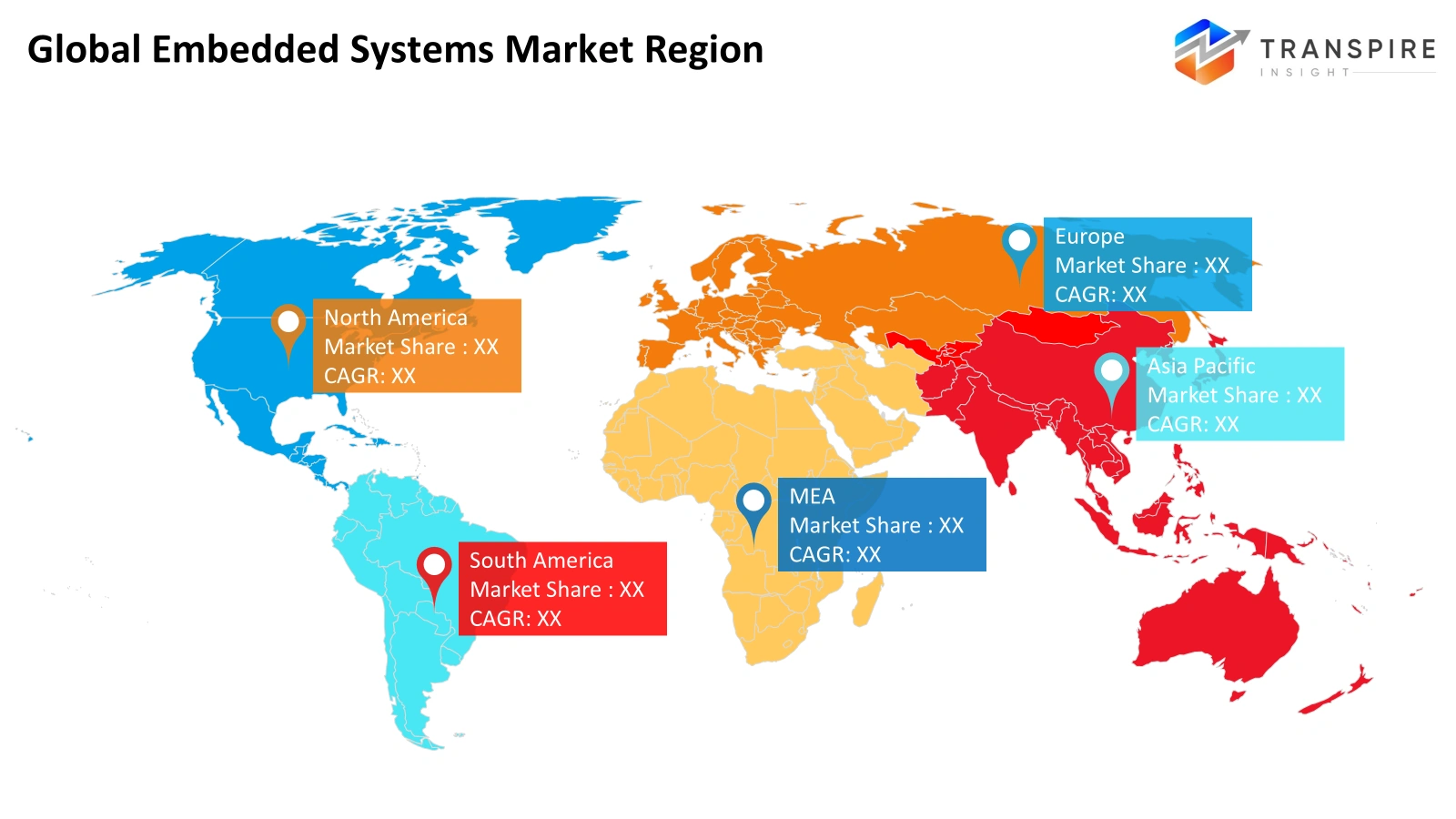
Asia Pacific represents 42% of the market and is currently the top-performing region. Large electronics manufacturing ecosystems, increasing industrial automation investments, and growing demand for semiconductors are all advantages for the region. Key economies within the Asia Pacific, like China, Japan, South Korea and India, are investing in smart manufacturing, industrial transformation, and smart infrastructures. Furthermore, a substantial output of consumer electronics, government-backed technology investment drives this sector of the region further. In April 2026, Qorix announced a strategic reseller partnership with RN Embedded Solutions Pvt. Ltd., based in India, to distribute TÜV-certified AUTOSAR Classic and Adaptive middleware platforms to local automotive OEMs and Tier-1 suppliers.
Europe makes up 23 % of the market on a worldwide scale. Unlike APAC, Europe is characterized by its sophisticated manufacturing in the automobile sector, an area where it is unmatched when it comes to Industrial and Industry adoption. A continued investment by key countries like Germany, France and the Netherlands, in industrial automation and smart factories, as well as smart and efficient embedded technologies, has been helping the overall stability of the market. In May 2026, Elektrobit and ETAS launched a fully integrated Advanced Driver Assistance Systems (ADAS) software foundation at the Automotive Engineering Exposition in Yokohama, combining EB corbos Linux for Safety Applications with the ETAS Vehicle Software Platform Suite ADAS profile.
At 27% share of the market, North America is the region expected to grow with the highest CAGR of 18.1%, with recent growth fuelled by growing investment in edge AI, autonomous systems, semiconductor technologies, and cloud-enabled embedded systems, supported by the presence of several innovative tech developers, research bodies and semiconductor companies. Potential future market in North America comes from AI empowered industrial automation, 5G and advanced telecommunications infrastructure, latest Healthcare and Smart transport applications.
Who are the Key Players in the Global Embedded Systems Market and how do they Compete?
Increased processing performance, artificial intelligence (AI) capabilities, improved connectivity, richer software environments and support throughout the long product lifecycle are at the heart of competition for embedded systems. Suppliers distinguish their products through proprietary architectures, energy-efficiency approaches, inherent embedded security features and market-segment specific offerings including automotive, industrial automation, healthcare, telecom and consumer markets.
Intel, Qualcomm and Broadcom are strongest in high-performance compute, edge intelligence and sophisticated communications on top of investments in AI acceleration, edge analytics and next-gen connectivity. ARM has the clear lead through the deeply entrenched and highly competitive business model of processor licensing across the entire embedded segment. NXP, STMicroelectronics, Texas Instruments, Renesas, Infineon and Microchip will battle in automotive, industrial automation, IoT integrated hardware-software and in the low-power and functional safety segments. Analog Devices makes a play for precision sensor and signal-processing technology. Samsung Electronics, Toshiba and Fujitsu leverage extensive experience across the breadth of their manufacturing capability and a wide array of semiconductor product families. Cypress Semiconductor adds more value to the marketplace in embedded connectivity-driven solutions. Investment in edge AI, security, and collaborative partnerships is a competitive enabler throughout the market.
Key Players are:
- Intel
- NXP
- STMicroelectronics
- Texas Instruments
- Renesas
- Infineon
- Microchip
- Qualcomm
- Broadcom
- Analog Devices
- ARM
- Samsung Electronics
- Toshiba
- Fujitsu
- Cypress Semiconductor
Recent Development News
In June 2026, Renesas Electronics Corporation completed the acquisition of software developer Pictorus to integrate a cloud-based behavioural modelling platform into its ecosystem, accelerating model-based system design and embedded application software development for engineering teams. This transition reduces tool fragmentation by enabling development within a unified cloud-based environment instead of isolated local systems.
Source: https://www.renesas.com
In June 2026, GigaDevice established a strategic global partnership with Qt Group to optimize and advance embedded Graphical User Interface (GUI) solutions for smart appliances, industrial automation frameworks, and consumer edge IoT systems. This collaboration combines GigaDevice’s 32-bit microcontrollers with high-performance HMI design tools to streamline high-efficiency motor control and display systems.
Source: https://www.businesswire.com
In March 2026, Texas Instruments launched its new MSPM0G5187 and AM13Ex microcontroller families featuring integrated TinyEngine neural processing units (NPUs) to scale low-power edge artificial intelligence capabilities across smart wearables, localized industrial sensors, and connected consumer hardware ecosystems.
Source: https://www.ti.co
What Strategic Insights Define the Future of the Global Embedded Systems Market?
AI, edge, enhanced connectivity, and software-defined architecture models will dictate the future trajectory of the embedded systems market. Value-capture, consequently, will become more sensitive to a system's capacity to deploy intelligent processing with power efficiency, security, and at scale without significantly pushing it towards the edge. However, increasing complexity can be an unseen threat to the market's progress, as the embedded system cost of developing and operating its complex systems (which accommodate multiple AI models, security functions, communication standards and applications layers) can exceed revenues for hardware manufacturers, putting at risk profit margins if system operational simplification processes aren't managed appropriately by organizations. This will also present opportunities to provide intelligent-by-design embedded systems tailored for autonomous industrial devices, transportation and public infrastructure. Solutions with hardware backed by strong and inclusive ecosystem strategies stand to unlock substantial business value.
Key Segmentations are:
By Component
- Microcontrollers
- Microprocessors
- DSPs
- ASICs
- FPGAs
- Memory Devices
- Sensors
- Others
By Software
- RTOS
- Embedded Linux
- Android Embedded
- Middleware
- Device Drivers
- Firmware
- Bare Metal Systems
- Others
By Application
- Automotive
- Consumer Electronics
- Industrial Automation
- Healthcare
- Aerospace & Defense
- Telecommunications
- Energy
- Others
By End User
- OEMs
- Enterprises
- Government
- Healthcare Providers
- Telecom Operators
- Manufacturers
- Research Institutes
- Others
By Connectivity
- Wired
- Wireless
- IoT-enabled
- Bluetooth
- Wi-Fi
- Zigbee
- Cellular
- Others
Regional Outlook
North America
- United States
- Canada
- Mexico
Europe
- Germany
- United Kingdom
- France
- Spain
- Italy
- Rest of Europe
Asia Pacific
- Japan
- China
- Australia & New Zealand
- South Korea
- India
- Rest of Asia Pacific
South America
- Brazil
- Argentina
- Rest of South America
Middle East & Africa
- Saudi Arabia
- United Arab Emirates
- South Africa
- Rest of the Middle East & Africa
Frequently Asked Questions
Find quick answers to common questions.
The global embedded systems market size was valued at USD 120.7 Billion in 2025 and is poised to reach USD 218.6 Billion by 2033, expanding at a 7.71% CAGR.
Key segments for the global embedded systems market are By Component (Microcontrollers, Microprocessors, DSPs, ASICs, FPGAs, Memory Devices, Sensors, Others); By Software (RTOS, Embedded Linux, Android Embedded, Middleware, Device Drivers, Firmware, Bare Metal Systems, Others); By Application (Automotive, Consumer Electronics, Industrial Automation, Healthcare, Aerospace & Defense, Telecommunications, Energy, Others); By End User (OEMs, Enterprises, Government, Healthcare Providers, Telecom Operators, Manufacturers, Research Institutes, Others); By Connectivity (Wired, Wireless, IoT-enabled, Bluetooth, Wi-Fi, Zigbee, Cellular, Others).
Growth is primarily driven by the accelerating deployment of intelligent connected infrastructure alongside the convergence of edge computing, IoT connectivity, and real-time analytics that require localized processing to reduce latency and lower cloud dependency.
The global embedded systems market is led by major manufacturers, including Intel, NXP, STMicroelectronics, Texas Instruments, Renesas, Infineon, Microchip, Qualcomm, Broadcom, Analog Devices, ARM, Samsung Electronics, Toshiba, Fujitsu, and Cypress Semiconductor.
Asia Pacific holds a dominant 42% market share by leveraging its massive electronics manufacturing ecosystems, surging semiconductor demand, and aggressive government-backed investments in smart manufacturing across China, Japan, South Korea, and India.
Commercial opportunities lie in the high-growth emergence of AI-native edge hardware, modular COM Express processor architectures, and industrial digital transformations implementing on-device machine vision and autonomous robotic control.
- Intel
- NXP
- STMicroelectronics
- Texas Instruments
- Renesas
- Infineon
- Microchip
- Qualcomm
- Broadcom
- Analog Devices
- ARM
- Samsung Electronics
- Toshiba
- Fujitsu
- Cypress Semiconductor
About the Authors

Avinash Kumar
I’m Avinash Kumar, a Senior Research Analyst at Transpire Insight, with expertise in the Electronics and Semiconductor and Energy & Power industry. My work focuses on analyzing emerging technologies, market trends, industry developments, and innovation across these sectors. I specialize in transforming complex technical and market insights into clear, research-backed content that helps professionals, businesses, and decision-makers stay informed. Through continuous industry research and data-driven analysis, I strive to deliver accurate, reliable, and practical perspectives on the latest advancements shaping the semiconductor and energy landscape.

Chakradhar Khansole
Chakradhar serves as the Research Director at Transpire Insight, bringing over 8 years of experience in technology, innovation, and strategic market intelligence. He specializes in transforming complex market data into actionable business insights that enable organizations to make informed, growth-oriented decisions. Recognized for his strategic vision and analytical expertise, Chakradhar leads high-impact research initiatives, delivering comprehensive market assessments, competitive intelligence, and forward-looking industry analysis.
Recently Published Reports
-
Apr 2026
Fiber Optic Faceplates Market
Fiber Optic Faceplates Market Size, Share & Analysis Report By Type (< 300 mm2, 300-350 mm2, and > 350 mm2, By Application (Night Vision, Holographic Imaging, Medical, and Others), and Geography (North America, Europe, Asia-Pacific, Middle East and Africa, South and Central America), 2021 - 2031
-
Apr 2026
High Temperature Superconductors Market
High Temperature Superconductors Market Size, Share & Analysis Report By Type (1G HTS, and 2G HTS), By Application (Power Cable, Fault Current Limiter, and Transformer), and Geography (North America, Europe, Asia-Pacific, Middle East and Africa, South and Central America), 2021 - 2031
-
Apr 2026
Industrial Plugs and Socket Market
Industrial Plugs and Socket Market Size, Share & Analysis Report By Type (Industrial Plugs, Industrial Sockets), By Current (Up to 32 A, 32 to 125 A, Above 125 A), By Protection (Dustproof and Splash Proof, Waterproof, Explosion Proof), By End User (Heavy Industries, Oil and Gas, Chemicals and Pharmaceuticals, Power Generation, Others), and Geography (North America, Europe, Asia-Pacific, Middle East and Africa, South and Central America), 2021 - 2031
-
Apr 2026
InGaAs Avalanche Photodiodes Market
InGaAs Avalanche Photodiodes Market Size, Share & Analysis Report By Type (1100 - 1700 nm, and 1000 - 1600 nm), By Application (Missile Warning System, Muzzle Flash Detection, Wafer Defect Inspection, Laser Rangefinders, and Others), and Geography (North America, Europe, Asia-Pacific, Middle East and Africa, South and Central America), 2021 - 2031