
Asia Pacific Embedded System Market Size & Forecast:
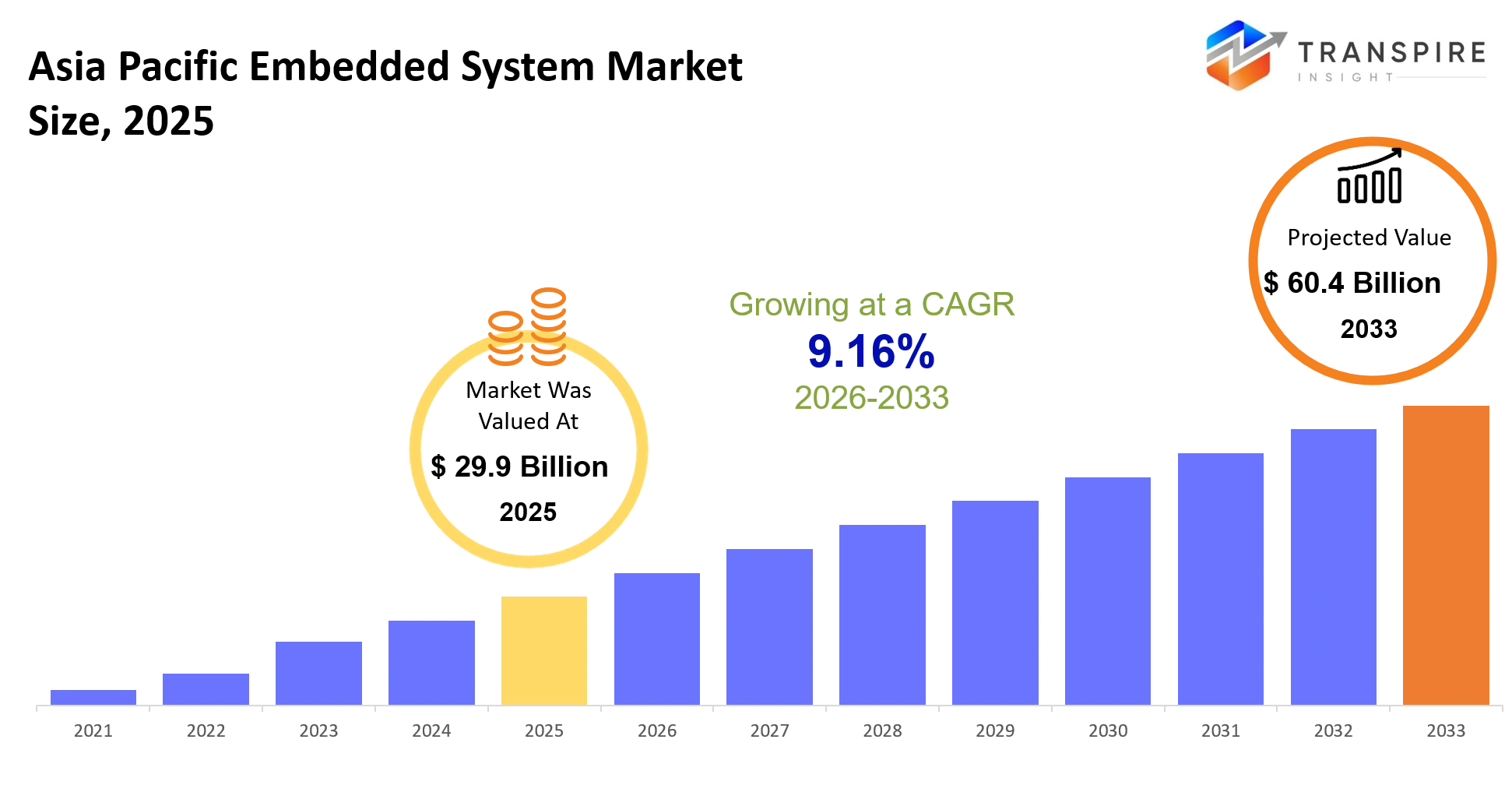
- Asia Pacific Embedded System Market Size 2025: USD 29.9 Billion
- Asia Pacific Embedded System Market Size 2033: USD 60.4 Billion
- Asia Pacific Embedded System Market CAGR: 9.16%
- Asia Pacific Embedded System Market Segments: By Component (Microcontrollers, Microprocessors, Sensors, Memory Devices, Connectivity Modules, Others); By Application (Consumer Electronics, Automotive Systems, Industrial Automation, Healthcare Devices, Aerospace & Defense, Others); By End User (Electronics Industry, Automotive Industry, Industrial Sector, Others)
To learn more about this report,  Download Free Sample Report
Asia Pacific Embedded System Market Summary
The Asia Pacific Embedded System Market was valued at USD 29.9 Billion in 2025. It is forecast to reach USD 60.4 Billion by 2033. That is a CAGR of 9.16% over the period.
The Asia Pacific Embedded System Market really sits behind the kind of intelligence you now find inside modern products and everyday infrastructure. It lets machines, vehicles, industrial apparatus, medical devices, and consumer electronics handle data, do automated actions, and keep running with less human involvement. In real conditions, embedded systems assist manufacturers in boosting production efficiency , support predictive care (as in maintenance that is planned before failures) and also make real time monitoring more practical across industrial setups and other connected spaces.
Over the last five years, the whole space has shifted in a way that is kinda structural— from mainly stand alone hardware minded designs toward software led, connected platforms that now pull in artificial intelligence along with edge computing features. That change has been pushed forward by semiconductor supply chain disruptions that showed up during and after the COVID 19 period. Because of this, many manufacturers adjusted how they source components and also redesigned products, trying to get more robustness. Since more industries are rolling out connected equipment, and then chasing automation to counter labor constraints , while improving operational visibility, embedded systems are increasingly becoming the core of digital transformation. So their job is going beyond basic device control, moving toward data based decision making. That in turn opens up additional income streams across industrial, automotive, healthcare, and consumer use cases.
Key Market Insights
- East Asia is kind of dominating the Asia Pacific Embedded System Market , with something like 45% of the regional revenue in 2025 .
- Meanwhile, Southeast Asia looks like the quickest mover during 2025–2032, mainly because smart manufacturing ecosystems keep expanding , bit by bit.
- India also keeps gaining momentum , and it seems driven by government-backed digitalization pushes that help embedded technology get adopted across industries.
- On the segment side, hardware is still the main player, and it will contribute almost 50% of the Asia Pacific Embedded System Market size in 2025 .
- Embedded software then takes the second spot, largely due to growing needs for more “intelligent device” functionality.
- AI-enabled embedded platforms are forecasted to be the fastest-growing segment all the way through 2032 , since edge intelligence adoption is accelerating.
- System-on-Chip , or SoC solutions, are getting more traction too, because they boost processing efficiency while also cutting down power consumption .
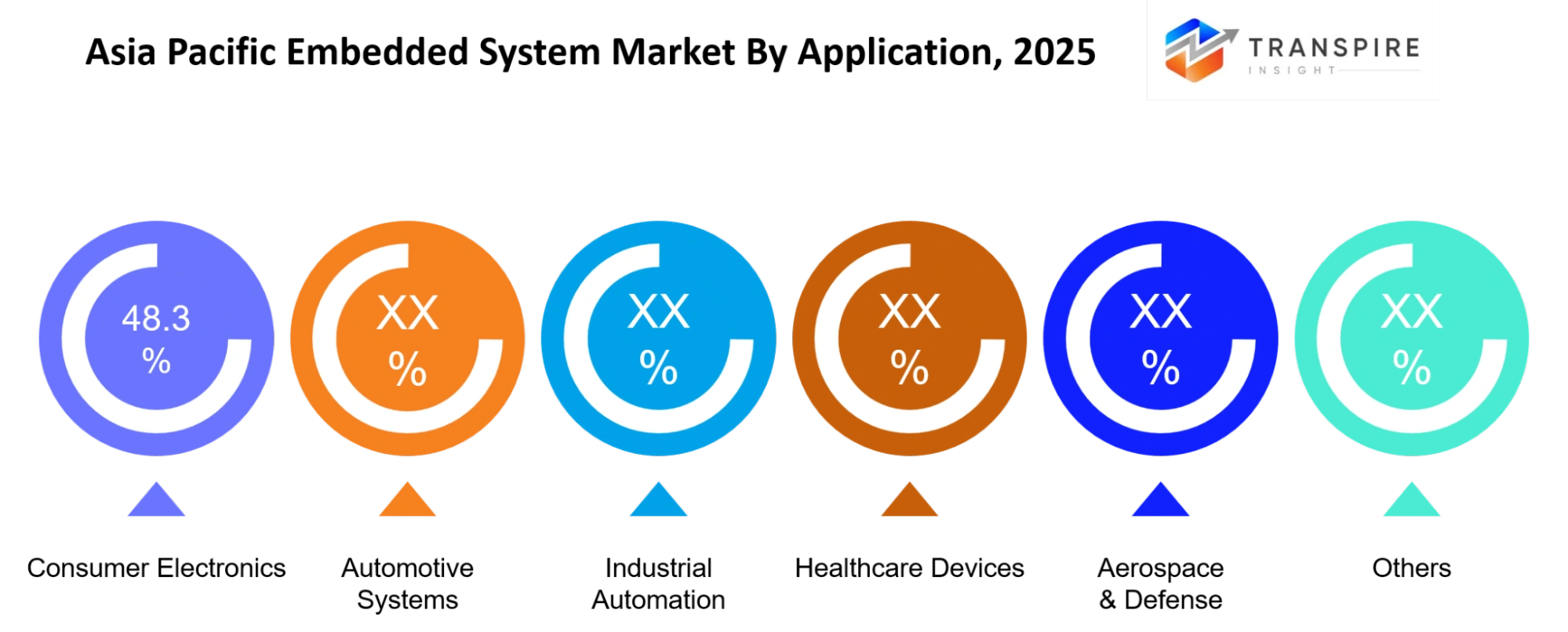
- For applications, consumer electronics lead demand, around 35% of market revenue in 2025 , roughly speaking.
- Automotive accounts for a notable portion as advanced driver assistance plus connected vehicle tech keeps expanding.
- And industrial automation shows up as the fastest-growing application segment across the forecast period .
What are the Key Drivers, Restraints, and Opportunities in the Asia Pacific Embedded System Market?
The biggest growth driver in the Asia Pacific Embedded System Market is basically the fast shift toward smarter connected infrastructure, across manufacturing automotive, and consumer electronics. That change got a real push from improvements in artificial intelligence, edge computing, and industrial Internet of Things, (IIoT) tech, which kinda makes real-time data handling more achievable and cheaper to run. Because of this manufacturers are embedding computing abilities straight into machines and equipment, not just as an add on but to boost output, cut operational pauses, and enable predictive maintenance. Also when enterprises keep pouring money into digital transformation initiatives, embedded systems are starting to move away from being only a component cost, and turning into a revenue enabling technology, which then supports more frequent deployments and pushes up the overall market worth.
One significant constraint is still the region relying heavily on a complicated semiconductor supply chain, which is concentrated in just a few countries. This problem is structural, since chip fabrication plants need billions in capital expenditure and years of testing and development before they reach full commercial capacity. So when supply gets disrupted, or when components are short in supply, or lead times stretch out too much, it can postpone product releases and delay industrial automation programs. Because of that, equipment suppliers often hold back deployments, which trims near-term revenue possibilities and slows down how fast the market can actually absorb new solutions.
A pretty big future chance is in weaving AI-enabled embedded systems into smart manufacturing setups, kind of like, the whole place gets smarter. India, and Vietnam too, are pulling in a lot of funding for electronics production and industrial upgrading. As plants roll out machine vision, autonomous quality checking, and edge-oriented analytics, the need for more capable embedded platforms should grow way past the old, more traditional uses. That should kick off a new kind of market growth, especially around these emerging industrial hubs where things are moving fast.
What Has the Impact of Artificial Intelligence Been on the Asia Pacific Embedded System Market?
Artificial intelligence plus advanced digital technologies are really moving the Asia Pacific Embedded System Market, kind of shifting embedded devices away from just basic control tasks , and toward real time decision platforms. In factory settings, AI enabled embedded controllers do more than people expect , like automated machine monitoring, quality inspection, plus production line adjustments, all while not depending so much on centralized computing resources. Industrial teams are also leaning on embedded edge devices to follow equipment performance, steer energy consumption, and handle compliance updates across linked sites, even when connectivity is a bit tricky.
On top of that, machine learning is sharpening predictive ability. Embedded systems keep on parsing sensor signals coming from motors, robotics, industrial equipment, and even connected vehicles, to spot abnormal operating behavior before anything breaks. Those predictive maintenance models support less unplanned downtime, longer asset life, and a more sensible maintenance rhythm. In automotive and industrial use cases, AI driven optimization approaches tune system efficiency, improve resource utilization, and help with safer operations through real time diagnostics and adaptive control.
And the day to day outcomes, they’re noticeable. Many organizations describe better equipment uptime, reduced maintenance expenses, quicker response windows, and more efficient use of power and computing resources. This whole set of advantages makes the business argument for wide deployment of intelligent embedded platforms feel a lot stronger, honestly.
Still, AI adoption has a key limitation. When it comes to folding machine learning abilities into embedded environments, you usually need specialized hardware, have fairly high development costs, and then there is the whole issue of collecting large amounts of high quality training data. All of that can end up slowing things down, especially for small to mid sized manufacturers with limited technical know-how or support, so progress gets kind of stuck in the same loop.
Key Market Trends
- Since 2020, a lot of manufacturers have been moving away from standalone controllers, and more toward AI enabled edge devices that process data locally, so the cloud dependency drops a bit, you know.
- Between 2020 and 2023, semiconductor shortages kind of forced OEMs to change direction , they diversified suppliers and redesigned products around what components were actually available.
- In vehicles, automotive manufacturers started adding more embedded system content per unit as electric adoption, and software defined vehicle growth, picked up across Asia Pacific.
- In industry, firms went from reactive maintenance to predictive maintenance, and they lean on embedded analytics to avoid those unexpected equipment failures, basically trying to stay ahead.
- Meanwhile China , India, and Vietnam kept expanding their domestic electronics manufacturing investments. This reduces how much they rely on imported components, and it also helps the regional supply chains hold together better.
- Embedded software also became more strategic, because buyers after 2021 started preferring upgradable platforms, rather than fixed function hardware. That shift mattered, a lot.
- Big names like Intel Corporation, NXP Semiconductors, and Renesas Electronics Corporation increased their spending on AI capable processors and edge computing solutions, trying to stay in the forefront.
- Energy efficiency turned into a major buying criterion too. Manufacturers started adopting low power architectures to support battery operated and connected devices, which makes sense.
- Also, industrial automation projects increasingly brought embedded systems together with IoT networks, so real time monitoring works across factories and logistics operations.
- And overall competition shifted, it was not only about hardware performance anymore. It became more about integrated ecosystems, combining processors, software tools, cybersecurity features and even cloud connectivity, all in one package.
Asia Pacific Embedded System Market Segmentation
By Component :
Microcontrollers kind of sit at the base of a lot of embedded systems ,because they take care of specific control chores inside electronic devices and industrial gear. Their small footprint, low power use, and steady operation make them a good fit when continuous monitoring and control is needed. You see them pretty much everywhere ,like in home electronics, vehicle related functions, and in industrial machinery, so adoption stays pretty constant.
Microprocessors ,on the other hand, bring more compute ability when a project needs advanced data processing plus real multitasking. Sensors then collect signals from the surrounding setting ,for example temperature, pressure, movement, and position ,and this helps the embedded system react with more precision when conditions shift. Memory devices are there too, they hold the instruction set and the actual application data so everything runs smoothly without stalling.
For talking to the outside world, connectivity modules handle communication among devices, networks, and cloud services using things like Wi‑Fi, Bluetooth, or cellular links. There are also other bits in the stack, including power management units, interface controllers, and specialized integrated circuits, these cover the kind of targeted operational needs that show up across different embedded uses.
By Application :
Consumer electronics are like a big playground for embedded systems, they power stuff in smartphones, smart televisions , wearable devices, home appliances, and gaming products. With embedded technologies the whole device can run better , use less energy, and feel smoother for people while still making it easier to get connected, and also turning on those automation vibes.
In cars, embedded solutions show up everywhere, for example engine control, safety routines, infotainment systems, battery supervision, and then advanced driver assistance features. In industry, factory automation leans on embedded platforms to watch over production processes, steer machinery, and enable predictive maintenance work. This kind of support often bumps up productivity , and keeps operations more efficient.
Healthcare gear also uses embedded systems for patient watch, diagnostic equipment, imaging systems, and portable medical instruments. In aerospace and defense, the requirements are tougher so reliable embedded technology is needed for navigation, surveillance, communication, and mission critical tasks. Beyond that, you can find smart infrastructure, energy management systems, and transportation networks that depend on intelligent control, in a way that feels coordinated and planned.
To learn more about this report, Download Free Sample Report
By End User :
The electronics industry counts as a major end user segment because embedded technologies keep getting stitched into both consumer electronics and business products. There is also this steady kind of product refresh, quicker development cycles, and a larger push for connected devices, all of which nudge companies toward broad embedded solutions in this area, really.
Then, the automotive industry leans more and more on embedded systems to cover safety needs, better connectivity, electrification efforts, and automation features. Embedded platforms basically help handle all those tangled vehicle functions, and at the same time they push forward driving control, passenger comfort, and the required compliance with industry norms that keep changing. With electric vehicle output ramping up, adoption keeps getting reinforced across automotive manufacturing lines too.
Meanwhile, in the industrial sector, embedded technologies are used to tighten operational governance, improve process steering, enable equipment surveillance, and raise production efficiency. Smart manufacturing projects keep on promoting wider deployment of intelligent embedded platforms. And beyond that, other end users show up like healthcare organizations, aerospace organizations, telecommunications providers, and energy operators looking for dependable and effective system work, day to day.
What are the Key Use Cases Driving the Asia Pacific Embedded System Market?
Consumer electronics still feel like the main thing driving demand for embedded systems across Asia Pacific. Smartphones, wearables, smart televisions, and connected household appliances all depend on embedded tech to handle processing, connectivity, power use, and how people interact with the device. Because production runs are huge, and upgrades keep coming out, electronics manufacturers stay thirsty for new components, and whole embedded platforms.
Then there’s automotive plus industrial automation, which is also growing fast. Vehicle makers are putting embedded platforms inside electric vehicles, battery management systems, infotainment units, and those advanced driver assistance functions. In industry, embedded solutions back machine monitoring, predictive maintenance, and automated production control. That helps factories get better operational efficiency, plus reduce downtime, in a more steady way.
More recently, you see use cases forming around edge AI and smart healthcare. AI-enabled embedded devices can process data right on site, for faster decisions in factories and intelligent infrastructure projects. For healthcare, connected diagnostic equipment and remote patient monitoring are getting a lot of attention, healthcare teams want smoother and more data-driven service delivery models across the region .
|
Report Metrics |
Details |
|
Market size value in 2025 |
USD 29.9 Billion |
|
Market size value in 2026 |
USD 32.7 Billion |
|
Revenue forecast in 2033 |
USD 60.4 Billion |
|
Growth rate |
CAGR of 9.16% from 2026 to 2033 |
|
Base year |
2025 |
|
Historical data |
2021 - 2024 |
|
Forecast period |
2026 - 2033 |
|
Report coverage |
Revenue forecast, competitive landscape, growth factors, and trends |
|
Regional scope |
Asia Pacific (India, China, Japan, Australia,South Korea, Rest of Asia Pacific) |
|
Key company profiled |
Intel, ARM Holdings, STMicroelectronics, NXP Semiconductors, Renesas Electronics, Texas Instruments, Qualcomm, Samsung Electronics, Infineon Technologies, Analog Devices, Microchip Technology, Broadcom, MediaTek, Toshiba, Cypress Semiconductor |
|
Customization scope |
Free report customization (country, regional & segment scope). Avail customized purchase options to meet your exact research needs. |
|
Report Segmentation |
By Component (Microcontrollers, Microprocessors, Sensors, Memory Devices, Connectivity Modules, Others); By Application (Consumer Electronics, Automotive Systems, Industrial Automation, Healthcare Devices, Aerospace & Defense, Others); By End User (Electronics Industry, Automotive Industry, Industrial Sector, Others) |
Which Regions are Driving the Asia Pacific Embedded System Market Growth?
East Asia still shows up as the key region in the Asia Pacific Embedded System Market, mainly because it stacks a lot of semiconductor production, has advanced electronics output, and also gets solid government backing for technology growth. In practice, China, Japan, South Korea, and Taiwan form this pretty mature ecosystem that links chip fabrication, component suppliers , device makers, and even research organizations. A lot of the national efforts—like programs around digital infrastructure, industrial automation, and semiconductor self reliance—keep nudging spending along the whole value chain, so investment stays “on”. With manufacturing at scale, strong technical know-how, and deep supply-chain coverage, the area keeps its top role pretty steadily.
Southeast Asia, on the other hand, feels more like a dependable revenue supporter with reasons that look a bit different. Instead of leaning on semiconductor supremacy, countries such as Singapore, Malaysia, Thailand, and Vietnam tend to benefit from steady foreign capital, export oriented manufacturing, and a slower but clear industrial modernization path. Big global electronics brands keep extending production footprints there, partly to spread supply chain exposure and also to lower concentration risk. And the continued push to expand manufacturing capacity, plus business policies that don’t get in the way, ends up making a stable base for embedded system uptake across several sectors.
South Asia is showing up as this fastest growing regional market, mostly steered by India. Lately, investments in electronics manufacturing and the whole semiconductor push, plus upgrades to digital infrastructure and smart factory development are helping technology land faster across different industrial fields. At the same time, government incentive programs have sort of nudged domestic and international companies to widen local production, while also building in embedded technology integration. You can expect this momentum to open up solid opportunities for technology providers, component suppliers and even investors during the 2026–2033 stretch.
Who are the Key Players in the Asia Pacific Embedded System Market and How Do They Compete?
In the Asia Pacific Embedded System Market the competitive landscape feels, sort of, moderately consolidated, you know global semiconductor giants are in the mix, but also some regional specialists and design driven firms. A lot of the pushing comes from tech innovation and not really just cost, even if pricing still matters. It’s more about processing efficiency, software integration abilities, and the long term supply reliability. Older suppliers tend to hold on to share by keeping wider product portfolios and by having those deep customer relationships. Meanwhile newer players often aim at artificial intelligence, edge computing , and also more application tailored solutions. As industries start taking up more connected, and more “intelligent” devices, the firms that can merge hardware, software, and development tools into one kinda unified ecosystem seem to get the better stance in competition.
Intel, for example, is centered around high-performance embedded computing platforms for industrial automation, edge analytics and artificial intelligence workloads. A real point of difference is how it blends stronger processing power with software development frameworks so deployment stays simpler across several kinds of applications. Intel keeps extending its reach with partnerships across industrial technology providers, plus investments that go toward edge AI solutions which support smart manufacturing initiatives.
NXP Semiconductors instead leans hard into automotive electronics, industrial control systems, and secure connectivity use cases. Their advantage comes largely from functional safety know-how, vehicle networking, and secure embedded processing, which together create separation in automotive as well as industrial markets.
Renesas Electronics kind of leverages strengths across microcontrollers , automotive semiconductors , and power-efficient embedded solutions, you know it works. They also push their reach by means of strategic acquisitions and more integrated hardware-software platforms , which tends to lower the whole product development complexity, a bit. STMicroelectronics on the other hand differentiates with low power designs , industrial sensors, plus microcontrollers that are optimized for the Internet of Things type of applications. They keep investing in artificial intelligence enabled edge devices and maintain partnerships across automotive, industrial, and consumer electronics sectors, so expansion keeps moving throughout Asia Pacific as well .
Company List
- Intel
- ARM Holdings
- STMicroelectronics
- NXP Semiconductors
- Renesas Electronics
- Texas Instruments
- Qualcomm
- Samsung Electronics
- Infineon Technologies
- Analog Devices
- Microchip Technology
- Broadcom
- MediaTek
- Toshiba
- Cypress Semiconductor
Recent Development News
In April 2026, Geniatech entered a partnership with NXP Semiconductors by officially joining the NXP Partner Program. The collaboration strengthens the development of edge AI and embedded solutions for industrial, IoT, automotive, and smart-device applications, enhancing scalability and performance across embedded systems deployments.
Source https://markets.financialcontent.com/
In March 2026, GOWIN Semiconductor launched its next-generation Arora GW1AN and GW3A FPGA families. The new programmable logic devices expand the company’s portfolio for embedded applications, offering enhanced integration flexibility and long-term production support for industrial, consumer, and IoT system developers.
Source https://www.asiapacificenergywatch.com/
What Strategic Insights Define the Future of the Asia Pacific Embedded System Market?
The Asia Pacific Embedded System Market is heading toward a future where more intelligent processing happens directly at the device level, not so much like, depending on centralized cloud infrastructure all the time. In the next five to seven years the mix of artificial intelligence plus edge computing, industrial automation, and software defined products is likely to change how buyers decide what to purchase. Value creation will probably move away from just standalone hardware power, and instead lean into integrated platforms that pull together processing power, software, connectivity, cybersecurity, and real time analytics, in a more unified way.
There is also this kind of hidden risk that is easy to overlook. Advanced semiconductor production is becoming more concentrated in a small number of manufacturing hubs. Even if today’s investment looks pretty solid, future geopolitical tensions, export controls, or supply chain disturbances could still cause bottlenecks. When that happens, product availability can get slowed down, and development costs may climb across the whole region.
On the opportunity side, one emerging opening looks tied to AI-enabled embedded platforms showing up more in India’s growing smart manufacturing efforts. As local electronics production grows, and factory modernization programs keep moving forward, the demand for intelligent edge devices should jump quite sharply. Market players should focus on partnerships that bundle hardware with software, plus system integration know-how, because customers are increasingly asking for complete solutions rather than single parts, or only discrete components.
Asia Pacific Embedded System Market Report Segmentation
By Component
- Microcontrollers
- Microprocessors
- Sensors
- Memory Devices
- Connectivity Modules
By Application
- Consumer Electronics
- Automotive Systems
- Industrial Automation
- Healthcare Devices
- Aerospace & Defense
By End User
- Electronics Industry
- Automotive Industry
- Industrial Sector
Frequently Asked Questions
Find quick answers to common questions.
The Asia Pacific Embedded System Market size is USD 60.4 Billion in 2033.
Key segments for the Asia Pacific Embedded System Market are By Component (Microcontrollers, Microprocessors, Sensors, Memory Devices, Connectivity Modules, Others); By Application (Consumer Electronics, Automotive Systems, Industrial Automation, Healthcare Devices, Aerospace & Defense, Others); By End User (Electronics Industry, Automotive Industry, Industrial Sector, Others).
Major Asia Pacific Embedded System Market players are Intel, ARM Holdings, STMicroelectronics, NXP Semiconductors, Renesas Electronics, Texas Instruments, Qualcomm, Samsung Electronics, Infineon Technologies, Analog Devices, Microchip Technology, Broadcom, MediaTek, Toshiba, Cypress Semiconductor.
The Asia Pacific Embedded System Market size is USD 29.9 Billion in 2025.
The Asia Pacific Embedded System Market CAGR is 9.16% from 2026 to 2033.
- Intel
- ARM Holdings
- STMicroelectronics
- NXP Semiconductors
- Renesas Electronics
- Texas Instruments
- Qualcomm
- Samsung Electronics
- Infineon Technologies
- Analog Devices
- Microchip Technology
- Broadcom
- MediaTek
- Toshiba
- Cypress Semiconductor
About the Authors

Mayur Shinde
I am Mayur Shinde, a Senior Research Analyst at Transpire Insight, specializing in the Automotive & Transportation and Information & Communication Technology (ICT) Industry. My work focuses on analyzing emerging market trends, technological advancements, competitive landscapes, and industry developments to deliver accurate, data-driven insights. I am passionate about transforming complex market information into clear, actionable content that helps businesses, professionals, and decision-makers stay informed and make confident strategic decisions.

Chakradhar Khansole
Chakradhar serves as the Research Director at Transpire Insight, bringing over 8 years of experience in technology, innovation, and strategic market intelligence. He specializes in transforming complex market data into actionable business insights that enable organizations to make informed, growth-oriented decisions. Recognized for his strategic vision and analytical expertise, Chakradhar leads high-impact research initiatives, delivering comprehensive market assessments, competitive intelligence, and forward-looking industry analysis.
Recently Published Reports
-
Apr 2026
3D Optical Profiler Market
3D Optical Profiler Market Size, Share & Analysis Report By Type (Desktop 3D Optical Profiler, and Portable 3D Optical Profiler), By Technology (Confocal Technology, and White Light Interference), By End-Use Industry (Manufacturing, Research Institutions, Automotive, Aerospace and Defense, Medical Devices, and Other), and Geography (North America, Europe, Asia-Pacific, Middle East and Africa, South and Central America), 2021 - 2031
-
Apr 2026
Depth Sensor Market
Depth Sensor Market Size, Share & Analysis Report By Type (Infrared Depth Sensors, Time-of-Flight (ToF) Sensors, Stereo Vision Sensors, Structured Light Sensors, Ultrasonic Depth Sensors), By Application (Automotive, Robotics, Gaming, Consumer Electronics, Industrial Automation, Healthcare, Security & Surveillance, Others), By End Users (Automotive Manufacturers, Consumer Electronics Companies, Healthcare Providers, Industrial Companies, Security Agencies, Gaming Companies, Robotics Companies, Others), and Geography (North America, Europe, Asia-Pacific, Middle East and Africa, South and Central America), 2021 – 2031
-
Apr 2026
Digital Manufacturing Market
Digital Manufacturing Market Size, Share & Analysis Report By Component (Hardware, Software, and Services), By Technology (Robotics, 3D Printing, Internet of Things (IoT), and Others), By Application (Automotive and Transportation, Aerospace and Defense, Consumer Electronics, Industrial Machinery, and Others), By Process Type (Computer-Based Designing, Computer-Based Simulation, Computer 3D Visualization, Analytics, and Others), and Geography (North America, Europe, Asia-Pacific, Middle East and Africa, South and Central America), 2021 – 2031
-
Apr 2026
Digital Visa Services Market
Digital Visa Services Market Size, Share & Analysis Report By Type (Individual Travelers, Group Travelers), By Application (Tourism, Business Travel, Others), and Geography (North America, Europe, Asia-Pacific, Middle East and Africa, South and Central America), 2021 – 2031