
Europe Grid Edge Technologies Market Size & Forecast:
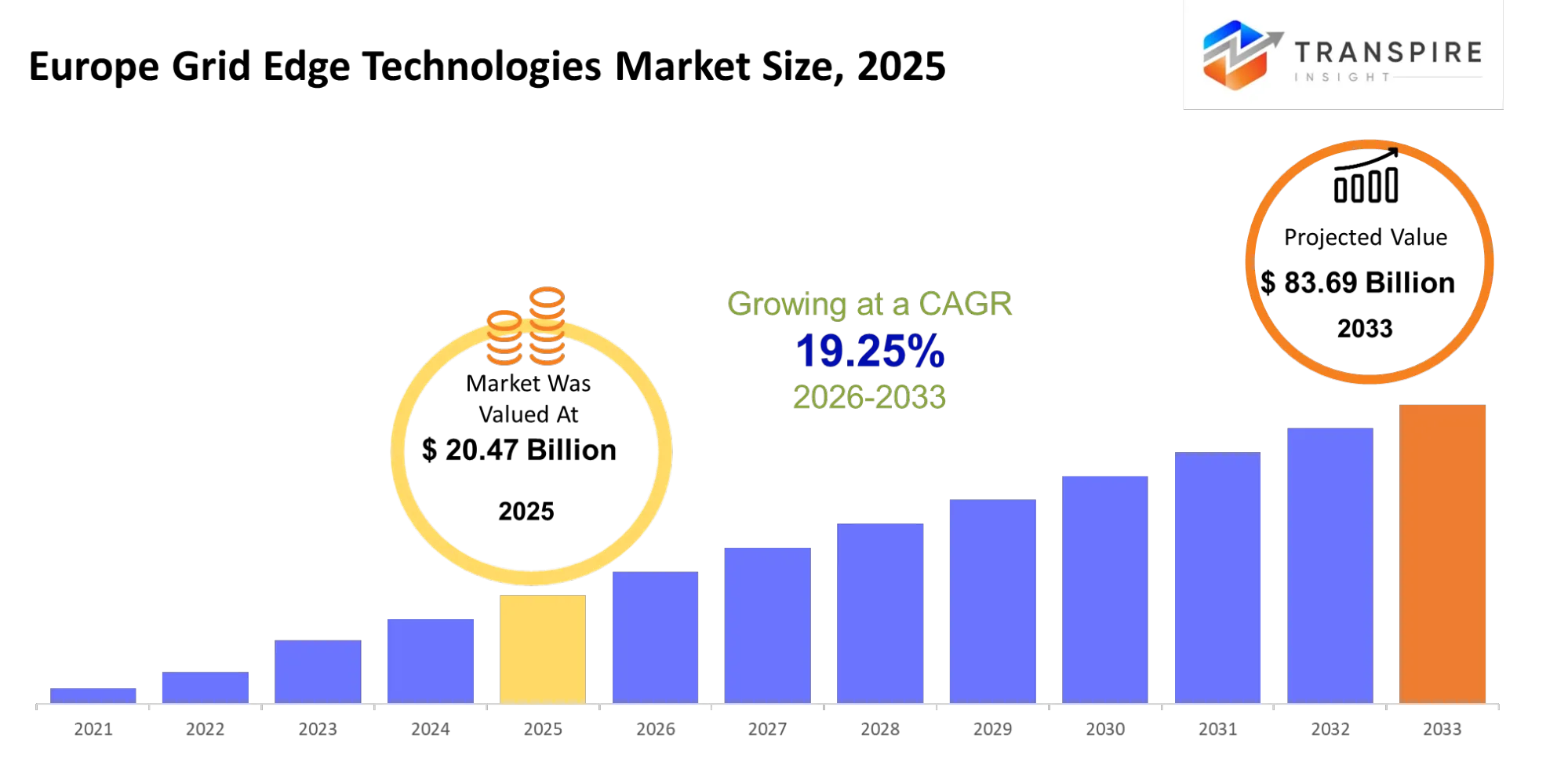
- Europe Grid Edge Technologies Market Size 2025: USD 20.47 Billion
- Europe Grid Edge Technologies Market Size 2033: USD 83.69 Billion
- Europe Grid Edge Technologies Market CAGR: 19.25%
- Europe Grid Edge Technologies Market Segments: By Type (Smart Meters, Energy Storage, Microgrids, Others), By Application (Demand Response, Grid Optimization, Energy Management, Others), By End-User (Utilities, Commercial, Residential, Industrial, Others), By Component (Hardware, Software, Services, Others).
To learn more about this report,  Download Free Sample Report
Europe Grid Edge Technologies Market Summary:
The Europe Grid Edge Technologies Market size is estimated at USD 20.47 Billion in 2025 and is anticipated to reach USD 83.69 Billion by 2033, growing at a CAGR of 19.25% from 2026 to 2033. The Europe Grid Edge Technologies Market has become essential for utilities and industrial operators to control unpredictable power supply fluctuations and matches their renewable energy source requirements and their need to manage electricity price changes.
Grid edge systems establish connections between smart meters and distributed energy resources and EV charging networks and battery storage and industrial control systems to deliver real-time load balancing solutions that help operators avoid costly grid system updates. The capability has gained significance because Europe promotes electrification for its transport networks and manufacturing sectors and residential heating systems.
The market has transitioned during the past five years from centralized grid management systems to decentralized energy orchestration systems that operate through software-based solutions. The energy crisis that occurred because of the Russia-Ukraine conflict showed Europe its energy dependence on imported fuel while revealing weaknesses in grid infrastructure protection. Utilities and commercial facilities adopted demand response platforms and AI-based grid analytics and localized storage systems to decrease their costs for peak electricity usage and interruptions in electricity supply because of the unpredictable electricity market. The transition results in two outcomes which include increasing recurring software and energy management revenues and speeding up implementation times for smart infrastructure providers.
Key Market Insights
- The Europe Grid Edge Technologies Market is experiencing steady growth because of three factors which include grid decentralization and EV charging expansion and the industrial sector's need for real-time energy optimization.
- Digital grid modernization programs which receive regulatory support created more than 38% of the market share for smart meters and distributed energy management platforms in 2025.
- AI grid analytics emerged as a primary trend in the Europe Grid Edge Technologies Market because it enables utilities to decrease outage risks and enhance their energy balancing operations.
- Germany maintained market leadership during 2025 with a 27% market share because of its commitment to renewable energy integration and its development of advanced smart infrastructure systems.
- The Nordic countries constitute the most rapidly developing regional cluster until 2030 because they invest heavily in digital substations and battery storage systems.
- The European Grid Edge Technologies Market sees its largest market share in Western Europe because utilities are implementing extensive smart grid systems and connecting distributed energy resources.
- The Eastern European region is experiencing its highest growth rate because governments are using EU energy transition funding to upgrade their outdated transmission systems.
- The UK and France are increasing their virtual power plant installations to decrease electricity demand fluctuations which occur when renewable energy sources generate power.
- The market in 2025 reached its highest share with hardware solutions which accounted for 44% of the market because of the extensive use of smart meters and sensors and grid automation devices.
- The software platforms market segment became the second largest segment because utilities are increasingly using predictive analytics together with cloud-based grid monitoring systems.
- The market share of distributed energy resource management reached 31% in 2025 because utilities used it to manage renewable energy fluctuations across their decentralized power systems.
What are the Key Drivers, Restraints, and Opportunities in the Europe Grid Edge Technologies Market?
The Europe Grid Edge Technologies Market experiences its most powerful market expansion because European countries are moving away from traditional energy systems to adopt decentralized energy systems. The growing use of renewable energy sources especially rooftop solar systems and battery storage and electric vehicle charging stations has created new challenges for traditional power grids which depend on centralized operations. The energy transition became more urgent after the Russia-Ukraine war showed European nations about their energy supply chain vulnerabilities and made them choose to stop using foreign energy sources. The response from utilities included greater funding for smart meter installations and systems that manage distributed energy resources and systems that use artificial intelligence to analyze grid operations. These technologies enable operators to monitor energy usage changes throughout the day while decreasing operational costs and preventing costly transmission system enhancements, which helps obtain better operational results and produces continuous software income.
The market faces its most significant structural challenge because Europe operates multiple disconnected grid systems and different regulatory frameworks. Many utilities continue to use their outdated transmission and distribution systems which were built more than 30 years ago and lack the capacity to handle two-way energy distribution and digital technologies. The process of upgrading these networks requires lengthy financial commitments that need both regulatory permission and system connection improvements to be implemented across numerous network components. The complicated system makes it difficult to complete projects on schedule while increasing operational expenses and decreasing adoption rates among smaller utilities who struggle with money management.
Virtual power plants together with grid-interactive battery networks create a significant opportunity for business expansion. Germany and the Netherlands present active improvements in their distribution storage systems which connect residential batteries with electric vehicles and commercial energy assets to develop adaptable grid resources. The ongoing electricity price fluctuations lead utilities and industrial operators to consider these platforms as income-producing assets instead of emergency power backup systems.
What Has the Impact of Artificial Intelligence Been on the Europe Grid Edge Technologies Market?
The Europe Grid Edge Technologies Market experiences transformation through artificial intelligence and advanced digital technologies which enable utilities to perform grid balancing and energy distribution and decentralized asset management tasks with improved accuracy. Utilities use AI distribution management systems to control voltage and activate demand response and detect outages throughout their smart grid systems. The platforms continue to study meter data and substation information and electric vehicle charging system data and distributed power resources data which helps operators maintain power balance without human assistance during renewable energy generation variations.
The process of predictive maintenance and load forecasting now relies on machine learning models to fulfill its requirements. Grid operators use historical consumption data and weather patterns and equipment performance metrics to predict transformer failures and optimize battery dispatch and forecast peak electricity demand. The approach enables utilities to decrease unexpected service interruptions while increasing equipment use and decreasing maintenance expenses. European utilities that implemented AI-powered analytics into their distribution systems have achieved measurable enhancements in outage response times and better operational efficiency.
European AI adoption experiences a significant challenge because the continent contains multiple disconnected legacy systems. The majority of utilities run incompatible grid systems which produce variable data quality problems that create expensive and lengthy and complex challenges for organizations to implement AI across their entire operations.
Key Market Trends
- The European utilities market has experienced increased smart meter implementations since 2021 because dynamic electricity pricing created demands for continuous monitoring of energy usage.
- The Germany government expanded its distributed battery integration programs because the Russia-Ukraine war revealed weaknesses in European energy systems which depend on centralized power distribution.
- Between 2020 and 2025 utilities changed their procurement methods from hardware-based systems to subscription services for grid analytics platforms which helped them maintain stable operational expenses.
- The operators selected AI-driven predictive maintenance when they observed that it led to faster outage resolution and better transformer performance in digital substations.
- Since 2023 peak-load penalties have driven up operational expenses for urban charging networks which led EV charging operators to adopt demand response software solutions.
- Siemens AG and Schneider Electric both expanded their utility partnerships to implement AI-based virtual power plant systems.
- The Nordic countries increased their investments in decentralized energy storage systems because renewable energy sources created difficulty in balancing power needs during peak winter demands.
- European authorities established stricter cybersecurity requirements for smart grids after hackers executed ransomware attacks against energy networks which revealed vulnerabilities in old control system technology.
- Industrial facilities started using edge-based energy management systems because electricity price changes started affecting their manufacturing profits between 2022 and 2025.
- Utility companies preferred cloud-native grid orchestration platforms because they needed rapid system implementation and computerized network connection across multiple platforms.
Europe Grid Edge Technologies Market Segmentation
By Type
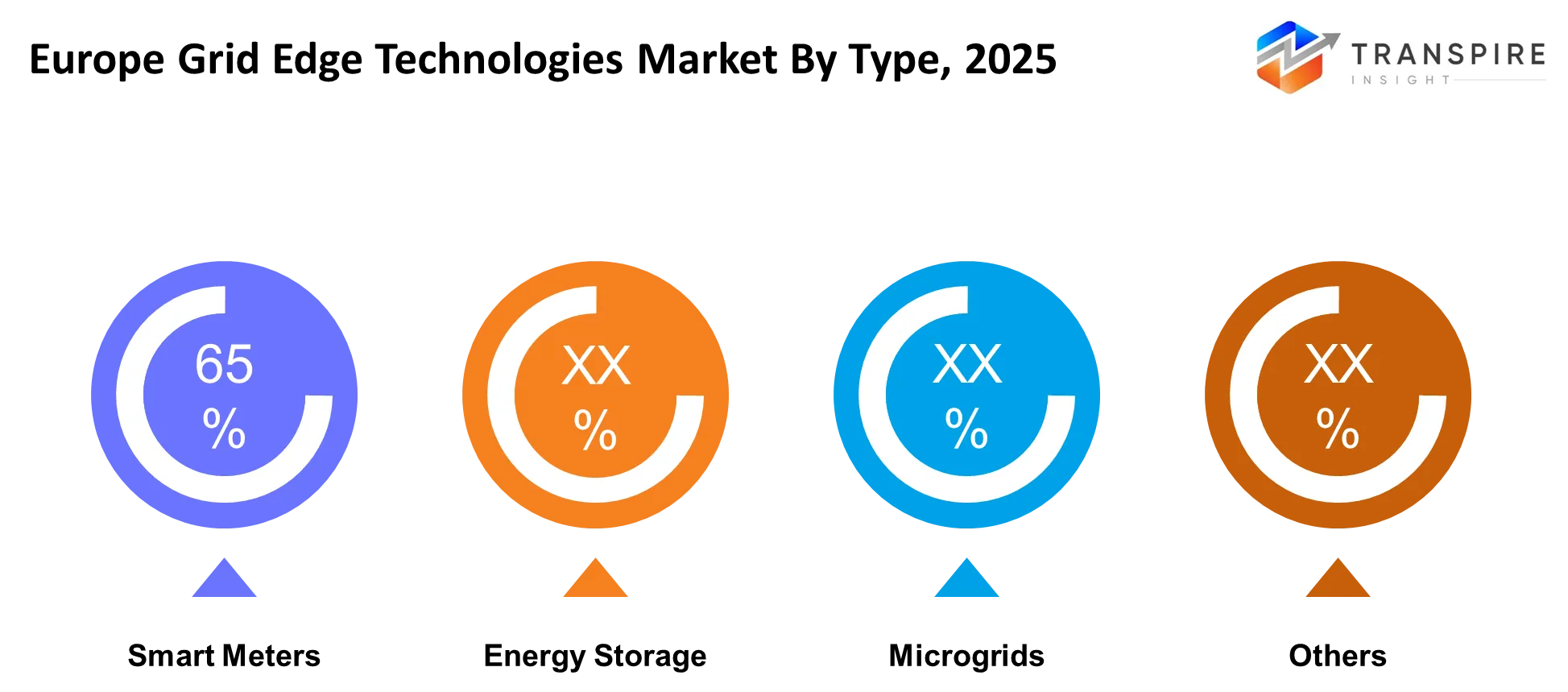
Smart meters hold the leading position within the type segment because utilities across Europe continue large-scale digital grid modernization programs. The two countries of Germany and France along with Italy and the Nordic region implemented advanced metering infrastructure together with dynamic electricity pricing solutions because these systems met regulatory requirements. Energy storage systems represent the fastest-expanding category as grid operators seek flexible balancing capacity for intermittent renewable generation. The number of lithium-ion battery installations experienced significant growth after electricity prices became unstable during the 2022 energy crisis.
Microgrids found increasing adoption in industrial zones and distant business sites where organizations needed energy reliability for their operations. The existing energy optimization processes at local sites receive ongoing support from distributed control platforms and edge intelligence devices. The upcoming investments will fund integrated systems which merge storage solutions with smart metering and AI-powered automation. The utilities require scalable platforms for decentralized energy management which has led manufacturers to concentrate on developing cybersecurity capabilities and interoperability features.
By Application
The primary application area of demand response continues to lead because electricity utilities need adaptable solutions which help them maintain grid stability during times of maximum power usage. Industrial operators and commercial facilities increasingly participate in automated demand response programs to reduce exposure to volatile power pricing and grid penalties. Grid optimization applications achieved substantial market growth as increased renewable energy use brought operational difficulties to transmission and distribution systems. Utilities use advanced analytics together with edge-based monitoring systems to enhance their ability to manage power distribution and handle power outages.
The energy management applications system is developing quickly across commercial spaces, electric vehicle charging systems, and data centers because businesses need to control energy expenditures to maintain their profitability. The rise of decentralized power generation systems is driving the growth of both distributed energy resource coordination and virtual power plant integration which are used in modern energy systems. The future of the company will rely on its ability to use AI-based forecasting and real-time control systems which will drive software companies and infrastructure providers to build systems that support flexible operations and automatic processes.
By End-User
The end-user segment remains under utility control because European energy transition programs give priority to grid modernization and renewable energy integration. The largest transmission and distribution operators spend the most money on smart grid technologies and advanced sensors and distributed energy management systems. The industrial sector experienced rapid growth because businesses needed to control rising electricity costs while ensuring continuous production.
Businesses implement localized storage systems together with intelligent energy optimization platforms to control expenses while building operational strength. European markets witnessed commercial buildings which include retail centers and office complexes and logistics hubs to expand their use of automated energy control systems after energy efficiency regulations became stricter. The residential market expands through smart home energy platforms and rooftop solar systems but high initial costs prevent widespread adoption. Future market direction indicates stronger connections between utility-scale infrastructure and customer-operated distributed energy systems.
By Component
The main element of the system consists of hardware because utility companies keep spending their resources on smart meters, communication devices and sensors and transformers and edge control infrastructure. The Western European region established consistent equipment procurement needs through its implementation of large-scale deployment programs which required physical grid modernization equipment. The software solutions market ranks as the second largest segment which shows rapid growth because utilities now focus on developing predictive analytics systems and distributed energy management systems and cloud-based monitoring systems. Artificial intelligence systems now enable automatic fault detection and energy forecasting and grid balancing optimization.
The services market developed into a vital business area because organizations need specialists to handle their implementation challenges and cybersecurity needs and interoperability issues. System integration services experienced particularly strong demand as legacy infrastructure upgrades accelerated across aging transmission networks. The digital transformation process receives ongoing assistance from all component categories which include communication modules and edge computing devices. The upcoming business competition will center around complete platform ecosystems which merge dependable hardware with sophisticated analytics and complete product support throughout its entire life cycle.
What are the Key Use Cases Driving the Europe Grid Edge Technologies Market?
The grid edge technologies receive their greatest usage from utilities through their ability to perform real-time load balancing together with their distributed energy management capabilities. The combination of smart meters and automated substations with demand response platforms enables operators to achieve stability in renewable-heavy electricity networks while they decrease peak-load stress levels.
The commercial building sector together with industrial facilities now utilize energy optimization systems to manage their electricity costs while they build their operational capacity. The operators of EV charging stations implemented edge-based energy management systems to protect their infrastructure from grid overload during periods of high use in urban charging networks.
Virtual power plants and grid-interactive residential battery networks represent emerging applications with strong long-term potential. Several European countries now pilot AI-enabled aggregation platforms which connect rooftop solar systems together with home batteries and electric vehicles to create flexible grid resources which balance renewable power fluctuations.
|
Report Metrics |
Details |
|
Market size value in 2025 |
USD 20.47 Billion |
|
Market size value in 2026 |
USD 24.41 Billion |
|
Revenue forecast in 2033 |
USD 83.69 Billion |
|
Growth rate |
CAGR of 19.25% from 2026 to 2033 |
|
Base year |
2025 |
|
Historical data |
2021 - 2024 |
|
Forecast period |
2026 - 2033 |
|
Report coverage |
Revenue forecast, competitive landscape, growth factors, and trends |
|
Regional scope |
Europe (Germany, United Kingdom, France, Italy, Spain and Rest of Europe) |
|
Key company profiled |
Siemens, Schneider Electric, ABB, GE, Honeywell, Itron, Landis+Gyr, Eaton, Cisco, IBM, Oracle, Hitachi Energy, Toshiba, Mitsubishi Electric, Enphase Energy |
|
Customization scope |
Free report customization (country, regional & segment scope). Avail customized purchase options to meet your exact research needs. |
|
Report Segmentation |
By Type (Smart Meters, Energy Storage, Microgrids, Others), By Application (Demand Response, Grid Optimization, Energy Management, Others), By End-User (Utilities, Commercial, Residential, Industrial, Others), By Component (Hardware, Software, Services, Others) |
Which Regions are Driving the Europe Grid Edge Technologies Market Growth?
Western European countries lead the Europe Grid Edge Technologies Market because Germany France and the United Kingdom dedicated substantial resources to smart grid development and renewable energy system integration during the past ten years. The deployment of smart meters and battery storage systems together with advanced grid analytics platforms accelerated because strong regulatory frameworks enabled distributed energy resources and dynamic pricing systems and carbon reduction targets to operate. The region's large utility operators can adopt AI-powered grid orchestration technologies more quickly because they possess advanced digital systems and sufficient financial resources. Western Europe's leading market position endures because established technology providers operate advanced transmission networks and renewable energy facilities at large scale.
Northern Europe represents the second-largest regional contributor, although market behavior differs significantly from Western Europe. The Nordic countries focus their efforts to develop grid systems which support both energy flexibility and energy resilience because their renewable energy sources produce electricity in unpredictable patterns throughout the year. Public investments and energy transition planning through multiple decades provided a foundation which enabled successful adoption of decentralized storage systems and microgrids and intelligent distribution management platforms. Swedish and Danish and Finnish utilities achieve high digital maturity, which enables them to implement automation technologies continuously while avoiding the infrastructure fragmentation problems experienced by many other European markets.
Who are the Key Players in the Europe Grid Edge Technologies Market and How Do They Compete?
The current state of the Europe Grid Edge Technologies Market shows moderate company consolidation because companies compete through their digital integration capabilities and their software intelligence and their utility-scale deployment expertise instead of competing through pricing. Large industrial technology companies continue defending market share through long-term utility contracts, while specialized software providers and energy management startups increasingly disrupt traditional infrastructure models. The competition between companies grew stronger during the period from 2022 to 2025 because European utilities began implementing their renewable energy solutions and their decentralized grid modernization initiatives. The current marketplace requires vendors to establish their competitive position through interoperability capabilities and AI-driven analytics and cybersecurity resilience and their ability to handle distributed energy resources across existing network infrastructure.
Siemens AG uses its integrated grid automation ecosystems to create a unique market position through its combination of smart infrastructure hardware and AI-based energy management software. Schneider Electric delivers energy efficiency solutions to commercial and industrial customers through its cloud-based analytics platform and microgrid technologies which help these customers to decrease their energy expenses at manufacturing facilities and data centers. The company established its cross-sector deployment capabilities throughout Western Europe through strategic partnerships with building automation companies and electric vehicle charging infrastructure vendors.
ABB Ltd. competes through advanced grid stabilization and substation automation technologies which serve power systems that depend on renewable energy sources. ABB secured utility modernization contracts throughout Eastern Europe and the Nordic region because of its strong engineering capabilities and digital control platforms. Hitachi Energy expanded its business operations through its high-voltage grid digitalization and battery integration projects which it conducted in countries that planned to build offshore wind facilities. Itron Inc. expanded its market reach by developing smart metering networks and distributed intelligence platforms which enable utilities to monitor consumption patterns and implement automated demand response programs at scale.
Company List
- Siemens
- Schneider Electric
- ABB
- GE
- Honeywell
- Itron
- Landis+Gyr
- Eaton
- Cisco
- IBM
- Oracle
- Hitachi Energy
- Toshiba
- Mitsubishi Electric
- Enphase Energy
Recent Development News
In April 2026, ABB Raises 2026 Outlook on Data Centre and Grid Modernisation Demand: Swiss technology giant ABB increased its 2026 sales outlook after reporting stronger-than-expected quarterly earnings, driven by surging demand for electrification, smart grid equipment, and data-centre infrastructure across Europe. The development highlights growing investments in grid-edge intelligence and distributed energy management systems supporting Europe’s energy transition.
Source: https://www.rte.ie
In September 2025, European Utilities Intensify Smart Grid Investments Amid Grid Congestion Concerns: A Reuters analysis reported rising private and institutional investment into European grid infrastructure as renewable penetration and electrification accelerate. Companies involved in advanced grid-edge technologies, digital substations, and distributed energy management are benefiting from increased infrastructure spending and policy support across the EU.
Source: https://www.reuters.com
What Strategic Insights Define the Future of the Europe Grid Edge Technologies Market?
The Europe Grid Edge Technologies Market is moving toward energy systems which use software to control decentralized power networks managed by utilities who monitor their distributed assets during all operational times. The existing foundation of this transformation exists because transport systems and heating systems and industrial processes are becoming more electrified while European countries build their renewable energy capacity. The upcoming five to seven years will see value creation shift from business hardware implementation toward artificial intelligence-based grid management systems and predictive analysis tools and energy flexibility solutions.
Businesses now face an underestimated danger because they rely too much on a small number of software and semiconductor companies which support advanced grid systems. The supply chain problems together with cybersecurity weaknesses will result in two outcomes which include delaying modernization efforts and causing operational difficulties for utilities that operate through connected networks.
A major opportunity has emerged in Eastern Europe because EU-backed grid modernization funding and cross-border energy integration projects have created a demand for digital substations and virtual power plant platforms. Market participants need to establish interoperable software systems together with cybersecurity partnerships at the beginning of their relationship with utilities who prefer vendors that can combine existing systems with new energy solutions.
Europe Grid Edge Technologies Market Report Segmentation
By Type
- Smart Meters
- Energy Storage
- Microgrids
- Others
By Application
- Demand Response
- Grid Optimization
- Energy Management
- Others
By End-User
- Utilities
- Commercial
- Residential
- Industrial
- Others
By Component
- Hardware
- Software
- Services
- Others
Frequently Asked Questions
Find quick answers to common questions.
The approximate Europe Grid Edge Technologies Market size for the market will be USD 83.69 Billion in 2033.
The key segments of the Europe Grid Edge Technologies Market are By Type (Smart Meters, Energy Storage, Microgrids, Others), By Application (Demand Response, Grid Optimization, Energy Management, Others), By End-User (Utilities, Commercial, Residential, Industrial, Others), By Component (Hardware, Software, Services, Others).
Major players in the Europe Grid Edge Technologies Market are Siemens, Schneider Electric, ABB, GE, Honeywell, Itron, Landis+Gyr, Eaton, Cisco, IBM, Oracle, Hitachi Energy, Toshiba, Mitsubishi Electric, Enphase Energy.
The current market size of the Europe Grid Edge Technologies Market is USD 20.47 Billion in 2025.
The Europe Grid Edge Technologies Market CAGR is 19.25%.
- Siemens
- Schneider Electric
- ABB
- GE
- Honeywell
- Itron
- Landis+Gyr
- Eaton
- Cisco
- IBM
- Oracle
- Hitachi Energy
- Toshiba
- Mitsubishi Electric
- Enphase Energy
Recently Published Reports
-
Apr 2026
3D Optical Profiler Market
3D Optical Profiler Market Size, Share & Analysis Report By Type (Desktop 3D Optical Profiler, and Portable 3D Optical Profiler), By Technology (Confocal Technology, and White Light Interference), By End-Use Industry (Manufacturing, Research Institutions, Automotive, Aerospace and Defense, Medical Devices, and Other), and Geography (North America, Europe, Asia-Pacific, Middle East and Africa, South and Central America), 2021 - 2031
-
Apr 2026
Depth Sensor Market
Depth Sensor Market Size, Share & Analysis Report By Type (Infrared Depth Sensors, Time-of-Flight (ToF) Sensors, Stereo Vision Sensors, Structured Light Sensors, Ultrasonic Depth Sensors), By Application (Automotive, Robotics, Gaming, Consumer Electronics, Industrial Automation, Healthcare, Security & Surveillance, Others), By End Users (Automotive Manufacturers, Consumer Electronics Companies, Healthcare Providers, Industrial Companies, Security Agencies, Gaming Companies, Robotics Companies, Others), and Geography (North America, Europe, Asia-Pacific, Middle East and Africa, South and Central America), 2021 – 2031
-
Apr 2026
Digital Manufacturing Market
Digital Manufacturing Market Size, Share & Analysis Report By Component (Hardware, Software, and Services), By Technology (Robotics, 3D Printing, Internet of Things (IoT), and Others), By Application (Automotive and Transportation, Aerospace and Defense, Consumer Electronics, Industrial Machinery, and Others), By Process Type (Computer-Based Designing, Computer-Based Simulation, Computer 3D Visualization, Analytics, and Others), and Geography (North America, Europe, Asia-Pacific, Middle East and Africa, South and Central America), 2021 – 2031
-
Apr 2026
Digital Visa Services Market
Digital Visa Services Market Size, Share & Analysis Report By Type (Individual Travelers, Group Travelers), By Application (Tourism, Business Travel, Others), and Geography (North America, Europe, Asia-Pacific, Middle East and Africa, South and Central America), 2021 – 2031