

Global Custom T-shirt Printing Market Size & Forecast:
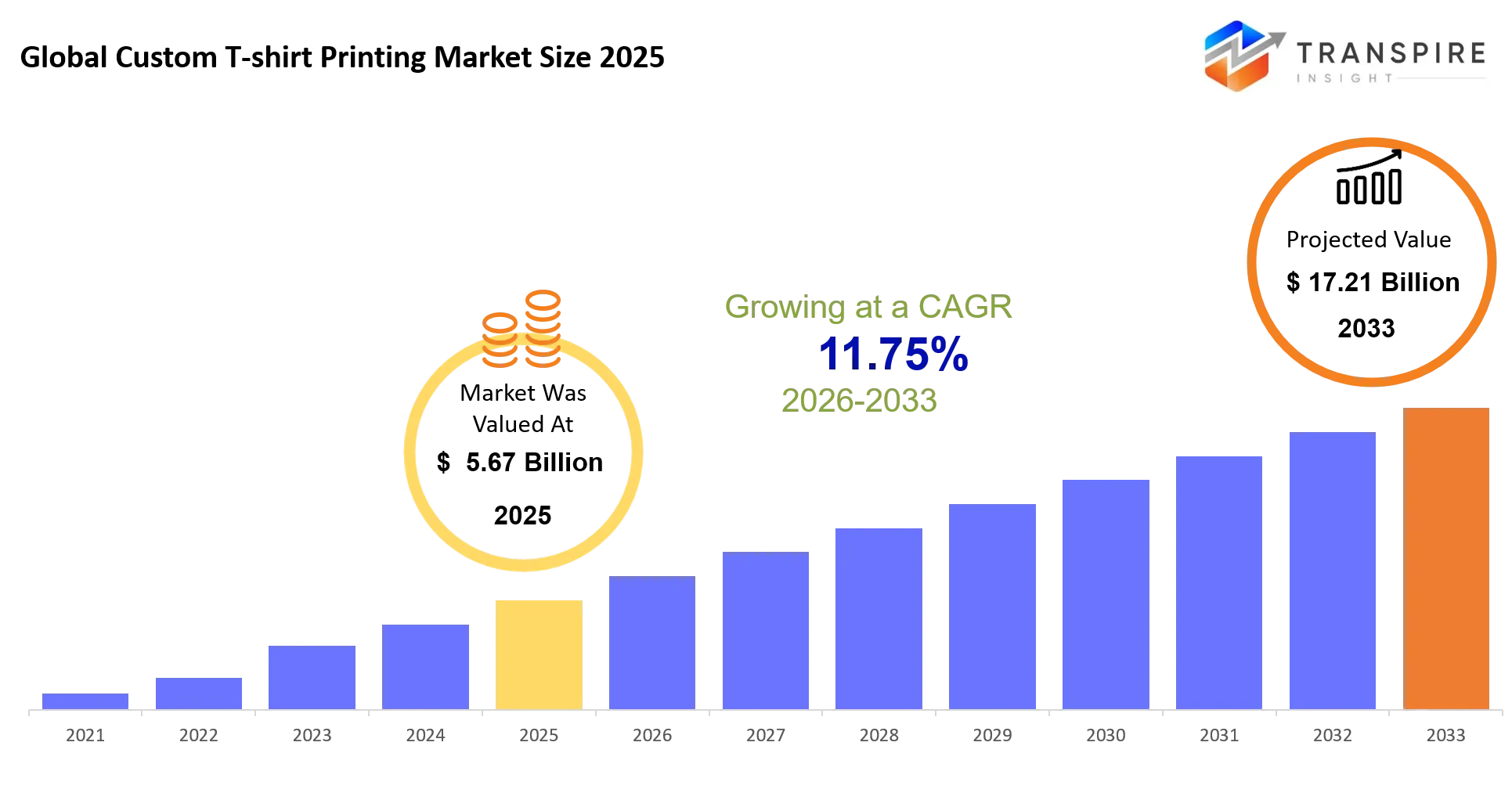
- Global Custom T-shirt Printing Market Size 2025: USD 5.67 Billion
- Global Custom T-shirt Printing Market Size 2033: USD 17.21 Billion
- Global Custom T-shirt Printing Market CAGR: 11.75%
- Global Custom T-shirt Printing Market Segments: By Printing Technology (Screen Printing, Digital Printing, Heat Transfer, Embroidery, Sublimation, Direct-to-Garment Printing, Vinyl Printing, Others); By End User (Individuals, Corporates, Sports Teams, Educational Institutions, Event Organizers, NGOs, Retail Brands, Others); By Design Type (Text Designs, Graphic Designs, Logos, Photo Printing, Artwork, Personalized Designs, Custom Branding, Others); By Distribution Channel (Online Platforms, Offline Stores, Retail Stores, Specialty Stores, Print-on-Demand Platforms, Franchise Stores, Direct Sales, Others); By Fabric (Cotton, Polyester, Blended Fabrics, Organic Cotton, Recycled Fabrics, Performance Fabrics, Premium Fabrics, Others)
Global Custom T-shirt Printing Market Summary:
As per Transpire Insight Analysis, the Global Custom T-shirt Printing Market size is estimated at USD 5.67 Billion in 2025 and is anticipated to reach USD 17.21 Billion by 2033, growing at a CAGR of 11.75% from 2026 to 2033. This industry powers the commercial ecosystems that transform plain apparel into custom branded merchandise, promotional team wear, and individualized fashion statement pieces. Everything changed over the last three - five years when the creator economy exploded alongside a massive real-world trigger: the post-pandemic surge in corporate culture resets and community-driven events. This spark accelerated a profound structural shift away from bulk-order screen setups toward high-speed, direct-to-garment (DTG) digital print workflows. This functional evolution forces the market to expand rapidly - because modern e-commerce brands and businesses now demand zero-inventory, print-on-demand fulfillment pipelines to avoid overproduction losses, printing networks are securing highly continuous, tech-integrated production lines that process single custom orders as quickly as massive bulk runs.
Key Market Insights:
The Global Custom T-shirt Printing Market is fundamentally transitioning from legacy mass-production bulk systems into an agile, highly digitized print-on-demand ecosystem. Propelled by the exponential expansion of e-commerce storefronts and social media creator networks, print networks are aggressively embedding high-capacity automated machinery and software APIs to fulfill hyper-personalized, high-definition apparel orders instantaneously without maintaining static physical stock.
- Pulling a massive 36% of all market revenue - screen printing remains the undeniable volume anchor of the industry; CustomInk scaled its large bulk facilities with automated multi-station carousels to compress turnaround timelines.
- Growing at an explosive 14.8% CAGR, Direct-to-Garment (DTG) printing is the fastest-growing technology; Printful deployed advanced industrial digital inkjet systems that spray water-based micro-droplets directly onto fabrics for zero-setup single orders.
- Ruling the entire global landscape with a dominant 39% market share, North America relies on a mature print-on-demand consumer base; VistaPrint expanded its domestic fulfillment infrastructure by deploying cloud-integrated web-to-print software.
- Scaling at an unmatched 15.9% CAGR, Asia Pacific is the fastest-growing region driven by localized manufacturing hubs; local startups are deploying high-volume sublimation networks to capitalize on custom athletic wear.
- Accounting for a vital 22% of the global footprint, the digital printing segment is pivoting rapidly to satisfy zero-inventory drop-shipping; Printify integrated its decentralized network with e-commerce APIs to route single-unit custom orders automatically.
- Capturing 27% of global revenue, the European territory is deeply focused on circular economy compliance; Spreadshirt expanded its catalog with certified organic cotton and recycled polyester blends to align with tightening eco-friendly demands.
- Snagging a clear 15% of total market demand, heat transfer methodologies are experiencing continuous growth; TeeSpring streamlined its creator merchandise dashboards, allowing artists to apply multi-color heat-press vinyl vectors with no upfront capital.
- Handling 10% of total market share, embroidery decorations are increasingly turning into a premium alternative to ink; Zazzle integrated automated pattern digitizers into its browser interface to convert 2D logos into high-density stitching.
- Covering 5% of the macro geographical distribution, Latin America is experiencing an aggressive shift as payment infrastructure matures; local printing companies are building regional production plants to eliminate cross-border logistics friction.
- Taking up the remaining 5% of global market revenue, the Middle East & Africa is transforming into a lucrative niche for custom event wear; global networks are launching joint ventures with regional fashion brands to build micro-factories.
What are the Key Drivers, Restraints, and Opportunities in the Global Custom T-shirt Printing Market?
Driver
The global market is expanding rapidly due to a structural transition toward zero-inventory, print-on-demand fulfillment networks integrated directly with e-commerce APIs. The exponential rise of micro-influencers and creator-led merchandising lines triggered this shift, as creators require rapid product launch capabilities without upfront capital. This setup accelerates immediate consumer adoption by completely eliminating minimum order quantities, allowing providers to secure recurring digital transaction volumes for single-unit custom apparel orders.
In November 2024, print-on-demand giants Printful and Printify officially announced a definitive merger to combine forces as equal partners under a unified parent corporation named Fyul. This massive integration directly scales up global custom apparel production by blending Printful's high-quality, in-house fulfillment centers with Printify's extensive marketplace of over 140 localized third-party printing facilities.
Restraint
The structural volatility of raw combed cotton pricing combined with tightening regulatory restrictions on plastisol waste and volatile organic compounds (VOCs) severely restricts operator profit margins. Traditional high-volume screen setups rely heavily on heavy-metal synthetic formulations that face aggressive environmental scrutiny - requiring extensive treatment facilities. This persistent regulatory pressure forces operators to absorb steep compliance costs, limiting capital re-investment for mid-sized print shops.
Opportunity
The most lucrative growth window lies in the technical integration of automated generative design engines with Direct-to-Film (DTF) transfer workflows. Deploying conversational design tools allows consumers to generate intricate, photorealistic graphics instantly via text prompts, expanding the target market to non-designers. This capability unlocks high-margin B2B avenues, providing rapid corporate branding turnarounds across varied blended fabrics.
What Has the Impact of Artificial Intelligence Been on the Global Custom T-shirt Printing Market?
Artificial intelligence is fundamentally reshaping how custom t-shirt printing operators handle day-to-day asset creation and supply chain logistics. Instead of relying on manual graphic design and static order sorting, printing platforms use machine learning layers and cloud-integrated text-to-image engines to accelerate product rollouts. On the design front - AI completely eliminates the technical entry barrier by letting non-designers generate print-ready, high-resolution vector artwork instantly through simple text descriptions. At the same time, predictive algorithms examine past buyer behaviors, trending social media keywords, and localized e-commerce traffic to help companies dynamically route individual orders to closest regional printing facilities. This automated optimization slashes delivery turnaround timelines while ensuring that material stock matches real-time geographical demands.
However, a major limitation remains the resolution and integration accuracy gap. Many AI text-to-image models natively produce compressed web graphics that create visible blurring or artifacting when stretched across large chest prints. This technical hurdle requires manual vector tracking or specialized software preprocessing before the art can be sent to high-capacity direct-to-garment (DTG) industrial printers.
In June 2026, Amazon officially deployed its voice-activated Alexa for Shopping AI tool across its United States market to disrupt the print-on-demand space. This product rollout allows customers to speak a descriptive prompt to Alexa, see a custom apparel graphic generated in seconds, and automatically transmit the design to Amazon Merch on Demand for instant printing and delivery.
Key Market Trends:
The methods driving custom t-shirt printing are undergoing a major architectural realignment, shifting from isolated, analog manual screen rooms toward fully automated, cloud-integrated digital micro-factories. Driven by strict environmental water laws and an intense commercial rush for rapid consumer responsiveness, printing houses are ditching heavy chemical inventory models for intelligent, agile direct-to-garment networks that manufacture apparel only after a transaction occurs.
- For decades, commercial brands placed massive bulk orders based on speculative market forecasts, but modern retail networks are rapidly adopting zero-inventory print-on-demand drop-shipping models to eliminate unsold fabric overhead.
- Traditional screen setups required laborious, multi-hour physical stencil alignments, but modern production facilities are shifting entirely to direct-to-garment automated inkjets that calibrate complex multi-color designs digitally in seconds.
- Instead of relying exclusively on heavy synthetic plastisol formulations, industrial textile printers are aggressively adopting water-based eco-inks to achieve a softer fabric feel while matching zero-discharge municipal environmental audits.
- Rather than managing disconnected online storefronts and manual fulfillment queues, global print networks are seamlessly embedding custom API plugins to route custom buyer orders automatically to the nearest regional micro-factory.
- The historically slow process of creating physical fabric color samples is fast disappearing, as web-to-print e-commerce platforms deploy hyper-realistic 3D digital mockup engines to achieve instant online customer design validation.
- Traditional single-fabric screen limitations are dissolving as printing houses pivot to advanced Direct-to-Film transfer tech, allowing multi-color graphic adhesion onto challenging synthetics, leather, and high-performance blends.
- Instead of keeping graphic creation confined to elite professional agencies, online print-on-demand marketplaces are deeply integrating conversational artificial intelligence layout widgets to transform basic text prompts into high-resolution, print-ready vectors.
- Commercial promotion budgets are steering heavily away from generic billboard signage toward high-visibility custom corporate merchandise, using wearable graphic apparel as a high-engagement, moving brand advertisement.
- The historical reliance on virgin synthetic polyester fibers is dropping dramatically, forcing print houses to aggressively restructure their product lines around certified organic cotton and recycled ocean plastic fabrics to fulfill green corporate mandates.
Global Custom T-shirt Printing Market Segmentation
By Printing Technology
Screen printing commands the absolute lion's share of value in this sector, accounting for 36% of total revenue due to its unmatched cost-efficiency in large bulk production batches. Concurrently, digital printing options—specifically Direct-to-Garment (DTG) technology—are capturing market territory at an explosive, industry-leading CAGR of 14.8%. The core mechanism behind this operational division is rooted in volume scalability and initial preparation overhead. Traditional screen print configurations depend on heavy physical stencils and multi-hour ink alignments, creating severe financial barriers for small-run apparel orders. Conversely, DTG systems leverage automated inkjet heads to translate pixel data directly onto fibers without minimum volume restrictions. Looking forward, hardware systems are moving toward hybrid inline configurations. Printing operations will increasingly combine high-speed screen baselines with automated digital overprint nozzles, allowing laboratories to apply individualized variable numbers and unique text layers directly on top of massive bulk-produced graphics without halting the active assembly line.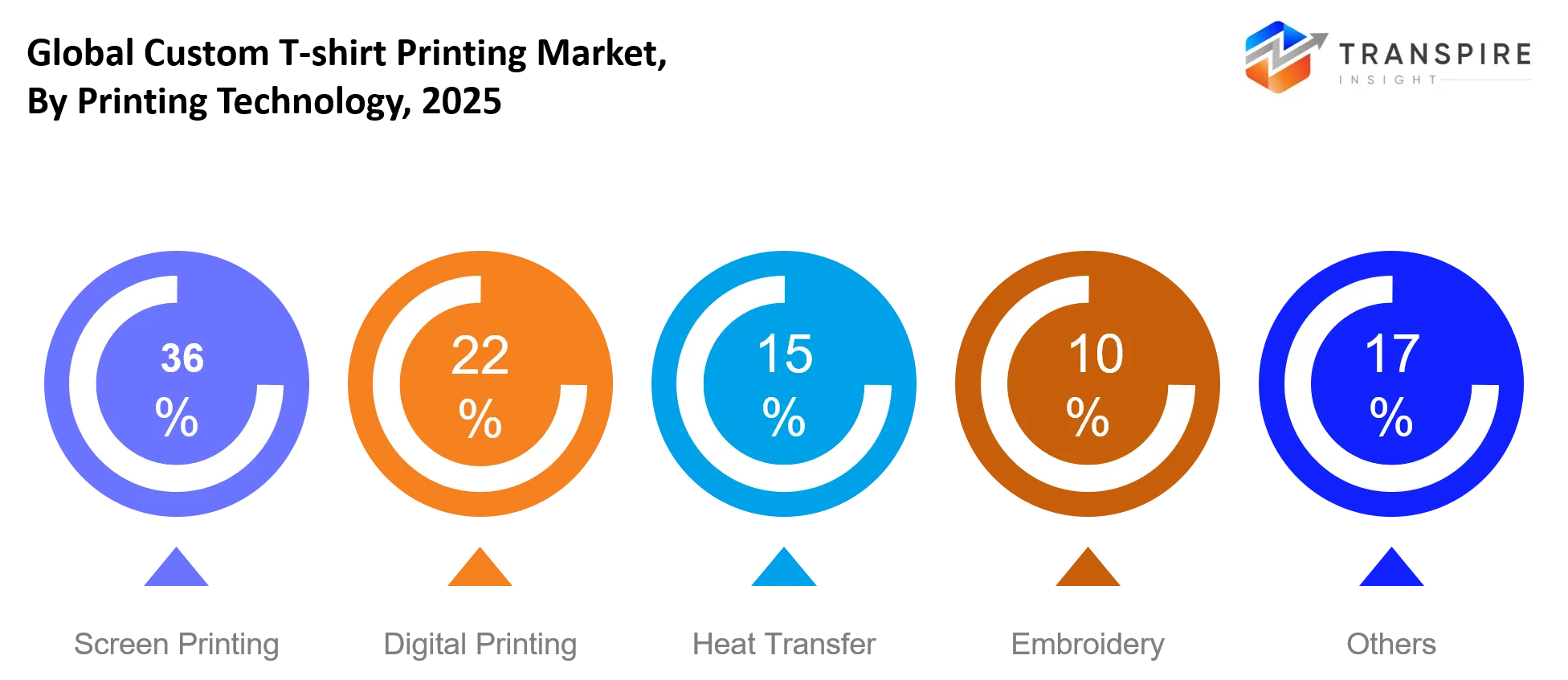
By End User
Corporates, small businesses, and retail brands represent the heavy-weight capital spenders within the global landscape, securing a massive chunk of recurring revenue through large-scale branding activities and customer appreciation gifting. Meanwhile, the individual customer and independent creator segment is expanding at an exceptional rate due to the widespread popularization of social media drop-shipping. The unique growth logic here relies on the functional shift from physical corporate marketing toward digitized, personal monetization ecosystems. Corporate buyers require strict corporate logo Pantone accuracy, highly reliable washing lifecycles, and automated bulk procurement channels to manage massive promotional campaigns. Simultaneously, individual buyers and digital creators demand instant web-to-print interfaces, rapid single-unit checkout features, and zero-inventory structural risk. Moving forward, providers must offer complete software-driven platform ecosystems rather than simple manual printing services. Long-term corporate retention will depend on deploying dedicated client portals that allow global enterprise divisions to customize, preview, and trigger automated regional fulfillment loops without human administrative delays.
By Design Type
Graphic designs and structural corporate branding logos lock down a dominant portion of the overall market value, functioning as the default choice for promotional apparel, professional uniforms, and mainstream commercial fashion. On the other side, fine artwork replication and hyper-personalized photo printing are charging ahead as the fastest-growing design niches. The architectural growth pattern is driven directly by the digital democratization of aesthetic asset generation. Traditional corporate branding requires clean, scalable vector arrays built to withstand hundreds of wash cycles without losing fine edge clarity. In contrast, modern artistic consumers prioritize full-color continuous tone accuracy, complex gradients, and photorealistic imagery. Moving forward, the industry will experience a complete convergence between artificial design generation and hardware execution. Print networks will have no option but to connect conversational generative-AI interfaces directly to their automatic preprocessing preflight systems, enabling non-technical users to build, validate, and verify complex artwork arrays instantly inside their web browsers.
By Distribution Channel
Traditional offline brick-and-mortar storefronts, commercial print shops, and dedicated franchise networks retain a major anchor position across the global market landscape, particularly for localized business-to-business bulk procurement. However, online e-commerce platforms and automated print-on-demand (POD) networks are the undisputed speed leaders, advancing rapidly at the fastest growth rate. This structural transition is governed entirely by the reduction of transactional friction and regional logistics overhead. Offline channels survive by offering tactile material testing, personal pricing negotiations, and immediate physical quality confirmation for high-stakes corporate uniforms. Nevertheless, online platforms are winning modern market share by integrating open API architectures, automated shopping checkouts, and seamless drop-shipping fulfillment routes. Moving forward, the entire distribution model will transform into a decentralized hybrid framework. Leading printing corporations will run centralized web-to-print nodes that ingest global transactions online but execute production across a heavily distributed network of local micro-factories to eliminate cross-border transport duties.
By Fabric
Standard combed cotton remains the foundational volume baseline of the entire industry, favored across a broad consumer spectrum for its high print-ink absorption capacity and day-to-day comfort. Concurrently, specialized performance synthetics, organic cotton variants, and recycled ocean plastic fabrics are surging ahead as the fastest-growing substrates. This product distribution is governed by distinct ink-adhesion chemistry and changing consumer purchasing ethics. Traditional cotton offers high surface tension that bonds perfectly with standard water-based or plastisol formulations, making it the highly predictable default choice for everyday lifestyle wear. However, athletic sports teams and eco-conscious global corporations are demanding advanced technical polyester grids with high moisture-wicking properties and certified sustainable sourcing profiles. Moving forward, textile printing systems must expand past single-substrate limitations. Factory floors will rely heavily on universal pre-treatment chemical coatings and flexible Direct-to-Film (DTF) transfer matrices to print vibrant, high-definition designs across blended fabrics without risking ink cracking or dye migration.
What are the Key Use Cases Driving the Global Custom T-shirt Printing Market?
The primary use case driving this market centers on corporate branding and promotional marketing campaigns, which directly fuels the dominant screen printing segment. Large enterprises and small businesses heavily deploy custom branded apparel as a low-cost, high-visibility advertising tool to increase brand recall and unify corporate identities during massive promotional - events, product launches, and everyday field operations.
Expanding applications are highly prominent within the sportswear and educational sectors. Athletic teams and academic organizations widely utilize customization to print performance jerseys, custom team uniforms, and school merchandise, requiring durable, flexible ink adhesion that withstands heavy physical wear.
An emerging use case is the rapid growth of creator-led merchandise lines within the online e-commerce ecosystem. Independent social media creators and digital artists leverage print-on-demand APIs to instantly launch personalized apparel drops, converting digital followers into a monetization engine without the risk of holding physical inventory.
|
Report Metrics |
Details |
|
Market size value in 2025 |
USD 5.67 Billion |
|
Market size value in 2026 |
USD 7.91 Billion |
|
Revenue forecast in 2033 |
USD 17.21 Billion |
|
Growth rate |
CAGR of 11.75% from 2026 to 2033 |
|
Base year |
2025 |
|
Historical data |
2021 - 2024 |
|
Forecast period |
2026 - 2033 |
|
Report coverage |
Revenue forecast, competitive landscape, growth factors, and trends |
|
Regional scope |
United States; Canada; Mexico; United Kingdom; Germany; France; Italy; Spain; Denmark; Sweden; Norway; China; Japan; India; Australia; South Korea; Thailand; Brazil; Argentina; South Africa; Saudi Arabia; United Arab Emirates |
|
Key company profiled |
CustomInk, Printful, Printify, VistaPrint, Spreadshirt, Zazzle, TeeSpring, Redbubble, CafePress, RushOrderTees, UberPrints, Bonfire, Threadbird, ooShirts, Printfection |
|
Customization scope |
Free report customization (country, regional & segment scope). Avail customized purchase options to meet your exact research needs. |
|
Report Segmentation |
By Printing Technology (Screen Printing, Digital Printing, Heat Transfer, Embroidery, Sublimation, Direct-to-Garment Printing, Vinyl Printing, Others); By End User (Individuals, Corporates, Sports Teams, Educational Institutions, Event Organizers, NGOs, Retail Brands, Others); By Design Type (Text Designs, Graphic Designs, Logos, Photo Printing, Artwork, Personalized Designs, Custom Branding, Others); By Distribution Channel (Online Platforms, Offline Stores, Retail Stores, Specialty Stores, Print-on-Demand Platforms, Franchise Stores, Direct Sales, Others); By Fabric (Cotton, Polyester, Blended Fabrics, Organic Cotton, Recycled Fabrics, Performance Fabrics, Premium Fabrics, Others) |
Which Regions are Driving the Global Custom T-shirt Printing Market Growth?
North America maintains a commanding grip on the Global Custom T-shirt Printing Market, primarily propelled by a mature corporate gifting culture and a highly advanced e-commerce ecosystem. Unlike other regional territories, this market relies on a massive volume of institutionalized business-to-business procurement pipelines where enterprises aggressively buy branded apparel for wide-scale promotional marketing campaigns. To support this significant volume of custom production, local fulfillment infrastructure is heavily integrated with sophisticated print-on-demand networks and automated web-to-print software layers. Consequently, low-inventory digital setups and fast short-run customization options remain a permanent structural capability for premium domestic printing companies looking to serve massive retail operations.
In February 2026, North American print leader CustomInk officially rolled out a major platform modernization and brand update, expanding low-minimum and single-unit ordering options to over 1,000 distinct items to instantly fulfill the region's shifting enterprise demand for small-batch, premium team merchandise.
The Asia Pacific region is expanding faster than any other global territory, propelled by rapid urban migration, expanding middle-class spending power, and a massive density of localized textile manufacturing facilities across India and China. A historic regional reliance on standard, pre-printed bulk fashion apparel is collapsing as social media marketing surges and younger demographics demand distinct personal expression. This sweeping cultural transformation forces regional printing houses to rapidly install high-capacity digital inkjet hardware and fast sublimation networks to handle a massive wave of localized athletic sportswear and creator merchandise orders. Looking ahead, the ultimate success of custom apparel brands in this booming corridor depends on deploying highly agile micro-factories that can process ultra-fast, single-unit custom checkouts with minimal domestic freight costs.
In January 2026, leading industrial printing manufacturer Brother officially executed the commercial launch of its next-generation DTRX Direct-to-Film (DTF) hardware line across dense textile processing territories, introducing automated wet-wiper systems to speed up multi-substrate production capabilities across Asian manufacturing hubs. 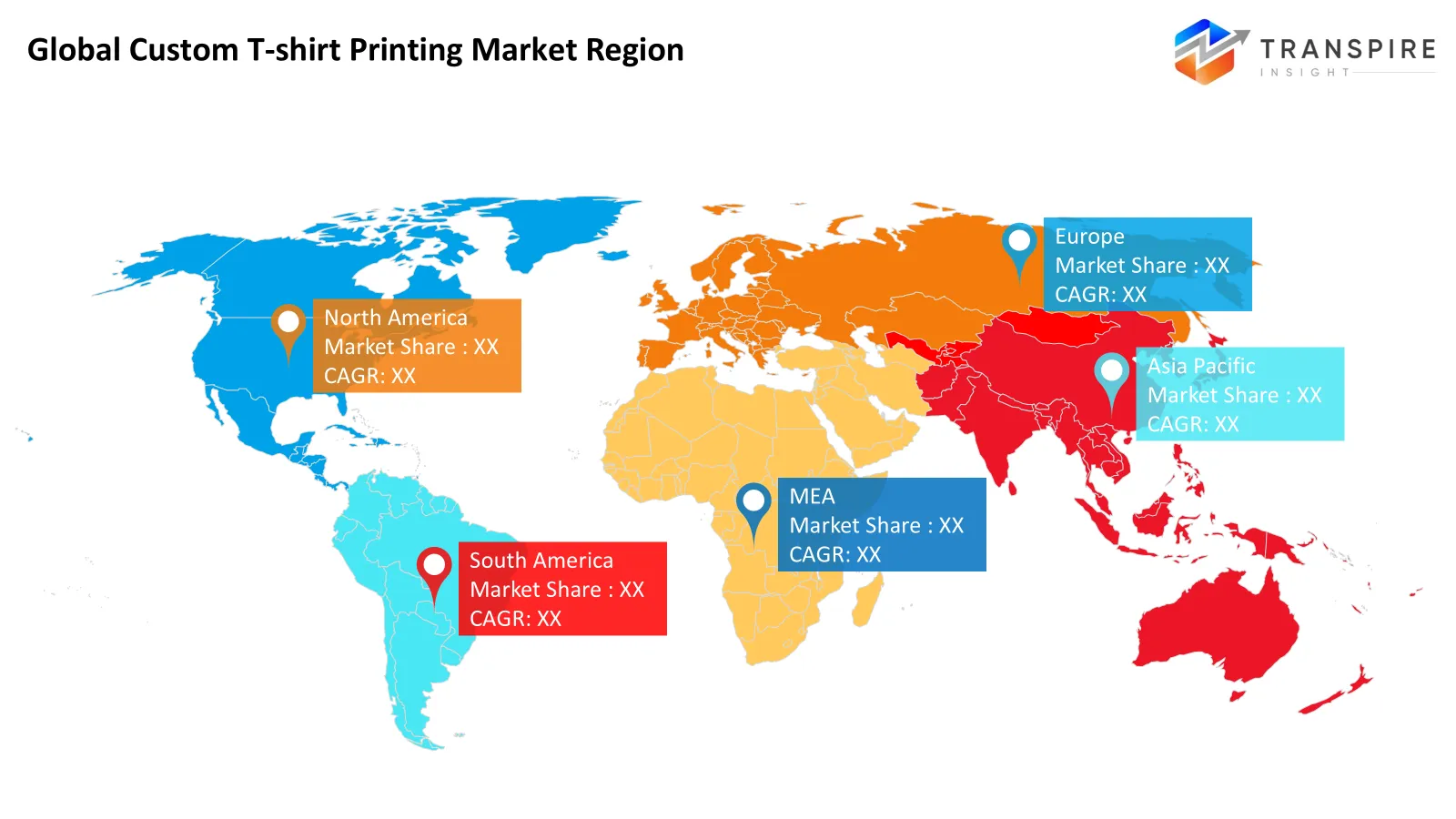
Who are the Key Players in the Global Custom T-shirt Printing Market and how do they Compete?
The Global Custom T-shirt Printing Market features intense competition between vertically integrated commercial production networks and tech-driven, decentralized print-on-demand (POD) software aggregators. Rather than competing purely on price per unit - market participants differentiate themselves by optimizing e-commerce API plug-ins, expanding sustainable fabric catalogs, and minimizing domestic delivery turnarounds to secure recurring enterprise and creator contracts.
CustomInk utilizes a corporate-focused innovation strategy, positioning itself as a premium partner for physical corporate branding and events. By rolling out extensive digital platform updates that drastically lower ordering minimums across hundreds of diverse product types, the firm secures steady business-to-business volume through dedicated corporate swag management dashboards and automated screen setups.
Concurrently, tech-enabled platforms Printful and Printify pursue a high-velocity digital marketplace strategy built for independent creators. Printful separates itself from competitors by pouring heavy capital into its own network of automated fulfillment facilities to control printing quality directly. Meanwhile, Printify operates on an asset-light software-marketplace model, connecting storefronts to a massive distributed network of local third-party printers to drive down foundational base costs and increase geographic catalog flexibility.
Company List
- CustomInk
- Printful
- Printify
- VistaPrint
- Spreadshirt
- Zazzle
- TeeSpring
- Redbubble
- CafePress
- RushOrderTees
- UberPrints
- Bonfire
- Threadbird
- ooShirts
- Printfection
Recent Development News
In April 2026, Kornit Digital officially unveiled its next-generation Atlas MATRIX unified digital apparel production system at the Konnections 2026 event. This product rollout removes printing limitations across cotton, polyester, and challenging blended fabrics via proprietary single-step color protection tech, allowing commercial printing houses to seamlessly scale short-run production for athletic sportswear and custom athleisure apparel without the risk of dye migration. [https://ir.kornit.com
In June 2026, VistaPrint launched its highly advanced global brand and technical creator platform titled Print Your Possible. This strategic expansion deploys an automated asset infrastructure called the Atoms Library, utilizing AI-driven agentic workflows to instantly format, render - push personalized custom marketing and custom apparel designs across six major global e-commerce markets concurrently without requiring manual graphic intervention. [https://www.vistaprint.com
In January 2025, industrial printing pioneer Epson officially announced the advanced rollout of its highly specialized SureColor G6060 wide-format production platform. This hardware launch delivers the brand's very first wide-format engine designed exclusively for high-volume Direct-to-Film (DTF) transfer workflows, equipping commercial textile operations with automated printhead wiping mechanisms and specialized UltraChrome DF formulations to rapidly customize synthetic sportswear matrices on a mass scale. [https://newzealandprinter.co.nz
What Strategic Insights Define the Future of the Global Custom T-shirt Printing Market?
The future of the Global Custom T-shirt Printing Market is heading toward a completely automated, web-to-print API infrastructure that prioritizes decentralized regional micro-fulfillment over single giant factories.
A hidden risk threatening operator margins is the extreme volatility of raw combed cotton pricing paired with intensifying platform fee compression, which forces small-scale printers into a dangerous discounting race to the bottom. Conversely, an emerging opportunity lies in the technical integration of conversational generative-AI design engines that instantly convert text prompts into high-resolution, print-ready vector files, expanding the addressable customer base to non-designers.
The core strategic recommendation for modern printing firms is to immediately transition away from isolated manual processing configurations and invest in integrated Direct-to-Film (DTF) hardware. Companies must blend their systems with automated cloud-routing workflows to guarantee multi-substrate printing flexibility and fast turnaround times.
key segmantation are:
By Printing Technology
- Screen Printing
- Digital Printing
- Heat Transfer
- Embroidery
- Sublimation
- Direct-to-Garment Printing
- Vinyl Printing
- Others
By End User
- Individuals
- Corporates
- Sports Teams
- Educational Institutions
- Event Organizers
- NGOs
- Retail Brands
- Others
By Design Type
- Text Designs
- Graphic Designs
- Logos
- Photo Printing
- Artwork
- Personalized Designs
- Custom Branding
- Others
By Distribution Channel
- Online Platforms
- Offline Stores
- Retail Stores
- Specialty Stores
- Print-on-Demand Platforms
- Franchise Stores
- Direct Sales
- Others
By Fabric
- Cotton
- Polyester
- Blended Fabrics
- Organic Cotton
- Recycled Fabrics
- Performance Fabrics
- Premium Fabrics
- Others
Regional Outlook
North America
- United States
- Canada
- Mexico
Europe
- Germany
- United Kingdom
- France
- Spain
- Italy
- Rest of Europe
Asia Pacific
- Japan
- China
- Australia & New Zealand
- South Korea
- India
- Rest of Asia Pacific
South America
- Brazil
- Argentina
- Rest of South America
Middle East & Africa
- Saudi Arabia
- United Arab Emirates
- South Africa
- Rest of the Middle East & Africa
Frequently Asked Questions
Find quick answers to common questions.
The Global Custom T-shirt Printing Market size was valued at USD 5.67 Billion in 2025 and is poised to reach USD 17.21 Billion by 2033, expanding at a 11.75% CAGR.
Key Segments for the Custom T-shirt Printing Market are Printing Technology (Screen Printing, Digital Printing, Heat Transfer, Embroidery, Sublimation, Direct-to-Garment Printing, Vinyl Printing, Others), End User (Individuals, Corporates, Sports Teams, Educational Institutions, Event Organizers, NGOs, Retail Brands, Others), Design Type (Text Designs, Graphic Designs, Logos, Photo Printing, Artwork, Personalized Designs, Custom Branding, Others), Distribution Channel (Online Platforms, Offline Stores, Retail Stores, Specialty Stores, Print-on-Demand Platforms, Franchise Stores, Direct Sales, Others), and Fabric (Cotton, Polyester, Blended Fabrics, Organic Cotton, Recycled Fabrics, Performance Fabrics, Premium Fabrics, Others).
Growth is primarily driven by the structural transition toward zero-inventory, print-on-demand fulfillment networks integrated directly with e-commerce APIs, alongside an exponential rise in micro-influencer merchandise lines and corporate promotional branding events.
The Global Market is led by Major Manufacturers including CustomInk, Printful, Printify, VistaPrint, Spreadshirt, Zazzle, TeeSpring, Redbubble, CafePress, RushOrderTees, UberPrints, Bonfire, Threadbird, ooShirts, and Printfection.
North America holds an estimated 39% share of global revenue, dominating market dynamics through its mature corporate gifting cultures, high enterprise advertising spends, and heavily integrated, tech-enabled print-on-demand e-commerce infrastructure.
Lucrative opportunities exist in the technical integration of automated generative design engines with Direct-to-Film (DTF) transfer workflows, expanding conversational design tools to non-designers, and unlocking high-margin B2B corporate branding turnarounds across varied blended fabrics.
- CustomInk
- Printful
- Printify
- VistaPrint
- Spreadshirt
- Zazzle
- TeeSpring
- Redbubble
- CafePress
- RushOrderTees
- UberPrints
- Bonfire
- Threadbird
- ooShirts
- Printfection
About the Authors

Chetan Dhatrak
I’m Chetan Dhatrak, a Senior Research Analyst at Transpire Insight, specializing in the Consumer Goods, Foods and Beverages industry. I focus on analyzing market trends, consumer behavior, competitive landscapes, and industry developments to deliver accurate, data-driven insights. My research at Transpire Insight is built on credible sources and in-depth analysis, helping businesses and readers better understand market dynamics, emerging opportunities, and evolving consumer preferences. I’m committed to creating reliable, well-researched content that supports informed decision-making and reflects the latest developments in the consumer goods and food & beverage sectors.

Chakradhar Khansole
Chakradhar serves as the Research Director at Transpire Insight, bringing over 8 years of experience in technology, innovation, and strategic market intelligence. He specializes in transforming complex market data into actionable business insights that enable organizations to make informed, growth-oriented decisions. Recognized for his strategic vision and analytical expertise, Chakradhar leads high-impact research initiatives, delivering comprehensive market assessments, competitive intelligence, and forward-looking industry analysis.
Recently Published Reports
-
Apr 2026
Bottled Water Market
Bottled Water Market Size, Share & Analysis Report By Product Type (Still Bottled Water, Carbonated Bottled Water, Functional Bottled Water, and Others), By Packaging (PET, Cans, and Others), By Sales Channel (Supermarkets/Hypermarkets, Convenience Stores/Drug Stores, Grocery Stores/Club Stores, Foodservice, and Others) and Geography (North America, Europe, Asia-Pacific, Middle East and Africa, South and Central America), 2021 - 2032
-
Apr 2026
Color Cosmetic Packaging Market
Color Cosmetic Packaging Market Size, Share & Analysis Report By Application (Mascara Packaging, Liquid Packaging, and Liquid Face), By Type (Tubes & Bottles, Pens & Markers, Compacts & Containers, and Droppers & Pumps), and Geography (North America, Europe, Asia-Pacific, Middle East and Africa, South and Central America), 2021 - 2031
-
Apr 2026
External Microphone For Camera Market
External Microphone For Camera Market Size, Share & Analysis Report By Type (Shotgun Microphone, Lavalier Microphone, and Others), By Application (Digital Camera, Professional Video Camera, and Others), and Geography (North America, Europe, Asia-Pacific, Middle East and Africa, South and Central America), 2021 - 2031
-
Apr 2026
Foot Orthotic Insoles Market
Foot Orthotic Insoles Market Size, Share & Analysis Report By Type (Pre-fabricated, and Custom-made), By Material (Thermoplastic, Composite Carbon Fiber, and Others), By Distribution Channel (Drug Stores, Hospitals & Clinics, and Others), and Geography (North America, Europe, Asia-Pacific, Middle East and Africa, South and Central America), 2021 - 2031