

Middle East and Africa Textile Printing Market Size & Forecast:
- Middle East and Africa Textile Printing Market Size 2025: USD 2099.9 Million
- Middle East and Africa Textile Printing Market Size 2033: USD 3802.1 Million
- Middle East and Africa Textile Printing Market CAGR: 7.73%
- Middle East and Africa Textile Printing Market Segments: By Printing Type (Screen Printing, Digital Printing, Rotary Printing, Transfer Printing, Sublimation Printing, Block Printing, Others); By Ink Type (Pigment Inks, Reactive Inks, Acid Inks, Disperse Inks, Sublimation Inks, Others); By Fabric Type (Cotton, Polyester, Silk, Wool, Blended Fabrics, Others); By End User (Fashion, Home Furnishing, Industrial Textiles, Sportswear, Others)
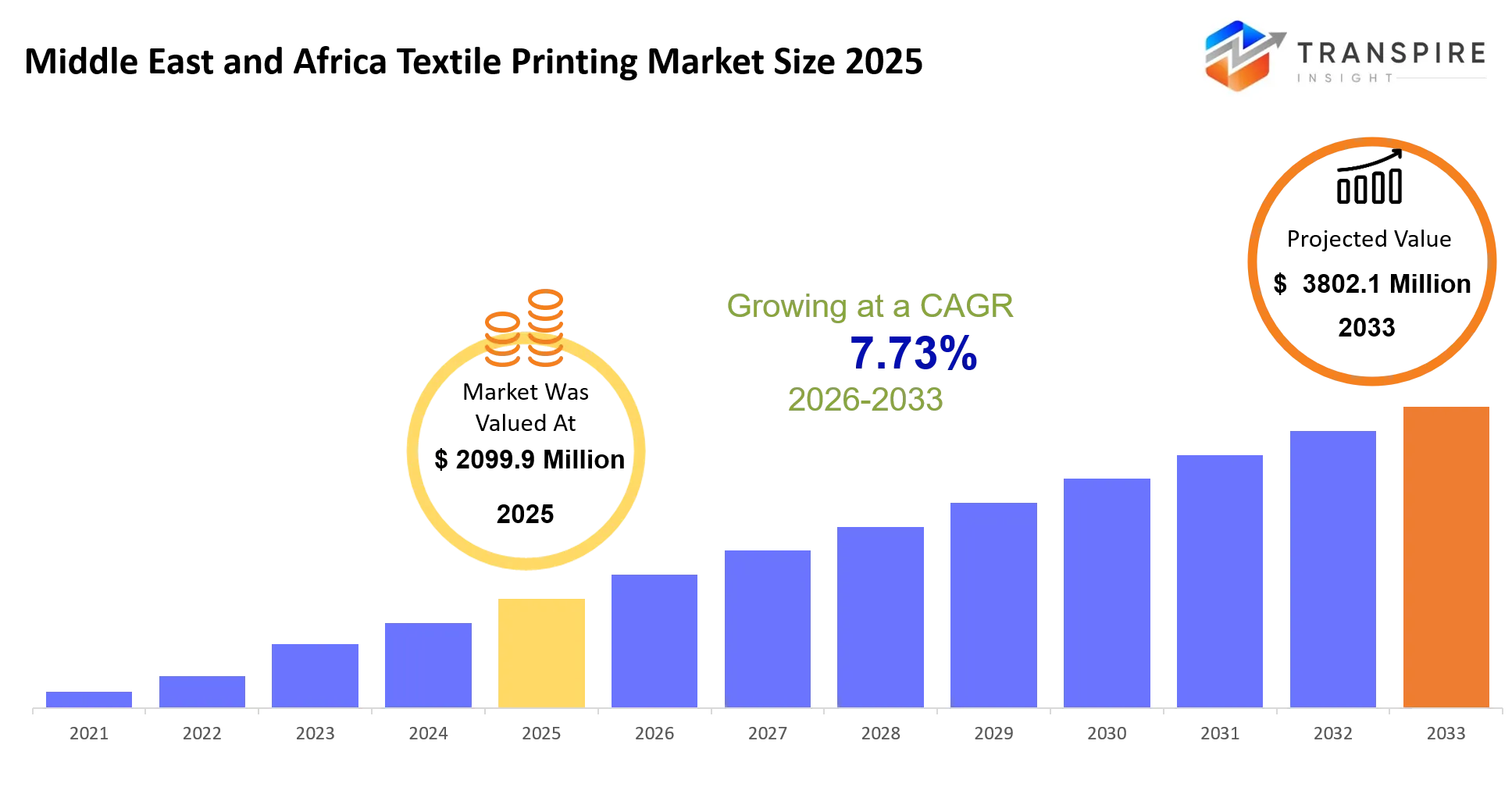
Middle East and Africa Textile Printing Market Summary
The Middle East and Africa Textile Printing Market was valued at USD 2099.9 Million in 2025. It is forecast to reach USD 3802.1 Million by 2033. That is a CAGR of 7.73% over the period.
Textile printing kind of matters a lot in turning plain fabrics into actual finished goods for fashion apparel, home furnishings, sportswear , promotional materials, and even industrial textiles. Basically it helps manufacturers and brands put designs, colors, patterns and customized graphics onto material without too much delay, plus it cuts production lead times and lowers inventory risks. In the Middle East and Africa, this kind of printing supports local garment production, interior decoration businesses, and also export-focused textile manufacturing.
Over the past five years, the market has been moving in a more structural way away from classic screen printing and rotary systems , toward digital textile printing setups. These digital systems make it possible to run shorter production batches, swap designs quicker, and use less water. The change picked up speed when supply chains got disrupted, and when inventory cycles stayed volatile, so manufacturers started leaning on on-demand production models , and on more localized sourcing. Now digital technologies help textile producers reduce waste, get better at customizing, and react fast when fashion trends shift. And since apparel brands are increasingly aiming for flexible manufacturing along with shorter product cycles, they keep investing in advanced printing equipment , specialty inks, and automated workflows, which keeps market revenue steady and also broadens adoption across many commercial textile uses.
Key Market Insights
- The Middle East and Africa Textile Printing Market is expected to climb to about USD 3.8 billion by 2033, showing pretty sustained investment in digital production tech, even if people tend to call it “just printing” sometimes.
- Digital printing is taking a notable chunk of new equipment installs as manufacturers push for faster turnaround and lower set up costs, it is kind of the whole point.
- In 2025, the Middle East region stands out and leads with roughly 58% market share, backed by textile manufacturing hubs in the UAE Saudi Arabia and Egypt, you know, where production keeps moving.
- Africa looks like the fastest growing regional market all the way through 2033, mainly because apparel manufacturing keeps expanding and export focused textile output is becoming more common.
- Digital printing is still the top technology segment, sitting at nearly 35% market share, largely due to customization needs and short run production capabilities that reduce waste.
- Screen printing stays as the second largest segment, mostly because of cost benefits for large volume textile production, and that still matters a lot for factories.
- Sublimation printing is projected to be the quickest grower through 2033, supported by sportswear demand and polyester fabric applications, it fits the materials pretty well.
- Fashion applications make up around 42% of market demand, so apparel is the dominant revenue driving category.
- Sportswear printing is also expanding quickly, as regional demand rises for personalized athletic wear across Gulf countries and South Africa.
- Key companies like Kornit Digital, Epson, Mimaki, HP, EFI Reggiani, and Durst are doubling down on automation, water saving technologies, and local distribution relationships, trying to lock in a stronger market position over time.
What are the Key Drivers, Restraints, and Opportunities in the Middle East and Africa Textile Printing Market?
The strongest growth driver seems to be the move toward digital textile manufacturing, and it’s getting more and more obvious with fashion brands, retailers and fabric producers asking for shorter cycles, smaller batch sizes. The main idea is to limit inventory exposure, which is a big deal in this market. With digital textile printers, there’s no longer screen preparation in the usual sense, and designers can adjust right away instead of waiting. That turns lead times from weeks into, like, days. Because of that kind of operational flexibility, manufacturers can take tailored orders profitably, and equipment utilization usually goes up too. In practice this is directly supporting revenue growth, across textile printing facilities and related operations.
The largest market restraint, however, is still the heavy capital investment needed for advanced digital printing equipment and its workflow systems. Industrial textile printers, color management software, drying units, and finishing equipment together require a substantial upfront spend. This isn’t just a temporary obstacle, it’s kind of structural. Many regional textile producers run on thin margins, and they often don’t have easy access to long-term industrial financing. So modernization projects get postponed, technology adoption rates drop, and productivity improvements slow down. Even when demand exists, the funding gap can interfere, in a very simple way, with implementation.
A major opportunity sits in water-efficient textile printing technologies. In multiple Middle Eastern countries, water scarcity concerns are pushing investment toward low-water, or even waterless production setups. New-generation digital printers that can reduce wastewater generation create a more convincing business rationale for textile manufacturers. If producers can cut water use they also can reduce operational costs, and at the same time meet environmental requirements more comfortably. That combination can open new chances for export-oriented textile manufacturing and for premium apparel production, especially where compliance matters.
What Has the Impact of Artificial Intelligence Been on the Middle East and Africa Textile Printing Market?
Artificial intelligence is slowly, but surely, getting better at improving day to day operational efficiency in textile printing facilities. The more modern digital printing setups use AI driven workflow software, it kind of stitches together tasks like color correction, job scheduling, print queue handling, and quality control, all in one go. With all that automation, there’s less manual stop and start, and the output tends to stay more consistent across different print runs… even when operators change.
Then there’s machine learning which is quietly helping predictive maintenance programs. The idea is that AI systems can watch printhead behavior, track ink consumption patterns, measure temperature swings, and read the machine operating conditions. From that, they can flag potential failures ahead of time, before those failures turn into production disruptions. In other words manufacturers get fewer unexpected interruptions and the equipment spends more time available for real work.
On top of that, advanced analytics platforms help production planning in a very practical way. They can forecast fabric consumption, estimate ink needs, and calculate production workloads. That forecast based approach usually cuts waste, improves inventory management, and brings operating costs down. At the same time automated defect detection systems, using computer vision, are improving print quality while lowering the amount of rework required.
Still, AI adoption isn’t everywhere and it’s not fully smooth. Integration costs can be high, and some production environments are fragmented. Quite a few textile manufacturers keep running older equipment that doesn’t include the connectivity features needed for deeper data analytics. Also, limited access to historical production datasets impacts how accurate predictive models can be, especially for small and medium sized textile printing operations.
Key Market Trends
- From 2021 to 2025 digital textile printer installations went up by a bit more than 20% , basically. It looks like many manufacturers shifted toward on demand production models and then, you know, adopted it faster than before.
- Water efficient printing technologies started getting real traction after 2022 , when textile producers began trying to lower their wastewater treatment costs. That kind of cost pressure was kind of everywhere.
- Fashion brands also leaned into smaller production batches, which kinda pushed digital printing more, compared to traditional screen methods. And yeah sublimation printing, it didn’t just grow, it expanded notably in sportswear manufacturing, mostly because polyester fabric use kept rising.
- On the operations side, textile producers increasingly adopted automated workflow software to trim labor needs and make production planning more reliable. Some companies even treated it like a must, not a nice to have.
- Mimaki rolled out the Tx330-1800 series in 2025, and that added even more water efficient digital textile printing capability. Meanwhile AI based quality inspection systems showed up across bigger textile facilities, cutting defect rates and keeping consistency steadier.
- Regional manufacturers then started localizing production more often after global supply chain disruptions, because sourcing vulnerabilities became obvious.
- Equipment suppliers followed that momentum too, expanding service networks across the Gulf region to strengthen technical support, and to keep customers longer.
- Finally, sustainability targets encouraged higher investment in pigment based and low water textile printing technologies , especially across commercial applications.
Middle East and Africa Textile Printing Market Segmentation
By Printing Type
Screen Printing still keeps doing the job for big volume textile production, mostly because it delivers solid color coverage and stays cost efficient when you are talking about long manufacturing runs. Digital Printing has been growing pretty fast too, since apparel brands want shorter turnaround times, very customized designs and also lower inventory levels, at least thats what most people say. Rotary Printing is still a big deal for high speed fabric output, especially when you need steady patterns and a large output at the same time.
Transfer Printing plus Sublimation Printing are now more common in sportswear , promotional items, and polyester based fabrics because the picture quality feels sharp and the color performance holds up well over time. Block Printing still keeps value in specialist and artisanal textile work, where that handcrafted look is kind of the whole point. Other printing approaches cover specific or niche needs across industrial and decorative textile production, so in the end they support more flexible manufacturing.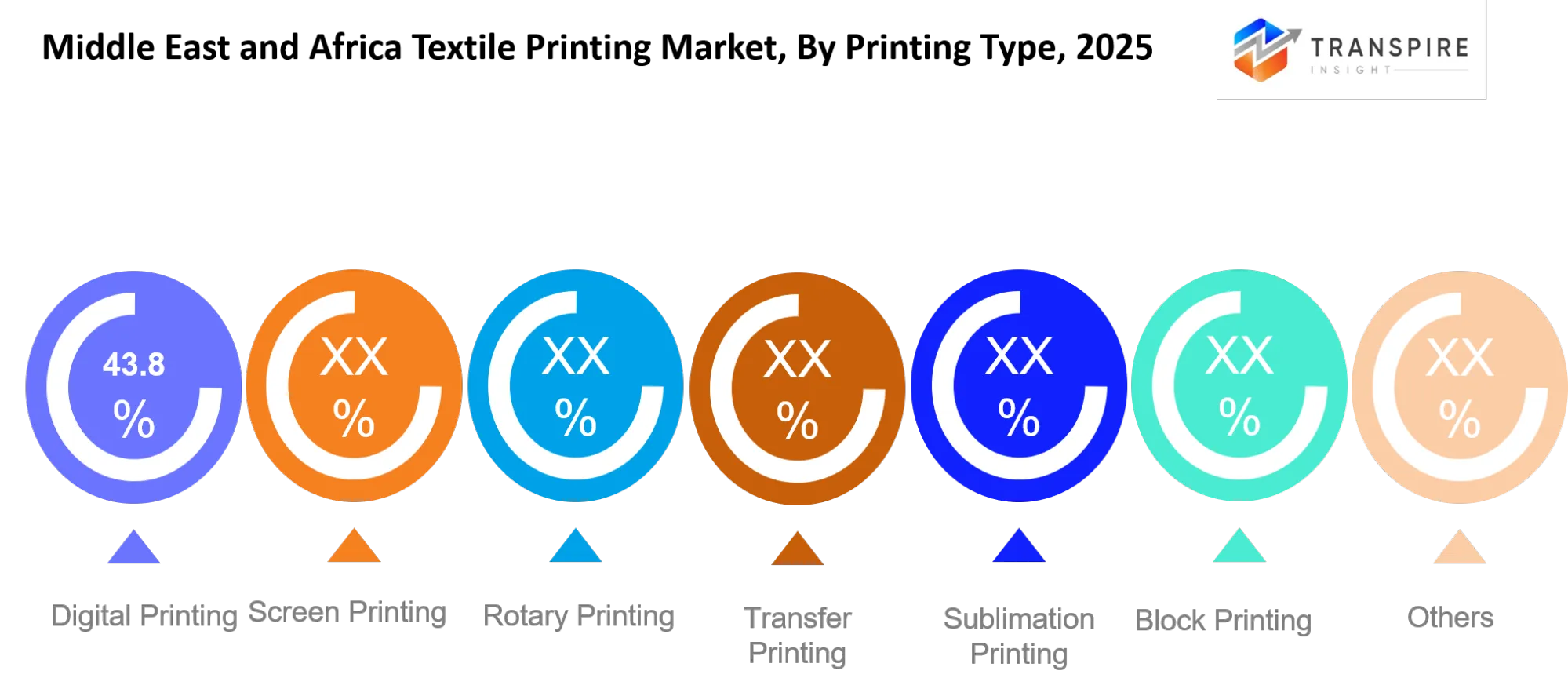
By Ink Type
Pigment inkshold a significant place because there is broad fabric compatibility, and also reduced processing needs. Reactive inks are widely used for cotton textiles,they give excellent color brightness, and strong wash durability. Acid inks work well for silk and nylon applications,especially when strong color penetration is needed and a premium finish quality matters.
Disperse inks stay tightly associated with polyester textile printing, and sportswear manufacturing too. Sublimation inks have grown steadily along with the expansion of polyester fabrics, and custom apparel production. Other specialty inks handle more technical textile jobs where specific performance traits are required, like durability, resistance, or a particular visual effect.
By Fabric Type
Cotton still stays as one major fabric type, not just because it is widely used across apparel and fashion, but also household textiles where people kind of rely on it for everyday comfort. Polyester got a lot more momentum lately, mostly from sportswear demand, its durability upsides, and the fact it works nicely with sublimation printing technologies. Silk is still a key choice in premium fashion and for decorative textile applications, where a refined finish really matters
Wool keeps showing up in specialized garments and furnishing uses, especially when thermal performance and that texture feel are the point. Blended fabrics have become more and more popular, because they blend strengths from different materials, and they also allow a wider set of printing needs. Other fabric categories, well they step in for more specialized industrial and commercial textile applications, where you need specific properties for specific use cases
By End User
Fashion is basically the largest end-user segment, because clothing brands keep rolling out new designs, seasonal collections,and sort of customized products too. In Home Furnishing, things like curtains, upholstery, bedding, and decorative textiles show up, where the printed patterns seem to add real commercial value. Then Industrial Textiles lean on printing technologies for functional plus technical fabric uses across different sectors, not just one.
Sportswear now has become one of the fastest-growing categories, mostly because people want customized athletic apparel and performance fabrics that actually work. Beyond that there are other end-user segments like promotional textiles, event materials, institutional fabrics, and also specialty applications, where you need tailored printing solutions for particular commercial needs.
What are the Key Use Cases Driving the Middle East and Africa Textile Printing Market?
Fashion apparel is still kind of the main thing here, because garment manufacturers need really high-quality printed textiles for seasonal collections, tailored clothing, and branded merchandise. Also, changes happen fast in design, and retail cycles are shorter so companies end up using digital printing technologies more often. These systems are able to handle flexible production timetables which sounds simple but it matters a lot.
At the same time home furnishing applications are growing in a steady way, think curtains, upholstery fabric, bedding items, and those decorative interior textiles that sort of tie a room together. On the sportswear side manufacturers are picking up sublimation and digital printing technologies more and more, mainly to get vivid durable patterns on polyester-based performance fabrics. In other words, they want color that holds up, not just pretty for a little while.
There are also newer, emerging use cases like customized promotional textiles, materials for event decoration, and technical fabrics for commercial settings. Plus, the growth in regional e-commerce platforms is pushing demand for on-demand textile printing services, so personalized apparel and home décor products can be made without waiting too long.
|
Report Metrics |
Details |
|
Market size value in 2025 |
USD 2099.9 Million |
|
Market size value in 2026 |
USD 2257.3 Million |
|
Revenue forecast in 2033 |
USD 3802.1 Million |
|
Growth rate |
CAGR of 7.73% from 2026 to 2033 |
|
Base year |
2025 |
|
Historical data |
2021 - 2024 |
|
Forecast period |
2026 - 2033 |
|
Report coverage |
Revenue forecast, competitive landscape, growth factors, and trends |
|
Regional scope |
United States; Canada; Mexico; United Kingdom; Germany; France; Italy; Spain; Denmark; Sweden; Norway; China; Japan; India; Australia; South Korea; Thailand; Brazil; Argentina; South Africa; Saudi Arabia; United Arab Emirates |
|
Key company profiled |
Kornit Digital, Epson, Mimaki, Roland DG, Durst, SPGPrints, Dover Corporation, Ricoh, Brother Industries, Konica Minolta, HP, Atexco, Huntsman, EFI Reggiani, Colorjet |
|
Customization scope |
Free report customization (country, regional & segment scope). Avail customized purchase options to meet your exact research needs. |
|
Report Segmentation |
By Printing Type (Screen Printing, Digital Printing, Rotary Printing, Transfer Printing, Sublimation Printing, Block Printing, Others); By Ink Type (Pigment Inks, Reactive Inks, Acid Inks, Disperse Inks, Sublimation Inks, Others); By Fabric Type (Cotton, Polyester, Silk, Wool, Blended Fabrics, Others); By End User (Fashion, Home Furnishing, Industrial Textiles, Sportswear, Others) |
Which Regions are Driving the Middle East and Africa Textile Printing Market Growth?
The Middle East seems to lead the market due to strong textile manufacturing investments, modern industrial infrastructure and, somehow, expanding apparel production activities. Countries like Saudi Arabia , the United Arab Emirates, and Egypt have built manufacturing ecosystems that back up advanced textile production technologies. Also government diversification programs and industrial development initiatives keep strengthening regional competitiveness. On top of that, solid logistics networks further back textile exports and equipment adoption.
South Africa is showing up as the second-largest regional contributor. But unlike the Gulf region, the growth there relies on established textile manufacturing capabilities, plus a mature retail sector and ongoing modernization of production facilities. Stable industrial demand together with investment in value-added textile production keeps market activity steady. And the consistent adoption of digital technologies supports productivity improvements across textile operations, without too many surprises.
The rest of Africa is expected to record the strongest growth through 2033. Expansion of garment manufacturing, foreign direct investment, and export-oriented textile production have created conditions that really help technology adoption. Industrial development programs in places such as Ethiopia , Kenya, and Morocco are drawing in new textile investments. In practice, this makes room for equipment suppliers, technology providers and investors that want visibility into emerging textile manufacturing markets.
Who are the Key Players in the Middle East and Africa Textile Printing Market and How Do They Compete?
Competition stays moderately fragmented, with global technology providers trading places via innovation, print quality, automation competence, and regional service networks. At the same time, the market is getting more swayed by digital printing technology, so manufacturers try to stand out using productivity upgrades, sustainability outcomes, and software integration— not just equipment pricing, and somehow it feels like that’s all they talk about.
Kornit Digital zeroes in on on-demand textile production platforms that bundle hardware, software, and workflow automation together. The company seems to differentiate through integrated production ecosystems, plus advanced digital garment printing technologies. Its recent push in automated workflow capabilities has helped it hold a stronger position in industrial digital textile manufacturing, even if it’s still “evolving”.
Mimaki competes with flexible textile printing systems able to manage multiple fabric types and different production environments. Its water-efficient printing technologies, together with hybrid printing platforms, build differentiation across apparel as well as broader textile applications. And the Tx330 series launch, basically expanded its digital textile portfolio more widely than before.
Epson leans into precision printing, color management, and reliability. HP, meanwhile, emphasizes scalable digital production systems and workflow integration. EFI Reggiani and Durst keep investing in industrial productivity, sustainability, and automation, which should reinforce their competitive positioning across textile manufacturing markets.
Company List
- Kornit Digital
- Epson
- Mimaki
- Roland DG
- Durst
- SPGPrints
- Dover Corporation
- Ricoh
- Brother Industries
- Konica Minolta
- HP
- Atexco
- Huntsman
- EFI Reggiani
- Colorjet
Recent Development News
In February 2025, Mimaki launched the Tx330-1800 and Tx330-1800B digital textile printers. The launch introduced water-efficient textile printing technology designed for on-demand apparel and textile production, supporting sustainability and production flexibility.https://mimaki.com
In February 2025, Mimaki Europe launched the Tx330 Series for textile and apparel applications. The new platform reduced wastewater generation and supported short-run, customized textile production, strengthening digital textile manufacturing capabilities.https://www.mimakieurope.com
In April 2026, Kornit Digital announced the acquisition of PrintFactory. The acquisition expanded workflow automation, color management, and production software capabilities, improving digital textile production efficiency and scalability.https://www.kornit.com (Kornit Digital).
What Strategic Insights Define the Future of the Middle East and Africa Textile Printing Market?
The market seems to be slowly, maybe not so slowly, moving toward digitally connected, low-water, and very tailored textile production systems. The most powerful force behind this shift is the increased need for shorter production cycles, more localized manufacturing, and flexible inventory controls. In plain terms, the manufacturers that can blend digital printing with automated workflows will likely take more value, because textile production is getting more and more demand-driven.
There is also a risk that is a bit less obvious, around how the market concentrates near a few advanced digital equipment suppliers and those specialized ink ecosystems. Relying on a small number of technology providers could end up making manufacturers more exposed to equipment pricing, service limitations,and even supply chain disruptions
One new chance shows up in water-efficient and even waterless textile printing technologies, especially in water stressed Middle Eastern markets where efficiency is becoming a real day-to-day operational priority. Firms that start early with sustainable production platforms, and also use AI-enabled workflow optimization, should be better placed to lock in long-term competitive advantages. For that reason the strategic focus should stay on digital transformation, workforce training, and localized service support, so the future market opportunities can be maximized.
Middle East and Africa Textile Printing Market Report Segmentation
-
By Printing Type
Screen Printing
Digital Printing
Rotary Printing
Transfer Printing
Sublimation Printing
Block Printing
Others -
By Ink Type
Pigment Inks
Reactive Inks
Acid Inks
Disperse Inks
Sublimation Inks
Others -
By Fabric Type
Cotton
Polyester
Silk
Wool
Blended Fabrics
Others -
By End User
Fashion
Home Furnishing
Industrial Textiles
Sportswear
Others
Frequently Asked Questions
Find quick answers to common questions.
The Expected Middle East and Africa Textile Printing Market size for the Market will be USD 3802.1 Million in 2033.
Key Segments for the Middle East and Africa Textile Printing Market are By Printing Type (Screen Printing, Digital Printing, Rotary Printing, Transfer Printing, Sublimation Printing, Block Printing, Others); By Ink Type (Pigment Inks, Reactive Inks, Acid Inks, Disperse Inks, Sublimation Inks, Others); By Fabric Type (Cotton, Polyester, Silk, Wool, Blended Fabrics, Others); By End User (Fashion, Home Furnishing, Industrial Textiles, Sportswear, Others).
Major Middle East and Africa Textile Printing Market Players are Kornit Digital, Epson, Mimaki, Roland DG, Durst, SPGPrints, Dover Corporation, Ricoh, Brother Industries, Konica Minolta, HP, Atexco, Huntsman, EFI Reggiani, Colorjet.
The Current Middle East and Africa Textile Printing Market size is USD 2099.9 Million in 2025.
The Middle East and Africa Textile Printing Market CAGR is 7.73% from 2026 to 2033.
- Kornit Digital
- Epson
- Mimaki
- Roland DG
- Durst
- SPGPrints
- Dover Corporation
- Ricoh
- Brother Industries
- Konica Minolta
- HP
- Atexco
- Huntsman
- EFI Reggiani
- Colorjet
About the Authors

Kartik bhong
I am Kartik Bhong, a Senior Research Analyst at Transpire Insight, specializing in the Packaging, Manufacturing, and Construction industry. My work focuses on analyzing market trends, emerging technologies, industry regulations, and competitive landscapes to deliver accurate, data-driven insights. I am passionate about transforming complex industry information into clear, practical content that helps businesses, professionals, and decision-makers stay informed and make confident strategic decisions. Through continuous research and a strong commitment to accuracy, I strive to create reliable, well-researched content that reflects the latest developments across these dynamic industries and supports the vision of Transpire Insight in delivering valuable market intelligence.

Chakradhar Khansole
Chakradhar serves as the Research Director at Transpire Insight, bringing over 8 years of experience in technology, innovation, and strategic market intelligence. He specializes in transforming complex market data into actionable business insights that enable organizations to make informed, growth-oriented decisions. Recognized for his strategic vision and analytical expertise, Chakradhar leads high-impact research initiatives, delivering comprehensive market assessments, competitive intelligence, and forward-looking industry analysis.
Recently Published Reports
-
Apr 2026
Handling and Lifting Equipment Market
Handling and Lifting Equipment Market Size, Share & Analysis Report By Product (Cranes and Hoists, Forklifts, Conveyor Systems, Aerial Work Platforms, Others), By Application (E-Commerce, Automotive and Railway, Food and Beverages, Aviation, Others), and Geography (North America, Europe, Asia-Pacific, Middle East and Africa, South and Central America), 2021 - 2031
-
Apr 2026
HVAC Equipment Market
HVAC Equipment Market Size, Share & Analysis Report By Heating Equipment Type (Boilers and Furnaces, Heat Pumps, and Unitary Heaters), By Ventilation Equipment (Air Handling Units, Humidifiers and Dehumidifiers, Air Filters, and Fan Coiling Units), By Air Conditioning Equipment (Unitary Air Conditioners, Room Air Conditioners, Packaged Terminal Air Conditioners, and Chillers), By End User (Commercial, Residential, Industrial, and others), and Geography (North America, Europe, Asia-Pacific, Middle East and Africa, South and Central America), 2021 – 2031
-
Apr 2026
Refrigeration Valves Market
Refrigeration Valves Market Size, Share & Analysis Report By Type (Solenoid Valves, Expansion Valves, Check Valves, Service Valves, Others), By Application (Commercial Refrigeration, Industrial Refrigeration, Transport Refrigeration, Residential Refrigeration, Air Conditioning Systems), By End User (Food and Beverage Industry, Pharmaceutical Industry, HVAC Industry, Chemical Industry, Others), and Geography (North America, Europe, Asia-Pacific, Middle East and Africa, South and Central America), 2021 – 2031
-
Apr 2026
E-Commerce Packaging Materials Market
E-Commerce Packaging Materials Market By Material Type (Corrugated Boxes, Paper & Paperboard, Foam & Cushioning Materials, Plastic Packaging, Flexible Packaging, Protective Packaging, Others), By Product(Primary Packaging, Secondary Packaging, Tertiary Packaging), By Packaging Function (Protective Packaging, Branding & Presentation Packaging, Transit & Logistic Packaging, Sustainable Packaging, Tamper Evidence Packaging), By End-User (Retail & Consumer Goods, Electronic Appliances, Food & Beverages, Healthcare & Pharmaceutical, Fashion & Apparel, Home & Furnishing, Others); By Industry Analysis, Size, Share, Growth, Trends, and Forecasts 2021-2033