

Asia Pacific Digital Textile Printing Market Size & Forecast:
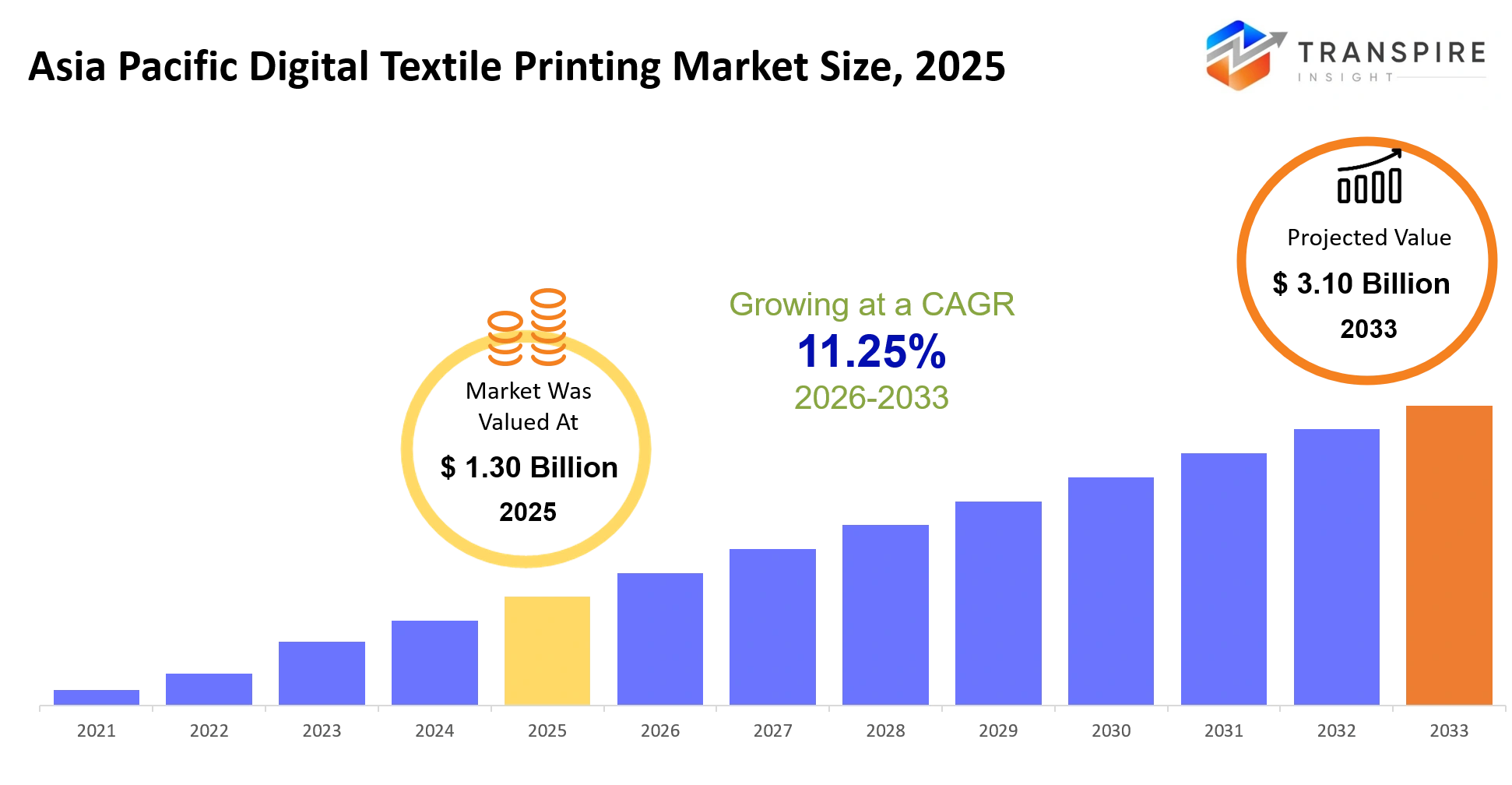
- Asia Pacific Digital Textile Printing Market Size 2025: USD 1.30 Billion
- Asia Pacific Digital Textile Printing Market Size 2033: USD 3.10 Billion
- Asia Pacific Digital Textile Printing Market CAGR: 11.25%
- Asia Pacific Digital Textile Printing Market Segments: By Printing Type (Direct-to-Garment, Direct-to-Fabric, Sublimation Printing, Pigment Printing, Reactive Printing, Acid Printing, Disperse Printing, Others); By Ink Type (Pigment Inks, Reactive Inks, Acid Inks, Sublimation Inks, Disperse Inks, UV Inks, Others); By Application (Fashion Apparel, Home Textiles, Sportswear, Soft Signage, Industrial Textiles, Others); By End User (Textile Manufacturers, Fashion Brands, Printing Service Providers, Others).
Asia Pacific Digital Textile Printing Market Summary
The Asia Pacific Digital Textile Printing Market was valued at USD 1.30 Billion in 2025. It is forecast to reach USD 3.10 Billion by 2033. That is a CAGR of 11.25% over the period.
The Asia Pacific Digital Textile Printing Market is really helpful for people who make textiles, clothes and home furnishings. It lets them make custom designs quickly and with waste. The old way of printing took a long time to set up and needed a lot of products to be made at once.. Digital textile printing is different. It allows people to change designs fast, make things when they are needed and handle orders easily. This is very important for businesses that make clothes and textiles because people want things all the time.
In the five years the market has changed a lot. It used to be about traditional screen printing but now it is more about digital printing with special inkjet technologies. This change happened faster after the pandemic caused problems with getting things from one place to another. It showed that making things too far in advance and having much extra stock was not a good idea. So companies started using systems that could make things quickly and locally and launch products fast.
Now the market is growing because people want new things fast, they want things that're just for them and they want to waste less. Textile producers are using water, not making too much of something that might not sell and letting people make custom prints. This means that more and more people are using printing. It is creating ways for companies that make equipment, ink, software and textiles to make money in the Asia Pacific Digital Textile Printing Market.
Key Market Insights
- The Asia Pacific Digital Textile Printing Market is getting bigger because textile manufacturers want to make things on demand, have shorter waiting times and use printing technologies that do not waste resources.
- The Asia Pacific Digital Textile Printing Market will probably keep doing so until 2033 because people want customized clothes companies are using digital manufacturing and there are advanced inkjet printing technologies.
- East Asia is the part of the Asia Pacific Digital Textile Printing Market with more than 45 percent of the market in 2025 because it has a lot of textile manufacturing capacity and is investing in technology.
- South Asia is growing the fastest because it is exporting clothes and modernizing its textile production facilities.
- Direct-to-fabric printing is the part of the market with more than 40 percent because it produces high-quality things, has fewer steps and is flexible.
- Direct-to-garment printing is the biggest because fashion brands want to make small batches of clothes and personalized designs.
- Pigment-based digital printing is growing the fastest between 2026 and 2033 because it uses water and energy.
- Most of the Asia Pacific Digital Textile Printing Market demand is for clothes because people want fashion and customized products.
- Home textiles are also growing, because interior furnishing brands are using printing to make new designs and launch products quickly.
- Big textile manufacturers are the users of the Asia Pacific Digital Textile Printing Market because they want to improve productivity and manage inventory better.
- Medium-sized textile businesses are growing the fastest because it is easier for them to get into the market and they have more access to digital equipment.
- Companies, like Epson Kornit Digital, Mimaki, Roland DG, HP and Konica Minolta are making products using artificial intelligence to improve workflows and working together with other companies.
What are the Key Drivers, Restraints, and Opportunities in the Asia Pacific Digital Textile Printing Market?
Driver
The thing that is making the market for textiles grow fast is that people want things made quickly and they want them to be special. Companies that make clothes and sports equipment and things for the home need to be able to make products quickly and in small amounts. The old way of printing on fabric is not good for this because it costs a lot to set up and takes a long time. Digital printing on fabric is a way because it lets people make changes to designs quickly and make things when they are needed.This change in the way things are made helps the people who make textiles make money because they do not have to keep as much extra fabric and they can make new products more often. Companies can see what people want and make it for them in a few weeks. They also throw away less. Do not have to spend as much money on samples. This makes them more profitable. As people want special things, digital printing is becoming more popular in the textile business.
Restraint
The biggest problem is that buying the machines, special ink, software and training people to use them costs a lot of money.This is an issue because these machines need to be updated all the time.People need to learn how to use them.Many sized textile companies do not have enough money, for these things.The problem is not the cost of the machines.The factories where things are made also need to be updated.Workers need to be trained on the machines.If companies do not invest in these things they will not be able to make things well as other companies.This means some companies will be making things in a way while others will still be doing things the old way.
Opportunity
There is an opportunity for digital textile printing that uses pigments. This way of printing uses water and energy and is better for the environment. It also works with different kinds of fabric. People are starting to invest in this kind of printing. It is becoming more popular.Another good thing that is happening is that people are making networks of places where things can be made quickly and when they are needed. This means that textile companies can make things close to where people live and do not have to keep much extra fabric. This will help companies that make equipment and software and textiles to grow and make money.
What Has the Impact of Artificial Intelligence Been on the Asia Pacific Digital Textile Printing Market?
Digital textile printing is changing because of intelligence and new digital technologies. These technologies are making the process easier by improving how colors look, making production faster and automating a lot of tasks. Now computers can take care of matching colors lining up patterns on fabric and using the amount of ink. This means people do not have to get involved when planning digital textile printing production.In textile factories special software is connected to printers made by companies like Epson and Kornit Digital. This software helps make sure digital textile printing production is on schedule and orders are filled on time. It makes the whole digital textile printing process run smoother and reduces delays when setting up the machines.
Digital textile printing and artificial intelligence are also being used to predict when parts of the machines might break down. It looks at things like how the machines are vibrating, how well the nozzles are working and how thick the ink is. This helps figure out if something is going to go wrong before it actually does. As a result the machines can keep running without stoppages and digital textile printing production can be more consistent. Digital textile printing also uses analytics to make sure the prints look good and that ink is used efficiently. This reduces waste and makes digital textile printing production more consistent.
There is a problem with digital textile printing. It is very expensive to set up these intelligence systems. They need a lot of good data to work well. A lot of textile manufacturers cannot afford to implement these systems because their production systems are not very modern and they do not have the digital infrastructure. So not everyone is using these textile printing technologies even though they can make digital textile printing production faster, cheaper and more accurate. Digital textile printing and artificial intelligence can make a difference. It is not available to everyone yet.
Key Market Trends
- Since 2022 textile makers have moved from big screen printing to systems. This change helps them save setup time and make production schedules more flexible.
- People want customized clothes more and more after 2023. Fashion brands now focus on making batches and changing designs fast.
- In 2024 Epson and Kornit Digital put more industrial printers in place. This helps more textile makers use digital systems.
- Old ways of dyeing that use a lot of water are being used less. More makers are using pigment-based printing now because they care about being sustainable.
- medium-sized textile firms started using digital printing more after 2024. This is because the equipment is smaller and not as expensive to start with.
- Systems that use AI to manage printing workflows help get the colors right and reduce waste. They do this by making sure the right amount of ink is used for batches.
- Makers of home textiles started using printing after 2023. This helps them change designs fast for the furniture market.
- Problems with supply chains in areas made makers want to produce textiles near where they are sold. So they want production facilities close by.
- High-quality inkjet printing replaced systems for high-end clothes. This makes designs more precise and production more consistent.
- Big companies are working more. They team up with textile mills to use production from start to finish. This makes things more competitive.
Asia Pacific Digital Textile Printing Market Segmentation
By Printing Type
There are ways to print on fabric. We have Direct-to-Garment, Direct-to-Fabric Sublimation Printing, Pigment Printing, Reactive Printing, Acid Printing, Disperse Printing and others. Direct-to-fabric printing is great for making a lot of textiles at once. It gives us quality. Reduces the number of steps we need to take. Companies that make fabric use Direct-to-fabric printing to work and waste less material. Fashion companies like Direct-to-fabric printing because they can change their designs easily and make batches of clothes.Direct-to-garment printing is good for making custom clothes. We do not have to keep a lot of clothes in stock. Sublimation printing and Pigment printing are getting more popular because they give us colors and are more sustainable. Reactive printing, Acid printing and Disperse printing are still used for kinds of textiles that need fabrics.
By Ink Type
We have kinds of inks like Pigment Inks, Reactive Inks, Acid Inks, Sublimation Inks, Disperse Inks, UV Inks and others. Pigment inks are used a lot because they use water and make the process simpler. Textile manufacturers use Pigment inks to reduce their impact on the environment and work efficiently. Pigment inks are good for making clothes and home textiles with quality.Reactive inks give us good quality fabric printing with colors that last. Sublimation inks are good for printing on polyester fabrics because they transfer well. Acid inks, Disperse inks and UV inks are used for textiles that need properties.
By Application
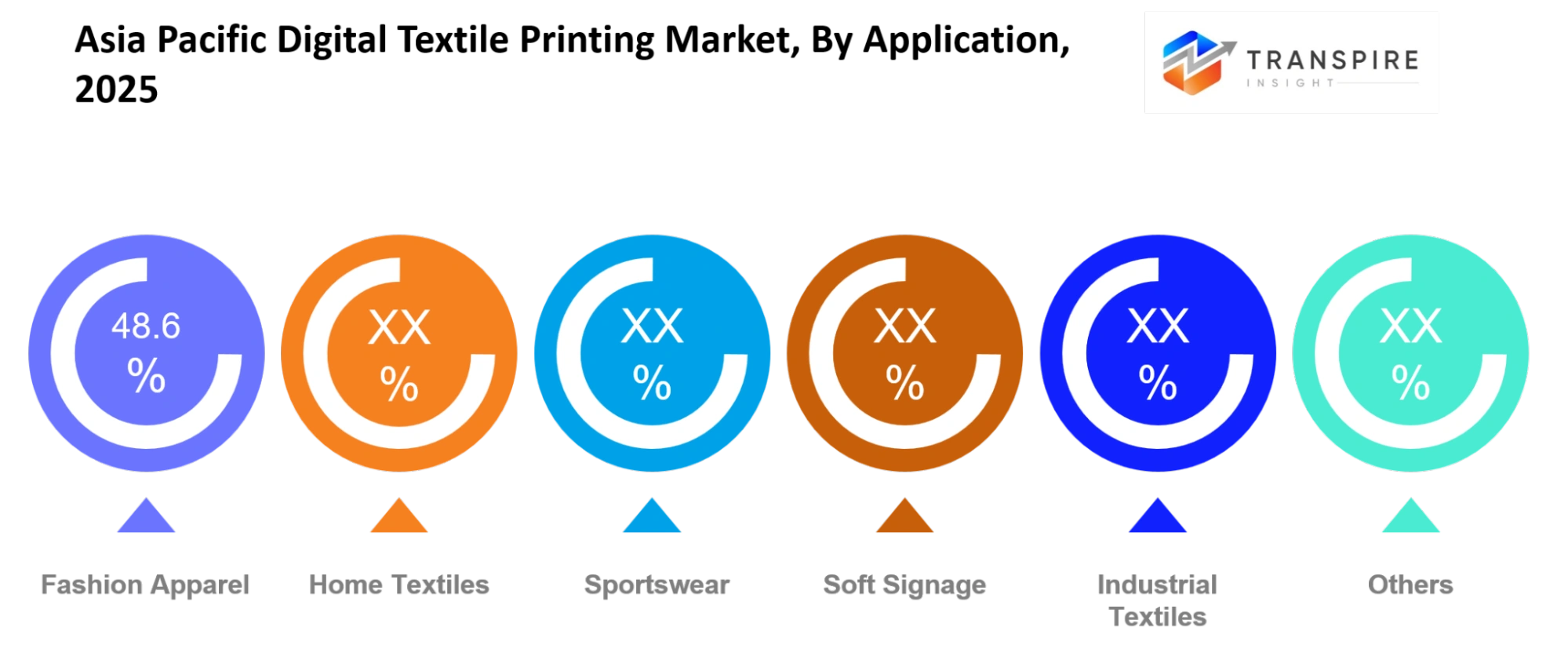
Digital textile printing is used for Fashion Apparel, Home Textiles, Sportswear, Soft Signage, Industrial Textiles and others. Fashion apparel is the area where people want custom clothes and fast production. Brands use Digital textile printing to keep up with the fashion trends. This helps them reduce inventory costs and launch products quickly.Home textiles are becoming more popular as people want custom designs for their homes. Sportswear production is increasing because it needs fabric printing. Soft signage and industrial textiles are also growing as businesses use Digital textile printing solutions.
By End User
Digital textile printing is used by Textile Manufacturers, Fashion Brands, Printing Service Providers and others. Textile manufacturers use Digital textile printing the most because they need to make a lot of textiles and want to optimize their processes. They adopt systems to work efficiently and reduce waste. Investing in automated Digital textile printing systems helps them control costs and give output.Fashion brands are using Digital textile printing more to offer custom clothes and fast production. Printing service providers are growing by offering on-demand services to industries. As Textile manufacturers, Fashion brands and Printing service providers work together the market will continue to grow.
What are the Key Use Cases Driving the Asia Pacific Digital Textile Printing Market?
The production of fashion clothes is a part of the Asia Pacific Digital Textile Printing Market. Fashion brands need to make design changes and produce small batches of clothes. This helps reduce the risk of having much inventory and lets them respond faster to what consumers want to wear especially in cities where people buy clothes.People are also using digital textile printing to make home textiles and sportswear. This is because textile manufacturers and fashion brands want to make clothes and special fabrics that perform well. Some companies that print textiles are using systems to fill small orders for stores and online fashion shops.
There are also some uses for digital textile printing that are becoming popular like making signs and printing on industrial textiles. These are used for things, like advertisements and special fabrics used in offices and other commercial places. More and more people want to be able to make things on demand so this is helping digital textile printing grow in many different industries, including the Asia Pacific Digital Textile Printing Market and the fashion apparel production sector.
|
Report Metrics |
Details |
|
Market size value in 2025 |
USD 1.30 Billion |
|
Market size value in 2026 |
USD 1.47 Billion |
|
Revenue forecast in 2033 |
USD 3.10 Billion |
|
Growth rate |
CAGR of 11.25% from 2026 to 2033 |
|
Base year |
2025 |
|
Historical data |
2021 - 2024 |
|
Forecast period |
2026 - 2033 |
|
Report coverage |
Revenue forecast, competitive landscape, growth factors, and trends |
|
Regional scope |
Asia Pacific |
|
Key company profiled |
Epson, Kornit Digital, Mimaki, Roland DG, Durst, EFI Reggiani, Konica Minolta, Ricoh, HP, Brother Industries, Colorjet, Atexco, SPGPrints, Dover Corporation, Huntsman. |
|
Customization scope |
Free report customization (country, regional & segment scope). Avail customized purchase options to meet your exact research needs. |
|
Report Segmentation |
By Printing Type (Direct-to-Garment, Direct-to-Fabric, Sublimation Printing, Pigment Printing, Reactive Printing, Acid Printing, Disperse Printing, Others); By Ink Type (Pigment Inks, Reactive Inks, Acid Inks, Sublimation Inks, Disperse Inks, UV Inks, Others); By Application (Fashion Apparel, Home Textiles, Sportswear, Soft Signage, Industrial Textiles, Others); By End User (Textile Manufacturers, Fashion Brands, Printing Service Providers, Others). |
Which Regions are Driving the Asia Pacific Digital Textile Printing Market Growth?
East Asia is leading the market because it has a base for making textiles, it uses advanced digital printing and it has good systems in place for exporting. Countries in this area benefit from having everything they need in one place, like fabric production, printing and global distribution networks. The government also helps businesses by supporting automation and sustainable practices, which encourages them to switch to textile printing. This setup allows for making a lot of products with quality, which is why East Asia brings in the most revenue.Southeast Asia is the biggest region and is growing steadily because of stable industrial growth and more foreign investment in making textiles and clothes. Unlike East Asia, which focuses on automation, Southeast Asia grows by keeping costs low and slowly adopting new technology. Countries here keep getting orders from fashion brands, which means they always have work for their printing facilities. As more factories and infrastructure are built it's likely that Southeast Asia will keep producing a lot of products and bringing in revenue.
South Asia is growing fast because it's exporting more textiles and updating its smaller factories. Recently there have been investments in digital printing equipment and upgrades which have changed how things are made. People want products that're affordable and made quickly which is why digital systems are becoming more popular. From 2026 to 2033 there will be a lot of opportunities for companies that provide technology and investors as more factories are built.
Who are the Key Players in the Asia Pacific Digital Textile Printing Market and How Do They Compete?
Competition in the Asia Pacific Digital Textile Printing Market remains moderately fragmented, with global printing technology providers competing alongside regional equipment manufacturers and ink suppliers. Technology innovation and printing efficiency have become the primary basis of competition as textile producers prioritize speed, color accuracy, and production flexibility. Incumbents continue to defend their positions through integrated hardware and software ecosystems, while new entrants focus on cost-effective printers and niche textile applications.
Epson focuses on technology innovation with high-precision inkjet systems that improve color consistency and reduce ink consumption, giving it an advantage in premium textile applications. Kornit Digital emphasizes direct-to-fabric solutions designed for on-demand production, which helps apparel brands reduce inventory risk and shorten lead times. Mimaki differentiates through versatile printing systems that support multiple fabric types, enabling broader adoption across small and mid-sized textile manufacturers. These companies continue expanding through regional distribution networks and partnerships with textile production hubs.
HP strengthens its position through scalable industrial printing platforms that integrate workflow automation and color management software. Konica Minolta focuses on hybrid printing technologies that combine productivity with sustainability improvements in ink usage and energy efficiency. Roland DG targets niche customization markets with compact systems suited for small batch production and printing service providers. Competitive expansion across Asia is driven by collaboration with textile mills, digital workflow integration, and localized manufacturing support.
Company List
- Durst Group
- EFI Reggiani
- Konica Minolta
- Ricoh
- HP
- Brother Industries
- Colorjet Group
- Atexco
- SPGPrints
- Dover Corporation
- Huntsman Corporation
Recent Development News
In August 2025, Kornit Digital launched its Apollo high-volume digital textile printing system. The solution improved industrial throughput by nearly 50 percent, supporting faster on-demand apparel production across Asia Pacific manufacturing hubs.
Source: https://www.yahoo.com
In April 2026, Epson expanded its industrial digital textile printing portfolio through enhanced PrecisionCore printhead integration. The upgrade improved color accuracy and reduced ink consumption for large-scale textile manufacturers shifting toward sustainable production workflows.
Source: https://www.researchandmarkets.com
In February 2026, Mimaki Engineering strengthened its Asia distributor network through a strategic partnership expansion with regional textile equipment suppliers. The collaboration increased access to compact digital printing systems for small and mid-sized textile producers.
Source: https://www.skyquestt.com
What Strategic Insights Define the Future of the Asia Pacific Digital Textile Printing Market?
The Asia Pacific Digital Textile Printing Market is structurally moving toward fully digitalized, on-demand textile production ecosystems where design, printing, and distribution are increasingly integrated into a single workflow. Over the next 5 to 7 years, growth will be driven by the need for shorter product cycles, localized manufacturing, and reduced inventory exposure across apparel and home textile supply chains. This shift is reinforced by fashion retailers and textile exporters prioritizing flexible production models that can respond quickly to seasonal demand changes.
A less visible risk is rising dependence on a limited group of advanced printhead and ink technology suppliers. Any disruption in semiconductor-based printhead production or specialty ink supply could constrain output capacity and increase pricing pressure across manufacturing clusters. This concentration risk becomes more significant as adoption of high-precision industrial printers accelerates.
A strong emerging opportunity lies in decentralized micro-factories for textile printing, particularly across South and Southeast Asia. These small, digitally connected production hubs enable near-market manufacturing and reduce logistics costs. Companies that invest early in integrated software platforms, scalable printing systems, and regional partnerships will be better positioned to capture value as production networks shift closer to end consumers.
Asia Pacific Digital Textile Printing Market Report Segmentation
By Printing Type
- Direct-to-Garment
- Direct-to-Fabric
- Sublimation Printing
- Pigment Printing
- Reactive Printing
- Acid Printing
- Disperse Printing
- Others
By Ink Type
- Pigment Inks
- Reactive Inks
- Acid Inks
- Sublimation Inks
- Disperse Inks
- UV Inks
- Others
By Application
- Fashion Apparel
- Home Textiles
- Sportswear
- Soft Signage
- Industrial Textiles
- Others
By End User
- Textile Manufacturers
- Fashion Brands
- Printing Service Providers
- Others
Frequently Asked Questions
Find quick answers to common questions.
The expected Asia Pacific Digital Textile Printing Market size for the market will be USD 3.10 Billion in 2033.
Key segments for the Asia Pacific Digital Textile Printing Market are By Printing Type (Direct-to-Garment, Direct-to-Fabric, Sublimation Printing, Pigment Printing, Reactive Printing, Acid Printing, Disperse Printing, Others); By Ink Type (Pigment Inks, Reactive Inks, Acid Inks, Sublimation Inks, Disperse Inks, UV Inks, Others); By Application (Fashion Apparel, Home Textiles, Sportswear, Soft Signage, Industrial Textiles, Others); By End User (Textile Manufacturers, Fashion Brands, Printing Service Providers, Others).
Major Asia Pacific Digital Textile Printing Market players are Epson, Kornit Digital, Mimaki, Roland DG, Durst, EFI Reggiani, Konica Minolta, Ricoh, HP, Brother Industries, Colorjet, Atexco, SPGPrints, Dover Corporation, Huntsman.
The Asia Pacific Digital Textile Printing Market size is USD 1.30 Billion in 2025.
The Asia Pacific Digital Textile Printing Market CAGR is 11.25% from 2026 to 2033.
- Epson
- Kornit Digital
- Mimaki Engineering
- Roland DG
- Durst Group
- EFI Reggiani
- Konica Minolta
- Ricoh
- HP
- Brother Industries
- Colorjet Group
- Atexco
- SPGPrints
- Dover Corporation
- Huntsman Corporation
About the Authors

Avinash Kumar
I’m Avinash Kumar, a Senior Research Analyst at Transpire Insight, with expertise in the Electronics and Semiconductor and Energy & Power industry. My work focuses on analyzing emerging technologies, market trends, industry developments, and innovation across these sectors. I specialize in transforming complex technical and market insights into clear, research-backed content that helps professionals, businesses, and decision-makers stay informed. Through continuous industry research and data-driven analysis, I strive to deliver accurate, reliable, and practical perspectives on the latest advancements shaping the semiconductor and energy landscape.

Chakradhar Khansole
Chakradhar serves as the Research Director at Transpire Insight, bringing over 8 years of experience in technology, innovation, and strategic market intelligence. He specializes in transforming complex market data into actionable business insights that enable organizations to make informed, growth-oriented decisions. Recognized for his strategic vision and analytical expertise, Chakradhar leads high-impact research initiatives, delivering comprehensive market assessments, competitive intelligence, and forward-looking industry analysis.
Recently Published Reports
-
Apr 2026
Fiber Optic Faceplates Market
Fiber Optic Faceplates Market Size, Share & Analysis Report By Type (< 300 mm2, 300-350 mm2, and > 350 mm2, By Application (Night Vision, Holographic Imaging, Medical, and Others), and Geography (North America, Europe, Asia-Pacific, Middle East and Africa, South and Central America), 2021 - 2031
-
Apr 2026
High Temperature Superconductors Market
High Temperature Superconductors Market Size, Share & Analysis Report By Type (1G HTS, and 2G HTS), By Application (Power Cable, Fault Current Limiter, and Transformer), and Geography (North America, Europe, Asia-Pacific, Middle East and Africa, South and Central America), 2021 - 2031
-
Apr 2026
Industrial Plugs and Socket Market
Industrial Plugs and Socket Market Size, Share & Analysis Report By Type (Industrial Plugs, Industrial Sockets), By Current (Up to 32 A, 32 to 125 A, Above 125 A), By Protection (Dustproof and Splash Proof, Waterproof, Explosion Proof), By End User (Heavy Industries, Oil and Gas, Chemicals and Pharmaceuticals, Power Generation, Others), and Geography (North America, Europe, Asia-Pacific, Middle East and Africa, South and Central America), 2021 - 2031
-
Apr 2026
InGaAs Avalanche Photodiodes Market
InGaAs Avalanche Photodiodes Market Size, Share & Analysis Report By Type (1100 - 1700 nm, and 1000 - 1600 nm), By Application (Missile Warning System, Muzzle Flash Detection, Wafer Defect Inspection, Laser Rangefinders, and Others), and Geography (North America, Europe, Asia-Pacific, Middle East and Africa, South and Central America), 2021 - 2031