
Germany Apparel Market Size & Forecast:
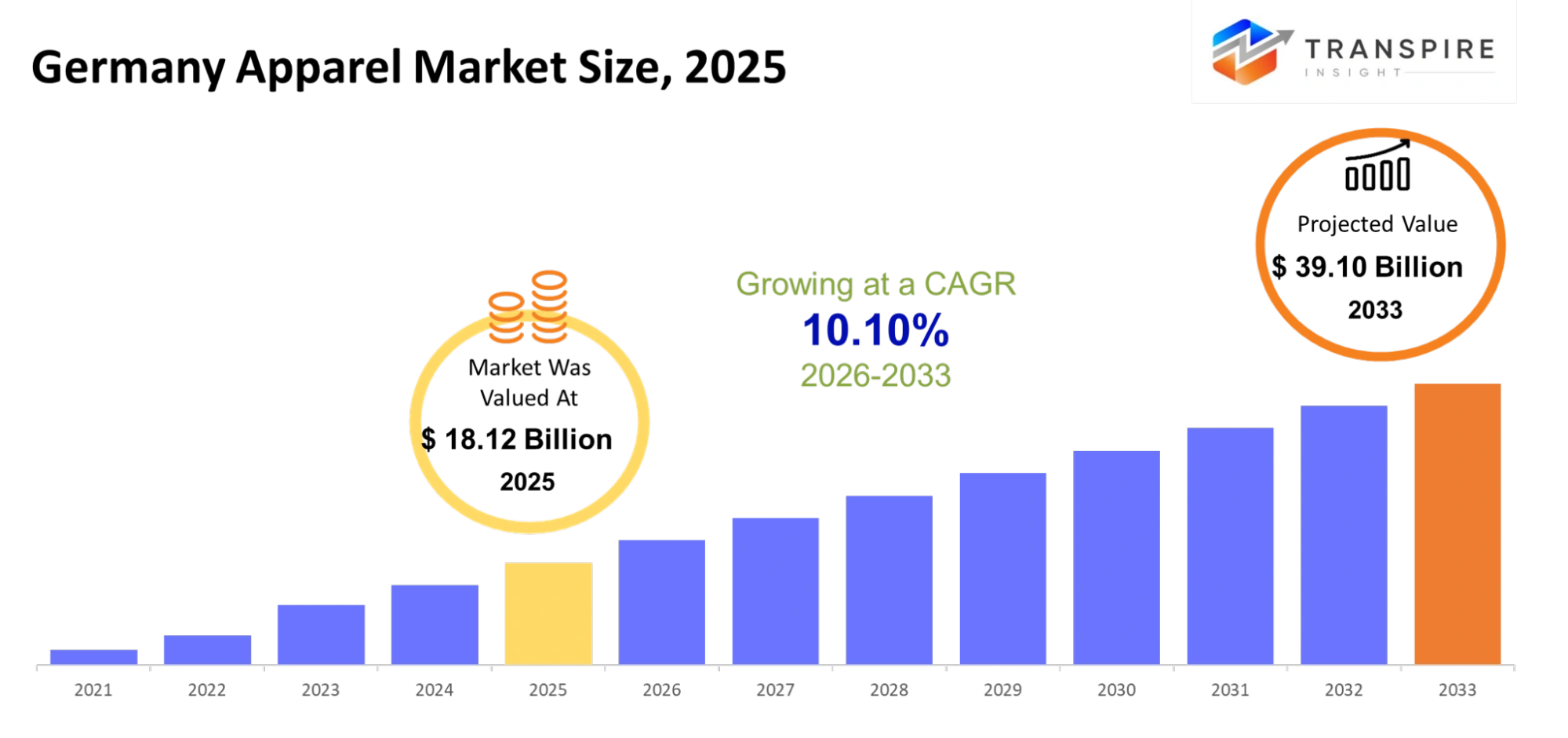
- Germany Apparel Market Size 2025: USD 18.12 Billion
- Germany Apparel Market Size 2033: USD 39.10 Billion
- Germany Apparel Market CAGR: 10.10%
- Germany Apparel Market Segments:By Product Type (Casual Wear, Formal Wear, Sportswear, Innerwear), End User (Men, Women, Kids), Distribution Channel (Offline Retail, Online Retail)
To learn more about this report,  Download Free Sample Report
Germany Apparel Market Summary:
The Germany Apparel Market size is estimated at USD 18.12 Billion in 2025 and is anticipated to reach USD 39.01 Billion by 2033, growing at a CAGR of 10.10% from 2026 to 2033. The apparel market will experience considerable growth because people want fashionable clothing which provides comfort and maintains high quality standards. The market will experience growth because there is a rising fashion awareness among people, their disposable income is increasing, and e-commerce sites are gaining more influence. Apparel brands will improve customer experience by implementing innovative designs which use eco-friendly materials and create multiple shopping options for customers to choose from.
Key Market Trends & Insights:
- The growing demand for premium and branded fashion will continue to be apparent as consumers in Germany continue to have more disposable income, allowing them to spend more on quality and branded fashion, particularly in urban areas where fashion awareness and brand consciousness will continue.
- The impact of social media and fashion trends will continue to be apparent as consumers in Germany will continue to be influenced by digital platforms, encouraging them to quickly adapt to emerging trends in fashion, thereby increasing demand for fashionable apparel.
- Demand for comfort wear is expected to continue to grow since changes in consumers’ lifestyles due to the COVID-19 pandemic are anticipated to result in consumers seeking products that are versatile.
- The growing demand for sustainable fashion is also likely to become more apparent as consumers in Germany make their purchasing decisions based on the growing awareness of environmental issues, which will encourage consumers to opt for apparel made from eco-friendly materials, and as such, brands will be forced to change their practices accordingly.
Germany Apparel Market Segmentation
By Product Type
- Casual Wear: The Organization will experience an increase in casual wear dominance because more people prefer to wear comfortable clothing. The demand for t-shirts and jeans and other similar items will increase because of changing lifestyles which include the growing work-from-home trend. Fashion apparel will also introduce stylish yet comfortable clothes to expand their customer base.
- Formal Wear: Formal wear has a steady share in the market due to a strong requirement for office wear, business suits, etc. Hybrid work culture might affect this segment to a certain extent, but overall, it will remain steady.
- Sportswear: Sportswear is supposed to see a high growth rate due to an increase in health awareness and a rise in outdoor activities. Athleisure wear is also expected to drive this segment as more people prefer to wear sportswear due to a mix of comfort and fashion.
- Innerwear: The innerwear segment will also remain an important segment with consistent demand for innerwear among all segments of consumers. Increasing focus on comfort and quality of fabrics and premium innerwear will contribute to the growth of the innerwear segment. Increasing awareness of hygiene and personal care will also contribute.
By End User
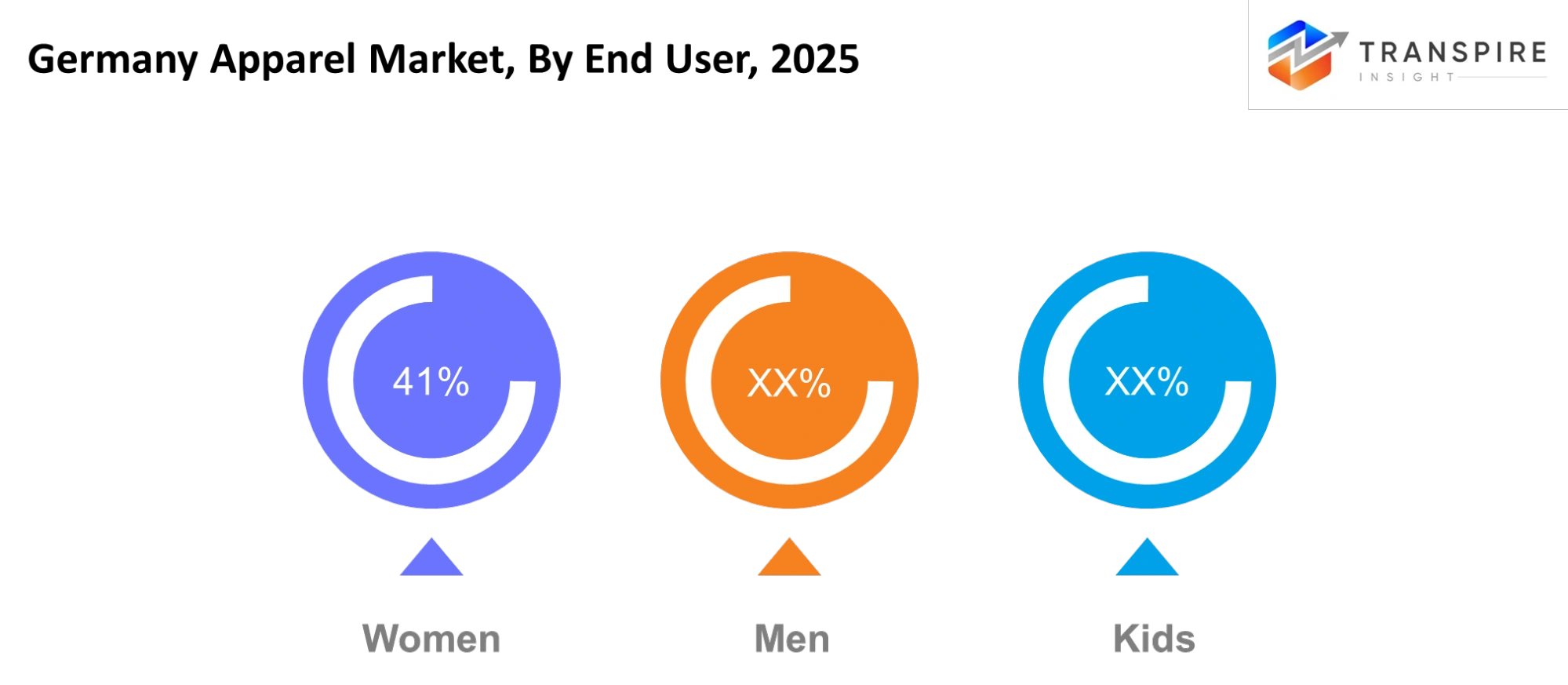
- Men: Mens fashion is the most important part of the Apparel market and is expected to grow steadily, as there is a requirement for both casual and formal wear. Fashion awareness among men is also on the rise, which would help this segment grow.
- Women: Women segment is expected to lead in terms of growth, as women spend more on fashion products compared to men and also make more purchases. A wide range of designs available in this segment, along with seasonal trends, would help this segment grow.
- Kids: This segment is supposed to grow steadily, as parents are more concerned about their kids' comfort, quality, and fashion. Increasing disposable income along with a growing trend towards branded apparel would help this segment grow.
To learn more about this report, Download Free Sample Report
By Distribution Channel
- Offline Retail: Offline retail will also remain important in the Germany apparel market, as customers prefer to use their products before purchasing them. Shopping malls, outlets, and retail stores will remain important in this regard.
- Online Retail: The growth of online retail is expected to remain high in the Germany apparel market, as more and more people are adopting technology and it has become a convenient way to shop.
Country Insights
Germany operates as a major European apparel market through its strong economic conditions and its citizens' high spending power and its advanced shopping systems. The German apparel market will experience continuous expansion as consumers develop more interest in stylish and durable environmentally friendly apparel. German consumers will have a high affinity for both international and local brands, with digitalization adding a positive dimension to the shopping experience.
The German market will also see a growing fashion-conscious population with a rising demand for sustainable clothing, providing a positive outlook for the market in the coming years. The apparel market in Northern Germany will experience continuous growth through its upcoming urban development projects and its established retail systems and increasing need for global fashion products. The fashion industry will establish Hamburg and other cities as main centers through their requirements for both high-end and everyday clothing. The presence of ports will also boost the availability of international brands, with the people of Northern Germany adopting online shopping. The demand for sustainable clothing will also grow, with a modern and environmentally friendly population.
Recent Development News
Expansion of Retail Stores by Global Brands: Fashion retailer Primark has restarted expansion in Germany through new store openings and planned stores to enhance their presence in the market after restructuring their business. They are focusing on product quality, pricing, and digital engagement to remain competitive against emerging e-commerce operators.
Growing Emphasis on Sustainability Regulations: Germany is planning to introduce new legislation regarding textiles, which requires fashion brands to share the cost of recycling clothes to reduce the environmental impact of fast fashion and promote sustainable practices.
Development of Sustainable and Circular Fashion: Growing interest in upcycled/recyclable apparel is gaining traction, as fashion brands are investing in sustainable materials to meet the growing need for sustainable fashion.
|
Report Metrics |
Details |
|
Market size value in 2025 |
USD 18.12 Billion |
|
Market size value in 2026 |
USD 19.94 Billion |
|
Revenue forecast in 2033 |
USD 39.10 Billion |
|
Growth rate |
CAGR of 10.10% from 2026 to 2033 |
|
Base year |
2025 |
|
Historical data |
2021 – 2024 |
|
Forecast period |
2026 – 2033 |
|
Report coverage |
Revenue forecast, competitive landscape, growth factors, and trends |
|
Country scope |
Germany |
|
Key company profiled |
Adidas AG, Puma SE, Hugo Boss AG, Zalando SE, H&M Group, Inditex (Zara), Nike Inc., Uniqlo (Fast Retailing), C&A Mode, Esprit Holdings, Bestseller Group, Under Armour, Levi Strauss & Co., Decathlon Group, Primark. |
|
Customization scope |
Free report customization (country, regional & segment scope). Avail customized purchase options to meet your exact research needs. |
|
Report Segmentation |
By Product Type (Casual Wear, Formal Wear, Sportswear, Innerwear), End User (Men, Women, Kids), Distribution Channel (Offline Retail, Online Retail) |
Key Germany Apparel Market Company Insights
The apparel market in the country is highly competitive and dynamic, with the presence of global apparel brands and domestic players. The country is home to a large number of apparel companies that offer fast fashion, premium, luxury, and sustainable apparel products. The apparel market in the country is dominated by established apparel brands that offer strong brand value, a large retail presence, and an increasing online presence. The apparel companies in the country operate through different modes of engagement, including brick and mortar and omnichannel retail.
Major companies in the German apparel market are shifting focus towards sustainability, digitalization, and product innovation to maintain competitive advantage in the market. Organizations are investing in sustainable products, digital technologies, and product innovation to meet the ever-changing demands of consumers. At the same time, the implementation of latest technologies in the German apparel market is providing a high-quality customer experience. The presence of global brands and local labels in the German apparel market is ensuring continuous innovation and high competition in the market, thus contributing to the growth of the German apparel market.
Company List
- Adidas AG
- Puma SE
- Hugo Boss AG
- Zalando SE
- H&M Group
- Inditex (Zara)
- Nike Inc.
- Uniqlo (Fast Retailing)
- C&A Mode
- Esprit Holdings
- Bestseller Group
- Under Armour
- Levi Strauss & Co.
- Decathlon Group
- Primark
Germany Apparel Market Market Report Segmentation
By Product Type
- Casual Wear
- Formal Wear
- Sportswear
- Innerwear
By End User
- Men
- Women
- Kids
By Distribution Channel
- Offline Retail
- Online Retail
Frequently Asked Questions
Find quick answers to common questions.
The Approximate Germany Apparel Market size is expected to reach USD 39.1 Billion by 2033.
The key Segments of the Germany Apparel Market By Product Type (Casual Wear, Formal Wear, Sportswear, Innerwear), End User (Men, Women, Kids), Distribution Channel (Offline Retail, Online Retail).
Major Germany Apparel Market Players are Adidas AG, Puma SE, Hugo Boss AG, Zalando SE, H&M Group, Inditex (Zara), Nike Inc., Uniqlo (Fast Retailing), C&A Mode, Esprit Holdings, Bestseller Group, Under Armour, Levi Strauss & Co., Decathlon Group, and Primark.
The Current Germany Apparel Market size is USD 18.12 Billion in 2025.
The Germany Apparel Market CAGR is 4.50%.
- Adidas AG
- Puma SE
- Hugo Boss AG
- Zalando SE
- H&M Group
- Inditex (Zara)
- Nike Inc.
- Uniqlo (Fast Retailing)
- C&A Mode
- Esprit Holdings
- Bestseller Group
- Under Armour
- Levi Strauss & Co.
- Decathlon Group
- Primark
Recently Published Reports
-
Apr 2026
Bottled Water Market
Bottled Water Market Size, Share & Analysis Report By Product Type (Still Bottled Water, Carbonated Bottled Water, Functional Bottled Water, and Others), By Packaging (PET, Cans, and Others), By Sales Channel (Supermarkets/Hypermarkets, Convenience Stores/Drug Stores, Grocery Stores/Club Stores, Foodservice, and Others) and Geography (North America, Europe, Asia-Pacific, Middle East and Africa, South and Central America), 2021 - 2032
-
Apr 2026
Color Cosmetic Packaging Market
Color Cosmetic Packaging Market Size, Share & Analysis Report By Application (Mascara Packaging, Liquid Packaging, and Liquid Face), By Type (Tubes & Bottles, Pens & Markers, Compacts & Containers, and Droppers & Pumps), and Geography (North America, Europe, Asia-Pacific, Middle East and Africa, South and Central America), 2021 - 2031
-
Apr 2026
External Microphone For Camera Market
External Microphone For Camera Market Size, Share & Analysis Report By Type (Shotgun Microphone, Lavalier Microphone, and Others), By Application (Digital Camera, Professional Video Camera, and Others), and Geography (North America, Europe, Asia-Pacific, Middle East and Africa, South and Central America), 2021 - 2031
-
Apr 2026
Foot Orthotic Insoles Market
Foot Orthotic Insoles Market Size, Share & Analysis Report By Type (Pre-fabricated, and Custom-made), By Material (Thermoplastic, Composite Carbon Fiber, and Others), By Distribution Channel (Drug Stores, Hospitals & Clinics, and Others), and Geography (North America, Europe, Asia-Pacific, Middle East and Africa, South and Central America), 2021 - 2031