
Asia Pacific Sustainable Printing Market Size & Forecast:
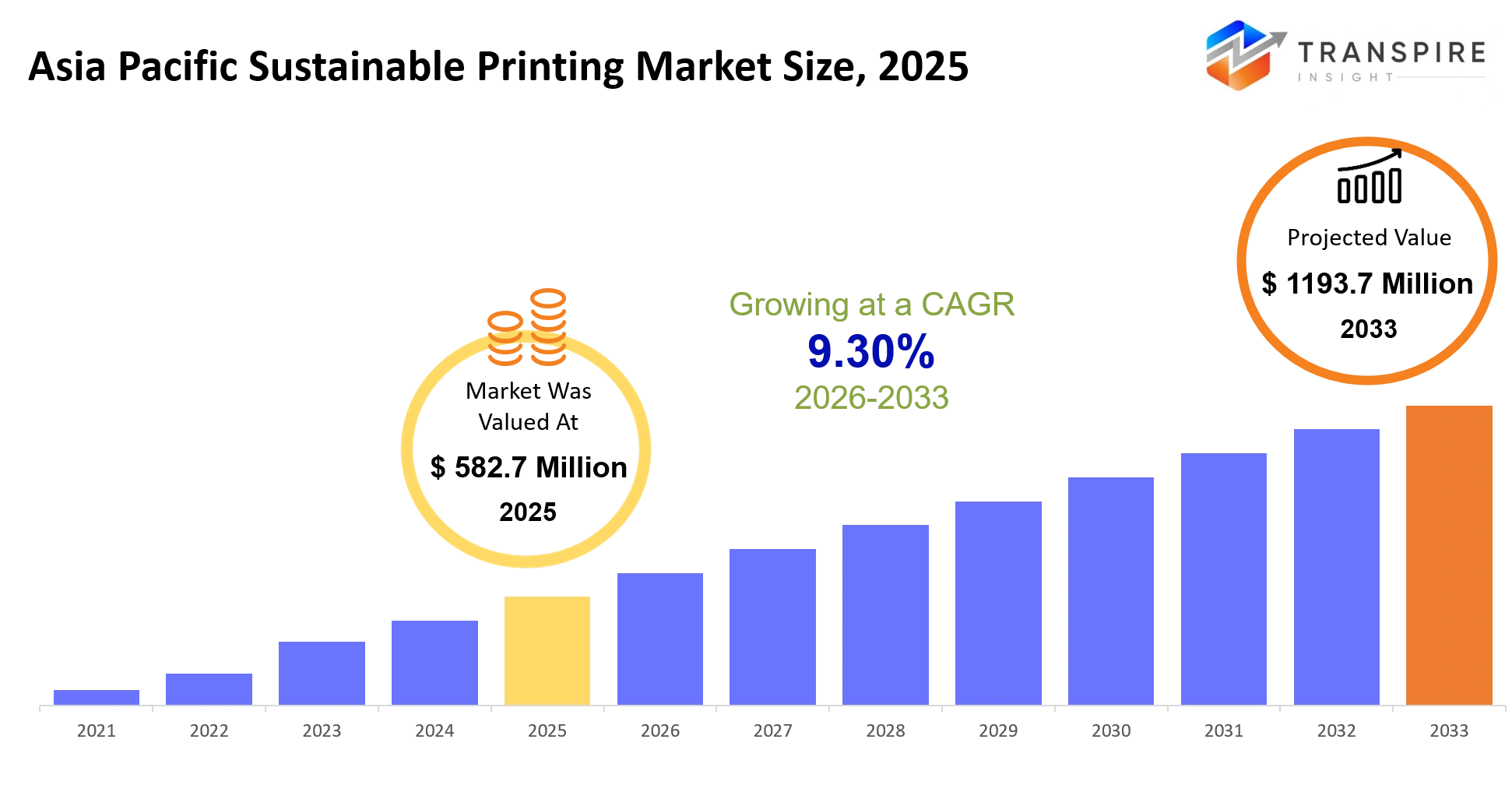
- Asia Pacific Sustainable Printing Market Size 2025: USD 582.7 Million
- Asia Pacific Sustainable Printing Market Size 2033: USD 1193.7 Million
- Asia Pacific Sustainable Printing Market CAGR: 9.30%
- Asia Pacific Sustainable Printing Market Segments: By Printing Type (Digital Printing, Offset Printing, Flexographic Printing, Screen Printing, Gravure Printing, Inkjet Printing, UV Printing, Others); By Material (Recycled Paper, FSC Certified Paper, Biodegradable Inks, Water-Based Inks, Soy-Based Inks, Recycled Cardboard, Eco Labels, Others); By Application (Packaging, Publishing, Advertising, Labels, Commercial Printing, Textile Printing, Signage Printing, Others); By End User (Packaging Companies, Publishers, Advertising Agencies, Retailers, Textile Companies, Brand Owners, Print Service Providers, Others).
Asia Pacific Sustainable Printing Market Summary
The Asia Pacific Sustainable Printing Market was valued at USD 582.7 Million in 2025. It is forecast to reach USD 1193.7 Million by 2033. That is a CAGR of 9.30% over the period.
In reality the Asia Pacific Sustainable Printing Market fosters how packaging, publishing and industrial label systems are able to minimize materials used and consumption of harmful inks, while shifting toward recyclable and bio-derived substrates. The market has enabled manufacturers and brand owners to not only comply with legislation, but also maintain the speed and volume expected from print streams within packaging lines, retail labels and logistics tracking.
Within the last 3-5 years, the market structure has rapidly evolved from predominantly solvent-based, petroleum-derived inks to include water-based, UV-curable, and digitised processes. Increased regulation of extended producer responsibility in India, China, Japan and across Southeast Asia forced converters to re-formulate inks and explore new substrate compatibility and a pandemic induced focus on supply chains has exposed vulnerabilities around foreign chemical suppliers, fueling local reformulations and production.
Now, adoption is no longer the choice for large firms; it is mandatory with sustainability built into purchasing protocols, demanding capital investment in eco-friendly printing presses and inks across the region.
Key Market Insights
- China is expected to dominate the Asia Pacific sustainable printing market in 2025 with close to 38% share, driven by high demand for packaging and manufacturing of export products at large scale.
- India is identified to be the fastest growing region until 2030, driven by increasingly strict compliance rules for plastics and inks in industrial printing.
- Southeast Asian countries are increasing their adoption rate of sustainable printing, with major global brands setting their production bases in Vietnam and Thailand.
- Japan's demand is stable, driven by sophisticated UV curable printing systems and high-precision industrial labeling processes.
- Water-based inks are expected to hold close to 41% share in 2025, owing to compliance to low VOC (Volatile Organic Compounds) levels and approval for use in food packaging applications.
- UV curable printing solutions hold the second largest market share. Growth is driven by benefits of faster curing times and lower energy usage in comparison to conventional printing solutions.
- The fastest growing application is projected to be the digital sustainable printing inks from 2024-2030, being an enabler for on-demand production.
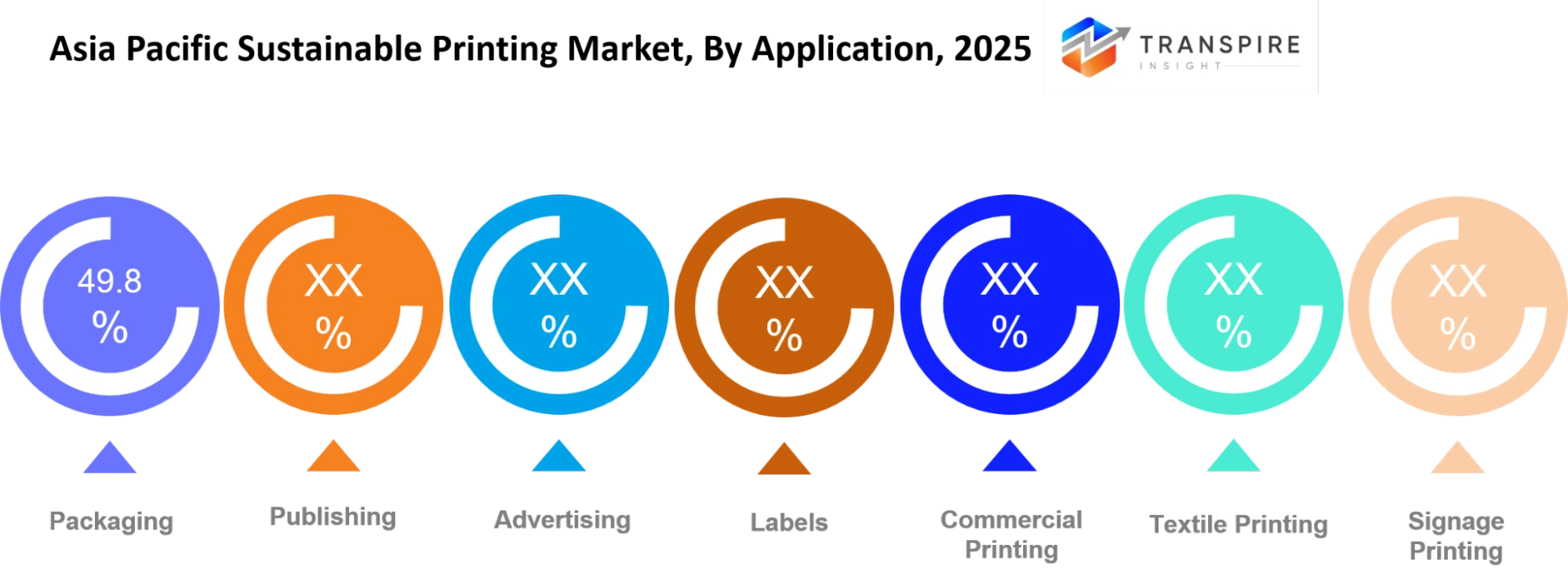
- Applications share is primarily attributed to packaging applications with nearly 52% share, as packaging is the core of Asia Pacific sustainable printing market.
- E-commerce logistics labeling is anticipated to grow at the highest rate, driven by developing cross-border fulfillment networks.
- FMCG and packaging manufacturers led the market with nearly 45% share, attributed to large-scale procurement shifts for compliance reasons.
What are the Key Drivers, Restraints, and Opportunities in the Asia Pacific Sustainable Printing Market?
The main growth driver is the regulations in place regarding VOC emissions, and reduction of packaging waste, which governments have been pushing in China, Japan and India. Higher compliance ceilings were imposed upon these countries, pushing ink producers to invest in the switch from solvent-based to water-based or UV-curable inks. This has a direct impact on the CAPEX expenditure on new printing solutions and drives demand on repetitive consumables for technology providers in the longer run, bringing stability to their revenue models.
The main growth dampener is the excessive cost of retrofitting current flexographic and gravure printing machinery to compliant specifications. In many cases, small and mid-sized converters have small profit margins and cannot easily make huge upfront investments for new curing systems, new ink formulation, or digitization of printing workflows. This fundamental constraint limits the replacement cycle of old machinery and leads to slower adoption of new technologies within tier-2 and tier-3 manufacturing locations, and hence dampens the short-run adoption.
A major opportunity exists within localized digital printing solutions for e-commerce packaging. With growing fulfillment networks across Asia, in places like India and Southeast Asia, it has become feasible to install on-demand, low waste digital printing solutions. In this context, initial investment in decentralized, smart packaging hubs, near logistics hubs like Vietnam and western India show the possibilities of localized manufacturing reducing material waste and also opening up new revenue streams through new service models
What Has the Impact of Artificial Intelligence Been on the Asia Pacific Sustainable Printing Market?
AI technology is changing the way productivity and regulation is handled in the Asia Pacific Sustainable Printing Market through the use of Automated print quality control and dynamic process control. AI-driven vision systems are being integrated into large packaging production lines to identify ink discrepancies, color variations, and substrate flaws while producing large production runs and decreasing print waste and re-print rates.
ML models are also being utilized as predictive maintenance systems, utilizing vibrational, thermal, and ink flow patterns of print equipment to estimate machinery failure prior to a down period. This has improved uptime in select facilities by minimizing unexpected downtimes and synchronizing planned maintenance in high-volume packaging plants in FMCG and logistics environments.
AI-driven workflow platforms are increasing productivity through job schedule optimization and reducing waste from printing the wrong lot sizes, with lot size and run time optimization driven by predictive forecasting models. These processes are inhibited by expensive integration costs and fragmented data within pre-existing printing equipment. The lag in full integration from analog presses into AI systems has caused slower widespread adoption among mid-tier printers in developing Asian printing hubs.
Key Market Trends
- Water-based ink adoption saw a substantial increase after 2022 replacing the solvent based systems in packaging plants to address tight regulations on VOC emissions.
- UV curable printing was widely adopted after 2023 by manufactures in high volume production lines due to faster curing time and reduced energy requirement in printing applications.
- China's tightened regulations on emission on packaging, influenced packaging converters after 2023 to adapt new workflows to adopt sustainable ink faster for export-oriented industries.
- India saw changes in its printing sector after 2024 with sustainability as a driver for procurement as FMCG brands demanded the vendors to contract on terms of substrate compatibility with recyclable packages.
- Digital sustainable printing saw significant increase in between 2022-2025, with e-commerce fulfillment centers opting for waste-reducing solutions through on-demand production of labels and packaging.
- Japan improved precision eco-printing systems after 2023 with firms investing on low energy UV presses to achieve high quality at stringent environmental requirements.
- Southeast Asian manufacturers increased production capacity in Vietnam and Thailand after 2022 shifting production processes to global sustainability-linked procurement requirement.
- HP Inc and Canon advanced innovation in sustainable printing with both launching innovative recyclable ink cartridges and energy efficient industrial printing platform during 2024.
- Ricoh and Fujifilm were engaged with increased number of packaging converters after 2023, to integrate closed-loop recycling systems into industrial printing applications.
- AI-enabled print quality control systems saw growth after 2024 due to effective decrease in waste rates via improved defect detection during high speed production.
Asia Pacific Sustainable Printing Market Segmentation
By Printing Type :
The Asia Pacific Sustainable Printing Market witnesses a significant transition from offset & gravure based systems to digital and UV printing in the packaging and industrial labeling industries. Digital printing is increasingly used to fulfill demands for short turnaround times, and minimal waste output on the packaging workflow. High-volume packaging lines are utilizing flexographic printing and inkjet printing solutions to meet customization and short runs required in commercial printing.
Regulatory pressure for emission control and sustainable processes within China, India and Japan compels printing units towards water based systems and low VOC outputs. UV printing is gaining traction as its low VOC emission and faster curing time enhances energy efficiency and efficiency. Higher raw material utilization by offset printing in the commercial industry has driven a decline in its application. Print service providers are investing in hybrid printing systems combining digital and flexo printing technology to achieve cost efficiency and environmental compliance in production workflows.
By Material :
Materials used in the Asia Pacific Sustainable Printing Market are shifting towards a wide range of recyclable substrates and low-emission inks, largely influenced by sustainability standards in packaging. The increased adoption of water based inks is largely driven by the stricter safety standards on food packaging and retail labels as compared to solvent based inks. Recycled paper and FSC certification paper hold significant procurement preference from brand owners in FMCG and retail sectors.
The uptake of biodegradable and soy based inks is seen growing across export-oriented manufacturing sectors in Southeast Asia, influenced by sustainability standards within the global supply chain. The usage of recycled cardboard in e-commerce packaging is also on the rise owing to the increase in parcel volume and environmental directives. Eco labels are becoming mandatory on branded packages with a drive for transparency on environmental factors across consumer facing industry segments.
By Application :
The packaging application covers the majority of the application segment in the Asia Pacific sustainable printing market owing to an increase in distribution networks for FMCG and increasing volume of orders under e-commerce fulfillment. Application of labels printing is expanding due to rising traceability demands throughout the supply chain of food, pharmaceuticals, and logistics industries. Application in commercial printing has seen a marginal increase and demand is shifting towards short-run print and customized solutions.
Application of advertising printing has seen a decrease in conventional print format and there has been a shift toward print campaigns using digital substrate and recyclable substrates. Applications of textile printing are shifting towards eco-friendly inks in view of increasing compliance standards for export products by apparel industries based in India and Vietnam. Application of signage printing has also seen an increased adoption of UV and recyclable-based materials as new infrastructure projects focus on environmental standards for public utility systems.
By End User :
The application of packaging industries demands for the Asia Pacific sustainable printing market will continue to witness large-scale shifts toward compliant packaging materials and ink systems. Brand owners are putting forth sustainability-driven purchasing agreements, which requires certified inks and recyclable materials to be sourced through a wider supplier network. Print service providers are increasing investment in digital infrastructure in line with increasing demands for custom printing.
The application of retailers and e-commerce players are driving greater adoption of sustainable printing solutions for reduction of packaging waste and increasing transparency in supply chains. Textile players will adopt a low impact printing process due to stricter export regulations and increasing commitments towards environmental standards globally. Application publishing has started to decrease its print volumes and move toward a hybrid digital print system for increased cost efficiency and reduced material consumption.
What are the Key Use Cases Driving the Asia Pacific Sustainable Printing Market?
Use cases for packaging represent most of the adoption across the Asia Pacific Sustainable Printing Market, as FMCG and food segments require low-emission, compliant printing at high volumes on substrates suitable for recycling. Brand owners utilize sustainable inks and certified materials in order to meet the stricter packaging waste mandates and export requirements in markets such as China, India, and Japan, driving consistent demand for high-throughput, low-emission printing solutions.
Label printing and commercial branding is becoming more popular due to the need among retailers and logistics operations to enhance tracking and traceability in their respective supply chains. Pharma businesses and e-commerce companies also depend more on water-based inks and digital printing technologies for variable data label printing and quicker supply chain visibility throughout regional supply networks.
Other burgeoning use cases involve the application of eco-friendly dyes to printed textiles in export-oriented garment manufacturing areas and printing signage for smart cities that utilize recyclable UV-curable materials. While these areas are still nascent in terms of penetration of sustainable printing solutions, growth is expected as government mandates on environmental responsibility and corporate ESG goals redefine purchasing requirements within the manufacturing and urban development sectors.
|
Report Metrics |
Details |
|
Market size value in 2025 |
USD 582.7 Million |
|
Market size value in 2026 |
USD 640.5 Million |
|
Revenue forecast in 2033 |
USD 1193.7 Million |
|
Growth rate |
CAGR of 9.30% from 2026 to 2033 |
|
Base year |
2025 |
|
Historical data |
2021 - 2024 |
|
Forecast period |
2026 - 2033 |
|
Report coverage |
Revenue forecast, competitive landscape, growth factors, and trends |
|
Regional scope |
Asia Pacific (India, China, Japan, Australia, South Korea, Rest of Asia Pacific) |
|
Key company profiled |
HP, Canon, Epson, Xerox, Ricoh, Konica Minolta, Heidelberg, Fujifilm, Agfa, Durst, Mimaki, Roland DG, SCREEN Holdings, Komori, Bobst. |
|
Customization scope |
Free report customization (country, regional & segment scope). Avail customized purchase options to meet your exact research needs. |
|
Report Segmentation |
By Printing Type (Digital Printing, Offset Printing, Flexographic Printing, Screen Printing, Gravure Printing, Inkjet Printing, UV Printing, Others); By Material (Recycled Paper, FSC Certified Paper, Biodegradable Inks, Water-Based Inks, Soy-Based Inks, Recycled Cardboard, Eco Labels, Others); By Application (Packaging, Publishing, Advertising, Labels, Commercial Printing, Textile Printing, Signage Printing, Others); By End User (Packaging Companies, Publishers, Advertising Agencies, Retailers, Textile Companies, Brand Owners, Print Service Providers, Others). |
Which Regions are Driving the Asia Pacific Sustainable Printing Market Growth?
China is by far the largest market in Asia Pacific Sustainable Printing due to its strict environmental enforcement and its immense export manufacturing clusters. Pressure from the regulators for reducing VOC emissions compelled packaging converters to adopt water based and UV based systems relatively quickly. Established clusters and well-functioning port logistics with a high FMCG output create a solid demand base and allow for continuous investment in regulated printing infrastructure at all the major manufacturing clusters.
Japan continues to be a stable, technology-focused supplier unlike the scale-driven China market. It adapts based on steady environmental regulations and long term planning of investment of corporations unlike in the situation of abrupt changes in regulation. Manufacturers prefer systems for precision printing that decrease usage of materials without compromising on print quality used for the electronics industry and luxury packages market. Its R&D development is well integrated with production processes and regular production processes ensure solid demand for established production networks.
India shows fastest growth rates of the market in the Asia Pacific region because of recent stringent rules related to package waste and exponential growth in organised retail and e-commerce logistics. Government imposed regulations regarding sustainability issued after 2023 accelerated the adoption of systems from traditional into digital and recyclable materials based systems. New industrial zones and packaging clusters are established rapidly across southern and western states. This indicates solid opportunities for market entry of suppliers of technology and materials in the region between 2026-2033.
Who are the Key Players in the Asia Pacific Sustainable Printing Market and How Do They Compete?
The competition within the Asia Pacific Sustainable Printing Market can be considered moderately consolidated, as major global printing technology companies are challenging regional converters and niche sustainable ink suppliers. Existing players seek to protect their existing share through technological improvements while new players endeavor to seize share by offering lower cost sustainable ink solutions and digital workflow technologies. The main competition is around energy efficiency, regulatory compliance performance and how sustainable low-emission printing technology can be embedded in mass packaging printing.
HP Inc. Continues to leverage digital printing dominance by scaling their inkjet printing platforms focusing on waste-reduction and increased printing efficiency in packaging printing applications. The company extends advantage through building relationships with packaging converters and in the investment in reusable cartridge systems that will conform to the different environmental requirements across Asia.
Canon Inc. Relies on precision UV and inkjet technology while attempting to tap into high-value commercial and industrial printing segments. Strategy includes expanding their regional production facility within Asia region and partnering with the enterprise print service provider to improve workflow and energy-saving process.
Seiko Epson Corporation utilizes Micro Piezo inkjet technology as a differentiator from higher ink usage while providing higher printing accuracy in the packaging printing, labeling and textiles printing applications. The company aims to grow by scaling their eco-tank printing solutions and expanding their distribution in Southeast Asia's packaging and textiles industries.
Company List
- HP
- Canon
- Epson
- Xerox
- Ricoh
- Konica Minolta
- Heidelberg
- Fujifilm
- Agfa
- Durst
- Mimaki
- Roland DG
- SCREEN Holdings
- Komori
- Bobst
Recent Development News
In May 2026, Ricoh Company, Ltd. announced Ricoh Global SDGs Action Month 2026. The initiative reinforces sustainability integration across its printing and document solutions business, aligning ESG targets with enterprise print workflows and accelerating adoption of energy-efficient systems in Asia-Pacific production environments.
Source: https://www.ricoh.com/
In April 2026, Fujifilm Business Innovation Asia Pacific launched remanufactured ApeosPort C5570 R and C3570 R multifunction printers. The move strengthens circular printing models and extends equipment life cycles across sustainable print production networks.
Source: https://www.rtmworld.com/
What Strategic Insights Define the Future of the Asia Pacific Sustainable Printing Market?
The Asia Pacific Sustainable Printing Market is characterized by an irreversible trend towards end-to-end, low-emission digital printing ecosystems where compliance, automation and material efficiencies represent key strategic considerations and long term competitive factors. Over the next 5-7 years market growth will be driven by, in particular, the adoption of closed loop ink systems and digital controlled short runs driven by increasing regulatory pressures on packaging in the China, India and SE Asia markets, rather than sheer volume increase.
The hidden threat is the potential acceleration of technology substitution pressure arising from truly digital, screenless labeling, and direct-to-package systems, that will move market participants away from traditional sustainable printing equipment much sooner than predicted, thus threatening profitability among medium-tiered converters still locked into hybrid analog systems.
A tangible growing opportunity exists in the formation of local, circular ink manufacturing hubs in India and Vietnam, enabling reduced supply chain emissions and costs with direct access to key packaging clusters. Businesses making early investments into local ink re-formulation and recycling capabilities will be in a stronger competitive position.
The competitive focus should remain on platform based printing solutions integrated with AI enabled workflow management and recyclable substrate suitability for emerging restrictive regulations.
Asia Pacific Sustainable Printing Market Report Segmentation
By Printing Type
- Digital Printing
- Offset Printing
- Flexographic Printing
- Screen Printing
- Gravure Printing
- Inkjet Printing
- UV Printing
By Material
- Recycled Paper
- FSC Certified Paper
- Biodegradable Inks
- Water-Based Inks
- Soy-Based Inks
- Recycled Cardboard
- Eco Labels
By Application
- Packaging
- Publishing
- Advertising
- Labels
- Commercial Printing
- Textile Printing
- Signage Printing
By End User
- Packaging Companies
- Publishers
- Advertising Agencies
- Retailers
- Textile Companies
- Brand Owners
- Print Service Providers
Frequently Asked Questions
Find quick answers to common questions.
The Asia Pacific Sustainable Printing Market size is USD 1193.7 Million in 2033.
Key segments for the Asia Pacific Sustainable Printing Market are By Printing Type (Digital Printing, Offset Printing, Flexographic Printing, Screen Printing, Gravure Printing, Inkjet Printing, UV Printing, Others); By Material (Recycled Paper, FSC Certified Paper, Biodegradable Inks, Water-Based Inks, Soy-Based Inks, Recycled Cardboard, Eco Labels, Others); By Application (Packaging, Publishing, Advertising, Labels, Commercial Printing, Textile Printing, Signage Printing, Others); By End User (Packaging Companies, Publishers, Advertising Agencies, Retailers, Textile Companies, Brand Owners, Print Service Providers, Others).
Major Asia Pacific Sustainable Printing Market players are HP, Canon, Epson, Xerox, Ricoh, Konica Minolta, Heidelberg, Fujifilm, Agfa, Durst, Mimaki, Roland DG, SCREEN Holdings, Komori, Bobst.
The Asia Pacific Sustainable Printing Market size is USD 582.7 Million in 2025.
The Asia Pacific Sustainable Printing Market CAGR is 9.30% from 2026 to 2033.
- HP
- Canon
- Epson
- Xerox
- Ricoh
- Konica Minolta
- Heidelberg
- Fujifilm
- Agfa
- Durst
- Mimaki
- Roland DG
- SCREEN Holdings
- Komori
- Bobst
About the Authors

Pankaj Ghogare Patil
I am Pankaj Ghogare Patil, a Senior Research Analyst at Transpire Insight, specializing in the Pharmaceutical, Chemicals & Materials, Healthcare IT, and Biotechnology industry. My expertise lies in conducting comprehensive market research, analyzing industry trends, evaluating competitive landscapes, and translating complex data into actionable insights. At Transpire Insight, I closely follow emerging technologies, regulatory developments, and market innovations to create accurate, well-researched, and informative content that helps businesses and professionals make informed decisions. I am committed to producing credible, evidence-based articles that reflect industry best practices while making technical topics accessible and valuable for a broad audience.

Chakradhar Khansole
Chakradhar serves as the Research Director at Transpire Insight, bringing over 8 years of experience in technology, innovation, and strategic market intelligence. He specializes in transforming complex market data into actionable business insights that enable organizations to make informed, growth-oriented decisions. Recognized for his strategic vision and analytical expertise, Chakradhar leads high-impact research initiatives, delivering comprehensive market assessments, competitive intelligence, and forward-looking industry analysis.
Recently Published Reports
-
May 2026
Healthcare Polymer Packaging Market
Healthcare Polymer Packaging Market Size, Share & Analysis Report By Packaging Type (Syringes, IV Bottles and Pouches, Clamshells, Blisters, Bottles & Jars, Containers, Tubes, IV Parental Packaging, Others), By Type (Regulated, Non-regulated), By Polymer Type (LDPE (Low-Density Polyethylene), HDPE (High-Density Polyethylene), Homo-polymer (Homo), Random Copolymer (Random), Block Copolymer (Block), PET, Polystyrene, Polyvinyl Chloride, Polyamide/EVOH, Others), and Geography (North America, Europe, Asia-Pacific, Middle East and Africa, South and Central America), 2021 - 2031
-
Apr 2026
Hydrophilic Tape (Waterstop) Market
Hydrophilic Tape (Waterstop) Market Size, Share & Analysis Report By Type (Bentonite-Based Hydrophilic Tape, Rubber-Based Hydrophilic Tape), By Application (Residential Buildings, Commercial Buildings, Infrastructure Projects), and Geography (North America, Europe, Asia-Pacific, Middle East and Africa, South and Central America), 2021 - 2031
-
Apr 2026
Metalens Market
Metalens Market Size, Share & Analysis Report By Type (Visible Light Metalens, and Infrared Metalens), By Application (Consumer Electronics, Automotive Electronics, Industrial, Medical, and Others), and Geography (North America, Europe, Asia-Pacific, Middle East and Africa, South and Central America), 2021 - 2031
-
Apr 2026
PBT Resin Market
PBT Resin Market Size, Share & Analysis Report By Type (Reinforced PBT Resin, Unreinforced PBT Resin), By Processing Method (Injection Molding, Extrusion, Blow Molding, Others), By End-User (Automotive, Electrical & Electronics, Consumer Appliances, Industrial Machinery, Medical Devices, Packaging, Others), and Geography (North America, Europe, Asia-Pacific, Middle East and Africa, South and Central America), 2021 - 2031