

Global Corrugated Packaging Market Size & Forecast:
- Global Corrugated Packaging Market Size 2025: USD 245.3 Billion
- Global Corrugated Packaging Market Size 2033: USD 360.6 Billion
- Global Corrugated Packaging Market CAGR: 4.93%
- Global Corrugated Packaging Market Segments: By Type (Single Wall, Double Wall, Triple Wall, Sheets), By Application (Food & Beverage, E-commerce, Electronics, Industrial), By End-User (Manufacturers, Retailers, E-commerce Companies, Logistics Firms)

To learn more about this report,  Download Free Sample Report
Global Corrugated Packaging Market Summary:
The Global Corrugated Packaging Market size is estimated at USD 245.3 Billion in 2025 and is anticipated to reach USD 360.6 Billion by 2033, growing at a CAGR of 4.93% from 2026 to 2033.
This industry manufactures the layered cardboard boxes that physically protect merchandise during shipping. If you look at the past three years, purchasing strategies here have completely transformed. What actually triggered this was a sudden explosion in online product returns. Standard boxes were simply failing under the stress of a round trip. To protect their margins, major retailers drove a structural shift toward automated, right-sized packaging lines. They now require boxes custom-cut to fit the exact product, eliminating empty space and drastically lowering freight fees.
At the same time, new government bans on single-use plastics are forcing brands to secure sustainable paper substitutes. A clear instance of this is grocery chains rolling out moisture-proof corrugated trays for fresh produce. Because supply chains must swap plastic mailers for these stronger paper options, manufacturers are locking down huge, recurring contracts.
Key Market Insights:
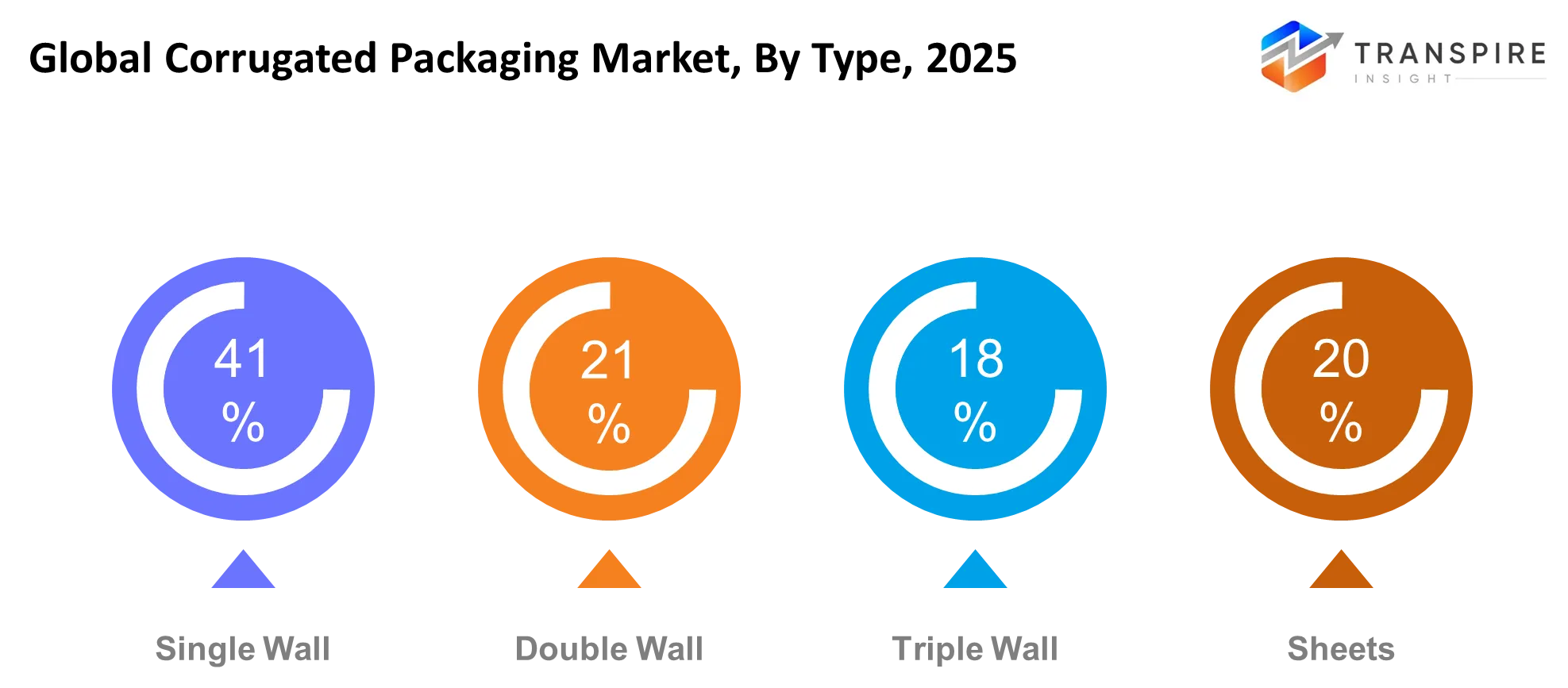
- Single wall designs lead with a 41% share of all type volumes as International Paper advances lightweight fluting, driving a behavioral movement toward low-impact, cost-effective deliveries.
- E-commerce commands a 67% share of applications as Smurfit Westrock upgrades automated packing lines, sparking a technological movement toward instant, right-sized parcel boxing.
- Asia Pacific captures a 46% geographic share as Nine Dragons Paper ramps up local mills, reflecting a behavioral movement to secure highly localized supply chains.
- Double wall containers capture a 21% share of types (8.9% CAGR) as DS Smith advances crush-resistant tech, pushing a technological movement to perfectly protect fragile goods.
- Europe grows at a 9.5% CAGR to secure a 22% regional share as Mondi rolls out fully recyclable options, forcing a behavioral movement to strictly comply with regional plastic bans.
- North America holds a 24% regional share as WestRock deploys advanced AI machinery, engineering a technological movement where warehouses instantly trim cardboard to size.
- Triple wall designs secure an 18% share of types as Packaging Corporation of America advances ultra-durable layers, triggering a behavioral movement replacing heavy wooden crates.
- The sheets segment maintains a 20% share of types as Georgia-Pacific scales bulk material output, supporting a technological movement letting converters stamp custom boxes on demand.
What are the Key Drivers, Restraints, and Opportunities in the Global Corrugated Packaging Market?
Driver:
The aggressive transition away from single-use plastics is forcefully expanding the market. The real-world trigger for this shift was a wave of strict government packaging taxes across Europe, which suddenly made plastic mailers legally problematic and financially draining. To stay compliant, retail giants are pivoting hard to heavy-duty paper alternatives. A practical instance of this is major e-commerce platforms completely replacing plastic bubble wrap with die-cut, fluted cardboard envelopes. Because global brands are legally forced into this permanent switch, packaging manufacturers are securing multi-year, high-volume recurring orders that heavily multiply overall industry revenue.
Restraint:
Severe raw material price volatility acts as the main ceiling on market profitability. This persists as a deep structural issue because corrugated manufacturers rely heavily on recycled pulp networks rather than raw timber. The actual supply of this recovered paper is highly inconsistent, swinging wildly based on localized municipal recycling rates and sudden spikes in global mill energy costs. When pulp processing fees unexpectedly jump, packaging companies must either absorb massive margin losses themselves or pass those costs directly down to their buyers, which immediately stalls contract renewals and limits broader market adoption.
Opportunity:
The biggest future opportunity actually lies in on-demand packaging machinery. Warehouses are essentially done buying massive stacks of pre-folded, standard boxes. Instead, they are pivoting to hardware that instantly cuts raw corrugated sheets to match exact product dimensions. By putting AI-driven box-making tech directly inside North American fulfillment centers, companies completely eliminate shipping dead air and instantly slash their daily freight costs. This shift away from stock sizes unlocks a huge modernization pipeline. It allows raw sheet suppliers to bypass traditional box makers entirely and secure highly profitable contracts directly with major logistics networks.
What Has the Impact of Artificial Intelligence Been on the Global Corrugated Packaging Market?
Artificial intelligence is fundamentally transforming the Global Corrugated Packaging Market from a manual manufacturing process into a highly optimized, data-driven operation. We are seeing a major shift toward automating the actual cutting and folding lines. Smart cameras now inspect cardboard fluting in real-time, instantly adjusting machine blades to maintain structural integrity without slowing down the conveyor belts.
AI also introduces powerful predictive maintenance capabilities to the factory floor. Upgraded monitoring systems track machine vibrations and heat levels, predicting exactly when a heavy-duty die-cutter or roller will need servicing weeks before a part actually requires replacement. This operational improvement drastically reduces unexpected factory downtime, keeping massive production quotas perfectly on schedule. A practical instance of this tech in action is logistics companies using AI algorithms to instantly calculate and cut custom box dimensions for complex e-commerce orders, completely eliminating wasted freight space.
The primary limitation to this technology is simply the complex integration process. Transitioning legacy paper mills to these advanced digital networks requires a substantial upfront capital investment and specialized infrastructure, currently positioning AI as a premium modernization step reserved mostly for well-funded, top-tier packaging corporations.
Key Market Trends:
- The market is shifting from basic transit protection to engineered, sustainable logistics. This is defined by a technological movement for automated right-sizing and a behavioral push to eliminate plastic.
- Warehouses replaced manual assembly over time with a technological movement toward AI right-sizing, driving an industry shift that eliminates dead freight space.
- Suppliers replaced unrecyclable wax over time through a technological movement for bio-based moisture barriers, sparking an industry shift toward circular grocery packaging.
- Brands evolved from plain boxes over time via a behavioral movement demanding premium graphics, driving an industry shift toward unboxing-centric D2C packaging.
- Engineers evolved past thick walls over time through a technological movement using micro-fluting, causing an industry shift toward lightweight, high-strength materials.
- Buyers shifted from imported stock over time through a behavioral movement to install local sheet cutters, solidifying an industry shift toward decentralized manufacturing.
- Logistics networks advanced past passive boxes over time via a technological movement embedding RFID tags, driving an industry shift toward smart, trackable supply chains.
- Retailers moved past one-way boxes over time via a behavioral movement implementing dual-seal strips, sparking an industry shift toward reusable return packaging.
- Industries abandoned plastic mailers over time through a behavioral movement adopting padded paper envelopes, cementing an industry shift toward total plastic elimination.
Global Corrugated Packaging Market Segmentation
By Type
Single wall designs currently hold the largest chunk of the market at 41%. Meanwhile, double wall materials are actually growing the fastest, tracking at an 8.9% CAGR. Single wall wins on pure volume because brands need cheap, lightweight boxes to keep everyday freight costs low. However, double wall is surging right now because delivery networks are getting rougher. Shippers simply need better crush resistance for fragile goods so they avoid expensive product returns. Going forward, expect single wall to stay the baseline for everyday retail. But packaging firms will likely funnel their heavy R&D spending into double wall tech to win over high-margin clients in the electronics sector.
To learn more about this report, Download Free Sample Report
By Application
When evaluating how these materials are actually utilized, the e-commerce application completely anchors the market, capturing a massive 67% share of the volume and heavily overshadowing food and beverage, electronics, and industrial uses. The unique growth logic powering this massive demand comes from the sheer scale of modern home delivery networks, where every single online purchase requires an individual, protective cardboard shell rather than traditional bulk pallet wrapping. The future implication here is a steady blending of marketing and logistics. Packaging suppliers will increasingly be forced to design boxes that not only survive the postal system but also feature premium internal printing to deliver a high-end unboxing experience directly on the consumer's doorstep.
By End-User
E-commerce platforms and big-box retailers basically run this market right now, easily outspending standard manufacturers and logistics providers. This dominance makes sense when you look at current buying habits. Since shoppers expect everything delivered straight to their doorsteps, retail giants have to buy billions of individual shipping units every single year just to keep their fulfillment centers running. Because these mega-retailers buy in such massive volumes, they are going to dictate the future of the entire supply chain. Moving forward, they will force strict sustainability rules down the pipeline. This means any packaging supplier who cannot offer 100% recyclable cardboard will simply get locked out of the biggest contracts.
What are the Key Use Cases Driving the Global Corrugated Packaging Market?
The biggest use case right now is direct-to-consumer retail shipping. Fueled by e-commerce, companies use lightweight single-wall boxes daily to route household purchases from warehouses straight to doorsteps.
Grocery delivery is another massive use case. Moving cold food is actually really tough on standard packaging. To fix this, the food sector uses specially treated double-wall trays for fresh produce and meal kits. This stops the cardboard from getting soggy and completely collapsing in transit.
Heavy equipment transport is an emerging application. Industrial manufacturers are actively swapping wooden crates for ultra-durable, triple-wall corrugated containers. This lets them ship bulk mechanical parts while instantly dropping freight weight.
|
Report Metrics |
Details |
|
Market size value in 2025 |
USD 245.3 Billion |
|
Market size value in 2026 |
USD 257.4 Billion |
|
Revenue forecast in 2033 |
USD 360.6 Billion |
|
Growth rate |
CAGR of 4.93% from 2026 to 2033 |
|
Base year |
2025 |
|
Historical data |
2021 - 2024 |
|
Forecast period |
2026 - 2033 |
|
Report coverage |
Revenue forecast, competitive landscape, growth factors, and trends |
|
Regional scope |
United States; Canada; Mexico; United Kingdom; Germany; France; Italy; Spain; Denmark; Sweden; Norway; China; Japan; India; Australia; South Korea; Thailand; Brazil; Argentina; South Africa; Saudi Arabia; United Arab Emirates |
|
Key company profiled |
International Paper, WestRock, Smurfit Kappa, DS Smith, Mondi, Packaging Corporation of America, Georgia-Pacific, Nine Dragons Paper, Oji Holdings, Stora Enso, Rengo, Pratt Industries, Cascades, Klabin, Mayr-Melnhof |
|
Customization scope |
Free report customization (country, regional & segment scope). Avail customized purchase options to meet your exact research needs. |
|
Report Segmentation |
By Type (Single Wall, Double Wall, Triple Wall, Sheets), By Application (Food & Beverage, E-commerce, Electronics, Industrial), By End-User (Manufacturers, Retailers, E-commerce Companies, Logistics Firms) |
Which Regions are Driving the Global Corrugated Packaging Market Growth?
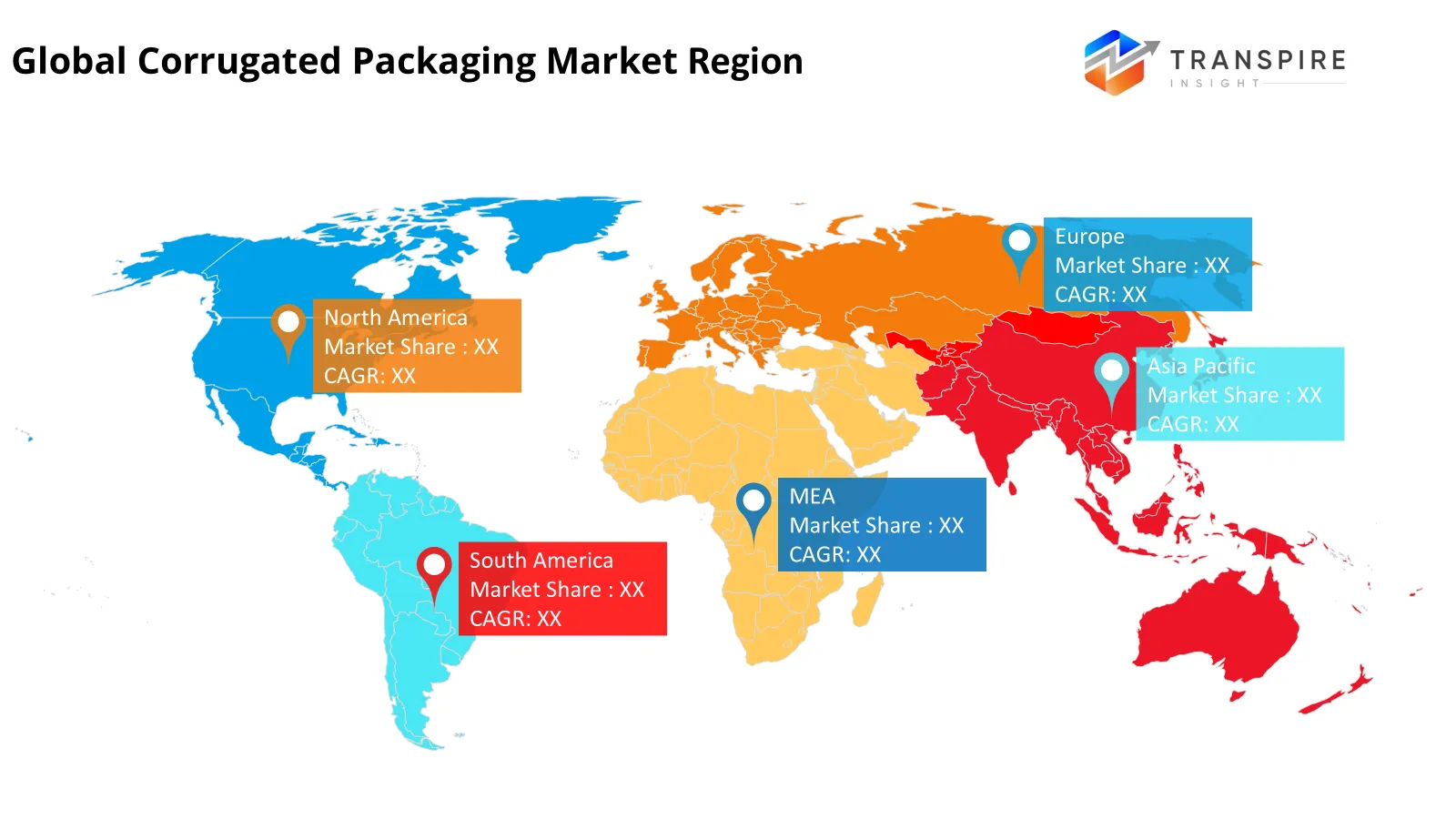
Asia Pacific completely dominates the Global Corrugated Packaging Market, commanding a massive 46% share of global volume. This sheer scale is driven by the region's position as the world's primary manufacturing hub, requiring endless supplies of transit boxes for exported consumer goods. The local ecosystem directly supports this massive demand through heavily integrated paper mills that process recycled pulp right alongside major factory centers. Additionally, strong government initiatives to modernize domestic logistics and freight networks ensure this region remains the undisputed leader in bulk production. In December 2025, Nine Dragons Paper aggressively expanded its high-end regional output by finishing major capacity projects at its Beihai base, adding hundreds of thousands of tons of fresh packaging board to support local export manufacturing centers.
North America is the second-largest market, holding steady at roughly 24% of global volume. Unlike Asia, which mostly churns out boxes for international export, this region survives on a massive, closed-loop e-commerce network. The business here stays incredibly stable because giant retailers sign multi-year contracts just to keep their automated packing lines running. On top of that, the local recycling infrastructure is so mature that regional manufacturers rarely worry about sudden global pulp price shocks. In April 2026, Packaging Corporation of America hit new production and speed records at its Jackson, Alabama mill after rolling out major upgrades to lock down steady containerboard supply lines for domestic fulfillment sorting networks.
Europe is currently the fastest-growing piece of the map, pushing forward at a massive 9.5% CAGR. This sudden jump started recently when strict government taxes made basic plastic shipping materials too expensive for companies to use. Everyday brands are now racing to ditch cheap plastic mailers and adopt heavy-duty, moisture-resistant cardboard instead. The biggest future payout will definitely go to suppliers who can invent fully recyclable, bio-coated boxes that beat these tough new environmental rules. In May 2026, Smurfit Westrock stepped up to target this exact shift by opening a major automated packaging superplant to mass-produce sustainable, plastic-replacing boxes for regional consumer goods and retail brands.
To learn more about this report, Download Free Sample Report
Who are the Key Players in the Global Corrugated Packaging Market and how do they Compete?
The corrugated packaging landscape operates as a highly consolidated arena where a few massive manufacturers fight ruthlessly for huge retail contracts. Competition no longer revolves around just making cheap boxes. Instead, the real battleground has shifted toward automated production capabilities and securing exclusive recycling networks. Firms must balance aggressive regional buyouts with heavy capital investments in smart factory tech to consistently outpace local rivals.
International Paper competes primarily on sheer cost efficiency and scale. They differentiate their product by running an enormous closed-loop pulp recovery network, which completely shields their profit margins from sudden global price swings. For their expansion approach, they target and acquire smaller regional mills. This lets them instantly absorb local recycling routes and push their proprietary lightweight fluting into new territories without having to build new factories from scratch.
Smurfit Kappa plays a totally different game, focusing purely on hardware innovation. Instead of just dropping off folded boxes, they actually build custom packing machines and install them right inside a buyer's warehouse. Once that machinery is running on the floor, Smurfit becomes a permanent piece of the daily shipping routine. When it comes to growth, they usually skip buying random paper mills. They focus instead on securing deep partnerships with international logistics brands. This exact move guarantees a massive, long-term pipeline for their continuous-feed cardboard rolls.
Company List
- International Paper
- WestRock
- Smurfit Kappa
- DS Smith
- Mondi
- Packaging Corporation of America
- Georgia-Pacific
- Nine Dragons Paper
- Oji Holdings
- Stora Enso
- Rengo
- Pratt Industries
- Cascades
- Klabin
- Mayr-Melnhof
Recent Development News
- In January 2025, International Paper finished up its huge acquisition of rival firm DS Smith plc. That massive corporate mashup instantly builds a unified global giant focused entirely on sustainable packaging across both the North American and European markets. [Source:https://www.internationalpaper.com
- In May 2026, Smurfit Westrock introduced ActiBlu, a brand-new prototype for a cardboard box that is completely glueline-free. The concept works with a quick water-activated mist instead of hot-melt glue machinery, meaning fulfillment centers can skip traditional adhesives altogether and reduce everyday operational complexity by quite a bit. https://www.smurfitwestrock.com
What Strategic Insights Define the Future of the Global Corrugated Packaging Market?
The market is rapidly shifting away from high-volume commodity manufacturing toward highly integrated, software-driven logistics. Future success relies entirely on automated plant optimization and localized, on-demand box cutting rather than shipping bulk empty stock.
A major hidden risk to this evolution is the industry's exposure to structural energy shocks and fragile regional fiber collection networks. If municipal paper recycling programs collapse under rising processing costs, raw material pipelines will choke. Conversely, embedding smart IoT capabilities directly into corrugated walls presents a massive emerging opportunity. Printing dynamic QR codes or sensor paths turns standard cardboard boxes into active supply chain tracking assets.
To win long-term contracts, manufacturers must stop marketing boxes as basic transit shells. The strategic recommendation is to invest heavily in smart, box-on-demand machinery partnerships, enabling retail clients to instantly trim freight waste directly on the factory floor.
Global Corrugated Packaging Market Report Segmentation
By Type
- Single Wall
- Double Wall
- Triple Wall
- Sheets
By Application
- Food & Beverage
- E-commerce
- Electronics
- Industrial
By End-User
- Manufacturers
- Retailers
- E-commerce Companies
- Logistics Firms
Regional Outlook
North America
- United States
- Canada
- Mexico
Europe
- Germany
- United Kingdom
- France
- Spain
- Italy
- Rest of Europe
Asia Pacific
- Japan
- China
- Australia & New Zealand
- South Korea
- India
- Rest of Asia Pacific
South America
- Brazil
- Argentina
- Rest of South America
Middle East & Africa
- Saudi Arabia
- United Arab Emirates
- South Africa
- Rest of the Middle East & Africa
Frequently Asked Questions
Find quick answers to common questions.
The expected global corrugated packaging market size will be USD 360.6 Billion in 2033.
Key segments for the global corrugated packaging market are Type (Single Wall, Double Wall, Triple Wall, Sheets), Application (Food & Beverage, E-commerce, Electronics, Industrial), and End-User (Manufacturers, Retailers, E-commerce Companies, Logistics Firms).
Major global corrugated packaging market players are International Paper, WestRock, Smurfit Kappa, DS Smith, Mondi, Packaging Corporation of America, Georgia-Pacific, Nine Dragons Paper, Oji Holdings, Stora Enso, Rengo, Pratt Industries, Cascades, Klabin, and Mayr-Melnhof.
The global corrugated packaging market size is USD 245.3 Billion in 2025.
The global corrugated packaging market CAGR is 4.93% from 2026 to 2033.
- International Paper
- WestRock
- Smurfit Kappa
- DS Smith
- Mondi
- Packaging Corporation of America
- Georgia-Pacific
- Nine Dragons Paper
- Oji Holdings
- Stora Enso
- Rengo
- Pratt Industries
- Cascades
- Klabin
- Mayr-Melnhof
About the Authors

Kartik bhong
I am Kartik Bhong, a Senior Research Analyst at Transpire Insight, specializing in the Packaging, Manufacturing, and Construction industry. My work focuses on analyzing market trends, emerging technologies, industry regulations, and competitive landscapes to deliver accurate, data-driven insights. I am passionate about transforming complex industry information into clear, practical content that helps businesses, professionals, and decision-makers stay informed and make confident strategic decisions. Through continuous research and a strong commitment to accuracy, I strive to create reliable, well-researched content that reflects the latest developments across these dynamic industries and supports the vision of Transpire Insight in delivering valuable market intelligence.

Chakradhar Khansole
Chakradhar serves as the Research Director at Transpire Insight, bringing over 8 years of experience in technology, innovation, and strategic market intelligence. He specializes in transforming complex market data into actionable business insights that enable organizations to make informed, growth-oriented decisions. Recognized for his strategic vision and analytical expertise, Chakradhar leads high-impact research initiatives, delivering comprehensive market assessments, competitive intelligence, and forward-looking industry analysis.
Recently Published Reports
-
Apr 2026
Pharmaceutical Cold Chain Packaging Market
Pharmaceutical Cold Chain Packaging Market By Material (Plastic,(Polyethylene (PE), Polypropylene (PP), Polyethylene Terephthalate (PET), Expanded Polystyrene (EPS), Polyurethane (PU),Others), Paper, Metal, Others), By Product (Small Boxes, Pallets, Large Sized Pallet Containers, Others), By End Use (Biopharmaceutical Companies, Clinical Research Organizations, Hospitals, Research Institutes, Logistics and Distribution Companies, Others)”, By Industry Analysis, Size, Share, Growth, Trends, and Forecasts 2026-2033
-
Apr 2026
Active & Intelligent Packaging Market
Active & Intelligent Packaging Market By Type (Active Packaging, Smart Packaging), By Material (Polymer-Based, Paper & Board-Based, Metal-Based, Glass-Based), By Technology (Time-Temperature Indicators, Freshness Indicators, RFID, Antimicrobial Packaging, Modified Atmosphere Packaging), By Application (Food & Beverages, Pharmaceutical, Cosmetics & Personal Care, Electronics & Consumer Goods, Others), By Industry Analysis, Size, Share, Growth, Trends, and Forecasts 2026-2033
-
Apr 2026
Biodegradable Cut Flower Packaging Market
Biodegradable Cut Flower Packaging Market By Material Type (Paper & Paperboard, Biodegradable Plastics, Natural Fibers, Molded Pulp, Others), By Product Type (Sleeves, Wraps, Boxes & Cartons, Bags & Pouches, Inserts & Holders), By Application (Roses, Carnations, Tulips, Chrysanthemums, Mixed Flowers, Others) and By Distribution Channel (Direct Sales, Distributors & Wholesalers, Online Channels), By Industry Analysis, Size, Share, Growth, Trends, and Forecasts 2026-2033
-
May 2026
Pharmaceutical Packaging Market
Pharmaceutical Packaging Market By Material Type (Plastic, Glass, Metal, Paper & Paperboard, Others), By Packaging Type (Bottles, Blister Packs, Vials, Ampoules, Pouches & Sachets, Others) and By End User (Hospitals & Clinics, Retail Pharmacies, Online Pharmacies, Pharmaceutical Manufacturers), By Industry Analysis, Size, Share, Growth, Trends, and Forecasts 2026-2033