

Middle East and Africa Corrugated Boxes Market Size & Forecast:
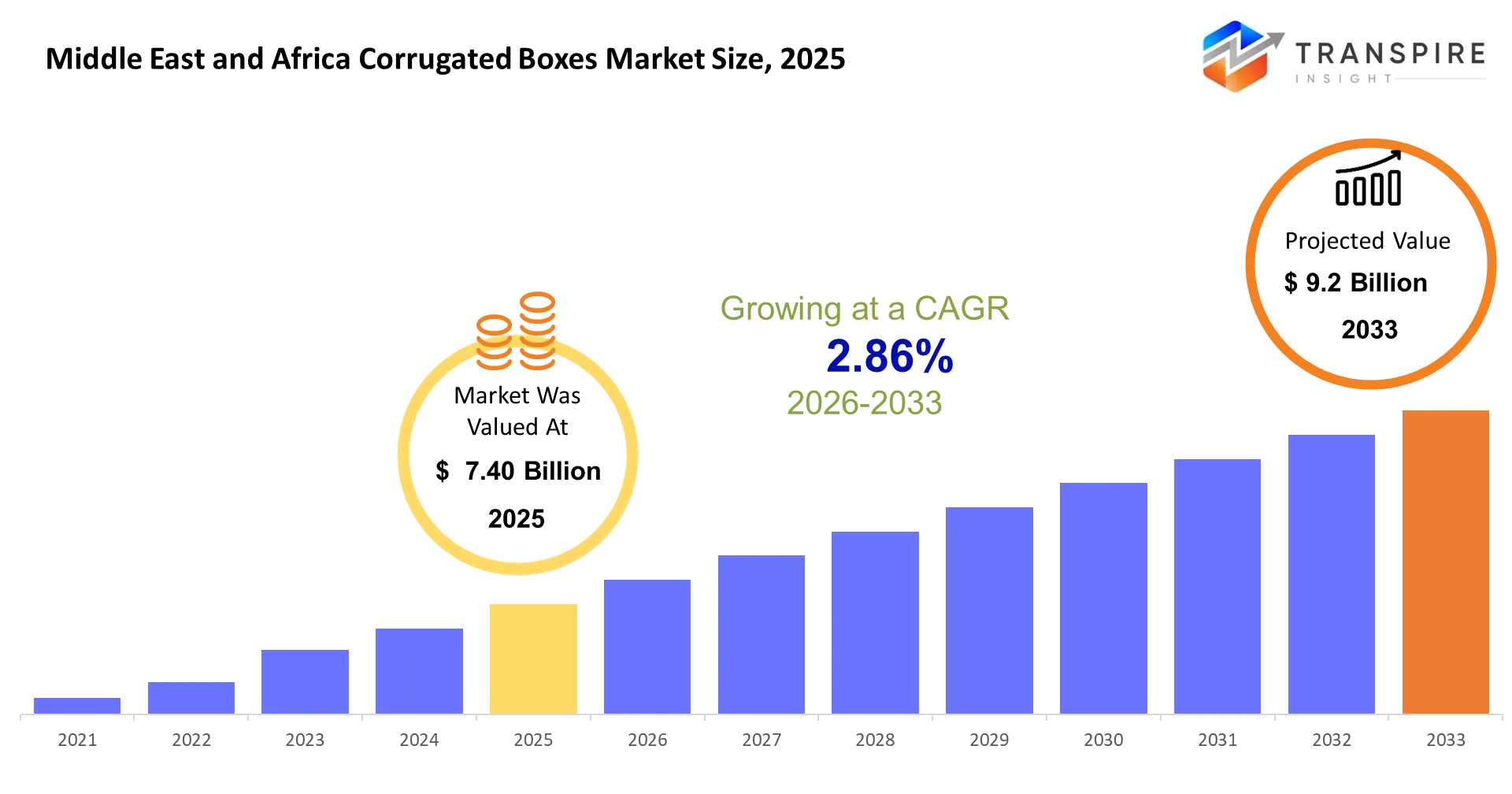
- Middle East and Africa Corrugated Boxes Market Size 2025: USD 7.40 Billion
- Middle East and Africa Corrugated Boxes Market Size 2033: USD 9.2 Billion
- Middle East and Africa Corrugated Boxes Market CAGR: 2.86%
- Middle East and Africa Corrugated Boxes Market Segments: By Type (Single Wall, Double Wall, Triple Wall, Others); By Application (Food & Beverages, E-commerce, Electronics, Industrial Packaging, Consumer Goods, Others); By End-User (E-commerce Companies, FMCG Companies, Food Industry, Electronics Industry, Industrial Firms, Others); By Material (Recycled Paper, Virgin Paper, Kraft Paper, Others)
To learn more about this report,  Download Free Sample Report
Middle East and Africa Corrugated Boxes Market Summary
The Middle East and Africa Corrugated Boxes Market was valued at USD 7.40 Billion in 2025. It is forecast to reach USD 9.2 Billion by 2033. That is a CAGR of 2.86% over the period.
The Middle East and Africa corrugated boxes market helps the movement of goods across fragmented retail, industrial , and export networks, where items have to make it through long transit paths, heat exposure, and yeah repeated handling. Corrugated packaging has really turned into a must have for food shipments, pharmaceuticals, e-commerce fulfillment, and industrial spare parts, since it mixes durability with low transport weight and scalable output, kind of the sweet spot everyone wants.
Over the past five years, the market moved away from more commodity-like bulk packaging toward formats that are more performance focused and recyclable, tailored for automated warehousing and omnichannel distribution. That change sped up after pandemic-era supply chain disruptions, because the true cost of damaged goods and inefficient packaging systems got very obvious. At the same time, sustainability rules in Gulf countries tightened, and in parts of Africa extended producer responsibility initiatives started gaining ground, so manufacturers leaned harder into recyclable fiber based packaging. Also, as regional manufacturing, retail logistics, and cross border trade keep expanding, converters are putting money into higher-quality printing, lighter board grades, and quicker production lines, which is boosting contract volumes and giving clearer revenue visibility across the packaging value chain.
Key Market Insights
- In 2025, the Gulf Cooperation Council area kind of dominated the Middle East and Africa Corrugated Boxes Market, with something around 38% market share, it’s not small.
- Saudi Arabia is leading the regional appetite , largely because of food processing expansion, industrial diversification, plus those big retail infrastructure investments at a large scale.
- Meanwhile South Africa stays a major corrugated packaging manufacturing hub, with solid production capability and export driven packaging demand that keeps moving.
- Over in East Africa, the region is expected to be the fastest-growing market during 2025–2030, mostly due to organized retail setups and logistics modernization, you know, the usual upgrade cycle.
- Looking at the product type, slotted corrugated boxes basically took the lead across the Middle East and Africa Corrugated Boxes Market, holding more than 45% revenue share in 2025.
- Die-cut corrugated boxes are projected as the fastest-growing portion up through 2030, because branding needs and customized retail packaging requirements are getting stronger.
- When it comes to end use, food and beverage packaging accounted for about 41% market share in 2025, helped by processed food distribution growing over time.
- E-Industrial shipping applications keep expanding, since exporters want lightweight but still protective packaging for those long distance transportation networks.
- For end users, retail and consumer goods companies dominated demand, with nearly 36% share in 2025.
- And finally, automation together with lightweight corrugated board innovations are helping manufacturers cut material costs , while also boosting operational scalability and meeting sustainability compliance requirements.
What are the Key Drivers, Restraints, and Opportunities in the Middle East and Africa Corrugated Boxes Market?
Honestly the strongest force that seems to push the Middle East and Africa corrugated boxes market forward is the quick reshaping of regional supply lines around organized retail, e-commerce fulfillment, and food distribution networks, though it varies by country. Over the last five years, Gulf nations put a lot of effort into logistics corridors fulfillment centers and cold chain facilities, mostly tied to economic diversification plans. That change made packaging needs shift, from cheap bulk hauling to more uniform high strength corrugated options, the kind that can handle automated warehousing and long distance movement without too much drama. When retailers and exporters lowered product loss and tightened pallet performance, corrugated box use went up across food processing, pharmaceuticals, and industrial production. That, in turn, feeds converter earnings and supports longer supply agreements.
At the same time the market’s biggest structural issue is still the thin regional recycling capacity, plus the ongoing reliance on imported kraft linerboard. A lot of African economies are still missing full waste pick up and fiber recovery frameworks, so the availability of raw material can feel erratic. It also leaves makers exposed to global pulp price swings. And no this isn’t a fast fix because recycling infrastructure needs bigger municipal funding, careful regulatory alignment , and long roadmaps. So smaller packaging converters end up dealing with unpredictable production costs, postponed expansion efforts, and weaker competitiveness versus imported packaging goods.
A big future chance is in digitally printed, and kind of lightweight corrugated packaging, meant for fast moving consumer goods plus e-commerce brands. In the UAE and Saudi Arabia, packaging makers are putting money into automated flexographic printing and precision die-cutting setups, so they can run shorter batches and build customized retail packs. With those capabilities, converters can target regional online sellers, pharmaceutical distributors and export led food producers, and still push higher margin packaging types, rather than only doing normal transport boxes. That basically creates a stronger value-added income stream, beyond the usual corrugated roles.
What Has the Impact of Artificial Intelligence Been on the Middle East and Africa Corrugated Boxes Market?
Artificial intelligence, plus advanced digital technologies, are quietly reshaping corrugated packaging operations across the Middle East and Africa . In practice, this is helping production move faster, use materials more wisely, and react better when the supply chain gets chaotic. Bigger corrugated box manufacturers are now putting AI-enabled vision tools right on the production line, so they can automate defect spotting, keep board alignment in check, and tune die cutting accuracy in real time. In many cases this cuts down material waste, and also makes output more uniform, especially in high-volume food plants and e-commerce packing facilities.
At the same time, machine learning is being folded into predictive maintenance platforms for corrugators, flexographic printers, and automated stacking equipment. They look at vibration traces, temperature swings, and machine load behavior . Then failures can often be flagged earlier, before an unexpected shutdown happens. Some converters say they’re seeing measurable downtime reductions, plus lower maintenance expenses after moving to sensor-driven monitoring setups. On top of that, AI backed demand forecasting tools are letting packaging suppliers sync production timing with retail seasons and export shipment rhythms , which usually improves inventory turns and makes warehouse operations feel less crowded.
Digital printing automation is adding even more value too, because it supports shorter runs and more customized packaging without dragging on setup delays too much. Still, AI adoption isn’t uniform, and smaller converters in the region tend to lag . The reason is that connecting industrial IoT infrastructure and advanced analytics platforms takes serious capital, plus technical expertise that isn’t always easy to find. So across several African manufacturing markets, that know how and the money to fund it are both unevenly available.
Key Market Trends
- Since 2021 Gulf packaging converters kinda upped the automated corrugator installations ,because e-commerce fulfillment centers were asking for quicker turnaround time and more consistent packaging quality , pretty much across the board.
- Food exporters across Saudi Arabia and the UAE leaned more into moisture resistant corrugated formats after the pandemic era shipping disruptions pushed up product damage claims a lot.
- Between 2020 and 2025 the digital flexographic printing uptake sped up ,as FMCG brands requested shorter runs ,along with more tailored retail packaging looks .
- African packaging manufacturers increased recycled fiber sourcing after imported kraft linerboard prices jumped by nearly 30% ,during broader global supply chain disruptions.
- Retail chains started swapping plastic secondary packaging for corrugated shelf-ready formats more often, to meet the changing regional rules on packaging waste after 2022, and this kept growing.
- Companies like Mondi Group and DS Smith expanded regional partnerships ,to improve localized packaging supply capability ,and get steadier deliveries .
- Since 2023 pharmaceutical distributors have been using higher strength corrugated shipping containers ,to better protect temperature sensitive products through long-distance logistics networks.
- Packaging buyers increasingly favored lighter corrugated board grades, because freight costs climbed ,so manufacturers tried to ship less weight and reduce pallet loads.
- UAE and South African converters also integrated AI based quality inspection systems ,which cut down material waste and made production lines more stable in large facilities .
- Industrial manufacturers moved toward double wall corrugated packaging formats ,as cross-border machinery exports grew across East African and Gulf trade routes.
Middle East and Africa Corrugated Boxes Market Segmentation
By Type
Single wall corrugated boxes are still taking the leading market position because they are used almost everywhere, like in food distribution, consumer goods, and retail logistics. They’re light enough to keep freight cost down, but also built well with lower production costs, plus they match automated packaging systems pretty naturally. Because of that , Gulf retail networks keep picking them, and African export operations do the same. FMCG manufacturers , and also e commerce fulfillment centers, keep choosing single wall formats for quick, fast-moving shipment cycles and for better pallet use, overall.
Double wall corrugated boxes sit in the second-largest share. The reason is pretty straightforward: industrial exporters and electronics makers want extra compression strength for long distance transportation. This segment really picked up momentum after cross-border trade routes expanded across East Africa , and along Gulf industrial corridors. Triple wall packaging is more niche, but it is also growing bit by bit. It shows up mainly in heavy machinery, automotive components, and chemical transport, where protection matters more than material spending, even if the box is thicker.
Over the forecast period, manufacturers are expected to push more investment into lightweight yet high strength board technologies, basically to balance freight efficiency with the durability requirements they get from customers. Packaging converters that can create moisture-resistant and digitally printable multi-wall formats are likely to earn stronger margins from industrial buyers and pharmaceutical clients too.
By Application
Food and beverage use cases dominate corrugated box consumption across the region. This happens because processed food exports keep rising, supermarkets expand steadily, and temperature sensitive distribution networks need reliable packing. Corrugated packaging also became more important once retailers started prioritizing standardized transport packaging. That approach helps reduce spoilage and improves warehouse handling efficiency.
Beverage manufacturers, plus agricultural exporters keep leaning on sturdy corrugated formats, for carrying large lots over extended shipping distances it’s kind of still the norm.
In terms of application, e-commerce packaging looks like the quickest climbing segment, since online retail keeps spreading across Saudi Arabia , the UAE, and South Africa. Electronics packaging also picked up steam because local distributors want impact resistant shipping setups for imported devices and appliances. Industrial packaging demand stays pretty steady, largely because manufacturing diversification continues and infrastructure development projects roll onward across Gulf economies.
Looking ahead, future market activity will probably prefer customized , and more shelf ready packaging options, with better print quality and compatibility for automated handling. Packaging suppliers that can support short-run digital printing needs , and also keep up with rapid fulfillment cycles should see firmer long-term arrangements from retail and logistics players.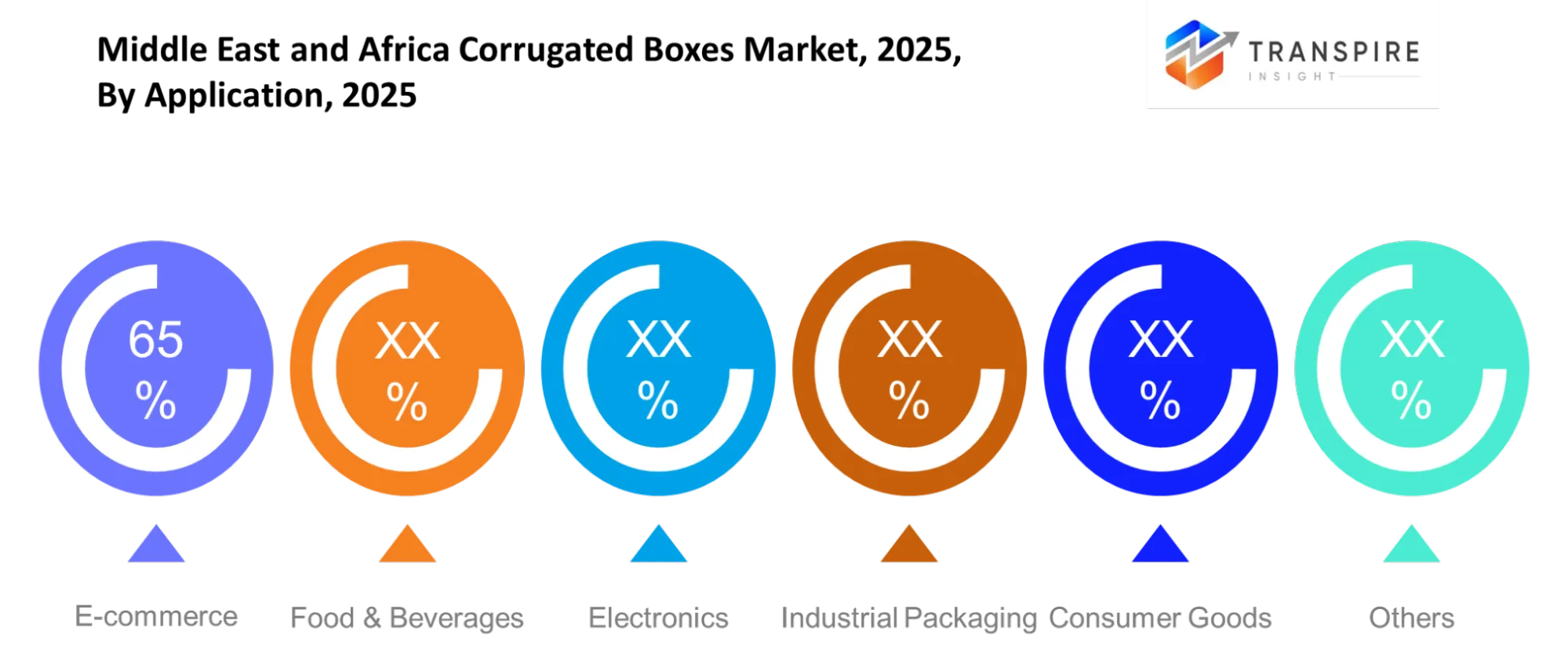
To learn more about this report, Download Free Sample Report
By End-User
FMCG companies hold the biggest end-user share, since consumer staples, packaged foods, and household products need a constant stream of high volume corrugated packaging supply. Retail modernization across city centers made the push stronger for shelf-ready transport packaging , the kind that helps logistics performance but still presents the goods well. Food industry players also keep buying in meaningful quantities because cold-chain distribution is expanding, and export-oriented agriculture keeps moving product out.
E-commerce companies are showing up as the quickest-growing end user group, especially as fulfillment networks roll out across the biggest metropolitan markets. Electronics manufacturers and industrial firms are moving more often toward reinforced corrugated formats to curb in-transit breakage and generally trim those annoying product return costs. At the same time, pharmaceutical distributors also bumped their purchases of corrugated packaging for temperature-sensitive medical shipments and, kind of, they helped reorganize healthcare supply chains so everything flows better.
Through the forecast period, end users are expected to favor packaging systems that are recyclable, lighter in weight, and digitally trackable. That emphasis should boost inventory visibility and improve transport efficiency. Packaging manufacturers that bake in automation friendly design ideas, and also deliver customized branding options, will likely end up reinforcing their relationships with multinational retail and logistics customers.
By Material
Recycled paper keeps the leading material share since packaging producers are still hunting for cost-effective raw inputs that match the latest sustainability regulations. Big converters increased recycled fiber usage after kraft linerboard price swings, worldwide, disrupted the import dependent supply chains between 2020 and 2023. Recycled paper also fits with regional waste reduction goals and it can improve supply flexibility for high volume packaging operations.
Virgin paper and kraft paper still see pretty strong demand in industrial and export packaging contexts, where durability and resistance to moisture basically have to stay top tier. Kraft based corrugated formats have been getting more traction with food exporters and heavy equipment manufacturers, mostly because the higher burst strength gives better shielding for products during long distance movement. At the same time, supply limitations and those pulp cost swings keep making it harder for the market to adopt premium virgin fiber materials at a wider scale.
Going forward, investments are expected to land more on advanced recycled fiber processing technologies, aiming to boost strength performance and also sharpen print quality. Packaging firms that manage to lock in localized recycling partnerships, along with integrated paper recovery systems, should be better positioned to lower raw material exposure and improve long term operating stability .
What are the Key Use Cases Driving the Middle East and Africa Corrugated Boxes Market?
Food and beverage distribution still seems like the biggest use case for corrugated boxes across the Middle East and Africa, mostly because supermarket chains, agricultural exporters, and processed food manufacturers just need transport packaging that’s light enough but also tough enough to survive the trip. You know fresh produce moving in large quantities, bottled beverages, and packaged foods going through regional logistics hubs, that whole rhythm keeps the packaging demand pretty steady
On another note e-commerce fulfillment and electronics shipping really picked up speed in the last five years, as online retail grew across Saudi Arabia, the UAE, and South Africa. Retailers plus third-party logistics providers are leaning harder on customized corrugated packaging for better product protection, fewer returns, and smoother automated warehouse handling setups, at least in many locations
Then there are the newer types of applications, like pharmaceutical cold-chain packaging, and also export focused industrial equipment transport. In healthcare, distributors are going for moisture-resistant corrugated formats for temperature sensitive medical shipments. Meanwhile industrial manufacturers are testing smart packaging ideas with digital tracking labels to boost shipment visibility along cross border trade corridors, kind of like adding extra situational awareness to every run
|
Report Metrics |
Details |
|
Market size value in 2025 |
USD 7.40 Billion |
|
Market size value in 2026 |
USD 7.55 Billion |
|
Revenue forecast in 2033 |
USD 9.2 Billion |
|
Growth rate |
CAGR of 2.86% from 2026 to 2033 |
|
Base year |
2025 |
|
Historical data |
2021 - 2024 |
|
Forecast period |
2026 - 2033 |
|
Report coverage |
Revenue forecast, competitive landscape, growth factors, and trends |
|
Regional scope |
Middle East and Africa (Saudi Arabia, United Arab Emirates, South Africa, Rest of Middle East and Africa) |
|
Key company profiled |
International Paper, WestRock, Smurfit Kappa, DS Smith, Mondi, Georgia-Pacific, Packaging Corp of America, Oji Holdings, Nine Dragons Paper, Rengo, Pratt Industries, Stora Enso, Cascades, Klabin, Mayr-Melnhof |
|
Customization scope |
Free report customization (country, regional & segment scope). Avail customized purchase options to meet your exact research needs. |
|
Report Segmentation |
By Type (Single Wall, Double Wall, Triple Wall, Others); By Application (Food & Beverages, E-commerce, Electronics, Industrial Packaging, Consumer Goods, Others); By End-User (E-commerce Companies, FMCG Companies, Food Industry, Electronics Industry, Industrial Firms, Others); By Material (Recycled Paper, Virgin Paper, Kraft Paper, Others) |
Which Regions are Driving the Middle East and Africa Corrugated Boxes Market Growth?
The Gulf Cooperation Council region is kind of leading the market because of strong industrial diversification programs, better logistics infrastructure, and steady retail packaging consumption across Saudi Arabia and the UAE. Major ports like Jebel Ali and King Abdullah Port help enable large scale import, export, and re export operations, which keeps pushing corrugated packaging demand forward. Government backed manufacturing initiatives also encouraged new investment into food processing, pharmaceuticals, and e-commerce fulfillment sites, and those usually call for standardized packaging systems. In general there’s a pretty solid ecosystem—paper converters , automated packaging plants , logistics providers , and regional distribution hubs— that keeps supporting the regions dominant market position.
South Africa sits in the second slot as a regional contributor, but the market behavior feels a bit different than in the Gulf economies. Demand growth depends less on quick infrastructure expansion and more on stable industrial output established retail networks, and mature packaging supply chains. There’s long standing manufacturing in consumer goods, agriculture , and mining equipment, and that supports consistent procurement of corrugated boxes for both domestic use and export routes. Regulatory steadiness plus relatively advanced recycling infrastructure also gives packaging makers better raw material recovery capabilities compared with a few other nearby African economies.
East Africa is sort of emerging as the fastest-growing regional market, mostly because trade corridor development is moving quickly, retail penetration keeps widening, and infrastructure investment is tied to regional manufacturing growth. You can see it in countries like Kenya and Tanzania, where after 2021 they increased investment in logistics parks, port modernization and industrial zones. That, in turn, is improving supply chain efficiency , for packaged goods distribution. At the same time, rising agricultural exports, plus expanding cross-border e-commerce networks, has been pushing demand for transport packaging that is both light-weight and durable, instead of just heavier alternatives. Over the 2026–2033 period, this path should open up real opportunities for packaging converters , recycled paper suppliers, and investors looking to build localized manufacturing capacity.
Who are the Key Players in the Middle East and Africa Corrugated Boxes Market and How Do They Compete?
The competitive landscape is still kind of moderately fragmented, with regional converters competing next to multinational packaging groups that run integrated paper and corrugated packaging networks. Lately, the fight seems to be more about production efficiency, recycled fiber access, digital printing ability, and whether a supplier can handle big retail volumes as well as e-commerce fulfillment contracts. At the same time, established makers keep defending their share by putting money into automation and localized production capacity, while smaller regional players often win with lower operating costs and faster customer response. Also, being close to major logistics corridors and export hubs really matters, since many packaging buyers lean on supply reliability, and shorter delivery cycles.
Mondi Group stands out because of vertically integrated paper sourcing and high performance lightweight corrugated packaging aimed at industrial and food distribution use cases. The company is still pushing forward on recycled fiber processing, plus digital printing capabilities, which helps with customization and cuts down on production waste. DS Smith leans into circular packaging design and supply chain optimization services, in a way that supports multinational retail clients who want to reduce transport inefficiencies and also use less packaging material. Their strong know how in recyclable packaging systems gives them a clear advantage among FMCG and e-commerce customers who are adjusting to stricter sustainability goals.
Smurfit Westrock boosts its competitiveness via big scale corrugated conversion ability and more advanced automation tools, which in turn make production feel steadier across export driven packaging work. As it expands into fast growing Gulf logistics markets, it gets wider access to food processing and industrial packaging contracts. International Paper stays in the race by relying on cost efficient containerboard production plus long term supply ties with multinational consumer product manufacturers. Arabian Packaging Co. keeps a regional edge thanks to localized manufacturing, quick order fulfillment , and customized corrugated formats made for Gulf retail and pharmaceutical distribution channels.
Company List
- International Paper
- WestRock
- Smurfit Kappa
- DS Smith
- Mondi
- Georgia-Pacific
- Packaging Corp of America
- Oji Holdings
- Nine Dragons Paper
- Rengo
- Pratt Industries
- Stora Enso
- Cascades
- Klabin
- Mayr-Melnhof
Recent Development News
In September 2025, Mondi Group started up its Duino recycled containerboard mill in Italy following a €200 million investment. The facility enhances recycled fiber supply security for corrugated box converters serving Europe, the Middle East, and North Africa.https://www.mondigroup.com
What Strategic Insights Define the Future of the Middle East and Africa Corrugated Boxes Market?
The Middle East and Africa corrugated boxes market is kinda shifting toward higher value, automation-friendly packaging ecosystems, not so much the volume-driven “commodity supply” vibe. Over time growth seems to gather around integrated logistics corridors, where retailers, exporters and 3PL operators start to align packaging specifications, to help automated warehousing and cross-border distribution run smoother. And you can see this change getting pulled along by regional industrial diversification policies, plus e-commerce fulfillment networks that need faster, lighter, and more traceable packaging systems.
One risk that is a bit less obvious, but still there, is how fiber supply can become concentrated and how much converters end up depending on imported kraft linerboard. That dependence makes converters exposed to global pulp price shocks, and also trade disruptions, even when demand looks strong. If sourcing constraints tighten more, then cost swings might start chewing up margins even in those high-demand segments, and then it can also slow down capacity expansion decisions. Meanwhile, an opportunity is quietly taking shape too, especially around digitally printed, smart-enabled corrugated packaging that links with inventory tracking and cold-chain monitoring, mainly in Gulf pharmaceutical and food export lanes.
Market participants might do well to push harder on localized recycling integration, and also invest in modular digital printing lines, so they reduce exposure to raw material volatility, while still capturing the higher-margin demand for customized packaging.
Middle East and Africa Corrugated Boxes Market Report Segmentation
By Type
- Single Wall
- Double Wall
- Triple Wall
- Others
By Application
- Food & Beverages
- E-commerce
- Electronics
- Industrial Packaging
- Consumer Goods
- Others
By End-User
- E-commerce Companies
- FMCG Companies
- Food Industry
- Electronics Industry
- Industrial Firms
- Others
By Material
- Recycled Paper
- Virgin Paper
- Kraft Paper
- Others
Frequently Asked Questions
Find quick answers to common questions.
The Middle East and Africa Corrugated Boxes Market size is USD 9.2 Billion in 2033.
Key Segments for the Middle East and Africa Corrugated Boxes Market are By Type (Single Wall, Double Wall, Triple Wall, Others); By Application (Food & Beverages, E-commerce, Electronics, Industrial Packaging, Consumer Goods, Others); By End-User (E-commerce Companies, FMCG Companies, Food Industry, Electronics Industry, Industrial Firms, Others); By Material (Recycled Paper, Virgin Paper, Kraft Paper, Others).
Major Middle East and Africa Corrugated Boxes Market Players are International Paper, WestRock, Smurfit Kappa, DS Smith, Mondi, Georgia-Pacific, Packaging Corp of America, Oji Holdings, Nine Dragons Paper, Rengo, Pratt Industries, Stora Enso, Cascades, Klabin, Mayr-Melnhof.
The Current Middle East and Africa Corrugated Boxes Market size is USD 7.40 Billion in 2025.
The Middle East and Africa Corrugated Boxes Market CAGR is 2.86% from 2026 to 2033.
- International Paper
- WestRock
- Smurfit Kappa
- DS Smith
- Mondi
- Georgia-Pacific
- Packaging Corp of America
- Oji Holdings
- Nine Dragons Paper
- Rengo
- Pratt Industries
- Stora Enso
- Cascades
- Klabin
- Mayr-Melnhof
Recently Published Reports
-
Apr 2026
Healthcare Polymer Packaging Market
Healthcare Polymer Packaging Market Size, Share & Analysis Report By Packaging Type (Syringes, IV Bottles and Pouches, Clamshells, Blisters, Bottles & Jars, Containers, Tubes, IV Parental Packaging, Others), By Type (Regulated, Non-regulated), By Polymer Type (LDPE (Low-Density Polyethylene), HDPE (High-Density Polyethylene), Homo-polymer (Homo), Random Copolymer (Random), Block Copolymer (Block), PET, Polystyrene, Polyvinyl Chloride, Polyamide/EVOH, Others), and Geography (North America, Europe, Asia-Pacific, Middle East and Africa, South and Central America), 2021 - 2031
-
Apr 2026
Hydrophilic Tape (Waterstop) Market
Hydrophilic Tape (Waterstop) Market Size, Share & Analysis Report By Type (Bentonite-Based Hydrophilic Tape, Rubber-Based Hydrophilic Tape), By Application (Residential Buildings, Commercial Buildings, Infrastructure Projects), and Geography (North America, Europe, Asia-Pacific, Middle East and Africa, South and Central America), 2021 - 2031
-
Apr 2026
Metalens Market
Metalens Market Size, Share & Analysis Report By Type (Visible Light Metalens, and Infrared Metalens), By Application (Consumer Electronics, Automotive Electronics, Industrial, Medical, and Others), and Geography (North America, Europe, Asia-Pacific, Middle East and Africa, South and Central America), 2021 - 2031
-
Apr 2026
PBT Resin Market
PBT Resin Market Size, Share & Analysis Report By Type (Reinforced PBT Resin, Unreinforced PBT Resin), By Processing Method (Injection Molding, Extrusion, Blow Molding, Others), By End-User (Automotive, Electrical & Electronics, Consumer Appliances, Industrial Machinery, Medical Devices, Packaging, Others), and Geography (North America, Europe, Asia-Pacific, Middle East and Africa, South and Central America), 2021 - 2031