

Global Child Presence Detection Market Size & Forecast:
- Global Market Size 2025: USD 0.68 Billion
- Expected Market Value (2033): USD 1.34 Billion
- Forecast CAGR (2026–2033): 8.85%
- Leading Region in 2025: Europe
- Fastest Growing Region: Asia Pacific
- Key Company Profiles: Bosch, Continental AG, Valeo, Denso Corporation, Aptiv, Magna International, Hyundai Mobis, Veoneer, ZF Friedrichshafen, Infineon Technologies, Texas Instruments, NXP Semiconductors, Cipia, Vayyar Imaging, Smart Eye.

Global Child Presence Detection Market Summary:
As per Transpire Insight Analysis, the Global Child Presence Detection Market size is estimated at USD 0.68 Billion in 2025 and is anticipated to reach USD 1.34 Billion by 2033, growing at a CAGR of 8.85% from 2026 to 2033. Development is driven by greater integration of sophisticated child presence detection technologies in cars.
The global child presence detection market is growing because car makers are using technology to keep people safe inside cars. They want to make sure kids are not left behind in cars and get help on time. This helps prevent kids from getting too hot or getting hurt.
In the past few years, the child presence detection market has changed a lot. It used to have simple sensors that would warn people. Now it has systems that use radar, cameras and computer intelligence to detect kids more accurately.
This change happened because the rules for keeping people safe in cars got stricter. Also, people started to care more about this issue after many kids got hurt in cars all around the world. Now car makers are making safety inside cars a priority. They want to keep kids safe in all kinds of cars. So they need child presence detection systems. This means companies that make these systems have to make them better and follow the rules. They have to make sure these systems work well in cars. The child presence detection market is still growing because of this. Car makers need child presence detection systems that really work.
Key Market Insights:
Increased vehicle safety legislation and heightened consumer awareness about cabin safety are making it necessary for automobile companies to use advanced child presence detection technology. The advancement in sensing and AI systems is changing how products are developed and increasing business opportunities in the automobile industry.
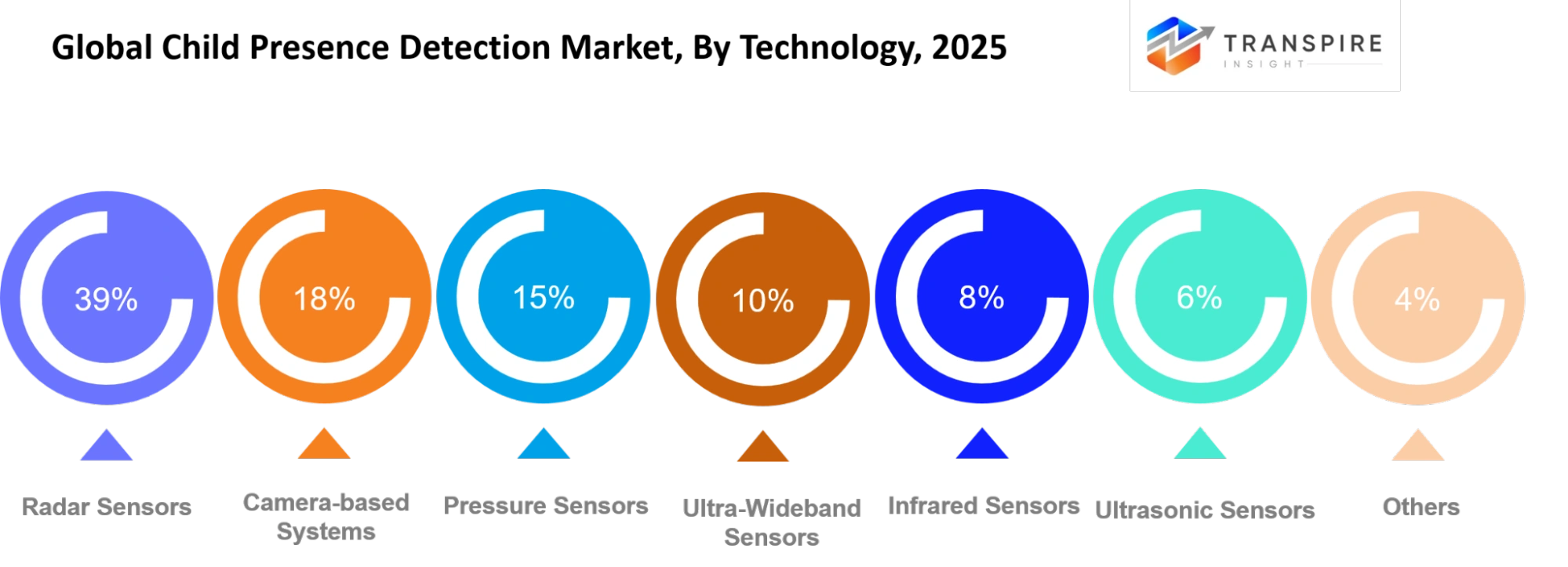
- Radar sensors occupy 39% of the share due to their accurate detection ability, and manufacturers keep working on improving their efficiency under varying cabin environments.
- Camera-based sensors take up 18% of the share as companies work on improving their ability to process images, making occupant recognition and real-time monitoring possible.
- The pressure sensors comprise 15% of the market share and remain popular for their capability of cost-effective detection of rear seat occupancy.
- The UWB sensors take up 10% of the market share due to their ability to detect passenger movement and reduce signal interference.
- The infrared sensors comprise 8% of the market share as a result of improved ability to detect objects in low-light cabin environments.
- Ultrasonic sensors make up 6% of the market share because companies keep working on improving their sensitivity in enclosed vehicle cabins.
- The other sensors comprise the remaining 4% and serve various types of specialised vehicle platforms.
- The AI-based detection systems will show the highest market growth with a CAGR of 18.9%.
What are the Key Drivers, Restraints, and Opportunities in the Global Child Presence Detection Market?
Drivers
The growth in demand for this market has been fueled due to the increased attention being placed on reducing the number of accidental deaths involving children in vehicles by various governments and vehicle safety organizations. The need for mandatory safety standards, changes in vehicle assessment programs, and the consumer inclination towards the incorporation of safety measures has pushed automobile manufacturers to adopt child presence detecting sensors in their cars. Furthermore, the increasing use of electric vehicles and connected vehicles is adding to the demand for intelligent cabin sensor systems.
Restraints
Although all these aspects are proving beneficial to the growth of the market, the high cost of advanced sensing technologies and complexities involved in combining hardware and software together are hindering the adoption process. Small-scale automotive firms lack the budget for such expensive technologies and the engineering challenge of maintaining performance is another issue that needs to be addressed.
Opportunities
Opportunities for growth in the future can be seen through the rising usage of artificial intelligence, radar-sensing technology, and software-defined car architecture. The development of stricter safety standards within emerging automotive marketplaces along with investments into smart mobility solutions, will help drive the usage further. One such opportunity that has arisen through the inclusion of AI-enabled interior sensors within next-generation passenger cars is the rise in commercial opportunities within intelligent safety technologies.
What Has the Impact of Artificial Intelligence Been on the Global Child Presence Detection Market?
Artificial Intelligence has revolutionised child detection systems through the use of technology whereby the car can interpret the happenings in the cabin with high levels of accuracy compared to the use of traditional sensors. The AI algorithms utilise information collected from radar, cameras, pressure sensors, and other technologies to differentiate between a child, an adult, a pet, or any other non-human object for an accurate and timely response.
The technology increases prediction ability, whereby the movement of occupants in the car, positioning of seats and the environment in general are evaluated and analysed to determine possible risks to the passengers. Such real-time evaluation enhances the reliability of the system and ensures that the vehicle meets higher safety standards set by the manufacturer. Moreover, the AI software used in child detection systems makes it easy to update the car without changing its hardware components. implementation of AI in vehicle safety systems still poses difficulties in terms of higher development costs, validation and the provision of high-quality data for training purposes. Maintaining the accuracy of detection in various environmental and cabin-related conditions still constitutes one of the main concerns of automotive companies and developers of technologies.
Key Market Trends:
Child presence detection technologies are developing in connection with the shift from passive to intelligent in-cabin monitoring by automotive safety providers. The latest developments in technologies of sensing, software, and regulations influence product innovations and strategies of the car manufacturer.
- Increasingly, automotive companies are moving away from using only one kind of sensor and switching to multiple detectors of occupant presence.
- Radar-based solutions have become more widely used because of high performance under poor visibility and micro-movement detection without line of sight.
- Artificial intelligence algorithms are becoming a standard part of cabin monitoring products as it provides quicker decisions and better recognition capabilities.
- Automobile manufacturers are combining child presence detection with other in-car monitoring solutions and turning them into full-fledged safety solutions.
- Software-based architecture enables the update of safety features via the Internet for more efficient monitoring in the entire lifecycle of the vehicle.
- Raising concern about children's safety on the part of consumers made automotive companies promote occupant monitoring technologies in their cars.
- Automotive suppliers enhance cooperation with companies producing sensors and semiconductors.
Global Child Presence Detection Market Segmentation
By Technology
Radar sensors dominate the child presence detection market globally with a market share of 39%, owing to the accuracy of their detection irrespective of lighting conditions. Their reliability and suitability with highly developed vehicle safety systems have ensured their adoption in various automotive companies. Camera-based detection systems have captured 18% of the market, with their ability to monitor the cabin visually, along with sensor detection. Pressure sensors make up 15% of the market due to their low-cost method of seat occupancy detection. UWB sensors capture 10% of the market, while Infrared sensors capture 8%, helping in motion and heat detection in particular applications. Ultrasonic sensors account for 6%, while others together capture 4% of the market. AI-based detection systems are predicted to grow the fastest with a CAGR of 18.9%.
By Vehicle
Passenger cars constitute the largest portion of adoption due to their significant production volume and inclusion of occupant safety technologies as standard equipment. Another vehicle type experiencing growing demand is SUVs, driven by the increasing consumer preference towards family-oriented cars with advanced safety technology. Electric and hybrid vehicles are contributing to the adoption of intelligent cabin monitoring systems through the use of digital safety technologies in future-generation models. Commercial vehicles, luxury vehicles, autonomous vehicles, and others are slowly adding to the market scope amid evolving regulations.
By Component
In terms of the key components, sensors will remain the most critical components of child presence detection systems as they serve as the main source of data needed to accurately identify occupants. In addition, cameras and control units collaborate to analyse cabin data. The importance of software platforms and AI processors is growing with the development of intelligent algorithms that minimise the occurrence of false alerts and help make decisions. Furthermore, communication modules allow the car to send notifications when necessary, whereas alarm systems offer instant notifications inside the vehicle.
By End User
In terms of end users, the largest group of customers will be passenger car OEMs because children’s safety technology is becoming a trend among new cars. Also, commercial vehicle OEMs are using more of these devices for the sake of improving passenger safety. There is an emerging interest in implementing cabin surveillance in fleet operators and mobility service operators for increasing passenger safety. Another area where retrofit solutions are being developed is the automotive aftermarket. There is also an adoption of such devices by government vehicle fleets and defence vehicles.
By Application
Regarding its applications, rear seat presence detection continues to be the main application area for child presence detection systems because of the emphasis in the automobile industry on protecting children from accidental entrapment within vehicles. The use of cabin monitoring systems and infant detection technologies is gaining increased sophistication through the use of radar technologies, cameras, and AI analysis of data. The development of driver monitoring systems in addition to occupant detection systems is increasing the capabilities of such systems by bringing in additional capabilities of driver monitoring to the mix. Other emergent applications are anticipated to enhance the future growth of such systems.
What are the Key Use Cases Driving the Global Child Presence Detection Market?
The detection of occupants in the rear seat still constitutes the main application of such technologies, such as the child presence detection system with the help of radar sensors. Such systems provide very precise recognition of the presence of passengers in the vehicle regardless of poor visibility conditions. Other fields of usage of such detectors include cabin monitoring, baby detection, and integration of such detectors with driver monitoring systems. The use of video cameras, pressure sensors, and software based on artificial intelligence enables to achieve high accuracy in the recognition of occupants and minimises false alarms.
Potential future areas of application of child presence detection systems include autonomous safety solutions, smart emergency notification services, and intelligent mobility solutions. With the spread of electric, autonomous, and software-defined cars, the role of child presence detection systems will continue to grow.
|
Report Metrics |
Details |
|
Market size value in 2025 |
USD 0.68 Billion |
|
Market size value in 2026 |
USD 0.74 Billion |
|
Revenue forecast in 2033 |
USD 1.34 Billion |
|
Growth rate |
CAGR of 8.85% from 2026 to 2033 |
|
Base year |
2025 |
|
Historical data |
2021 - 2024 |
|
Forecast period |
2026 - 2033 |
|
Report coverage |
Revenue forecast, competitive landscape, growth factors, and trends |
|
Regional scope |
United States; Canada; Mexico; United Kingdom; Germany; France; Italy; Spain; Denmark; Sweden; Norway; China; Japan; India; Australia; South Korea; Thailand; Brazil; Argentina; South Africa; Saudi Arabia; United Arab Emirates |
|
Key company profiled |
Bosch, Continental AG, Valeo, Denso Corporation, Aptiv, Magna International, Hyundai Mobis, Veoneer, ZF Friedrichshafen, Infineon Technologies, Texas Instruments, NXP Semiconductors, Cipia, Vayyar Imaging, Smart Eye. |
|
Customization scope |
Free report customization (country, regional & segment scope). Avail customized purchase options to meet your exact research needs. |
|
Report Segmentation |
By Technology (Ultra-Wideband Sensors, Radar Sensors, Pressure Sensors, Camera-based Systems, Ultrasonic Sensors, Infrared Sensors, AI-based Detection Systems, Others); By Vehicle Type (Passenger Cars, SUVs, Commercial Vehicles, Electric Vehicles, Hybrid Vehicles, Luxury Vehicles, Autonomous Vehicles, Others); By Component (Sensors, Control Units, Cameras, Software, Communication Modules, AI Processors, Alarm Systems, Others); By End User (Passenger Vehicle OEMs, Commercial Vehicle OEMs, Fleet Operators, Automotive Aftermarket, Mobility Service Providers, Government Fleets, Defense Vehicles, Others); By Application (Rear Seat Occupancy Detection, Cabin Monitoring, Infant Detection, Driver Monitoring Integration, Safety Alerts, Emergency Notifications, Autonomous Safety Systems, Others). |
Which Regions are Driving the Global Child Presence Detection Market Growth?
North America
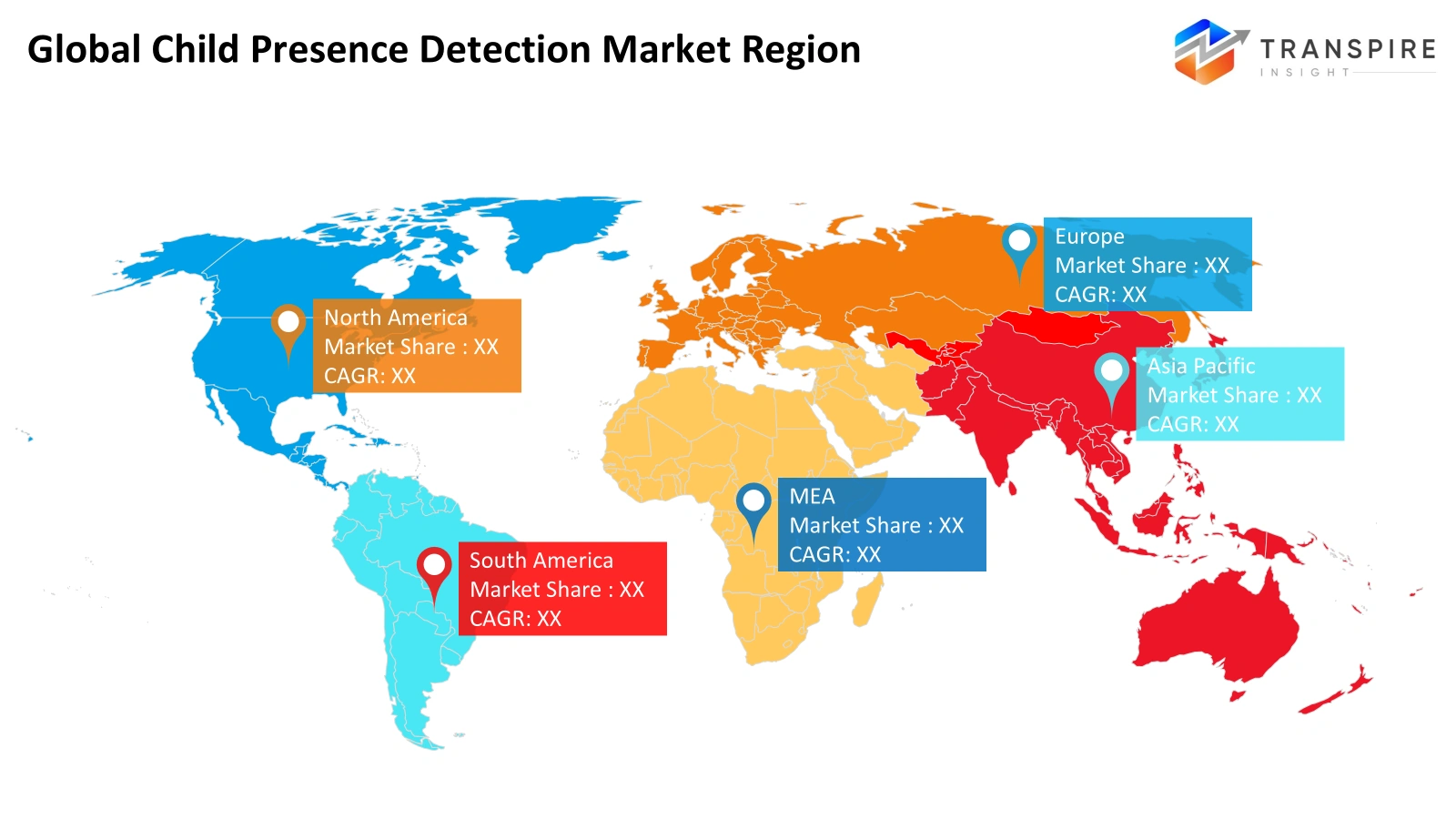
North America represents 25% of the market share owing to the increase in the number of connected car demands and the rising preference for safety technologies in automobiles. North America has the advantage of having the presence of prominent players in the automobile industry, technology providers, and semiconductor companies with a keen interest in intelligent cabin monitoring solutions. Investment in software-defined vehicles and artificial intelligence is contributing to the growth of child presence detection systems in different types of vehicles.
Europe
The market for detecting child presence in Europe dominates the worldwide market share of 36%, owing to stringent automobile safety regulations and early adoption of intelligent in-cabin sensing technologies. The automotive companies in the region have been increasingly integrating child presence detection systems in their new generation of vehicle platforms to ensure compliance with safety standards. Well-established R&D capabilities, automotive supply chain companies, and continuous innovations in intelligent mobility solutions further bolster the market dominance of Europe. Consumer awareness about passenger safety will further encourage the application of these technologies in passenger vehicles and premium vehicles.In May 2025,Smart Eye announced its guidelines for the Euro NCAP 2026 Child Presence Detection protocol. This announcement stressed that with the help of Interior Sensing AI technology, Smart Eye was able to assist automakers with compliance of CPD criteria in Europe
Asia-Pacific
The Asia-Pacific region accounts for 30% of the worldwide market share and is estimated to witness the fastest rate of growth at a CAGR of 19.8%. The fast production of automobiles, the increased manufacture of electric vehicles, and an increasing focus by governments on road safety are some factors driving the growth of the market in countries such as China, Japan, South Korea, and India. Car manufacturers are making significant investments in AI-powered cabin monitoring systems and innovative sensor technologies to enhance the safety of their automobiles while adhering to international standards. The synergy between high disposable income levels, automobile production capabilities, and favourable regulations should provide many opportunities in the future.In January 2025,Hyundai Mobis revealed its cutting-edge In-Cabin Monitoring System that allows for passenger posture and biosignal monitoring in real-time. The technology enables passenger safety and serves as a basis for child presence detection in the future vehicle models.
Who are the Key Players in the Global Child Presence Detection Marketand how do they Compete?
The competitive dynamics of the worldwide child presence detection market revolve around technological innovation, adherence to new safety regulations for cars, and establishing long-term cooperation with car manufacturers. Firms are developing new technologies of sensing, artificial intelligence, and cabin monitoring platforms to enhance their competitiveness and comply with the changing demands of global vehicle manufacturers.
Participants such as Continental AG, Bosch, Valeo, Denso Corporation, and Aptiv PLC concentrate on creating systems based on multiple sensors using radar, cameras, and AI software to increase the accuracy of passenger detection. The key strengths of these players include well-developed research and development abilities, established cooperation with automotive makers, and capacity to provide scalable safety systems for luxury and mass market cars. Many firms among those mentioned above are also developing through strategic cooperation with semiconductor and software producers to boost innovation.
The main characteristics of the other competitors, such as Magna International, ZF Friedrichshafen AG, NXP Semiconductors, Texas Instruments, and Gentex Corporation, involve specialised sensor technologies, intelligent processing platforms, and connected car solutions. These companies distinguish themselves by customising their product range, establishing production facilities in various regions, and constant investments in new-generation cabin monitoring solutions.
Global Child Presence Detection Market companies
- Bosch
- Continental AG
- Valeo
- Denso Corporation
- Aptiv
- Magna International
- Hyundai Mobis
- Veoneer
- ZF Friedrichshafen
- Infineon Technologies
- Texas Instruments
- NXP Semiconductors
- Cipia
- Vayyar Imaging
- Smart Eye
Recent Development News
In May 2025, Smart Eye drew attention to the revised Euro NCAP 2026 Child Presence Detection assessment protocol, which focuses on more stringent performance requirements for the direct detection of children through movement, breathing, or heartbeat detection in any seating position. The revised assessment protocol is motivating automobile makers to hasten the incorporation of advanced CPD technologies in their new vehicles.
Source: https://smarteye.se
In November 2025, Euro NCAP continued applying the improved protocol for assessing CPD systems in cars by adding new criteria for the evaluation of occupant monitoring systems and raising awareness of vehicles with effective CPD technology. The protocol is anticipated to foster OEM involvement in developing radar and AI-based in-cabin monitoring solutions.
Source: https://www.euroncap.com
In April 2026, Bosch Service Solutions proceeded with the growth of the Child Presence Detection Intervention Service. The service allows carmakers to integrate in-cabin detection and emergency intervention processes. It provides connections between drivers, their contacts, and emergency services.
Source: https://www.boschservicesolutions.com
What Strategic Insights Define the Future of the Global Child Presence Detection Market?
The global market for child presence detection systems is trending towards intelligent and software-based safety systems that integrate radar technology, artificial intelligence, and cabin monitoring in an integrated platform inside the vehicle.
As stricter automotive safety regulations are adopted and more connected vehicles come into use, companies that develop advanced detection systems with high accuracy, regulatory compliance, and scalability will benefit from improved market competitiveness. One of the less obvious problems that needs to be solved by the industry is the problem of consistent performance of detection systems in different car interiors, under various conditions, and occupancy configurations while minimising system costs. Meanwhile, widespread software-defined vehicles and over-the-air update capability provide an excellent opportunity for improving detection performance without substantial changes in hardware configuration.
Key Segmentations are:
By Technology
- Ultra-Wideband Sensors
- Radar Sensors
- Pressure Sensors
- Camera-based Systems
- Ultrasonic Sensors
- Infrared Sensors
- AI-based Detection Systems
By Vehicle Type
- Passenger Cars
- SUVs
- Commercial Vehicles
- Electric Vehicles
- Hybrid Vehicles
- Luxury Vehicles
- Autonomous Vehicles
By Component
- Sensors
- Control Units
- Cameras
- Software
- Communication Modules
- AI Processors
- Alarm Systems
By End User
- Passenger Vehicle OEMs
- Commercial Vehicle OEMs
- Fleet Operators
- Automotive Aftermarket
- Mobility Service Providers
- Government Fleets
- Defense Vehicles
By Application
- Rear Seat Occupancy Detection
- Cabin Monitoring
- Infant Detection
- Driver Monitoring Integration
- Safety Alerts
- Emergency Notifications
- Autonomous Safety Systems
Regional Outlook
North America
- United States
- Canada
- Mexico
Europe
- Germany
- United Kingdom
- France
- Spain
- Italy
- Rest of Europe
Asia Pacific
- Japan
- China
- Australia & New Zealand
- South Korea
- India
- Rest of Asia Pacific
South America
- Brazil
- Argentina
- Rest of South America
Middle East & Africa
- Saudi Arabia
- United Arab Emirates
- South Africa
- Rest of the Middle East & Africa
Frequently Asked Questions
Find quick answers to common questions.
The global child presence detection market size was valued at USD 0.68 Billion in 2025 and is poised to reach USD 1.34 Billion by 2033, expanding at an 8.85% CAGR.
Key segments for the global child presence detection market are By Technology (Ultra-Wideband Sensors, Radar Sensors, Pressure Sensors, Camera-based Systems, Ultrasonic Sensors, Infrared Sensors, AI-based Detection Systems, Others); By Vehicle Type (Passenger Cars, SUVs, Commercial Vehicles, Electric Vehicles, Hybrid Vehicles, Luxury Vehicles, Autonomous Vehicles, Others); By Component (Sensors, Control Units, Cameras, Software, Communication Modules, AI Processors, Alarm Systems, Others); By End User (Passenger Vehicle OEMs, Commercial Vehicle OEMs, Fleet Operators, Automotive Aftermarket, Mobility Service Providers, Government Fleets, Defense Vehicles, Others); By Application (Rear Seat Occupancy Detection, Cabin Monitoring, Infant Detection, Driver Monitoring Integration, Safety Alerts, Emergency Notifications, Autonomous Safety Systems, Others).
Growth is primarily driven by Strict safety standards in vehicles for children, increasing use of advanced driver assistance systems (ADAS), increasing incorporation of cabin monitoring systems, increasing awareness among consumers about child deaths due to heatstroke inside vehicles, and increasing manufacture of connected and smart cars.
The global market is led by major manufacturers including Bosch, Continental AG, Valeo, Denso Corporation, Aptiv, Magna International, Hyundai Mobis, Veoneer, ZF Friedrichshafen, Infineon Technologies, Texas Instruments, NXP Semiconductors, Cipia, Vayyar Imaging, Smart Eye.
The child detection market in Europe holds a 36% share in the global child presence detection market on account of strict vehicular safety standards, increasing usage of ADAS, and high production of passenger vehicles with occupant monitoring technologies. High level of automotive innovation, increasing consumer awareness regarding child safety, and presence of prominent automakers add to the leadership position of the region in the market.
Business opportunities within the global market for child occupancy detection are abundant due to the increasing use of sophisticated cabin safety technology in passenger cars as well as electric cars, the increased use of artificial intelligence- and radar-based occupant detection technologies, the expansion of child safety regulations in leading markets, and collaborations between car OEMs and companies providing sensor technology.
- Bosch
- Continental AG
- Valeo
- Denso Corporation
- Aptiv
- Magna International
- Hyundai Mobis
- Veoneer
- ZF Friedrichshafen
- Infineon Technologies
- Texas Instruments
- NXP Semiconductors
- Cipia
- Vayyar Imaging
- Smart Eye
About the Authors

Mayur Shinde
I am Mayur Shinde, a Senior Research Analyst at Transpire Insight, specializing in the Automotive & Transportation and Information & Communication Technology (ICT) Industry. My work focuses on analyzing emerging market trends, technological advancements, competitive landscapes, and industry developments to deliver accurate, data-driven insights. I am passionate about transforming complex market information into clear, actionable content that helps businesses, professionals, and decision-makers stay informed and make confident strategic decisions.

Chakradhar Khansole
Chakradhar serves as the Research Director at Transpire Insight, bringing over 8 years of experience in technology, innovation, and strategic market intelligence. He specializes in transforming complex market data into actionable business insights that enable organizations to make informed, growth-oriented decisions. Recognized for his strategic vision and analytical expertise, Chakradhar leads high-impact research initiatives, delivering comprehensive market assessments, competitive intelligence, and forward-looking industry analysis.
Recently Published Reports
-
Apr 2026
ATV & UTV Market
ATV & UTV Market Size, Share & Analysis Report By Type (ATV, and UTV), By Variants (Less Than 400 CC, 400 CC To 800 CC, and More Than 800 CC), and Geography (North America, Europe, Asia-Pacific, Middle East and Africa, South and Central America), 2021 - 2031
-
Apr 2026
Automotive Central Gateway Module Market
Automotive Central Gateway Module Market Size, Share & Analysis Report By Type (Ethernet Central Gateway Module, CAN Central Gateway Module, LIN Central Gateway Module, and FlexRay), By Application (Powertrain Control, Body Control, Infotainment System, Advanced Driver Assistance Systems (ADAS), and Others), By End User (Passenger Vehicles, and Commercial Vehicles), and Geography (North America, Europe, Asia-Pacific, Middle East and Africa, South and Central America), 2021 - 2031
-
Apr 2026
Automotive Engine Oil Filter Market
Automotive Engine Oil Filter Market Size, Share & Analysis Report By Filter Type (Fuel Filter, Engine Oil Filter, Hydraulic Oil Filter, and Others), By Filter Media (Cellulose, Synthetic, and Micro), By Sales Channel (OEMs, and Aftermarket), By Vehicle Type (Passenger Cars, Light Commercial Vehicles, Heavy Duty Trucks, Buses and Coaches, and Off-road Vehicles), and Geography (North America, Europe, Asia-Pacific, Middle East and Africa, South and Central America), 2021 - 2031
-
Apr 2026
Automotive Parts Aluminium Die Casting Market
Automotive Parts Aluminium Die Casting Market Size, Share & Analysis Report By Production Process (Pressure Die Casting, Vacuum Die Casting, Squeeze Die Casting, Gravity Die Casting), By Application (Body Parts, Engine Parts, Transmission Parts, Battery And Related Components, Other Application Types), and Geography (North America, Europe, Asia-Pacific, Middle East and Africa, South and Central America), 2021 - 2031
Our Clients



