

Europe Commercial Vehicle Market Size & Forecast
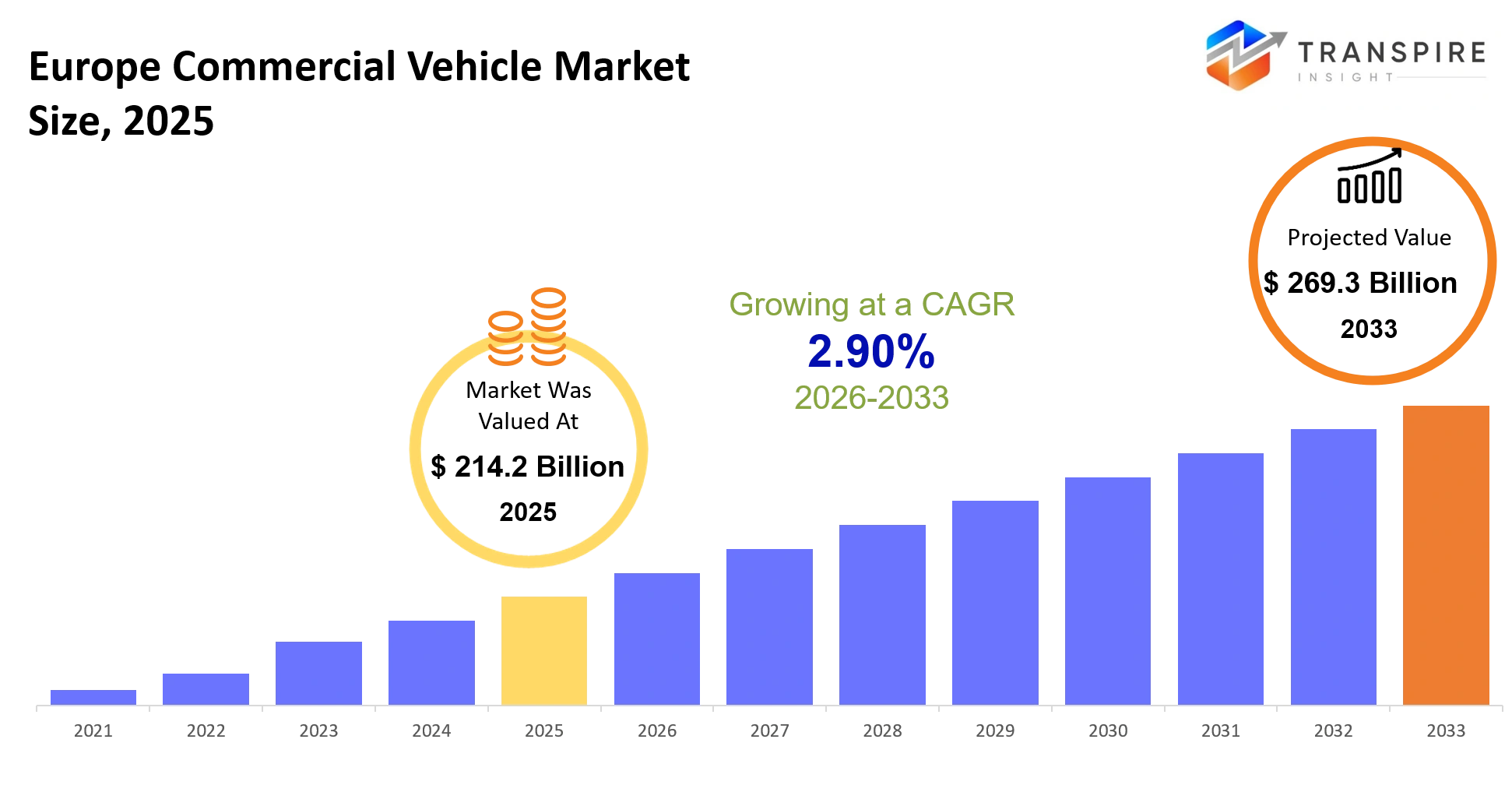
- Europe Commercial Vehicle Market Size 2025: USD 214.2 Billion
- Europe Commercial Vehicle Market Size 2026: USD 220.4 Billion
- Europe Commercial Vehicle Market Size 2033: USD 269.3 Billion
- Europe Commercial Vehicle Market CAGR: 2.90%
- Europe Commercial Vehicle Market Segments: By Vehicle Type (Light Commercial Vehicles, Medium Commercial Vehicles, Heavy Commercial Vehicles, Others), By Propulsion (Diesel, Petrol, Electric, Hybrid, Others), By Application (Logistics, Construction, Passenger Transport, Municipal Services, Others), By End User (Fleet Operators, SMEs, Government, Others), By Sales Channel (OEM, Dealers, Others), By Tonnage (Below 3.5 Tons, 3.5–16 Tons, Above 16 Tons, Others)
Europe Commercial Vehicle Market Summary
The European commercial vehicle market encompasses trucks, vans, and specialized vehicles used for logistics, construction, passenger transport, and municipal services. These vehicles form the backbone of European supply chains, moving goods across borders and within cities from dawn through the night. At USD 214.2 Billion in 2025, the market is projected to grow to USD 269.3 Billion by 2033.
A really significant change in the structure of this market is happening - the move away from diesel to alternative propulsion systems. Diesel engines had dominated European commercial vehicles for ages because they were very efficient and offered great torque characteristics. Between 2019 and 2024, super-tight Euro 6 emissions regulations plus government incentives for zero-emission vehicles pushed manufacturers to speed up their development of electric powertrains much faster than before. This transition isn't an option; it reflects actual regulatory enforcement - not just empty policy promises. Cities such as London, Paris, and Amsterdam are even restricting diesel trucks during peak hours or charging congestion fees that make traditional powertrains economically impractical for urban deliveries.
What's really happening in the real world is accelerating this shift - the incredibly rapid expansion of e-commerce and our last-mile delivery networks. In 2020-22, online retailing saw its growth double delivery demands right when cities clamped down on emissions further. Retailers vying with each other for same-day delivery commitments found out that electric vans solved two major problems at once: regulatory compliance and operational cost reduction via dramatically lower fuel and maintenance costs. DHL, Amazon Logistics, and UPS all announced several-year plans to buy electric vehicles that involved committing to purchase many tens of thousands of units. These huge commitments gave OEMs the confidence to put billions into developing new electric platforms. The result is that vehicle operators who bought traditional diesel trucks in 2021 now face a risk of having a 'stranded asset' as the used market gets increasingly flooded with older powertrains.
Key Europe Commercial Vehicle Market Insights
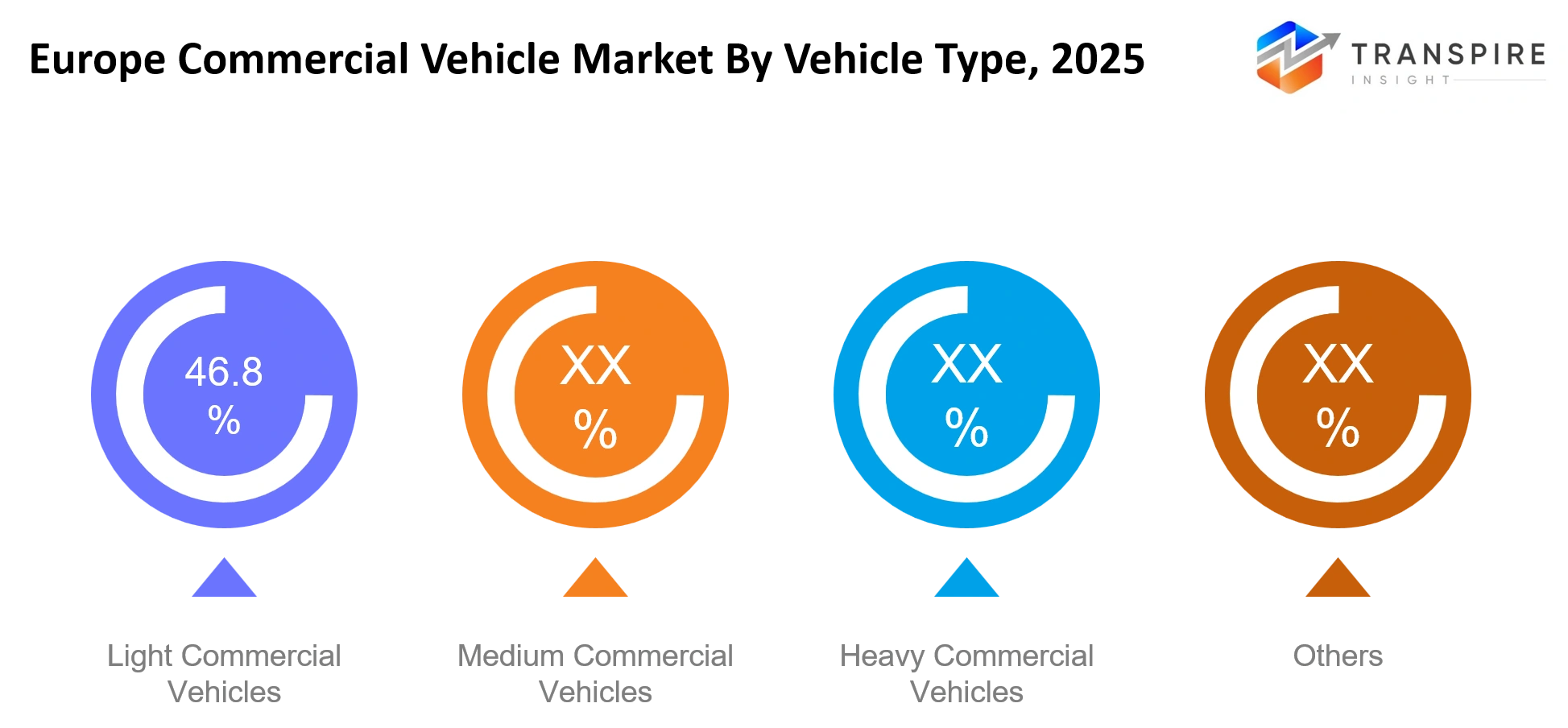
- Light commercial vehicles make up 46. 8% of European commercial vehicle market revenue by 2025 - all thanks to the growth of urban deliveries and small/medium-sized enterprise (SME) fleets operating in construction and service industries.
- Germany and France will account for a whopping 45% of the entire European market value in 2025, with well-established manufacturing facilities and strong demand from the logistics and construction sectors in both countries.
- Even so, diesel engines still power about 68% of new commercial vehicle sales in 2025, but their share is declining by 8 to 12 percentage points each year as electric and hybrid powertrains become much more popular.
- Electric commercial vehicles are really the fastest-growing propulsion category, expected to grow at a projected compound annual growth rate (CAGR) of 31% through 2033 - driven primarily by urban delivery vans weighing less than 3. 5 tons.
- Mercedes-Benz Trucks and Volvo Trucks collectively own around 28% of the European commercial vehicle market thanks to their well-established distribution networks and great brand reputation.
- Fleet operators purchase 52% of commercial vehicles - compared to just 31% for SMEs and 17% for government buyers, making their procurement decisions the main driving force of the market.
- Electric heavy commercial vehicles over 16 tons remain below 4% of their respective sales in 2025, heavily constrained by battery weight penalties and very limited charging infrastructure on European highways.
- Construction and logistics applications drive a massive 64% of European commercial vehicle demand, indicating the EU's construction sector recovery and ongoing e-commerce volume growth.
- Original equipment manufacturer (OEM) direct sales account for 58% of commercial vehicle transactions in 2025, while dealer networks account for 42%, highlighting the shift towards building closer relationships directly with fleet operators.
- Total cost of ownership analysis is shifting buying decisions significantly towards electric powertrains for urban delivery fleets, where lower fuel costs help offset higher upfront purchase prices within three to four years.
What are the Key Drivers, Restraints, and Opportunities in the Europe Commercial Vehicle Market?
Driver: The main driver is regulatory enforcement of Euro 6 emissions standards, combined with city-level diesel bans making traditional powertrains quite impractical in major metropolitan markets. This isn't aspirational regulation; rather, it's enforceable law. London's Ultra-Low Emission Zone charges GBP 12. 50 per day for diesel trucks; Paris bans diesel vehicles over 3. 5 tons every weekday. These regulations really create a structural cost penalty for diesel ownership - one that compounds itself over a fleet's entire operational life. Fleet operators conducting a total cost of ownership analysis find that electric vehicles, despite their higher initial cost, offer a lower cost per kilometre in urban operations due to electricity prices, reduced maintenance, and no emissions taxes. This economic crossover point really changes electric vehicles from just a compliance exercise into a very rational purchasing decision based on operational economics.
Restraint: Charging infrastructure still remains our biggest obstacle to large-scale electric vehicle adoption. A diesel truck refuels in just three minutes - and can travel 600 kilometres on a single tank. Electric trucks need 30 to 90 minutes for a significant charge - and have a maximum range of 300 to 400 kilometres under real-world conditions. This is somewhat manageable operationally for urban last-mile delivery fleets that do return to a depot each night, but it's really quite incompatible with long-haul logistics operations crossing many European borders - requiring pretty predictable charging availability along key corridors. Private charging networks managed by energy companies do cover quite dense urban areas - but rural regions and secondary highways really lack sufficient infrastructure. This charging gap simply can't be closed by fleet operators themselves; it really needs coordinated government investment in public fast-charging networks - something that's happening relatively slowly in most European countries.
Opportunity: Our clearest future opportunity lies in hydrogen fuel cell technology for heavy trucks running long-haul routes. Hydrogen provides us with both the range and the refuelling speed of diesel - without direct emissions - making it perfect for trucks that can't work efficiently with batteries because of weight and distance restrictions. Many European governments - including Germany, France, and the Netherlands - are co-funding hydrogen truck development programmes through various industrial policy initiatives. Daimler's Mercedes-Benz Fuel Cell Truck will start pilot operations with logistics operators in 2026 and 2027 - giving us a commercial pathway that competitors will really need to match. Unlike battery electric vehicles - which demand distributed charging networks - hydrogen can actually use existing refuelling station infrastructure run by energy companies competing in the transport fuel market itself.
What Has the Impact of Artificial Intelligence Been on the Europe Commercial Vehicle Market?
Artificial intelligence affects the European commercial vehicle market via three practical pathways: route optimization, predictive maintenance, and self-driving technology development. Route optimization algorithms process up-to-the-minute traffic information, weather forecasts, and even real-time fuel prices to suggest delivery orders and truck routes that really do lower operational costs - and emissions too. Companies such as DHL and FedEx have put in place AI-based route planning systems that cut down vehicle mileage by 8 to 15 percent per delivery round by optimizing loads and sequences much better. These systems produce quantifiable benefits - justifying both hardware and software costs that vehicle buyers then bill back to their clients through logistics rates.
Predictive maintenance systems look at engine sensor data, brake performance statistics, and transmission stress indicators to forecast part failures even before they happen. A gearbox with early warning signs of wear gets serviced at a scheduled depot stop instead of failing out on the road - greatly reducing emergency roadside assistance calls and related downtime. This application really does generate significant direct cost savings - leading to better operational profit margins. Almost all major commercial vehicle makers have actually integrated telematics and AI-based maintenance predictions right into their fleet management software, which vehicle operators now see more as essential rather than a luxury option.
Right now, the main hold-back is the relatively new development of autonomous heavy trucks within European regulatory guidelines. Although platooning technology - which lets trucks follow closely using automated steering and braking - has shown fuel savings of 8 to 12 percent, regulatory approval remains scattered throughout Europe. Germany, France, and Spain are starting some small-scale pilots, yet most other EU countries don't really have any clear laws governing the use of self-driving commercial vehicles. Integration costs still remain pretty high - adding somewhere between €15,000 to €25,000 per vehicle for the necessary extra computing equipment and sensor packages, which manufacturers tend not to include when regulatory approval is very uncertain - and fleet operators wonder if autonomous features are worth the added expense difference.
Key Market Trends
- Electric vans under 3.5 tons grew 45% year-over-year in 2024, representing the fastest-growing sub-segment across all vehicle types and propulsion combinations.
- Diesel engine sales declined 12% in 2024 compared to 2023, continuing a multi-year contraction as regulatory penalties and operational cost disadvantages accumulate.
- Germany accounts for 32% of European commercial vehicle sales through its established manufacturing base and regional demand from logistics and construction sectors.
- Fleet electrification programs from DHL, Amazon, and major logistics operators committed to purchasing over 200,000 electric vehicles through 2030, creating sustained OEM demand visibility.
- Used diesel truck values declined 18 to 22 percent year-over-year in 2024 and 2025, reflecting buyer concerns about stranded asset risk and residual value deterioration.
- Charging infrastructure installed capacity grew 62% in 2024, but coverage remains concentrated in urban areas with sparse availability on secondary highways.
- Hybrid commercial vehicles represent a transition segment, capturing 6% of new sales in 2025 among operators uncertain about full electrification timelines.
- Scania and Volvo are the leading European OEMs by commercial vehicle unit sales, each capturing 16 to 18 percent of regional market volume.
- Government vehicle procurement programs prioritize zero-emission vehicles, with purchase mandates creating guaranteed demand for OEMs willing to invest in electric platform development.
- Total cost of ownership calculations now favor electric over diesel for urban delivery fleets, shifting purchasing decisions from fuel cost to total operational expenditure analysis.
Europe Commercial Vehicle Market Segmentation
By Vehicle Type
Light Commercial Vehicles (LCVs) dominate at 46.8% of European market revenue. These vans under 3.5 tons handle urban deliveries, small construction jobs, and service calls. LCV electrification is moving fastest due to lower battery costs at smaller scale and favorable urban delivery economics. Mercedes, Ford, and Volkswagen lead this segment through established van lineups. Medium and Heavy trucks remain diesel-dominated but are transitioning slower due to charging infrastructure constraints and longer return-on-investment periods for battery systems.
By Propulsion
Diesel engines power 68% of new commercial vehicle sales in 2025, though this share contracts 8 to 12 points annually. Electric powertrains are the fastest-growing segment at 31% CAGR through 2033, concentrated in vehicles under 7.5 tons used for urban delivery. Hybrid systems capture 6% of sales as a transition option for operators uncertain about full electrification timelines. Petrol remains marginal for commercial vehicles. Hydrogen fuel cells are entering pilot phase with expected scale-up beginning in 2028 for long-haul operations.
By Application
Logistics and construction together represent 64% of application demand. Logistics drive urban last-mile delivery growth and are the primary adopters of electric vehicles for operational cost benefits. Construction demand is tied to EU infrastructure spending and building renovation programs. Passenger transport and municipal services account for smaller but stable shares. Government vehicle procurement programs prioritize zero-emission vehicles, creating guaranteed demand for specific applications including public transit and municipal waste collection.
By End User
Fleet operators purchasing 10 or more vehicles generate 52% of market volume through institutional procurement processes and total cost of ownership analysis. SMEs operating 2 to 9 vehicles represent 31% of purchases and are slower to adopt electric vehicles due to capital constraints. Government buyers account for 17% through public procurement mandates that increasingly specify zero-emission vehicles. Fleet operator purchasing decisions set the market direction as their operational scale allows systematic evaluation of emerging technologies.
By Sales Channel
OEM direct sales capture 58% of European commercial vehicle transactions through dedicated sales teams that serve fleet operators. Dealer networks handling 42% of sales remain important for SME and smaller fleet purchases where local service relationships matter. Direct relationships strengthen OEM control over pricing, specifications, and financing terms for fleet operators making large commitments. Dealers maintain advantages in regional markets and after-sales service integration.
By Tonnage
Vehicles below 3.5 tons account for 46.8% of market revenue and are experiencing rapid electrification. The 3.5 to 16-ton class represents 38% of revenue and is transitioning slowly toward electric and hydrogen powertrains. Vehicles above 16 tons constitute 15.2% of revenue and remain heavily diesel-dependent due to range and payload requirements. This tonnage distribution shapes propulsion technology adoption rates, with smaller vehicles leading electrification and larger vehicles requiring hydrogen or advanced battery technology.
What are the Key Use Cases Driving the Europe Commercial Vehicle Market?
Last-mile delivery in urban environments is the dominant use case for commercial vehicles, driven by e-commerce growth and same-day delivery commitments. Electric vans have become the preferred platform for this application due to favorable total cost of ownership in urban operations where range limitations do not apply. DHL, Amazon, and Zalando all operate electric vehicle fleets for urban deliveries, proving the operational model at scale.
Construction materials transport remains a critical use case tied to EU infrastructure spending and building renovation. This application still relies primarily on diesel engines due to payload requirements and range needs, though hybrid systems are beginning to penetrate the market. Construction sector electrification will accelerate only when hydrogen or advanced battery technology enables equivalent range and payload capacity.
Municipal services including waste collection, street cleaning, and emergency response represent a growing but specialized application. Electric vehicles are ideal for these use cases due to fixed routes, return-to-depot operations, and high visibility of government procurement programs. This application generates smaller volumes but higher margin opportunities through specialized vehicle configurations and service contracts.
|
Report Metrics |
Details |
|
Market size value in 2025 |
USD 214.2 Billion |
|
Market size value in 2026 |
USD 220.4 Billion |
|
Revenue forecast in 2033 |
USD 269.3 Billion |
|
Growth rate |
CAGR of 2.90% from 2026 to 2033 |
|
Base year |
2025 |
|
Historical data |
2021 - 2024 |
|
Forecast period |
2026 - 2033 |
|
Report coverage |
Revenue forecast, competitive landscape, growth factors, and trends |
|
Regional scope |
United Kingdom; Germany; France; Italy; Spain; Netherlands; Belgium; Sweden; Poland; Greece; Portugal; Denmark; Austria; Czech Republic; Ireland; Hungary |
|
Key companies profiled |
Mercedes-Benz Trucks, Volvo Trucks, Scania, MAN, Iveco, Renault Trucks, Ford, Stellantis, Volkswagen Commercial Vehicles, DAF Trucks, Isuzu, Tata Motors, Maxus, Hyundai, Toyota |
|
Customization scope |
Free report customization (country, regional & segment scope). Avail customized purchase options to meet your exact research needs. |
|
Report Segmentation |
By Vehicle Type (Light Commercial Vehicles, Medium Commercial Vehicles, Heavy Commercial Vehicles, Others), By Propulsion (Diesel, Petrol, Electric, Hybrid, Others), By Application (Logistics, Construction, Passenger Transport, Municipal Services, Others), By End User (Fleet Operators, SMEs, Government, Others), By Sales Channel (OEM, Dealers, Others), By Tonnage (Below 3.5 Tons, 3.5–16 Tons, Above 16 Tons, Others) |
Which Regions are Driving the Europe Commercial Vehicle Market Growth?
Germany and France together represent 45% of European commercial vehicle market revenue. Germany leads through its established manufacturing ecosystem, strong domestic demand from logistics and construction sectors, and aggressive government electrification incentives. German manufacturers including Daimler and MAN operate vertically integrated supply chains that support cost-competitive production. France drives demand through aggressive last-mile delivery growth in urban areas including Paris and Lyon, where municipal diesel restrictions force rapid fleet electrification. Both countries benefit from robust charging infrastructure development funded by government and private investment.
The UK and Northern Europe, including Scandinavia, represent 32% of European market revenue. The UK market is declining due to post-Brexit logistics complexity and reduced construction activity, though London's Urban Mobility program creates opportunities for electric vehicle specialists. Scandinavian markets, particularly Sweden and Norway, are leading European electrification with government incentives that make electric vehicles cost-competitive with diesel on acquisition price. Swedish manufacturer Volvo uses its home market as a testing ground for emerging technologies, which it then exports to other European markets.
Southern and Central European markets including Spain, Italy, Poland, and Greece represent growing but lower-value segments. These regions rely on older vehicle fleets with longer replacement cycles, and they lack the government electrification incentives available in Germany and Scandinavia. Construction activity in these regions remains volatile, constraining commercial vehicle demand growth. However, EU infrastructure spending programs targeting less-developed regions will create sustained demand for construction vehicles through 2030, particularly in Poland and Greece.
Who are the Key Players in the Europe Commercial Vehicle Market and How Do They Compete?
Mercedes-Benz Trucks and Volvo Trucks together control approximately 28% of the European market through brand reputation and distribution scale. Mercedes competes through premium positioning, advanced telematics platforms, and aggressive electric vehicle development in the LCV segment. Volvo emphasizes total cost of ownership for fleet operators and has invested heavily in hydrogen fuel cell technology for heavy trucks. Scania, owned by Traton Group, and MAN compete through cost leadership and strong relationships with professional fleet operators. Iveco and Renault Trucks hold regional strength in Southern and Central Europe. Ford and Volkswagen leverage their consumer vehicle platforms to develop commercial variants, competing primarily in the LCV segment on brand recognition and dealer network density.
Competition is shifting from vehicle specification to integrated fleet management services. OEMs are bundling connectivity, maintenance prediction, route optimization, and financing into comprehensive offerings that address total fleet operational needs rather than just vehicle supply. Volvo's Fleet Management system, Mercedes' Telematics platform, and Scania's Fleet Visibility programs all compete on software capability and data-driven decision support for fleet operators. This shift favors large established OEMs with existing customer relationships and technology investment capacity.
New entrants including Chinese manufacturers Maxus and Tata Motors are expanding European presence through price competition in the LCV and light-duty segments, though they struggle to match established brands on service network density and financing availability. Government vehicle procurement programs that prioritize zero-emission vehicles without brand discrimination are creating openings for non-traditional competitors willing to invest in electric platform development and European service support. The competitive landscape remains consolidated at the top end but faces increasing pressure from emerging markets and specialty electric vehicle manufacturers in the LCV segment.
Europe Commercial Vehicle Market Companies
- Mercedes-Benz Trucks
- Volvo Trucks
- Scania
- MAN
- Iveco
- Renault Trucks
- Ford
- Stellantis
- Volkswagen Commercial Vehicles
- DAF Trucks
- Isuzu
- Tata Motors
- Maxus
- Hyundai
- Toyota
Recent Developments
In March 2026, Mercedes-Benz Trucks announced the launch of the eActros 600, a long-haul electric heavy truck with 600-kilometer range targeting logistics operators on major European corridors. The vehicle integrates with Mercedes' Telematics platform to optimize charging stops and delivery schedules. https://www.mercedes-benz.com
In February 2026, Volvo Trucks initiated commercial hydrogen fuel cell truck pilots with DHL and Schenker across Germany and Sweden, marking the transition from development to operational testing. The FC Trucks operating in these pilots will generate real-world performance data on hydrogen refueling logistics and operational reliability. https://www.volvotrucks.com
In January 2026, Stellantis formed a joint venture with ChargePoint to accelerate commercial vehicle charging infrastructure deployment across Europe, targeting 1,000 new fast-charging stations by 2028 in logistics hubs and highway corridors. https://www.stellantis.com
What Strategic Insights Define the Future of the Europe Commercial Vehicle Market?
Over the next five to seven years, the European commercial vehicle market will stratify into two distinct powertrains: battery electric for urban operations under 250 kilometers per day, and hydrogen for long-haul routes exceeding 400 kilometers. This bifurcation reflects fundamental physics constraints that batteries cannot overcome at the scale required for heavy long-haul trucks. The underlying force driving this split is not technology preference but regulatory pressure combined with operational economics that increasingly favors electrification for urban fleets.
The hidden risk market participants face is oversupply of diesel used vehicles as fleets transition to electric platforms faster than secondary markets can absorb them. Residual values are already declining at 18 to 22 percent annually, and this depreciation will accelerate as electrification programs from major fleet operators create a torrent of used diesel trucks for which demand is collapsing. Operators holding diesel vehicles in 2026 and 2027 face genuine stranded asset risk, which will accelerate capital equipment replacement cycles and benefit OEMs selling electric vehicles but impose losses on operators who maintained faith in diesel technology.
The emerging opportunity is subscription-based fleet management services that generate recurring revenue from software and data analytics rather than hardware sales alone. OEMs bundling connectivity, maintenance prediction, route optimization, and telematics into unified platforms that fleet operators subscribe to monthly are creating stickier customer relationships with higher lifetime value than traditional one-time vehicle sales. Volvo and Mercedes are both pursuing this strategy, and winners in this space will command premium valuations based on software margins and customer lock-in rather than traditional vehicle gross margin metrics.
Europe Commercial Vehicle Market Report Segmentation
By Vehicle Type
- Light Commercial Vehicles
- Medium Commercial Vehicles
- Heavy Commercial Vehicles
- Others
By Propulsion
- Diesel
- Petrol
- Electric
- Hybrid
- Others
By Application
- Logistics
- Construction
- Passenger Transport
- Municipal Services
- Others
By End User
- Fleet Operators
- SMEs
- Government
- Others
By Sales Channel
- OEM
- Dealers
- Others
By Tonnage
- Below 3.5 Tons
- 3.5–16 Tons
- Above 16 Tons
- Others
Frequently Asked Questions
Find quick answers to common questions.
The Europe Commercial Vehicle Market size is expected to reach USD 269.3 Billion by 2033.
The key segments include By Vehicle Type (Light Commercial Vehicles, Medium Commercial Vehicles, Heavy Commercial Vehicles, Others), By Propulsion (Diesel, Petrol, Electric, Hybrid, Others), By Application (Logistics, Construction, Passenger Transport, Municipal Services, Others), By End User (Fleet Operators, SMEs, Government, Others), By Sales Channel (OEM, Dealers, Others), and By Tonnage (Below 3.5 Tons, 3.5–16 Tons, Above 16 Tons, Others).
Major players include Mercedes-Benz Trucks, Volvo Trucks, Scania, MAN, Iveco, Renault Trucks, Ford, Stellantis, Volkswagen Commercial Vehicles, DAF Trucks, Isuzu, Tata Motors, Maxus, Hyundai, and Toyota.
The Europe Commercial Vehicle Market size is USD 214.2 Billion in 2025.
The Europe Commercial Vehicle Market CAGR is 2.90% from 2026 to 2033.
- Mercedes-Benz Trucks
- Volvo Trucks
- Scania
- MAN
- Iveco
- Renault Trucks
- Ford
- Stellantis
- Volkswagen Commercial Vehicles
- DAF Trucks
- Isuzu
- Tata Motors
- Maxus
- Hyundai
- Toyota
About the Authors

Mayur Shinde
I am Mayur Shinde, a Senior Research Analyst at Transpire Insight, specializing in the Automotive & Transportation and Information & Communication Technology (ICT) Industry. My work focuses on analyzing emerging market trends, technological advancements, competitive landscapes, and industry developments to deliver accurate, data-driven insights. I am passionate about transforming complex market information into clear, actionable content that helps businesses, professionals, and decision-makers stay informed and make confident strategic decisions.

Chakradhar Khansole
Chakradhar serves as the Research Director at Transpire Insight, bringing over 8 years of experience in technology, innovation, and strategic market intelligence. He specializes in transforming complex market data into actionable business insights that enable organizations to make informed, growth-oriented decisions. Recognized for his strategic vision and analytical expertise, Chakradhar leads high-impact research initiatives, delivering comprehensive market assessments, competitive intelligence, and forward-looking industry analysis.
Recently Published Reports
-
Apr 2026
ATV & UTV Market
ATV & UTV Market Size, Share & Analysis Report By Type (ATV, and UTV), By Variants (Less Than 400 CC, 400 CC To 800 CC, and More Than 800 CC), and Geography (North America, Europe, Asia-Pacific, Middle East and Africa, South and Central America), 2021 - 2031
-
Apr 2026
Automotive Central Gateway Module Market
Automotive Central Gateway Module Market Size, Share & Analysis Report By Type (Ethernet Central Gateway Module, CAN Central Gateway Module, LIN Central Gateway Module, and FlexRay), By Application (Powertrain Control, Body Control, Infotainment System, Advanced Driver Assistance Systems (ADAS), and Others), By End User (Passenger Vehicles, and Commercial Vehicles), and Geography (North America, Europe, Asia-Pacific, Middle East and Africa, South and Central America), 2021 - 2031
-
Apr 2026
Automotive Engine Oil Filter Market
Automotive Engine Oil Filter Market Size, Share & Analysis Report By Filter Type (Fuel Filter, Engine Oil Filter, Hydraulic Oil Filter, and Others), By Filter Media (Cellulose, Synthetic, and Micro), By Sales Channel (OEMs, and Aftermarket), By Vehicle Type (Passenger Cars, Light Commercial Vehicles, Heavy Duty Trucks, Buses and Coaches, and Off-road Vehicles), and Geography (North America, Europe, Asia-Pacific, Middle East and Africa, South and Central America), 2021 - 2031
-
Apr 2026
Automotive Parts Aluminium Die Casting Market
Automotive Parts Aluminium Die Casting Market Size, Share & Analysis Report By Production Process (Pressure Die Casting, Vacuum Die Casting, Squeeze Die Casting, Gravity Die Casting), By Application (Body Parts, Engine Parts, Transmission Parts, Battery And Related Components, Other Application Types), and Geography (North America, Europe, Asia-Pacific, Middle East and Africa, South and Central America), 2021 - 2031
Our Clients



