

Europe Light Commercial Vehicle (LCVs) Market Size & Forecast:
- Europe Light Commercial Vehicle (LCVs) Market Size 2025: USD 114.2 Billion
- Europe Light Commercial Vehicle (LCVs) Market Size 2033: USD 205.9 Billion
- Europe Light Commercial Vehicle (LCVs) Market CAGR: 7.65%
- Europe Light Commercial Vehicle (LCVs) Market Segments: By Vehicle Type (Pickup Trucks, Vans, Chassis Cab, Mini Trucks, Others); By Propulsion (Diesel, Petrol, Electric, Hybrid, Others); By Application (Logistics, Construction, Passenger Transport, Municipal Services, Others); By End User (Fleet Operators, SMEs, Government, Others); By Sales Channel (OEM, Dealers, Others); By Tonnage (Below 2 Tons, 2–3.5 Tons, Above 3.5 Tons, Others)
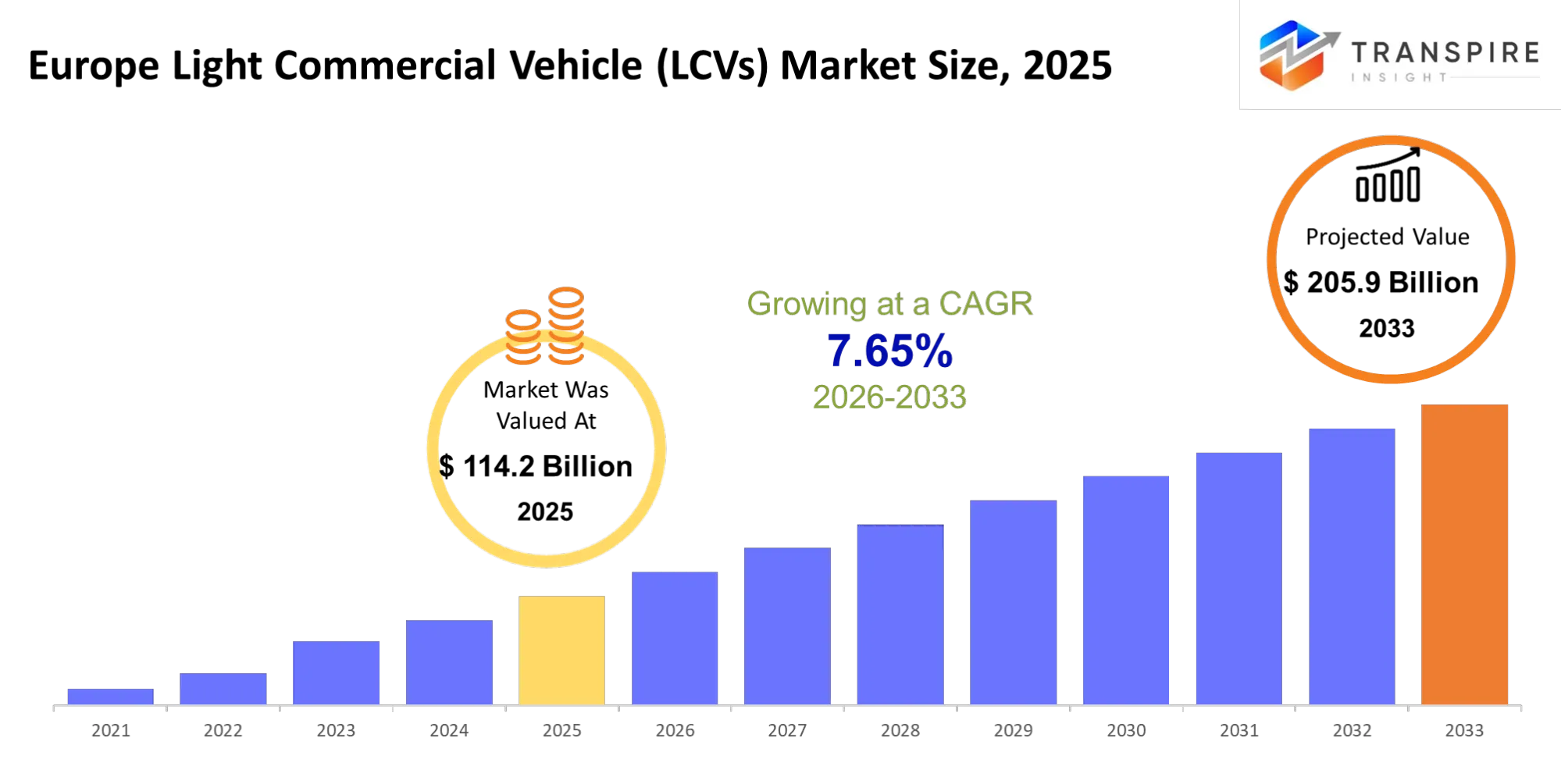
Europe Light Commercial Vehicle (LCVs) Market Summary
The Europe Light Commercial Vehicle (LCVs) Market was valued at USD 114.2 billion in 2025. It is forecast to reach USD 205.9 billion by 2033. That is a CAGR of 7.65% over the period.
The Europe Light Commercial Vehicle market plays a role in the daily operations of various industries. It provides a means of transportation for goods and services connecting businesses to their customers. In the few years a significant structural shift has occurred with the adoption of electric and hybrid vehicles.The introduction of emissions regulations has triggered a major change in market behavior pushing manufacturers to develop more sustainable options. As a result the market is experiencing growth because companies are looking for ways to reduce their footprint.
The demand for eco- vehicles is driving innovation and investment in the sector. This growth means that businesses are more likely to adopt these technologies leading to increased revenue for manufacturers and a more sustainable future for the industry.The Europe Light Commercial Vehicle market is evolving to meet the needs of a changing world.
Key Market Insights
- Western Europe has the part of the Europe Light Commercial Vehicle Market with almost 42 percent in 2025. This is because Western Europe has roads and a lot of people need things delivered in cities.
- Eastern Europe is growing the fastest in the Europe Light Commercial Vehicle Market from 2026 to 2033. This is happening because Eastern Europe is building roads for industries to use and companies are replacing old vehicles with new ones.
- Vans are the popular type of Light Commercial Vehicle. They are used a lot for delivering things to people's homes and for businesses in European cities.
- Pickup trucks are the most popular type of vehicle. They are used a lot in construction, farming and utility services in areas that're not too big and not too small.
- Electric Light Commercial Vehicles are becoming very popular fast. This is because the European Union has rules to reduce pollution and governments are giving money to companies that use vehicles.
- Delivering things to peoples homes and doing logistics is the use of Light Commercial Vehicles with over 50 percent of the market.
- Construction and city services are also using Light Commercial Vehicles more and more. This is because cities are building things and need to keep them maintained.
- Big companies that have a lot of vehicles are the users of Light Commercial Vehicles. They buy a lot of vehicles to deliver things and provide services.
- Medium sized businesses are using Light Commercial Vehicles more and more. This is because they are getting into the business of delivering things to peoples homes.
- Big companies like Ford, Mercedes-Benz, Renault, Volkswagen, Stellantis and Iveco are competing with each other by making vans, leasing vehicles to companies and putting new technology in their vehicles to make logistics better, in Europe.
What are the Key Drivers, Restraints, and Opportunities in the Europe Light Commercial Vehicle (LCVs) Market?
Drivers
The Europe Light Commercial Vehicle market is driven by rules about the bad things that vehicles put into the air. The European Union has rules that say vehicles have to be cleaner. This is making companies that deliver things replace their old vans with electric and hybrid vehicles. This means that companies that make these vehicles are going to sell more of them in cities in Western Europe where they need to deliver things.
Restraints
One thing that is slowing this down is that electric vehicles are expensive to buy at first and there are no places to charge them. This is a problem for companies that do not have a lot of money so they are not buying as many electric vehicles as bigger companies are. This means that it is going to take for all vehicles to be electric even though the government is trying to make it happen.
Opportunity
There is a chance for growth in Central and Eastern Europe, where cities are getting bigger and more warehouses are being built. Countries, like Poland and Romania are getting money to build roads and other things that will help vehicles get around. This will make it easier for companies to use vehicles especially if they can just swap out the battery when it runs out of power. Companies that can provide vehicles and a place to charge them will be able to make money in the long run. The Europe Light Commercial Vehicle market is going to keep growing because of these things.
What Has the Impact of Artificial Intelligence Been on the Europe Light Commercial Vehicle (LCVs) Market?
Europe's light commercial vehicle system is getting smarter with intelligence. This artificial intelligence is being used in connected fleet platforms to make routes better, watch how drivers behave and check if they are following the rules about emissions and safety in the European Union. Logistics companies use these intelligence systems to make delivery routes better in real time which means they are not wasting time and the vehicles are being used more. These systems also help the fleets follow the rules about low-emission zones by changing the routes based on the rules.
Artificial intelligence is also used to predict when vehicles might break down. It looks at how the engine's doing the health of the battery in electric vans and how much the brakes are worn out. This helps reduce the number of times vehicles break down. Fleet operators say that when they use these systems their vehicles are working 10 to 15 percent more of the time and they are using 8 to 12 percent less fuel or energy. Artificial intelligence is also used to predict emissions, which helps logistics companies make their fleets better and schedule when to charge their vehicles.
There is a big problem. Using advanced artificial intelligence platforms is very expensive. This is especially true for medium fleet operators. Many of these systems need upgrades and they need to be connected to the internet all the time, which is not always possible on rural delivery routes. Even though many companies are using technology quickly, the fact that different companies have different standards for their data is still a problem. This means that the systems that are used to manage fleets cannot work together perfectly.
Key Market Trends
- Since 2023 low-emission zones in EU cities have grown, making it necessary to replace diesel vans in city delivery fleets.
- Between 2024 and 2026 more companies started using vans as Ford and Renault offered more electric commercial vehicles.
- After 2023 logistics companies began using technology to manage their fleets which helped them find more efficient routes and reduce downtime.
- Since 2022 there has been an increase in e-commerce parcels leading to a higher demand for delivery vehicles that can make many short trips.
- Mercedes-Benz and Volkswagen started making electric vans after 2024 to meet stricter CO₂ emission targets for their fleets.
- Small fleet owners began leasing or subscribing to vehicles often after 2023 because electric vehicles were expensive to buy upfront.
- Between 2024 and 2026 charging stations expanded across Western Europe making it easier for fleets to switch to vehicles.
- After 2025 Stellantis started using platforms that could work with brands to make vans, which simplified production and reduced complexity, in Europe.
- More companies started using AI to predict and prevent vehicle breakdowns after 2024, which helped reduce issues in logistics fleets.
- New logistics hubs appeared in Eastern Europe after 2025 offering a cost- way to distribute goods across borders using vans.
Europe Light Commercial Vehicle (LCVs) Market Segmentation
By Vehicle Type:
Vans are really popular in the Europe Light Commercial Vehicle market. This is because they are very useful for delivering things in cities and for making last-minute deliveries. Many companies are replacing their diesel vans with electric ones in big European cities. Pickup trucks are still in demand for construction and utility services. Some vehicles can be customized for business needs. Small trucks are also becoming popular for delivering things in cities. Vans will continue to be popular because more and more people are shopping online.
By Propulsion:
Diesel is still widely used. It is becoming less popular because of strict rules to reduce pollution in Europe. Electric vehicles are becoming more popular because governments are encouraging people to use them and many cities are creating areas where only low-emission vehicles are allowed. Petrol vehicles are not as popular. Some small businesses still use them. Some vehicles can use both diesel and electric power. More and more commercial vehicles will be electric in the future.
By Application:
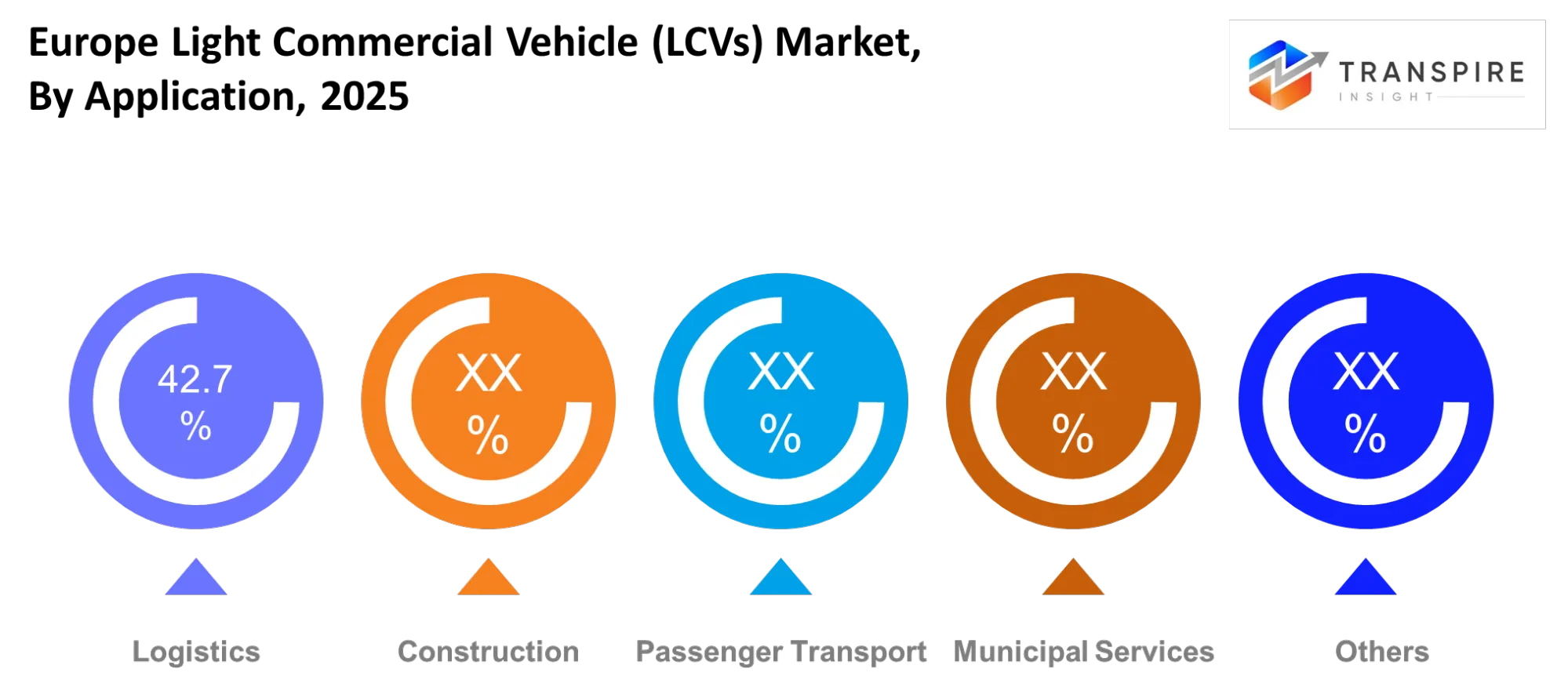
The Europe Light Commercial Vehicle market is dominated by logistics. This is because many people are shopping online and need things delivered quickly. Construction is also a user of these vehicles because of big infrastructure projects in Europe. Some vehicles are used to transport people. Cities are also using these vehicles for waste management and other services. Logistics will continue to be the reason people buy these vehicles.
By End User:
Big companies that operate vehicles are the largest buyers of these vehicles. They need them to deliver things and for logistics. Small businesses are also buying more of these vehicles. Governments use them for services. Many companies are leasing vehicles or buying them. Big companies will continue to buy the vehicles.
By Sales Channel:
Most vehicles are sold directly by the manufacturers to companies. Dealers also sell vehicles. Provide services. Some vehicles are sold online. Manufacturers are partnering with logistics companies to sell vehicles. This way of selling will continue to be popular.
By Tonnage:
Vehicles that can carry between 2 and 3.5 tons are popular. This is because they can carry a lot of weight and are still easy to drive in cities. Some vehicles can carry more than 2 tons and are used for small deliveries. Others can carry, than 3.5 tons and are used for heavy deliveries. Vehicles that can carry an amount of weight will continue to be the most popular. The European Light Commercial Vehicle market will keep using these vehicles.
What are the Key Use Cases Driving the Europe Light Commercial Vehicle (LCVs) Market?
The main thing that people use Light Commercial Vehicles for in Europe is to deliver things to people. This is because a lot of people are buying things online and they want to get them on the day. So companies that deliver things use these vehicles to get packages to people in cities.They need to be able to move around the city and not cost too much. Some other people use Light Commercial Vehicles to help build things and to keep cities clean. They use them to carry tools and other things that they need to do their jobs.
Now people are starting to use Light Commercial Vehicles in many ways. For example some cities want to be more environmentally friendly so they are using vehicles.. Some companies are using special vehicles to keep food and medicine cool while they are being delivered. This is a thing for companies that make Light Commercial Vehicles because it means they can make new kinds of vehicles that people will want to buy.
|
Report Metrics |
Details |
|
Market size value in 2025 |
USD 114.2 Billion |
|
Market size value in 2026 |
USD 122.9 Billion |
|
Revenue forecast in 2033 |
USD 205.9 Billion |
|
Growth rate |
CAGR of 7.65% from 2026 to 2033 |
|
Base year |
2025 |
|
Historical data |
2021 - 2024 |
|
Forecast period |
2026 - 2033 |
|
Report coverage |
Revenue forecast, competitive landscape, growth factors, and trends |
|
Regional scope |
Europe |
|
Key company profiled |
Ford, Mercedes-Benz, Renault, Volkswagen, Stellantis, Iveco, Toyota, Nissan, Fiat, Peugeot, Citroen, Opel, Isuzu, Maxus, MAN |
|
Customization scope |
Free report customization (country, regional & segment scope). Avail customized purchase options to meet your exact research needs. |
|
Report Segmentation |
By Vehicle Type (Pickup Trucks, Vans, Chassis Cab, Mini Trucks, Others); By Propulsion (Diesel, Petrol, Electric, Hybrid, Others); By Application (Logistics, Construction, Passenger Transport, Municipal Services, Others); By End User (Fleet Operators, SMEs, Government, Others); By Sales Channel (OEM, Dealers, Others); By Tonnage (Below 2 Tons, 2–3.5 Tons, Above 3.5 Tons, Others) |
Which Regions are Driving the Europe Light Commercial Vehicle (LCVs) Market Growth?
Western Europe leads the Europe Light Commercial Vehicle (LCVs) Market due to its strong logistics infrastructure, dense urban freight networks, and strict emission regulations. Countries such as Germany, France, and the Netherlands maintain large fleet bases driven by e-commerce distribution and industrial supply chains. Well-developed charging infrastructure and government incentives for electric mobility further accelerate fleet electrification. Strong OEM presence and advanced manufacturing ecosystems support continuous vehicle innovation. This region maintains dominance through regulatory pressure combined with high commercial vehicle turnover.
Northern Europe represents the second major region, supported by stable economic conditions and early adoption of clean transport policies. Unlike Western Europe, growth here is driven more by sustainability commitments and long-term carbon neutrality targets rather than sheer logistics scale. Countries such as Sweden and Denmark show consistent fleet modernization supported by public-private mobility programs. High consumer acceptance of electric vehicles strengthens adoption across urban delivery networks. This region contributes steady and predictable demand to the market.
Eastern Europe is the fastest-growing region due to rapid expansion of logistics corridors and rising e-commerce penetration. Recent infrastructure investments in Poland, Romania, and Czech Republic have improved cross-border freight efficiency and fleet utilization. Lower vehicle ownership costs and increasing foreign investment in distribution hubs are accelerating commercial fleet expansion. Government support for industrial development and transport modernization further strengthens demand. This region offers significant growth potential for OEMs and fleet service providers during 2026–2033.
Who are the Key Players in the Europe Light Commercial Vehicle (LCVs) Market and How Do They Compete?
The Europe Light Commercial Vehicle (LCVs) Market is moderately consolidated, with a few large OEM groups controlling significant share while regional manufacturers and electric mobility entrants increase competitive pressure. Traditional players are defending positions through electrification of van portfolios and expansion of fleet leasing solutions. Competition is increasingly defined by technology integration, especially electric powertrains, telematics systems, and total cost of ownership optimization rather than vehicle pricing alone. New entrants focused on EV platforms are disrupting legacy diesel-dominated product lines, intensifying innovation cycles across the sector.
Ford focuses on electric van leadership, especially through its E-Transit platform, which strengthens its position in urban logistics fleets. The company expands through fleet partnerships with logistics providers, enabling large-scale electrification contracts across Western Europe. Renault builds competitive strength through compact electric LCVs designed for dense urban delivery environments, supported by strong domestic European manufacturing networks.
Stellantis adopts a multi-brand strategy across Peugeot, Citroën, and Opel, allowing cost efficiency through shared LCV platforms and rapid EV integration. Volkswagen focuses on scalable modular van architecture and connected fleet services, strengthening long-term enterprise contracts. Mercedes-Benz differentiates through premium electric vans and advanced driver assistance integration, targeting high-value logistics operators seeking reliability and digital fleet optimization.
Company List
- Ford
- Mercedes-Benz
- Renault
- Volkswagen
- Stellantis
- Iveco
- Toyota
- Nissan
- Fiat
- Peugeot
- Citroën
- Opel
- Isuzu
- Maxus
- MAN
Recent Development News
In December 2025, Ford Motor Company and Renault Group announced a strategic partnership to jointly develop and produce light commercial vehicles for the European market. The collaboration focuses on shared electric vehicle platforms and cost-efficient LCV architectures to accelerate electrification and improve competitiveness against rising global EV manufacturers.https://www.reuters.com
In May 2026, Ford Motor Company announced plans to launch seven new vehicle models in Europe by 2029, including a fully electric urban transit van aimed at strengthening its commercial vehicle presence. This move is intended to regain market share in Europe and expand Ford’s electrified light commercial vehicle portfolio amid intensifying competition from Chinese and European OEMs.https://www.reuters.com
What Strategic Insights Define the Future of the Europe Light Commercial Vehicle (LCVs) Market?
The Europe Light Commercial Vehicle (LCVs) Market is structurally moving toward full electrification and digitally connected fleet ecosystems, driven by tightening CO₂ emission regulations and rapid expansion of urban logistics networks. Over the next 5–7 years, demand will shift from traditional diesel vans to software-enabled electric fleets, where operational efficiency, total cost of ownership, and regulatory compliance determine competitive advantage rather than vehicle volume alone.
A less visible risk is dependency on charging infrastructure rollout speed, where uneven development across Eastern and Southern Europe may slow fleet electrification despite strong policy pressure. This creates fragmented adoption cycles and limits uniform market scaling across regions.
A key emerging opportunity lies in integrated fleet-as-a-service models combining electric LCV leasing, charging infrastructure, and predictive maintenance platforms. This model is gaining early traction in Western Europe logistics corridors and can significantly reshape ownership structures. Manufacturers that build partnerships with energy providers and logistics operators will capture long-term recurring revenue streams rather than one-time vehicle sales. The strategic recommendation is to prioritize platform-based mobility ecosystems that integrate vehicles, software, and charging infrastructure into unified commercial solutions to secure future market leadership.
Europe Light Commercial Vehicle (LCVs) Market Report Segmentation
By Vehicle Type
- Pickup Trucks
- Vans
- Chassis Cab
- Mini Trucks
- Others
By Propulsion
- Diesel
- Petrol
- Electric
- Hybrid
- Others
By Application
- Logistics
- Construction
- Passenger Transport
- Municipal Services
- Others
By End User
- Fleet Operators
- SMEs
- Government
- Others
By Sales Channel
- OEM
- Dealers
- Others
By Tonnage
- Below 2 Tons
- 2–3.5 Tons
- Above 3.5 Tons
- Others
Frequently Asked Questions
Find quick answers to common questions.
The expected Europe Light Commercial Vehicle (LCVs) Market size for the market will be USD 205.9 Billion in 2033.
Key segments for the Europe Light Commercial Vehicle (LCVs) Market are By Vehicle Type (Pickup Trucks, Vans, Chassis Cab, Mini Trucks, Others); By Propulsion (Diesel, Petrol, Electric, Hybrid, Others); By Application (Logistics, Construction, Passenger Transport, Municipal Services, Others); By End User (Fleet Operators, SMEs, Government, Others); By Sales Channel (OEM, Dealers, Others); By Tonnage (Below 2 Tons, 2–3.5 Tons, Above 3.5 Tons, Others).
Major Europe Light Commercial Vehicle (LCVs) Market players are Ford, Mercedes-Benz, Renault, Volkswagen, Stellantis, Iveco, Toyota, Nissan, Fiat, Peugeot, Citroen, Opel, Isuzu, Maxus, MAN.
The Europe Light Commercial Vehicle (LCVs) Market size is USD 114.2 Billion in 2025.
The Europe Light Commercial Vehicle (LCVs) Market CAGR is 7.65% from 2026 to 2033.
- Ford
- Mercedes-Benz
- Renault
- Volkswagen
- Stellantis
- Iveco
- Toyota
- Nissan
- Fiat
- Peugeot
- Citroën
- Opel
- Isuzu
- Maxus
- MAN
About the Authors

Mayur Shinde
I am Mayur Shinde, a Senior Research Analyst at Transpire Insight, specializing in the Automotive & Transportation and Information & Communication Technology (ICT) Industry. My work focuses on analyzing emerging market trends, technological advancements, competitive landscapes, and industry developments to deliver accurate, data-driven insights. I am passionate about transforming complex market information into clear, actionable content that helps businesses, professionals, and decision-makers stay informed and make confident strategic decisions.

Chakradhar Khansole
Chakradhar serves as the Research Director at Transpire Insight, bringing over 8 years of experience in technology, innovation, and strategic market intelligence. He specializes in transforming complex market data into actionable business insights that enable organizations to make informed, growth-oriented decisions. Recognized for his strategic vision and analytical expertise, Chakradhar leads high-impact research initiatives, delivering comprehensive market assessments, competitive intelligence, and forward-looking industry analysis.
Recently Published Reports
-
Apr 2026
ATV & UTV Market
ATV & UTV Market Size, Share & Analysis Report By Type (ATV, and UTV), By Variants (Less Than 400 CC, 400 CC To 800 CC, and More Than 800 CC), and Geography (North America, Europe, Asia-Pacific, Middle East and Africa, South and Central America), 2021 - 2031
-
Apr 2026
Automotive Central Gateway Module Market
Automotive Central Gateway Module Market Size, Share & Analysis Report By Type (Ethernet Central Gateway Module, CAN Central Gateway Module, LIN Central Gateway Module, and FlexRay), By Application (Powertrain Control, Body Control, Infotainment System, Advanced Driver Assistance Systems (ADAS), and Others), By End User (Passenger Vehicles, and Commercial Vehicles), and Geography (North America, Europe, Asia-Pacific, Middle East and Africa, South and Central America), 2021 - 2031
-
Apr 2026
Automotive Engine Oil Filter Market
Automotive Engine Oil Filter Market Size, Share & Analysis Report By Filter Type (Fuel Filter, Engine Oil Filter, Hydraulic Oil Filter, and Others), By Filter Media (Cellulose, Synthetic, and Micro), By Sales Channel (OEMs, and Aftermarket), By Vehicle Type (Passenger Cars, Light Commercial Vehicles, Heavy Duty Trucks, Buses and Coaches, and Off-road Vehicles), and Geography (North America, Europe, Asia-Pacific, Middle East and Africa, South and Central America), 2021 - 2031
-
Apr 2026
Automotive Parts Aluminium Die Casting Market
Automotive Parts Aluminium Die Casting Market Size, Share & Analysis Report By Production Process (Pressure Die Casting, Vacuum Die Casting, Squeeze Die Casting, Gravity Die Casting), By Application (Body Parts, Engine Parts, Transmission Parts, Battery And Related Components, Other Application Types), and Geography (North America, Europe, Asia-Pacific, Middle East and Africa, South and Central America), 2021 - 2031
Our Clients



