
Global Broadband Services Market Size & Forecast:
- Global Broadband Services Market Size 2025: USD 545.8 Billion
- Global Broadband Services Market Size 2033: USD 1208.5 Billion
- Global Broadband Services Market CAGR: 10.41%
- Global Broadband Services Market Segments: By Type (Fibre Broadband, DSL Broadband, Cable Broadband, Wireless Broadband, Satellite Broadband, Others); By Application (Residential, Commercial, Educational Institutions, Government Facilities, Others); By End-User (Households, Enterprises, Schools, Government Organisations, Others); By Technology (5G Broadband, FTTH, Wi-Fi 6, Others).
Global Broadband Services Market Summary:
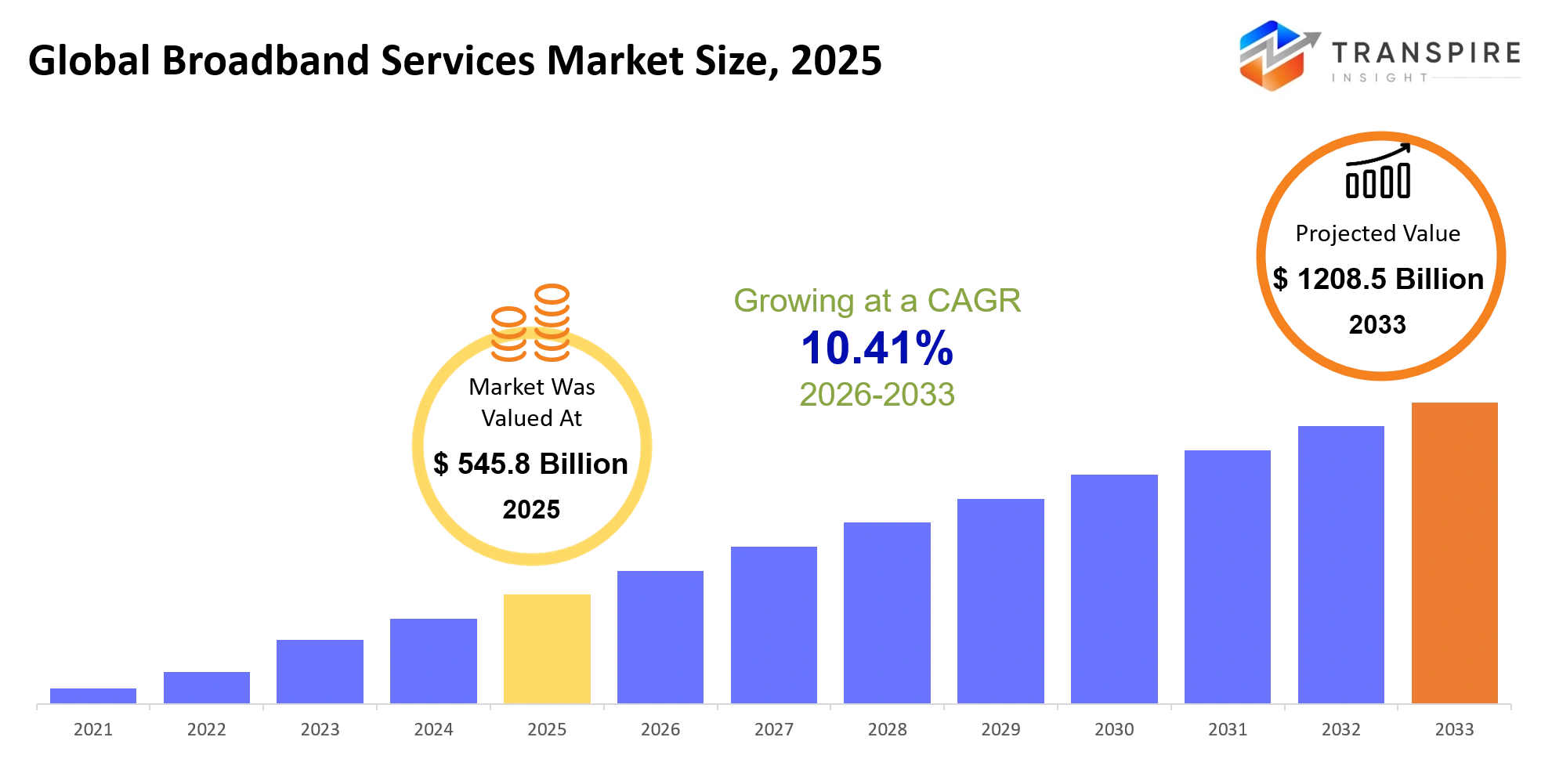
As per Transpire Insight Analysis, the Global Broadband Services Market size is estimated at USD 545.8 Billion in 2025 and is anticipated to reach USD 1208.5 Billion by 2033, growing at a CAGR of 10.41% from 2026 to 2033.
From a humble home internet solution to the digital backbone connecting remote workforces, cloud-based platforms, streaming entertainment, online learning, virtual healthcare and “always on” connected enterprise devices, the Global Broadband Services Market has experienced significant evolution over the past five years, transitioning its structure from outdated copper networks to advanced fibre optics and 5G technologies. Key factors and recent catalysts to this global infrastructure upgrade process include substantial broadband expansion initiatives by many governments worldwide and large-scale public and private investment in nationwide fibre and 5G rollouts in key economies, including the US Broadband Equity, Access & Deployment (“BEAD”) initiative, Europe’s Gigabit connectivity programme and India's BharatNet initiative. With global businesses moving applications and workloads to the cloud, and consumer adoption of data-rich applications increasing, broadband operators’ investments in network modernisation have enabled greater adoption and usage, boosting consumer and enterprise data consumption and generating additional service revenue.
Key Global Broadband Services Market Insights:
The broadband service industry is evolving and driven by fibre, 5G deployment, AI-given network intelligence, operators prioritising service quality and ecosystem integration, and not just connectivity. The growing data demands of cloud services, streaming and connected devices are driving infrastructure spending and new revenue streams for consumers and enterprise customers alike.
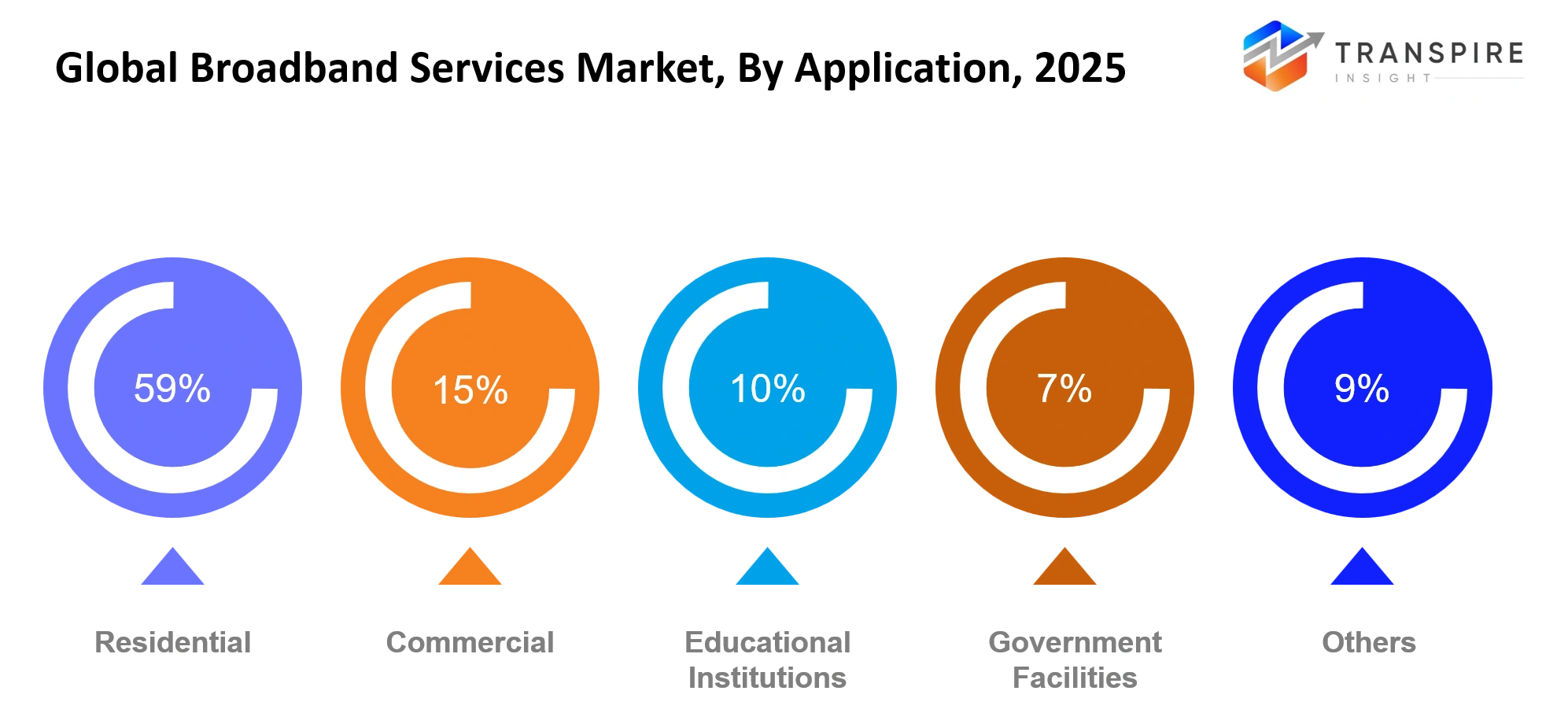
- Residential applications dominate the market, with a 59% share, due to growth in the demand for streaming, smart-home connectivity and multi-device internet usage.
- 5G Broadband will experience a CAGR of 17.2%, as Verizon, T-Mobile and Reliance Jio will drive deployment of fixed wireless access to strengthen the broadband offering.
- Fibre Broadband is still the leading access technology, with the likes of AT&T, Deutsche Telekom and Orange still making big bets on FTTH for higher-capacity networks.
- Commercial applications account for 15% of the market, while Vodafone and the BT Group are boosting enterprise cloud connectivity and managed network services.
- Educational Institutions (EI) account for 10% of the market, and Airtel and China Telecom have improved connectivity to digital learning with high-speed broadband infrastructure.
- Government Facilities make up 7% of demand, with public broadband expansion programmes and operator investments—such as NTT Communications and Telefónica—fuelled by this.
- There is greater adoption of wireless and satellite broadband in areas that are not served well, as providers invest in other types of connections to expand coverage beyond urban areas.
- Predictive maintenance, traffic optimisation, and customer experience are improving in broadband networks, with the help of AI-driven network management.
What are the Key Drivers, Restraints, and Opportunities in the Global Broadband Services Market?
Driver:
The rapid build-out of fibre to the home (FTTH) and 5G broadband networks is a key enabler of the overall market growth. Accelerated spending on high-speed networks comes from governments and telecommunication service providers’ increased spending on the digital economy, cloud applications, and smart city projects. With ever-higher demand for video, streaming, industrial process automation and business operations in remotely-connected locations, an increased flow of bandwidth demands will generate substantial uptake in subscribers and average revenue per user.
In June 2026, Nokia and Indosat Ooredoo Hutchison announced a major network modernisation partnership. The agreement drives a large-scale low- and mid-band 5G rollout across Indonesia to handle exponentially increasing data demands and anchor future AI-ready infrastructure layers.
Restraint:
The pace and scale of the rollout are also hampered by expensive and difficult broadband infrastructure. Installing broadband fibre networks takes massive capital outlay, lengthy regulatory processes, and long-term maintenance efforts, and so-called “structural” obstacles, as slow return on investment on rural low-density broadband networks means private investors still see it as less viable than expanding in dense regions. Spectrum costs and issues regarding infrastructure sharing also contribute to the problem.
Opportunity:
The convergence of broadband networks and newer digital ecosystems, like those powering smart cities, the industrial internet of things (IIoT), and edge computing, presents a huge opportunity. Next-gen fibre corridors, private 5G networks, and satellite broadband projects are enabling new revenue generation possibilities. For instance, with the rollout of low-earth orbit satellite broadband, even those in the most rural geographies where fibre deployment would simply be too expensive are gaining access to high-speed internet service and can bring on totally new customers, thereby expanding long-term demand.
In June 2026, Airtel Africa signed a strategic partnership with SpaceX. The collaboration introduces Starlink's low-Earth orbit satellite direct-to-cell broadband technology to 14 African nations, expanding high-speed connectivity to rural communities lacking traditional terrestrial infrastructure.
Source: https://www.airtel.africa/press-release
What Has the Impact of Artificial Intelligence Been on the Global Broadband Services Market?
While AI’s ability to create smarter networks isn’t new, providers are now employing a wider range of AI services across their infrastructure to make network operations more agile, efficient, and robust, while reducing costs and increasing reliability.AI analysis of network traffic identifies performance degradations, optimizes capacity dynamically and helps to avoid impact on service delivery as data usage, the volume of which is increasing at an exponential rate from cloud services, video, consumer IoT and the applications of digital businesses, continues to grow. AI enables the prediction of likely demand at times, identifies anomalies or performance degradations in network infrastructure equipment, and predicts possible service outages. Beyond the operational management of the network, AI is improving customer experience by delivering better engagement, automated services and issue remediation, and faster service delivery and turn-ups. This, coupled with proactive intrusion and cyber threat detection, is helping broadband service providers retain subscribers. However, adoption is challenged due to legacy telecommunication infrastructure and poor data.
In June 2026, Nokia launched its advanced agentic AI framework integrated into its Network Services Platform (NSP). This implementation deploys autonomous AI agents to automate complex IP network troubleshooting.
Source: https://www.nokia.com/ip-networks/network-services-platform/
Key Global Broadband Services Market Trends:
Broadband is becoming more than just a connectivity service; it is evolving into a smart platform of digital infrastructure that enables cloud-based solutions, automation, and real-time applications. Rather than higher Internet speeds, network operators are gaining and increasingly competing based on service quality, latency, and ecosystem integration.
- Fibre broadband has grown rapidly around the world, to replace legacy copper networks and increase long-term network scalability.
- Fixed wireless access is no longer just an alternative technology, but a viable mainstream broadband option, as 5G coverage grows.
- Broadband companies are increasingly offering bundled packages in the form of streaming, cloud storage, cyber-protection and smart-home services.
- Demand for enterprise broadband has evolved to focus on dedicated high-speed connections to support cloud-based and hybrid working.
- Traffic optimisation, predictive maintenance, and customer support automation are now commonplace with AI-driven network management.
- As edge computing grows in adoption, demand for low-latency broadband networks to support real-time applications is rising.
- Satellite broadband is not just a solution for emergencies, but a viable mainstream service too.
- Households are becoming multi-device and always-on, which has led to higher average data consumption.
- The telecom operators are aggressively establishing infrastructure-sharing relationships to cut down on deployment expenses and quicken the pace of network growth.
Global Broadband Services Market Segmentation
By Type:
Fibre Broadband leads in the ranking with high speed, stability, and scalability, being favourable among many home users and enterprises as they migrate to higher data applications. Wireless Broadband (including 4G/5G/Other Wireless) is growing fastest with 5G expanding broadband coverage, Cable Broadband keeps gaining traction in mature regions via upgrades, while DSL Broadband is losing shares to operators upgrading them to Fibre Satellite Broadband are becoming popular in underserved remote areas. Fibre Broadband, along with wireless broadband, will become key investments going forward.
By Application:
The residential segment captures a share of 59% of the market as demand for streaming, remote work, online education, and smart-home services rises. Commercial applications contribute about 15% of the market as the adoption of cloud and digital business operations increases. Government Facilities and educational institutions contribute a share of 7% and 10% respectively, driven by demand for digital service delivery from broadband networks, and the rest 9% includes the others specialized applications.
By End-User:
Households are the largest user segment due to increased demand for digital entertainment and remote connectivity. Enterprises, Schools, and Governments are adopting broadband more for cloud services, e-learning, and digitalising the functions, driving sustained network infrastructure demand of enterprises.
By Technology:
FTTH is still spearheading the network up-gradation, 5G Broadband, with 17.2% projected growth CAGR expected to become the fastest-growing technology with the capability to provide low-latency high-speed connection. Moreover, uptake of Wi-Fi 6 is boosting the performance in in-home and in enterprise networks, paving the way for a future connected devices ecosystem.
What are the Key Use Cases Driving the Global Broadband Services Market?
The dominant application is still in residential connectivity, with video, online collaboration, gaming, smart home, remote work, and online learning being provided over fibre and broadband wireless services, which dominate the global broadband subscription share.
Increasingly, additional applications come from enterprises and in the industrial arena, including services that utilise broadband networks in areas such as cloud computing, cybersecurity and operational automation (also see connectivity for the Industrial Internet of Things).
The newest areas that have potential to utilise additional and robust broadband services are smart cities, vehicle connectivity, edge environments and additional connectivity services for the Industrial IoT or IIoT applications described previously.
|
Report Metrics |
Details |
|
Market size value in 2025 |
USD 545.8 Billion |
|
Market size value in 2026 |
USD 604.2 Billion |
|
Revenue forecast in 2033 |
USD 1208.5 Billion |
|
Growth rate |
CAGR of 10.41% from 2026 to 2033 |
|
Base year |
2025 |
|
Historical data |
2021 - 2024 |
|
Forecast period |
2026 - 2033 |
|
Report coverage |
Revenue forecast, competitive landscape, growth factors, and trends |
|
Regional scope |
United States; Canada; Mexico; United Kingdom; Germany; France; Italy; Spain; Denmark; Sweden; Norway; China; Japan; India; Australia; South Korea; Thailand; Brazil; Argentina; South Africa; Saudi Arabia; United Arab Emirates |
|
Key company profiled |
AT&T, Verizon, Comcast, Charter Communications, Vodafone, China Telecom, BT Group, Reliance Jio, Deutsche Telekom, Telefónica, Orange, NTT Communications, Rogers Communications, T-Mobile, Airtel. |
|
Customization scope |
Free report customisation (country, regional & segment scope). Avail customised purchase options to meet your exact research needs. |
|
Report Segmentation |
By Type (Fibre Broadband, DSL Broadband, Cable Broadband, Wireless Broadband, Satellite Broadband, Others); By Application (Residential, Commercial, Educational Institutions, Government Facilities, Others); By End-User (Households, Enterprises, Schools, Government Organisations, Others); By Technology (5G Broadband, FTTH, Wi-Fi 6, Others). |
Which Regions are Driving the Global Broadband Services Market Growth?
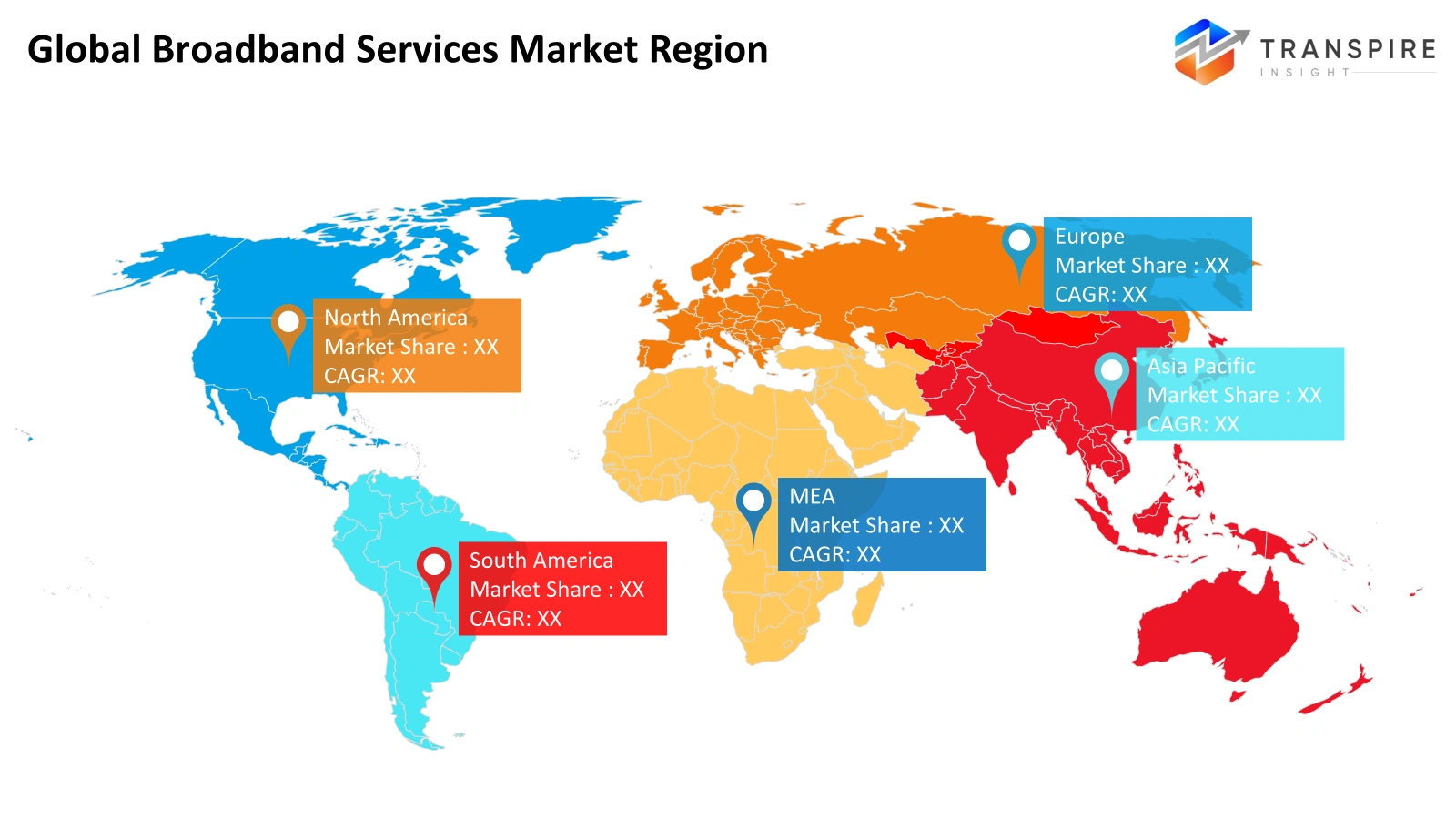
North America is expected to hold nearly 36% share of the global broadband services market and is likely to retain its position as the premier region. Growing demand for advanced solutions, including fibre, expanding 5G networks, considerable adoption of digital services, increasing consumer spending on premium connectivity solutions, a well-developed cloud ecosystem and increased use of high-bandwidth internet in households and enterprises will aid the growth. The growing capital expenditures made by telecom operators on expanding their broadband networks and government-funded schemes on broadband deployment. In April 2026, T-Mobile US agreed to form a 50/50 joint venture with Oak Hill Capital to acquire a 50% stake in fibre providers GoNetspeed and Greenlight. The transaction integrates both companies into T-Mobile's residential portfolio to expand high-speed T-Fibre services.
Europe accounts for about 21% of the worldwide market, where regulators support new digital infrastructure investments to advance sustainability objectives and digital connectivity. Investment in gigabit broadband connectivity, as well as in digital cross-border co-operation projects, accelerated deployment throughout the region in the past. Broadband suppliers are targeting to boost network upgradation and service improvement. Opportunities for gigabit broadband are predicted for the smart infrastructure projects, for industry automation, as well as the growing necessity of high-speed, reliable communication. 8% share comes from ROW, where the progress of broadband penetration will continue through new investments in network development.
Asia Pacific accounts for 35% of the market and is expected to experience the highest growth rate during the forecast period, with a CAGR of 16.4%. Growth in the Asia Pacific is predominantly attributed to faster urbanisation, major digital transformation projects, and growing internet penetration in underdeveloped regions. Investments in fibre and the next-generation of Wireless infrastructure, such as that China, India, South Korea and Japan have ongoing investments in fibre and next-gen wireless, high population density, and a rapidly expanding digital consumer base. In May 2026, Bharti Airtel launched its commercial "Priority Postpaid" 5G network slicing service in India. The implementation creates dedicated, virtual network layers across shared physical infrastructure to provide high-speed, premium connectivity and more stable bandwidth for enterprise and high-data consumers.
Who are the Key Players in the Global Broadband Services Market and how do they Compete?
Competition in the broadband market relies on network quality, network ownership, service innovation, subscriber loyalty, and geographic expansion. Operators will focus increasingly more on its fiber expansion coverage, the 5G services expansion, bundled digital and enterprise offers rather than solely on price. AT&T, Verizon, Comcast and Charter Communications highlight network upgrades, infrastructure development, fixed wireless and a bundle of broadband-entertainment offers while leveraging their existing significant network coverage and wide client base.
Vodafone, BT Group, Deutsche Telekom, Telefnica, Orange and NTT Communications emphasise network innovation, enterprise business and cloud-hosted offers or joint ventures to expand in business and local services segments. The global broadband leaders China Telecom, Reliance Jio, Airtel, Rogers Communications and T-Mobile focus on client acquisition by building a scale network coverage and expanding offers in different fields: for Reliance Jio, it is affordable digital ecosystems, fibre, and fixed services offerings, and for T-Mobile, it is the 5G broadband expansion. Generally, operators continue to invest heavily in new next-generation infrastructure to strengthen their market positions.
Key Players are:
- AT&T
- Verizon
- Comcast
- Charter Communications
- Vodafone
- China Telecom
- BT Group
- Reliance Jio
- Deutsche Telekom
- Telefónica
- Orange
- NTT Communications
- Rogers Communications
- T-Mobile
- Airtel
Recent Development News
In April 2026, Inseego signed an asset purchase agreement to acquire Nokia's global Fixed Wireless Access (FWA) business unit. The acquisition more than doubles Inseego’s revenue stream and transitions it from a regionally focused player into a global-scale wireless broadband service and hardware giant.
Souece: https://www.nokia.com
In March 2026, Axian Telecom and AST SpaceMobile announced a landmark partnership to deploy Africa's first space-based cellular broadband network. The direct-to-device service operates under Axian's unified Yas brand to deliver 4G LTE and 5G connectivity directly to standard, unmodified smartphones across remote terrestrial, maritime, and aviation zones.
Source: https://satnews.com
In June 2026, Midwest-based regional ISP Omni Fibre officially closed its corporate acquisition deal for Citizens Fibre. This asset consolidation integrates an established, 100% fiber-optic network across Pennsylvania’s Westmoreland County into Omni Fibre's system.
Source: https://www.lightreading.com
What Strategic Insights Define the Future of the Global Broadband Services Market?
Fibre optics, 5G, and AI in networking and a cloud native digital ecosystem will shape the broadband market of tomorrow. Intelligence of the network, services convergence and adoption for innovative applications like edge computing, industrial IOT, and smart cities will be key sources of competitive differentiation. One significant and often overlooked risk is the increasing CAPEX requirement for regular network modernisation; Operators that cannot extract the desired return on network infrastructure investment might be under stress on account of declining ROI despite increased data usage. Conversely, there’s a significant opportunity as fibre, Fixed wireless access and satellite-based technologies can address new customer segments in underserved geographies. This recommends that providers plan for scalable infrastructure deployment, leverage operational intelligence enabled by AI, establish alliances across multiple ecosystem players and deliver value-added services rather than commodity-based connectivity for strong long-term growth prospects.
Key Segmentations are:
By Type
- Fibre Broadband
- DSL Broadband
- Cable Broadband
- Wireless Broadband
- Satellite Broadband
- Others
By Application
- Residential
- Commercial
- Educational Institutions
- Government Facilities
- Others
By End-User
- Households
- Enterprises
- Schools
- Government Organizations
- Others
By Technology
- 5G Broadband
- FTTH
- Wi-Fi 6,
- Others
Regional Outlook
North America
- United States
- Canada
- Mexico
Europe
- Germany
- United Kingdom
- France
- Spain
- Italy
- Rest of Europe
Asia Pacific
- Japan
- China
- Australia & New Zealand
- South Korea
- India
- Rest of Asia Pacific
South America
- Brazil
- Argentina
- Rest of South America
Middle East & Africa
- Saudi Arabia
- United Arab Emirates
- South Africa
- Rest of the Middle East & Africa
Frequently Asked Questions
Find quick answers to common questions.
The global broadband services market size was valued at USD 545.8 Billion in 2025 and is poised to reach USD 1208.5 Billion by 2033, expanding at a 10.41% CAGR.
Key segments for global broadband services market are By Type (Fiber Broadband, DSL Broadband, Cable Broadband, Wireless Broadband, Satellite Broadband, Others); By Application (Residential, Commercial, Educational Institutions, Government Facilities, Others); By End-User (Households, Enterprises, Schools, Government Organizations, Others); By Technology (5G Broadband, FTTH, Wi-Fi 6, Others).
Growth is primarily driven by expanding fibre and 5G infrastructure, rising cloud adoption, increasing data-intensive applications, and government-backed broadband expansion initiatives.
The global broadband services market is led by major manufacturers, including AT&T, Verizon, Comcast, Charter Communications, Vodafone, China Telecom, BT Group, Reliance Jio, Deutsche Telekom, Telefónica, Orange, NTT Communications, Rogers Communications, T-Mobile, and Airtel.
North America holds 36% of the global market, supported by advanced broadband infrastructure, strong fibre and 5G investments, high digital service adoption, and a mature cloud ecosystem.
Key opportunities include smart city deployments, industrial IoT connectivity, edge computing services, private 5G networks, and broadband expansion in underserved and rural regions.
- AT&T
- Verizon
- Comcast
- Charter Communications
- Vodafone
- China Telecom
- BT Group
- Reliance Jio
- Deutsche Telekom
- Telefónica
- Orange
- NTT Communications
- Rogers Communications
- T-Mobile
- Airtel
About the Authors

Mayur Shinde
I am Mayur Shinde, a Senior Research Analyst at Transpire Insight, specializing in the Automotive & Transportation and Information & Communication Technology (ICT) Industry. My work focuses on analyzing emerging market trends, technological advancements, competitive landscapes, and industry developments to deliver accurate, data-driven insights. I am passionate about transforming complex market information into clear, actionable content that helps businesses, professionals, and decision-makers stay informed and make confident strategic decisions.

Chakradhar Khansole
Chakradhar serves as the Research Director at Transpire Insight, bringing over 8 years of experience in technology, innovation, and strategic market intelligence. He specializes in transforming complex market data into actionable business insights that enable organizations to make informed, growth-oriented decisions. Recognized for his strategic vision and analytical expertise, Chakradhar leads high-impact research initiatives, delivering comprehensive market assessments, competitive intelligence, and forward-looking industry analysis.
Recently Published Reports
-
Apr 2026
3D Optical Profiler Market
3D Optical Profiler Market Size, Share & Analysis Report By Type (Desktop 3D Optical Profiler, and Portable 3D Optical Profiler), By Technology (Confocal Technology, and White Light Interference), By End-Use Industry (Manufacturing, Research Institutions, Automotive, Aerospace and Defense, Medical Devices, and Other), and Geography (North America, Europe, Asia-Pacific, Middle East and Africa, South and Central America), 2021 - 2031
-
Apr 2026
Depth Sensor Market
Depth Sensor Market Size, Share & Analysis Report By Type (Infrared Depth Sensors, Time-of-Flight (ToF) Sensors, Stereo Vision Sensors, Structured Light Sensors, Ultrasonic Depth Sensors), By Application (Automotive, Robotics, Gaming, Consumer Electronics, Industrial Automation, Healthcare, Security & Surveillance, Others), By End Users (Automotive Manufacturers, Consumer Electronics Companies, Healthcare Providers, Industrial Companies, Security Agencies, Gaming Companies, Robotics Companies, Others), and Geography (North America, Europe, Asia-Pacific, Middle East and Africa, South and Central America), 2021 – 2031
-
Apr 2026
Digital Manufacturing Market
Digital Manufacturing Market Size, Share & Analysis Report By Component (Hardware, Software, and Services), By Technology (Robotics, 3D Printing, Internet of Things (IoT), and Others), By Application (Automotive and Transportation, Aerospace and Defense, Consumer Electronics, Industrial Machinery, and Others), By Process Type (Computer-Based Designing, Computer-Based Simulation, Computer 3D Visualization, Analytics, and Others), and Geography (North America, Europe, Asia-Pacific, Middle East and Africa, South and Central America), 2021 – 2031
-
Apr 2026
Digital Visa Services Market
Digital Visa Services Market Size, Share & Analysis Report By Type (Individual Travelers, Group Travelers), By Application (Tourism, Business Travel, Others), and Geography (North America, Europe, Asia-Pacific, Middle East and Africa, South and Central America), 2021 – 2031