
Middle East and Africa AI In Media & Entertainment Market Size & Forecast:
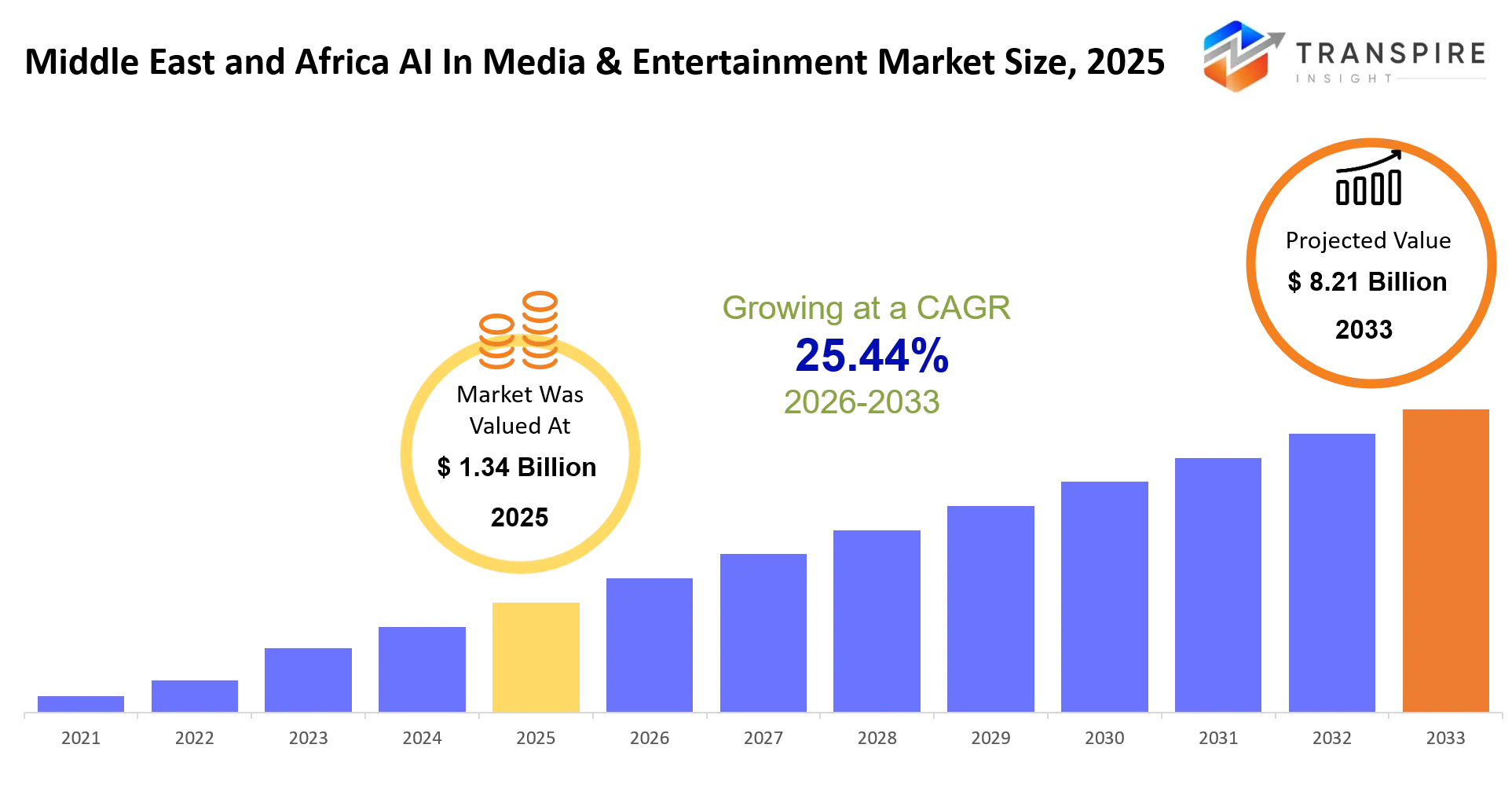
- Middle East and Africa AI In Media & Entertainment Market Size 2025: USD 1.34 Billion
- Middle East and Africa AI In Media & Entertainment Market Size 2033: USD 8.21 Billion
- Middle East and Africa AI In Media & Entertainment Market CAGR: 25.44%
- Middle East and Africa AI In Media & Entertainment Market Segments: By Component (Software, Services, Hardware, Others); By Application (Content Creation, Video Editing, Personalization, Advertising, Gaming, Others); By Deployment (Cloud, On-premise, Hybrid, Others); By End User (Studios, Broadcasters, OTT Platforms, Others)
To learn more about this report,  Download Free Sample Report
Middle East and Africa AI In Media & Entertainment Market Summary
The Middle East and Africa AI In Media & Entertainment Market was valued at USD 1.34 Billion in 2025. It is forecast to reach USD 8.21 Billion by 2033. That is a CAGR of 25.44% over the period.
The Middle East and Africa AI in the Media & Entertainment market kind of helps media companies, broadcasters , gaming studios , and streaming platforms to create, edit, distribute, and personalize content at scale. In practice the AI tools reduce production timelines, automate those repetitive creative chores, improve audience targeting, and let companies cope with all that expanding content volume across different digital channels. Over the last five years, the whole space shifted from early experimental AI usage toward more integrated generative AI workflows, kind of built right into video production, content recommendation, advertising, and audience analytics platforms .
One big structural change has been the move away from traditional content production toward AI-assisted creation, where generative models support video, images, audio, and also localized content. And then the rapid commercialization of generative AI, after those large-scale model breakthroughs, pushed investment across the region faster than before. Meanwhile government-backed AI efforts in Saudi Arabia and the UAE encouraged infrastructure growth and broader enterprise adoption. Media organizations also want quicker content delivery and more audience interaction, so AI helps reduce production costs, while also enabling personalized experiences. That combo sort of opens a direct road to higher monetization and stronger platform revenues.
Key Market Insights
- In 2025 GCC countries basically make up around 48% of the regional market revenue, you know, because of national AI programs plus digital media spend.
- The Middle East seems to be the biggest player for market share, while Africa is expected to grow the quickest by 2033 , largely from more mature digital content ecosystems forming over there.
- On the solution side, software services lead at about 45% share , powered by AI based content generation, recommendation engines and also audience analytics platforms.
- Then services come as the second largest chunk, and they’re backed by implementation work, advisory consulting, and AI integration projects across media enterprises.
- Cloud deployment is over 60% in 2025, which helps scalable AI processing for streaming, gaming , and digital publishing applications.
- For applications, content creation stays on top, bringing in more than 30% of industry revenue through automated image, video and text generation.
- Personalization applications are forecast to rise above 28% per year, supported by OTT recommendation systems and more targeted ad placements.
- When it comes to end-user adoption, OTT platforms take the lead with roughly 35% share, using AI in order to boost viewer retention and engagement metrics.
- Companies like Google, Microsoft, Adobe, IBM and NVIDIA are also pushing ahead by expanding generative AI innovation and regional partnerships.
- Overall strategic expansion is tilting toward localized Arabic-language AI models, cloud-based production platforms, and AI-driven advertising technologies across regional media networks, kind of all together.
What are the Key Drivers, Restraints, and Opportunities in the Middle East and Africa AI In Media & Entertainment Market?
The strongest growth driver i s the fast, almost sudden, adoption of generative AI across content creation and distribution. Once commercially viable AI models for video creation, image making, voice synthesis, and content localization became available, the whole economics of media production kind of flipped. Work that used to take huge creative squads now gets done in hours instead of days. Because of that, broadcasters, studios, and OTT providers can push out more material while still keeping operating costs under control. Those quicker production cycles also tend to boost monetization, since there s more content going live and audience engagement happens sooner.
Still, the biggest wall is the shortage of AI infrastructure and the right specialized talent in several African markets. Advanced media AI use cases need serious computing capacity, reliable cloud resources, and professionals who can actually train and deploy these AI systems. And the issue is pretty structural, not just temporary, since infrastructure builds, workforce development, and data ecosystem maturity all take years of steady investment. So, a lot of organizations end up postponing broader AI rollouts, which then limits revenue growth and slows down how deeply they can enter the market.
A major future chance sits in localized generative AI content platforms, tuned for Arabic and multiple African languages. Investments in regional AI ecosystems, especially across Saudi Arabia and the UAE, are setting the stage for culturally resonant content generation and more tailored advertising experiences. Localization tools powered by AI can help media companies reach wider audiences across different language groups while cutting down on both translation effort and production expenses.
What Has the Impact of Artificial Intelligence Been on the Middle East and Africa AI In Media & Entertainment Market?
Artificial intelligence has kind of, fundamentally changed how content gets made and how audiences stay engaged across the regional media industry, and honestly it feels like it happened faster than many teams expected. Broadcasters, streaming platforms, and creative studios are increasingly relying on AI in order to automate things like video editing, subtitle generation , content tagging , image enhancement, and digital asset management. With those automated workflows, the manual effort drops and the production schedules basically speed up, so organizations can publish content more often.
At the same time , machine learning models are getting better at prediction. Streaming platforms often analyze viewing behavior to forecast what audiences might like and then fine tune their content recommendations . Advertising networks do predictive analytics too, aiming to improve campaign targeting and push conversion rates higher . Meanwhile gaming companies use AI-driven behavioral models to personalize user experiences and boost retention metrics, which is not a small thing.
Operational efficiency has improved a lot as well, mainly through automated editing, content moderation, and audience analytics systems. A lot of media organizations report shorter production cycles, quicker content localization, and better viewer engagement overall. Plus AI generated content tools can reduce production costs tied to repetitive creative tasks, which teams usually dislike doing anyway.
Still, it’s not all smooth, integration can remain challenging. There are high-performance computing requirements, licensing costs, and in many places the availability of regional training datasets is limited, so adoption gets slowed down. Also, content accuracy plus cultural relevance tends to demand human oversight, especially for Arabic and African language applications where the training data is less mature than English-language datasets . So, teams often end up using AI, but with people double checking, and that part matters a lot .
Key Market Trends
- Since 2023 , the adoption of AI generated video production has kinda sped up among regional broadcasters, mostly because they want faster turnarounds and less time in editing, lower costs too.
- From 2023 to 2025 , OTT platforms boosted AI powered recommendations deployment by more than 40%, not just for “better algorithms” but to keep viewers sticking around, retention and all that.
- In 2025 , Arabic language generative AI initiatives grew quite a lot, mostly driven by government backed infrastructure investments , so yeah , the base got stronger.
- By 2025 , cloud based AI production workflows started beating traditional on premise deployments across major media orgs, it’s like the old setup got left behind in practice.
- Advertising agencies have been leaning harder on AI generated creative assets, and as a result campaign development timelines are now shrinking by nearly 50%, which is kinda huge.
- Gaming developers also jumped in , using AI assisted content generation to speed up character design and the creation of virtual environments, quicker builds overall.
- Media companies, rather than using standalone AI tools, have shifted toward integrated production ecosystems that connect creation, editing , and distribution functions, all in one flow.
- Partnerships between global technology firms and regional organizations increased a lot during 2024 and 2025 , like more collaborations , fewer isolated projects.
- AI powered audience analytics moved beyond pure demographic targeting, toward behavioral prediction and real time engagement optimization, so it’s less “who they are” and more “what they might do”.
- Competition is increasingly about proprietary generative AI capabilities, localized language support, and how well content personalization performs, basically it’s the differentiator game now.
Middle East and Africa AI In Media & Entertainment Market Segmentation
By Component
Software does play a big part in market activity because AI-powered applications back up content creation, audience metrics, recommendation engines, and even automated editing pipelines. Media organizations, you know, end up using software tools to boost workflow efficiency and also to handle huge numbers of digital content, all at once. With advanced algorithms involved it becomes easier to craft customized experiences and make engagement grow across different digital channels. And yeah, continuous upgrades plus cloud-based delivery models should help speed up broader software adoption through entertainment businesses.
Services matter too, not just in theory, but through consulting, system integration, maintenance, and training activities that let orgs roll out AI solutions more effectively. Hardware then supports the whole compute burden via servers, graphics processors , and specialized computing systems that are needed for AI workloads. There are also “other” parts like supporting technologies and complementary solutions that help with content administration and daily operations. Put together, these pieces build a sort of balanced ecosystem, which enables smoother deployment and long term scalability without too much drama.
By Application
AI Content Creation has a fairly big share, since these tools help churn out text, images, animations and other digital assets in shorter timeframes—like way faster, you know. Video Editing kinda rides the same wave, with automated clipping, scene detection , subtitle generation and also quality enhancement. Then there is Personalization which sorta supports audience engagement more, by suggesting what to watch next based on viewing behavior , and also those preferences people actually have. In the end these tools let organizations boost productivity, but also keep the content pipeline steady and consistent output.
Advertising is also leaning hard on AI, for optimizing campaign targeting, splitting audiences into clearer groups , and tracking performance measurement across multiple digital platforms. Gaming keeps moving forward too, using AI for character development, virtual environments and interactive user experiences that feel more responsive. Other areas include content moderation, metadata tagging, localization, and audience analytics applications, which basically helps broader entertainment operations run smoother. As this keeps expanding in those spaces, it should open up new opportunities for tech providers and media companies overall.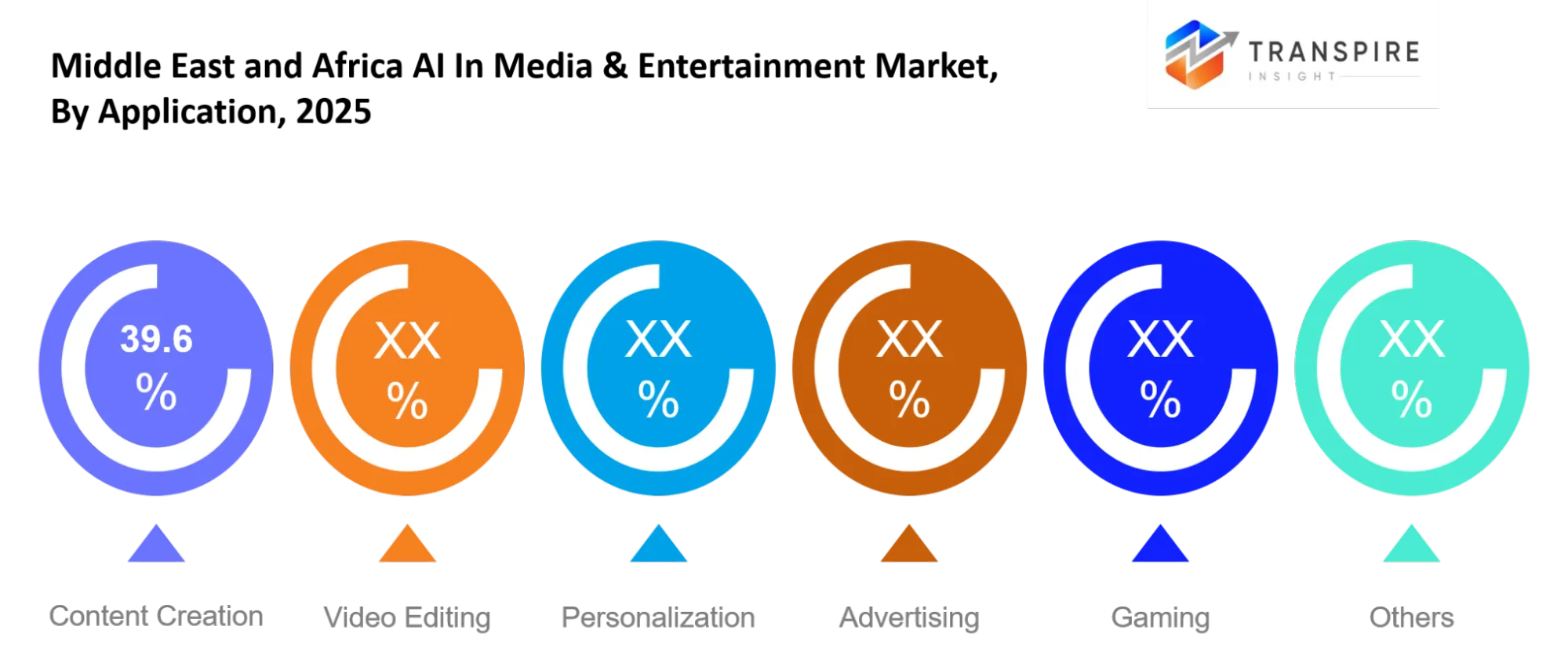
To learn more about this report, Download Free Sample Report
By Deployment
Cloud deployment is kinda holding a strong position, because scalable infrastructure lets organizations work with huge datasets without needing a big upfront investment. With flexible resource allocation, teams can support content creation , analytics, and AI model deployment across several locations, or wherever they happen to run things. The speed of implementation , plus system updates that are way easier, also makes cloud environments look attractive for entertainment companies . And the cost efficiency along with accessibility keeps pushing adoption forward, for both longtime players and newer orgs.
Meanwhile, on-premise deployment stays relevant when a company needs direct control over sensitive data and also their internal infrastructure. Hybrid deployment kind of blends the cloud’s flexibility with on-site security, so it becomes a practical choice for organizations juggling different operational needs. There are also other options, like specialized deployment models built for unusual business environments and regulatory expectations. In general , the different deployment approaches give flexibility depending on the budget , the level of security that is expected, and what operational priorities actually come first.
By End User
Studios tend to use AI technologies to kinda help with production planning, script ideation and development, visual effects work, and even the less glamorous content management tasks. Meanwhile, broadcasters lean on smarter systems for timing the programming schedule, audience profiling and analysis, automated editing, and distribution of content. With operational efficiency gains and quicker content delivery, AI ends up feeling like a real business tool across both areas, even if the workflow are a bit different. Ongoing digital transformation pushes will also help keep technology more tightly integrated into both production and broadcasting settings.
For OTT platforms, they pretty much count as a big end user category, because they lean so much on recommendation engines, audience insights, and personalized content delivery mechanisms. AI supports better viewer retention, higher engagement levels, and also advertising performance on streaming services. Other end users include digital publishers, advertising agencies, and entertainment service providers, they often use AI for workflow automation and customer experience improvement. With wide adoption across these end user groups, market growth should keep moving forward during the whole forecast period.
What are the Key Use Cases Driving the Middle East and Africa AI In Media & Entertainment Market?
Content creation is probably the biggest use case across the whole industry. Media companies use generative AI to churn out video clips, graphics, scripts, subtitles, and promotional stuff more quickly. And the shorter production timelines , with lower content development costs , keep nudging more adoption by studios, broadcasters, and digital publishers, even when teams are busy.
Then there are these additional angles growing pretty fast in video editing and personalization workflows. OTT platforms lean on AI recommendation engines to boost viewer engagement, while broadcasters turn to automated editing along with metadata generation tools to speed up content preparation. Ad organizations too, they deploy AI systems for smarter campaign targeting and for creative development that’s less time consuming.
On top of that, emerging applications are starting to appear in more specific pockets, like AI-generated virtual presenters, interactive storytelling experiences, and real-time multilingual content localization. Also gaming developers are looking at generative AI for dynamic environments and adaptive player experiences. These things are still in early stages, but they’re showing real commercial pull across the forecast period.
|
Report Metrics |
Details |
|
Market size value in 2025 |
USD 1.34 Billion |
|
Market size value in 2026 |
USD 1.68 Billion |
|
Revenue forecast in 2033 |
USD 8.21 Billion |
|
Growth rate |
CAGR of 25.44%from 2026 to 2033 |
|
Base year |
2025 |
|
Historical data |
2021 - 2024 |
|
Forecast period |
2026 - 2033 |
|
Report coverage |
Revenue forecast, competitive landscape, growth factors, and trends |
|
Regional scope |
Middle East and Africa (Saudi Arabia, United Arab Emirates, South Africa, Rest of Middle East and Africa) |
|
Key company profiled |
Google, Microsoft, Adobe, IBM, NVIDIA, AWS, Meta, OpenAI, Autodesk, Unity, Epic Games, Oracle, SAP, Accenture, Cognizant |
|
Customization scope |
Free report customization (country, regional & segment scope). Avail customized purchase options to meet your exact research needs. |
|
Report Segmentation |
By Component (Software, Services, Hardware, Others); By Application (Content Creation, Video Editing, Personalization, Advertising, Gaming, Others); By Deployment (Cloud, On-premise, Hybrid, Others); By End User (Studios, Broadcasters, OTT Platforms, Others) |
Which Regions are Driving the Middle East and Africa AI In Media & Entertainment Market Growth?
In the Gulf Cooperation Council region, market revenue generation is kind of leading the charge. Saudi Arabia and the United Arab Emirates keep investing heavily into artificial intelligence infrastructure , cloud computing, and those broader digital transformation efforts. There’s strong government support which kind of pushes media organizations to bring in advanced AI technologies into production as well as distribution operations. At the same time, mature digital ecosystems , and high streaming adoption, help keep that regional leadership in place, pretty consistently.
South Africa shows up as the second-largest contributor, not far behind. The growth is backed by a well established broadcasting industry, more activity in digital advertising, and steady spending on enterprise technology modernization. Here though, it feels different compared with the Gulf region. The development depends more on private-sector media investment, rather than government-led AI programs. That mix ends up building a stable base for ongoing adoption across media and entertainment companies.
Meanwhile, the rest of Africa is expected to see the fastest growth through 2033. Better internet connectivity, wider smartphone penetration, and higher levels of digital content consumption are opening up more room for AI-enabled media services. Also, investments in cloud infrastructure and digital entertainment platforms have sped up market development across multiple emerging economies. This whole momentum creates pretty attractive opportunities for technology providers, investors, and content platforms that want long-term expansion.
Who are the Key Players in the Middle East and Africa AI In Media & Entertainment Market and How Do They Compete?
Competition is still pretty moderately concentrated among the big global technology companies, especially the ones with solid AI muscles, cloud infrastructure, and that media software ecosystem. You can see the separation between competitors is getting more and more tied to generative AI performance, scalability, support for localized languages, and how well everything plugs into the existing media workflows. So, rather than just competing on pricing, most of it is innovation focused, like genuinely innovation, as the main basis.
Adobe kinda leans into creative workflow automation, using Firefly, Premiere Pro, and various content generation tools. Because Adobe works across content creation, editing, and publishing environments it lands in a strong spot with professional media organizations. Adobe keeps pushing out AI-powered video generation plus editing features to boost creative productivity. It leverages Azure AI infrastructure enterprise relationships, and also proprietary AI models, to handle large-scale media workloads. Cloud integration, along with enterprise-grade deployment capabilities, differentiates the strategy pretty clearly.
It competes by doubling down on AI research, recommendation technologies, and advanced video generation platforms. The strong cloud infrastructure, combined with multimodal AI capabilities, supports expansion across media and entertainment use cases. It also benefits from leadership in AI computing hardware and software platforms, which helps enable large-scale training and deployment of generative media models. Infrastructure demand continues to strengthen the competitive position. OpenAI expands, mostly through partnerships and advanced generative models that get used across content creation personalization, and media production workflows.
Company List
- Microsoft
- Adobe
- IBM
- NVIDIA
- AWS
- Meta
- OpenAI
- Autodesk
- Unity
- Epic Games
- Oracle
- SAP
- Accenture
- Cognizant
Recent Development News
In February 2025, Adobe launched the Firefly application with the Firefly Video Model in public beta. The launch expanded commercially safe AI-powered video generation capabilities for media companies, content creators, and entertainment platforms, accelerating AI adoption across digital content production workflows.https://news.adobe.com/news/2025/02/firefly-web-app-commercially-safe (Adobe News).
In April 2025, Adobe launched new Firefly Image Model 4, Firefly Image Model 4 Ultra, and made the Firefly Video Model generally available. The release strengthened AI-driven content creation by enabling faster generation of images, videos, audio, and creative assets through a unified platform.https://news.adobe.com/news/2025/04/adobe-revolutionizes-ai-assisted-creativity-firefly (Adobe News).
In November 2025, Adobe and Qualcomm entered a partnership with Humain. The collaboration aims to develop Arabic-focused generative AI tools and localized content creation solutions, supporting the expansion of AI-powered media and entertainment ecosystems across the Middle East.https://www.reuters.com/world/middle-east/adobe-qualcomm-partner-with-humain-generative-ai-middle-east-2025-11-19/ (Reuters).
What Strategic Insights Define the Future of the Middle East and Africa AI In Media & Entertainment Market?
The Middle East and Africa AI In Media & Entertainment Market is kind of moving toward AI-native content ecosystems where content creation , localization, audience engagement, advertising optimization, and distribution all work through one integrated generative AI platform or two. The main thing driving it is the growing need for content production that can scale across many languages , formats, and digital channels while still keeping day to day operations efficient and with real monetization potential .
At the same time, there’s a more “quiet” risk—kind of like a trap—market concentration around a few global AI infrastructure providers and foundation model companies. When a region depends on a small group of technology vendors , it can push licensing costs up, reduce how much you can customize, and in the long run it can also lock regional media organizations into weaker competitive positions.
But there’s also a solid opportunity showing up fast. People are working on Arabic-language and African-language generative AI models that are tailored for local audiences. With government-backed AI funding in places like Saudi Arabia and the UAE, the environment is becoming more supportive for localized content generation and for media experiences that feel culturally closer , not just translated.
So, market participants should put focus on building proprietary datasets, improving regional language strengths, and setting up strategic partnerships with cloud and AI providers. Companies that develop localized AI content ecosystems , instead of relying only on global platforms, should be better set to capture long-term value and sharpen competitive differentiation through 2033.
Middle East and Africa AI In Media & Entertainment Market Report Segmentation
-
By Component
Software
Services
Hardware
Others -
By Application
Content Creation
Video Editing
Personalization
Advertising
Gaming
Others -
By Deployment
Cloud
On-premise
Hybrid
Others -
By End User
Studios
Broadcasters
OTT Platforms
Others
Frequently Asked Questions
Find quick answers to common questions.
The Expected Middle East and Africa AI In Media & Entertainment Market size for the market will be USD 8.21 Billion in 2033.
Key Segments for the Middle East and Africa AI In Media & Entertainment Market are By Component (Software, Services, Hardware, Others); By Application (Content Creation, Video Editing, Personalization, Advertising, Gaming, Others); By Deployment (Cloud, On-premise, Hybrid, Others); By End User (Studios, Broadcasters, OTT Platforms, Others).
Major Middle East and Africa AI In Media & Entertainment Market Players are Google, Microsoft, Adobe, IBM, NVIDIA, AWS, Meta, OpenAI, Autodesk, Unity, Epic Games, Oracle, SAP, Accenture, Cognizant.
The Middle East and Africa AI In Media & Entertainment Market size is USD 1.34 Billion in 2025.
The Middle East and Africa AI In Media & Entertainment Market CAGR is 25.44% from 2026 to 2033.
- Microsoft
- Adobe
- IBM
- NVIDIA
- AWS
- Meta
- OpenAI
- Autodesk
- Unity
- Epic Games
- Oracle
- SAP
- Accenture
- Cognizant
About the Authors

Mayur Shinde
I am Mayur Shinde, a Senior Research Analyst at Transpire Insight, specializing in the Automotive & Transportation and Information & Communication Technology (ICT) Industry. My work focuses on analyzing emerging market trends, technological advancements, competitive landscapes, and industry developments to deliver accurate, data-driven insights. I am passionate about transforming complex market information into clear, actionable content that helps businesses, professionals, and decision-makers stay informed and make confident strategic decisions.

Chakradhar Khansole
Chakradhar serves as the Research Director at Transpire Insight, bringing over 8 years of experience in technology, innovation, and strategic market intelligence. He specializes in transforming complex market data into actionable business insights that enable organizations to make informed, growth-oriented decisions. Recognized for his strategic vision and analytical expertise, Chakradhar leads high-impact research initiatives, delivering comprehensive market assessments, competitive intelligence, and forward-looking industry analysis.
Recently Published Reports
-
Apr 2026
3D Optical Profiler Market
3D Optical Profiler Market Size, Share & Analysis Report By Type (Desktop 3D Optical Profiler, and Portable 3D Optical Profiler), By Technology (Confocal Technology, and White Light Interference), By End-Use Industry (Manufacturing, Research Institutions, Automotive, Aerospace and Defense, Medical Devices, and Other), and Geography (North America, Europe, Asia-Pacific, Middle East and Africa, South and Central America), 2021 - 2031
-
Apr 2026
Depth Sensor Market
Depth Sensor Market Size, Share & Analysis Report By Type (Infrared Depth Sensors, Time-of-Flight (ToF) Sensors, Stereo Vision Sensors, Structured Light Sensors, Ultrasonic Depth Sensors), By Application (Automotive, Robotics, Gaming, Consumer Electronics, Industrial Automation, Healthcare, Security & Surveillance, Others), By End Users (Automotive Manufacturers, Consumer Electronics Companies, Healthcare Providers, Industrial Companies, Security Agencies, Gaming Companies, Robotics Companies, Others), and Geography (North America, Europe, Asia-Pacific, Middle East and Africa, South and Central America), 2021 – 2031
-
Apr 2026
Digital Manufacturing Market
Digital Manufacturing Market Size, Share & Analysis Report By Component (Hardware, Software, and Services), By Technology (Robotics, 3D Printing, Internet of Things (IoT), and Others), By Application (Automotive and Transportation, Aerospace and Defense, Consumer Electronics, Industrial Machinery, and Others), By Process Type (Computer-Based Designing, Computer-Based Simulation, Computer 3D Visualization, Analytics, and Others), and Geography (North America, Europe, Asia-Pacific, Middle East and Africa, South and Central America), 2021 – 2031
-
Apr 2026
Digital Visa Services Market
Digital Visa Services Market Size, Share & Analysis Report By Type (Individual Travelers, Group Travelers), By Application (Tourism, Business Travel, Others), and Geography (North America, Europe, Asia-Pacific, Middle East and Africa, South and Central America), 2021 – 2031