

Asia Pacific Digital Content Creation Market Size & Forecast:
- Asia Pacific Digital Content Creation Market Size 2025: USD 8.1 Billion
- Asia Pacific Digital Content Creation Market Size 2033: USD 25.72 Billion
- Asia Pacific Digital Content Creation Market CAGR: 15.46%
- Asia Pacific Digital Content Creation Market Segments: By Content Type (Video Content, Graphic Design, Animation, Podcasts, Written Content, Others); By Platform (Social Media Platforms, Streaming Platforms, Websites, Gaming Platforms, Others); By Application (Marketing Campaigns, Entertainment, Education, Corporate Communication, Others); By End User (Media Companies, Enterprises, Influencers, Educational Institutions, Others)

To learn more about this report,  Download Free Sample Report
Asia Pacific Digital Content Creation Market Summary
The Asia Pacific Digital Content Creation Market was valued at USD 8.1 Billion in 2025. It is forecast to reach USD 25.72 Billion by 2033. That is a CAGR of 15.46% over the period.
In practice, the Asia Pacific digital content creation market lets businesses, studios, and independent creators sort of make and distribute video, graphics, and interactive media for marketing, training, and digital commerce. It also backs the kinds of industries that really need constant, fast-turnaround outputs, like retail, media, and industrial training settings where visual guidance improves day to day operational efficiency, overall.
Over the last five years, the whole market kind of moved away from desktop-leaning licensed software habits, toward cloud based, AI assisted, mobile-first production setups. COVID-19 lockdowns kinda made distributed teams work from home, and they nudged brands to crank out more digital ads, and more e- commerce content too. At the same time the quick spread of smartphones, and social video platforms across India plus Southeast Asia helped these creator led content ecosystems grow. Once those changes were in place, the obstacles around production got lower, content cycles turned quicker, so tools for subscriptions got picked up faster, and meanwhile software vendors plus service providers also expanded revenue.
Key Market Insights
- The Asia Pacific kind of dominates the Asia Pacific Digital Content Creation Market, holding nearly 40% share, largely from heavy digital media consumption across China India and Japan, these ecosystems just keep pushing usage.
- Southeast Asia meanwhile shows the quickest rise, backed by social commerce growth, plus mobile first content creation platforms that people are adopting fast.
- You can also see urban digital hubs like Bengaluru, Singapore and Seoul acting as innovation hubs, for example they’re pulling in new content production tools, and SaaS adoption is climbing there.
- Cloud based content creation platforms take the lead by share, mainly because scaling is easier and enterprises keep asking for team editing, plus more collaborative workflows.
- On the application side digital marketing and advertising hold the dominant piece, and that category lands at over 45% of total usage across industries.
- Social media content creation is the fastest-growing application too, and it’s getting extra fuel from influencer marketing together with short form video demand.
- Corporate training and e learning content production is also expanding quickly across enterprise ecosystems, like a lot of companies are rolling it out.
- For end users, media and entertainment companies stay the top segment, they rely on high volume video production workflows, day after day.
- Retail and e-commerce brands are the fastest growing end-user category, mainly because digital storefront expansion keeps accelerating.
- Finally, enterprises are increasingly wiring in content automation tools, to reduce production time and operational costs, it’s basically becoming the norm.
What are the Key Drivers, Restraints, and Opportunities in the Asia Pacific Digital Content Creation Market?
The Asia Pacific Digital Content Creation Market is getting shaped by three connected things that kinda decide how fast tools are adopted and how easily monetized across different industries.
One big driver is the fast uptake of AI assisted content creation plus cloud based editing workflows, which basically makes production more affordable. As generative models and real time co-working platforms improve, costs have gone down a lot, so SMEs and independent creators can ramp up output without needing old school studio infrastructure. This whole shift got triggered by enterprise digitization after 2020 and the general normalization of remote production pipelines. And then, because of that, subscription based revenue models have grown quickly, especially in marketing , media, and e-commerce, where they need steady content output all the time.
The main restraint though is this ongoing skills gap in advanced digital production, plus using AI tools in a practical way. A lot of smaller firms and older media houses across emerging APAC economies still don’t have trained people who can really leverage these modern content platforms. That kind of structural limitation tends to slow adoption of higher value tools, and it pushes them toward outsourced production. Which is not cheap, and it also reduces the internal productivity benefits they might have gotten. The gap feels hard to fix quickly due to uneven education infrastructure and the varying levels of digital literacy across the region.
The bigger opportunity is coming from localized generative AI ecosystems, mainly in India and Southeast Asia. Here, language specific models and mobile first editing apps are gaining traction. Firms that invest in vernacular AI content tools, plus lightweight mobile editing platforms, are basically opening up new creator segments. That means monetization becomes possible in regional markets that were previously underserved, in a more direct way.
What Has the Impact of Artificial Intelligence Been on the Asia Pacific Digital Content Creation Market?
Artificial intelligence and advanced analytics are increasingly reshaping marine emission control systems and scrubber performance systems across the Asia Pacific shipping fleets, kind of like they’re changing how operators watch , estimate and steer vessel emissions compliance in a practical way. Not just theory, but in day to day operations, AI enabled scrubber monitoring platforms now automate real time tracking of exhaust gas cleaning technology performance, which in turn reduces manual inspection cycles and makes centralized fleet compliance reporting more straightforward across multiple ports , and yeah different jurisdictions too. People say this shift is mostly pushed by tighter IMO sulfur regulations and the constant fuel cost pressure, so ship operators leaned into digital optimization tools that lower the chances of non compliance, and also help minimize operational downtime.
On top of that, machine learning models are being used for predictive maintenance and emissions forecasting, where sensor data from scrubbers , engines and fuel systems gets digested in a continuous loop to anticipate fouling, corrosion, or a performance drift, before any failure becomes obvious. In many cases, these predictive abilities can boost uptime by 10–20 percent, and they also improve fuel efficiency through a more steady combustion and scrubbing balance, so voyage level operating costs drop. Operators are even relying on AI driven simulations to adjust sailing parameters for emissions intensity reduction, even as load, weather and sea state keep moving around them , in that real world messy manner.
Adoption is further hindered by lack of connectivity at sea. Since real-time data from vessels at sea in offshore oceanic routes cannot be transmitted to land-based centers there will be delays in model updates and less accuracy in forecast under ever-changing conditions at sea.
Key Market Trends
- Adoption of cloud editing has already surpassed desktop after 2022 as organizations focused on enabling real-time collaboration among geographically disparate creative teams.
- AI-powered creative tools experienced rapid expansion post-2023, including integration of generative AI into platforms such as Adobe to shorten production cycles.
- Rise of short-form video Between 2020-2025, short-form videos gained unprecedented popularity and changed the content strategy of brands catering to the mobile-first audience in India and SEA.
- Subscription model prevails One-time purchase models have been widely superseded by subscription-based software across most enterprise workflows, improving recurring revenue visibility for content creation vendors.
- Mobile-first editing use cases surged after smartphone penetration exceeded 70% in several APAC markets, leading to large-scale creator-led ecosystems.
- From visual static to dynamic content E-commerce brands rapidly migrated from static visual content to dynamically evolving video content, driving usage of DIY tools like Canva for quicker campaign production.
- Increased use of automated compliance tracking Since 2021, a tightening of regulations around digital advertising disclosure is compelling businesses to integrate automated compliance monitoring into their content creation process.
- Global reach with localization Localization across different markets increased with enhancements in AI translation and synthesis tools decreasing the time to market of regional campaigns.
- Decline of traditional studio production Studio production share declined in importance, giving rise to agile, AI-enhanced workflows replacing cost-intensive hardware-dependent content creation methods in most organizations.
Asia Pacific Digital Content Creation Market Segmentation
By Content Type:
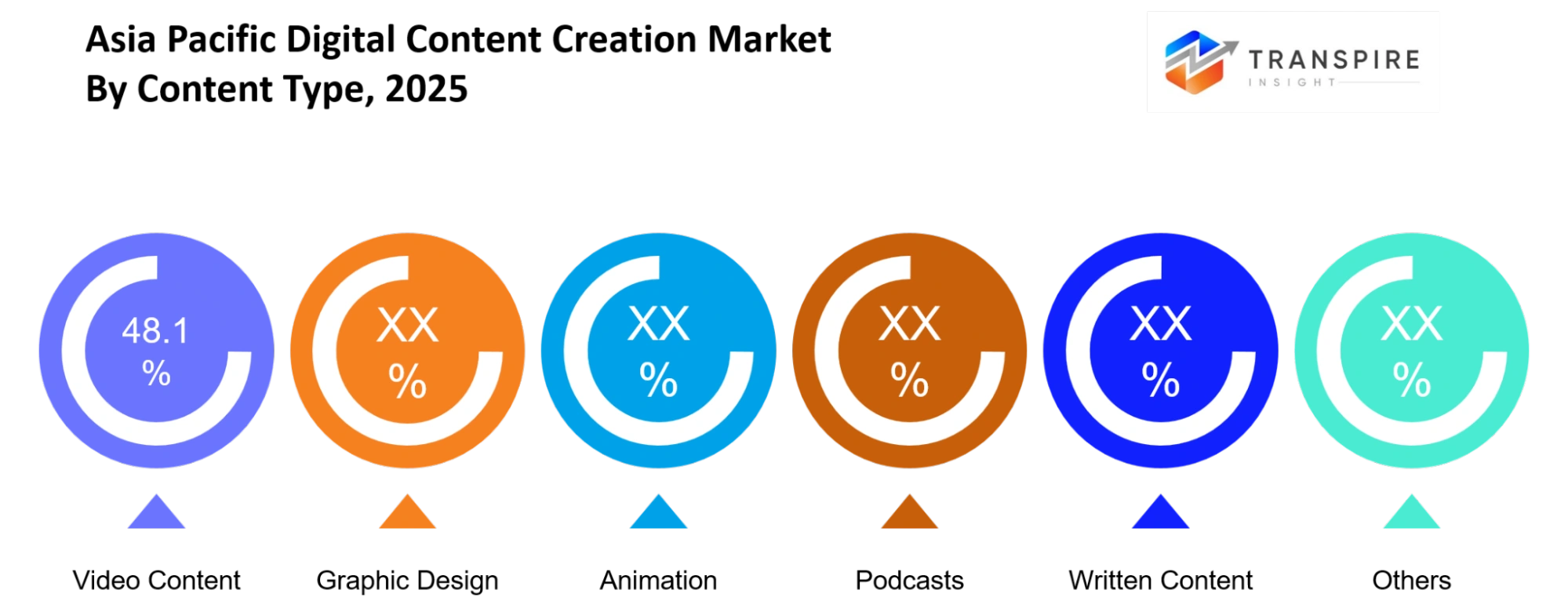
Across Asia Pacific, production now leans heavily toward the short-form and mobile-first video, graphic design, animation, podcast and written content formats. Usage is primarily dominated by video and graphics as brands and creators are embracing the need for quicker content turnarounds. The use of AI tools can simplify production, from scripting and editing, to the enhancement of visuals; reducing overall content production times and driving higher productivity across all channels.
Written and podcast usage continues to build with businesses looking to embrace more digital communication channels. The usage of animation, predominantly used in advertising, is growing steadily in training content as organizations move from more static formats to a more dynamic, interactive form. This demand is fueled by the need for adaptable content pipelines capable of supporting the use of many languages and distinct target audiences within the Asia Pacific markets.
To learn more about this report, Download Free Sample Report
By Platform:
Algorithm-driven content distribution and platforms begin to dominate across the Asia Pacific with usage heavily driven by social media, streaming platforms, websites, and gaming platforms. Social media usage continues to rise as creators leverage their predominantly mobile audience. The increasing adoption of on-demand and interactive content formats on streaming platforms is further driving up content production across these regions.
Content delivery and engagement at websites and on gaming platforms evolves towards the integrated content hub model. Algorithms used by these platforms and distribution channels dictate the content formats that creators and brands can leverage the best. These also push for content that requires shorter production times and offers high levels of engagement, while all monetization systems within platforms demand continuous content production.
By Application:
As a result of the aging global population in the Asia Pacific and limiting conceptions of entertainment, other areas of digital life, such as education, corporate communication, and other applications, will push toward digital-first execution. Marketing takes the lead as brands move from traditional media to highly targeted digital delivery strategies. Entertainment production proliferates with an increase in the need for more rapid visual and video storytelling across online channels.
More and more the education and corporate communication sphere rely on digital content for education and internal communication. AI-driven personalization allows more precise targeting of messages and knowledge enhancement. Companies are committed to adopting automated content generation systems to have, globally, homogeneous messages and, locally, limit the internal labor.
By End User:
Faster adoption by end users - media companies, enterprises, influencers, educational institutions and other end users in Asia Pacific- are adopting tools more widely for digital content creation. Media companies maintain high usage as they continuously generate new content. Enterprises ramp up adoption. For marketing, branding and communication on the digital platforms.
Enablers:Mobile and AI enabled tools enable content creation activities to scale up. Content Creation-power users like Influencers tend to churn multiple shorts content. Educational users tend to churn more video and interactive content. Content creation moving away from outsourced to in-house content creation becomes more affordable across user groups.
What are the Key Use Cases Driving the Asia Pacific Digital Content Creation Market?
The leading use case in the Asia Pacific Digital Content Creation Market is digital marketing and advertising content, which has continued to be a major revenue-driving sector where businesses utilize video and visual content to reach mobile-first audiences and maintain higher frequency levels across their social media channels.
Corporate training and educational content creation is also gaining significant growth amongst enterprises and educational institutes with increased adoption of video modules and interactive graphics to provide better training efficiencies, cut costs and facilitate wider digital upskilling to geographically distributed workforce throughout Asia Pacific countries.
Other use cases like AI-driven personalized content creation, AR and VR content creation for retail and industrial visualization have seen earlier adoption rates and continue to grow as brands experiment with real-time customization and interactive storytelling.
|
Report Metrics |
Details |
|
Market size value in 2025 |
USD 8.1 Billion |
|
Market size value in 2026 |
USD 9.4 Billion |
|
Revenue forecast in 2033 |
USD 25.72 Billion |
|
Growth rate |
CAGR of 15.46% from 2026 to 2033 |
|
Base year |
2025 |
|
Historical data |
2021 - 2024 |
|
Forecast period |
2026 - 2033 |
|
Report coverage |
Revenue forecast, competitive landscape, growth factors, and trends |
|
Regional scope |
Asia Pacific (India, China, Japan, Australia,South Korea, Rest of Asia Pacific) |
|
Key company profiled |
Adobe, Canva, Autodesk, Corel, Apple, Meta, Google, Microsoft, NVIDIA, Unity Technologies, Epic Games, Shutterstock, Figma, Wondershare, CyberLink |
|
Customization scope |
Free report customization (country, regional & segment scope). Avail customized purchase options to meet your exact research needs. |
|
Report Segmentation |
By Content Type (Video Content, Graphic Design, Animation, Podcasts, Written Content, Others); By Platform (Social Media Platforms, Streaming Platforms, Websites, Gaming Platforms, Others); By Application (Marketing Campaigns, Entertainment, Education, Corporate Communication, Others); By End User (Media Companies, Enterprises, Influencers, Educational Institutions, Others) |
Which Regions are Driving the Asia Pacific Digital Content Creation Market Growth?
The leader of APAC, North Asia, dominates over rivals by implementing robust digital infrastructure, robust maritime value chains, and tight regulatory frameworks. Because these countries operate the majority of the world's commercial fleet, their ports have advanced digitization in operation processes and monitor, analytics and content based operation systems to penetrate swiftly into shipping markets. The implementation of government-driven initiatives on smart shipping corridors and automation in ports contributes to a constantly renewed incorporation of digital tools in its systems. Existing robust shipbuilding capacity and established software environments help to consolidate its position as the leader.
Southeast Asia remains the region where growth is steady and consistent by following systematic owner investment and progressive alignment of regulatory requirements to international maritime regulations. As the counterpart to highly automated Northern Asia, its focus is on iterative implementation of digital solutions across its port and fleet operations systems, rather than radical adoption of advanced solutions. The presence of substantial transshipment activities and sophisticated logistics infrastructure networks of countries such as Singapore and Malaysia, secures steady growth in demand for the use of operation analytics systems. The resilience of its economic system and global trade linkage prevents any major collapse in adoption during the general global volatility of shipping market.
South Asia experiences growth rates more rapidly because of recent investment on modernization of ports such as India and Bangladesh, also significant increase of ship acquisition activities. Conditions for adopting operational analytics and monitoring systems have improved significantly from 2023 as India adopted fully the digitizing process of shipping documentation and started adopting smart ports policy, thereby facilitating market penetration and encouraging the use of advanced technologies. Growing trade flow and the adoption of government supported shipping and port modernization programs drive demand for operational analytics and monitoring systems in this region. This is indeed a market where investors and market entrants have high potentials for development during 2026-2033, because the region exhibits quickening digitizing speed and expanding domestic trade volume.
Who are the Key Players in the Asia Pacific Digital Content Creation Market and How Do They Compete?
The digital content creation market in Asia Pacific displays moderately concentrated structures in top-tiers and is fragmented for emergent AI-native tools and localized start-ups. Existing software ecosystems attempt to hold market share, but the appearance of new applications challenges traditional workflows with a mobile-first approach to editing and automation through generative AI. Competition between players in this segment can be largely based on AI capability, ecosystem and workflow integration, adaptable pricing plans and user simplicity as opposed to just software capabilities. Additionally, subscriptions can only be sustained through a higher emphasis on renewal and across-device usability, with creators switching between applications on different devices.
Adobe has been bolstering its position with thorough integration of generative AI to its Creative Cloud Suite; the Firefly toolset reduces time for professional creative workflow and encourages enterprise subscription uptake by locking users into its ecosystem. Canva is competitive through its relatively cheaper template-based tools, allowing it to attract SMEs and influencers; this is now supplemented by expanded features including a mobile-first approach to editing and interactive design tools across Asia Pacific markets. Through the integration of Copilot into Microsoft 365, users now benefit from the AI assistance that can automate content creation from within productivity tools, supported by Microsoft's expansive distribution networks into the enterprise market.
Autodesk caters to the niche professional market for 3D modelling and animation used primarily in industry design and entertainment productions with its unique toolsets, defending its leadership in this segment. Apple leverages its hardware and software integration to provide smooth workflows across iPhone and Mac-based creative applications used by professional and independent artists. Sony leverages its dominance in image sensors and production tools for the film, broadcasting, and gaming industry to broaden its reach and position in professional-level content creation.
Company List
- Adobe
- Canva
- Autodesk
- Corel
- Apple
- Meta
- Microsoft
- NVIDIA
- Unity Technologies
- Epic Games
- Shutterstock
- Figma
- Wondershare
- CyberLink
Recent Development News
In March 2026, POPS and Mediacube entered into a strategic partnership. The collaboration integrates fintech-enabled solutions to help digital creators across Asia scale content distribution and monetization across Southeast Asia, Japan, and emerging markets.
Source https://popsww.com/
In May 2026, Globavend Holdings Limited announced proposed acquisition of Loomi Entertainment Group Limited. The acquisition expands Globavend into AI-enabled short-form digital entertainment, strengthening its position in mobile-first micro-drama content production and distribution across Southeast Asia.Source https://www.globenewswire.com/
What Strategic Insights Define the Future of the Asia Pacific Digital Content Creation Market?
Overall, the Asia Pacific Digital Content Creation market will structurally migrate toward AI-native and cloud-first production ecosystems whereby content creation, editing, and distribution are subsumed by unified digital workflows. Continued gains in generative AI models and a greater bundling of content tools within corporate software stacks, which minimizes manual production, will propel this transformation. Over the next five to seven years, market share growth will continue to migrate to solutions combining automation, cross-device workflow collaboration, and real-time publishing.
A more subtle risk is increasing platform concentration: a small handful of global software players that dominate the space increasingly exert considerable control over creative workflow and pricing terms, leading to increased dependence and potentially decreased flexibility for businesses should the license terms of such solutions become stricter or if further restrictions are placed upon the output generated by AI models. Simultaneously, regional regulatory shifts surrounding data privacy and AI model training will likely impact and interfere with fluid cross-border creative content operations for global marketing campaigns.
An opportune growth area to explore is localized generative AI ecosystems for the Vietnamese and Indian language market whereby early-stage adoption has commenced rapidly, especially for firms focusing on vernacular AI models and lighter mobile creation tools to reach the creator base. Market participants are strongly encouraged to focus on flexible, modular AI tool integration to facilitate faster localized content production, enable greater price flexibility, and conform to regional data governance trends.
Asia Pacific Digital Content Creation Market Report Segmentation
By Content Type
- Video Content
- Graphic Design
- Animation
- Podcasts
- Written Content
By Platform
- Social Media Platforms
- Streaming Platforms
- Websites
- Gaming Platforms
By Application
- Marketing Campaigns
- Entertainment
- Education
- Corporate Communication
By End User
- Media Companies
- Enterprises
- Influencers
- Educational Institutions
Frequently Asked Questions
Find quick answers to common questions.
The Asia Pacific Digital Content Creation Market size is USD 25.72 Billion in 2033.
Key segments for the Asia Pacific Digital Content Creation Market are By Content Type (Video Content, Graphic Design, Animation, Podcasts, Written Content, Others); By Platform (Social Media Platforms, Streaming Platforms, Websites, Gaming Platforms, Others); By Application (Marketing Campaigns, Entertainment, Education, Corporate Communication, Others); By End User (Media Companies, Enterprises, Influencers, Educational Institutions, Others).
Major Asia Pacific Digital Content Creation Market players are Adobe, Canva, Autodesk, Corel, Apple, Meta, Google, Microsoft, NVIDIA, Unity Technologies, Epic Games, Shutterstock, Figma, Wondershare, CyberLink.
The Asia Pacific Digital Content Creation Market size is USD 8.1 Billion in 2025.
The Asia Pacific Digital Content Creation Market CAGR is 15.46% from 2026 to 2033.
- Adobe
- Canva
- Autodesk
- Corel
- Apple
- Meta
- Microsoft
- NVIDIA
- Unity Technologies
- Epic Games
- Shutterstock
- Figma
- Wondershare
- CyberLink
About the Authors

Mayur Shinde
I am Mayur Shinde, a Senior Research Analyst at Transpire Insight, specializing in the Automotive & Transportation and Information & Communication Technology (ICT) Industry. My work focuses on analyzing emerging market trends, technological advancements, competitive landscapes, and industry developments to deliver accurate, data-driven insights. I am passionate about transforming complex market information into clear, actionable content that helps businesses, professionals, and decision-makers stay informed and make confident strategic decisions.

Chakradhar Khansole
Chakradhar serves as the Research Director at Transpire Insight, bringing over 8 years of experience in technology, innovation, and strategic market intelligence. He specializes in transforming complex market data into actionable business insights that enable organizations to make informed, growth-oriented decisions. Recognized for his strategic vision and analytical expertise, Chakradhar leads high-impact research initiatives, delivering comprehensive market assessments, competitive intelligence, and forward-looking industry analysis.
Recently Published Reports
-
Apr 2026
3D Optical Profiler Market
3D Optical Profiler Market Size, Share & Analysis Report By Type (Desktop 3D Optical Profiler, and Portable 3D Optical Profiler), By Technology (Confocal Technology, and White Light Interference), By End-Use Industry (Manufacturing, Research Institutions, Automotive, Aerospace and Defense, Medical Devices, and Other), and Geography (North America, Europe, Asia-Pacific, Middle East and Africa, South and Central America), 2021 - 2031
-
Apr 2026
Depth Sensor Market
Depth Sensor Market Size, Share & Analysis Report By Type (Infrared Depth Sensors, Time-of-Flight (ToF) Sensors, Stereo Vision Sensors, Structured Light Sensors, Ultrasonic Depth Sensors), By Application (Automotive, Robotics, Gaming, Consumer Electronics, Industrial Automation, Healthcare, Security & Surveillance, Others), By End Users (Automotive Manufacturers, Consumer Electronics Companies, Healthcare Providers, Industrial Companies, Security Agencies, Gaming Companies, Robotics Companies, Others), and Geography (North America, Europe, Asia-Pacific, Middle East and Africa, South and Central America), 2021 – 2031
-
Apr 2026
Digital Manufacturing Market
Digital Manufacturing Market Size, Share & Analysis Report By Component (Hardware, Software, and Services), By Technology (Robotics, 3D Printing, Internet of Things (IoT), and Others), By Application (Automotive and Transportation, Aerospace and Defense, Consumer Electronics, Industrial Machinery, and Others), By Process Type (Computer-Based Designing, Computer-Based Simulation, Computer 3D Visualization, Analytics, and Others), and Geography (North America, Europe, Asia-Pacific, Middle East and Africa, South and Central America), 2021 – 2031
-
Apr 2026
Digital Visa Services Market
Digital Visa Services Market Size, Share & Analysis Report By Type (Individual Travelers, Group Travelers), By Application (Tourism, Business Travel, Others), and Geography (North America, Europe, Asia-Pacific, Middle East and Africa, South and Central America), 2021 – 2031