
Global Aircraft Turbofan Engine Market Size & Forecast:
- Global Aircraft Turbofan Engine Market Size 2025: USD 112.8 Billion
- Global Aircraft Turbofan Engine Market Size 2033: USD 167.9 Billion
- Global Aircraft Turbofan Engine Market CAGR: 5.08%
- Global Aircraft Turbofan Engine Market Segments: By Engine Type (High-Bypass Turbofan, Low-Bypass Turbofan, Geared Turbofan, Military Turbofan, Business Jet Turbofan, Others); By Aircraft Type (Commercial Aircraft, Military Aircraft, Business Jets, Cargo Aircraft, Others); By Component (Fan, Compressor, Turbine, Combustor, Exhaust System, Others); By End User (OEMs, MRO Providers, Defense Organizations, Airlines, Others); By Thrust Class (Below 20,000 lbf, 20,000–50,000 lbf, Above 50,000 lbf, Others).

Global Aircraft Turbofan Engine Market Summary
As per Transpire Insight Analysis, the Global Aircraft Turbofan Engine Market size is estimated at USD 112.8 Billion in 2025 and is anticipated to reach USD 167.9 Billion by 2033, growing at a CAGR of 5.08% from 2026 to 2033. This market focuses - manufacturing, maintaining, and upgrading the heavy-duty propulsion systems that power modern commercial airliners, military fighters, and cargo jets. Over the last few years - the operational baseline shifted dramatically as soaring jet fuel prices and strict environmental targets forced aviation fleets to prioritize fuel efficiency above all else. This severe cost pressure triggered a major technological movement toward geared architectures and advanced ceramic matrix composites (CMCs) that withstand higher operating temperatures. A critical real-world trigger has been the rapid post-pandemic surge in global air travel coupled with military fleet modernization mandates. Because airlines must slash operating margins and carbon emissions simultaneously - they are rapidly buying fleet-wide engine retrofits to lower fuel burn.
Key Market Insights
The global aircraft turbofan engine market - fundamentally transitioning from conventional direct-drive architectures to ultra-high bypass geared fan configurations and hybrid-electric systems built to maximize thermodynamic efficiency. Spurred by strict net-zero aviation targets and high fuel cost volatility, airlines and defense organizations are rapidly abandoning legacy, low-bypass engine platforms to invest in propulsion technologies that integrate advanced additive manufacturing and ceramic matrix composites to dramatically cut down fuel burn.
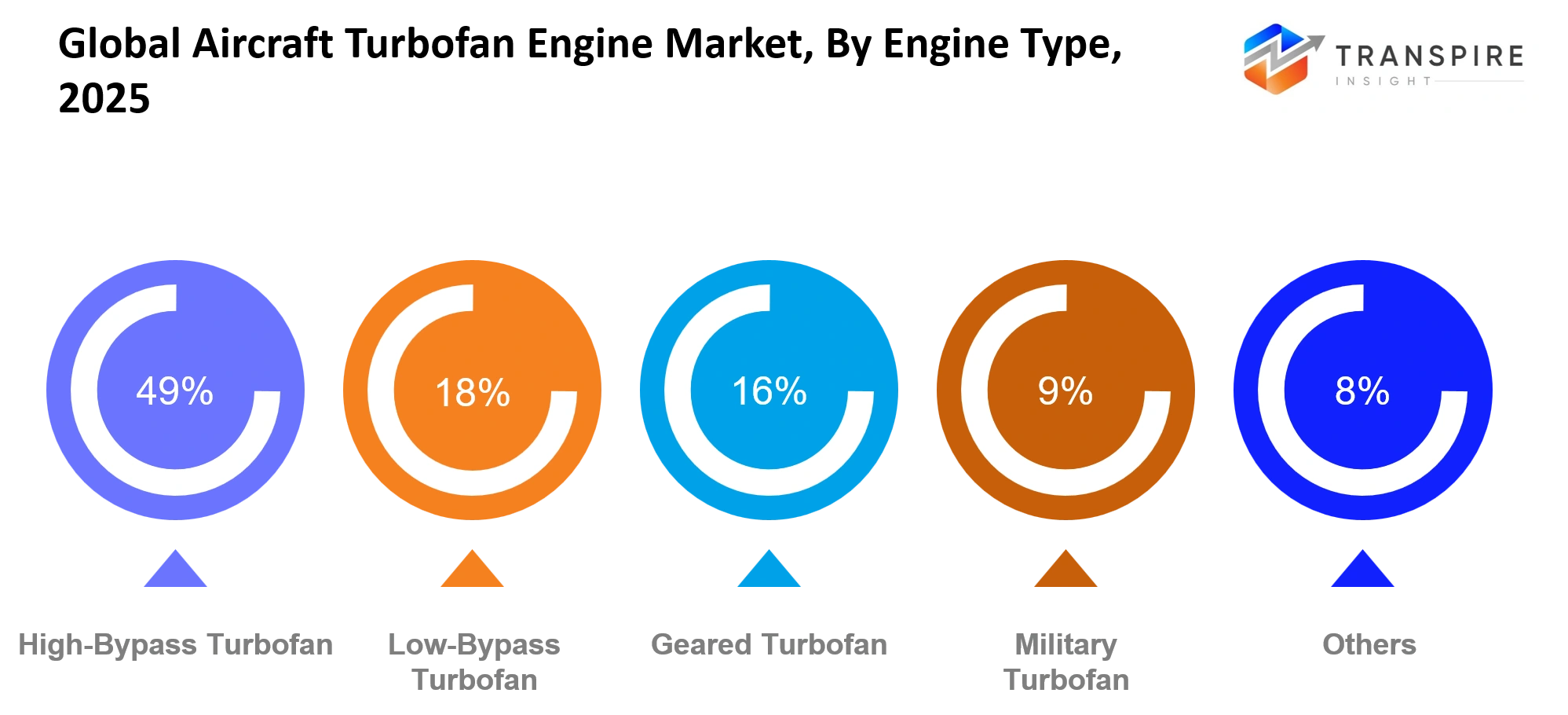
- Locking down a dominant 49% share, High-Bypass Turbofans lead the engine type landscape, with joint venture mainstays like CFM International rolling out advanced durability upgrades to significantly increase time-on-wing for narrowbody aircraft fleets.
- Expanding at a market-leading CAGR of 11.4%, Geared Turbofan (GTF) engines function as the primary technological accelerator as Pratt & Whitney deploys its newly certified GTF Advantage platforms to deliver up to 20% lower fuel consumption per trip.
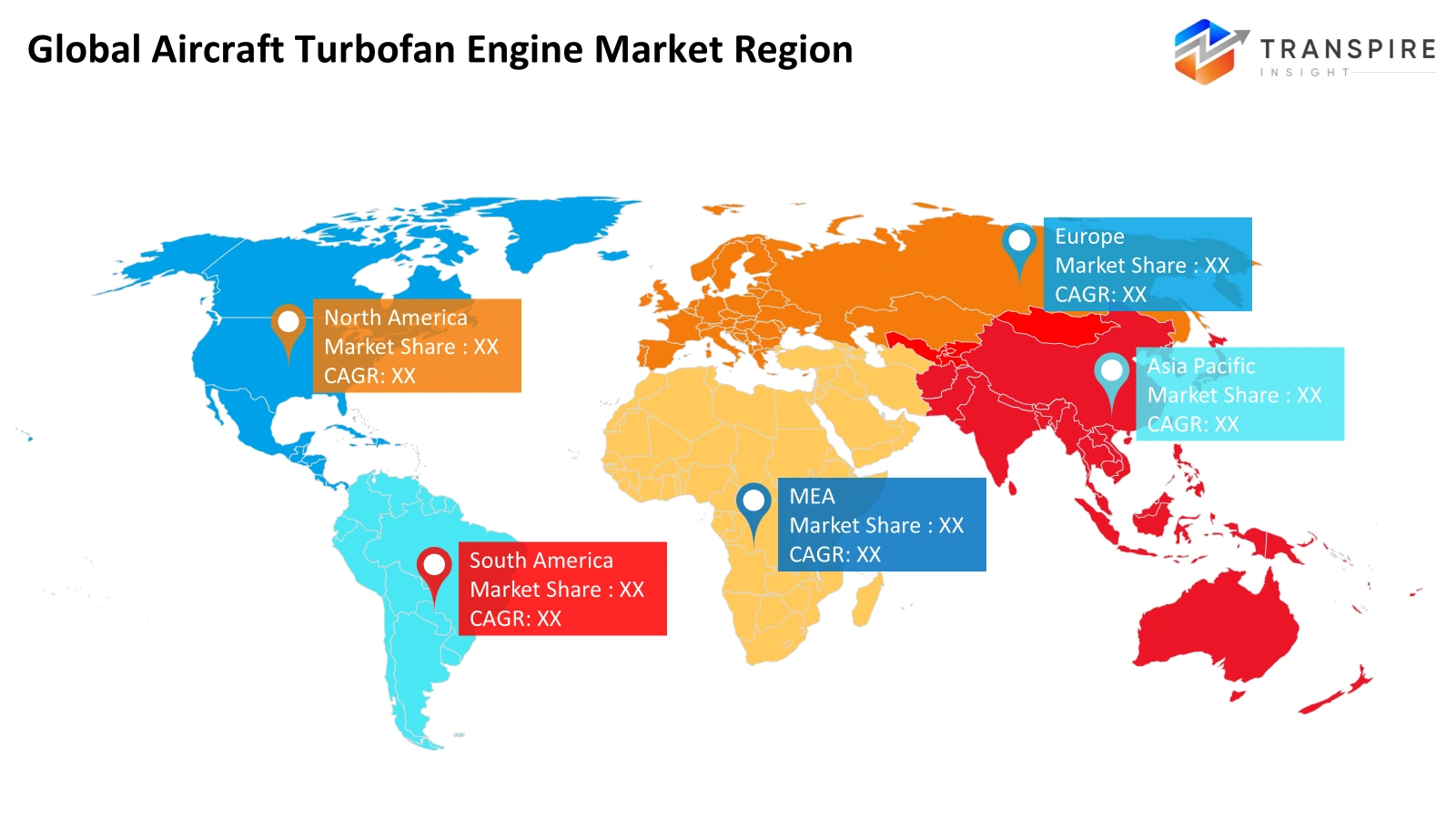
- Capturing a dominant 42% share of total industry revenue, North America stands as the undisputed geographic anchor, supported by aggressive narrowbody aircraft replacements and massive manufacturing site investments from GE Aerospace to expand engine delivery capacity.
- Securing an essential 31% market slice, Europe acts as a highly stable structural driver, compelling aerospace networks to back research programs like the Rolls-Royce UltraFan technology to achieve a step-change improvement in engine bypass ratios.
- Accounting for 20% of global industry volume, the Asia Pacific theater represents the fastest-growing territory with an explosive 12.6% CAGR, fueled by massive commercial aircraft fleet expansions and extensive local supply chain component partnerships with OEMs like Safran Aircraft Engines.
- Controlling a critical 18% share of the market, Low-Bypass Turbofans are undergoing targeted military design updates as global defense agencies replace older tactical fighter platforms with modern, long-range combat airframes.
- Representing a substantial 16% portion of the operational landscape, the Geared Turbofan segment is driving unprecedented industrial shifts, forcing airlines to modify fleet planning strategies and expand MRO shop access to resolve recent component availability bottlenecks.
- Claiming an integrated 9% market footprint, Military Turbofan variants are pivoting toward multi-stream adaptive cycle designs, allowing global air forces to dynamically switch between high-thrust combat execution and highly efficient loiter flight modes.
- Representing a combined 8% specialized footprint, Business Jet Turbofans and other niche engine configurations are transitioning away from standard alloys to employ localized 3D-printed metal components from players like Honeywell Aerospace to trim total engine weight.
- Securing a targeted 7% slice of total sector capital, Latin America (3%) and the Middle East & Africa (4%) corridors are expanding their regional maintenance footprints to establish localized engine repair shops, lowering downtime for rapid-growth regional carriers.
What Strategic Drivers, Restraints, and Opportunities Define the Global Aircraft Turbofan Engine Market?
Driver
The market is expanding due to the intense pressure on commercial airlines and defense groups to dramatically lower fuel consumption and fulfill strict net-zero carbon aviation mandates. This operational movement was triggered by a combination of high post-pandemic flight passenger traffic and an unprecedented backlog of over 17,000 commercial aircraft orders. This surging demand drives massive propulsion revenue as global carriers aggressively phase out older, less fuel-efficient aircraft and rapidly adopt high-bypass and geared architectures that integrate lightweight ceramic matrix composites.
In April 2026, global propulsion giant GE Aerospace directly demonstrated this massive procurement acceleration, reporting a staggering 87% year-on-year surge in total quarterly equipment and service orders to hit USD 23.0 Billion. This large-scale capital booking heavily scales up the rapid deployment of next-generation narrowbody and widebody turbofan platforms, ensuring long-term commercial assembly lines remain fully booked to feed global fleet replacement pipelines. By anchoring this high-volume financial momentum, the transaction underscores an industry-wide transition toward automated engine telemetry, cloud-connected diagnostics, and 100% sustainable aviation fuel (SAF) compatibility. [https://www.geaerospace.com/news/press-releases/ge-aerospace-announces-first-quarter-2026-results]
Restraint
Severe aerospace manufacturing bottlenecks and critical raw material supply chain disruptions act as a major bottleneck capping market growth. The production of advanced turbofan components relies heavily on a specialized circle of tier-one suppliers - meaning that ongoing casting delays, skilled labor shortages, and complex geopolitical sanctions on Russian titanium persistently stall OEM delivery schedules. This constraint creates extended maintenance backlogs, forcing airlines to operate older airframes longer and limiting immediate capital deployment for next-generation engine upgrades.
Opportunity
The most lucrative growth window lies in the development of hybrid-electric auxiliary propulsion systems combined with adaptive - multi-stream military engine architectures. Fusing intelligent fluid management with modular high-pressure turbine cores allows engineering teams to construct dual-use propulsion platforms that dynamically maximize thrust during takeoff while slashing loiter fuel burn. This technological - transition unlocks highly profitable long-term integration revenues as defense organizations and commercial cargo carriers invest heavily in sustainable, low-noise open-fan layouts to future-proof their global aviation fleets against tightening emissions boundaries.
What Has the Impact of Artificial Intelligence Been on the Global Aircraft Turbofan Engine Market?
Artificial intelligence is fundamentally reshaping how aerospace engineers - operators design, manufacture, and maintain advanced propulsion systems - shifting the market from standard scheduled servicing to real-time predictive health monitoring. Instead of pulling engines off-wing based on rigid hourly intervals, operators rely on physics-informed machine learning models to instantly analyze high-frequency operational telemetry and optimize system lifespans.
On the flight line - AI algorithms optimize fleet scheduling by feeding live exhaust gas temperatures, vibration signatures, and pressure ratios directly into engine digital twins. These advanced systems continuously track thermodynamic degradation patterns, forecasting precise maintenance requirements months before a component fails. By matching these continuous data streams, software platforms automatically coordinate localized maintenance, repair, and overhaul (MRO) workflows to ensure replacement components are distributed before shop induction. However, an operational limitation persists around an accuracy gap; AI analytics frequently struggle to differentiate anomalous sensor noise from genuine sub-surface structural fractures, meaning destructive manual inspections remain critical for validation.
In May 2026, aviation titan GE Aerospace officially showcased its native generative AI engineering assistants and AI-enabled Blade Inspection Tools integrated across its production facilities. This technology deployment utilizes advanced machine learning to guide technicians during complex turbine blade image reviews, providing automated quality standardization that cuts physical engine inspection times in half to just 1.5 hours. [https://www.geaerospace.com/artificial-intelligence]
Key Market Trends
The global aircraft turbofan engine landscape is undergoing a massive structural transformation, moving away from legacy direct-drive propulsion layouts toward ultra-high bypass geared fan configurations and open-rotor designs. Driven by stringent international aviation decarbonization mandates and volatile jet fuel economics, aerospace engineers and global fleet managers are systematically replacing conventional metallic engine architectures with highly automated - cloud-connected propulsion platforms built on advanced metallurgy and adaptive cooling.
- Airlines are rapidly shifting away from standard steel and nickel superalloys, increasingly substituting lightweight Ceramic Matrix Composites (CMCs) inside high-pressure turbine zones to withstand combustion temperatures exceeding 2,400°F.
- Engine manufacturers are executing a major industry pivot by transitioning from traditional closed nacelle airframe assemblies toward advanced single-stage open-fan architectures, targeting un-ducted bypass ratios as high as 60:1 to cut carbon emissions.
- Fleet operators are completely overhauling their scheduled maintenance models, abandoning fixed hourly shop intervals to integrate real-time edge computing nodes that stream high-frequency vibration and thermal telemetry directly to engine digital twins.
- MRO providers are rapidly transforming their shop floor behaviors, moving from manual structural reviews to automated, AI-driven blade inspection systems that utilize computer vision to slash turnaround times on grounded narrowbody fleets.
- Propulsion designers are accelerating a critical technological shift by migrating from fixed, single-stream architectures toward multi-stream military adaptive cycle engines that dynamically modulate internal airflow configurations between high-thrust combat and fuel-efficient cruise modes.
- Component fabricators are steadily phasing out traditional subtractive machining processes, rapidly adopting large-scale additive manufacturing and 3D metal printing to produce highly intricate, low-weight combustor swirlers and fuel nozzles.
- Commercial operators are transitioning away from pure petroleum-based aviation fuels, modifying modern fuel-delivery systems and seal materials to achieve complete, unblended 100% Sustainable Aviation Fuel (SAF) operational compatibility.
- Global supply networks are executing a critical localized pivot, moving away from centralized, single-source component production hubs to build heavily capitalized, regional MRO quick-turn engine centers near high-density air traffic corridors.
- Military procurement agencies are shifting funding priorities away from traditional low-bypass platform extensions, heavily investing in hybrid-electric auxiliary integration to provide substantial on-board electrical power for directed-energy defense systems.
Global Aircraft Turbofan Engine Market Segmentation
By Engine Type
High-Bypass Turbofans anchor this segment, holding a dominant 49% share of total industry revenue, while Low-Bypass Turbofans and Geared Turbofans follow as critical secondary pillars at 18% and 16%, respectively. Military Turbofans command a 9% share, with Business Jet Turbofans and other specialized propulsion formats accounting for the final 8%. This division persists because global airline operators rely heavily on widebody and narrowbody commercial airliners to move massive passenger volumes efficiently across long-haul hubs. High-Bypass systems retain their peak market position because joint venture mainstays like CFM International and GE Aerospace have optimized these reliable, dual-shaft layouts over decades to maximize time-on-wing. Meanwhile, Geared Turbofan architectures are the absolute growth driver, expanding at a market-leading CAGR of 11.4% as airlines demand a structural shift toward decoupler gearboxes that allow the main fan and low-pressure turbine to spin at their respective optimal thermodynamic speeds. Moving forward, standard direct-drive systems will give way to these high-efficiency layouts. Dominant engine builders will focus heavily on scaling Geared Turbofan manufacturing to resolve narrowbody fleet backlogs while introducing advanced aerodynamic profiles.
By Aircraft Type
Commercial Aircraft serve as the primary operational engine of the market, holding the largest portion of global manufacturing volume, while Military Aircraft and Business Jets represent highly vital secondary pillars. This growth logic is tied directly to the reality of modern global transportation, where skyrocketing passenger traffic across emerging economies forces commercial fleets to expand rapidly, creating an unprecedented global backlog of aircraft orders. Commercial platforms retain their high share because passenger airframes require continuous, multi-decade propulsion replacements and intensive lifecycle maintenance. However, Military Aircraft and Cargo networks are growing at an accelerated clip because global defense organizations must invest heavily in long-range, high-thrust strategic assets to future-proof their tactical combat wings. Moving forward, aircraft propulsion boundaries will shift completely past legacy airframe designs. Market dominance will belong to engine manufacturers who design fully integrated propulsion packages that minimize drag and maximize fuel burn efficiency through advanced, ultra-high-bypass open-fan configurations.
By Component
Turbines and Compressors function as the absolute financial anchor of the component industry, capturing the largest portion of revenue due to their high thermal stress, intricate aerodynamics, and massive replacement cycles. Fans, Combustors, and Exhaust Systems follow closely behind as critical technical subsystems. The market dynamic relies on pure thermodynamic physics and material degradation; high-pressure turbine blades spin continuously in environments exceeding the melting point of standard metals, creating a massive, non-negotiable demand for advanced aftermarket components and single-crystal superalloys. Turbine components retain their peak position because global operators must continuously refresh life-limited parts (LLPs) to maintain flight safety certifications. Conversely, Fan and Combustor modules are accelerating as rapid innovation zones as OEMs deploy large-scale additive manufacturing and 3D metal printing to craft complex fuel nozzles. Looking ahead, component boundaries will completely integrate through automated manufacturing. Structural success will belong to component builders who can combine multi-piece assemblies into unified, lightweight 3D-printed blocks that minimize maintenance overhead.
By End User
Airlines lead the market with a commanding share of global industry volume, driven by relentless flight operations, continuous engine degradation, and high fuel burn metrics. Concurrently, MRO Providers and Defense Organizations are rising as highly active, fast-growing secondary sectors. The underlying market logic is dictated by the sheer volume of flight hours logged globally, where tier-one commercial carriers run around-the-clock schedules that burn through engine blade life limits rapidly. Airlines deploy advanced engine management programs to optimize their operating margins, while MRO Providers leverage real-time diagnostic telemetry to coordinate quick-turn shop visits. Moving forward, market success will require moving past generic maintenance models. Long-term profitability will belong to aerospace OEMs and MRO networks that deploy predictive digital twin frameworks, allowing engineering teams to safely schedule engine teardowns based on actual thermal stress and localized environmental exposure rather than arbitrary hourly intervals.
By Thrust Class
Engines in the 20,000–50,000 lbf thrust class rule this segment, expanding at the largest market volume as global narrowbody passenger fleets undergo wholesale modernizations. Simultaneously, the Above 50,000 lbf class remains a massive revenue pipeline for widebody international operations, while Below 20,000 lbf models secure niche regional segments. This structural alignment persists because the narrowbody aircraft sector represents the highest density of commercial airline operations worldwide, demanding versatile engines capable of executing multiple short-to-medium-haul cycles daily. The 20,000–50,000 lbf range leads because platforms like the Airbus A320neo and Boeing 737 MAX rely entirely on this thrust band to achieve optimal payload performance. Moving forward, thrust boundaries will blend with hybrid-electric innovation. Rather than treating thrust purely as a function of raw fuel combustion, forward-looking systems will integrate electric auxiliary motors to provide a supplemental power boost during peak takeoff, allowing manufacturers to downsize physical engine cores and optimize cruise fuel efficiency.
What Key Use Cases Driving the Global Aircraft Turbofan Engine Market?
The primary use case centers on commercial fleet modernization and narrowbody route expansion, where global airline groups deploy high-bypass propulsion units to maximize fuel economy across high-density passenger networks. This operational model relies on advanced engine control architectures to regulate internal core pressures, enabling tier-one operators to safely execute multiple daily short-to-medium-haul flight cycles while dropping trip-level emissions.
Beyond civil passenger transport, expanding applications focus heavily on multi-mission tactical deployment within national defense organizations. Driven by intensifying geopolitical stability requirements, air force commands rely on low-bypass military propulsion systems to achieve rapid, supersonic interception speeds while maintaining long-range loiter capabilities during heavy payload combat operations.
Emerging use cases are shifting toward automated - cloud-connected predictive health management across global maintenance, repair, and overhaul (MRO) networks. As major engine leasing consortia and cargo carriers scale up aircraft utilization, they leverage real-time diagnostic stream ingestion to autonomously coordinate predictive part deliveries, optimizing time-on-wing parameters before physical component degradation forces unscheduled ground delays.
|
Report Metrics |
Details |
|
Market size value in 2025 |
USD 112.8 Billion |
|
Market size value in 2026 |
USD 118.7 Billion |
|
Revenue forecast in 2033 |
USD 167.9 Billion |
|
Growth rate |
CAGR of 5.08% from 2026 to 2033 |
|
Base year |
2025 |
|
Historical data |
2021 - 2024 |
|
Forecast period |
2026 - 2033 |
|
Report coverage |
Revenue forecast, competitive landscape, growth factors, and trends |
|
Regional scope |
United States; Canada; Mexico; United Kingdom; Germany; France; Italy; Spain; Denmark; Sweden; Norway; China; Japan; India; Australia; South Korea; Thailand; Brazil; Argentina; South Africa; Saudi Arabia; United Arab Emirates |
|
Key company profiled |
GE Aerospace, Pratt & Whitney, Rolls-Royce, Safran Aircraft Engines, CFM International, MTU Aero Engines, Honeywell Aerospace, IHI Corporation, Mitsubishi Heavy Industries, GKN Aerospace, Avio Aero, RTX, Kawasaki Heavy Industries, Hanwha Aerospace, Engine Alliance. |
|
Customization scope |
Free report customization (country, regional & segment scope). Avail customized purchase options to meet your exact research needs. |
|
Report Segmentation |
By Engine Type (High-Bypass Turbofan, Low-Bypass Turbofan, Geared Turbofan, Military Turbofan, Business Jet Turbofan, Others); By Aircraft Type (Commercial Aircraft, Military Aircraft, Business Jets, Cargo Aircraft, Others); By Component (Fan, Compressor, Turbine, Combustor, Exhaust System, Others); By End User (OEMs, MRO Providers, Defense Organizations, Airlines, Others); By Thrust Class (Below 20,000 lbf, 20,000–50,000 lbf, Above 50,000 lbf, Others). |
Which Regions are Driving the Global Aircraft Turbofan Engine Market Growth?
North America maintains a commanding grip on the aircraft turbofan engine market, capturing a dominant 42% of all worldwide industry revenue. This geographic leadership is heavily driven by the historical concentration of premier engine original equipment manufacturers (OEMs)—such as GE Aerospace and Pratt & Whitney—alongside massive domestic commercial fleet replacement programs. The regional ecosystem is structurally supported by strict Federal Aviation Administration (FAA) modernization policies, dense aerospace supply networks, and an unprecedented surge in domestic defense procurement allocations. Consequently, transitioning away from legacy direct-drive architectures to ultra-efficient geared and high-bypass propulsion units has become the operational baseline for local airlines seeking to optimize flight margins.
In January 2026, leading propulsion architect GE Aerospace officially reported a record finish to its fiscal year, highlighting an immense equipment and service backlog that surged to approximately USD 190 Billion. This massive commercial pipeline is heavily driven by a 28% year-over-year surge in high-bypass LEAP engine deliveries alongside expanding domestic maintenance shop capacity. To systematically support this unprecedented manufacturing volume, the vendor committed over USD 1 Billion globally to upgrade its localized MRO service networks. This continuous capital influx solidifies North America’s undisputed technical leadership and establishes a highly resilient operational baseline for next-generation narrowbody delivery channels.
Europe serves as a highly stable, predictable secondary pillar for the global market, locking down an essential 31% share of total industry demand. While North American expansion is propelled by massive domestic order books and heavy defense allocations, European turbofan adoption is tightly shaped by aggressive continental environmental mandates and regional circular economy frameworks. This regional market stability is structurally insulated by deep public-private aerospace research partnerships, pushing continental manufacturers to heavily focus on ultra-high bypass ratios and open-fan configurations. To satisfy tightening European Union emissions boundaries and rising jet fuel costs, local engineering groups steadily invest in advanced material technologies like ceramic matrix composites.
In March 2026, British propulsion pioneer Rolls-Royce officially secured EUR 64 Million from the European Union's Clean Aviation Joint Undertaking program to directly fund its advanced UltraFan 30 technology demonstrator. This targeted capital injection accelerates comprehensive ground and testing phases for scalable, ultra-high-bypass geared engine configurations designed to deliver a 20% step-change improvement in fuel burn. By matching this regional public funding with the firm's record annual operating profits of GBP 3.5 Billion, the rollout reinforces Europe’s focus on sustainable engineering. This collaborative development establishes a robust regulatory and technical framework to future-proof continental aviation networks against strict 2050 net-zero targets.
The Asia Pacific region has emerged as the fastest-growing territory globally, accelerating at a market-leading CAGR of 12.6% to capture an essential 20% slice of global sales. This sudden structural shift is driven by a massive post-pandemic explosion in regional air passenger traffic across expanding mobile-first economies like China and India. Historically, regional air carriers relied on completely imported Western lifecycle maintenance packages, but a sudden expansion of domestic aviation initiatives has forced a transition toward localized manufacturing and sovereign military engine development. Looking ahead, future infrastructure development in this booming corridor relies heavily on spinning up high-capacity regional maintenance hubs to handle complex, high-velocity narrowbody aircraft arrays.
Who Are the Key Players in the Global Aircraft Turbofan Engine Market and How Do They Compete?
Competition in the aircraft turbofan engine space is an intense battle between legacy propulsion titans and highly integrated international aerospace engineering consortia. Instead of competing on flat equipment pricing - vendors win high-volume airframe contracts by maximizing thermodynamic bypass ratios, engineering hyper-durable turbine metallurgy, and providing extensive maintenance, repair, and overhaul (MRO) diagnostic packages that drastically improve time-on-wing parameters.
GE Aerospace commands market share through an intensive, innovation-first strategy focused on high-efficiency high-bypass platforms and advanced Ceramic Matrix Composites (CMCs). They differentiate themselves by utilizing their dominant CFM International joint venture to supply the record-breaking LEAP engine series while simultaneously engineering multi-stream adaptive cycle architectures for next-generation defense wings. Their expansion approach relies on deploying multi-billion-dollar global MRO facility upgrades to aggressively service their staggering commercial asset backlogs.
Pratt & Whitney utilizes a technology-niche and innovation strategy centered directly on its revolutionary Geared Turbofan (GTF) architecture. The vendor stands out by decoupling low-pressure turbine speeds from the main intake fan through a specialized power gearbox, achieving up to 20% lower fuel burn and halved noise footprints. They expand their footprint by introducing upgraded platforms like the GTF Advantage alongside massive capital investments to expand localized, quick-turn engine overhaul centers.
Company List
- GE Aerospace
- Pratt & Whitney
- Rolls-Royce
- Safran Aircraft Engines
- CFM International
- MTU Aero Engines
- Honeywell Aerospace
- IHI Corporation
- Mitsubishi Heavy Industries
- GKN Aerospace
- Avio Aero
- RTX
- Kawasaki Heavy Industries
- Hanwha Aerospace
- Engine Alliance
Recent Development News
In February 2026, Vietjet Air finalized a major propulsion deal with RTX business Pratt & Whitney to acquire GTF engines for 44 of its incoming Airbus A320neo family jets. This fleet expansion covers a specific combination of 24 A321neos and 20 long-range A321XLRs - backed by a comprehensive 12-year EngineWise maintenance package to maximize daily aircraft utilization.
Source: https://www.vietjetair.com
In March 2026, GE Aerospace announced a massive USD 1.0 Billion capital injection into its United States factories and supply chains to clear ongoing commercial assembly backlogs. This domestic funding spreads across 17 states to expand localized 3D printing capabilities and build high-pressure turbine durability kits, expanding narrowbody engine delivery rates for global airline networks.
Source: https://www.geaerospace.com
In March 2026, GE Aerospace extended its manufacturing network upgrades by committing over EUR 110 Million to expand its European production sites and fund regional high-tech workforce training. The targeted budget upgrades critical engine testing cells and advanced machining equipment across facilities in the UK, Italy, and Romania, boosting component delivery times for international aircraft programs.
Source: https://www.geaerospace.com
What Strategic Insights Define the Future of the Global Aircraft Turbofan Engine Market?
The turbofan market is shifting toward total uptime agreements where airlines buy guaranteed operational hours rather than just buying physical hardware. Manufacturers track this performance using real-time digital twins that link live engine wear directly to long-term maintenance contracts.
However, a major hidden risk sits in the high concentration of specialized aerospace forge houses. Because modern engines rely on a tiny network of suppliers for single-crystal superalloys, any local factory delay or sudden trade tariff can instantly freeze global assembly lines. An emerging opportunity lies in modular engine cores built for 100% Sustainable Aviation Fuel (SAF) and hybrid-electric power boots. This technology allows carriers to slash emissions on regional routes without rebuilding their existing fleets from scratch.
To stay competitive - aerospace leaders must stop treating engine building as a standalone factory job. Companies should build small, fast-response repair shops right next to major airport hubs, using live flight telemetry to stock replacement parts before planes even land.
Key Segmentations are:
By Engine Type
- High-Bypass Turbofan
- Low-Bypass Turbofan
- Geared Turbofan
- Military Turbofan
- Business Jet Turbofan
- Others
By Aircraft Type
- Commercial Aircraft
- Military Aircraft
- Business Jets
- Cargo Aircraft
- Others
By Component
- Fan
- Compressor
- Turbine
- Combustor
- Exhaust System
- Others
By End User
- OEMs
- MRO Providers
- Defense Organizations
- Airlines
- Others
By Thrust Class
- Below 20,000 lbf
- 20,000–50,000 lbf
- Above 50,000 lbf
- Others
Regional Outlook
North America
- United States
- Canada
- Mexico
Europe
- Germany
- United Kingdom
- France
- Spain
- Italy
- Rest of Europe
Asia Pacific
- Japan
- China
- Australia & New Zealand
- South Korea
- India
- Rest of Asia Pacific
South America
- Brazil
- Argentina
- Rest of South America
Middle East & Africa
- Saudi Arabia
- United Arab Emirates
- South Africa
- Rest of the Middle East & Africa
Frequently Asked Questions
Find quick answers to common questions.
The global aircraft turbofan engine market size was valued at USD 112.8 Billion in 2025 and is poised to reach USD 167.9 Billion by 2033, expanding at a 5.08% CAGR.
Key segments for the global aircraft turbofan engine market are Engine Type (High-Bypass Turbofan, Low-Bypass Turbofan, Geared Turbofan, Military Turbofan, Business Jet Turbofan, Others); By Aircraft Type (Commercial Aircraft, Military Aircraft, Business Jets, Cargo Aircraft, Others); By Component (Fan, Compressor, Turbine, Combustor, Exhaust System, Others); By End User (OEMs, MRO Providers, Defense Organizations, Airlines, Others); By Thrust Class (Below 20,000 lbf, 20,000–50,000 lbf, Above 50,000 lbf, Others).
Growth is primarily driven by massive commercial airliner fleet modernizations, skyrocketing post-pandemic passenger travel volumes, rising global military defense budgets, and severe regulatory pressures to slash fuel burn and meet international net-zero carbon aviation targets.
The global market is led by major manufacturers including GE Aerospace, Pratt & Whitney, Rolls-Royce, Safran Aircraft Engines, CFM International, MTU Aero Engines, Honeywell Aerospace, IHI Corporation, Mitsubishi Heavy Industries, GKN Aerospace, Avio Aero, RTX, Kawasaki Heavy Industries, Hanwha Aerospace, Engine Alliance.
North America holds a dominant 42% share of the total industry revenue, anchoring global dynamics due to its dense concentration of top-tier engine OEMs, massive narrowbody aircraft replacement cycles, and large-scale domestic military propulsion procurement.
Key commercial opportunities include developing modular engine cores optimized for 100% Sustainable Aviation Fuel (SAF) compatibility, building hybrid-electric auxiliary propulsion boosters for regional short-haul routes, and establishing automated, real-time edge diagnostic networks within high-capacity MRO shops.
- GE Aerospace
- Pratt & Whitney
- Rolls-Royce
- Safran Aircraft Engines
- CFM International
- MTU Aero Engines
- Honeywell Aerospace
- IHI Corporation
- Mitsubishi Heavy Industries
- GKN Aerospace
- Avio Aero
- RTX
- Kawasaki Heavy Industries
- Hanwha Aerospace
- Engine Alliance
About the Authors

Tejashri Dhatrak
I am Tejashri Dhatrak, a Senior Research Analyst at Transpire Insight, specializing in the Aerospace and Defence sector. My work focuses on analyzing industry trends, defence technologies, market developments, and emerging innovations that shape the global aerospace and security landscape. At Transpire Insight, I research complex topics, evaluate credible sources, and transform technical insights into accurate, well-structured, and easy-to-understand content for industry professionals and decision-makers. My goal is to provide reliable, research-backed information that helps readers stay informed about defence capabilities, aerospace advancements, strategic developments, and the evolving dynamics of the global defence ecosystem.

Chakradhar Khansole
Chakradhar serves as the Research Director at Transpire Insight, bringing over 8 years of experience in technology, innovation, and strategic market intelligence. He specializes in transforming complex market data into actionable business insights that enable organizations to make informed, growth-oriented decisions. Recognized for his strategic vision and analytical expertise, Chakradhar leads high-impact research initiatives, delivering comprehensive market assessments, competitive intelligence, and forward-looking industry analysis.
Recently Published Reports
-
Apr 2026
Aerospace Fluoropolymers Market
Aerospace Fluoropolymers Market Size, Share & Analysis Report By Type (PTFE, FEP, PFA, ETFE, and Others), By Application (Electrical Insulation, Seals & Gaskets, Coatings, and Others), By End User (Commercial Aviation, Military Aviation, General Aviation, and Others), and Geography (North America, Europe, Asia-Pacific, Middle East and Africa, South and Central America), 2021 - 2031
-
Apr 2026
Airborne SATCOM System Market
Airborne SATCOM System Market Size, Share & Analysis Report By Type (SATCOM Terminals, Transceivers, Airborne Radio, Modems and Routers, SATCOM Radomes, and Other), By Application (Government and Defense and Commercial), and Geography (North America, Europe, Asia-Pacific, Middle East and Africa, South and Central America), 2021 – 2031
-
Apr 2026
Ship Leasing Market
Ship Leasing Market Size, Share & Analysis Report By Vessel Type (Container Ships, Bulk Carriers, Tankers, and Specialized Vessels), By Lease Duration (Short-Term Lease (Less than 1 year), Medium-Term Lease (1-5 years), and Long-Term Lease (More than 5 years)), By Lease Type (Bareboat Charter, Time Charter, Financial Lease, and Others), By End-User Industry (Oil and Gas, Manufacturing and Industrial, Automotive, Agriculture and Food, Retail and Consumer Goods, and Others), and Geography (North America, Europe, Asia-Pacific, Middle East and Africa, South and Central America), 2021 – 2031
-
Apr 2026
Thread Rolling Dies Market
Thread Rolling Dies Market Size, Share & Analysis Report By Type (Flat Thread Rolling Dies, Circular (Cylindrical) Dies, Tangential Thread Rolling Dies, Planetary Thread Rolling Dies, and Other Types), By Material Type (High-Speed Steel (HSS), Carbide, Tool Steel, Alloy Steel, and Other Specialized Alloys), By Distribution Channel (Direct Sales, Distributors and Dealers, and Online Platforms), By Application (Automotive Industry, Aerospace and Defense, Construction and Infrastructure, Industrial Machinery, Electronics and Electrical Components, Medical Devices, and Fastener Production), and Geography (North America, Europe, Asia-Pacific, Middle East and Africa, South and Central America), 2021 – 2031
Our Clients