
Asia Pacific Ceramic Matrix Composites Market Size & Forecast:
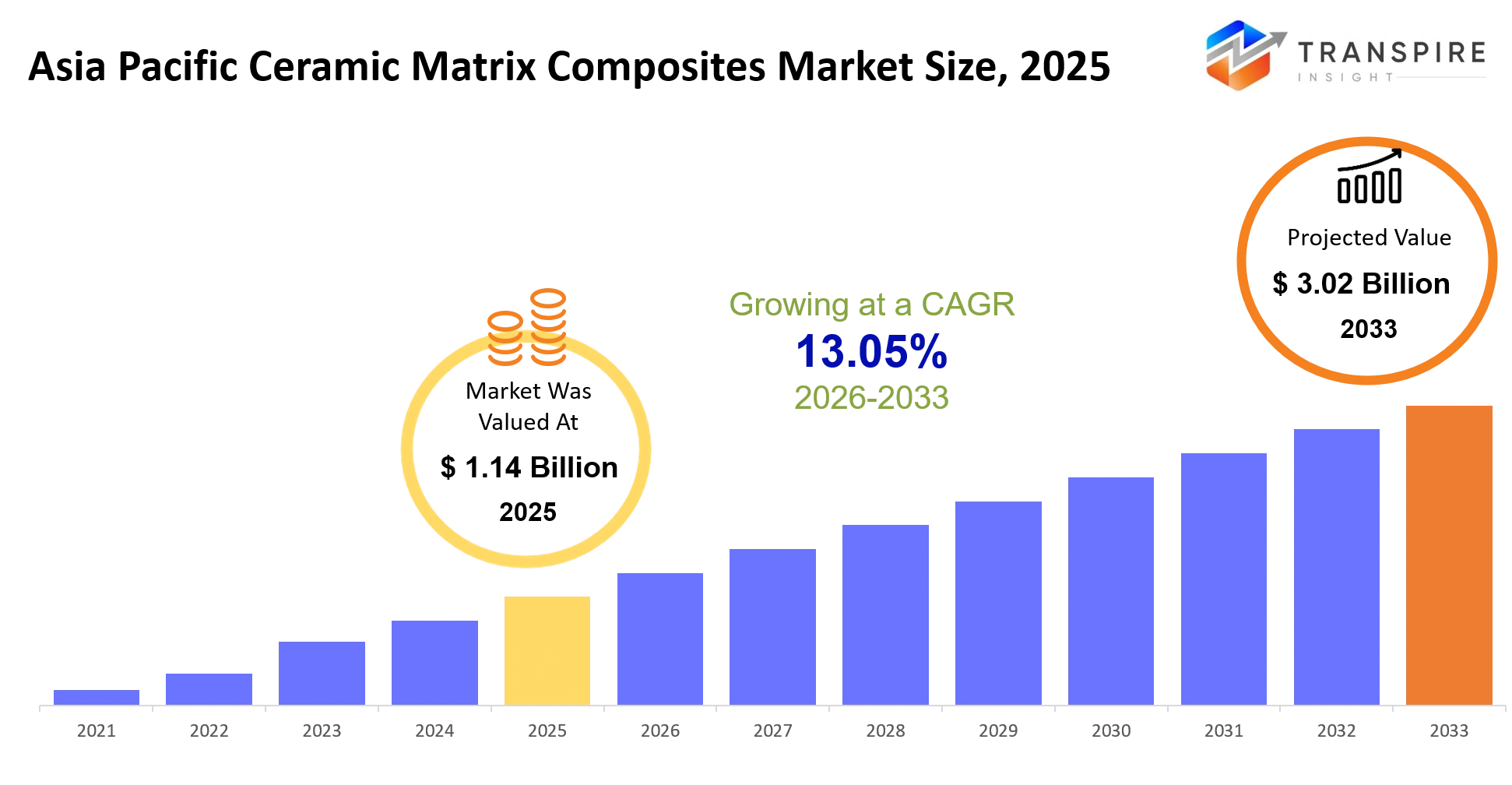
- Asia Pacific Ceramic Matrix Composites Market Size 2025: USD 1.14 Billion
- Asia Pacific Ceramic Matrix Composites Market Size 2033: USD 3.02 Billion
- Asia Pacific Ceramic Matrix Composites Market CAGR: 13.05%
- Asia Pacific Ceramic Matrix Composites Market Segments: By Fiber Type (Carbon Fiber, Silicon Carbide Fiber, Oxide Fiber, Alumina Fiber, Others); By Matrix Type (Oxide Matrix, Silicon Carbide Matrix, Carbon Matrix, Others); By Application (Aerospace, Defense, Automotive, Energy & Power, Industrial, Others); By End User (OEMs, Aerospace Companies, Defense Organizations, Energy Sector, Others).
To learn more about this report,  Download Free Sample Report
Asia Pacific Ceramic Matrix Composites Market Summary
The Asia Pacific Ceramic Matrix Composites Market was valued at USD 1.14 Billion in 2025. It is forecast to reach USD 3.02 Billion by 2033. That is a CAGR of 13.05% over the period.
The Asia Pacific Ceramic Matrix Composites (CMC) market, basically serves industries that want materials that can handle extreme heat, mechanical stress, and corrosive conditions without really giving up performance or durability. Like in practice, CMCs are used so aerospace manufacturers can boost engine efficiency, let industrial operators run equipment longer, and also back up advanced energy systems where regular metals hit thermal limits, too quickly.
Over the last five years the market kind of went through a structural change, from mostly experimental, and kinda niche deployments toward being integrated inside commercial aerospace engines, defense platforms, and other high-temperature industrial equipment. This shift got pushed further by tighter efficiency and emissions requirements, which tend to steer buyers toward lighter materials that also tolerate higher operating temperatures. A big trigger was global supply chain disruptions and energy price volatility , which then made the real cost of repeated maintenance and constant component replacement stand out. So when manufacturers were trying to build more operational resilience, spending on longer-lasting high-performance materials started moving faster. In the end this strengthened adoption across key sectors, turning the material performance edge into actual, measurable cost savings, stronger productivity outcomes, and ongoing revenue growth for CMC suppliers.
Key Market Insights
- China kind of dominates the Asia Pacific Ceramic Matrix Composites Market, taking about 38–42% of the market share in 2025, mainly because aerospace and industrial manufacturing investments keep ramping up.
- India is the quickest mover in the region during the forecast window, powered by defense modernization and indigenous aerospace production efforts, which helps a lot with pace.
- Japan still holds a meaningful chunk thanks to advanced materials know how, turbine component manufacturing and solid research-to-commercialization capabilities.
- South Korea keeps pushing with a more deliberate roadmap, via investments in aerospace materials, defense systems, and newer ceramic manufacturing technologies.
- Overall, Oxide CMCs kind of lead the industry size picture, they make up around 45% of the market share, largely tied to industrial furnace uses and thermal protection applications.
- Silicon carbide/silicon carbide composite materials kinda sit as the second-largest segment, pushed along mostly by aerospace engine component deployments and that whole demand cycle.
- In parallel, SiC/SiC composites are expected to grow the quickest through 2032 , mainly due to stronger temperature resistance, and also the usual weight reduction benefits that people keep pointing out.
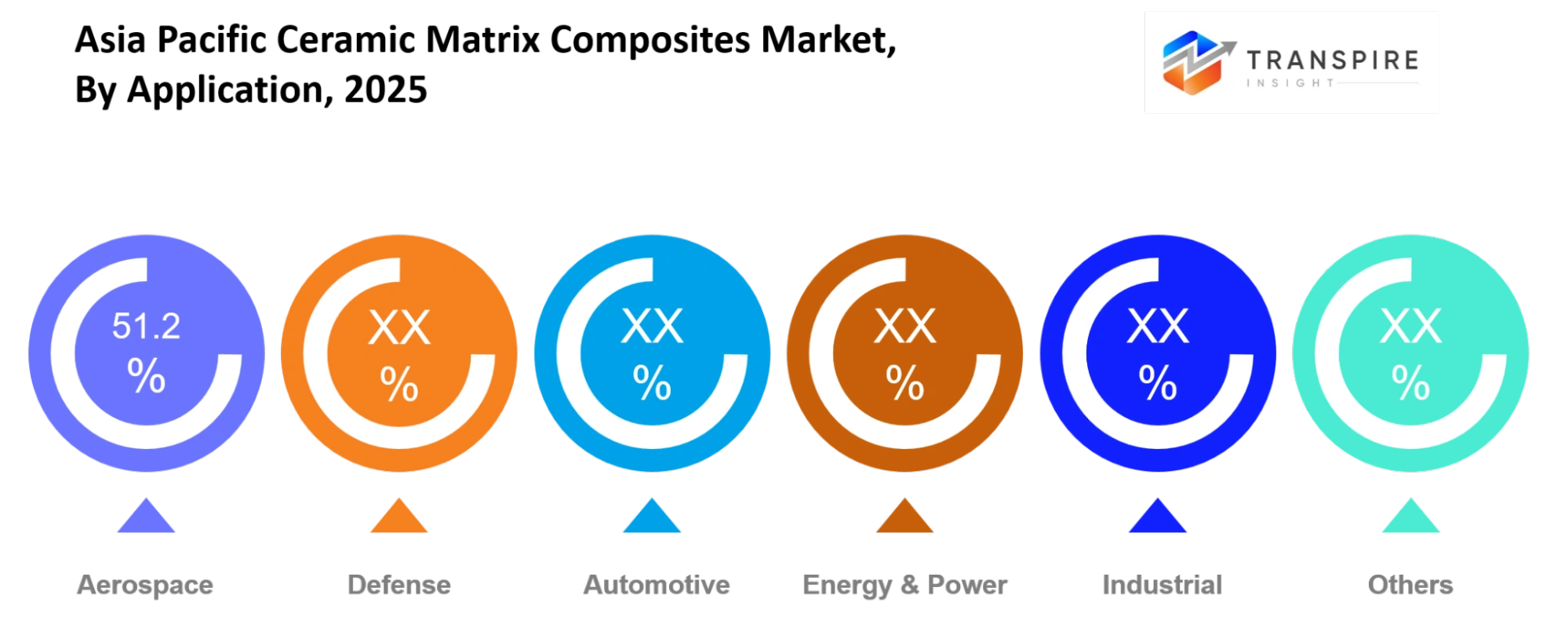
- When it comes to use, aerospace applications stay dominant with almost 48% market share in 2025 , backed by aircraft engines, turbine shrouds and thermal protection systems.
- For applications, defense and hypersonic vehicle programs show up as the fastest-growing category across the regional market forecast too.
- Meanwhile, industrial energy systems are starting to look like a high potential application area, mostly because efficiency improvement requirements are getting more intense.
What are the Key Drivers, Restraints, and Opportunities in the Asia Pacific Ceramic Matrix Composites Market?
The main push that’s really driving growth in the Asia Pacific Ceramic Matrix Composites Market is tied to how the aerospace industry is moving toward more efficient engines, the kind that can run at noticeably higher temperatures. Aircraft makers and engine designers now seem to be looking for materials that cut down on weight but still hold up, especially when the heat gets extreme. This change has been nudged along by tighter fuel efficiency targets , plus requirements to lower lifecycle costs, and frankly the desire to boost overall engine output. Ceramic matrix composites let engines tolerate hotter operating conditions than traditional metal parts can, and that helps efficiency climb, while fuel use tends to drop. With commercial aviation fleets spreading across Asia Pacific , and with defense programs putting emphasis on advanced propulsion, CMC adoption ends up feeding into stronger component revenues and larger production agreements.
Still, the biggest obstacle is the manufacturing side, it’s complex , and it’s also very capital intensive. Making ceramic matrix composites takes specialized equipment, longer fabrication timeframes, carefully designed fiber structures, plus strict quality control requirements. The difficulty is kinda structural as in, building the know-how for production, obtaining certification skills, and maintaining dependable supplier networks is not quick, it tends to take years of investment. Because of that, the available production capacity stays constrained, component pricing stays high, and uptake in cost sensitive industrial sectors moves slower than you’d expect just from the technical advantages alone.
There is a big opportunity here in more advanced energy, and also hydrogen related industrial systems, kind of like a domino effect. Think about high-temperature hydrogen making plants, next generation gas turbines, and even concentrated solar power setups, they all keep asking for materials that can handle harsh thermal surroundings. In China, Japan, South Korea, and India, Governments alongside private investors are putting money into low carbon industrial foundations, so that gives CMC a pretty good launchpad. And as these tools move past little pilot experiments and into full commercial operations, ceramic matrix composites might take on a bigger part that is not only aerospace. That could mean a new phase of market growth, plus more ways to diversify revenue.
What Has the Impact of Artificial Intelligence Been on the Asia Pacific Ceramic Matrix Composites Market?
Artificial intelligence and more advanced digital technologies are slowly but steadily reshaping the ceramic matrix composites industry, mostly by boosting manufacturing precision, quality control, and also asset performance management. Companies are starting to use AI enabled inspection setups that look at microscopic defects, see fiber alignment patterns, and spot material inconsistencies while things are still in production. In practice, automated vision systems can flag problems faster than the older manual inspection approach, which then cuts down scrap rates and generally pushes production yields higher.
Then there are machine learning models, they are quietly used for predictive maintenance across composite manufacturing plants. Instead of waiting until something goes wrong, these systems collect data like equipment vibration, temperature, pressure, and various operational signals. From that, they estimate when maintenance will be needed, before critical failures actually show up. The payoff is usually higher plant uptime, fewer unexpected shutdowns, and smoother, more efficient production runs.
On top of that, digital twin technologies can refine component design in a kind of “test it before building it” manner, simulating thermal and mechanical behavior under realistic operating situations. That helps shrink development cycles, and in many cases speeds up commercialization. In aerospace work, AI driven simulation platforms allow engineers to improve turbine parts and thermal protection systems, making it easier to qualify materials sooner and optimize performance more effectively. Overall, these tools help lower development costs, raise reliability, and support stronger operational performance over the whole product lifecycle.Learning models.
Key Market Trends
- Between 2020 and 2025, aerospace OEMs began pushing higher CMC integration in turbine engines, basically because fuel efficiency targets got a lot tighter across commercial aviation programs, and yeah it became a recurring theme.
- China also ramped up its domestic advanced materials production capacity after the pandemic era supply disruptions, which kinda made the dependence on imported high-performance composite components painfully obvious.
- Since 2021, defense agencies in Japan, India, and South Korea have leaned more into hypersonic and next generation propulsion systems, where CMC materials are starting to show up in more serious ways.
- Manufacturers moved away from pure laboratory-scale development toward full commercial production lines, which reduced the qualification timelines and also, improved consistency across aerospace grade components, even when demand shifts.
- GE Aerospace and several major engine suppliers expanded their long-term supplier relationships to lock in ceramic fiber availability and cut down procurement risks that used to pop up unexpectedly.
- Industrial operators, more and more, swapped out heat-resistant metal components for CMC alternatives, since energy costs made the longer service intervals feel way more valuable than before.
- Between 2022 and 2025, investment in automated inspection, plus AI-assisted quality control, ramped up too, and that helped producers lower defect rates during manufacturing.
- Hydrogen production projects and advanced gas turbine initiatives became new demand centers, so CMC applications started spreading beyond the usual aerospace-only markets.
- Regional governments increased support for strategic materials manufacturing, encouraging local supply chain growth. that also reduced exposure to geopolitical disruptions that can disrupt everything, quickly.
- At the same time, buyers have been putting more weight on lifecycle performance rather than just upfront component cost, so adoption is accelerating for materials that improve durability under harsh operating conditions.
Asia Pacific Ceramic Matrix Composites Market Segmentation
By Fiber Type :
Carbon fiber has a big part in ceramic matrix composites, where you need lighter construction and good strength or whatever. This pairing is often used to bring down the component weight, but still keep the mechanical behavior solid when things get rough during operation. You still see adoption in places where efficiency , and durability are kind of the main performance drivers.
Silicon carbide fiber is one of the more common choices, partly due to excellent heat resistance , oxidation resistance, and how well the strength holds up at higher temperatures. Oxide fiber works for use cases that really want stability in hot environments . Alumina fiber gives better thermal performance and reliability, while other specialized fibers cover particular engineering wants for advanced industrial and technical applications.
By Matrix Type :
Oxide matrix materials are usually picked when the environment is hot and also likely to oxidize. Their thermal stability is strong, and degradation resistance is a big deal, so oxide matrix composites tend to fit industrial tools , power systems, and other setups that need dependable long‑term operation.
Silicon carbide matrix materials have also become more important, because they offer top tier thermal and mechanical properties. Their high temperature capability makes them relevant for aerospace and defense parts . Carbon matrix materials bring lightweight characteristics, plus thermal shock resistance, so they can be used for more specialized purposes. Other matrix types cover narrower requirements when customized material performance is needed.
By Application :
Aerospace still feels like one of the most important application segments, mainly because there is a push for lightweight materials that can take on extreme temperatures and rough operating conditions. Ceramic matrix composites tend to support better engine efficiency, less fuel burn, and an extended service life for those critical parts.
In defense, these material families show up in advanced propulsion systems, protective structures, and high-performance equipment, where performance really matters. For automakers, ceramic matrix composites get explored for weight reduction and smarter thermal control. In energy and power plants, they’re used in turbines and other high temperature systems, and in industrial settings they help with durability, wear resistance, and day to day operational efficiency. Then there are additional uses that keep showing up, because material technologies keep advancing and getting more mature.
To learn more about this report, Download Free Sample Report
By End User :
OEMs count as a major end user segment since they are involved in component design, manufacturing, and overall system integration. Ceramic matrix composites can improve product performance, reliability, and operational efficiency across a range of industries. Also, the ongoing investment in advanced materials keeps expanding the chances of wider adoption in new product development programs.
Aerospace companies lean on these materials for engines, thermal protection systems, and structural components. Defense organizations use ceramic matrix composites inside mission critical equipment, especially where high durability and heat resistance are non negotiable. The energy sector applies them to turbines and power generation setups, aiming to boost performance while also trimming maintenance needs. Beyond that, other end users adopt ceramic matrix composites whenever harsh operating environments demand more advanced material solutions.
What are the Key Use Cases Driving the Asia Pacific Ceramic Matrix Composites Market?
In the Asia Pacific Ceramic Matrix Composites Market, aerospace applications do end up taking the largest slice of demand, I mean it really dominates. Aircraft engine manufacturers rely on these materials for turbine components and the hot-section pieces, since ceramic matrix composites can handle extreme temperatures while also trimming down weight a bit. That pairing helps with fuel efficiency, makes components last longer, and supports stronger, more aggressive engine operating performance, even when conditions get rough.
On the adoption side, things are also spreading into defense and energy . Defense organizations are putting ceramic matrix composites into advanced propulsion systems, thermal protection structures, and other high-performance equipment that has to endure harsh operating conditions day after day. Meanwhile in the energy industry, gas turbines and power generation setups are starting to use these materials more often, mainly to lift thermal efficiency and also cut down the maintenance frequency.
There are more emerging use cases too, especially around hydrogen production infrastructure and next generation hypersonic systems. Also worth noting, advanced industrial processing equipment that runs in high temperature settings looks like it has solid potential. As research programs keep maturing and manufacturing capabilities get better, these kinds of applications should keep opening up additional opportunities for long term market growth across the region.
|
Report Metrics |
Details |
|
Market size value in 2025 |
USD 1.14 Billion |
|
Market size value in 2026 |
USD 1.28 Billion |
|
Revenue forecast in 2033 |
USD 3.02 Billion |
|
Growth rate |
CAGR of 13.05% from 2026 to 2033 |
|
Base year |
2025 |
|
Historical data |
2021 - 2024 |
|
Forecast period |
2026 - 2033 |
|
Report coverage |
Revenue forecast, competitive landscape, growth factors, and trends |
|
Regional scope |
Asia Pacific (India, China, Japan, Australia, South Korea, Rest of Asia Pacific) |
|
Key company profiled |
GE Aerospace, Rolls-Royce, CoorsTek, SGL Carbon, Kyocera, CeramTec, 3M, Saint-Gobain, Applied Thin Films, Lancer Systems, Safran, Mitsubishi Chemical, Hitachi, Toshiba, NGK Insulators. |
|
Customization scope |
Free report customization (country, regional & segment scope). Avail customized purchase options to meet your exact research needs. |
|
Report Segmentation |
By Fiber Type (Carbon Fiber, Silicon Carbide Fiber, Oxide Fiber, Alumina Fiber, Others); By Matrix Type (Oxide Matrix, Silicon Carbide Matrix, Carbon Matrix, Others); By Application (Aerospace, Defense, Automotive, Energy & Power, Industrial, Others); By End User (OEMs, Aerospace Companies, Defense Organizations, Energy Sector, Others). |
Which Regions are Driving the Asia Pacific Ceramic Matrix Composites Market Growth?
China takes the lead in the Asia Pacific Ceramic Matrix Composites Market, not just because of one reason but more like a bundle of things happening together. You have large-scale aerospace manufacturing running there, plus solid government backing for advanced materials, and then a lot of money going into domestic supply chains. Because of national industrial policies, companies are pushed to build up high-performance ceramics, specialty fibers, and next-generation aerospace components. On top of that, the big aircraft programs, defense modernization initiatives, and the steady uptick in industrial production , end up creating a wide pool of buyers for ceramic matrix composite suppliers. And there’s also this fairly mature ecosystem—research institutes, material producers, and component manufacturers all working in a connected way—so it keeps reinforcing China as the region’s biggest market.
Japan shows up as the second most influential market, though the drivers aren’t exactly the same. Instead of leaning on sheer production scale, Japan leans more on materials know-how, precision manufacturing capabilities, and long-term commitment to research and development. It’s also supported by strong relationships between material suppliers, aerospace companies, and industrial equipment manufacturers, which helps keep demand steadier across multiple sectors. That kind of steadiness makes Japan a dependable part of regional revenue, especially for high-value applications where performance, as well as quality expectations, is where things really matter.
India seems to be showing up as the quickest growing market in this area. With defense budgets going up, aerospace localization programs rolling on, and money pouring into advanced manufacturing, the pull for high-temperature composite materials keeps getting stronger. There are also government-backed pushes, like support for domestic aircraft production and the broader strategic technologies, that kind of open fresh doorways for suppliers, as well as for those technology partners too. Over the 2026–2033 stretch, that same momentum should keep drawing capital toward building local production knowhow. So India may become a more and more major spot for companies entering the market, aiming for long term growth, not just short gains
Who are the Key Players in the Asia Pacific Ceramic Matrix Composites Market and How Do They Compete?
Competition in the Asia Pacific Ceramic Matrix Composites Market stays, moderately concentrated, mainly because making high-performance ceramic composites needs specialized know-how, intellectual property protection, and a hefty amount of capital. Instead of price, technology performance is the real basis of competition. Older, established suppliers tend to push forward on thermal resistance , longer service life (durability) and also on manufacturing efficiency. Meanwhile newer entrants try to carve out space via niche use cases and regional alliances, sometimes a bit faster than you’d expect. What really decides who wins is material innovation, stable output quality, and the capability to satisfy demanding aerospace and defense qualification rules.
GE Aerospace competes by using cutting-edge engine technologies where ceramic matrix composites are integrated into hot-section, high-temperature parts. They stand out because of deep aerospace certification experience plus ongoing connections with aircraft manufacturers , which matters more than it sounds. Rolls-Royce Holdings leans into propulsion systems where the materials must endure severe thermal environments. It strengthens its position through nonstop engine performance upgrades and joint development programs, with partners that can reduce risk across the whole lifecycle.
CoorsTek kinda pushes materials engineering, plus customized ceramic solutions for tough industrial and aerospace needs. Kyocera Corporation leans on know how in advanced ceramics manufacture, and also precision processing—so they can serve high-performance end markets really well. SGL Carbon stands out via specialized carbon-and composite technologies, and it keeps opening up new opportunities through investments in advanced material development, and via strategic collaborations with industrial plus aerospace customers. In the end, the group competes by improving material performance, expanding production capabilities a bit, and protecting their positions in next-generation aerospace, defense, and energy programs.
Company List
- GE Aerospace
- Rolls-Royce
- CoorsTek
- SGL Carbon
- Kyocera
- CeramTec
- 3M
- Saint-Gobain
- Applied Thin Films
- Lancer Systems
- Safran
- Mitsubishi Chemical
- Hitachi
- Toshiba
- NGK Insulators
Recent Development News
In March 2026, GE Aerospace announced a USD 55 million investment in its Huntsville, Alabama advanced materials facility. The investment will expand production capacity for ceramic matrix composite materials used in next-generation commercial and military aircraft engines, strengthening global CMC supply chains and supporting higher-volume adoption in aerospace applications.
Source: https://www.huntsvillecommerce.com/
In September 2025, the U.S. Department of Defense, through the Lightweight Innovations for Tomorrow (LIFT) initiative, committed USD 9.2 million to advance lower-cost ceramic matrix composite manufacturing technologies. The funding is intended to improve production affordability and scalability, helping accelerate broader deployment of CMC components across aerospace and defense programs.
Source: https://www.americanmachinist.com/
What Strategic Insights Define the Future of the Asia Pacific Ceramic Matrix Composites Market?
The Asia Pacific Ceramic Matrix Composites Market is kind of moving, more and more, toward deeper integration in high performance aerospace, defense, and advanced energy systems, mainly because the region keeps pushing for better fuel efficiency , stronger thermal performance, and that whole drive for technological self-reliance. In the next five to seven years, the demand is likely to shift away from small niche adoption and toward wider use in mission critical parts, as makers want materials that can keep working under increasingly harsh conditions. There’s also a risk that is less obvious at first: the market leans heavily on specialized precursor materials and on very concentrated processing know-how, so even if demand stays strong, you could still see supply bottlenecks and weaker scalability.
On the opportunity side, things are starting to form around next generation hypersonic platforms and more advanced gas turbine programs especially across China, India, and a few targeted Southeast Asian markets, where strategic spending on locally built aerospace abilities is accelerating. Market players should focus on long term collaborations across the precursor-to-component value chain to keep supply steady, and to grab the higher value use cases before competitive barriers get tighter.
Asia Pacific Ceramic Matrix Composites Market Report Segmentation
By Fiber Type
- Carbon Fiber
- Silicon Carbide Fiber
- Oxide Fiber
- Alumina Fiber
By Matrix Type
- Oxide Matrix
- Silicon Carbide Matrix
- Carbon Matrix
By Application
- Aerospace
- Defense
- Automotive
- Energy & Power
- Industrial
By End User
- OEMs
- Aerospace Companies
- Defense Organizations
- Energy Sector
Frequently Asked Questions
Find quick answers to common questions.
The Asia Pacific Ceramic Matrix Composites Market size is USD 3.02 Billion in 2033.
Key segments for the Asia Pacific Ceramic Matrix Composites Market are By Fiber Type (Carbon Fiber, Silicon Carbide Fiber, Oxide Fiber, Alumina Fiber, Others); By Matrix Type (Oxide Matrix, Silicon Carbide Matrix, Carbon Matrix, Others); By Application (Aerospace, Defense, Automotive, Energy & Power, Industrial, Others); By End User (OEMs, Aerospace Companies, Defense Organizations, Energy Sector, Others).
Major Asia Pacific Ceramic Matrix Composites Market players are GE Aerospace, Rolls-Royce, CoorsTek, SGL Carbon, Kyocera, CeramTec, 3M, Saint-Gobain, Applied Thin Films, Lancer Systems, Safran, Mitsubishi Chemical, Hitachi, Toshiba, NGK Insulators.
The Asia Pacific Ceramic Matrix Composites Market size is USD 1.14 Billion in 2025.
The Asia Pacific Ceramic Matrix Composites Market CAGR is 13.05% from 2026 to 2033.
- GE Aerospace
- Rolls-Royce
- CoorsTek
- SGL Carbon
- Kyocera
- CeramTec
- 3M
- Saint-Gobain
- Applied Thin Films
- Lancer Systems
- Safran
- Mitsubishi Chemical
- Hitachi
- Toshiba
- NGK Insulators
About the Authors

Pankaj Ghogare Patil
I am Pankaj Ghogare Patil, a Senior Research Analyst at Transpire Insight, specializing in the Pharmaceutical, Chemicals & Materials, Healthcare IT, and Biotechnology industry. My expertise lies in conducting comprehensive market research, analyzing industry trends, evaluating competitive landscapes, and translating complex data into actionable insights. At Transpire Insight, I closely follow emerging technologies, regulatory developments, and market innovations to create accurate, well-researched, and informative content that helps businesses and professionals make informed decisions. I am committed to producing credible, evidence-based articles that reflect industry best practices while making technical topics accessible and valuable for a broad audience.

Chakradhar Khansole
Chakradhar serves as the Research Director at Transpire Insight, bringing over 8 years of experience in technology, innovation, and strategic market intelligence. He specializes in transforming complex market data into actionable business insights that enable organizations to make informed, growth-oriented decisions. Recognized for his strategic vision and analytical expertise, Chakradhar leads high-impact research initiatives, delivering comprehensive market assessments, competitive intelligence, and forward-looking industry analysis.
Recently Published Reports
-
May 2026
Healthcare Polymer Packaging Market
Healthcare Polymer Packaging Market Size, Share & Analysis Report By Packaging Type (Syringes, IV Bottles and Pouches, Clamshells, Blisters, Bottles & Jars, Containers, Tubes, IV Parental Packaging, Others), By Type (Regulated, Non-regulated), By Polymer Type (LDPE (Low-Density Polyethylene), HDPE (High-Density Polyethylene), Homo-polymer (Homo), Random Copolymer (Random), Block Copolymer (Block), PET, Polystyrene, Polyvinyl Chloride, Polyamide/EVOH, Others), and Geography (North America, Europe, Asia-Pacific, Middle East and Africa, South and Central America), 2021 - 2031
-
Apr 2026
Hydrophilic Tape (Waterstop) Market
Hydrophilic Tape (Waterstop) Market Size, Share & Analysis Report By Type (Bentonite-Based Hydrophilic Tape, Rubber-Based Hydrophilic Tape), By Application (Residential Buildings, Commercial Buildings, Infrastructure Projects), and Geography (North America, Europe, Asia-Pacific, Middle East and Africa, South and Central America), 2021 - 2031
-
Apr 2026
Metalens Market
Metalens Market Size, Share & Analysis Report By Type (Visible Light Metalens, and Infrared Metalens), By Application (Consumer Electronics, Automotive Electronics, Industrial, Medical, and Others), and Geography (North America, Europe, Asia-Pacific, Middle East and Africa, South and Central America), 2021 - 2031
-
Apr 2026
PBT Resin Market
PBT Resin Market Size, Share & Analysis Report By Type (Reinforced PBT Resin, Unreinforced PBT Resin), By Processing Method (Injection Molding, Extrusion, Blow Molding, Others), By End-User (Automotive, Electrical & Electronics, Consumer Appliances, Industrial Machinery, Medical Devices, Packaging, Others), and Geography (North America, Europe, Asia-Pacific, Middle East and Africa, South and Central America), 2021 - 2031