
South Korea Waste to Energy Market Size & Forecast:
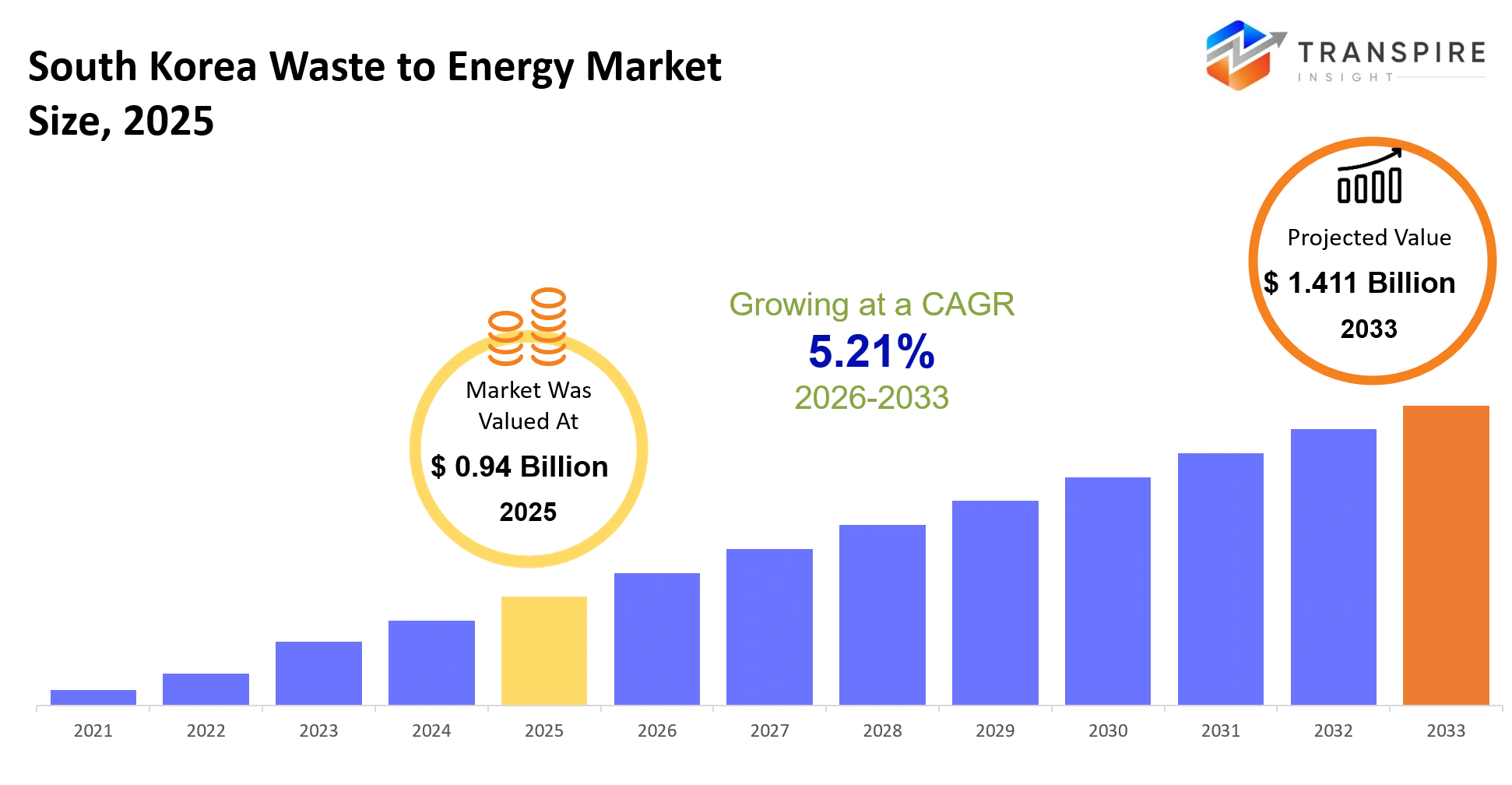
- South Korea Waste to Energy Market Size 2025: USD 0.94 Billion
- South Korea Waste to Energy Market Size 2033: USD 1.411 Billion
- South Korea Waste to Energy Market CAGR: 5.21%
- South Korea Waste to Energy Market Segments:By Technology (Incineration, Gasification, Pyrolysis, Anaerobic Digestion, Others); By Waste Type (Municipal Solid Waste, Industrial Waste, Agricultural Waste, Others); By Application (Electricity Generation, Heat Generation, CHP, Others)
To learn more about this report,  Download Free Sample Report
South Korea Waste to Energy Market Summary
The South Korea Waste to Energy Market was valued at USD 0.94 billion in 2025. It is forecast to reach USD 1.411 billion by 2033. That is a CAGR of 5.21% over the period.
The South Korea Waste to Energy Market kind of plays a critical role in turning municipal , industrial and agricultural waste into electricity , heat and so called alternative fuels, which helps cut down landfill reliance while also backing the country’s energy security and resource efficiency targets. In real day to day terms, waste-to-energy facilities offer a two part solution, they help with waste disposal pain points and at the same time they produce usable energy for industries and nearby communities too.
In the last five years , the market has also shifted in a more structural way, moving away from classic mass-burn incineration toward higher-efficiency options like gasification, anaerobic digestion and advanced energy recovery systems. A major push behind this shift has been South Korea’s carbon neutrality roadmap, plus tougher waste management regulations, both of which have increased the pressure on municipalities and companies to divert waste from landfills. When disposal costs keep rising and environmental compliance rules get stricter, waste-to-energy infrastructure starts looking more attractive financially. This momentum is then widening project pipelines , encouraging upgrades in the technology stack and opening up additional revenue angles , through power generation, district heating delivery and broader resource recovery activities.
Key Market Insights
- The Seoul Capital Area is really big in the South Korea Waste to Energy Market. It has 42 percent of the market in 2025. This is because there are a lot of people and a lot of waste in the Seoul Capital Area.
- Gyeonggi Province also has a share. This is because it has facilities to treat waste and heating systems for homes.
- The Busan-Ulsan-Gyeongnam area is growing fast until 2030. This is because it is working on projects to turn waste into energy.
- The governments in areas are working to improve the way they manage waste. They want to reduce the amount of waste in landfills and bad emissions.
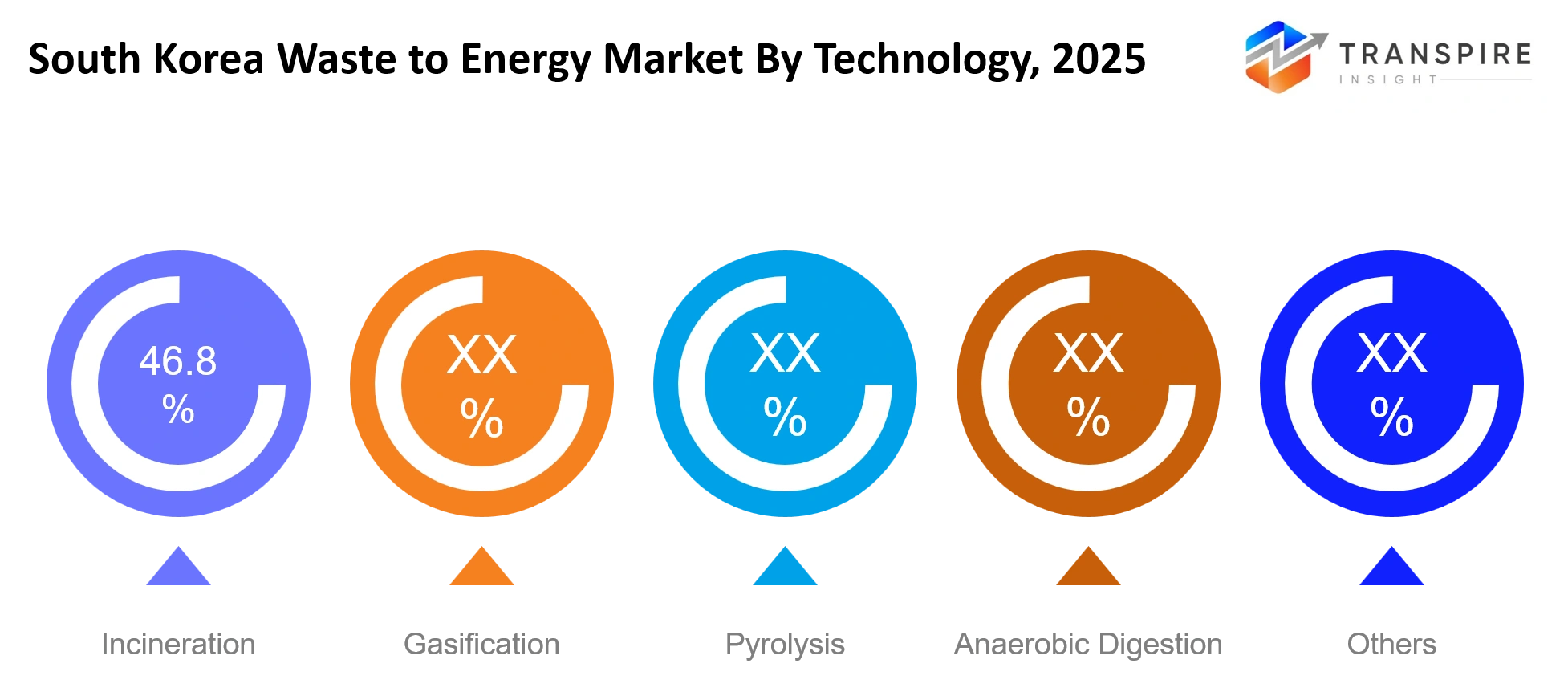
- Burning waste is the common way to make energy in the South Korea Waste to Energy Market. It has 55 percent of the market in 2025. This is because it is a way to make energy and the facilities are already built.
- Breaking down waste with organisms is the second most common way. This is because people want to treat waste and make biogas.
- Turning waste into gas or oil is getting more popular. This is because it is more efficient and better for the environment.
- New systems that use heat to make energy are also getting popular. This is because they can make energy and recover more resources.
- Making electricity is the use of energy in the South Korea Waste to Energy Market. It has 48 percent of the market in 2025. This is because South Korea wants to use kinds of energy.
- Heating homes is also an use of energy. This is because it works well with the energy systems in cities and the heating systems, in homes.
What are the Key Drivers, Restraints, and Opportunities in the South Korea Waste to Energy Market?
The main force driving the South Korea Waste to Energy market is basically the government tightening the landfill rules and pushing carbon reduction policies a bit harder. South Korea resource circulation framework, along with its carbon neutrality pledges, has nudged municipalities to reroute bigger waste volumes away from landfills and more toward energy recovery plants. So that regulatory shift gives a pretty obvious “reason to act” for local governments and industrial operators to put money into waste-to-energy infrastructure. When disposal costs go up, and landfill capacity feels more and more cramped, waste-to-energy projects start looking more profitable. In practice, you often see more project approvals, higher utilization rates for existing facilities, and steadier income streams from electricity generation, district heating services, and waste treatment operations.
The biggest limiter though, is the high capital requirement behind advanced waste-to-energy setups. Stuff like gasification , pyrolysis, and the newer emissions control systems need a lot of initial funding, plus long permitting steps. This is kind of structural, since it is tied to infrastructure financing, regulatory compliance, and multi-year development timelines that can’t really be fixed overnight. A lot of municipalities run into budget ceilings , and private investors also want long-term revenue clarity before they commit capital. Together these issues slow down project rollout, delay new capacity, and in the end suppress the market revenue that could have been generated sooner.
Big chance here is in pushing forward the more advanced waste conversion approaches for both industrial and organic waste streams, kinda like , you know, turning waste into usable value. The funding side for anaerobic digestion plants that can generate biogas, plus renewable natural gas is really picking up momentum now. Places like Ulsan and Busan look especially favorable since there is a lot of waste being produced in one area, there is already energy infrastructure in place and the industrial customers have a strong need for alternative power. As these setups become larger and larger, they might open up a fresh market growth phase past the usual incineration based energy recovery.
What Has the Impact of Artificial Intelligence Been on the South Korea Waste to Energy Market?
Artificial intelligence and advanced digital technologies are now gradually improving the efficiency ,and reliability of South Korea’s waste-to-energy sector. In many plants , operators are rolling out AI-enabled control systems, kind of to automate combustion management, keep an eye on boiler conditions, and fine tune energy recovery steps in real time. Sensors placed across waste handling, incineration, and emissions treatment setups continuously gather operational data, so the system can make automated adjustments that boost steadiness and cut down on the need for so much manual attention.
Machine learning is also being applied for predictive maintenance and overall performance improvement. Once these models ingest vibration signals, temperature swings, and equipment operating histories, they can flag early cues of component wear before an unexpected shutdown shows up. At the same time, AI-driven forecasting tools support operators in anticipating emissions levels, arranging feedstock mixes more effectively, and holding to compliance requirements tied to stricter environmental regulations. Overall, facilities tend to gain better uptime, lower maintenance spending, and produce electricity and heat with a more consistent output pattern.
Digital twins are really showing up as one more big technology, letting operators kind of preview plant performance under many different waste mix and operating situations. It does help a lot with decision making, plus it tends to support a more efficient use of resources.
But, AI adoption still has a major wall. A lot of older waste-to-energy facilities run on legacy equipment, you know, the kind that was never meant for advanced data integration. To retrofit those plants often means big capital spending, and also a lot of data harmonization work, sometimes that can slow the rollout down quite a bit and it can even lower the near term payoff from digital transformation efforts.
Key Market Trends
- Since 2020 municipalities have sped up programs to reduce waste in landfills. They are now sending waste to facilities that turn waste into energy. This helps meet targets for recycling resources.
- Operators have upgraded plants that burn waste to produce energy. They have added systems to control pollution. This is because environmental rules have become stricter over the five years.
- Companies that produce a lot of waste are looking for long-term partnerships with energy facilities. This is because it has become more expensive to dispose of waste. There are also rules to follow.
- Facilities that turn waste into energy are focusing on getting more energy from each ton of waste. They are not just building facilities. They want to make the most of the waste they process.
- Some new technologies are becoming popular. Gasification and pyrolysis are methods that help recover resources from waste. They also have an impact on the environment. More projects using these technologies have started since 2021.
- Facilities are using tools to monitor and maintain their operations. This helps reduce shutdowns and makes plants more reliable.
- More cities are using heat from waste. This allows municipalities to get value from waste.
- Companies like Veolia, Suez and Hitachi Zosen are in a position. They have partnered with technology companies. Improved how efficiently they operate.
- There is a focus on reducing carbon emissions. Regulators now consider how much carbon dioxide is produced over the life of a project. They also think about how waste a facility can handle.
- Areas, like Busan and Ulsan are seeing investment. This is because they have a lot of waste and existing energy infrastructure.
South Korea Waste to Energy Market Segmentation
By Technology:
Incineration still keeps a big role in the South Korea Waste to Energy Market, mostly because the infrastructure is already in place and the energy generation stays reliable. Local municipal authorities often lean toward incineration plants for dealing with high volumes of mixed waste, but also, they are trying to shrink landfill dependency. With time, upgrades in combustion efficiency and emission control systems improved day to day performance, so it runs steadier than before. On top of that, regulatory backing for waste diversion has added momentum, especially across more dense urban regions.
Lately though, gasification, pyrolysis, and anaerobic digestion have been getting a lot more attention. In practice, these approaches bring better resource recovery, and they can produce higher value energy outputs from certain waste streams. For example, anaerobic digestion projects have increased, as initiatives to manage organics and produce biogas move forward. More investment into advanced conversion systems also hints at a broader shift, toward waste treatment that is not only more efficient, but also more environmentally compliant and easier to justify with newer standards.
To learn more about this report, Download Free Sample Report
By Waste Type:
Municipal solid waste kinda stands out as the biggest waste category sent through waste-to-energy facilities around South Korea. Because the high population density in main metropolitan areas, there is a lot of waste showing up constantly and it needs fast, effective processing and disposal. Those waste-to-energy plants, they ease pressure on landfills too, while still yielding electricity plus thermal energy. Local governments keep putting municipal waste handling upfront, as part of longer-term resource circulation plans .
Industrial waste has also become a meaningful piece for facility utilization , and for pushing forward project development. Manufacturing zones produce sizable amounts of waste that can be tapped for energy recovery purposes. On top of that agricultural waste brings fresh options especially in places with strong farming activity and plenty of organic residues. Mixing the feedstocks from various waste streams, helps plants run more efficiently and keeps energy output steadier across seasons, not just during the busy months .
By Application:
Electricity generation is still the main use, because waste-to-energy facilities feed into domestic power production in a kind of steady way. The energy that comes back from waste acts like an alternative power stream, and it also lines up with national sustainability aims. Facility operators keep tuning the conversion efficiency so they can squeeze more electricity out of whatever feedstock is on hand. With reliable generating capacity like this, investors feel steadier about funding the sector over the long run.
District heating keeps growing, most noticeably in cities where centralized heating networks are already in place. Thermal energy recovered during waste processing then helps meet residential and commercial heating needs, and it often improves the plant’s overall financial picture . At the same time alternative fuel making has picked up speed as industries look for lower-carbon options. More and more, wider use of recovered energy products is showing up, which creates extra revenue possibilities, and it strengthens the longer-term worth of waste-to-energy infrastructure..
What are the Key Use Cases Driving the South Korea Waste to Energy Market?
In South Korea, electricity generation is still the main thing that keeps waste-to-energy infrastructure being adopted. Municipal waste treatment plants take in huge amounts of solid waste, then turn that into power, which in turn helps local governments cut back on landfill use while still feeding electricity to urban areas. In other words, the mix of waste handling and energy production really has that economic pull, so project investment keeps moving in a steady way.
Also, district heating seems to be picking up momentum, especially as cities weave waste based thermal energy into the heating systems they already have. On the industrial side, operators are expanding energy recovery setups to deal with manufacturing waste streams, and those efforts can offset energy costs, not just “manage” the waste. These options are getting more appealing in areas where industry is packed together, and where waste disposal rules are tight.
And there are newer directions too, like renewable natural gas being produced from organic waste, plus more advanced recovery of materials from industrial residues. More projects are getting attention around biogas upgrading, plus low-carbon fuel creation as carbon reduction goals get stricter. For now, these uses are still on the smaller side. But they’re expected to take a bigger role as the forecast period goes on, and that part feels pretty likely.
|
Report Metrics |
Details |
|
Market size value in 2025 |
USD 0.94 Billion |
|
Market size value in 2026 |
USD 0.989 Billion |
|
Revenue forecast in 2033 |
USD 1.411 Billion |
|
Growth rate |
CAGR of 5.21% from 2026 to 2033 |
|
Base year |
2025 |
|
Historical data |
2021 - 2024 |
|
Forecast period |
2026 - 2033 |
|
Report coverage |
Revenue forecast, competitive landscape, growth factors, and trends |
|
Regional scope |
South Korea |
|
Key company profiled |
Caterpillar Inc., Cummins Inc., Rolls-Royce Veolia, Suez, Hitachi Zosen, Babcock & Wilcox, Covanta, Mitsubishi Heavy Industries, Keppel Seghers, Martin GmbH, Ramboll, Wheelabrator, CNIM, Doosan Enerbility, Hyundai E&C, POSCO E&C, Samsung C&T |
|
Customization scope |
Free report customization (country, regional & segment scope). Avail customized purchase options to meet your exact research needs. |
|
Report Segmentation |
By Technology (Incineration, Gasification, Pyrolysis, Anaerobic Digestion, Others); By Waste Type (Municipal Solid Waste, Industrial Waste, Agricultural Waste, Others); By Application (Electricity Generation, Heat Generation, CHP, Others) |
Which Regions are Driving the South Korea Waste to Energy Market Growth?
The Seoul Capital Area still holds the top spot in the South Korea Waste to Energy Market, mostly because of dense population levels, big waste generation volumes, and solid policy backing for resource circulation. Local governments across Seoul, plus nearby metropolitan districts, have been putting serious money into waste treatment as well as energy recovery infrastructure—so they can cut back on landfill dependence . New and ongoing environmental requirements, plus fairly aggressive carbon reduction targets, keep pushing operators to upgrade facilities and refine how things run day to day. On top of that there’s a pretty well-developed network of technology providers, engineering groups, utilities, and municipal operators who keep supporting further investment and, in a sense, help lock in regional leadership.
Gyeonggi Province sits as the second most important regional market, even if the growth pattern is not exactly like the Seoul metropolitan core. Instead of leaning on urban density as the main driver, the area gains from a more even mix of residential, commercial, and industrial waste streams. Economic conditions are steady, and long-term planning for infrastructure has helped keep waste-to-energy plants consistently utilized. With continued spending by local authorities and industrial players, the province keeps functioning as a dependable source of market earnings and project momentum.
In the Busan–Ulsan–Gyeongnam region it seems like the fastest growth is really taking hold, mostly because industrial waste generation keeps climbing and there’s been recent investment into advanced waste processing tech, you know. As industrial complexes keep expanding and environmental compliance rules get stricter, firms are more willing to move toward energy recovery in a more serious way. New projects are showing up around anaerobic digestion, gasification, and resource recovery, so it’s not only the usual incineration angle anymore. This kind of direction is expected to pull in technology suppliers, infrastructure investors, and project developers who are looking for expansion chances between 2026 and 2033.
Who are the Key Players in the South Korea Waste to Energy Market and How Do They Compete?
Competition in the South Korea Waste to Energy Market is sort of moderately consolidated, where you usually see a blend of big global engineering groups, tech providers, and infrastructure developers, all going after major municipal plus industrial contracts. In practice, players do not just go head to head on price , they tend to compete on how well the technology performs, how strong their emissions control really is, and how efficient the plant operates over the long run, plus the operational wisdom they bring over time. Bigger, established operators generally keep defending their market share by leaning on proven project delivery track records and more integrated service packages. Meanwhile newer, more technology-driven firms are hunting for chances in advanced waste conversion and resource recovery systems, like moving faster into next generation circular setups. Also, the whole regulatory compliance side and the heavy capex requirements can act like gatekeepers, so firms with solid technical skills and financing knowhow usually have the advantage.
Veolia sort of stands out with integrated waste handling and energy recovery offerings, where waste collection, treatment, and power generation are tied together under one operating approach. This kind of unified model helps them maintain tighter operational control and improve efficiency across the entire value chain. Suez meanwhile leans more into advanced resource recovery and circular economy solutions, assisting cities in getting more energy extraction, while also shrinking the residual waste volumes. Both organizations keep pushing forward via public–private partnerships and longer-term service arrangements with local authorities, so they can stay embedded in ongoing municipal needs.
Hitachi Zosen operates by leaning on advanced waste treatment methods, along with high performance emissions control systems meant for tight environmental standards . Meanwhile Mitsubishi Heavy Industries leans into engineering know how, plus big scale infrastructure delivery so that complicated facility buildouts become more efficient, and yes more reliable too. Babcock & Wilcox centers on high efficiency combustion technologies, and plant optimization measures which help raise energy output, and also keep operations steady.
Ongoing spending on digital monitoring systems, emissions cutting technologies, and modernization initiatives for existing facilities, lets these firms boost their competitive standing and capture fresh project chances across South Korea.
Company List
- Veolia
- Suez
- Hitachi Zosen
- Babcock & Wilcox
- Covanta
- Mitsubishi Heavy Industries
- Keppel Seghers
- Martin GmbH
- Ramboll
- Wheelabrator
- CNIM
- Doosan Enerbility
- Hyundai E&C
- POSCO E&C
- Samsung C&T
Recent Development News
"In November 2025, Valmet announced the supply of an automation system for Seongnam City's waste-to-energy incineration facility in Gyeonggi-do, South Korea. The project introduces advanced automation and process control technologies designed to improve energy recovery efficiency, operational stability, and emissions management at the new facility.https://www.valmet.com
"In August 2024, EQT Infrastructure VI entered into a definitive agreement to acquire KJ Environment and affiliated companies from Genesis Private Equity. The acquisition will establish a scaled waste treatment platform focused on plastic recycling and waste-to-energy, expanding infrastructure coverage across areas representing more than half of South Korea's population.https://eqtgroup.com
"In August 2024, EQT announced a US$733 Billion acquisition of South Korean waste treatment platform KJ Environment and its affiliates. The transaction strengthens investment in recycling and waste-to-energy infrastructure and highlights growing private equity interest in South Korea's environmental services sector.https://www.reuters.com
What Strategic Insights Define the Future of the South Korea Waste to Energy Market?
In the next five to seven years, the South Korea Waste to Energy Market should, kinda, move past its old identity as just a waste disposal answer and become more baked into the country’s resource circulation plus energy security setup. The biggest push behind this change will be the growing focus on pulling as much usable value as possible from waste streams, using advanced conversion technologies, digital optimization, and better energy recovery systems that squeeze more efficiency out of the same input. Going forward, investment choices will look less at raw processing capacity only and more at energy output, carbon performance, and resource recovery rates.
There’s also a quieter worry though, related to feedstock availability and quality. If recycling rates keep improving and waste reduction policies get sharper, some plants might struggle to lock in steady volumes of high-calorific waste, and that can mess with operating economics and the overall project returns.
At the same time, there’s an opening that’s starting to show up more. Renewable natural gas, plus advanced biofuel production, from organic and industrial waste streams can expand, especially around industrial regions like Ulsan and Busan. Market players should lean toward investments in flexible, multi-feedstock technologies, so they can handle shifting waste compositions, and also keep up with evolving regulatory requirements. That approach, in practice, should add resilience, and support a stronger long-term competitive edge.
South Korea Waste to Energy Market Report Segmentation
By Technology
- Incineration
- Gasification
- Pyrolysis
- Anaerobic Digestion
- Others
By Waste Type
- Municipal Solid Waste
- Industrial Waste
- Agricultural Waste
- Others
By Application
- Electricity Generation
- Heat Generation
- CHP (Combined Heat and Power)
- Others
Frequently Asked Questions
Find quick answers to common questions.
The expected South Korea Waste to Energy Market size for the market will be USD 1.411 Billion in 2033.
Key segments for the South Korea Waste to Energy Market are By Technology (Incineration, Gasification, Pyrolysis, Anaerobic Digestion, Others); By Waste Type (Municipal Solid Waste, Industrial Waste, Agricultural Waste, Others); By Application (Electricity Generation, Heat Generation, CHP, Others).
Major South Korea Waste to Energy Market players are Veolia, Suez, Hitachi Zosen, Babcock & Wilcox, Covanta, Mitsubishi Heavy Industries, Keppel Seghers, Martin GmbH, Ramboll, Wheelabrator, CNIM, Doosan Enerbility, Hyundai E&C, POSCO E&C, Samsung C&T.
The South Korea Waste to Energy Market size is USD 0.94 Billion in 2025.
The South Korea Waste to Energy Market CAGR is 5.21% from 2026 to 2033.
- Veolia
- Suez
- Hitachi Zosen
- Babcock & Wilcox
- Covanta
- Mitsubishi Heavy Industries
- Keppel Seghers
- Martin GmbH
- Ramboll
- Wheelabrator
- CNIM
- Doosan Enerbility
- Hyundai E&C
- POSCO E&C
- Samsung C&T
About the Authors

Avinash Kumar
I’m Avinash Kumar, a Senior Research Analyst at Transpire Insight, with expertise in the Electronics and Semiconductor and Energy & Power industry. My work focuses on analyzing emerging technologies, market trends, industry developments, and innovation across these sectors. I specialize in transforming complex technical and market insights into clear, research-backed content that helps professionals, businesses, and decision-makers stay informed. Through continuous industry research and data-driven analysis, I strive to deliver accurate, reliable, and practical perspectives on the latest advancements shaping the semiconductor and energy landscape.

Chakradhar Khansole
Chakradhar serves as the Research Director at Transpire Insight, bringing over 8 years of experience in technology, innovation, and strategic market intelligence. He specializes in transforming complex market data into actionable business insights that enable organizations to make informed, growth-oriented decisions. Recognized for his strategic vision and analytical expertise, Chakradhar leads high-impact research initiatives, delivering comprehensive market assessments, competitive intelligence, and forward-looking industry analysis.
Recently Published Reports
-
Apr 2026
Active Power Filter Market
Active Power Filter Market Size, Share & Analysis Report By Type (Shunt Active Power Filters, Series Active Power Filter, Hybrid Active Power Filter), By Application (Harmonics Mitigation, Reactive Power Compensation, Voltage Regulation, Power Factor Correction), By Phase (Single Phase, Three Phase), By End-User Industry (Manufacturing, Healthcare, Commercial, Automotive, Oil and Gas, Others), and Geography (North America, Europe, Asia-Pacific, Middle East and Africa, South and Central America), 2021 - 2031
-
Apr 2026
Electrical Transformer Market
Electrical Transformer Market Size, Share & Analysis Report By Core (Closed, Shell, and Berry), By Insulation (Gas, Oil, Solid, Air, and Other), By Phase (Single, and Three), By Rating (100 MVA to 500 MVA, 501 MVA to 800 MVA, and 801 MVA to 1200 MVA), and Geography (North America, Europe, Asia-Pacific, Middle East and Africa, South and Central America), 2021 – 2031
-
Apr 2026
Hydraulic Piston Pumps Market
Hydraulic Piston Pumps Market Size, Share & Analysis Report By Type (Axial Piston Pumps, Radial Piston Pumps), By Operating Pressure (Low Pressure, Medium Pressure, High Pressure), By Application (Construction, Mining, Agriculture, Automotive, Oil & Gas, Industrial Machinery, Others), By End-User (OEMs, Aftermarket), and Geography (North America, Europe, Asia-Pacific, Middle East and Africa, South and Central America), 2021 – 2031
-
Apr 2026
Laboratory Gas Generators Market
Laboratory Gas Generators Market Size, Share & Analysis Report By Product (Nitrogen Gas Generator, Hydrogen Gas Generator, Zero Air Gas Generator, Purge Gas Generator, TOC Gas Generators, Others), By Application (Gas Chromatography, Liquid Chromatography-mass Spectrometry (LC-MS), Gas Analyzers, Others), By End-user (Life Science, Chemical & Petrochemical, Food & Beverage, Others), and Geography (North America, Europe, Asia-Pacific, Middle East and Africa, South and Central America), 2021 – 2031