
Global 2 Loop FIBC Bags Market Size & Forecast:
- Global 2 Loop FIBC Bags Market Size 2025: USD 5.79 Billion
- Global 2 Loop FIBC Bags Market Size 2033: USD 9.16 Billion
- Global 2 Loop FIBC Bags Market CAGR: 5.91%
- Global 2 Loop FIBC Bags Market Segments: By Bag Type (Standard 2 Loop Bags, Baffle Bags, Conductive Bags, Ventilated Bags, UN Certified Bags, Food Grade Bags, Anti-static Bags, Others); By Capacity (Below 500 kg, 500–1000 kg, 1000–1500 kg, Above 1500 kg, Medium Duty Bags, Heavy Duty Bags, Custom Capacity Bags, Others); By Material (Woven Polypropylene, Laminated Polypropylene, UV Stabilized Polypropylene, Conductive Fabric, Food Grade Fabric, Recycled Polypropylene, Virgin Polypropylene, Others); By End User (Agriculture, Chemicals, Food & Beverage, Construction, Mining, Pharmaceuticals, Fertilizers, Others); By Design (Circular Bags, U-Panel Bags, Four Panel Bags, Tubular Bags, Coated Bags, Uncoated Bags, Printed Bags, Others).

Global 2 Loop FIBC Bags Market Summary:
As per Transpire Insight Analysis, the Global 2 Loop FIBC Bags Market size is estimated at USD 5.79 Billion in 2025 and is anticipated to reach USD 9.16 Billion by 2033, growing at a CAGR of 5.91% from 2026 to 2033.
The global 2 Loop FIBC bags market is getting bigger around the world. This is because companies need packaging that's strong, light, and does not cost too much to transport and store large amounts of materials. The 2 Loop FIBC bags are used a lot in industries like agriculture, chemicals, food processing, construction, mining and fertiliser. This is because they make it easier to handle materials, reduce waste from packaging and improve logistics.
Over the past few years, the people who make these bags have been working on making them stronger, able to be recycled and good for specific jobs. They want to meet the standards of quality and what the customers need. The 2 Loop FIBC bags market has seen a change to using materials that are sustainable and good for the environment. This is because of rules to protect the environment and people wanting packaging that is responsible. More and more countries are trading amounts of goods, and companies are investing in machines that can fill and handle the 2 Loop FIBC bags automatically. This has helped the market for 2 Loop FIBC bags grow faster. Companies want to keep their products safe and spend less money on transporting goods. So they keep asking for 2 Loop FIBC bags. This is happening in new industrial markets. The 2 Loop FIBC bags are very important for these companies.
Key Market Insights:
The global 2 Loop FIBC bags market is progressing past the traditional bulk packaging, with manufacturers focusing on offering durable, sustainable, and industry-oriented designs of their products. Investments in food-grade materials, automated handling technologies, and recyclable packaging are influencing the competitive landscape of the market and generating new possibilities.
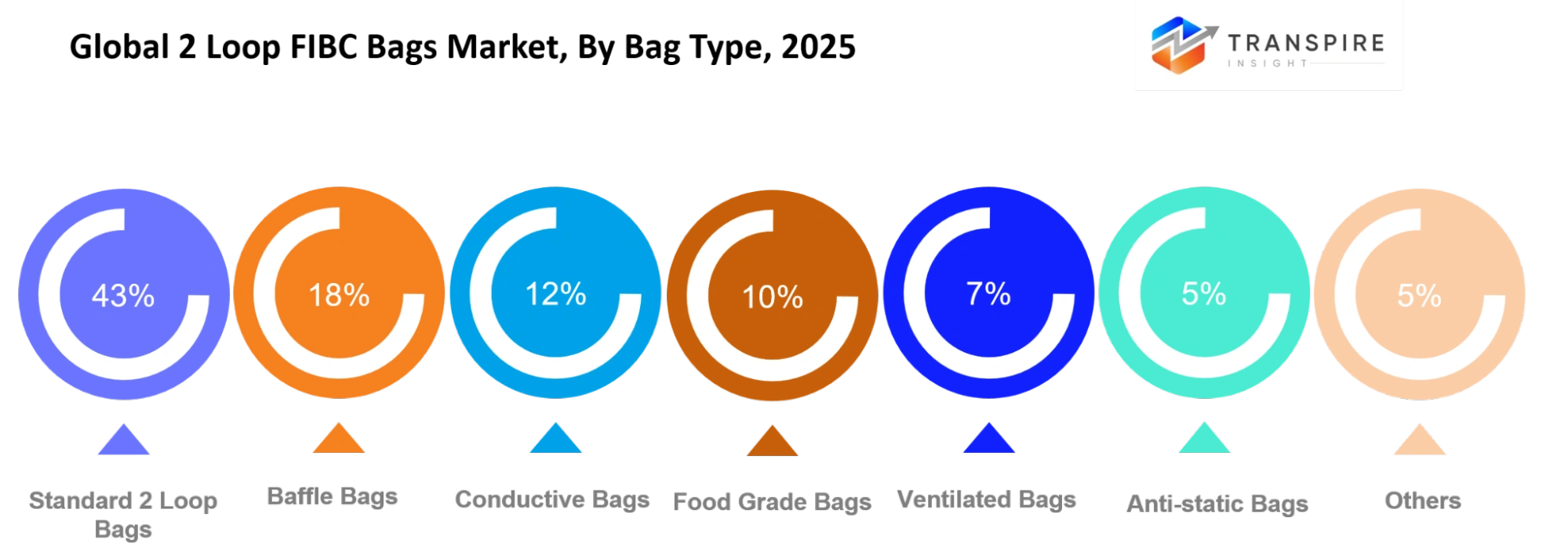
- Standard 2 Loop Bags occupy the largest share of the market (43%), owing to their cost-effectiveness, efficient forklift handling capabilities, and widespread usage across various industries such as agriculture, chemicals, and construction.
- Food Grade FIBC Bags are estimated to witness the fastest CAGR growth of 13.2%, owing to stringent food safety standards and growing need for contamination-resistant bulk packaging across food processing and export activities.
- Baffle Bags are accounting for 18% of the overall demand in the market as manufacturers are opting for packaging technologies that save space, help optimise use of containers, and reduce logistics costs.
- Conductive Bags make up 12% of the market as they are gaining popularity in the chemical and industrial sectors to prevent electrostatic discharge while handling materials.
- Manufacturers are producing more recyclable polypropylene FIBC bags in response to consumer demand for environmentally-friendly packaging.
- Export manufacturers are working towards building their presence internationally through production capacity increase, product certification improvement, and forging long-term relationships with their logistics and industrial clients.
- Product innovation is becoming more and more oriented at developing light but strong bags which will minimise costs associated with transportation and ensure excellent load-carrying capabilities.
What are the Key Drivers, Restraints, and Opportunities in the Global 2 Loop FIBC Bags Market?
Drivers
Global demand for 2 Loop FIBC bags is expected to be fueled by the increasing requirement for reliable and cost-efficient bulk packages among different industries like agriculture, chemicals, construction, food processing, and mining. Rising international trade in bulk cargo leads companies to find new ways of reducing loading time, improving the transportation process, and preventing losses during transport. Increasing automation of filling and discharging processes contributed significantly to the popularity of 2 Loop FIBC bags due to their easy-to-handle nature and low cost of operating with them, which allowed the manufacturers to increase sales and become more efficient in supply chain management.
Restraints
Despite good prospects, there are some obstacles that prevent further market expansion. Firstly, fluctuations in prices of polypropylene resins significantly influence production costs, making it difficult for producers to find an acceptable price level. Secondly, there are strict food safety regulations, environmental restrictions, and requirements for exporting goods that require constant testing and certification. Small manufacturers have difficulty meeting them.
Opportunities
Opportunities in the form of growing prospects exist in the area of sustainable and customised FIBC bags. Investment in recyclable polypropylene products, food-grade packaging, and advanced manufacturing techniques is providing new prospects. Those companies that produce lightweight, reusable, and customised bags in various industries, such as the pharmaceutical industry and food processing industry, etc. are in a position to gain from future business opportunities. Growing industrial production and export activity in developing nations will provide future opportunities to those companies focusing on product innovation and capacity building.
What Has the Impact of Artificial Intelligence Been on the Global 2 Loop FIBC Bags Market?
Artificial intelligence technology is slowly but steadily revolutionising the worldwide 2 Loop FIBC bags market by enhancing the manufacturing process, quality, and logistics efficiency. Manufacturers are installing an AI-enabled defect detection system, which operates along with their automated weaving and sewing systems in order to detect any flaws, maintain size precision, and reduce the wastage of material during the manufacturing process. Predictive maintenance systems also assist in monitoring production machinery in real time and thus reducing unexpected machine breakdowns, increasing manufacturing productivity.
AI is also helping manufacturers in forecasting demand and managing their inventories. Through historical data analysis about sales, consumer buying behaviour, and raw material availability, AI is assisting manufacturers to enhance their production schedule and manage their inventories efficiently. The logistics service providers are making use of AI for route and warehouse management in order to save on their transportation costs. Through the use of AI-powered performance analysis, product development involves creating a design for the bags that will allow for more loading space, increased durability, and efficiency in material use. But the use of AI is not free from problems. High implementation costs, high skill levels required, and compatibility with existing manufacturing systems are the main obstacles faced by manufacturers, especially small and medium-sized firms. Despite the shortcomings, AI is likely to become one of the key tools of competition in future manufacturing. In June 2025, the Fraunhofer Institute for Process Engineering and Packaging IVV rolled out the KIOptiPack project, involving 51 industrial and academic partners, in order to come up with an AI solution that would be used for the optimisation of plastic packaging design, an increase in recycled material application and manufacturing process efficiency. This development will definitely prove useful to polypropylene bulk packaging manufacturers such as 2 Loop FIBC bags.
Key Market Trends:
The global 2 Loop FIBC bags industry is currently transitioning towards advanced, sustainable, and industry-oriented packing solutions. The manufacturers are giving high importance to innovative products, efficiency in operation, and meeting international quality standards as per their changing industrial needs and exports.
- There is an increasing tendency among manufacturers to use environmentally-friendly recycled and reusable FIBC bags made up of polypropylene as an alternative to conventional bulk packing bags.
- As the food processing and exporting companies are now focusing more on hygiene and compliance with global food standards, there is an increasing demand for food-grade and certified FIBC bags.
- Production units are now adopting automated production and quality assurance technology for accurate manufacturing, minimising defects, and improving the efficiency of operations.
- Manufacturers are designing lightweight but durable FIBC bags for clients who can benefit from this as a result of lowering their transportation costs.
- The FIBC industry is also seeing an increasing trend of customisation of FIBC bags as companies are demanding special coatings, printing, liners, and capacity specifications according to industrial needs.
Global 2 Loop FIBC Bags MarketSegmentation
By Bag Type
The market share of the Bag Type segment is dominated by Standard 2 Loop Bags, which capture 43% of the global market owing to their low cost and ease of handling and wide applicability in agriculture, chemicals, construction, and fertilisers industry. The ability of these bags to be filled and lifted using automated machines gives them an advantage over other types of bags in case of bulk shipment. Baffle Bags hold an 18% market share because of their efficient space usage that helps in increasing the cargo capacity of the shipping container. Conductive Bags constitute 12% of the market because of the increasing requirement for electrostatic-sensitive materials such as chemicals. Food Grade Bags hold 10% of the market and are forecasted to grow at a CAGR of 13.2%. This is because food manufacturers need contamination-free packaging bags. Ventilated Bags make up 7% of the market, while Anti-Static Bags and Other bags have 5% share each.
By Capacity
This capacity category will keep on changing according to the needs of the respective industries for packaging that suits their particular load needs. Bags having capacities from 500 kg to 1000 kg and from 1000 kg to 1500 kg are still considered the most popular because these bags serve as a perfect combination of good storage and transport qualities as well as safety measures. Bags with lower capacities below 500 kg are mostly used in the transportation of speciality chemicals, food ingredients, and pharmaceuticals requiring smaller shipment loads. On the other hand, bags with higher capacities above 1500 kg are gaining popularity in industries like mining and construction.
By Material
In terms of materials, woven polypropylene rules the roost, being the most popular option because of its strength, durability, and economy. The laminated variant of polypropylene is common in scenarios where moisture-proofing and product protection are important, while the UV-stabilized variant of polypropylene is fast becoming popular in outdoor storage and long-distance transporting. The demand for food-grade fabrics is increasing with the development of the food processing industry, but at the same time, the use of conductive fabrics is on the rise in chemical industries where there are ESD requirements.
By End User
The end-user segment of the market comprises majorly of agriculture, chemical, and construction sectors, where 2 Loop FIBC bags have wide applications such as grains, fertilisers, cement, minerals, and other powders. The food & beverages industry is growing at an immense rate because of the rising need for food-grade bagged bulk packaging products. New possibilities have been identified in the pharmaceutical sector with regard to contamination-controlled packaging and the mining industry with regard to transporting bulk minerals and ores. Rising industrialisation and global trade will continue to create customised requirements of various end-users.
By Design
The design segment includes circular, U-panel, four-panel, tubular, coated, uncoated, and printed bags, which cater to different operational needs. Circular and tubular bags enjoy preference over the others owing to their strength and easy manufacturing process. U-Panel and four-panel bags help in stacking and storing the items in a more stable manner. Coated bags offer moisture resistance for sensitive goods, while uncoated bags can be used for dry bulk goods with air circulation requirements. Printed bags are gaining popularity with companies using customised branding features for supply chain management.
What are the Key Use Cases Driving the Global 2 Loop FIBC Bags Market?
The uses of 2 Loop FIBC bags are the transport and packaging of bulk material used in agriculture, chemicals, and construction industries. These bags are extensively used for the packaging of grains, fertilisers, cement, sand, minerals, and industrial powders, as these bags help make the process easy and cut down on logistics costs.
These bags have gained popularity among the food and beverage industry, pharmaceuticals, and speciality chemical companies due to the importance of good packaging in these industries to maintain product quality and ensure adherence to strict regulations. The exponential growth of Food Grade FIBC Bags is the result of an increased demand for bulk hygienic packaging for domestic processing and exports. Some new uses for FIBC bags include recycling of bulk packaging, automation in warehouses, and export logistics. Some other examples of innovations include custom-made FIBC bags that are strong, moisture-resistant, and allow better tracking of products in the supply chain.
|
Report Metrics |
Details |
|
Market size value in 2025 |
USD 5.79 Billion |
|
Market size value in 2026 |
USD 6.13 Billion |
|
Revenue forecast in 2033 |
USD 9.16 Billion |
|
Growth rate |
CAGR of 5.91%from 2026 to 2033 |
|
Base year |
2025 |
|
Historical data |
2021 - 2024 |
|
Forecast period |
2026 - 2033 |
|
Report coverage |
Revenue forecast, competitive landscape, growth factors, and trends |
|
Regional scope |
United States; Canada; Mexico; United Kingdom; Germany; France; Italy; Spain; Denmark; Sweden; Norway; China; Japan; India; Australia; South Korea; Thailand; Brazil; Argentina; South Africa; Saudi Arabia; United Arab Emirates |
|
Key company profiled |
Greif, Berry Global, Conitex Sonoco, LC Packaging, Rishi FIBC, BAG Corp, Jumbo Bag Ltd., Halsted Corporation, FlexiTuff Ventures, Emmbi Industries, Intertape Polymer Group, Taihua Group, Virgo Polymers, Global-Pak, Bulk Lift International. |
|
Customization scope |
Free report customization (country, regional & segment scope). Avail customized purchase options to meet your exact research needs. |
|
Report Segmentation |
By Bag Type (Standard 2 Loop Bags, Baffle Bags, Conductive Bags, Ventilated Bags, UN Certified Bags, Food Grade Bags, Anti-static Bags, Others); By Capacity (Below 500 kg, 500–1000 kg, 1000–1500 kg, Above 1500 kg, Medium Duty Bags, Heavy Duty Bags, Custom Capacity Bags, Others); By Material (Woven Polypropylene, Laminated Polypropylene, UV Stabilized Polypropylene, Conductive Fabric, Food Grade Fabric, Recycled Polypropylene, Virgin Polypropylene, Others); By End User (Agriculture, Chemicals, Food & Beverage, Construction, Mining, Pharmaceuticals, Fertilizers, Others); By Design (Circular Bags, U-Panel Bags, Four Panel Bags, Tubular Bags, Coated Bags, Uncoated Bags, Printed Bags, Others). |
Which Regions are Driving the Global 2 Loop FIBC Bags Market Growth?
North America
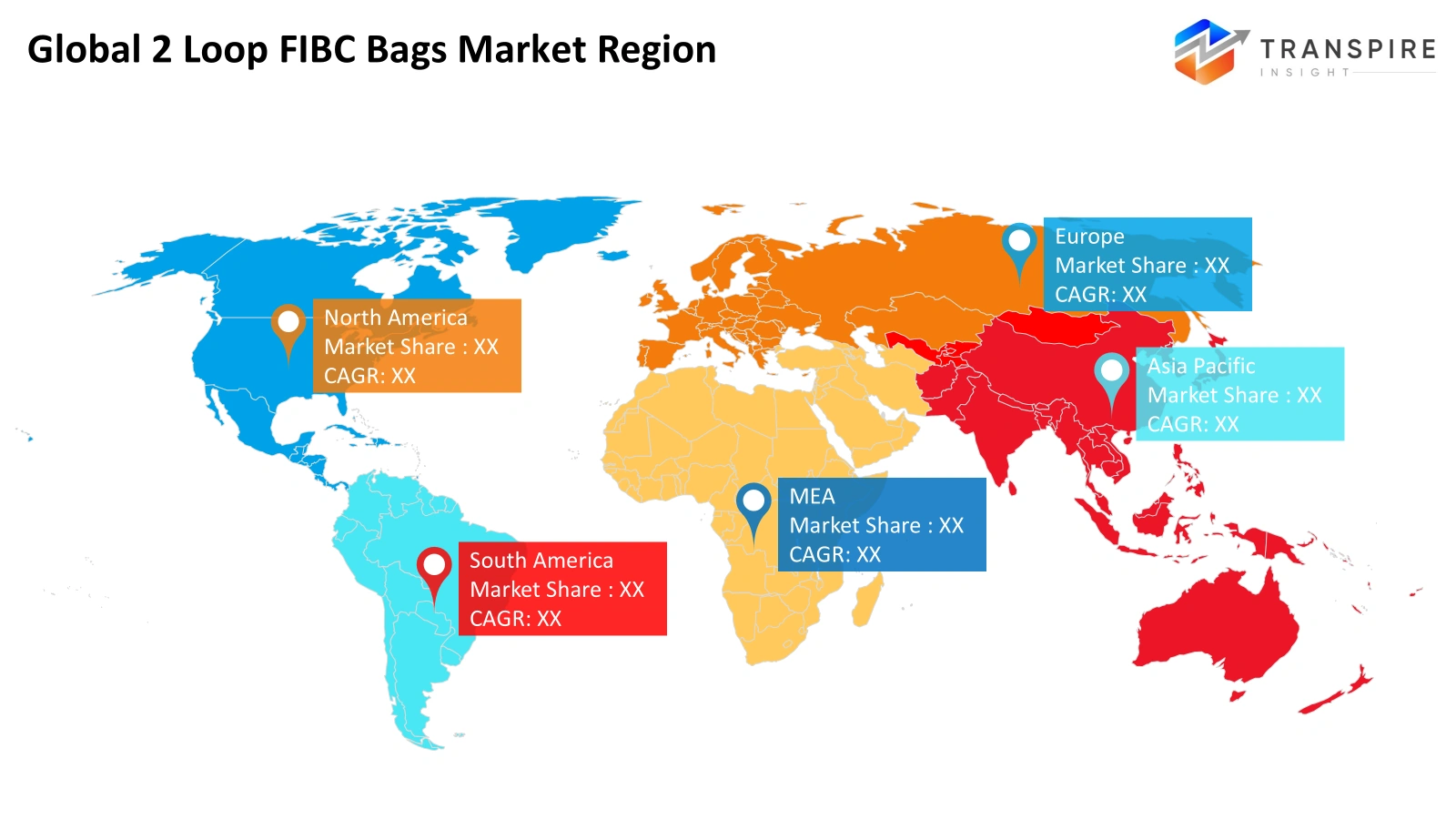
Latin America currently represents 6% of the global market but is projected to record the fastest growth with a CAGR of 12.1%. Rapid expansion of agricultural exports, fertiliser consumption, mining activities, and food processing industries is driving demand for efficient bulk packaging solutions across the region. Increasing industrial investments and improving logistics infrastructure are further accelerating adoption. Meanwhile, the Middle East & Africa, accounting for 5% of the market, is gradually creating new opportunities as infrastructure development, industrial diversification, and cross-border trade continue to increase demand for durable FIBC packaging solutions.
Europe
The share of Europe in the global 2 Loop FIBC bags market is estimated to be 23%, and North America holds 20%. There are specific reasons why these regions are leading in the market. Europe ensures stable demand due to packaging quality standards, sustainability, and wide use of industrial packaging products that can be easily recycled in the food, chemical, and pharmaceutical industries. The growth of North America is driven by developed logistics facilities, automation in the packaging process, and constant demand from agriculture, mining, and speciality chemicals markets.
Asia Pacific
Asia Pacific dominates the global 2 Loop FIBC bags market, accounting for 46% of the total market share, due to its robust manufacturing sector, increased exporting activities, and large production volumes of chemicals, fertilisers, foods, and building materials. Countries such as China and India gain an advantage from a well-developed polypropylene industry, cost-effective manufacturing, and constant investments into industrial facilities. Also, Asia Pacific is known as a major provider of bulk packaging products to the global market, thus increasing its dominance. Growing production volumes and international trade are expected to be key driving forces that will keep Asia Pacific leading in the future years.
Who are the Key Players in the Global 2 Loop FIBC Bags Marketand how do they Compete?
In the global 2 Loop FIBC bags industry, competition factors include product quality, manufacturing process efficiency, customizability, and international packaging standards. The leading organisations in the sector have been adopting innovative production techniques, sustainability initiatives like using recyclable materials, and developing application-based solutions to create their competitive advantage in the market. With increasing diversity in demand from agricultural, chemical, food processing, mining, and construction industries, organisations have been growing their global presence while concentrating on cost minimisation and building long-term customer relationships.
Companies like Berry Global Inc., LC Packaging International BV, Conitex Sonoco, Greif Inc., and Rishi FIBC Solutions Pvt. Ltd. have been competing in terms of offering a wide range of certified bulk packaging products for different kinds of industrial purposes. They distinguish themselves from other players based on the parameters of product quality, regulatory compliance, and customisation options that include food-grade, conductive, and heavy-duty FIBC bags. The other key players in the market, such as Halsted Corporation, Intertape Polymer Group, Emmbi Industries Ltd., Jumbo Bag Ltd., and Taihua Group, are concentrating on production capacity expansions, better exporting activities, and environmentally friendly packaging. They are making significant investments in using recyclable materials, designing lighter bags, and providing custom printing and labelling services. Forming strategic alliances with their distributors and industrial customers, alongside innovations in products and expansion into geographically diverse areas, are the main strategies that companies use to establish themselves within the global 2 Loop FIBC bags market.
Global 2 Loop FIBC Bags Market companies
- Greif
- Berry Global
- Conitex Sonoco
- LC Packaging
- Rishi FIBC
- BAG Corp
- Jumbo Bag Ltd.
- Halsted Corporation
- FlexiTuff Ventures
- Emmbi Industries
- Intertape Polymer Group
- Taihua Group
- Virgo Polymers
- Global-Pak
- Bulk Lift International
Recent Development News
In January 2026, FIBCA released the 2026 industry initiatives of the year aimed at safe handling, sustainability, and good practices in FIBC packaging. The program will help promote adoption of better bulk packaging standards and drive innovation in the international FIBC industry.
Source: https://fibca.com/
In September 2024, LC Packaging partnered with RAFF Plastics to launch a closed-loop recycling program that will turn used FIBC bags into new bulk bags. This initiative reinforced circular packaging practices, minimised the use of virgin plastic materials, and proved the viability of recycling in the FIBC industry.
Source: https://www.lcpackaging.com
What Strategic Insights Define the Future of the Global 2 Loop FIBC Bags Market?
The 2 Loop FIBC bags market around the world is poised to head towards high-performance, recyclable, and industry-specific bulk packaging due to growing focus on efficiency and compliance with environmental norms by various industries. The demand for the products would mainly come from food processing, chemicals, agricultural, mining, and construction sectors where durable and certified packaging is essential. On the other hand, another issue that is not so obvious is the risk of volatility of polypropylene resin prices and increasing stringency in the plastic packaging laws, both of which might lead to increased production cost and pressure on the manufacturer's margin of profits.
The primary growth opportunity for this market is the use of recyclable polypropylene, closed-loop recycling systems, and automation technology that would help to enhance the quality of the products while minimising material losses. Companies which would be investing in sustainable materials, customizable FIBC design, and production technology would stand a better chance to fulfil the changing requirements of their customers. In order to stay ahead of the competition, companies must develop a resilient supply chain, develop their product portfolio, and innovate in the process.
Key Segmentations are:
By Bag Type
- Standard 2 Loop Bags
- Baffle Bags
- Conductive Bags
- Ventilated Bags
- UN Certified Bags
- Food Grade Bags
- Anti-static Bags
By Capacity
- Below 500 kg
- 500–1000 kg
- 1000–1500 kg
- Above 1500 kg
- Medium Duty Bags
- Heavy Duty Bags
- Custom Capacity Bag
By Material
- Woven Polypropylene
- Laminated Polypropylene
- UV Stabilized Polypropylene
- Conductive Fabric
- Food Grade Fabric
- Recycled Polypropylene
- Virgin Polypropylene
By End User
- Agriculture
- Chemicals
- Food & Beverage
- Construction
- Mining
- Pharmaceuticals
- Fertilizers
By Design
- Circular Bags
- U-Panel Bags
- Four Panel Bags
- Tubular Bags
- Coated Bags
- Uncoated Bags
- Printed Bags
Regional Outlook
North America
- United States
- Canada
- Mexico
Europe
- Germany
- United Kingdom
- France
- Spain
- Italy
- Rest of Europe
Asia Pacific
- Japan
- China
- Australia & New Zealand
- South Korea
- India
- Rest of Asia Pacific
South America
- Brazil
- Argentina
- Rest of South America
Middle East & Africa
- Saudi Arabia
- United Arab Emirates
- South Africa
- Rest of the Middle East & Africa
Frequently Asked Questions
Find quick answers to common questions.
The global 2 loop FIBC bags market size was valued at USD 5.79 Billion in 2025 and is poised to reach USD 9.16 Billion by 2033, expanding at a 5.91% CAGR.
Key segments for the global 2 loop FIBC bags market are By Bag Type (Standard 2 Loop Bags, Baffle Bags, Conductive Bags, Ventilated Bags, UN Certified Bags, Food Grade Bags, Anti-static Bags, Others); By Capacity (Below 500 kg, 500–1000 kg, 1000–1500 kg, Above 1500 kg, Medium Duty Bags, Heavy Duty Bags, Custom Capacity Bags, Others); By Material (Woven Polypropylene, Laminated Polypropylene, UV Stabilized Polypropylene, Conductive Fabric, Food Grade Fabric, Recycled Polypropylene, Virgin Polypropylene, Others); By End User (Agriculture, Chemicals, Food & Beverage, Construction, Mining, Pharmaceuticals, Fertilizers, Others); By Design (Circular Bags, U-Panel Bags, Four Panel Bags, Tubular Bags, Coated Bags, Uncoated Bags, Printed Bags, Others).
Growth is primarily driven by the following factors. High demand for affordable bulk packaging, expansion in the agriculture industry, increased use in the chemical industry, increased international trade, and the use of lightweight packaging.
The global market is led by major manufacturers including Greif, Berry Global, Conitex Sonoco, LC Packaging, Rishi FIBC, BAG Corp, Jumbo Bag Ltd., Halsted Corporation, FlexiTuff Ventures, Emmbi Industries, Intertape Polymer Group, Taihua Group, Virgo Polymers, Global-Pak, Bulk Lift International.
Asia Pacific dominates the global 2 loops FIBC bags market share with 46%. This is due to the region’s robust manufacturing facilities, developing chemical and agriculture industries, low-cost manufacturing, higher exports, and increased bulk packaging requirements.
Market opportunities exist in the form of increased demand from agriculture, chemicals, food and construction industries, export growth, development of sustainable/recyclable FIBC bags and use of custom-made lightweight bulk packaging systems.
- Greif
- Berry Global
- Conitex Sonoco
- LC Packaging
- Rishi FIBC
- BAG Corp
- Jumbo Bag Ltd.
- Halsted Corporation
- FlexiTuff Ventures
- Emmbi Industries
- Intertape Polymer Group
- Taihua Group
- Virgo Polymers
- Global-Pak
- Bulk Lift International
About the Authors

Kartik bhong
I am Kartik Bhong, a Senior Research Analyst at Transpire Insight, specializing in the Packaging, Manufacturing, and Construction industry. My work focuses on analyzing market trends, emerging technologies, industry regulations, and competitive landscapes to deliver accurate, data-driven insights. I am passionate about transforming complex industry information into clear, practical content that helps businesses, professionals, and decision-makers stay informed and make confident strategic decisions. Through continuous research and a strong commitment to accuracy, I strive to create reliable, well-researched content that reflects the latest developments across these dynamic industries and supports the vision of Transpire Insight in delivering valuable market intelligence.

Chakradhar Khansole
Chakradhar serves as the Research Director at Transpire Insight, bringing over 8 years of experience in technology, innovation, and strategic market intelligence. He specializes in transforming complex market data into actionable business insights that enable organizations to make informed, growth-oriented decisions. Recognized for his strategic vision and analytical expertise, Chakradhar leads high-impact research initiatives, delivering comprehensive market assessments, competitive intelligence, and forward-looking industry analysis.
Recently Published Reports
-
Apr 2026
Pharmaceutical Cold Chain Packaging Market
Pharmaceutical Cold Chain Packaging Market By Material (Plastic,(Polyethylene (PE), Polypropylene (PP), Polyethylene Terephthalate (PET), Expanded Polystyrene (EPS), Polyurethane (PU),Others), Paper, Metal, Others), By Product (Small Boxes, Pallets, Large Sized Pallet Containers, Others), By End Use (Biopharmaceutical Companies, Clinical Research Organizations, Hospitals, Research Institutes, Logistics and Distribution Companies, Others)”, By Industry Analysis, Size, Share, Growth, Trends, and Forecasts 2026-2033
-
Apr 2026
Active & Intelligent Packaging Market
Active & Intelligent Packaging Market By Type (Active Packaging, Smart Packaging), By Material (Polymer-Based, Paper & Board-Based, Metal-Based, Glass-Based), By Technology (Time-Temperature Indicators, Freshness Indicators, RFID, Antimicrobial Packaging, Modified Atmosphere Packaging), By Application (Food & Beverages, Pharmaceutical, Cosmetics & Personal Care, Electronics & Consumer Goods, Others), By Industry Analysis, Size, Share, Growth, Trends, and Forecasts 2026-2033
-
Apr 2026
Biodegradable Cut Flower Packaging Market
Biodegradable Cut Flower Packaging Market By Material Type (Paper & Paperboard, Biodegradable Plastics, Natural Fibers, Molded Pulp, Others), By Product Type (Sleeves, Wraps, Boxes & Cartons, Bags & Pouches, Inserts & Holders), By Application (Roses, Carnations, Tulips, Chrysanthemums, Mixed Flowers, Others) and By Distribution Channel (Direct Sales, Distributors & Wholesalers, Online Channels), By Industry Analysis, Size, Share, Growth, Trends, and Forecasts 2026-2033
-
May 2026
Pharmaceutical Packaging Market
Pharmaceutical Packaging Market By Material Type (Plastic, Glass, Metal, Paper & Paperboard, Others), By Packaging Type (Bottles, Blister Packs, Vials, Ampoules, Pouches & Sachets, Others) and By End User (Hospitals & Clinics, Retail Pharmacies, Online Pharmacies, Pharmaceutical Manufacturers), By Industry Analysis, Size, Share, Growth, Trends, and Forecasts 2026-2033