

Asia Pacific Smart Agriculture Market Size & Forecast:
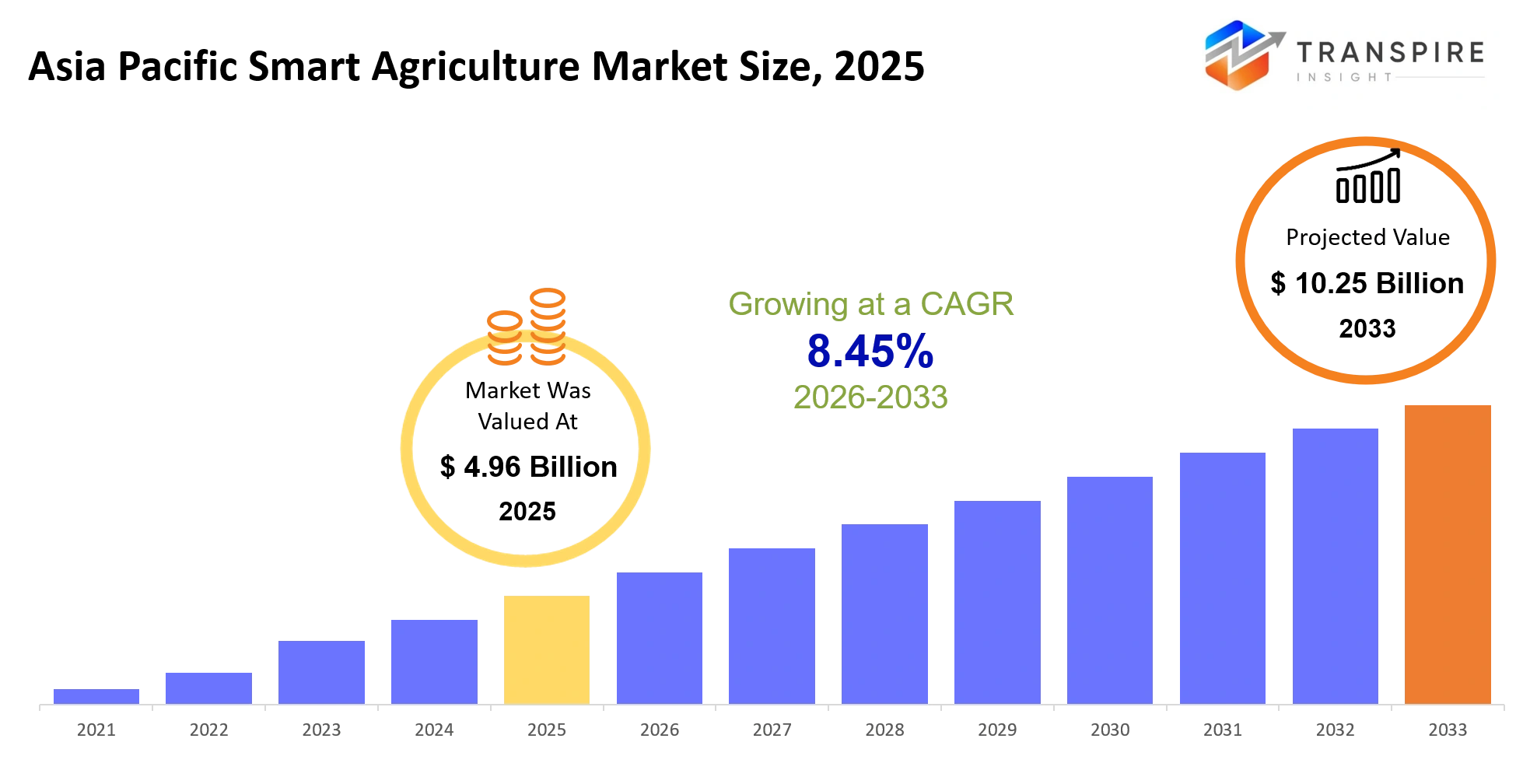
- Asia Pacific Smart Agriculture Market Size 2025: USD 4.96 Billion
- Asia Pacific Smart Agriculture Market Size 2033: USD 10.25 Billion
- Asia Pacific Smart Agriculture Market CAGR: 8.45%
- Asia Pacific Smart Agriculture Market Segments: By Technology (IoT, AI & Analytics, Drones, Robotics, GPS & GIS, Smart Irrigation, Sensors, Others); By Application (Precision Farming, Livestock Monitoring, Greenhouse Farming, Crop Monitoring, Yield Management, Others); By Deployment (Cloud, On-Premise, Hybrid, Others); By End User (Farmers, Agribusinesses, Cooperatives, Government Agencies, Others).
To learn more about this report,  Download Free Sample Report
Asia Pacific Smart Agriculture Market Summary
The Asia Pacific Smart Agriculture Market was valued at USD 4.96 Billion in 2025. It is forecast to reach USD 10.25 Billion by 2033. That is a CAGR of 8.45% over the period.
The Asia Pacific Smart Agriculture Market sorta lets farmers and agribusinesses manage crop production by using real time data from sensors , satellites, drones, and connected farm machinery. This helps with better decisions around irrigation, fertilization, pest management, plus when to time the harvest. Instead of just going on field “gut feelings” alone, many operators are turning to analytics platforms that aim to optimize yield per hectare, while also cutting down on input waste across those really fragmented farming setups .
Over the last five years, the whole thing seems to have moved away from standalone precision tools into more connected digital farming ecosystems that bring together IoT devices, cloud platforms, and AI driven agronomic insights. One important structural shift has been consolidating farm management technologies into unified platforms , so the field level signals can link up with supply chain planning. A big part of what sped things up has been volatility in fertilizer and crop input prices, especially after global supply chain disruptions , which basically made producers lock in on efficiency and cost optimization. Meanwhile climate variability across key agricultural economies has also gotten more intense, and that raises production risk. So stakeholders are leaning toward data-led farming models, because they improve resilience and make output predictability feel more reliable.
Key Market Insights
- The Asia Pacific Smart Agriculture Market is really expanding, because farmers are starting to use IoT based precision farming tools, they do it to optimize irrigation and fertilizer use, plus those real time crop monitoring decisions.
- Also, digital agriculture platforms are bringing in AI analytics along with satellite imaging which helps with yield forecasting accuracy by nearly 20% across the bigger farms.
- There’s this structural shift too , moving toward unified farm management systems that replace standalone sensor setups, and that’s changing the whole Asia Pacific Smart Agriculture Market ecosystem in practice.
- In 2025, China holds roughly 35% of the market, mainly due to large scale mechanization, and government backed smart farming programs, and all that.
- Meanwhile, software platforms sit as the second largest segment, fueled by rising demand for farm analytics and cloud based decision systems.
- Precision irrigation apps kind of dominate with about 30% share, sort of showing water scarcity pressures and efficiency driven farming routines.
- Drone based crop monitoring is the fastest growing part, it's expanding fast because costs are going down, and imaging accuracy keeps getting better.
- Meanwhile large commercial farms still are the leading end user slice, pushing over 50% share, mainly due to how scalable smart agriculture investments can be.
- Smallholder farmers are the fastest growing end user group too, backed by cheaper mobile based advisory platforms, plus agri fintech integration too.
- Some key players are John Deere, Trimble Inc , Bayer AG, AGCO Corporation, Kubota Corporation and XAG.
What are the Key Drivers, Restraints, and Opportunities in the Asia Pacific Smart Agriculture Market?
The main drive behind the Asia Pacific Smart Agriculture Market is basically the growing need to squeeze better agricultural productivity while input costs get tighter and climate conditions keep acting unstable. I mean, fertilizer and water prices swing around a lot, and that has nudged farms toward sensor led irrigation systems and AI based crop monitoring tools. In practice this helps with yield predictability, and also cuts down operational waste, like the daily stuff people used to lose. Because of that , technology adoption cycles start moving faster, especially in China, India and Australia, where big operations can turn efficiency gains into revenue pretty quickly .
The biggest restraint though is more like fragmented land holding patterns , plus a lack of digital infrastructure in many rural zones, so deployment of integrated smart farming systems becomes slower. A lot of smallholder farms don’t have steady connectivity , or they struggle with capital access . So adoption ends up uneven, across different regions. This kind of structural issue delays revenue for the solution providers , and it also blocks full ecosystem integration, notably in parts of emerging Southeast Asian agricultural markets.
A solid opportunity sits in satellite enabled precision agriculture , teamed with low cost mobile advisory platforms. Governments and agri tech startups are getting more interest and investment in digital agriculture corridors, particularly in India and Vietnam, where scalable cloud farming models are being tested. As those ecosystems grow more mature, they’re expected to open up the next phase of growth in the Asia Pacific Smart Agriculture Market, by making low cost data driven farming possible even for smallholder producers .
What Has the Impact of Artificial Intelligence Been on the Asia Pacific Smart Agriculture Market?
Artificial intelligence is sorta transforming the Asia Pacific Smart Agriculture Market, by enabling real time decision making across irrigation, crop wellness monitoring, and yield optimization systems. AI powered platforms take in satellite images , soil sensors, plus weather information and then use that to automate irrigation timing and fertilizer dosing. This reduces the usual manual touch, and it tends to boost input efficiency across pretty large farms.
At the same time predictive analytics models are more and more used to forecast crop diseases , expected yield results, and resource needs with stronger precision. that helps farmers pivot their planting strategies before the seasonal risks really show up. Also machine learning algorithms quietly improve drone imaging workflows, which upgrades detection of pest activity and nutrient shortfalls during early stages. In practical terms, these uses have led to documented gains, luke 10–25% less water use, and more consistent yield outputs across precision managed farms.
Still, adoption isn’t frictionless , because there are not enough high quality agricultural datasets in many places. plus field conditions can be inconsistent, so model accuracy drops when you move across different soil types and climate zones. And there’s also the integration cost issue for AI enabled hardware, plus connectivity gaps in rural areas, both of which slow down wider deployment. Even so, AI keeps reshaping operational efficiency in the Asia Pacific Smart Agriculture Market by supporting scalable, data driven farming systems, while lowering how much farmers rely on manual inspections and older style forecasting approaches.
Key Market Trends
- Farmers have slowly moved away from manual irrigation methods toward sensor powered automation stuff, and it cut water use by around 15–25% across irrigated farms since 2022.
- Governments in China and India also expanded digital agriculture subsidies after 2023, which sort of sped up large scale take up of precision farming tools in a bunch of rural areas.
- Meanwhile agribusinesses stopped relying on standalone farm gadgets and started leaning into connected digital ecosystems, mixing IoT, AI analytics, and cloud farm management platforms, since 2021.
- Drone based crop monitoring really jumped after 2022, it’s kind of replacing older field scouting routines, and pest detection is faster by more than 30% too .
- Because fertilizer prices have been wild since 2022, farmers leaned into precision nutrient management systems, trimming surplus fertilizer use and helping keep yield costs more stable.
- Companies like John Deere and Trimble Inc. widened their AI driven farm analytics platforms across Asia Pacific distribution networks in 2023.
- Better rural connectivity after 2021 helped cloud agriculture platforms grow, especially in India , Vietnam, and Indonesia where farming regions can be pretty fragmented.
- Also, traditional farm machinery brands have shifted toward software tied equipment, putting sensors and telematics into tractors and harvesters since 2022, not just mechanical upgrades.
- Climate variability got stronger after 2023, so regulators and agritech firms are prioritizing predictive agriculture models for yield risk mitigation, more than before.
- And smallholder farmers are increasingly using mobile first advisory apps rather than in person extension services, which is accelerating digital involvement across Southeast Asian agriculture systems
Asia Pacific Smart Agriculture Market Segmentation
By Technology:
IoT, AI and analytics, drones , robotics, GPS and GIS , smart irrigation, sensors, and other tools are changing how farming is managed across the region. Like, these technologies help farmers track soil conditions, weather patterns, and crop health in real time. Over the last few years, simple sensor use has kind of moved toward connected systems that share data across platforms, which then helps farm decisions, and also cuts down on waste .
AI and analytics tools now guide irrigation timing and fertilizer use with better accuracy than the older, traditional methods . Drones and GPS systems have moved from limited use to wider field coverage, so crop checks happen faster, plus mapping is improved. Smart irrigation systems and sensor networks are now more linked with cloud platforms, which helps with better water control and improves overall farm output consistency.
By Application:
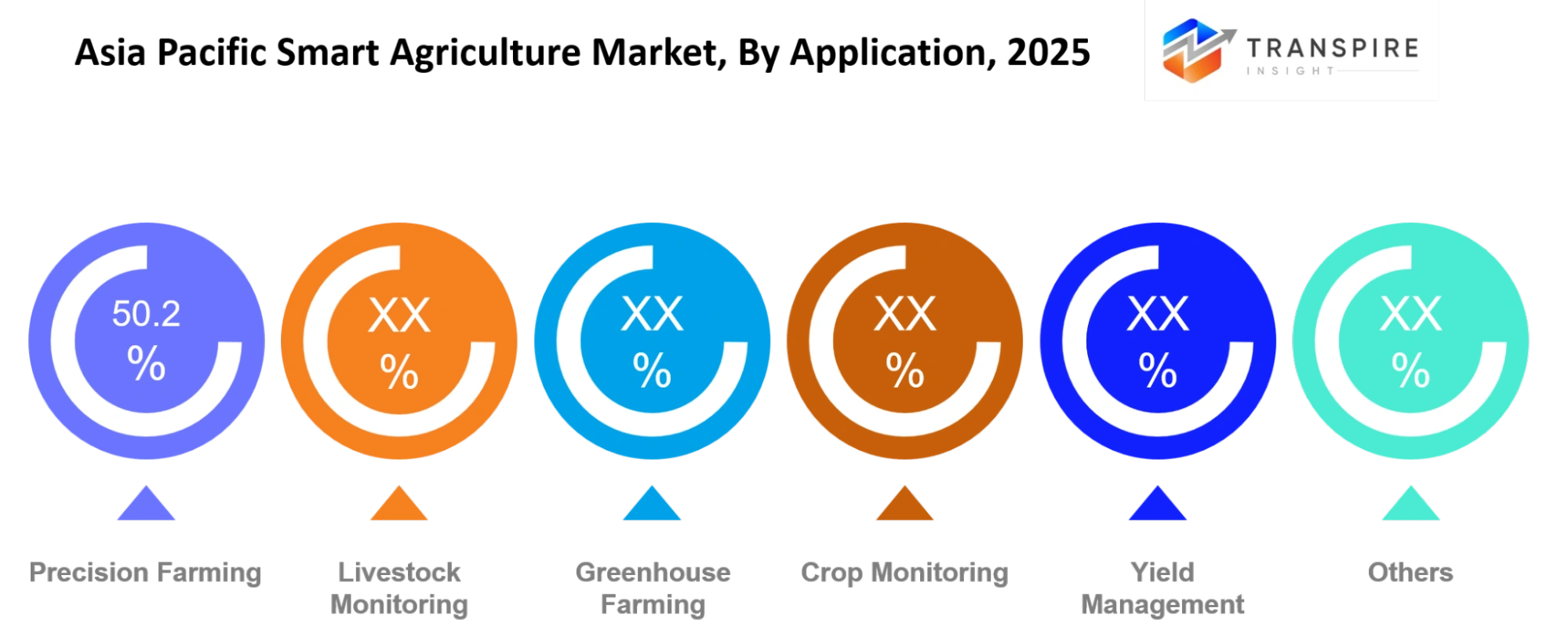
Precision farming, livestock monitoring , greenhouse farming, crop monitoring, yield management, and related uses are shaping modern agricultural practices. Precision farming has gone from trial use to regular adoption, as farmers focus on reducing input costs, and improving output. Crop monitoring has become more digital, replacing manual field checks in many regions.
Yield management systems are now used more widely to plan harvest timing and reduce post-harvest losses . Greenhouse farming has moved toward automated control of temperature and humidity, so crop quality gets better. Livestock monitoring is also improving with sensor based tracking that helps with early detection of health issues, which leads to better animal care and fewer losses.
To learn more about this report, Download Free Sample Report
By Deployment:
Cloud, on-premise, hybrid, and a few other models are now helping how agricultural data is stored and used, pretty much everywhere. Cloud deployment is moving ahead strongly, as farmers and agribusinesses shift away from local setups toward shared digital platforms. In practice this means real-time access to farm data from remote places and better coordination across day to day farming operations
On-premise systems still get used in places where internet access is weak, but their presence is slowly declining now that connectivity keeps improving. Hybrid systems are turning up more and more, since they kind of mix local governance with cloud reach. That balance makes data handling feel smoother, and it helps farmers respond quickly when weather shifts or when market conditions change, even if it’s sudden
By End User:
Adoption of smart farming tools is being pushed by farmers, agribusinesses, cooperatives, government agencies, and other participants in the supply ecosystem. Farmers are using mobile based platforms and sensor tools more often, to make decisions for dairy farming, for example. Overall the process is moving from experience based methods to data supported planning in many parts of agriculture
At the same time, agribusinesses are funding bigger digital systems to oversee supply chains and boost productivity. Cooperatives are also leaning into shared technology models so they can back smaller farmers who have limited resources. Government agencies add another layer too, because they support digital agriculture initiatives, and those programs expand access to modern farm tools while lifting agricultural efficiency across the region
What are the Key Use Cases Driving the Asia Pacific Smart Agriculture Market?
Precision farming is still kinda like the main use case across the Asia Pacific Smart Agriculture Market, because it really does tie into better crop yield and also lower costs for inputs. People on the ground tend to lean on real time soil sensors , satellite feeds and AI driven irrigation planning to deal with water stress and fertilizer use in a more efficient, kind of exact way. This whole use case keeps pulling in strong demand since it helps profitability, especially in areas where land is split up into smaller parcels and where climate makes yields jump around unpredictably.
Crop monitoring and yield management are also growing, and this is mostly showing up with agribusinesses and cooperatives running larger contract farming setups. They typically use drone imaging, GPS mapping and predictive analytics to watch crop health across scattered plots, and then they coordinate harvesting timing more smoothly, which is useful when schedules can’t really drift. On a parallel track livestock monitoring is picking up too , particularly for commercial dairy and poultry operators who want improved health tracking and smarter feed optimization.
More emerging use cases are starting to show up as well: like autonomous farm robotics for planting and harvesting, plus climate risk prediction platforms that pull together long range weather modeling. In addition, government backed digital agriculture programs are testing blockchain based traceability systems, mainly so they can improve food supply transparency and stay aligned with export requirements.
|
Report Metrics |
Details |
|
Market size value in 2025 |
USD 4.96 Billion |
|
Market size value in 2026 |
USD 5.81 Billion |
|
Revenue forecast in 2033 |
USD 10.25 Billion |
|
Growth rate |
CAGR of 8.45% from 2026 to 2033 |
|
Base year |
2025 |
|
Historical data |
2021 - 2024 |
|
Forecast period |
2026 - 2033 |
|
Report coverage |
Revenue forecast, competitive landscape, growth factors, and trends |
|
Regional scope |
Asia Pacific (India, China, Japan, Australia, South Korea, Rest of Asia Pacific) |
|
Key company profiled |
John Deere, Trimble, AGCO, Bayer, Syngenta, IBM, Microsoft, Bosch, DJI, Topcon, CropX, DeLaval, CNH Industrial, Hexagon, Oracle. |
|
Customization scope |
Free report customization (country, regional & segment scope). Avail customized purchase options to meet your exact research needs. |
|
Report Segmentation |
By Technology (IoT, AI & Analytics, Drones, Robotics, GPS & GIS, Smart Irrigation, Sensors, Others); By Application (Precision Farming, Livestock Monitoring, Greenhouse Farming, Crop Monitoring, Yield Management, Others); By Deployment (Cloud, On-Premise, Hybrid, Others); By End User (Farmers, Agribusinesses, Cooperatives, Government Agencies, Others). |
Which Regions are Driving the Asia Pacific Smart Agriculture Market Growth?
In the Asia Pacific Smart Agriculture Market, China sort of leads, mainly because it has a massive commercial farming base and pretty solid, government-backed digital farming programs, you know the usual. National policies that lean into precision farming, smarter irrigation and AI-led crop monitoring have basically sped up tech uptake across a lot of agricultural provinces. There is also a reasonably mature agri-tech ecosystem, with strong manufacturing muscle for sensors, drones and farm machinery, so deployment keeps happening at scale. On top of that, the links between research institutions and agribusinesses feel tighter, which helps adoption move along faster and commercialization happen quicker for newer farming tools.
India sits as a pretty steady second region, mostly from ongoing agricultural needs, plus a gradual but constant shift toward digital practices in farming communities. Instead of China’s very large mechanized farming setup, India’s progress is more tied to smallholder farmers using mobile-based advisory platforms, and also through subsidized agri-tech access programs. Government efforts around soil health monitoring, and irrigation efficiency improvements, add longer-term steadiness to how adoption patterns play out. So even if there isn’t that rapid industrial-scale consolidation, the roll out remains consistent enough to keep contributing market revenue over time.
Southeast Asia looks like the fastest growing region, kinda backed by new investments in agri-digital infrastructure and those export-facing crop modernization programs. Lately, Countries such as Vietnam, Indonesia, and Thailand have expanded smart irrigation, and drone based crop monitoring after 2023 , to boost productivity in plantation farming. The demand for climate resilient farming techniques is rising too, and that has really sped up adoption, even more then before. For market entrants as well as investors, this area seems like a solid place to expand between 2026 and 2033 , mainly because the agricultural base is still under digitized and the overall technology readiness keeps climbing.
Who are the Key Players in the Asia Pacific Smart Agriculture Market and How Do They Compete?
The Asia Pacific Smart Agriculture Market looks like its moderately fragmented, and it sort of feels competitive in two lanes: big global agricultural machinery names on one side, and then specialized agri-tech startups on the other,yeah. The push in this space is mostly about technology integration , how quickly solutions can be deployed, and whether players can actually deliver data guided farming results, not just sell equipment and call it a day. Most established brands tend to upgrade older machinery by adding sensors and software, but the newer players show up with drone analytics, AI platforms, and mobile first farm management tools that quietly, or not so quietly, mess with the usual business models.
John Deere leans hard into technology led equipment integration, basically embedding precision sensors plus AI based analytics into tractors and harvesting systems. That approach gives it an edge in big commercial farms where end to end mechanization improves operating efficiency and also cuts down labor dependency. Their expansion strategy seems to revolve around digital farming platforms and ongoing partnerships with regional distributors across Asia Pacific
Trimble Inc. plays its part through geospatial accuracy and farm data analytics, and it differentiates with high precision mapping and guidance systems. A lot of its offerings get used for yield optimization and field level planning, especially in large scale farming operations. The growth engine is supported by cloud platform upgrades and integration deals with agribusiness software providers.
XAG specializes in autonomous drones and smart spraying systems, focusing on areas where farming is still pretty labor intensive. Kubota Corporation, meanwhile, reinforces its position with dependable mechanized equipment that is adapted for small to mid sized farms across Asia. Bayer AG expands by leaning into digital agronomy platforms that bring seeds, crop protection, and data advisory services together into one farming ecosystem.
Company List
- John Deere
- Trimble
- AGCO
- Bayer
- Syngenta
- IBM
- Microsoft
- Bosch
- DJI
- Topcon
- CropX
- DeLaval
- CNH Industrial
- Hexagon
- Oracle
Recent Development News
In October 2025, Google expanded its India-developed Agricultural Landscape Understanding (ALU) and Agricultural Monitoring & Event Detection (AMED) AI tools to Malaysia, Vietnam, Indonesia, and Japan. The rollout enables satellite-based crop monitoring and event detection at scale, improving early risk identification for farmers and agribusinesses.
Source: https://timesofindia.indiatimes.com/
What Strategic Insights Define the Future of the Asia Pacific Smart Agriculture Market?
The Asia Pacific Smart Agriculture Market feels like it is slowly, but really, moving toward more fully integrated data-centric farming setups where AI plus IoT and remote sensing kinda run as one decision layer across the whole production cycle. You can see it being pushed by input cost pressure that's rising, climate instability, and this ongoing need to optimize yields even when land is fragmented and the holdings are small. In the next 5–7 years value creation looks like it will gather around platforms that tie together hardware, analytics, and advisory services, not just standalone equipment, if that makes sense.
One less visible but real concern is the growing dependency on a fairly small circle of cloud and analytics providers, and that could translate into pricing pressure, plus awkward data access constraints for farmers and agribusinesses. This kind of concentration could also quietly slow down innovation and make interoperability between different systems harder than it should be.
At the same time there’s a strong emerging chance in satellite-enabled micro-farm intelligence combined with mobile-first advisory models for smallholder farmers across Southeast Asia and India. It is still kinda underpenetrated, but it is picking up speed because of public digital agriculture programs. Market players really should focus on building interoperable low-cost platforms that include local language interfaces, and offline functionality too, so they can capture the next wave of rural digital adoption.
Asia Pacific Smart Agriculture Market Report Segmentation
By Technology
- IoT
- AI & Analytics
- Drones
- Robotics
- GPS & GIS
- Smart Irrigation
- Sensors
By Application
- Precision Farming
- Livestock Monitoring
- Greenhouse Farming
- Crop Monitoring
- Yield Management
By Deployment
- Cloud
- On-Premise
- Hybrid
By End User
- Farmers
- Agribusinesses
- Cooperatives
- Government Agencies
Frequently Asked Questions
Find quick answers to common questions.
The expected Asia Pacific Smart Agriculture Market size is USD 10.25 Billion in 2033.
Key segments for the Asia Pacific Smart Agriculture Market are By Technology (IoT, AI & Analytics, Drones, Robotics, GPS & GIS, Smart Irrigation, Sensors, Others); By Application (Precision Farming, Livestock Monitoring, Greenhouse Farming, Crop Monitoring, Yield Management, Others); By Deployment (Cloud, On-Premise, Hybrid, Others); By End User (Farmers, Agribusinesses, Cooperatives, Government Agencies, Others).
Major Asia Pacific Smart Agriculture Market players are John Deere, Trimble, AGCO, Bayer, Syngenta, IBM, Microsoft, Bosch, DJI, Topcon, CropX, DeLaval, CNH Industrial, Hexagon, Oracle.
The Asia Pacific Smart Agriculture Market size is USD 4.96 Billion in 2025.
The Asia Pacific Smart Agriculture Market CAGR is 8.45% from 2026 to 2033.
- John Deere
- Trimble
- AGCO
- Bayer
- Syngenta
- IBM
- Microsoft
- Bosch
- DJI
- Topcon
- CropX
- DeLaval
- CNH Industrial
- Hexagon
- Oracle
About the Authors

Avinash Kumar
I’m Avinash Kumar, a Senior Research Analyst at Transpire Insight, with expertise in the Electronics and Semiconductor and Energy & Power industry. My work focuses on analyzing emerging technologies, market trends, industry developments, and innovation across these sectors. I specialize in transforming complex technical and market insights into clear, research-backed content that helps professionals, businesses, and decision-makers stay informed. Through continuous industry research and data-driven analysis, I strive to deliver accurate, reliable, and practical perspectives on the latest advancements shaping the semiconductor and energy landscape.

Chakradhar Khansole
Chakradhar serves as the Research Director at Transpire Insight, bringing over 8 years of experience in technology, innovation, and strategic market intelligence. He specializes in transforming complex market data into actionable business insights that enable organizations to make informed, growth-oriented decisions. Recognized for his strategic vision and analytical expertise, Chakradhar leads high-impact research initiatives, delivering comprehensive market assessments, competitive intelligence, and forward-looking industry analysis.
Recently Published Reports
-
Apr 2026
Fiber Optic Faceplates Market
Fiber Optic Faceplates Market Size, Share & Analysis Report By Type (< 300 mm2, 300-350 mm2, and > 350 mm2, By Application (Night Vision, Holographic Imaging, Medical, and Others), and Geography (North America, Europe, Asia-Pacific, Middle East and Africa, South and Central America), 2021 - 2031
-
Apr 2026
High Temperature Superconductors Market
High Temperature Superconductors Market Size, Share & Analysis Report By Type (1G HTS, and 2G HTS), By Application (Power Cable, Fault Current Limiter, and Transformer), and Geography (North America, Europe, Asia-Pacific, Middle East and Africa, South and Central America), 2021 - 2031
-
Apr 2026
Industrial Plugs and Socket Market
Industrial Plugs and Socket Market Size, Share & Analysis Report By Type (Industrial Plugs, Industrial Sockets), By Current (Up to 32 A, 32 to 125 A, Above 125 A), By Protection (Dustproof and Splash Proof, Waterproof, Explosion Proof), By End User (Heavy Industries, Oil and Gas, Chemicals and Pharmaceuticals, Power Generation, Others), and Geography (North America, Europe, Asia-Pacific, Middle East and Africa, South and Central America), 2021 - 2031
-
Apr 2026
InGaAs Avalanche Photodiodes Market
InGaAs Avalanche Photodiodes Market Size, Share & Analysis Report By Type (1100 - 1700 nm, and 1000 - 1600 nm), By Application (Missile Warning System, Muzzle Flash Detection, Wafer Defect Inspection, Laser Rangefinders, and Others), and Geography (North America, Europe, Asia-Pacific, Middle East and Africa, South and Central America), 2021 - 2031