

Germany Child Day Care Services Market Summary
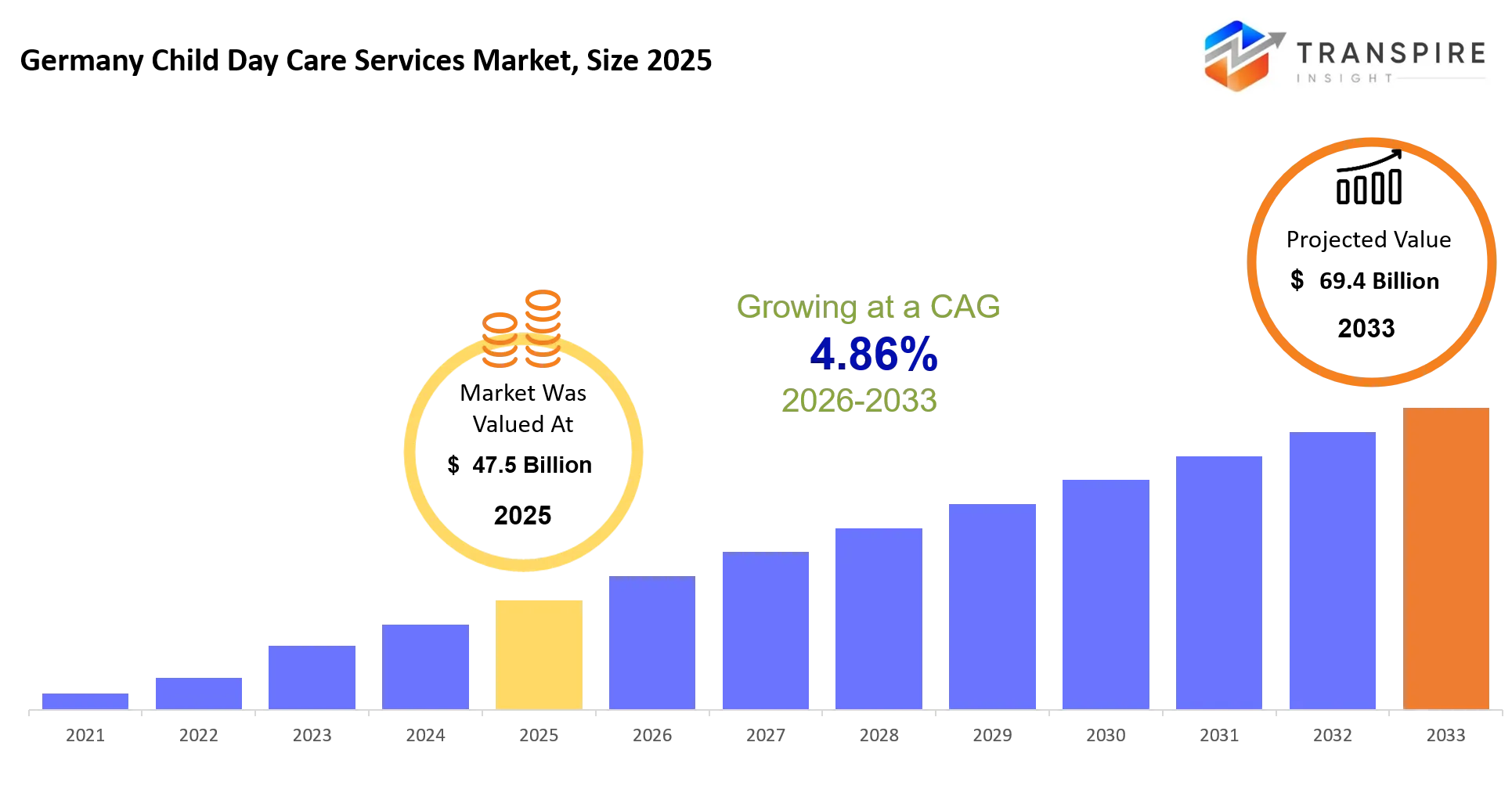
As per Transpire Insight Analysis the Germany Child Day Care Services Market size is estimated at USD 47.5 Billion in 2025 and is anticipated to reach USD 69.4 Billion by 2033, growing at a CAGR of 4.86% from 2026 to 2033.
The German Child Day Care Services Market plays a critical role in enabling parents to work while ensuring kids receive structured early-years education, supervision, and consistent developmental support. In practice, day care providers kind of bridge that tricky line between home-based care and formal learning, by delivering age-aligned activities, balanced nutrition ,and social growth services. Over the past five years, the whole market seems to move more toward integrated early education models, backed by stronger federal and state spending, mostly to raise childcare accessibility and push quality standards higher. Then the COVID-19 pandemic sort of shoved the change faster , because it made childcare shortages more visible, and it led governments, employers and local organizations to beef up childcare infrastructure plus add workplace family support programs.
More dual income households now lean on professional childcare, and employers are also doing more direct subsidization of childcare benefits to keep talent in place. As a result, occupancy rates keep trending up ,and premium service adoption is gradually improving too. Put together, these shifts from demographics, labor participation, and policy supported capacity building are supporting stronger, longer term revenue across Germany’s childcare services ecosystem.
Germany Child Day Care Services Market Size & Forecast:
- Germany Child Day Care Services Market Size 2025: USD 47.5 Billion
- Expected Market Value 2033: USD 69.4 Billion
- Forecast CAGR: 4.86%
- Key Profile: Bright Horizons, KinderCare Learning Companies, Babilou Group, Busy Bees, Grandir, Learning Care Group, Kinderhut, Fröbel Bildung und Erziehung, AWO, Johanniter, DRK Kinderbetreuung, Diakonie Deutschland, Caritas Deutschland, pme Familienservice, Wichtel Akademie
Key Market Insights
- Regional Analysis: Western Germany kinda just… dominates the Germany Child Day Care Services Market, with roughly 52% share in 2025, helped by dense cities and already in-place childcare infrastructure.
- Regional Analysis: Eastern Germany is expected to grow the quickest through 2033, mostly because participation rates in childcare are higher there, plus municipalities keep putting in money, and more initiatives.
- Segment Analysis: Center-based childcare services are leading, taking nearly 61% in 2025, mainly due to regulated educational programs and full-day care options that are pretty standard.
- Segment Analysis: Home-based childcare stays the second-biggest service segment, while employer-supported childcare is the fastest-growing one during the forecast window.
- Application Insights: Full-day childcare is the dominant application, around 65% market share, mirroring Germany’s dual-income workforce growth and longer working hours.
- Application Insights: After-school care is starting to rise the fastest too, backed by nationwide growth of all-day school programs, plus childcare routines that are more flexible, and easier to match.
- End-User Insights: Kids aged 1–6 years make up almost 70% of total usage, so preschool education ends up being the biggest end-user category.
- End-User Insights: Infants under one year are actually the fastest-growing end-user group, supported by more parental leave flexibility and extra nursery capacity coming online.
- Competitive Landscape: Bright Horizons, Busy Bees, Babilou Group, Fröbel Bildung und Erziehung, Caritas Deutschland, and pme Familienservice keep pushing ahead with strategic expansion, like acquisitions, employer linkups, digital parent engagement platforms, and curriculum-related innovation.
What are the Key Drivers, Restraints, and Opportunities in the Germany Child Day Care Services Market?
Driver: The strongest growth driver is Germany's ongoing public spending on early childhood education, with policies that push parents higher into the workforce at the same time. Federal and state governments keep expanding childcare capacity while employers are more often financing childcare benefits, like a kind of talent retention strategy. These initiatives directly raise enrollment levels and boost facility utilization, and they also support premium childcare programs with richer educational services. Since labor shortages are still there across multiple industries, accessible childcare has basically turned into an important economic enabler, which then helps strengthen longer term market revenues.
Restraint: The main structural problem is still the lack of qualified childcare professionals. Bringing in and keeping certified educators takes years of training , and demographic pressures keep pushing demand upward. Staffing shortages restrict how much facilities can run, they delay new center openings, and they limit occupancy even when the physical infrastructure exists. At the same time rising wage costs squeeze operating margins, so fast expansion becomes financially hard for many providers.
Opportunity: Digital childcare management platforms, paired with employer sponsored childcare arrangements, create a major opportunity for future growth. Cloud based enrollment systems, parent communication apps , automated billing, and workforce scheduling improve operational efficiency while also upgrading the customer experience. Meanwhile, corporate money for workplace childcare facilities is rising in metropolitan areas like Munich, Frankfurt , and Berlin, which opens up new revenue streams for both public and private childcare operators.
What Has the Impact of Artificial Intelligence Been on the Germany Child Day Care Services Market?
Artificial intelligence and advanced digital technologies are slowly shifting how childcare works in Germany,mostly by making the admin side feel less heavy, by supporting workforce coordination and by giving early education that’s a bit more customized. For instance, AI-powered scheduling tools can handle educator assignments using attendance forecasts, staffing constraints and those child-to-caregiver ratios. In the real world, that reduces a lot of back and forth paperwork, while still staying aligned with the compliance requirements. Then machine learning models look at earlier enrollment trends to estimate future occupancy, so providers can plan staffing, materials, and timing better, and also avoid having unused capacity sitting there idle.
At the same time, digital learning platforms are adding adaptive techniques that adjust activities based on a child’s developmental movement, kind of step by step. This lets educators follow learning progress more consistently rather than relying on scattered observations. Also, AI-enabled communication tools can automate parent updates, attendance tracking meal planning, and incident logs, which improves operational clarity. Less paperwork, more visibility. Predictive analytics can even support maintenance planning for childcare buildings by detecting when particular equipment should be serviced before breakdowns interrupt the daily routine.
Still, the big catch is that AI adoption is not moving as fast as people hope. The implementation costs are often high, and there are strict data privacy obligations under European rules. Plus, working with children’s personal information is inherently sensitive. Smaller providers, unfortunately, tend to have neither the budget nor the digital know-how needed to plug in these advanced systems. So the wider rollout across Germany’s childcare services ecosystem becomes slower, and a bit uneven.
Key Market Trends
- Since 2021, employer sponsored childcare partnerships have expanded by more than 20% , kind of helping businesses hang on to employees better, while also nudging childcare enrollment higher.
- Public money for childcare infrastructure has picked up after the pandemic, so municipalities could scale licensed capacity more quickly and chip away at waiting lists in many major cities.
- Meanwhile providers, like Busy Bees, Babilou Group, and Fröbel Bildung und Erziehung, have been building up regional networks with acquisitions and fresh facility openings since 2022, not always in the same rhythm, but still moving forward.
- Digital enrollment, attendance management, and parent communication platforms have pretty much become normal day to day tools now, and in big childcare organizations they’re cutting back admin workloads by around 25–30% .
- Also, demand seems to have drifted toward full day childcare programs, with dual income households and more flexible work patterns continuing to reshape how parents use childcare across Germany.
- AI supported workforce scheduling plus occupancy forecasting have improved staffing efficiency, which lets larger providers plan educator allocation more smartly across the year.
- Premium childcare operators are differentiating more often too, for example with bilingual education, STEM centered learning programs, and upgraded developmental assessment tools.
- Sustainability themes have really gained momentum since 2023 , with newer facilities using energy efficient building designs, healthier indoor settings, and environmentally responsible educational materials.
- And public private collaboration keeps widening childcare access in major metropolitan areas, so capacity grows and service quality gets better, not just one or the other.
Germany Child Day Care Services Market Segmentation
By Service Type
Center-Based Care stays the biggest category, mainly because structured learning settings, certified caregivers, and regulated safety benchmarks somehow click with what working families need across Germany. Home-Based Care comes with flexibility, like adjusted timetables and smaller groups, plus familiar surroundings, which works well for families wanting personalized focus. Preschool Programs center on early learning, language growth, social contact, and being ready for school before formal lessons really start. After-School Care carries kids beyond class hours with supervised activities, calm recreation, and homework help too.
Infant Care tackles the special needs for children under one year, using trained staff, age-suitable nutrition, and nonstop supervision. Special Needs Child Care provides tailored learning and developmental support via specialized facilities and qualified experts. Holiday Care supports families during school breaks, with short-term childcare and educational experiences, so there’s less stress overall. Others basically cover additional options such as adaptable childcare that fits local community needs, longer opening times, and customized family assistance programs, depending on the area.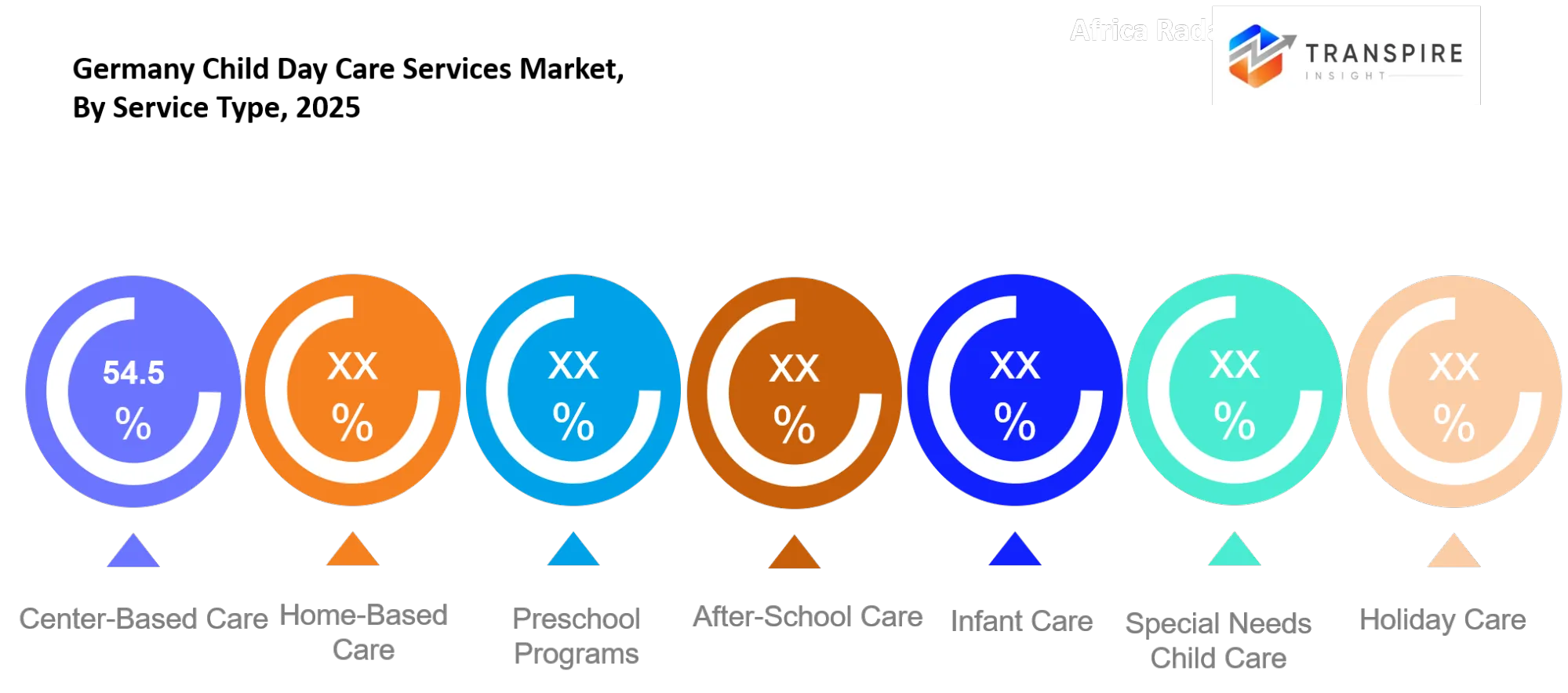
By Age Group
Infants need super specialized care that is all about safety, health check ups, consistent feeding routines, and those early developmental things, like gentle stimulation and age appropriate play. Toddlers usually do better with a more organized style of play, communication development, and supervised learning moments that nudge social contact and cognitive growth along. Preschool Children are the biggest age group, because early education programs help them get ready for primary school through organized classroom activities, and skill building , kind of day by day. School-Age Children mostly rely on after school and holiday services that try to balance school help with recreational downtime, so it does not feel only like homework.
Special Care Children are different, they often need individualized learning plans, therapeutic guidance, and caregivers who are really dedicated, so both developmental and medical needs are handled properly. Others can include mixed age childcare setups and flexible enrollment options , these match changing family schedules, pretty straightforward. Service providers keep updating their programs based on developmental milestones and what educators expect over time. Age specific services generally improve learning outcomes while also helping providers keep strong childcare quality standards, consistently.
By Ownership
Public Centers make up a big portion of childcare services because local government funding helps keep access affordable, and it also helps with standardized schooling style programs. Private Centers tend to pull in families who want longer opening hours, more specific learning routes, bilingual education, and extra enrichment activities that sound nice on paper. Non-Profit Organizations still have a solid footprint, since they deliver community centered childcare with a focus on accessibility, plus social inclusion too. Employer-Sponsored Centers are still growing, as companies try to support employee retention using workplace based childcare assistance.
Community Centers run childcare locally, so they can respond to what a neighborhood really needs and they improve access for the families around them. Other setups include faith based organizations, cooperative childcare spaces, and independent operators who serve particular groups of people. When the ownership models differ, you usually get healthy competition, which can raise service quality along the way and also improve day to day efficiency. Ongoing investment across both public and private sectors keeps childcare more broadly available across Germany.
By End User
Working Parents make up the biggest chunk of childcare demand because full-time work really needs steady daily oversight, plus a sort of organized early education setup. Single Parents tend to lean on more flexible childcare hours that let them stay working, while still keeping consistent care for their children. Corporate Employees are seeing more advantages from employer-backed childcare efforts which help work-life balance a bit, and also cut down the commuting hurdles tied to childcare plans. Government Employees add to the stable demand too, mainly through organized childcare networks and public service support.
Low-Income Families get real help via subsidized childcare options, which boost affordability, and also encourage participation in early childhood education. Others, meaning self-employed professionals, shift workers, and households needing temporary, or seasonal supervision, also shape the demand. Different end-user groups create different service expectations across both urban and rural areas. Service providers keep expanding adaptive care models so they can fit shifting employment patterns.
By Booking Mode
Direct Enrollment still kinda seems like the best booking option, mostly because families talk straight with childcare providers about admissions , schedules , and what services are actually available. Online Enrollment keeps growing via digital platforms that make the whole process easier, like simplifying the applications, handling document submission, managing payment processing, and also dealing with waiting list stuff. Agency Referral is there for folks who want help picking childcare facilities based on location, service quality, and availability. Employer Programs let organizations coordinate childcare placements for employees through corporate benefit initiatives, which is pretty practical.
Other routes include municipal referral systems, community registration platforms, and partnerships with educational institutions, these improve childcare accessibility overall. Digital booking methods continue to reduce the administrative workload , and at the same time strengthen communication between providers and families. Also, technology adoption tends to shorten enrollment timelines and it boosts transparency all through the registration procedure. Newer enrollment systems will keep getting better, and that should improve operational efficiency across childcare service providers.
What are the Key Use Cases Driving the Germany Child Day Care Services Market?
Center-based childcare still feels like the main use case, because those structured learning programs , plus qualified educators and regulated facilities help early childhood development, and at the same time it keeps the parents workforce participation more stable. Sectors like manufacturing, healthcare, retail, education, and public administration really lean on reliable childcare services, mainly to support employees who have young children at home.
Employer-sponsored childcare and after-school programs keep spreading too, especially across larger businesses and public institutions. You see corporate offices, hospitals, research organizations , and government departments partnering more often with childcare providers. The goal is pretty practical: improve employee retention, lower absenteeism, and generally make workplace benefits stronger, somehow at the same time.
Also flexible childcare services are getting more attention—like holiday care, emergency childcare, and digital enrollment platforms—these look like emerging use cases with good future potential. More support for children with developmental needs and integrated early learning programs will open up extra opportunities, as education policies, workplace flexibility, and family support initiatives keep moving forward across Germany.
|
Report Metrics |
Details |
|
Market size value in 2025 |
USD 47.5 Billion |
|
Market size value in 2026 |
USD 49.8 Billion |
|
Revenue forecast in 2033 |
USD 69.4 Billion |
|
Growth rate |
CAGR of 4.86% from 2026 to 2033 |
|
Base year |
2025 |
|
Historical data |
2021 - 2024 |
|
Forecast period |
2026 - 2033 |
|
Report coverage |
Revenue forecast, competitive landscape, growth factors, and trends |
|
Regional scope |
Germany |
|
Key company profiled |
Bright Horizons, KinderCare Learning Companies, Babilou Group, Busy Bees, Grandir, Learning Care Group, Kinderhut, Fröbel Bildung und Erziehung, AWO, Johanniter, DRK Kinderbetreuung, Diakonie Deutschland, Caritas Deutschland, pme Familienservice, Wichtel Akademie |
|
Customization scope |
Free report customization (country, regional & segment scope). Avail customized purchase options to meet your exact research needs. |
|
Report Segmentation |
By Service Type (Center-Based Care, Home-Based Care, Preschool Programs, After-School Care, Infant Care, Special Needs Child Care, Holiday Care, Others); By Age Group (Infants, Toddlers, Preschool Children, School-Age Children, Special Care Children, Others); By Ownership (Public Centers, Private Centers, Non-Profit Organizations, Employer-Sponsored Centers, Community Centers, Others); By End User (Working Parents, Single Parents, Corporate Employees, Government Employees, Low-Income Families, Others); By Booking Mode (Direct Enrollment, Online Enrollment, Agency Referral, Employer Programs, Others) |
Which Regions are Driving the Germany Child Day Care Services Market Growth?
Western Germany kinda takes the biggest slice of the market, partly because the big metropolitan pockets—North Rhine-Westphalia, Bavaria, and Baden-Württemberg specifically—tend to sit on high employment rates and also have fairly well-developed childcare infrastructure. Between strong state funding, broad municipal backers, and long-standing connections among public, private, and non-profit childcare providers there is this pretty stable setup, so service expansion does not feel quite as risky. Plus large city populations keep enrollment levels consistently high, and then employer-sponsored childcare programs add even more lift, so usage stays strong.
Southern Germany sits in second place, and it grows in a slightly different way. Instead of going all-in on rapid capacity expansion, it leans more on economic steadiness. In Bavaria and the nearby states, multinational employers are concentrated, and they are increasingly supporting childcare via workplace partnerships and family-friendly employment policies. Also, higher household incomes push families toward premium childcare centers that often offer bilingual education, longer opening times, and specialized learning programs. With municipal budgets holding up and ongoing investments in educational infrastructure, revenue generation stays more dependable even if economic conditions get a bit unstable.
Eastern Germany is expected to show the fastest growth over the forecast period. This is mainly because regional governments keep expanding childcare capacity and modernizing what already exists. More recently, investments in early childhood education facilities, along with policies aimed at encouraging labor force participation, have improved the availability of licensed childcare across several municipalities, even where capacity was previously tight.
Who are the Key Players in the Germany Child Day Care Services Market and How Do They Compete?
Competition still looks kind of fragmented, because public organizations, non-profit institutions, and private childcare operators kinda serve different customer groups, with separate service models . In practice competition leans less on pure pricing, and more on educational quality , geographic reach, staff qualifications, operating flexibility, and also employer partnerships. Public and charitable providers keep strong local footing thanks to government backing , while private players usually try to stand out via premium services, bilingual learning, and digital parent engagement platforms.
Bright Horizons is mostly focused on employer sponsored childcare plus backup care programs , and that helps organizations support employee retention and boost workforce productivity. Fröbel Bildung und Erziehung differentiates itself through research based early education, STEM learning initiatives, multilingual offers , and ongoing expansion of childcare centers across German cities. Babilou Group builds competitiveness using acquisitions, standardized operating practices, and digital management systems that make service delivery more consistent across different locations.
Busy Bees keeps expanding by using international operational know-how, developing new childcare centers, and pushing curriculum innovation that supports early childhood learning. Familienservice emphasizes corporate childcare partnerships, emergency childcare services, and family support programs that handle employer needs beyond the usual daycare. Non-profit organizations including Caritas Deutschland, AWO, and Johanniter retain competitive strength through wide community networks, affordable childcare options, and close cooperation with municipalities, which results in broad regional coverage that private providers sometimes struggle to replicate, in full.
Company List
• Bright Horizons
• KinderCare Learning Companies
• Babilou Group
• Busy Bees
• Grandir
• Learning Care Group
• Kinderhut
• Fröbel Bildung und Erziehung
• AWO
• Johanniter
• DRK Kinderbetreuung
• Diakonie Deutschland
• Caritas Deutschland
• pme Familienservice
• Wichtel Akademie
Recent Development News
In February 2026, Bright Horizons Family Solutions reported its full-year 2025 financial results and announced 2026 business guidance. Revenue growth and continued investment in employer-sponsored childcare services reinforced expansion across corporate childcare markets.https://investors.brighthorizons.com/news-releases/news-release-details/bright-horizons-family-solutions-reports-financial-results-4 (Bright Horizons Family Solutions)
In December 2025, Klett Group announced the merger of Villa Luna Kindertagesstätten and Kinderzentren Kunterbunt under the new brand "kitea." The integration created a childcare organization serving around 7,890 children across more than 110 locations, strengthening operational scale in Germany.https://www.klett-gruppe.de/newsroom/detailansicht/kitea-startet-2-kita-traeger-aus-der-klett-gruppe-buendeln-ihre-kraefte-in-der-fruehkindlichen-bildung (Klett Group)
In 2026, Fröbel expanded employer cooperation programs through new corporate childcare partnerships and digital family support services under its "Work & Baby" initiative. The expansion broadened employer-sponsored childcare access while strengthening family support offerings for partner organizations.https://www.froebel-gruppe.de/nrw/kooperationen (Fröbel Group)
What Strategic Insights Define the Future of the Germany Child Day Care Services Market?
The market will keep inching toward more integrated childcare ecosystems, sorta combine early learning with digital admin, plus employer links and flexible ways to deliver services. Workforce participation, public money into extra childcare capacity, and the employer push to draw in skilled employees will stay as the big structural forces behind steady, long-term growth. There is also a more low-profile risk, the ongoing shortage of qualified childcare professionals, which could limit how fully facilities get used even if funding and physical infrastructure keep expanding. At the same time, there’s an opportunity that’s starting to show up: AI-enabled childcare management platforms that help with enrollment forecasting, workforce scheduling, parent communication, and day to day operational efficiency, for public providers and for private ones too.
Organizations moving into new regional markets should really focus on partnerships with municipalities and employers, while also investing in staff development and digital management systems. If you blend operational efficiency with really solid educational programming, you get a stronger long-term differentiation than trying to grow simply by adding more facilities.
Germany Child Day Care Services Market Report Segmentation
By Service Type
• Center-Based Care
• Home-Based Care
• Preschool Programs
• After-School Care
• Infant Care
• Special Needs Child Care
• Holiday Care
• Others
By Age Group
• Infants
• Toddlers
• Preschool Children
• School-Age Children
• Special Care Children
• Others
By Ownership
• Public Centers
• Private Centers
• Non-Profit Organizations
• Employer-Sponsored Centers
• Community Centers
• Others
By End User
• Working Parents
• Single Parents
• Corporate Employees
• Government Employees
• Low-Income Families
• Others
By Booking Mode
• Direct Enrollment
• Online Enrollment
• Agency Referral
• Employer Programs
• Others
Frequently Asked Questions
Find quick answers to common questions.
The Expected Germany Child Day Care Services Market size for the Market will be USD 69.4 Billion in 2033.
Key segments for the Germany Child Day Care Services Market are By Service Type (Center-Based Care, Home-Based Care, Preschool Programs, After-School Care, Infant Care, Special Needs Child Care, Holiday Care, Others); By Age Group (Infants, Toddlers, Preschool Children, School-Age Children, Special Care Children, Others); By Ownership (Public Centers, Private Centers, Non-Profit Organizations, Employer-Sponsored Centers, Community Centers, Others); By End User (Working Parents, Single Parents, Corporate Employees, Government Employees, Low-Income Families, Others); By Booking Mode (Direct Enrollment, Online Enrollment, Agency Referral, Employer Programs, Others).
Major Germany Child Day Care Services Market players are Bright Horizons, KinderCare Learning Companies, Babilou Group, Busy Bees, Grandir, Learning Care Group, Kinderhut, Fröbel Bildung und Erziehung, AWO, Johanniter, DRK Kinderbetreuung, Diakonie Deutschland, Caritas Deutschland, pme Familienservice, Wichtel Akademie.
The Current Germany Child Day Care Services Market size is USD 47.5 Billion in 2025.
The Germany Child Day Care Services Market CAGR is 4.86% from 2026 to 2033.
• Bright Horizons
• KinderCare Learning Companies
• Babilou Group
• Busy Bees
• Grandir
• Learning Care Group
• Kinderhut
• Fröbel Bildung und Erziehung
• AWO
• Johanniter
• DRK Kinderbetreuung
• Diakonie Deutschland
• Caritas Deutschland
• pme Familienservice
• Wichtel Akademie
About the Authors

Chetan Dhatrak
I’m Chetan Dhatrak, a Senior Research Analyst at Transpire Insight, specializing in the Consumer Goods, Foods and Beverages industry. I focus on analyzing market trends, consumer behavior, competitive landscapes, and industry developments to deliver accurate, data-driven insights. My research at Transpire Insight is built on credible sources and in-depth analysis, helping businesses and readers better understand market dynamics, emerging opportunities, and evolving consumer preferences. I’m committed to creating reliable, well-researched content that supports informed decision-making and reflects the latest developments in the consumer goods and food & beverage sectors.

Chakradhar Khansole
Chakradhar serves as the Research Director at Transpire Insight, bringing over 8 years of experience in technology, innovation, and strategic market intelligence. He specializes in transforming complex market data into actionable business insights that enable organizations to make informed, growth-oriented decisions. Recognized for his strategic vision and analytical expertise, Chakradhar leads high-impact research initiatives, delivering comprehensive market assessments, competitive intelligence, and forward-looking industry analysis.
Recently Published Reports
-
Apr 2026
Bottled Water Market
Bottled Water Market Size, Share & Analysis Report By Product Type (Still Bottled Water, Carbonated Bottled Water, Functional Bottled Water, and Others), By Packaging (PET, Cans, and Others), By Sales Channel (Supermarkets/Hypermarkets, Convenience Stores/Drug Stores, Grocery Stores/Club Stores, Foodservice, and Others) and Geography (North America, Europe, Asia-Pacific, Middle East and Africa, South and Central America), 2021 - 2032
-
Apr 2026
Color Cosmetic Packaging Market
Color Cosmetic Packaging Market Size, Share & Analysis Report By Application (Mascara Packaging, Liquid Packaging, and Liquid Face), By Type (Tubes & Bottles, Pens & Markers, Compacts & Containers, and Droppers & Pumps), and Geography (North America, Europe, Asia-Pacific, Middle East and Africa, South and Central America), 2021 - 2031
-
Apr 2026
External Microphone For Camera Market
External Microphone For Camera Market Size, Share & Analysis Report By Type (Shotgun Microphone, Lavalier Microphone, and Others), By Application (Digital Camera, Professional Video Camera, and Others), and Geography (North America, Europe, Asia-Pacific, Middle East and Africa, South and Central America), 2021 - 2031
-
Apr 2026
Foot Orthotic Insoles Market
Foot Orthotic Insoles Market Size, Share & Analysis Report By Type (Pre-fabricated, and Custom-made), By Material (Thermoplastic, Composite Carbon Fiber, and Others), By Distribution Channel (Drug Stores, Hospitals & Clinics, and Others), and Geography (North America, Europe, Asia-Pacific, Middle East and Africa, South and Central America), 2021 - 2031