

Asia Pacific Child Care Services Market Size & Forecast:
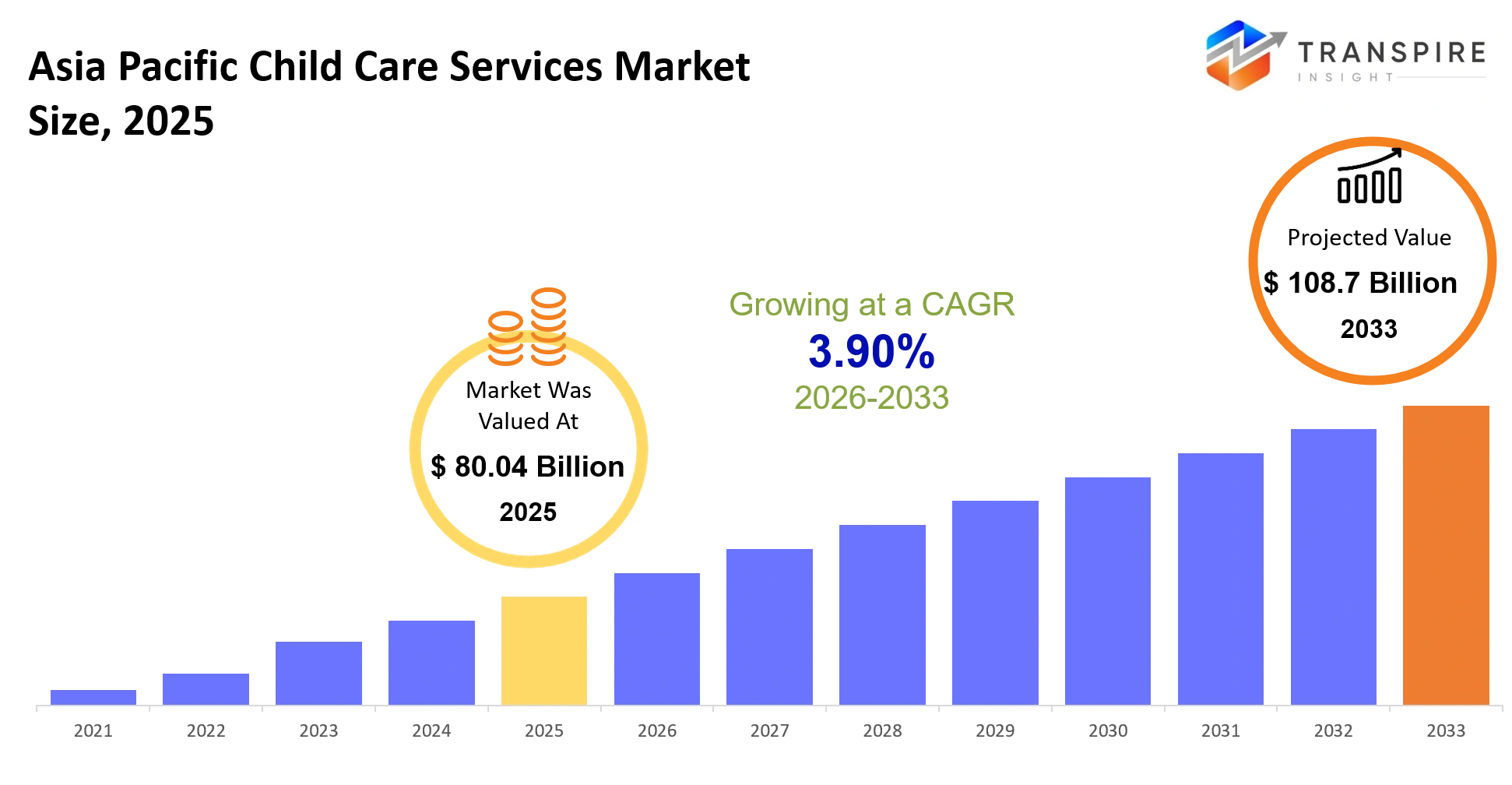
- Asia Pacific Child Care Services Market Size 2025: USD 80.04 Billion
- Asia Pacific Child Care Services Market Size 2033: USD 108.7 Billion
- Asia Pacific Child Care Services Market CAGR: 3.90%
- Asia Pacific Child Care Services Market Segments: By Service Type (Day Care Services, Preschool Education, After-school Programs, Infant Care Services, Others); By Application (Educational Development, Child Supervision, Skill Development, Others); By End User (Working Parents, Corporate Childcare Programs, Government Childcare Schemes, Others)
To learn more about this report,  Download Free Sample Report
Asia Pacific Child Care Services Market Summary
The Asia Pacific Child Care Services Market was valued at USD 80.04 Billion in 2025. It is forecast to reach USD 108.7 Billionby 2033. That is a CAGR of 3.90% over the period.
The Asia Pacific child care services market has this kind of key role in helping working families, because it offers a safe, structured, educational setup for kids throughout the day. More than just watching children, these services let caregivers keep showing up for the workforce, while also supporting early cognitive, social, and emotional growth. In practice the market can include daycare centers, preschools, after school programs, and even employer-supported child care facilities, which end up helping household output today and also building longer term human capital later.
In the last five years, the whole market started moving more clearly toward organized, professionally managed childcare networks. This shift seems tied to tougher quality standards, curriculum driven learning programs, and digital parent engagement platforms, and you can see it in day to day operations. One big trigger was the post pandemic workforce recovery, it kind of sped up the return of dual income households, and it made more families rely on formal childcare arrangements. Governments in places like China, Australia Japan, and Singapore have also pushed more childcare subsidies and family support policies. And as parent labor force participation keeps getting stronger, plus employers see childcare as a way to retain staff, enrollment levels and service revenues continue to rise across both city districts and outer suburban areas.
Key Market Insights
- Asia Pacific Child Care Services Market hit USD 80.04 billion in 2025, and by 2033 it’s expected to go above USD 108.7 billion too.
- In the same region, East Asia kind of leads overall, holding about 42% market share, largely because of big childcare infrastructure, and it helps with scale.
- Meanwhile Southeast Asia looks like the quickest riser through 2033, mainly tied to urbanization plus the rising female workforce participation, which is pretty noticeable lately.
- In terms of formats, center based childcare services make up close to 55% of revenue, since structured learning is needed, and there are regulatory compliance requirements that don’t really go away.
- Preschool and early education programs take around 35% of market share, so they’re the top service category.
- Employer sponsored childcare programs are also set to grow at more than 5% per year across the forecast period, even if the pacing varies by country.
- Digital parent communication platforms have seen adoption jump by over 30% among organized childcare operators between 2021 and 2025, and that basically changed how updates get delivered.
- For application segments, corporate childcare is still the most dominant one, contributing nearly 40% of premium childcare service revenues.
- Also, working parent households account for more than 60% of formal childcare enrollment across major economies in Asia Pacific, so demand is steady.
- Some companies like Bright Horizons, Busy Bees, KinderCare, G8 Education, and EtonHouse keep expanding, often through acquisitions, digital learning investments, and adding new locations via regional networks.
- And overall, strategic partnerships with employers, curriculum innovation, and movement into secondary cities are improving competitive positioning across the childcare services industry, pretty much all the time.
What are the Key Drivers, Restraints, and Opportunities in the Asia Pacific Child Care Services Market?
Market growth really seems to be mostly driven by the slow but steady rise in dual-income households, paired up with government-backed childcare affordability programs. A few countries like Australia, Singapore, Japan, and China have rolled out subsidy schemes, along with tax incentives, and various childcare support measures… all aimed at nudging workforce participation higher. In practice, these kinds of efforts lower the amount families have to pay out of their own pockets for care, and it makes formal childcare options easier to reach. Once enrollment keeps climbing, childcare operators can lean on better occupancy rates, clearer revenue forecasts, and even the chance to grow their facility footprint.
On the flip side, the biggest restraint feels pretty structural: there just aren’t enough qualified early childhood educators. These childcare services rely a lot on trained staff, because they need to satisfy regulatory requirements and keep quality standards consistent. Recruiting and keeping educators is still hard, mainly because wages are under pressure, certification rules are demanding, and workforce shortages show up across many Asia Pacific markets. As a result, expansion gets held back, enrollment capacity gets constrained, and operating costs tend to go up. Workforce development doesn’t happen in months though it takes years, so it’s not likely to get fixed quickly.
Meanwhile, there’s a pretty clear chance in employer-sponsored childcare combined with tech-enabled childcare services. Large companies are now treating support for childcare as a way to keep employees, mostly when they’re struggling with skilled labor gaps, and honestly retention is the big focus. At the same time, digital platforms are getting better and better at enrollment management, tracking child development, parent communication, and operational analytics, and because of that overall efficiency goes up plus the service quality tends to follow. Southeast Asia’s newer, growing economies could look especially interesting as well, since city populations keep expanding, while formal childcare penetration is still kind of low in comparison.
What Has the Impact of Artificial Intelligence Been on the Asia Pacific Child Care Services Market?
Artificial intelligence is gradually reshaping childcare operations throughout the Asia Pacific region, mostly by bumping up administrative efficiency, safety control, and tailored learning experiences. More childcare operators are starting to lean on AI based platforms that sort of handle things like attendance logs, staff rota planning, enrollment forecasting and parent messaging routines. With those tools there, the day to day paperwork feels less heavy and educators can spend more time on the real child development work, not this endless coordination .
Beyond that, machine learning is now helping with predictive planning in a more practical kind of way. Operators look at past enrollment cycles, seasonal swings in demand, and staffing needs, then use those signals to fine tune workforce allocation and how well each facility is used. A few more advanced providers also roll out AI powered assessment tools that surface learning progress patterns, and then suggest age suited educational activities—sometimes even aligning them with individual children's preferences.
What’s interesting is that these operational changes are becoming easier to measure. Automated scheduling can cut staffing inefficiencies, while predictive enrollment insights make capacity planning and occupancy management more predictable. Digital monitoring systems also help with compliance, safety, and regulatory expectations because they can generate near real time reporting and keep documentation organized.
That said, AI adoption still hits some walls, mainly implementation costs and the limits of available data. Smaller childcare operators often don’t have enough budget to deploy these more sophisticated setups. Also, child development outcomes aren’t simple, they depend on many behavioral factors that are hard for algorithms to interpret correctly. So for now, AI mostly acts like a decision support partner, not a full replacement for educators and childcare professionals.
Key Market Trends
- So it seems that organized childcare providers managed to push market penetration up by about 20% somewhere between 2020 and 2025, mainly via acquisitions plus those multi-center expansion moves, and it worked pretty well.
- Meanwhile digital parent engagement platforms basically became the norm across the big operators, which helped with smoother communication and attendance tracking, also better child progress reporting in a sort of more continuous way.
- In Australia, the childcare subsidy programs were expanded over the last few years, and that boosted formal childcare participation quite a bit, which in turn supported higher center occupancy levels as well.
- China, after 2021, went further on family support policies. this encouraged more investment in affordable childcare infrastructure, along with early education services that families can actually use.
- Employer-sponsored childcare programs also gained some real traction among large corporations trying to improve employee retention, and overall workforce participation, not just childcare as a side idea.
- At the same time premium early-learning curricula moved beyond the major metropolitan areas, since parents were prioritizing developmental outcomes alongside the childcare services itself.
- Across Southeast Asia, enrollment growth looked stronger than in the more mature markets, mostly due to rapid urbanization and the expanding middle-class population.
- Consolidation activity picked up too, as regional operators bought independent centers to reach scale, and to standardize the service quality a bit more tightly.
- Busy Bees expanded its North American footprint by acquisition activity in 2025 and 2026, and that sort of mirrors the broader consolidation trends seen across the sector.
- Finally childcare providers increasingly leaned on data-driven operational tools, aiming to make staffing efficiency better, strengthen occupancy planning, and improve regulatory compliance without as much guesswork.
Asia Pacific Child Care Services Market Segmentation
By Service Type
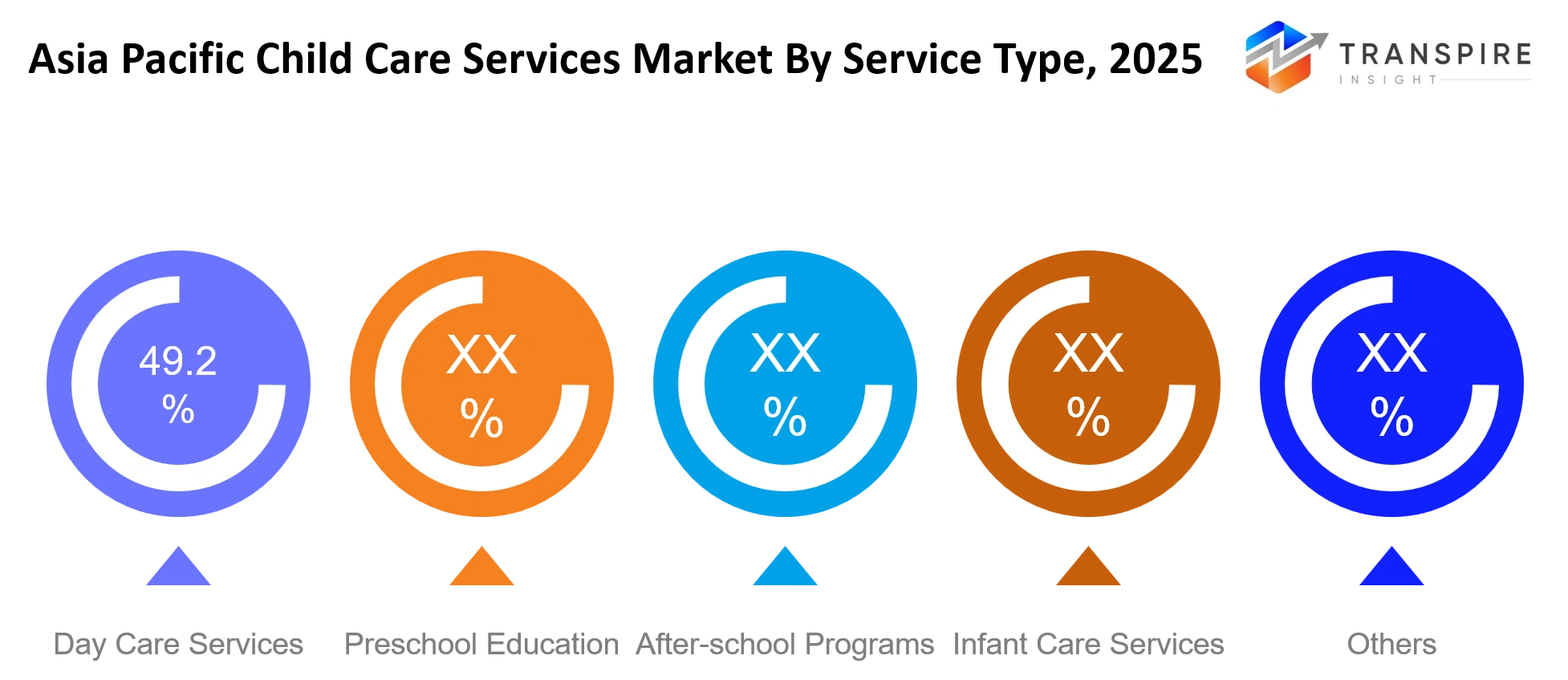
Day Care Services take a big part in childcare use, because this kind of daily structure really helps families juggling full-time work, and you know the kind of schedules that never slow down. In these places, safe spaces, monitored activities, and learning plans that fit each age group help keep families enrolling pretty steadily, both in urban and suburban areas. And as organized childcare networks keep growing, they also make it easier to find services in the main population centers.
Preschool Education still matters a lot, mainly since more parents and systems are placing emphasis on early childhood development, and on being ready for school. When the education is organized, children tend to pick up language, social behavior, and thinking skills before formal classes start. After-school Programs also fill the gap for kids during the time between school ends and when a caregiver is actually available at home, so working households get something workable and more realistic.
Infant Care Services cover families with very small children who need specialized attention, strong safety measures, and guidance for development. Caregivers who are trained, plus lower child-to-staff ratios, keep this category in demand. Other options also show up like more flexible childcare arrangements, holiday care services, and targeted programs made to match different family needs, depending on what’s going on at the time.
To learn more about this report, Download Free Sample Report
By Application
Educational Development is a big thing here, because childcare providers now often weave structured learning activities into everyday schedules and routines, kind of on purpose. Programs around early literacy, numeracy, talking skills, and social growth really do help with better educational results later. And then, ongoing spending on curriculum design helps providers stand out more from each other, or at least that’s what many people say.
Child Supervision still has a solid spot, since lots of families need dependable care during working hours. Safe settings, supervised play, monitored activities, and caregiving that is professional enough remain the essentials in this area. Skill Development also keeps getting more attention, especially with programs that target creativity, problem-solving, language learning, and interpersonal improvement. You know, the whole package.
Other options also show up, like recreational play, behavioral development schemes, and specialized support services adjusted to the individual needs of each child. Service providers keep expanding their offerings to match shifting family expectations and developmental goals. In the end, having a broader set of services tends to support steadier enrollment, and better customer retention too.
By End User
Working Parents are basically the biggest end-user group, because childcare services let people stay in the workforce while still giving children a kind of structured care. More and more dual-income households keep showing up across major economies in the region, so the demand doesn’t really “dip” much. When families have dependable childcare options they can, more or less, juggle their job expectations with child development needs.
Corporate Childcare Programs have become more important too, since employers want reasonable methods to boost employee retention and overall workplace comfort. On-site centers, childcare partnerships, and even childcare subsidies all help stabilize the workforce in labor markets that are pretty competitive right now. Government Childcare Schemes also play a role, through financial assistance efforts and publicly supported childcare initiatives that raise accessibility for families that need it.
Other participants include community organizations, nonprofit institutions, plus family support networks that offer childcare-related support. Ongoing policy encouragement and some private investment still matter a lot for getting wider service coverage across different income groups. When different end-users stay involved like this it supports long-term market growth, and it opens up chances for more service expansion.
What are the Key Use Cases Driving the Asia Pacific Child Care Services Market?
The largest use case still feels like full-day childcare services for working parents. These programs give structured supervision, education, nutrition, and developmental support for children while letting parents keep full-time work going. In fact, this application seems to get the most demand because it answers workforce participation needs, plus the whole family care expectation, in a pretty direct way.
Also, past the classic daycare model, after-school care programs and early childhood education services are growing pretty quickly. You see them especially with urban households that want academic enrichment, language development, and those social learning moments. On top of that, corporate-sponsored childcare programs are popping up more often among large employers, since they want to boost employee retention and also cut down on workforce turnover.
Newer use cases include flexible childcare subscriptions, hybrid learning support programs, and employer-partnered childcare hubs that sit near workplaces. More and more people are paying attention to technology-enabled childcare services too, where digital learning assessments and parent engagement tools are used together. Operators seem to want this kind of setup so they can stand out, and also raise overall service quality.
|
Report Metrics |
Details |
|
Market size value in 2025 |
USD 80.04 Billion |
|
Market size value in 2026 |
USD 83.16 Billion |
|
Revenue forecast in 2033 |
USD 108.7 Billion |
|
Growth rate |
CAGR of 3.90% from 2026 to 2033 |
|
Base year |
2025 |
|
Historical data |
2021 - 2024 |
|
Forecast period |
2026 - 2033 |
|
Report coverage |
Revenue forecast, competitive landscape, growth factors, and trends |
|
Regional scope |
Asia Pacific (India, China, Japan, Australia, South Korea, Rest of Asia Pacific) |
|
Key company profiled |
Bright Horizons, KinderCare, Learning Care Group, Busy Bees, Goodstart Early Learning, G8 Education, Primrose Schools, Spring Education Group, Cadence Education, Goddard Systems, KLAY Schools, Maple Bear, Safari Kid, Kids ‘R’ Kids, EtonHouse |
|
Customization scope |
Free report customization (country, regional & segment scope). Avail customized purchase options to meet your exact research needs. |
|
Report Segmentation |
By Service Type (Day Care Services, Preschool Education, After-school Programs, Infant Care Services, Others); By Application (Educational Development, Child Supervision, Skill Development, Others); By End User (Working Parents, Corporate Childcare Programs, Government Childcare Schemes, Others) |
Which Regions are Driving the Asia Pacific Child Care Services Market Growth?
East Asia is still kind of the main regional market because it has this huge population base, lots of childcare infrastructure, and quite active government involvement in family-support policies. Places like China, Japan and South Korea have gone and expanded childcare funding as well as early childhood education programs to deal with demographic pressures, and also to push labor force participation. These areas also get a boost from regulatory frameworks that are already in place, plus solid institutional support. Basically, the mix of public money and organized service providers keeps East Asia at the top.
Oceania comes next, and it’s mostly led by Australia and New Zealand. But, unlike East Asia, growth here feels less like it’s powered by sheer population scale and more by steady funding mechanisms, mature childcare regulations, and pretty high usage of formal childcare services. Government subsidy programs do help keep things affordable, while still backing provider revenues. The region also has predictable operating conditions, and the long-term demand visibility is strong which matters a lot for planning.
Then there’s Southeast Asia, and it’s emerging as the fastest-growing regional market through 2033. Rapid urbanization, more people in middle-income brackets, and rising female workforce participation have made families rely more on organized childcare services. Countries such as Indonesia, Vietnam, Thailand, and the Philippines are seeing major private-sector investment into childcare infrastructure. For investors and new market entrants, these conditions can be an opening to build an early footing, before industry consolidation speeds up.
Who are the Key Players in the Asia Pacific Child Care Services Market and How Do They Compete?
Competition in the Asia Pacific childcare services industry is, honestly, moderately fragmented. You have big international operators in the mix, but also regional chains and independent centers that still pull in local families. What really decides who wins is usually service quality, the educational curriculum, where they can actually reach, affordability, and how well they involve parents. Lately, a lot of players are leaning on acquisitions and technology investments too, to keep or improve their market standing.
Bright Horizons is kind of different because it leans into employer sponsored childcare programs, plus backup care services, and corporate partnerships that end up driving a steady flow of enrollments. They keep doing acquisitions and center expansion, basically to thicken their network density and strengthen what they can deliver.
Busy Bees goes harder on geographic expansion, and also growth that’s acquisition-led. For example, its acquisition of Learn and Play Montessori School helped expand into California, and then additional acquisitions added momentum in Washington State. With this setup, they can enter new markets quickly, and also reach operational scale without waiting too long.
G8 Education uses its large Australian center network, and also leans heavily on curriculum standardization. Meanwhile, EtonHouse competes with premium, education-first childcare offerings, and it has strong brand recognition across Asia. KLAY Schools, on the other hand, emphasizes workplace childcare partnerships and targets urban corporate clients, which shapes a more tailored service model around employer expectations.
Company List
- Bright Horizons
- KinderCare
- Learning Care Group
- Busy Bees
- Goodstart Early Learning
- G8 Education
- Primrose Schools
- Spring Education Group
- Cadence Education
- Goddard Systems
- KLAY Schools
- Maple Bear
- Safari Kid
- Kids ‘R’ Kids
- EtonHouse
Recent Development News
In January 2025, Busy Bees North America announced the acquisition of Learn and Play Montessori School. The deal added 15 Montessori schools in California and expanded Busy Bees' presence into a major new U.S. market while strengthening its early education portfolio.https://www.prnewswire.com
In February 2026, Busy Bees North America announced the acquisition of Kids N Us Early Learning Schools and Birch Tree Academy. The transaction added thirteen early learning centers in Washington State and accelerated the company's regional expansion strategy.https://www.busybeesna.com
In July 2025, Busy Bees North America announced a leadership transition, appointing Darla Kestle as successor to CEO Mary Ann Curran. The change supports the company's next phase of expansion and operational growth across North America.https://www.busybeesna.com
What Strategic Insights Define the Future of the Asia Pacific Child Care Services Market?
The Asia Pacific childcare services market is kind of moving toward a more organized, technology-enabled, and institutionally supported type of structure. Under that shift there is this main engine, the rising economic value of workforce participation, especially for parents in big city labor markets. In practice, governments and employers more and more treat childcare like core infrastructure, not some optional home service, you know.
But there is also a risk people don’t always talk about, the steady shortage of qualified childcare professionals. Even if demand is still high, staffing limits can quietly cap enrollment growth and make expansion timelines drag. And as regulatory rules keep getting tighter in multiple countries, this issue could become more noticeable, sooner than expected.
Still, there’s an opportunity showing up in employer sponsored childcare ecosystems. These can tie together childcare, early education, and digital family support services, in one coordinated approach. Places across Southeast Asia seem especially ready for it, because corporate childcare adoption is still relatively low, yet labor force participation keeps rising.
For the market players, the best path is usually a mix: expanding the network while also putting money into educator development and digital operating platforms. The operators that can scale without losing service quality, and also keep workforce stability, should end up in a better place to win long term market share gains.
Asia Pacific Child Care Services Market Report Segmentation
By Service Type
- Day Care Services
- Preschool Education
- After-school Programs
- Infant Care Services
- Others
By Application
- Educational Development
- Child Supervision
- Skill Development
- Others
By End User
- Working Parents
- Corporate Childcare Programs
- Government Childcare Schemes
- Others
Frequently Asked Questions
Find quick answers to common questions.
The expected Asia Pacific Child Care Services Market size for the market will be USD 108.7 Billion in 2033.
Key segments for the Asia Pacific Child Care Services Market are By Service Type (Day Care Services, Preschool Education, After-school Programs, Infant Care Services, Others); By Application (Educational Development, Child Supervision, Skill Development, Others); By End User (Working Parents, Corporate Childcare Programs, Government Childcare Schemes, Others)
Major Asia Pacific Child Care Services Market players are Bright Horizons, KinderCare, Learning Care Group, Busy Bees, Goodstart Early Learning, G8 Education, Primrose Schools, Spring Education Group, Cadence Education, Goddard Systems, KLAY Schools, Maple Bear, Safari Kid, Kids ‘R’ Kids, EtonHouse
The Asia Pacific Child Care Services Market size is USD 80.04 Billion in 2025.
The Asia Pacific Child Care Services Market CAGR is 3.90% from 2026 to 2033.
- Bright Horizons
- KinderCare
- Learning Care Group
- Busy Bees
- Goodstart Early Learning
- G8 Education
- Primrose Schools
- Spring Education Group
- Cadence Education
- Goddard Systems
- KLAY Schools
- Maple Bear
- Safari Kid
- Kids ‘R’ Kids
- EtonHouse
About the Authors

Chetan Dhatrak
I’m Chetan Dhatrak, a Senior Research Analyst at Transpire Insight, specializing in the Consumer Goods, Foods and Beverages industry. I focus on analyzing market trends, consumer behavior, competitive landscapes, and industry developments to deliver accurate, data-driven insights. My research at Transpire Insight is built on credible sources and in-depth analysis, helping businesses and readers better understand market dynamics, emerging opportunities, and evolving consumer preferences. I’m committed to creating reliable, well-researched content that supports informed decision-making and reflects the latest developments in the consumer goods and food & beverage sectors.

Chakradhar Khansole
Chakradhar serves as the Research Director at Transpire Insight, bringing over 8 years of experience in technology, innovation, and strategic market intelligence. He specializes in transforming complex market data into actionable business insights that enable organizations to make informed, growth-oriented decisions. Recognized for his strategic vision and analytical expertise, Chakradhar leads high-impact research initiatives, delivering comprehensive market assessments, competitive intelligence, and forward-looking industry analysis.
Recently Published Reports
-
Apr 2026
Bottled Water Market
Bottled Water Market Size, Share & Analysis Report By Product Type (Still Bottled Water, Carbonated Bottled Water, Functional Bottled Water, and Others), By Packaging (PET, Cans, and Others), By Sales Channel (Supermarkets/Hypermarkets, Convenience Stores/Drug Stores, Grocery Stores/Club Stores, Foodservice, and Others) and Geography (North America, Europe, Asia-Pacific, Middle East and Africa, South and Central America), 2021 - 2032
-
Apr 2026
Color Cosmetic Packaging Market
Color Cosmetic Packaging Market Size, Share & Analysis Report By Application (Mascara Packaging, Liquid Packaging, and Liquid Face), By Type (Tubes & Bottles, Pens & Markers, Compacts & Containers, and Droppers & Pumps), and Geography (North America, Europe, Asia-Pacific, Middle East and Africa, South and Central America), 2021 - 2031
-
Apr 2026
External Microphone For Camera Market
External Microphone For Camera Market Size, Share & Analysis Report By Type (Shotgun Microphone, Lavalier Microphone, and Others), By Application (Digital Camera, Professional Video Camera, and Others), and Geography (North America, Europe, Asia-Pacific, Middle East and Africa, South and Central America), 2021 - 2031
-
Apr 2026
Foot Orthotic Insoles Market
Foot Orthotic Insoles Market Size, Share & Analysis Report By Type (Pre-fabricated, and Custom-made), By Material (Thermoplastic, Composite Carbon Fiber, and Others), By Distribution Channel (Drug Stores, Hospitals & Clinics, and Others), and Geography (North America, Europe, Asia-Pacific, Middle East and Africa, South and Central America), 2021 - 2031