

North America Automated Endoscope Reprocessors Market Size & Forecast:
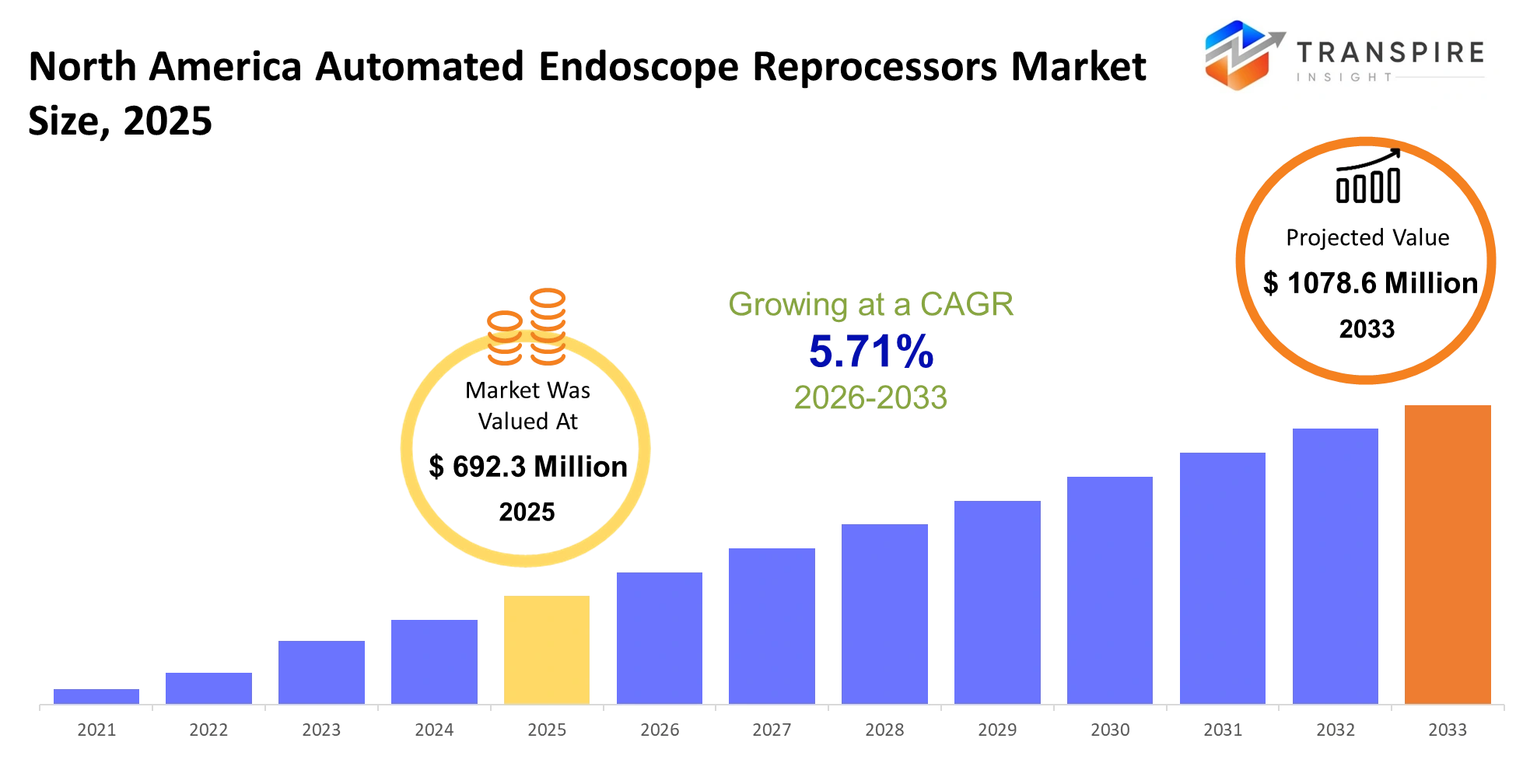
- North America Automated Endoscope Reprocessors Market Size 2025: USD 692.3 Million
- North America Automated Endoscope Reprocessors Market Size 2033: USD 1078.6 Million
- North America Automated Endoscope Reprocessors Market CAGR: 5.71%
- North America Automated Endoscope Reprocessors Market Segments: By Product Type (Single-basin Reprocessors, Dual-basin Reprocessors, Benchtop Reprocessors, Others), By Application (GI Endoscopy, Bronchoscopy, Urology Endoscopy, ENT Endoscopy, Others), By End User (Hospitals, Ambulatory Surgical Centers, Specialty Clinics, Others), By Technology (Fully Automated Systems, Semi-automated Systems, AI-enabled Reprocessors, Others).
To learn more about this report,  Download Free Sample Report
North America Automated Endoscope Reprocessors Market Summary:
The North America Automated Endoscope Reprocessors Market size is estimated at USD 692.3 Million in 2025 and is anticipated to reach USD 1078.6 Million by 2033, growing at a CAGR of 5.71% from 2026 to 2033. The North America Automated Endoscope Reprocessors (AER) market kind of supports one of the more critical jobs in modern care: making sure flexible endoscopes get cleaned and disinfected in the same pattern, between each procedure. These setups, they allow hospitals, ambulatory surgical centers, and specialty clinics to limit cross contamination exposure, keep day to day operations a lot smoother, and remain aligned with demanding infection prevention rules.
In the last three to five years, the market seems to be moving in a more structural way, away from manual and semi-automated reprocessing toward fully automated and digitally monitored setups. Those newer systems bring traceable records, plus standardized cycle validation, which sounds boring but matters a lot. A big nudge came from the increased attention on infection control after the COVID-19 pandemic. That period showed some weak points in medical device reprocessing processes, so funding and decisions leaned harder into automated disinfection infrastructure. Result is that demand keeps rising for AER platforms with stronger governance, meaning they can reduce human error and also help with regulatory compliance. And because providers are doing more minimally invasive diagnostic and treatment procedures every year, faster turnaround times, along with documented reprocessing workflows, are turning into real equipment adoption. At the same time, that pattern supports recurring service revenues across the region too.
Key Market Insights
- The United States really owns the North America Automated Endoscope Reprocessors Market, with something like over 80% market share in 2025, not even close to most other places. A solid healthcare setup and a lot of endoscopy procedures keep feeding the industry, so it stays #1 for both market size and revenue generation too.
- Canada looks like the fastest-moving regional market through 2032, helped by hospital modernization efforts plus infection-control spending that keeps getting pushed forward. In general, the local demand is pulled by stricter reprocessing standards, aging populations, and the steady expansion of outpatient care facilities, year after year.
- Automated endoscope reprocessors dominate the whole thing, bringing in roughly 65% of total revenue, mainly because the workflow is efficient and it supports compliance. Then there’s high-level disinfectants, which take the second-largest slice, and that’s largely tied to ongoing repeat buying across healthcare sites.
- Digitally integrated reprocessing systems are likely the quickest growth segment from 2025 to 2032, since traceability is turning into the sort of regulatory priority everyone has to meet.
- Also, more advanced systems with automated documentation features are picking up noticeable share among big hospital groups, and integrated networks.
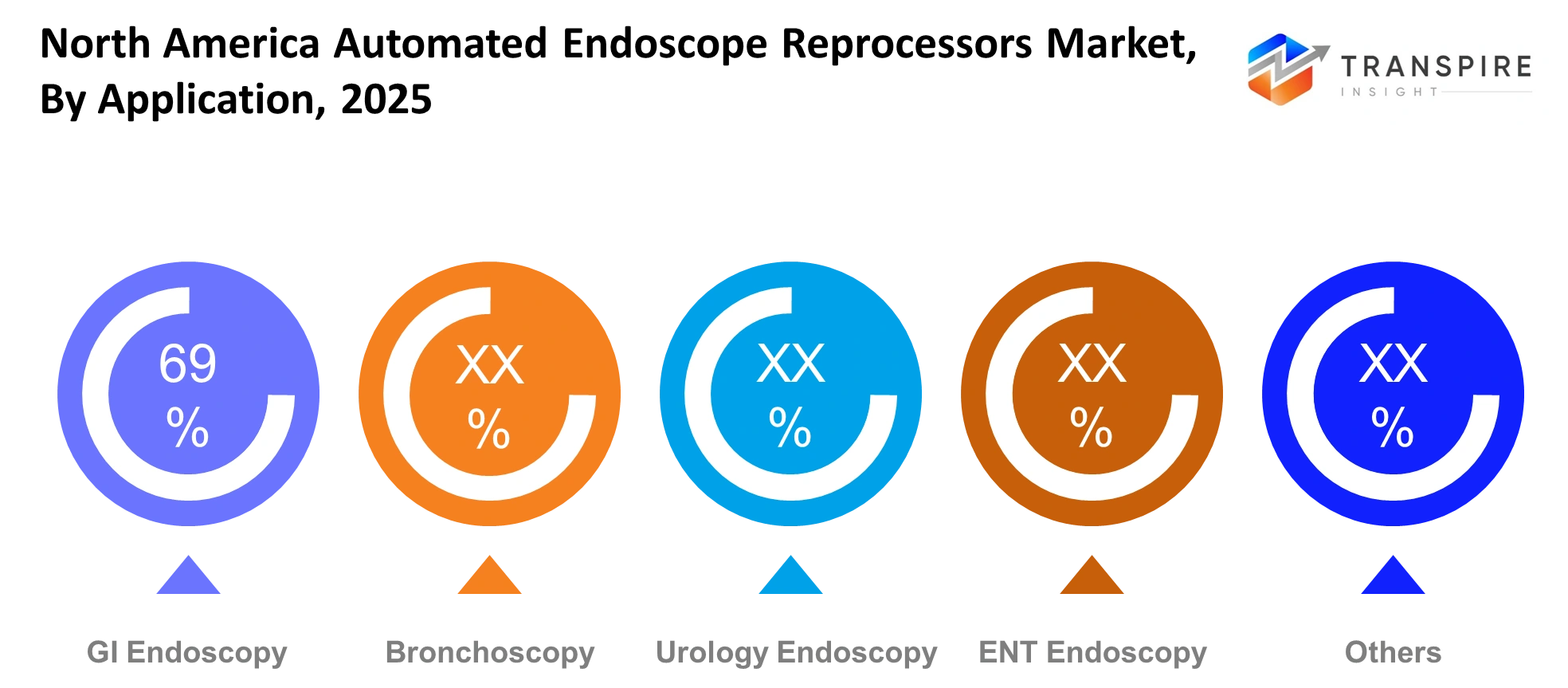
- On application, hospitals are the lead segment, contributing close to 55% of demand in 2025. Gastrointestinal endoscopy is still the biggest application area because the procedure count stays high, plus infection-control needs never really ease up.
- Pulmonology, and bronchoscopy uses are emerging as the fastest-growing segments during the forecast window. And the wider turn toward least intrusive, minimally invasive procedures keeps, somehow reinforcing the need for automated reprocessing equipment, even while clinical workflows get more complex.
- Hospitals, together with integrated healthcare systems, are leading the North America Automated Endoscope Reprocessors Market, they grab more than 50% market share.
What are the Key Drivers, Restraints, and Opportunities in the North America Automated Endoscope Reprocessors Market?
In the North America Automated Endoscope Reprocessors Market, one of the strongest growth drivers is this gradual tightening of infection prevention and reprocessing compliance requirements across healthcare facilities. A couple of well publicized contamination incidents, those linked to endoscopes that weren’t reprocessed properly pushed regulators, accreditation groups and hospital networks to add more scrutiny on reprocessing workflows. So, healthcare providers have been leaning harder toward a transition away from manual cleaning setups and toward automated platforms, more or less. These platforms tend to run validated disinfection cycles, provide digital recordkeeping, and lower operator variability, even when staffing changes. That direction backs market revenue growth, because automated reprocessors generally need not only early equipment purchases, but also continuing outlays for maintenance, consumables and service agreements.
The biggest restraint is the high total cost of ownership that comes with advanced reprocessing infrastructure. It is not just the purchase price. Facilities also end up spending on dedicated reprocessing rooms, ongoing staff training, workflow reconfiguration and compliance documentation systems. In a way, the barrier is structural, because it’s connected to healthcare capital budgets and facility layout constraints, which do not change quickly. Smaller hospitals, plus independent outpatient centers, often delay these upgrades. That delay limits adoption, lowers penetration rates, and in turn holds back the possible market revenue.
A big future opportunity seems to sit in digitally connected reprocessing platforms that hook into hospital information systems. More and more facilities are looking for real-time traceability , automatic audit trails , and even predictive maintenance sorts of capability. As health care networks keep growing their data driven quality management programs , intelligent reprocessors that can tie disinfection records back to individual patient procedures may turn into a differentiator , especially inside very large hospital systems and across rapidly expanding ambulatory surgery networks.
What Has the Impact of Artificial Intelligence Been on the North America Automated Endoscope Reprocessors Market?
Artificial intelligence plus newer digital tools are really changing how automated endoscope reprocessing runs, mostly by giving better workflow control, more efficient equipment utilization, and stronger compliance oversight. Lately, many reprocessors are starting to include AI enabled monitoring setups that keep an eye on cycle parameters, chemical concentrations, temperature ranges and even whether disinfection is finished or not, kinda in real time. In practice these systems can automatically highlight any deviations, they also create audit ready records, and they tend to cut down the paperwork load that usually comes with infection control requirements.
Machine learning is stretching into predictive maintenance too, not just monitoring. When algorithms start reading sensor data from pumps , valves filters, and fluid delivery parts, they can catch early hints of performance slowing down before a real breakdown shows up. In hospitals and ambulatory surgery centers, they use these signals to schedule upkeep a bit earlier, so it’s less likely they’ll get hit with sudden downtime. That approach also tends to stretch the overall equipment lifespan out longer. In endoscopy units with high volume, predictive maintenance efforts can raise overall equipment availability and reduce service disruptions, which helps facilities keep their procedure timetables steady and make better use of their assets.
Then there are advanced analytics, which back up operational gains in a more direct way. For example, analytics can reveal where workflow bottlenecks are forming, they can improve reprocessing turnaround timing, and they can reduce consumable waste. Alongside that, digital traceability approaches reinforce regulatory compliance and also lower the odds of documentation mistakes when inspections show up.
Still though, there’s a major sticking point: the cost and complexity of hooking AI enabled platforms into existing hospital information systems. On top of that, a number of facilities simply don’t have large enough historical datasets, and that can hurt model accuracy or slow down wider adoption of these predictive capabilities.
Key Market Trends
- Since 2020, healthcare providers have been speedin up the replacement of manual reprocessing routines, with automated systems, kind of reducing operator variability and compliance risks, at the same time.
- Digital traceability used to feel like a premium extra , but after pandemic-era reviews hospitals became more strict about audit readiness and paperwork standards so it turned into procurement-required stuff.
- Manufacturers have also been folding in cloud-based monitoring platforms more and more, so oversight of reprocessing equipment becomes centralized across multi-hospital healthcare networks, which is practical.
- Between 2021 and 2025 the demand kind of moved toward systems that include automated cycle validation, and that shift mirrors tougher accreditation rules and infection-control expectations.
- Healthcare facilities increasingly like long-term service agreements, rather than just buying standalone units, and that tends to give suppliers more predictable recurring revenue.
- On the advanced platforms, AI-enabled predictive maintenance tools started showing up too, and they help identify component failures before anything disruptive happens in endoscopy department operations.
- With outpatient procedures growing, ambulatory surgery centers have pushed toward compact, high-throughput reprocessors that allow quicker instrument turnaround.
- Companies like STERIS, Getinge, Olympus, and Soluscope expanded their software features as a way to stand out, not only on core disinfection performance but also on the broader experience.
- Supply chain disruptions in 2021 and 2022 made hospitals diversify vendor relationships, and as a result they often keep larger buffers of essential consumables.
- Overall, competition has shifted away from hardware specifications alone, toward integrated ecosystems that combine reprocessors, compliance software analytics, and preventive maintenance services.
North America Automated Endoscope Reprocessors Market Segmentation
By Product Type
By product type, dual-basin reprocessors kinda hold the leading spot, mostly because big healthcare sites tend to want faster throughput , smoother workflow continuity, and quicker instrument turnaround times. The chance to run multiple endoscopes in parallel helps hectic endoscopy departments keep their procedural schedules on track. Single-basin reprocessors still show up a lot in smaller hospitals and outpatient centers, where procedure volumes are lower and, honestly , budget constraints shape the purchasing choice.
Benchtop reprocessors are taking up more space in the market, especially in areas that are short on room, looking for compact solutions without major infrastructure changes. Then there are other specialized configurations that handle particular clinical needs, but they represent a smaller slice of total demand.Overall growth seems to tilt more and more toward systems that blend automation, digital documentation, and day-to-day operational efficiency. Looking ahead, investment is expected to cluster around scalable platforms— those that can handle rising procedure volumes while also meeting tougher compliance requirements, which leaves some space for manufacturers that can deliver both throughput and traceability.
By Application
In terms of application, gastrointestinal endoscopy looks like the leading segment, mostly because colonoscopy, plus upper gastrointestinal procedures, happen very often across North America. Big screening efforts, an aging demographic , and the growing push for early detection of disease keep equipment utilization quite high here. After that, bronchoscopy shows up as the second-largest application, backed by respiratory diagnostics and also critical care practices. Urology and ENT endoscopy keep growing as minimally invasive techniques get more accepted in daily specialty workflows, kinda like they just fit in.
Still, every application comes with different expectations for the reprocessing process, so equipment requirements and service needs end up varying quite a bit. Overall demand keeps leaning toward lowering contamination risk while also boosting procedural speed. Looking ahead, market movement will probably track the rise of outpatient diagnostics and therapeutic endoscopy, which should nudge suppliers toward more application focused solutions that help balance throughput, regulatory compliance, and day to day operational flexibility.
To learn more about this report, Download Free Sample Report
By End-User
End user organizations, especially hospitals, still hold the biggest slice of the market, mainly because large healthcare systems end up running the highest number of endoscopic procedures and they do it with strict infection control standards. They also bring serious capital to the table and they deal with pretty involved clinical workflows so it makes sense for them to invest in advanced reprocessing infrastructure. Ambulatory surgical centers come in as the second-largest group, since care keeps drifting toward more cost-efficient outpatient environments.
Then specialty clinics are starting to look like one of the fastest-growing segments, mostly in gastroenterology, pulmonology, and urology. And it’s not all the same from one end user to another, buying priorities vary. Hospitals usually care most about integration, scalability, and how compliance gets managed, while outpatient sites tend to prioritize efficiency and quick instrument turnaround. Looking ahead, growth should ramp up in decentralized care settings, which pushes manufacturers toward compact, easy-to-use systems that can fit the day to day operational needs of facilities that differ a lot in procedure volume, and also in how staffing is organized.
By Technology
By technology, fully automated systems kind of run the market, since healthcare providers, well, they increasingly want standardized disinfection routines, less human touch, and full on documentation abilities. In practice these systems help with regulatory alignment while also trimming down variability across reprocessing rounds, which is what everyone seems to care about. Semi-automated systems still matter in places that are more budget constrained, but they get slowly pushed aside as automation costs become more, you know, competitive.
AI-enabled reprocessors are the fastest-growing slice of the segment, mostly because people are chasing predictive upkeep, smoother workflow planning, and more sophisticated performance observation. With data analytics built in, facilities can actually tune equipment usage and cut down on those surprise stoppages. There are also other emerging approaches that center around connectivity, remote diagnostics, and improved traceability, more or less. Overall the technology scene is shifting toward connected digital ecosystems, not just separate machines that sit there on their own. And that change opens up chances for vendors who bundle equipment plus software and service, offering healthcare orgs clearer operational sight, along with longer-term efficiency benefits.
What are the Key Use Cases Driving the North America Automated Endoscope Reprocessors Market?
The main use case for automated endoscope reprocessors is gastrointestinal endoscopy in hospitals and big health care systems. Colonoscopy and upper gastrointestinal procedures generate really high instrument volumes, so automated reprocessing becomes kind of mandatory to keep throughput steady, lower the contamination risk, and still meet infection control requirements.
At the same time, bronchoscopy and urology endoscopy are getting more attention, since minimally invasive diagnostic and therapeutic procedures keep expanding… especially in ambulatory surgery centers and specialty clinics. Those environments rely on streamlined reprocessing workflows , to enable same day scheduling, get instruments back quicker, and stay aligned with accreditation rules that are getting more strict.
Newer or emerging use cases show up too, like advanced pulmonary diagnostics and more complex therapeutic endoscopy programs. In these cases, enhanced traceability and digital documentation matter a lot, because the program needs stronger reporting. Also, the growing adoption of AI driven reprocessing platforms and connected compliance tools is opening doors for integrated health networks, where centralized monitoring and predictive servicing can help improve operational performance across multiple locations.
|
Report Metrics |
Details |
|
Market size value in 2025 |
USD 692.3 Million |
|
Market size value in 2026 |
USD 731.1 Million |
|
Revenue forecast in 2033 |
USD 1078.6 Million |
|
Growth rate |
CAGR of 5.71% from 2026 to 2033 |
|
Base year |
2025 |
|
Historical data |
2021 - 2024 |
|
Forecast period |
2026 - 2033 |
|
Report coverage |
Revenue forecast, competitive landscape, growth factors, and trends |
|
Country scope |
North America (Canada, The United States, and Mexico) |
|
Key company profiled |
Olympus Corporation, Getinge, Steris, Cantel Medical, Medivators, Wassenburg Medical, Steelco, Soluscope, Belimed, Ecolab, ASP, Shinva Medical, Tuttnauer, Metrex Research, Borer Chemie. |
|
Customization scope |
Free report customization (country, regional & segment scope). Avail customized purchase options to meet your exact research needs. |
|
Report Segmentation |
By Product Type (Single-basin Reprocessors, Dual-basin Reprocessors, Benchtop Reprocessors, Others), By Application (GI Endoscopy, Bronchoscopy, Urology Endoscopy, ENT Endoscopy, Others), By End User (Hospitals, Ambulatory Surgical Centers, Specialty Clinics, Others), By Technology (Fully Automated Systems, Semi-automated Systems, AI-enabled Reprocessors, Others). |
Which Regions are Driving the North America Automated Endoscope Reprocessors Market Growth?
The United States is still the main market across North America, mainly because it has such a big installed base of endoscopy devices, plus a huge hospital network, and rather strict infection-prevention rules. Between federal guidance and state level oversight, many healthcare providers feel pushed to switch toward automated reprocessing setups that help with consistent record keeping and overall compliance. Also, the procedure numbers stay high in gastroenterology, pulmonology, and urology, so demand never really dips for more sophisticated reprocessing tech. There’s just an entire “ecosystem” already in place too, with device manufacturers , service teams, accreditation organizations, and big healthcare systems, all of which keep reinforcing that leadership position.
Canada ends up being the second-largest regional market, but it moves a bit differently than the US. Since public healthcare is funded in a particular way, hospitals tend to think long term with capital planning, and they invest steadily in modernizing facilities rather than doing fast equipment swaps, every few months or whatever. Regulations get applied in a consistent manner, and patient safety remains a central priority, so procurement stays predictable across major healthcare networks. Because of that calm, more stable pattern, Canada keeps contributing reliably to regional revenue even if the overall market size is smaller.
Mexico is showing up as the fastest-growing market, with healthcare infrastructure investment increasing access to advanced diagnostics and minimally invasive procedures. Private hospital groups, in particular, have sped up modernization work, so it opens up fresh chances for automated reprocessing solutions that boost day to day efficiency and also help with compliance. On top of that, medical tourism keeps growing, and that kind of pressure makes facilities try to match international infection-control expectations and technology norms, not just locally “good enough”.
Who are the Key Players in the North America Automated Endoscope Reprocessors Market and How Do They Compete?
The North America Automated Endoscope Reprocessors Market looks kind of moderately consolidated, like a few established manufacturers kinda control most of it by having a strong installed base, plus service contract coverage. Real competition isn’t so much about entry level price, it’s more about steady long-term compliance results, uptime reliability, and how well everything fits into hospital infection control workflows. The older players tend to defend their share by locking in multi year maintenance agreements and sticking with validated reprocessing ecosystems, while some newer entrants try to shake things up using digital monitoring, and lower footprint systems mostly aimed at outpatient centers. Buyers care a lot about certification compliance and traceability, so technology enabled service models start winning over pure hardware differences.
STERIS plc keeps strengthening its role via vertically integrated infection prevention platforms, where automated reprocessors are bundled with consumables and service contracts. That bundling thing makes switching less likely for hospitals, because cycle validation and maintenance stay in one vendor environment. They also push growth through long term hospital partnerships, plus ongoing upgrades to digital documentation features that match regulatory audit needs.
Getinge AB leans more into workflow automation and system interoperability, positioning itself through connected reprocessing units that plug into hospital sterile processing departments. Their expansion approach rests on partnerships with big healthcare networks, which standardize equipment across multiple facilities, and that helps them scale in a fairly repeatable way.
Olympus Corporation uses its endoscope lead, sort of bundles reprocessing solutions together with its imaging systems , so it can keep a steadier grip on the procedural ecosystem. Then it pushes outward via global service agreements,plus it sells bundled endoscopy platforms that feel… pretty tied in.
Cantel Medical goes after the same space in a different way, focused on infection control, it brings dedicated reprocessing consumables and systems that are validation- centered. For growth, it leans into hospital conversions that are a bit more targeted, and also tries to mesh into bigger healthcare supply chains.
Company List
- Olympus Corporation
- Getinge
- Steris
- Cantel Medical
- Medivators
- Wassenburg Medical
- Steelco
- Soluscope
- Belimed
- Ecolab
- ASP
- Shinva Medical
- Tuttnauer
- Metrex Research
- Borer Chemie
Recent Development News
In May 2026, Olympus Corporation Reports Double-Digit North American GI Endoscopy Growth in FY2026: Olympus reported that its GI Endoscopy division achieved 20% year-over-year growth during the fourth quarter of FY2026. The company attributed performance to strong demand across North America and other major regions, supported by new endoscopy product introductions and expanded procedural volumes. The update reflects continued investment in endoscopy infrastructure and associated reprocessing ecosystems.
Source: https://www.olympus-global.com
In April 2026, Fujifilm Holdings Corporation Showcases Newly Launched ELUXEO 8000 Endoscopy Platform at DDW 2026: Fujifilm announced it would present its recently launched ELUXEO 8000 endoscopic imaging system at the Digestive Disease Week (DDW) 2026 conference in the United States. The launch expands the company’s North American endoscopy portfolio and supports healthcare facilities upgrading endoscopy workflows, including reprocessing and infection-control operations tied to advanced endoscope fleets.
Source: https://www.businesswire.com
What Strategic Insights Define the Future of the North America Automated Endoscope Reprocessors Market?
The North America Automated Endoscope Reprocessors Market is gradually moving toward fully connected software-driven reprocessing ecosystems, where the hardware is becoming secondary to things like data integrity, traceability and also the ability to work with hospital information systems smoothly. That change is mainly pushed by stricter infection-control enforcement ,and honestly by the rising expectation that every single reprocessing cycle should be digitally verifiable across multi-site healthcare networks. But there is also a less obvious risk showing up, around platform concentration where hospitals end up relying on a small set of integrated vendors. That can mean pricing becomes kind of rigid, plus interoperability issues may creep in, especially if the regulatory rules for open data standards trail behind how fast adoption happens.
At the same time there’s an emerging opportunity that feels more “forward-looking” : AI-enabled reprocessing orchestration. Think predictive maintenance and cycle optimization, which can reduce downtime in high-throughput endoscopy units, and that matters even more as ambulatory surgical centers expand their procedural capacity. In the next phase, vendors that bundle equipment with cloud-based compliance intelligence should move ahead of the hardware-only competitors. Market participants, or operators, should focus on building open, API-driven architectures and backing broader service ecosystems instead of just selling standalone devices. Because as it stands, purchasing decisions are increasingly swayed by lifecycle performance guarantees, rather than the initial acquisition cost , alone.
North America Automated Endoscope Reprocessors Market Report Segmentation
By Product Type
- Single-basin Reprocessors
- Dual-basin Reprocessors
- Benchtop Reprocessors
- Others
By Application
- GI Endoscopy
- Bronchoscopy
- Urology Endoscopy
- ENT Endoscopy
- Others
By End User
- Hospitals
- Ambulatory Surgical Centers
- Specialty Clinics
- Others
By Technology
- Fully Automated Systems
- Semi-automated Systems
- AI-enabled Reprocessors
- Others
Frequently Asked Questions
Find quick answers to common questions.
The approximate North America Automated Endoscope Reprocessors Market size for the market will be USD 1078.6 Million in 2033.
The key segments of the North America Automated Endoscope Reprocessors Market are By Product Type (Single-basin Reprocessors, Dual-basin Reprocessors, Benchtop Reprocessors, Others), By Application (GI Endoscopy, Bronchoscopy, Urology Endoscopy, ENT Endoscopy, Others), By End User (Hospitals, Ambulatory Surgical Centers, Specialty Clinics, Others), By Technology (Fully Automated Systems, Semi-automated Systems, AI-enabled Reprocessors, Others).
Major players in the North America Automated Endoscope Reprocessors Market are Olympus Corporation, Getinge, Steris, Cantel Medical, Medivators, Wassenburg Medical, Steelco, Soluscope, Belimed, Ecolab, ASP, Shinva Medical, Tuttnauer, Metrex Research, Borer Chemie.
The current market size of the North America Automated Endoscope Reprocessors Market is USD 692.3 Million in 2025.
The North America Automated Endoscope Reprocessors Market CAGR is 5.71%.
- Olympus Corporation
- Getinge
- Steris
- Cantel Medical
- Medivators
- Wassenburg Medical
- Steelco
- Soluscope
- Belimed
- Ecolab
- ASP
- Shinva Medical
- Tuttnauer
- Metrex Research
- Borer Chemie
About the Authors

Pankaj Ghogare Patil
I am Pankaj Ghogare Patil, a Senior Research Analyst at Transpire Insight, specializing in the Pharmaceutical, Chemicals & Materials, Healthcare IT, and Biotechnology industry. My expertise lies in conducting comprehensive market research, analyzing industry trends, evaluating competitive landscapes, and translating complex data into actionable insights. At Transpire Insight, I closely follow emerging technologies, regulatory developments, and market innovations to create accurate, well-researched, and informative content that helps businesses and professionals make informed decisions. I am committed to producing credible, evidence-based articles that reflect industry best practices while making technical topics accessible and valuable for a broad audience.

Chakradhar Khansole
Chakradhar serves as the Research Director at Transpire Insight, bringing over 8 years of experience in technology, innovation, and strategic market intelligence. He specializes in transforming complex market data into actionable business insights that enable organizations to make informed, growth-oriented decisions. Recognized for his strategic vision and analytical expertise, Chakradhar leads high-impact research initiatives, delivering comprehensive market assessments, competitive intelligence, and forward-looking industry analysis.
Recently Published Reports
-
Apr 2026
AI in Diabetic Retinopathy Market
AI in Diabetic Retinopathy Market Size, Share & Analysis Report By Type (Screening AI Systems, Diagnostic AI Systems, and Predictive AI Models), By Application Segment (Hospitals, Ophthalmology Clinics, Diagnostic Centers, and Research and Development), and Geography (North America, Europe, Asia-Pacific, Middle East and Africa, South and Central America), 2021 - 2031
-
Apr 2026
Psychometric Tests Market
Psychometric Tests Market Size, Share & Analysis Report By Type (Personality Tests, Ability/Aptitude Tests, Skill/Knowledge Tests, and Others), By Application (Talent Acquisition and Talent Management), and Geography (North America, Europe, Asia-Pacific, Middle East and Africa, South and Central America), 2021 – 2031
-
Apr 2026
Rare Biological Sample Collection Market
Rare Biological Sample Collection Market Size, Share & Analysis Report By Type (Isolation Kits & Reagent, Blood Collection Tubes, and Others), By Application (Oncology, Transcriptomics, Pharmacogenomics, and Others), and Geography (North America, Europe, Asia-Pacific, Middle East and Africa, South and Central America), 2021 – 2031
-
Jul 2026
Diabetic Retinopathy Market
Diabetic Retinopathy Market Size, Share & Analysis Report By Type (Proliferative Diabetic Retinopathy, and Diabetic Macular Edema (DME)), By Treatment Type (Anti VEGF Drug, Steroid Implants, Laser Surgeries, and Vitrectomy), and Geography (North America, Europe, Asia-Pacific, Middle East and Africa, South and Central America), 2021 – 2031
Our Clients







