
Europe Corporate Financial Risk and Strategic Advisory Market Size & Forecast:
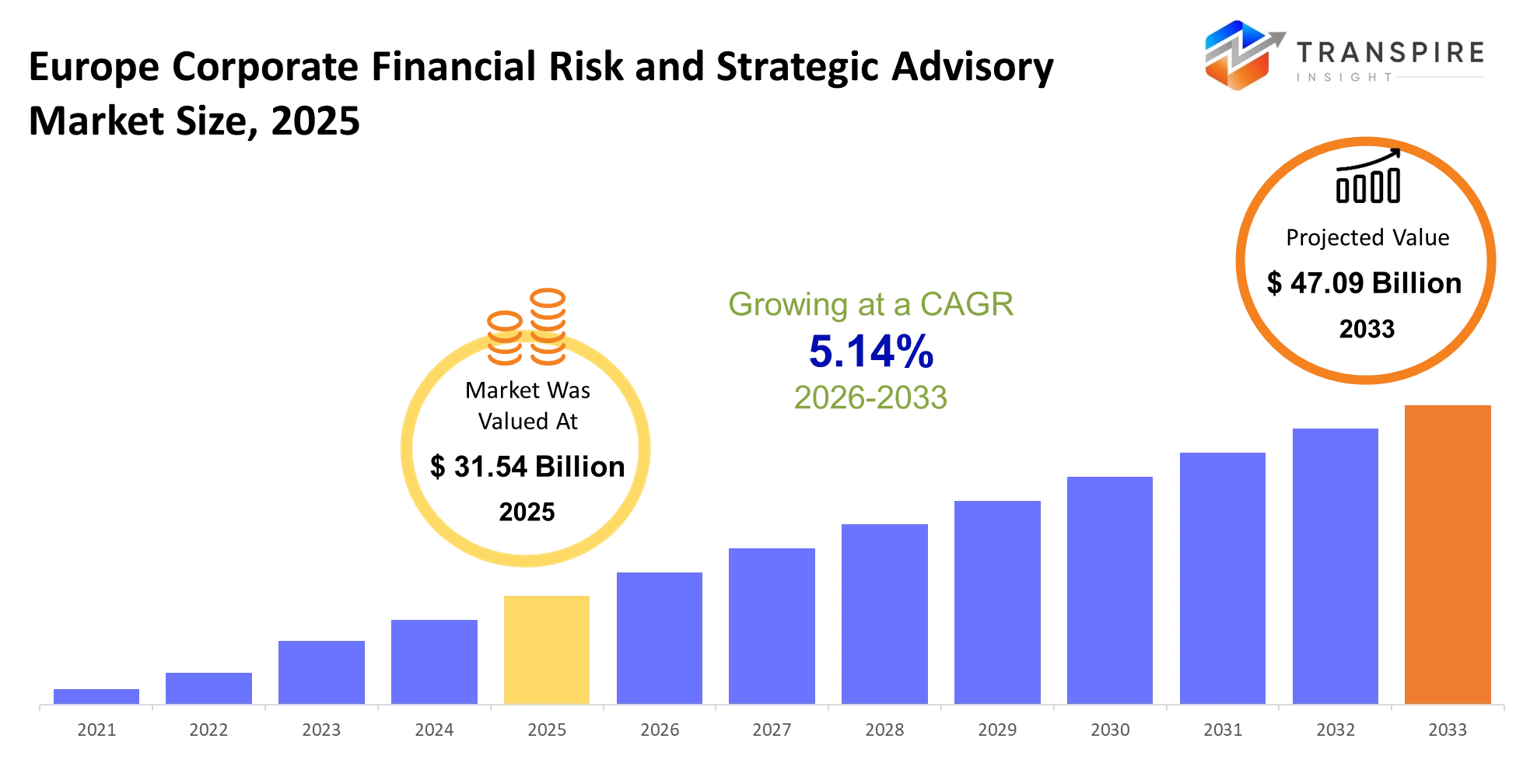
- Europe Corporate Financial Risk and Strategic Advisory Market Size 2025: USD 31.54 Billion
- Europe Corporate Financial Risk and Strategic Advisory Market Size 2033: USD 47.09 Billion
- Europe Corporate Financial Risk and Strategic Advisory Market CAGR: 5.14%
- Europe Corporate Financial Risk and Strategic Advisory Market Segments: By Type (Risk Advisory, Financial Consulting, Strategic Advisory, Compliance Advisory, Crisis Management, Others); By Application (Mergers & Acquisitions, Risk Management, Business Strategy, Financial Planning, Restructuring, Others); By End-User (Enterprises, SMEs, Financial Institutions, Government, Others); By Service (Consulting, Analytics, Implementation, Digital Advisory, Others)
To learn more about this report,  Download Free Sample Report
Europe Corporate Financial Risk and Strategic Advisory Market Summary
The Europe Corporate Financial Risk and Strategic Advisory Market was valued at USD 31.54 Billion in 2025. It is forecast to reach USD 47.09 Billion by 2033. That is a CAGR of 5.14% over the period.
The Europe Corporate Financial Risk and Strategic Advisory Market assists businesses which face three operational challenges, three financial difficulties and two strategic development needs because of the unpredictable nature of modern business environments. Advisory firms support corporations, private equity groups, and industrial operators in managing debt exposure, evaluating acquisitions, restructuring portfolios, and responding to regulatory scrutiny before financial stress escalates into operational disruption. Data-driven scenario modeling and ESG-linked risk advisory have become the main consulting services for the market because European sustainability disclosure regulations became stricter and lenders adopted more stringent control measures during the past five years. The Russia-Ukraine conflict and rising energy prices caused an increased need for companies to establish liquidity planning systems, supply chain risk assessment procedures, and geopolitical risk evaluation methods throughout the manufacturing and transport industries. Companies spend their advisory budgets on resilience planning because they face high financing costs which creates permanent income streams for specialized advisory services.
Key Market Insights
- The European Corporate Financial Risk and Strategic Advisory Market in 2025 achieved its highest market value through Western Europe which controlled approximately 58% of the market because of its established financial systems.
- The German market maintains its position as the top country market because the industrial sector requires extensive restructuring services while manufacturing companies seek insolvency advisory support.
- Northern Europe represents the fastest-growing regional cluster through 2032, supported by ESG reporting mandates and digital financial governance investments.
- The Europe Corporate Financial Risk and Strategic Advisory Market generated its highest revenue through financial restructuring and turnaround advisory services which accounted for approximately 34% of total revenue in 2025.
- The second largest market segment for transaction advisory services operates as private equity companies maintain their current investment activities while corporate organizations carry out product line optimization projects.
- ESG-linked risk advisory is predicted to achieve its highest growth rate between 2026 and 2032 because of the enforcement of new EU sustainability disclosure rules.
- Corporate restructuring applications accounted for nearly 39% market share in 2025, reflecting elevated refinancing pressure and operational cost restructuring activity.
- The application area for strategic liquidity planning showed the strongest growth pattern after European borrowing costs increased and energy market prices experienced volatility.
- The Europe Corporate Financial Risk and Strategic Advisory Market functioned through large enterprises which held more than 61% of market share because these organizations needed to navigate intricate international compliance standards.
- The private equity sector shows the fastest growth among end-user groups because dealmakers now concentrate on operational due diligence and post-acquisition restructuring capabilities.
What are the Key Drivers, Restraints, and Opportunities in the Europe Corporate Financial Risk and Strategic Advisory Market?
The Europe Corporate Financial Risk and Strategic Advisory Market experiences its most powerful growth through European financial disclosure requirements which have become stricter since the post-pandemic debt expansion and energy market volatility. The Corporate Sustainability Reporting Directive mandates stricter environmental, social, and governance (ESG) reporting requirements which companies need to evaluate their cash flow risks, debt repayment methods, and business operation resilience during times of increased interest rates. The demand for financial restructuring advisory services and forensic accounting services and scenario-based financial planning services increased through this new development. Companies now enter advisory partnerships which generate higher-value permanent relationships after they establish ongoing methods for monitoring enterprise risks and managing capital resources.
The market experiences its most significant structural limitation because of the existing deficiency in advisory experts who possess cross-border advisory skills which combine regulatory knowledge with industry expertise and advanced financial analytics. Building senior advisory teams with restructuring, ESG compliance, and geopolitical risk capabilities requires years of training and regional experience. The talent shortfall prevents projects from expanding and makes operational costs higher and advisory services slower to reach mid-sized businesses. Premium consulting fees prevent smaller businesses from engaging with consultants which limits the ability of the entire market to expand across Southern and Eastern Europe.
The next significant growth opportunity arises through AI-powered predictive risk intelligence systems. Financial institutions and multinational manufacturers are increasingly investing in real-time scenario modeling tools that integrate supply chain exposure, commodity volatility, and regulatory data.Poland and Czech Republic show industrial exporters who need to update their governance systems because they must comply with changing EU financial oversight regulations which are their current operational requirements.
What Has the Impact of Artificial Intelligence Been on the Europe Corporate Financial Risk and Strategic Advisory Market?
The Europe Corporate Financial Risk and Strategic Advisory Market experiences rapid transformation through artificial intelligence which automates challenging financial oversight operations and compliance control processes and strategic risk evaluation activities. Advisory firms increasingly use AI-powered control systems to automate their regulatory reporting procedures and transaction surveillance operations and ESG compliance tracking activities and real-time financial fraud detection systems throughout their international business activities. Machine learning models now analyze historical restructuring cases, supply chain exposure, liquidity stress indicators, and macroeconomic signals to forecast insolvency risks and optimize capital allocation strategies before financial deterioration becomes visible through traditional reporting cycles.
Advanced predictive analytics platforms provide support for organizations to create interest rate volatility scenarios and assess commodity price risks and analyze potential geopolitical disturbances. These systems help corporations reduce reporting delays, improve audit accuracy, and strengthen regulatory compliance across cross-border operations. Several European advisory providers report measurable efficiency gains through automated due diligence workflows, including faster transaction evaluations and lower operational overhead for enterprise risk management teams. AI-powered financial intelligence systems help organizations retain customers better because they provide ongoing monitoring services instead of delivering single consulting assessments.
The fragmented financial data systems that exist throughout European countries present a major obstacle to organizations that want to implement artificial intelligence. Many companies operate with legacy ERP systems and inconsistent reporting standards, which reduces model accuracy and increases integration costs for enterprise-wide deployment.
Key Market Trends
- The introduction of ESG reporting requirements through CSRD forced advisory companies to develop expertise in sustainability-based financial risk assessment and disclosure advisory services.
- The number of cross-border insolvency cases in Germany and France increased after interest rates rose which weakened corporate balance sheets that were heavily indebted during 2023 and 2024.
- Private equity companies started to focus on operational due diligence and turnaround advisory work because deal valuations decreased after 2022.
- The development of AI-based scenario modeling platforms resulted in financial stress testing processes which now take 40 percent less time compared to traditional risk assessment procedures that use spreadsheets.
- The three companies Deloitte PwC and KPMG established digital restructuring services to enhance their ongoing business consulting agreements.
- The European banks that tightened their lending criteria throughout the industrial and logistics sectors led mid-sized enterprises to start outsourcing their treasury risk management functions.
- The relocation of supply chain operations by multinational manufacturers to EU production hubs resulted in increased advisory investments into Central and Eastern European markets.
- The field of cyber-financial risk consulting experienced growth because ransomware attacks revealed vulnerabilities in corporate governance systems and operational continuity plans during 2023.
- Advisory companies began to combine predictive analytics technology with ERP systems because it helped them forecast liquidity more accurately while decreasing their compliance reporting time.
Europe Corporate Financial Risk and Strategic Advisory Market Segmentation
By Type:
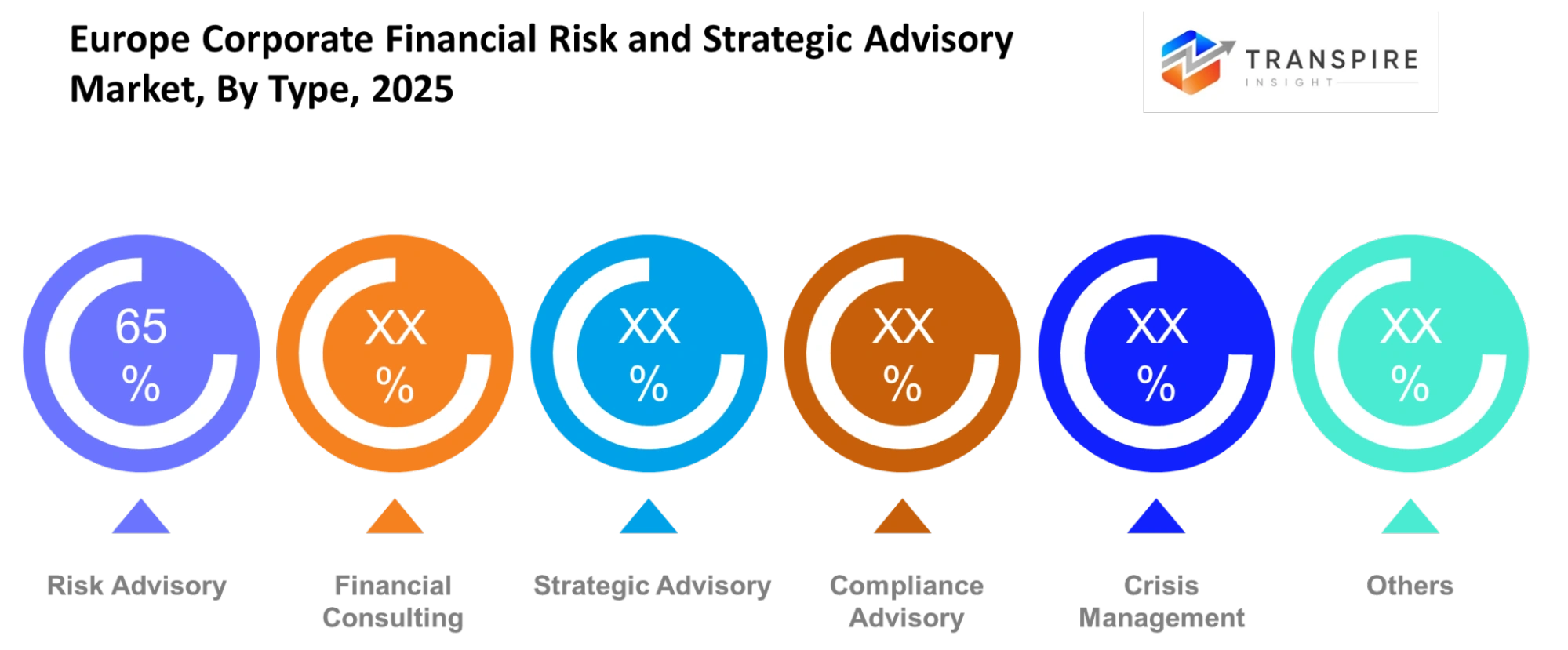
Risk advisory maintains its top market share because European financial regulations create ongoing challenges which businesses face through their cyber vulnerabilities and geopolitical risks. Companies continue to invest substantial amounts of money into their enterprise risk modeling systems and their internal control frameworks and their regulatory compliance efforts. The demand for services increased after 2022 because energy market instability and refinancing difficulties created greater operational and liquidity risks to businesses. Financial institutions and industrial enterprises now prioritize continuous monitoring instead of periodic compliance reviews.
Financial consulting maintains a strong secondary position because corporations require support for capital restructuring, tax optimization, and balance-sheet management amid elevated borrowing costs. Strategic advisory services have become more popular because boardrooms need to create new business strategies which include portfolio development and supply chain production methods and acquisition planning. Compliance advisory services experienced rapid growth after European Union countries implemented new environmental and social governance disclosure regulations. Crisis management services also experienced notable growth following inflationary shocks and cross-border supply disruptions. During the forecast period AI-enabled advisory platforms together with industry-specific consulting models will change how organizations compete which will lead advisory firms to develop predictive analytics solutions and build expertise in particular industries.
To learn more about this report, Download Free Sample Report
By Application:
The market research shows that risk management applications lead all other applications because financial volatility and cyber threats and regulatory scrutiny continue to expand throughout multinational operations. Enterprises utilize scenario modeling tools together with liquidity forecasting and operational stress-testing solutions to strengthen their ability to handle interest rate changes and geopolitical crises. Mergers and acquisitions advisory also represents a significant application area because private equity firms and multinational corporations continue pursuing consolidation opportunities across fragmented European industries. Advisory providers established stronger transaction due diligence skills because increased valuation uncertainty emerged after the 2022 economic disruptions.
Industrial companies expand business strategy and restructuring applications because they seek to optimize their manufacturing operations while moving their supply chains closer to European production centers. Mid-sized enterprises now use financial planning services because they want to improve their capital management and obtain refinancing assistance during the current strict lending environment. The upcoming growth period will occur through the development of predictive financial analytics and enterprise planning systems which will enable organizations to create integrated strategic decision-making frameworks that connect their operational and regulatory and market information.
By End-User:
The end-user testing procedure establishes requirements for testing enterprises which use complex international business operations and need to meet international regulatory standards and have high financial risk exposure. The Industrial sector together with logistics companies and energy firms continues to boost its expenditure on restructuring services and treasury consulting and operational risk assessment services. Large organizations also maintain stronger adoption rates for AI-driven financial analytics platforms because internal governance structures support enterprise-scale implementation. The advisory services showed a major increase in usagewhen European banks established new tight lending rules which made organizations worry about their ability to manage cash flow and handle their debt obligations.
Financial institutions function as the primary end-user group since banks need to conduct ongoing regulatory reporting together with capital adequacy testing and cyber-financial risk management. Small and medium enterprises now prefer to hire external consultants because rising inflation and uncertain financing conditions have made it difficult for them to manage their internal financial planning processes. Government entities keep spending on strategic advisory services to improve their fiscal management capabilities and build better infrastructure funding systems. The future market growth will rely on digital advisory solutions which will help mid-sized businesses achieve budget-friendly compliance and restructuring services.
By Service:
The market currently exists in a state where consulting services remain the dominant force because corporations maintain their preference for expert-led restructuring guidance and transaction advisory and regulatory compliance planning. The consulting industry sees its most valuable projects being executed by large enterprises that need to handle cross-border financial risks while they execute operational changes. The demand for services reached its peak because industrial and transportation sectors needed to refinance their pandemic-related debt which had accumulated during that time. The consulting industry maintains its high service rates because clients require consultants who possess specialized knowledge and skills to interpret regulations according to specific industry requirements.
Organizations establish their analytics and digital advisory services as their most rapidly expanding business unit through the implementation of AI-powered forecasting and automated reporting and predictive financial risk management systems. The implementation of services became more common because enterprises needed assistance to execute ERP system updates and compliance automation projects. Digital transformation trends enable advisory services to deliver their work through new models which decrease reporting time and enhance visibility of operations in organizations that operate in multiple countries. Advisory providers who choose to invest in cloud-based analytics systems and automation-powered service platforms will achieve better client retention and revenue growth throughout the forecast period.
What are the Key Use Cases Driving the Europe Corporate Financial Risk and Strategic Advisory Market?
The manufacturing transportation and energy sectors across Europe primarily use advisory services for two purposes which are corporate restructuring and liquidity risk management. Large enterprises needed strategic assistance to handle their debt restructuring and cash flow forecasting and operational cost reduction needs because of high borrowing costs and refinancing challenges they faced. Industrial groups that operate worldwide through multiple locations create strong demand because their financial instability results in production disruptions and breakdowns of their supply chain links.
The private equity industry and banking sector and mid-sized export companies are increasing their demand for transaction advisory services and ESG compliance consulting work. Financial institutions use advisory services to enhance their stress-testing procedures and improve their regulatory reporting accuracy which they need to meet new European disclosure requirements. The logistics and infrastructure sector extended its geopolitical risk assessment capabilities after supply chain disruptions during 2022 and 2023 revealed its operational weaknesses.
AI-driven predictive insolvency monitoring and real-time scenario modeling for commodity exposure and trade disruption analysis exist as new operational capabilities. Central European exporters and technology-intensive manufacturers are beginning to adopt integrated digital risk intelligence platforms to improve strategic planning and investment resilience over long forecasting cycles.
|
Report Metrics |
Details |
|
Market size value in 2025 |
USD 31.54 Billion |
|
Market size value in 2026 |
USD 33.16 Billion |
|
Revenue forecast in 2033 |
USD 47.09 Billion |
|
Growth rate |
CAGR of 5.14% from 2026 to 2033 |
|
Base year |
2025 |
|
Historical data |
2021 - 2024 |
|
Forecast period |
2026 - 2033 |
|
Report coverage |
Revenue forecast, competitive landscape, growth factors, and trends |
|
Regional scope |
Europe (Germany, United Kingdom, France, Italy, Spain, Rest of Europe) |
|
Key company profiled |
Deloitte, PwC, EY, KPMG, Accenture, McKinsey, BCG, Bain & Company, IBM Consulting, Capgemini, Alvarez & Marsal, FTI Consulting, Protiviti, Oliver Wyman, Roland Berger. |
|
Customization scope |
Free report customization (country, regional & segment scope). Avail customized purchase options to meet your exact research needs. |
|
Report Segmentation |
By Type (Risk Advisory, Financial Consulting, Strategic Advisory, Compliance Advisory, Crisis Management, Others); By Application (Mergers & Acquisitions, Risk Management, Business Strategy, Financial Planning, Restructuring, Others); By End-User (Enterprises, SMEs, Financial Institutions, Government, Others); By Service (Consulting, Analytics, Implementation, Digital Advisory, Others). |
Which Regions are Driving the Europe Corporate Financial Risk and Strategic Advisory Market Growth?
Western Europe has established itself as the market leader because of its high number of multinational corporations and its developed banking systems and its advanced regulatory systems. Germany, France, and the United Kingdom show strong demand for restructuring advisory services and ESG compliance consulting and transaction risk assessment services. The Corporate Sustainability Reporting Directive and enhanced anti-money laundering regulations led businesses to adopt advisory services across all industrial and financial sectors. The region maintains market leadership because global consulting firms and institutional investors and legal networks and advanced digital infrastructure create a dense ecosystem.
Northern Europe stands as the second largest regional contributor although its growth patterns show major differences compared to Western Europe. Nordic countries developed more resilient advisory environments through their stable fiscal policies and strong corporate governance standards and early adoption of digital financial systems. Swedish and Danish and Norwegian companies now shift their focus from major restructuring projects to predictive financial analytics and cyber-risk consulting and sustainability-based strategic planning. The region sustained steady advisory demand because of its ongoing investment in digital governance systems and its clear execution of regulatory frameworks.
The fastest growth rate in Central and Eastern Europe results from industrial expansion and supply chain realignment after the 2022 geopolitical events. The demand for transaction advisory services and compliance planning and operational risk consulting services increased because manufacturers moved their operations closer to European Union production centers in Poland and Czech Republic and Romania. The government-supported digital modernization initiatives together with increasing foreign direct investment prompted businesses to develop their financial governance and international reporting systems. The expansion of this region presents advisory firms and technology companies and private equity investors with multiple opportunities to grow their businesses from 2026 until 2033.
Who are the Key Players in the Europe Corporate Financial Risk and Strategic Advisory Market and How Do They Compete?
The Europe Corporate Financial Risk and Strategic Advisory Market maintains a state of moderate consolidation because worldwide consulting networks handle major international projects while specialized advisory firms compete strongly in restructuring projects and insolvency cases and industry-specific risk assessment services. The competition in the market has started to focus on three key areas which include digital technologies and regulatory knowledge and the ability to provide combined advisory services that cover financial and compliance and cybersecurity and environmental social governance reporting needs. The major companies use AI-powered analytics systems to protect their market position while they provide international services, and mid-sized consulting companies create affordable, niche consulting services, which they offer to regional businesses.
The organization creates its distinctive value proposition through its enterprise-level digital risk intelligence systems which integrate predictive analytics with ESG reporting and operational resilience assessment into a single advisory solution. The company maintains its growth in Central Europe through its establishment of regional partnerships and development of cloud-based compliance automation solutions which serve multinational manufacturing companies. PwC provides its services to private equity and infrastructure clients who need assistance with financial consulting and transaction advisory services that relate to sustainability. European restructuring projects become more challenging because strong regulatory interpretation skills and comprehensive tax advisory networks enable the company to meet all requirements.
Alvarez & Marsal competes through operational turnaround specialization and rapid-response restructuring teams that support distressed industrial and transportation businesses. The firm strengthened its regional presence through mid-market insolvency advisory expansion which it executed in various Eastern European countries. FTI Consulting provides forensic risk analysis and geopolitical exposure assessment and cyber-financial investigation services which became more popular after organizations faced increased ransomware attacks and needed to comply with sanctions. KPMG continues its funding of AI-powered audit analytics and automated regulatory reporting solutions which help multinational companies decrease compliance expenses while enhancing financial visibility across their entire operations.
Company List
- Deloitte
- PwC
- EY
- KPMG
- Accenture
- McKinsey
- BCG
- Bain & Company
- IBM Consulting
- Capgemini
- Alvarez & Marsal
- FTI Consulting
- Protiviti
- Oliver Wyman
- Roland Berger
Recent Development News
In February 2026, Deloitte announced the launch of a new integrated EMEA operating structure with planned investments exceeding €1.5 billion in GenAI and digital advisory services. The restructuring improves cross-border collaboration and expands large-scale advisory delivery capacity across more than 80 countries.
Source: https://www.deloitte.com
In October 2025, KPMG announced an agreement to acquire the intellectual property and technology assets of YData Labs. The acquisition strengthened KPMG’s synthetic data and AI-enabled advisory capabilities, improving enterprise-scale risk analytics and regulatory compliance services.
Source: https://kpmg.com
What Strategic Insights Define the Future of the Europe Corporate Financial Risk and Strategic Advisory Market?
The Europe Corporate Financial Risk and Strategic Advisory Market is transitioning to continuous technology-based advisory systems which will replace its current project-based consulting approach within the next five to seven years. Businesses must implement real-time risk intelligence systems which operate through their main business decision processes because of ongoing regulatory challenges and AI-based financial tracking and escalating geopolitical conflicts. The advisory firms that deliver predictive analytics solutions together with ESG governance expertise and automated compliance systems will gain most of the market because clients choose long-lasting business solutions instead of quick cost savings.
The market faces a hidden danger because advisory networks that operate globally and possess advanced AI systems and extensive regulatory capabilities dominate the market. The concentration of these resources will create two negative effects because it will decrease price options available to medium-sized companies while preventing regional experts from developing new solutions. Central and Eastern Europe currently offers companies a major chance to grow their business because industrial businesses move their operations and EU digital funding programs implement training programs and companies build new supply chains. Market participants should invest aggressively in proprietary AI-enabled financial intelligence tools and region-specific compliance expertise to secure long-term competitive positioning.
Europe Corporate Financial Risk and Strategic Advisory Market Report Segmentation
By Type
- Risk Advisory
- Financial Consulting
- Strategic Advisory
- Compliance Advisory
- Crisis Management
- Others
By Application
- Mergers & Acquisitions
- Risk Management
- Business Strategy
- Financial Planning
- Restructuring
- Others
By End-User
- Enterprises
- SMEs
- Financial Institutions
- Government
- Others
By Service
- Consulting
- Analytics
- Implementation
- Digital Advisory
- Others
Frequently Asked Questions
Find quick answers to common questions.
The Europe Corporate Financial Risk and Strategic Advisory Market size is USD 47.09 Billion in 2033.
Key segments for the Europe Corporate Financial Risk and Strategic Advisory Market are By Type (Risk Advisory, Financial Consulting, Strategic Advisory, Compliance Advisory, Crisis Management, Others); By Application (Mergers & Acquisitions, Risk Management, Business Strategy, Financial Planning, Restructuring, Others); By End-User (Enterprises, SMEs, Financial Institutions, Government, Others); By Service (Consulting, Analytics, Implementation, Digital Advisory, Others).
Major Europe Corporate Financial Risk and Strategic Advisory Market players are Deloitte, PwC, EY, KPMG, Accenture, McKinsey, BCG, Bain & Company, IBM Consulting, Capgemini, Alvarez & Marsal, FTI Consulting, Protiviti, Oliver Wyman, Roland Berger.
The Europe Corporate Financial Risk and Strategic Advisory Market size is USD 31.54 Billion in 2025.
The Europe Corporate Financial Risk and Strategic Advisory Market CAGR is 5.14% from 2026 to 2033.
- Deloitte
- PwC
- EY
- KPMG
- Accenture
- McKinsey
- BCG
- Bain & Company
- IBM Consulting
- Capgemini
- Alvarez & Marsal
- FTI Consulting
- Protiviti
- Oliver Wyman
- Roland Berger
About the Authors

Mayur Shinde
I am Mayur Shinde, a Senior Research Analyst at Transpire Insight, specializing in the Automotive & Transportation and Information & Communication Technology (ICT) Industry. My work focuses on analyzing emerging market trends, technological advancements, competitive landscapes, and industry developments to deliver accurate, data-driven insights. I am passionate about transforming complex market information into clear, actionable content that helps businesses, professionals, and decision-makers stay informed and make confident strategic decisions.

Chakradhar Khansole
Chakradhar serves as the Research Director at Transpire Insight, bringing over 8 years of experience in technology, innovation, and strategic market intelligence. He specializes in transforming complex market data into actionable business insights that enable organizations to make informed, growth-oriented decisions. Recognized for his strategic vision and analytical expertise, Chakradhar leads high-impact research initiatives, delivering comprehensive market assessments, competitive intelligence, and forward-looking industry analysis.
Recently Published Reports
-
Apr 2026
3D Optical Profiler Market
3D Optical Profiler Market Size, Share & Analysis Report By Type (Desktop 3D Optical Profiler, and Portable 3D Optical Profiler), By Technology (Confocal Technology, and White Light Interference), By End-Use Industry (Manufacturing, Research Institutions, Automotive, Aerospace and Defense, Medical Devices, and Other), and Geography (North America, Europe, Asia-Pacific, Middle East and Africa, South and Central America), 2021 - 2031
-
Apr 2026
Depth Sensor Market
Depth Sensor Market Size, Share & Analysis Report By Type (Infrared Depth Sensors, Time-of-Flight (ToF) Sensors, Stereo Vision Sensors, Structured Light Sensors, Ultrasonic Depth Sensors), By Application (Automotive, Robotics, Gaming, Consumer Electronics, Industrial Automation, Healthcare, Security & Surveillance, Others), By End Users (Automotive Manufacturers, Consumer Electronics Companies, Healthcare Providers, Industrial Companies, Security Agencies, Gaming Companies, Robotics Companies, Others), and Geography (North America, Europe, Asia-Pacific, Middle East and Africa, South and Central America), 2021 – 2031
-
Apr 2026
Digital Manufacturing Market
Digital Manufacturing Market Size, Share & Analysis Report By Component (Hardware, Software, and Services), By Technology (Robotics, 3D Printing, Internet of Things (IoT), and Others), By Application (Automotive and Transportation, Aerospace and Defense, Consumer Electronics, Industrial Machinery, and Others), By Process Type (Computer-Based Designing, Computer-Based Simulation, Computer 3D Visualization, Analytics, and Others), and Geography (North America, Europe, Asia-Pacific, Middle East and Africa, South and Central America), 2021 – 2031
-
Apr 2026
Digital Visa Services Market
Digital Visa Services Market Size, Share & Analysis Report By Type (Individual Travelers, Group Travelers), By Application (Tourism, Business Travel, Others), and Geography (North America, Europe, Asia-Pacific, Middle East and Africa, South and Central America), 2021 – 2031