

Asia Pacific K-12 Education Market Summary
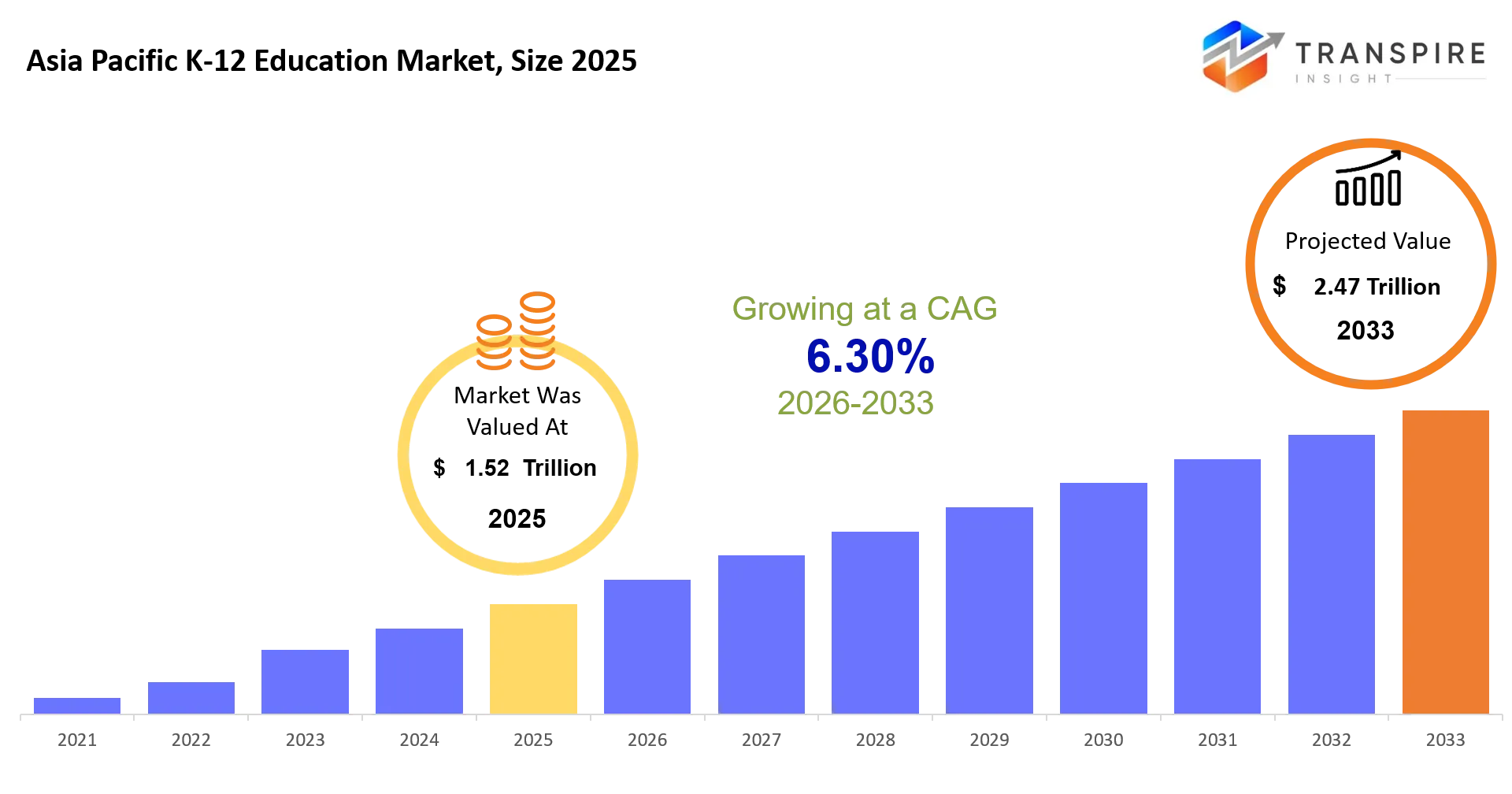
As per Transpire Insight Analysis, the Asia Pacific K-12 Education Market size is estimated at USD 1.52 Trillion in 2025 and is anticipated to reach USD 2.47 Trillion by 2033, growing at a CAGR of 6.30% from 2026 to 2033.
The Asia Pacific K-12 Education Market kinda backs schools so they can deliver more structured learning via regular classroom instruction, digital platform set ups, curriculum materials, assessment utilities, and school administration systems. In general it helps students pick up both academic knowledge and practical know-how, you know. It also lets governments and private schools broaden who can access what, while they try to raise education quality, and at the same time it improves teaching efficiency and learning results across different groups.
Over the last five years, there’s been this noticeable shift away from the mostly old style, classroom-first models. Now it leans more toward blended approaches and digitally enabled education, mostly because of continuing investments in education technology plus curriculum modernisation efforts. And honestly the COVID-19 pandemic was the big defining push, it forced schools to set up remote learning infrastructure pretty quickly and it sped up longer term digital transformation plans.
Even now, as governments keep funding things like connected classrooms, teacher training, and personalized learning platforms, educational institutions are adopting these more integrated solutions. These solutions tend to boost student participation, strengthen administrative workflows, and make performance measurement feel more precise. As that rolls on, it opens up stronger recurring revenue pathways for technology providers, curriculum content developers, and education service companies, all at once.
Asia Pacific K-12 Education Market Size & Forecast:
- Asia Pacific K-12 Education Market Size 2025: USD 1.52 Trillion
- Expected Market Value 2033: USD 2.47 Trillion
- Forecast CAGR: 6.30%
- Leading region in 2025: China
- Fastest Growing region: India
- Key Profile: BYJU'S, Pearson, McGraw Hill, Cengage, Blackboard, Google for Education, Microsoft Education, Coursera, Khan Academy, LEGO Education, Educomp Solutions, Next Education, ClassDojo, PowerSchool, Instructure
Key Market Insights
- China kind of dominated the Asia Pacific K-12 Education Market, taking about 42% market share in 2025helped by heavy public education spending and nation-wide digital classroom programmes, you know, the sort that rolled out broadly.
- India, on the other hand, is projected to stay the quickest-moving regional market during 2025–2033, mostly because of school digitalisation drives, more private education networks popping up, and solid EdTech investments.
- When it comes to products and services, digital learning platforms pretty much led the way with nearly 34% market share in 2025, since schools keep weaving in cloud based content plus assessment tools.
- Learning management systems were positioned as the second-largest segment, and this seems to have been boosted by wider rollouts across both public and private school networks since 2022.
- For growth, AI-enabled adaptive learning solutions are expected to be the fastest growing from 2025 to 2033. This is linked to personalised instruction, and analytics driven learning outcomes, which makes sense in a very practical way.
- In terms of applications, classroom learning stayed the main option with roughly 61% share in 2025. Meanwhile, blended digital delivery kept expanding, slowly but surely, across urban and suburban schools.
- Remote and hybrid learning applications are forecast to become the fastest-growing application segment by 2033, as institutions invest in more resilient education infrastructure
- Looking at end users, public schools generated nearly 68% of end-user revenue in 2025. This reflects continued government funding, and also large student enrolments.
- Private K-12 institutions are expected to be the fastest-growing end-user group across the forecast period, helped by premium digital curriculum adoption and ongoing technology investments.
What are the Key Drivers, Restraints, and Opportunities in the Asia Pacific K-12 Education Market?
The strongest driver of market expansion is steady government spending on digital learning infrastructure, plus a real shift in curriculum. In many places national education reforms revved up after the COVID-19 pandemic made connected classrooms a central point, alongside digital assessments, and teacher upskilling. At the same time, cloud infrastructure costs kept easing down and broadband coverage got wider, so the “start up” barriers went down too. With all of that, schools were more willing to swap out fragmented teaching setups for more unified education platforms, even if that sounds simple on paper. As a knock on effect, technology vendors ended up winning bigger recurring deals, meaning software plus service contracts, while schools improved student engagement. And then you see clearer platform adoption, plus longer term revenue generation that actually sticks.
The main brake though is uneven digital infrastructure, especially across rural areas and lower income regions. A lot of schools still deal with shaky internet connectivity, older classroom equipment that won’t quite cooperate, and teacher training that doesn’t fully cover advanced digital tools. Those issues don’t resolve fast, because they depend on sustained public funding, infrastructure modernization, and broader workforce development. From the Transpire Insight review of regional procurement announcements, and launch timelines, supply chain concentration looks like the core execution risk. The outcome tends to be slower rollouts, postponed procurement cycles, and reduced software subscription revenue in underserved education markets, which is why adoption can lag for longer than expected.
A big chance seems to be in AI driven, personalised learning setups that actually slot in with wider national digital education strategies, and it feels like a lot of that is already underway. Governments across India, Southeast Asia, and Australia are still pushing more money into cloud based education infrastructure, along with digital materials , and analytics platforms. At the same time adaptive learning tools, multilingual learning content, and systems that foresee student performance are opening up brand new commercial avenues. Vendors that blend AI, learning analytics, plus cybersecurity into one education platform, they might be the ones that are best set for the next wave of regional growth.
What Has the Impact of Artificial Intelligence Been on the Asia Pacific K-12 Education Market?
Artificial intelligence and newer digital tools are quietly reshaping K-12 education across the Asia Pacific region , mostly by automating stuff like admin routines, lesson preparation, attendance monitoring, exam management and compliance reporting. More and more schools are rolling out AI helpers so teachers can spend less time on clerical tasks. At the same time, digital platforms tend to grade assignments automatically and flag learning gaps. In the end , educators get a bit more room for personalized teaching and real student engagement, even if the day to day still feels busy.
Then there is machine learning, which is basically boosting prediction abilities inside schools. Analytics dashboards can forecast how students might perform, pinpoint who is at risk of lagging behind, help optimize how resources get used, and suggest specific, targeted supports before results start slipping. School leaders also rely on these predictive signals for enrollment planning, staffing decisions, and whether the curriculum is actually landing as intended. Overall the impact shows up as better operational efficiency , quicker administrative work, and steadier educational performance, while the usual manual processing costs are pushed down.
Still, even with these advantages, broad deployment is not straightforward. Integration costs can be high, digital infrastructure is uneven, student data often ends up fragmented, and cybersecurity practices vary across different education systems. Many schools , especially beyond the biggest metropolitan centres, still struggle with reliable connectivity and enough technical know-how to use advanced AI platforms properly. How well these obstacles get handled will decide how fast intelligent education technologies spread through the regional education ecosystem , step by step, without rushing too much.
Key Market Trends
- Since 2021, blended learning has sort of turned into a long term instructional model across big education systems, and it’s now largely replacing those temporary emergency remote teaching setups.
- Between 2022 and 2025, many governments basically sped up one to one student device programmes, and in doing so they improved digital content accessibility and also pushed classroom technology adoption a lot more quickly.
- Since 2023, AI powered adaptive learning platforms have been rolling out at a fast pace, they help deliver personalized lesson paths and even generate automated performance recommendations, which is kind of the whole point.
- Cloud based learning management systems are still steadily replacing locally hosted platforms, because schools keep prioritising scalability, cybersecurity, and that centralised administration idea.
- China has gone further with smart classroom deployment ,thanks to continuing investment in digital education, and that sort of solidifies regional leadership for educational technology implementation.
- India is now a more strategic destination for EdTech investment, supported by wider internet access, plus large scale education modernisation programmes that keep expanding.
- Google, Microsoft, and Lenovo have also increased education focused hardware and software partnerships with regional school systems since 2022, so partnerships are kind of everywhere.
- Interactive displays, digital assessment tools, and virtual science laboratories have become regular procurement priorities across newly modernised schools, whether it’s district wide or individual campuses.
- Cybersecurity spending has climbed steadily, education providers are protecting cloud based student records, AI applications, and connected classroom infrastructure, pretty constantly.
- Finally, learning analytics platforms increasingly support evidence based curriculum planning, by turning real time student performance data into actionable educational insights.
Asia Pacific K-12 Education Market Segmentation
By School Type :
Public schools kind of hold the biggest share, in the sense that national education systems keep getting serious government money for infrastructure , curriculum upgrades, and digital classroom programmes. When enrollment stays high, there is always this steady need for educational technologies, assessment platforms, and teaching resources. Private schools still keep a solid role too, mainly because they put resources into premium learning experiences, modern classroom technology, and specialised academic programmes. Meanwhile international schools keep pushing outward in metropolitan areas where expatriate communities and higher-income households actually support those premium education services.
Charter schools and online schools keep drawing attention through more flexible teaching models, and technology driven learning environments . Hybrid education strategies, sort of improved digital capabilities across these institutions while also making things easier for a wider student group . Other types of schools, like specialised or vocational institutions, continue adopting modern learning tools to raise educational outcomes. In the long run, investment across every school type should help sustain the expansion of education technology plus related services.
By Learning Mode :
Offline learning stays as the prime learning mode , since classroom instruction keeps doing the usual structured teaching, hands-on tasks, and that direct kind of interaction between educators and learners. Usual learning spaces are still needed for academic development, examinations, and group-based collaboration. Digital resources are showing up more and more as a useful supplement to classroom teaching, not as a direct replacement for physical instruction. Schools and colleges keep weaving technology into everyday teaching practices, but they do not remove face-to-face learning from the mix.
Hybrid learning seems to be growing the quickest , because many schools want better flexibility and resilience after those big scale digital change efforts. Online learning keeps getting stronger thanks to cloud-based platforms, interactive materials, and virtual assessments that make education easier to reach. Distance learning still helps communities that are spread out, where physical access is limited or not really available. Other learning methods also keep supporting specialised educational needs, using adapted teaching strategies and digital delivery models, in a more tailored way.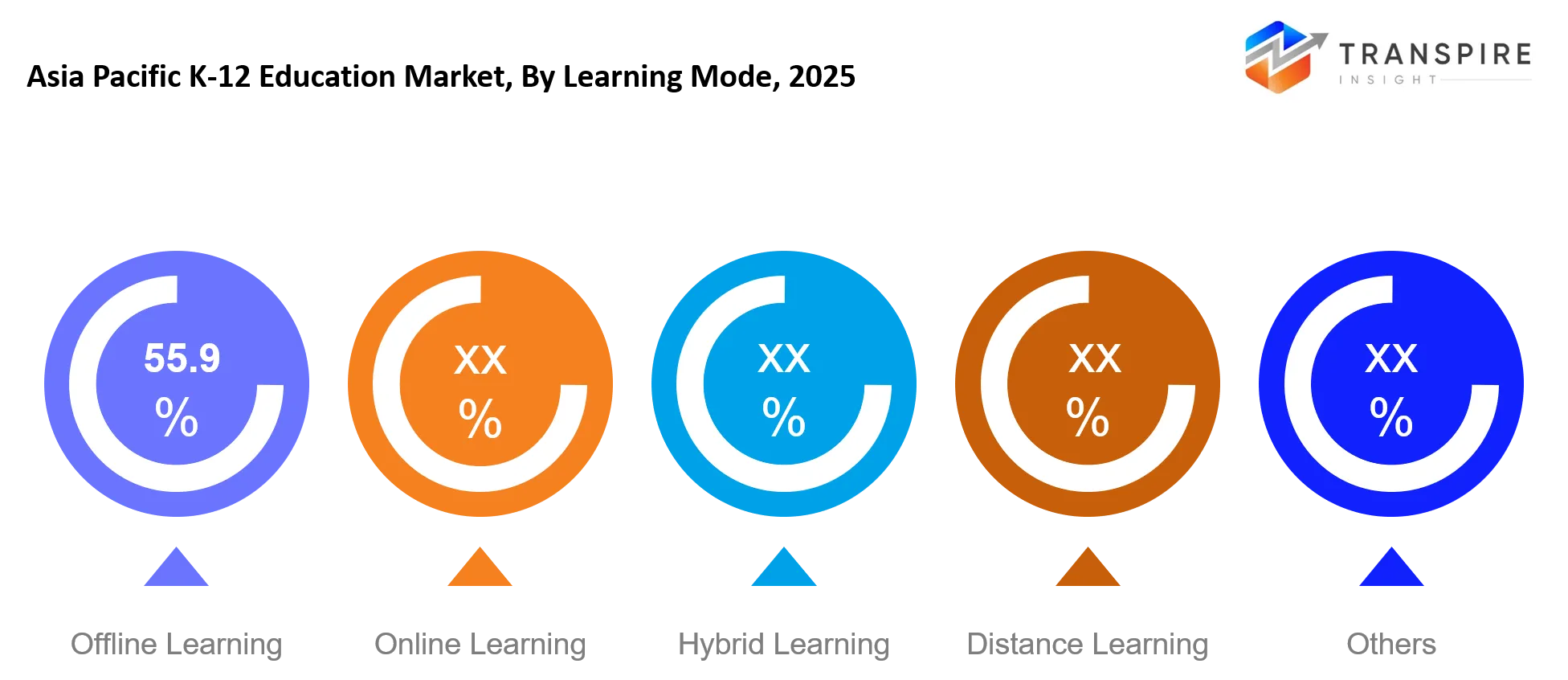
By Product Type :
Digital learning platforms tend to bring in the largest revenue share because schools are now more often asking for integrated solutions that cover content delivery, communication, classroom management and even performance tracking. Ongoing software upgrades, they keep improving the functionality, and they also help with scalable rollout across different education systems. Curriculum solutions still matter a lot too, mainly as governments keep updating academic standards and rolling out competency based learning frameworks. Meanwhile assessment tools are still growing, with automated evaluation, real-time analytics, and digital exam options becoming more common.
Learning management systems also keep getting adopted, mostly because centralised administration makes everything feel more efficient across teaching, student monitoring, and institutional oversight. Educational content providers keep expanding the interactive multimedia materials they offer, since those resources support engagement, and in practice they tend to lift learning outcomes. Artificial intelligence then goes one step further by enabling more adaptive learning across several product types. And the other education technologies? They continue handling niche institutional needs with carefully targeted software and service offerings.
By End User :
Schools sit at the leading end-user spot because educational institutions mostly coordinate buying decisions for classroom tech, software platforms, digital materials, and the underlying infrastructure sort of investments. Over the long run, digital transformation initiatives still keep going , supporting those connected education ecosystems across public and private organisations. Government agencies stay as big contributors too, via policy rollouts, funding programmes, and curriculum development efforts, even if the roles shift a bit over time. Students keep getting more access to tailored learning resources and engaging educational technologies, which is what most people notice first.
Teachers are also moving toward digital teaching tools that make lesson prep easier , and help with assessment plus day to day classroom management while overall instructional quality improves. Parents join in actively through digital communication platforms that help strengthen their engagement, around academic progress and school activities. Then there are other end users, like education administrators or support organisations, who keep picking up specialised solutions aimed at better operational efficiency. If the different stakeholder groups keep cooperating, the long-term adoption of education technology should stay strong, and that’s kind of the whole point, right?
By Deployment :
Cloud-based deployment seems to be winning overall, mostly because schools want a scalable platform that helps lower infrastructure costs, while still allowing remote access, centralized updates , and safer data handling. The subscription-style software approach also makes it easier to get started and it cuts down the whole maintenance side across big school networks. Plus cloud infrastructure tends to enable quicker integration with learning management systems, testing or assessment platforms, and digital content libraries. And with continuous improvements in cybersecurity, institutions feel more comfortable leaning into cloud adoption.
Hybrid deployment is also growing, where schools mix cloud flexibility with local infrastructure, especially when it comes to sensitive educational data or older, legacy applications. Meanwhile, on-premise deployment is still around , for institutions that need to meet strict regulatory rules, or more rigid operational requirements. Other deployment models keep serving more niche or specialised needs by using customised technology environments. In general, the ongoing digital transformation efforts will likely push wider adoption of flexible deployment architectures across regional education systems.
What are the Key Use Cases Driving the Asia Pacific K-12 Education Market?
Classroom teaching, still supported by digital learning platforms, remains like the primary use case, and in total it ends up taking the biggest chunk of spending across public and private schools. Education authorities, and also the school operators , they put money into integrated platforms for running lessons, handling assignments, doing assessments and tracking student performance, while at the same time trying to boost administrative efficiency, and also making curriculum delivery smoother.
Assessment tools plus learning management systems are now spreading across international schools as well as online education providers, mostly to keep academic evaluation consistent and to keep content managed from one place. At the same time government education departments are rolling out digital curriculum solutions, in order to standardise learning quality and to follow academic performance across big school networks, not just a single site.
AI assisted personalised learning, and immersive experiences like augmented and virtual reality, are showing up as pretty promising applications. There are pilot programmes in science, engineering, and language education that are being backed by national digital education initiatives, and they are expected to open up fresh opportunities as infrastructure keeps improving, teacher training ramps up, and classroom connectivity gets better.
|
Report Metrics |
Details |
|
Market size value in 2025 |
USD 1.52 Trillion |
|
Market size value in 2026 |
USD 1.61 Trillion |
|
Revenue forecast in 2033 |
USD 2.47 Trillion |
|
Growth rate |
CAGR of 6.30% from 2026 to 2033 |
|
Base year |
2025 |
|
Historical data |
2021 - 2024 |
|
Forecast period |
2026 - 2033 |
|
Report coverage |
Revenue forecast, competitive landscape, growth factors, and trends |
|
Regional scope |
Asia Pacific (India, China, Japan, Australia, South Korea, Rest of Asia Pacific) |
|
Key company profiled |
BYJU'S, Pearson, McGraw Hill, Cengage, Blackboard, Google for Education, Microsoft Education, Coursera, Khan Academy, LEGO Education, Educomp Solutions, Next Education, ClassDojo, PowerSchool, Instructure . |
|
Customization scope |
Free report customization (country, regional & segment scope). Avail customized purchase options to meet your exact research needs. |
|
Report Segmentation |
By School Type (Public Schools, Private Schools, International Schools, Charter Schools, Online Schools, Others); By Learning Mode (Offline Learning, Online Learning, Hybrid Learning, Distance Learning, Others); By Product Type (Curriculum Solutions, Digital Learning Platforms, Assessment Tools, Educational Content, Learning Management Systems, Others); By End User (Students, Teachers, Schools, Government, Parents, Others); By Deployment (Cloud-Based, On-Premise, Hybrid, Others) |
Which Regions are Driving the Asia Pacific K-12 Education Market Growth?
China was responsible for around 42% of regional revenue in 2025, and I mean East Asia really ends up as the main contributor for the Asia Pacific K-12 Education Market. Even with that, strong government actions around digital learning, curriculum reform, and smart classroom rollouts keep nudging schools and districts toward adoption. There’s also a fairly mature mix of playerslocal technology companies, international education software providers, device manufacturers, and cloud infrastructure alliesso deployment doesn’t really stall, and services keep expanding. Looking ahead, steady education budgets, countrywide digital connectivity, and routine curriculum updates should keep this region in the lead across the forecast window.
Japan, meanwhile, shows up as the second-biggest regional contributor. The reason is sort of the same but not exactly: education spending tends to follow a calm, structured method, where the emphasis is on quality enhancement rather than quick capacity growth. The regulatory rules stay consistent, public funding is reliable, and digital infrastructure has matured enough that procurement cycles for edtech suppliers become pretty predictable. Schools keep putting money into classroom supervision software, digital evaluation platforms, and more interactive instruction experiences, while also holding onto higher day to day operational expectations. That balanced pattern creates steady, dependable revenue windows for vendors plus education service companies, even if enrollment growth moves at a slower pace.
India is expected to see the fastest expansion between 2026 and 2033, largely because investments are speeding up in digital education infrastructure , broadband connectivity, and broader education reforms at the national level. More people are adopting cloud based learning platforms plus AI supported teaching tools, and meanwhile affordable student devices are helping widen technology access across city and semi-urban schools. Private education providers along with state governments keep pushing ahead with digital learning programs, aiming to boost educational quality and also improve day to day operational efficiency. With this momentum still building it should open up attractive opportunities for software developers , cloud service providers, education content firms, and investors who are looking for long term growth across the whole regional education ecosystem.
Who are the Key Players in the Asia Pacific K-12 Education Market and How Do They Compete?
Competition across the Asia Pacific K-12 education market is still, pretty moderately fragmented, since multinational technology firms, regional education companies, and specialised software providers tend to go after slightly different customer segments. Basically the main fight happens around technology innovation and integrated service capabilities though cloud deployment, artificial intelligence, and digital content keep rewriting how buyers decide what to purchase. Established education technology providers keep extending their platform capabilities , while newer players push in with specialised learning applications and localised educational content, to meet those country specific curriculum needs.
Google sits apart thanks to Chromebook devices, Google Classroom, and its cloud based collaboration tools, all of which make large scale digital learning deployment easier for schools. It also keeps putting money into artificial intelligence features and education partnerships, which in turn strengthens how widely the platform gets adopted by both public and private institutions. Microsoft competes by bringing Microsoft 365 Education, Teams, and AI powered productivity tools into classroom day to day workflows, and that creates smoother collaboration along with administrative efficiency, while also expanding regional cloud infrastructure. Pearson mainly differentiates through digital curriculum , online assessment, and adaptive learning content, so educational institutions can blend academic resources with more measurable learning outcomes.
BYJU'S has been expanding in a sort of hybrid way, mixing learning services with digital course offerings and regional material made to fit local curricula, so engagement looks better for more than one type of student group. Lenovo meanwhile boosts competitiveness by providing education-focused laptops, tablets and classroom devices, and that support is not just one time, it comes from long term institutional partnerships, plus device management solutions that keep things running. With continuous product innovation , and then strategic collaborations with education authorities, plus investment in cloud-enabled learning ecosystems , both companies manage to hold a stronger market presence while they react to the way school procurement priorities keep shifting over time.
Company List
- BYJU'S
- Pearson
- McGraw Hill
- Cengage
- Blackboard
- Google for Education
- Microsoft Education
- Coursera
- Khan Academy
- LEGO Education
- Educomp Solutions
- Next Education
- ClassDojo
- PowerSchool
- Instructure
Recent Development News
In June 2026, GEMS Education (India) announced an investment of up to USD 30 million to develop 21 new school projects and launch a SEBI-regulated Alternative Investment Fund for education infrastructure. The investment expands private K-12 capacity in India and supports long-term education infrastructure development across a high-growth regional market.
Source https://timesofindia.indiatimes.com/
In June 2025, Pearson and Google Cloud announced a multi-year strategic partnership to develop next-generation AI tools for students and educators. The collaboration integrates Google Cloud AI with Pearson's K-12 learning products to deliver personalized learning, teacher analytics, and scalable AI-powered education services. Source https://plc.pearson.com/
What Strategic Insights Define the Future of the Asia Pacific K-12 Education Market?
The Asia Pacific K-12 Education Market is kind of moving toward these integrated digital education ecosystems where artificial intelligence, cloud platforms, and data-driven learning analytics are becoming usual pieces of what actually happens in a classroom, not really “extra” add-ons anymore. If you look at the bigger picture, this shift is being pushed by long-run public funding, curriculum modernisation , and upgrades to digital infrastructure across a lot of emerging economies.
At the same time there’s this less visible risk that people may not notice right away, regulatory fragmentation. Like, different countries keep using different national standards for student data privacy, AI governance, and even the approval process for digital content , which could bump up compliance costs and make cross-border platform expansion slower than expected.
On the opportunity side, there’s also something interesting happening: multilingual AI learning platforms. These are being tailored to local curricula , especially across Southeast Asia and India, where education reforms keep encouraging tech adoption. Market participants should really focus on partnerships with regional education authorities and curriculum developers, while building flexible platforms that can adapt quickly to country-specific regulatory rules as well as language requirements. If they do that, they can build more sustainable competitive advantages over the next decade or so.
Asia Pacific K-12 Education Market Report Segmentation
By School Type
- Public Schools
- Private Schools
- International Schools
- Charter Schools
- Online Schools
By Learning Mode
- Offline Learning
- Online Learning
- Hybrid Learning
- Distance Learning
By Product Type
- Curriculum Solutions
- Digital Learning Platforms
- Assessment Tools
- Educational Content
- Learning Management Systems
By End User
- Students
- Teachers
- Schools
- Government
- Parents
By Deployment
- Cloud-Based
- On-Premise
- Hybrid
Frequently Asked Questions
Find quick answers to common questions.
The Expected Asia Pacific K-12 Education Market size for the Market will be USD 2.47 Trillion in 2033.
Key segments for the Asia Pacific K-12 Education Market are By School Type (Public Schools, Private Schools, International Schools, Charter Schools, Online Schools, Others); By Learning Mode (Offline Learning, Online Learning, Hybrid Learning, Distance Learning, Others); By Product Type (Curriculum Solutions, Digital Learning Platforms, Assessment Tools, Educational Content, Learning Management Systems, Others); By End User (Students, Teachers, Schools, Government, Parents, Others); By Deployment (Cloud-Based, On-Premise, Hybrid, Others).
Major Asia Pacific K-12 Education Market players are BYJU'S, Pearson, McGraw Hill, Cengage, Blackboard, Google for Education, Microsoft Education, Coursera, Khan Academy, LEGO Education, Educomp Solutions, Next Education, ClassDojo, PowerSchool, Instructure.
The Current Asia Pacific K-12 Education Market size is USD 1.52 Trillion in 2025.
The Asia Pacific K-12 Education Market CAGR is 6.30% from 2026 to 2033.
- BYJU'S
- Pearson
- McGraw Hill
- Cengage
- Blackboard
- Google for Education
- Microsoft Education
- Coursera
- Khan Academy
- LEGO Education
- Educomp Solutions
- Next Education
- ClassDojo
- PowerSchool
- Instructure
About the Authors

Mayur Shinde
I am Mayur Shinde, a Senior Research Analyst at Transpire Insight, specializing in the Automotive & Transportation and Information & Communication Technology (ICT) Industry. My work focuses on analyzing emerging market trends, technological advancements, competitive landscapes, and industry developments to deliver accurate, data-driven insights. I am passionate about transforming complex market information into clear, actionable content that helps businesses, professionals, and decision-makers stay informed and make confident strategic decisions.

Chakradhar Khansole
Chakradhar serves as the Research Director at Transpire Insight, bringing over 8 years of experience in technology, innovation, and strategic market intelligence. He specializes in transforming complex market data into actionable business insights that enable organizations to make informed, growth-oriented decisions. Recognized for his strategic vision and analytical expertise, Chakradhar leads high-impact research initiatives, delivering comprehensive market assessments, competitive intelligence, and forward-looking industry analysis.
Recently Published Reports
-
Apr 2026
3D Optical Profiler Market
3D Optical Profiler Market Size, Share & Analysis Report By Type (Desktop 3D Optical Profiler, and Portable 3D Optical Profiler), By Technology (Confocal Technology, and White Light Interference), By End-Use Industry (Manufacturing, Research Institutions, Automotive, Aerospace and Defense, Medical Devices, and Other), and Geography (North America, Europe, Asia-Pacific, Middle East and Africa, South and Central America), 2021 - 2031
-
Apr 2026
Depth Sensor Market
Depth Sensor Market Size, Share & Analysis Report By Type (Infrared Depth Sensors, Time-of-Flight (ToF) Sensors, Stereo Vision Sensors, Structured Light Sensors, Ultrasonic Depth Sensors), By Application (Automotive, Robotics, Gaming, Consumer Electronics, Industrial Automation, Healthcare, Security & Surveillance, Others), By End Users (Automotive Manufacturers, Consumer Electronics Companies, Healthcare Providers, Industrial Companies, Security Agencies, Gaming Companies, Robotics Companies, Others), and Geography (North America, Europe, Asia-Pacific, Middle East and Africa, South and Central America), 2021 – 2031
-
Apr 2026
Digital Manufacturing Market
Digital Manufacturing Market Size, Share & Analysis Report By Component (Hardware, Software, and Services), By Technology (Robotics, 3D Printing, Internet of Things (IoT), and Others), By Application (Automotive and Transportation, Aerospace and Defense, Consumer Electronics, Industrial Machinery, and Others), By Process Type (Computer-Based Designing, Computer-Based Simulation, Computer 3D Visualization, Analytics, and Others), and Geography (North America, Europe, Asia-Pacific, Middle East and Africa, South and Central America), 2021 – 2031
-
Apr 2026
Digital Visa Services Market
Digital Visa Services Market Size, Share & Analysis Report By Type (Individual Travelers, Group Travelers), By Application (Tourism, Business Travel, Others), and Geography (North America, Europe, Asia-Pacific, Middle East and Africa, South and Central America), 2021 – 2031