

Asia Pacific AI In Education Market Size & Forecast:
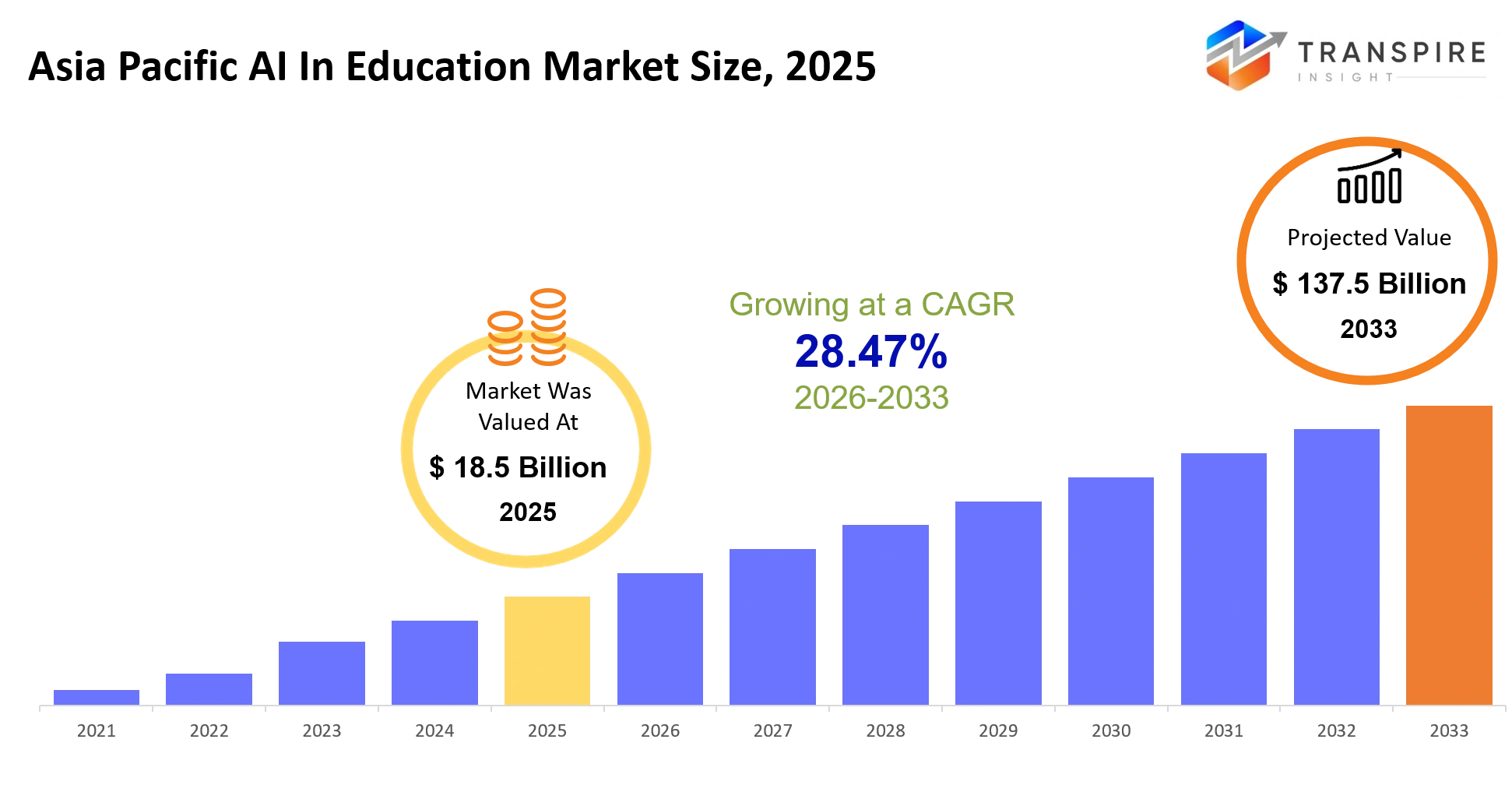
- Asia Pacific AI In Education Market Size 2025: USD 18.5 Billion
- Asia Pacific AI In Education Market Size 2033: USD 137.5 Billion
- Asia Pacific AI In Education Market CAGR: 28.47%
- Asia Pacific AI In Education Market Segments: By Component (Software, Services, Platforms, Analytics Tools, Chatbots, Assessment Tools, Others); By Application (Personalized Learning, Virtual Tutors, Administration, Content Creation, Language Learning, Others); By Deployment (Cloud, On-Premise, Hybrid, Others); By End User (Schools, Universities, EdTech Firms, Training Centers, Others).
Asia Pacific AI In Education Market Summary
The Asia Pacific AI In Education Market was valued at USD 18.5 Billion in 2025. It is forecast to reach USD 137.5 Billion by 2033. That is a CAGR of 28.47% over the period.
The Asia Pacific AI in Education Market is kind of reshaping the whole way schools ,universities, and training institutions deliver learning, by helping educators personalize lessons, offload administrative tasks, and notice student learning gaps earlier. In the real world, AI-powered platforms can reduce teacher workload while also lifting student interest and overall outcomes, and in general it makes education systems feel more scalable and data driven, not just a nice idea on paper.
Over the last five years, there’s been this structural shift from experimental AI tools toward more institution-wide learning ecosystems, where adaptive learning, analytics, and generative AI features all sit together. The COVID-19 pandemic really acted like a big trigger for the transition, forcing education providers to put digital infrastructure in place at scale, and also showing where traditional teaching models fall short. Now, as institutions look for measurable gains in learning efficiency and workforce readiness ,investment is slowly moving toward AI platforms that support continuous assessment, multilingual coverage, and personalized learning pathways. That, in turn, creates stronger recurring revenue chances for technology providers who can actually stay embedded.
Key Market Insights
- With about 40% market share by 2025, China has a significant hold over the Asia Pacific AI in education market due to its large EdTech investments and AI-powered classroom infrastructure.
- India emerges as the fastest growing country market until 2032, backed by digital public infrastructure, a growing internet reach and government-supported modernization of education.
- Emerging demand for AI-based services is observed in Southeast Asian countries as educational institutions have initiated investment in cloud-based learning platforms and multilingual AI tutors.
- Software platforms captured the dominant share, about 58% market share in 2025 of the Asia Pacific AI in education market, backed by increasing adoption of adaptive learning solutions.
- AI-enabled content creation and assessment tools holds the second largest segment, supported by increased demand for automated grading and content customization.
- AI based learning assistants will grow to be the highest growth area from 2025 to 2032, as universities and colleges will seek solutions to engage student populations at scale.
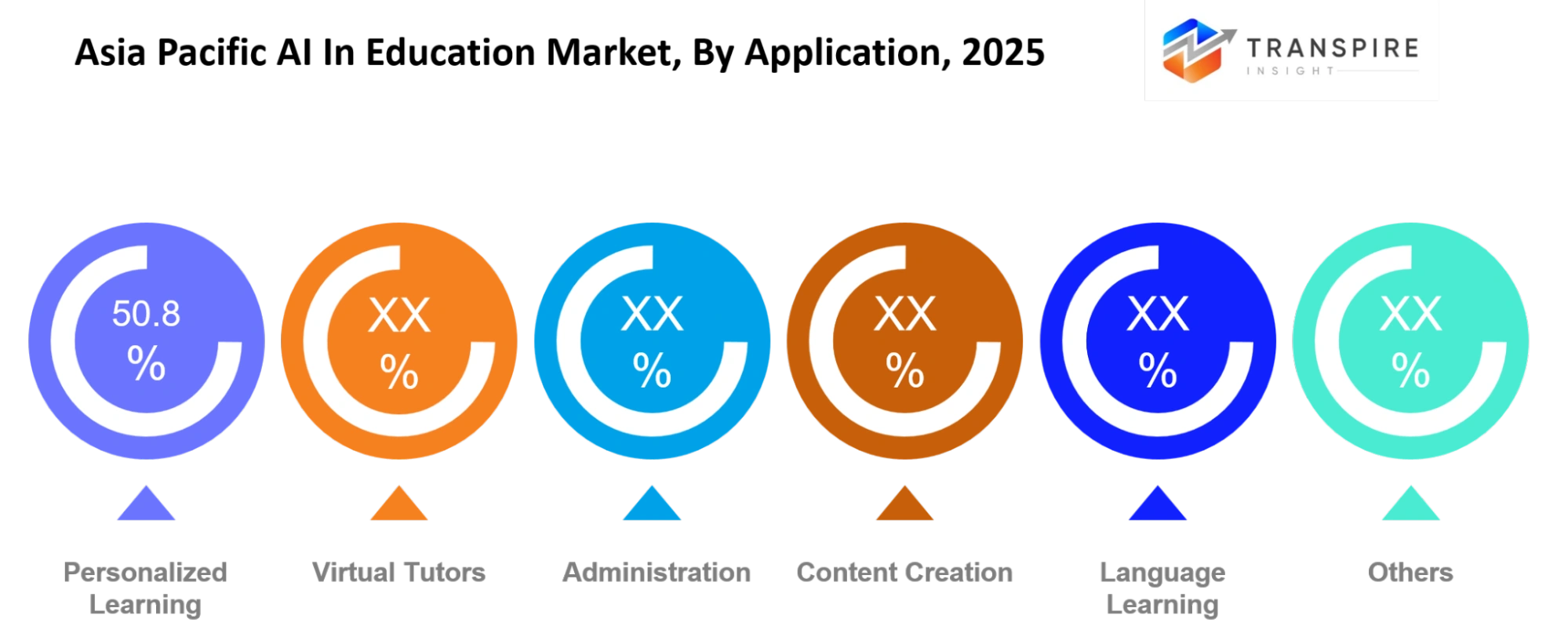
- Customized learning is predicted to be the top application by market share, and will account for roughly 35% in 2025, where teaching can be data-driven to maximize learning gains.
- AI tutoring is a rapidly increasing application category with significant growth potential as K-12 and higher education embrace hybrid models of learning.
- Institutions of higher learning hold the majority market share at nearly 42% in 2025, driven by funding of AI in research, learning analytics and student success initiatives.
- The K-12 segment will be the fastest growing end-user market, due to increasing national education initiatives to bring AI into national education strategies and into the classroom.
What are the Key Drivers, Restraints, and Opportunities in the Asia Pacific AI In Education Market?
Digitization of education following COVID-19, has been the most significant catalyst in fueling the growth of the Asia Pacific AI In Education Market. Governments and organizations invested in developing digital infrastructure, cloud-learning platforms and AI-enabled applications for uninterrupted education delivery, moving AI from an experimental tech to an integral part of education. In an effort to achieve measurable improvements in students' performance and efficiency of educational operations, investment in intelligent tutoring systems, automated assessment and adaptive learning continues to grow in turn boosting recurring software revenue and long-term platform adoption.
Privacy of data and infrastructure disparity remain the greatest barriers to the growth of the AI In Education Market in Asia Pacific. Educational organizations hold personal student data, and have varying levels of digital infrastructure across the Asia Pacific region, particularly rural schools which have unstable connectivity and computing capacity. Addressing these structural issues needs a long-term plan and collaboration at various levels, resulting in slower development cycles and constrained market adoption in promising markets.
Generative AI is considered the most valuable opportunity to drive growth of the AI In Education market over the coming years. AI-powered intelligent tutoring systems, intelligent content creation tools, and personalized AI learning assistants are gradually becoming common practice after undergoing various pilot programs. India and the Southeast Asian countries pose the greatest opportunities for investments as governments push for building robust digital education infrastructures, along with expanding personalized AI education offerings across various segments.
What Has the Impact of Artificial Intelligence Been on the Asia Pacific AI In Education Market?
AI and further digital technologies are transforming the operations and delivery of education in educational institutions in Asia Pacific. AI applications are used in routine tasks such as attendance, grading, examination supervision, scheduling of courses, and provision of support through virtual learning assistants which have reduced administrative load and enabled academic institutions to prioritize teaching and mentorship tasks.
The use of machine learning models has further supported the identification of students at risk of dropping out, forecasting enrollment levels and suggesting optimal learning paths that are best suited to each individual’s learning progress based on historical data. The learning institutions that use predictive students analytics have noticed improvements in course completion and retention rates.
Standardized assignments can be reduced by more than 50% using AI enabled assessment tools, while intelligent teaching systems that deliver immediate feedback optimize the utilization of resources and learner engagement. High costs and integration challenges for AI within existing learning systems have been a major constraint and that most schools lack high quality local data, the technological infrastructure and staff for successfully deploying AI solutions at scale.
Key Market Trends
- In 2020 the e-learning solutions landscape shifted away from a simple content repository to a suite where AI-driven tutoring, analytics and auto-scoring were combined.
- Adoption rates of generative AI accelerated significantly post-2023 as companies like Google, Microsoft and Baidu released new AI-driven assistants and content development tools for education.
- Predictive analytics for at-risk students gained traction at universities, with machine learning models helping institutions increase student retention by 10-20%.
- From 2021 to 2025, governments in China, India and Singapore moved away from pilot programs towards national strategies for AI in education.
- Buyers are opting for cloud-based AI solutions over on-premise systems, shortening deployment cycles and providing for on-going updates on campuses.
- Multilingual AI tutoring is an increasingly key feature with providers working on models that are specifically tailored for local languages and cultures across the Asia Pacific region.
- The battle for market share has moved from content ownership to capabilities; suppliers are therefore spending aggressively on generating AI, analytics and personalization engines.
- Institutions increasingly look for measurable results in AI deployments, rather than simply innovation of technology, including student engagement, course completion, and administrative efficiency.
- Partnerships between EdTech providers and universities grew rapidly after 2022, with the increased adoption of AI and shorter commercialization cycles expected to expand further into all markets in the region.
Asia Pacific AI In Education Market Segmentation
By Component:
The software is inclusive of intelligent learning applications, adaptive learning systems, and AI powered classroom management systems aimed at helping institutions to better their teaching methods and manage institutions effectively. The services offered encompass the consulting, integration, training and maintenance required to integrate the technologies efficiently within the institutions. Platforms encompass entire learning content, student performance management, and communication services in a single platform.
Analytics tools collect and analyze student and institutional data to identify trends, and provide insights related to student success and institutional performance. Chatbots help to automate student support by answering student inquiries, providing instructions and information to students. Assessment tools help in assessing students' learning, through automated assessment and progress tracking. The other applications cover AI services specifically designed for specific learning situations, and new learning methods.
By Application:
Personalized learning is tailored to individual students based on their learning style, ability, performance and choices to improve their academic performance and engagement with the curriculum by AI based analysis of their interaction and performance. Virtual tutors will guide students in solving specific problems through conversation, providing access to a knowledge system, through a conversation interface and intelligent tutor system.
Administrative applications aim at simplifying administrative tasks by automating such tasks as attendance, scheduling, admissions etc. Content creation software allows educators to create learning materials such as quizzes, exercises and notes, and language learning software helps to improve a student's fluency by an intelligent communication process. Other such applications include career guidance, research assistance and specialised learning services.
By Deployment:
Institutions of learning can take advantage of the readily available AI solutions over the internet through the cloud. The cloud delivery model has the advantage of avoiding substantial upfront investments on the required infrastructure. This allows for easier scaling, ease of access and seamless upgrades making it convenient for institutions in search of quick and cost-effective technological solutions.
Local deployment places all responsibility on the educational institution to have complete ownership and control of its data and infrastructure. The on premise model provides institutions with ultimate authority and say on data management and security needs of its system. Hybrid deployment leverages the benefits of both cloud and on premise solutions where the institution benefits from a flexible and safe alternative that caters to data security requirements and data accessibility. Other models of deployment can include the provision of custom hosting solutions depending on the particular need of the institution or region.
By End User:
Schools are now using AI to deliver better teaching methods, to support the administration, and deliver tailored teaching that cater to students of all academic levels. Colleges use AI to foster educational innovation and enhance overall teaching. Universities leverage AI applications to offer better support on research, data analytics and management of facilities within the campus.
EdTech companies provide modern and revolutionary services that open up the avenues of digital education, e-learning and intelligence-based learning. Training centers utilize AI for teaching and learning in relation to skill-development and vocational training, whereas other customers can range from corporate learning providers to unique educational institutions that demand sophisticated learning methods.
What are the Key Use Cases Driving the Asia Pacific AI In Education Market?
Personalized learning is the most prominent application in the Asia Pacific AI In Education Market. AI is being used in both schools and universities to examine the academic progress, learning velocity and user engagement levels of students in order to offer tailored lesson modules and tests. This personalization increases learning gains and allows institutes to better handle large numbers of varied student bodies, which is the reason for high adoption throughout Asia Pacific.
Virtual tutors and administrative AI systems are gaining popularity among universities, ed-tech companies, training institutes, and so on. They are used by educational institutions to offer immediate tutoring help and also automate processes such as attendance management, admissions, and administrative services while keeping service quality consistent.
Newer application types, such as generative AI content creation and multilingual learning assistants, are also emerging. While the former allows automatic development of content such as lesson notes and interactive assignments, the latter can be used to provide assistance in various languages to students in different regions.
|
Report Metrics |
Details |
|
Market size value in 2025 |
USD 18.5 Billion |
|
Market size value in 2026 |
USD 23.8 Billion |
|
Revenue forecast in 2033 |
USD 137.5 Billion |
|
Growth rate |
CAGR of 28.47% from 2026 to 2033 |
|
Base year |
2025 |
|
Historical data |
2021 - 2024 |
|
Forecast period |
2026 - 2033 |
|
Report coverage |
Revenue forecast, competitive landscape, growth factors, and trends |
|
Regional scope |
Asia Pacific (India, China, Japan, Australia, South Korea, Rest of Asia Pacific) |
|
Key company profiled |
Google, Microsoft, OpenAI, IBM, Oracle, Blackboard, Coursera, Duolingo, BYJU'S, Pearson, Instructure, Udemy, Khan Academy, SAP, Adobe. |
|
Customization scope |
Free report customization (country, regional & segment scope). Avail customized purchase options to meet your exact research needs. |
|
Report Segmentation |
By Component (Software, Services, Platforms, Analytics Tools, Chatbots, Assessment Tools, Others); By Application (Personalized Learning, Virtual Tutors, Administration, Content Creation, Language Learning, Others); By Deployment (Cloud, On-Premise, Hybrid, Others); By End User (Schools, Universities, EdTech Firms, Training Centers, Others). |
Which Regions are Driving the Asia Pacific AI In Education Market Growth?
China continued to hold a dominant position within the Asia Pacific AI In Education Market owing to increasing government support, vast digital infrastructure and a large student base. The artificial intelligence development plans announced by the government along with a high investment in smart classrooms and educational technology helped speed up AI adoption by universities and schools. The domestic technology firms continued to partner with educational institutions to promote AI solutions tailored for curriculum demands and linguistic differences. These factors help China to hold its leadership.
Japan stood second as a leading market, however with a different progression than China. Educational institutions in Japan mainly utilized AI learning solutions for improved teacher productivity and to combat the lack of staff as opposed to expanding the digital ecosystem. Stable economic and increasing investments in EdTech continued to remain a positive factor for the consistent market growth. Japanese universities and training centers kept adopting the learning technologies with universities and corporate training centers contributing to the revenue streams of the Asia Pacific market.
India emerged as the fastest growing market in the region, with the learning methodology being revolutionized through initiatives aimed at digital education, low-cost Internet access and increasing smartphone ownership in the region. Government-led projects to enhance digital infrastructure and awareness of artificial intelligence led to the quick integration of learning platforms among universities, schools and EdTech providers. The substantial recent investments witnessed within generative artificial intelligence, multilingual tutoring platforms and cloud-based learning solutions have boosted opportunities for technology companies and potential investors during the period between 2026 and 2033.
Who are the Key Players in the Asia Pacific AI In Education Market and How Do They Compete?
The competitive landscape within the Asia Pacific AI In Education Market is moderately fragmented as both the global technology companies and regional EdTech and niche AI vendors are competitive with each other. Based on technological innovation, these institutions gauge vendors based on their personalized learning capabilities, features, and use of generative AI, multilinguality, and data analysis performances. Existing companies expand their competitive edge by enhancing their ecosystem and defending market share; whereas, new companies tend to focus on niche applications and locally developed learning solutions relevant to respective education systems.
Google competes through its cloud AI solutions and generative AI capabilities in educational applications and leverages its expandable cloud infrastructure, productivity solutions, and established schools/universities partnerships. Microsoft concentrates on integrating AI within the collaboratively learning environment, building ties with education institutions and cloud solution providers, and providing enhanced analytics, strong security, and integration to learning platforms.
Baidu differentiates through its use of Chinese AI models, localized education applications aligned to curriculum needs within China, while Pearson provides distinct solutions based on the fusion of educational content knowledge and AI-based assessment and personalized learning applications. TAL Education Group has concentrated its strategies in developing adaptive learning platforms and continuous development of digital solutions to boost learning results.
Company List
- Microsoft
- OpenAI
- IBM
- Oracle
- Blackboard
- Coursera
- Duolingo
- BYJU'S
- Pearson
- Instructure
- Udemy
- Khan Academy
- SAP
- Adobe
Recent Development News
In April 2026, Microsoft announced a USD 5.5 billion investment in cloud and AI infrastructure in Singapore and expanded Microsoft Elevate programs for educators and tertiary students. The investment strengthens AI adoption across education institutions by providing free AI tools, training, and broader access to generative AI capabilities in the region.
Source: https://news.microsoft.com/
In April 2026, Microsoft expanded the 'AI for Teachers' initiative in Thailand after training more than 160,000 educators between October 2025 and March 2026. The program accelerated AI integration across primary, secondary, and vocational education while creating a larger ecosystem for AI-powered learning solutions serving more than 3.3 million students.
Source: https://news.microsoft.com/
What Strategic Insights Define the Future of the Asia Pacific AI In Education Market?
Within the Asia Pacific AI In Education Market there will be an overall migration from the purchase of artificial intelligence as a singular entity into a deeply embedded learning environment where it functions within daily instruction, assessment and institutional operations. A significant driver for this will be the increasing requirement for scalable, individualised education within large student population countries and divergent learning needs, and long-term competitive advantage will depend significantly on the capacity to synthesize generative AI, analytics and localized content within a unified offering over the next five to seven years.
A less visible threat is the market's increasing centralization around a handful of cloud and AI infrastructure providers, which could compromise pricing latitude and interoperability as educational institutions become too reliant on these few technology stacks, exposing them to data and policy shifts. Meanwhile, opportunity abounds in the development of multilingual generative AI applications targeting less developed markets throughout Southeast Asia; providers ought to act swiftly and preemptively in developing localized AI and in forging strong partnerships with educational institutions.
Asia Pacific AI In Education Market Report Segmentation
By Component
- Software
- Services
- Platforms
- Analytics Tools
- Chatbots
- Assessment Tools
By Application
- Personalized Learning
- Virtual Tutors
- Administration
- Content Creation
- Language Learning
By Deployment
- Cloud
- On-Premise
- Hybrid
By End User
- Schools
- Universities
- EdTech Firms
- Training Centers
Frequently Asked Questions
Find quick answers to common questions.
The Asia Pacific AI In Education Market size is USD 137.5 Billion in 2033.
Key segments for the Asia Pacific AI In Education Market are By Component (Software, Services, Platforms, Analytics Tools, Chatbots, Assessment Tools, Others); By Application (Personalized Learning, Virtual Tutors, Administration, Content Creation, Language Learning, Others); By Deployment (Cloud, On-Premise, Hybrid, Others); By End User (Schools, Universities, EdTech Firms, Training Centers, Others).
Major Asia Pacific AI In Education Market players are Google, Microsoft, OpenAI, IBM, Oracle, Blackboard, Coursera, Duolingo, BYJU'S, Pearson, Instructure, Udemy, Khan Academy, SAP, Adobe.
The Asia Pacific AI In Education Market size is USD 18.5 Billion in 2025.
The Asia Pacific AI In Education Market CAGR is 28.47% from 2026 to 2033.
- Microsoft
- OpenAI
- IBM
- Oracle
- Blackboard
- Coursera
- Duolingo
- BYJU'S
- Pearson
- Instructure
- Udemy
- Khan Academy
- SAP
- Adobe
About the Authors

Mayur Shinde
I am Mayur Shinde, a Senior Research Analyst at Transpire Insight, specializing in the Automotive & Transportation and Information & Communication Technology (ICT) Industry. My work focuses on analyzing emerging market trends, technological advancements, competitive landscapes, and industry developments to deliver accurate, data-driven insights. I am passionate about transforming complex market information into clear, actionable content that helps businesses, professionals, and decision-makers stay informed and make confident strategic decisions.

Chakradhar Khansole
Chakradhar serves as the Research Director at Transpire Insight, bringing over 8 years of experience in technology, innovation, and strategic market intelligence. He specializes in transforming complex market data into actionable business insights that enable organizations to make informed, growth-oriented decisions. Recognized for his strategic vision and analytical expertise, Chakradhar leads high-impact research initiatives, delivering comprehensive market assessments, competitive intelligence, and forward-looking industry analysis.
Recently Published Reports
-
Apr 2026
3D Optical Profiler Market
3D Optical Profiler Market Size, Share & Analysis Report By Type (Desktop 3D Optical Profiler, and Portable 3D Optical Profiler), By Technology (Confocal Technology, and White Light Interference), By End-Use Industry (Manufacturing, Research Institutions, Automotive, Aerospace and Defense, Medical Devices, and Other), and Geography (North America, Europe, Asia-Pacific, Middle East and Africa, South and Central America), 2021 - 2031
-
Apr 2026
Depth Sensor Market
Depth Sensor Market Size, Share & Analysis Report By Type (Infrared Depth Sensors, Time-of-Flight (ToF) Sensors, Stereo Vision Sensors, Structured Light Sensors, Ultrasonic Depth Sensors), By Application (Automotive, Robotics, Gaming, Consumer Electronics, Industrial Automation, Healthcare, Security & Surveillance, Others), By End Users (Automotive Manufacturers, Consumer Electronics Companies, Healthcare Providers, Industrial Companies, Security Agencies, Gaming Companies, Robotics Companies, Others), and Geography (North America, Europe, Asia-Pacific, Middle East and Africa, South and Central America), 2021 – 2031
-
Apr 2026
Digital Manufacturing Market
Digital Manufacturing Market Size, Share & Analysis Report By Component (Hardware, Software, and Services), By Technology (Robotics, 3D Printing, Internet of Things (IoT), and Others), By Application (Automotive and Transportation, Aerospace and Defense, Consumer Electronics, Industrial Machinery, and Others), By Process Type (Computer-Based Designing, Computer-Based Simulation, Computer 3D Visualization, Analytics, and Others), and Geography (North America, Europe, Asia-Pacific, Middle East and Africa, South and Central America), 2021 – 2031
-
Apr 2026
Digital Visa Services Market
Digital Visa Services Market Size, Share & Analysis Report By Type (Individual Travelers, Group Travelers), By Application (Tourism, Business Travel, Others), and Geography (North America, Europe, Asia-Pacific, Middle East and Africa, South and Central America), 2021 – 2031