

Asia Pacific E-learning Services Market Size & Forecast:
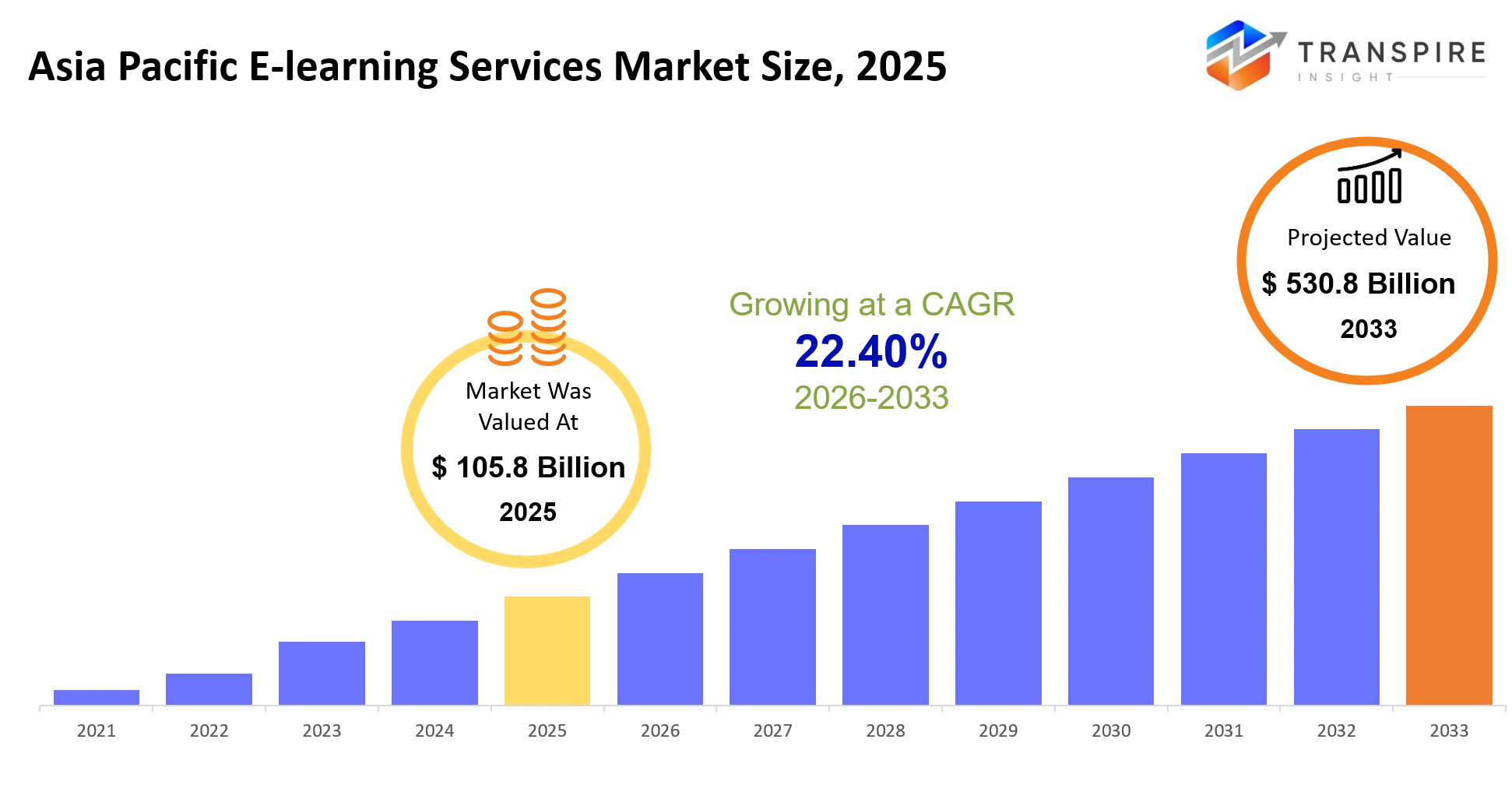
- Asia Pacific E-learning Services Market Size 2025: USD 105.8 Billion
- Asia Pacific E-learning Services Market Size 2033: USD 530.8 Billion
- Asia Pacific E-learning Services Market CAGR: 22.40%
- Asia Pacific E-learning Services Market Segments: By Course Type (Academic, Professional, Certification, Language, Technical, Corporate Training, Others); By Delivery Mode (Self-paced, Instructor-led, Blended, Others); By End User (K-12, Higher Education, Enterprises, Individuals, Others); By Platform (Web-based, Mobile-based, LMS, Others).
To learn more about this report,  Download Free Sample Report
Asia Pacific E-learning Services Market Summary
The Asia Pacific E-learning Services Market was valued at USD 105.8 Billion in 2025. It is forecast to reach USD 530.8 Billion by 2033. That is a CAGR of 22.40% over the period.
In Asia Pacific, e-learning services help manufacturers, logistics operators, and maritime companies do training for people who are spread out, especially around safety procedures, compliance standards, and technical know-how, without having to remove staff from operations for very long. In practice these platforms break down complicated operational needs into well organized digital lessons you can reach whenever you need them, across different plants, ports, and field locations.
Over the last five years, the market kind of moved in a deeper way, away from instructor-led classroom training and toward cloud based, mobile first learning, plus even more AI supported adaptive learning systems. The COVID 19 pandemic pushed this change faster, since enterprises still had to keep training going while in person gatherings were limited. At the same time, tougher industrial safety and compliance expectations in export driven economies kinda pushed firms to standardize their digital certification workflows. That whole shift reduced training downtime, it boosted audit readiness , and it helped with faster workforce redeployment. So overall enterprise adoption kept climbing across APAC industries.
Key Market Insights
- Asia Pacific E-learning Services Market is mostly led by China and India , and together they contribute more than 45% share in 2025, mainly because of large-scale enterprise digitalization programs.
- India is the fastest-growing regional hub, with a strong double-digit projected growth rate. This is powered by IT services and also manufacturing workforce upskilling needs, more often than not.
- Meanwhile Southeast Asia is showing a new wave of interest, as logistics and maritime firms start adopting digital compliance learning platforms, for their day to day operations.
- Cloud-based learning platforms are dominating the Asia Pacific E-learning Services Market, with almost 40% share in 2025 due to scalability along with cost effectiveness.
- Content development services sit in second place, driven by industry tailored training modules for industrial processes and maritime operations.
- Mobile learning solutions are the fastest growing slice through 2030, partly because remote workers can reach things more easily, and because app based adoption keeps spreading.
- Corporate training is still the main use case, hitting more than 50% share in the Asia Pacific e learning services market, yeah.
- Compliance and safety training seems to be the one moving quickest, with stricter maritime and industrial enforcement pushing it.
- Big enterprises tend to lead adoption, around 55% share, mostly from planned training budgets and mandatory obligations, not just “interest.”
- Meanwhile, SMEs are the fastest growing end user group, since subscription platforms lower the starting entry barriers.
What are the Key Drivers, Restraints, and Opportunities in the Asia Pacific E-learning Services Market?
The primary driver of the Asia Pacific E-learning Services Market i s enterprise digital transformation, plus the strict compliance requirements that come with manufacturing, logistics, and maritime operations. In many places across APAC, governments and port authorities have tightened safety certification rules, so companies feel pushed to adopt standardized digital training systems. And yeah, this change helps cut operational downtime, speeds up workforce readiness, and then it shows up as higher enterprise subscription revenues along with longer-term platform adoption.
The main restraint is uneven digital infrastructure maturity across several developing APAC economies. A lot of industrial sites and offshore operations still deal with unstable connectivity, so real-time learning delivery becomes patchy and engagement consistency ends up suffering. It’s kind of structural too, meaning it can’t be fixed fast because it hinges on huge telecom and infrastructure investment cycles. That ends up delaying broad adoption in remote maritime areas and rural industrial zones, even if the demand is there.
The major opportunity is AI-enabled adaptive learning platforms that are tailored for industrial skill mapping.For instance, maritime training providers are already weaving scenario based simulations into the engine room safety routines and emissions compliance tracking. Meanwhile, as enterprises pour more effort into workforce reskilling for automation heavy operations, the spending emphasis is likely to drift toward personalized, data driven learning ecosystems, that somehow boost certification turnaround and operational readiness at the same time.
What Has the Impact of Artificial Intelligence Been on the Asia Pacific E-learning Services Market?
Artificial intelligence is, kinda reshaping the Asia Pacific E-learning Services Market by enabling adaptive training systems that will adjust learning modules on the fly, based on worker performance plus role requirements. In industrial and maritime settings, AI driven platforms are showing up more and more to handle compliance tracking automatically, keep an eye on safety certification monitoring, and then compile training completion analytics. That seems to cut down on manual supervision and those nagging administrative delays.
Also, machine learning models are getting better at predicting workforce readiness planning, they can flag skill gaps before those gaps start hurting operational efficiency. In big manufacturing sites and port operations, AI based recommendation engines help tune the training schedules, so downtime is reduced while productivity continuity stays steadier across shifts.
You can see the operational improvements becoming measurable, enterprises are reporting faster certification cycles and better compliance accuracy , especially in safety critical environments like engine maintenance and hazardous material handling. And there is a cost side too , AI enabled systems can make training more cost efficient by trimming redundant training hours and improving knowledge retention rates.
Still, there’s a noticeable limitation that keeps coming up, the quality of real world training data can be inconsistent, and in maritime environments it’s even more tricky. Connectivity gaps at sea restrict that continuous data flow. So model accuracy gets capped, and it also slows the full scale rollout of advanced AI learning systems across those remote operational zones.
Key Market Trends
- Enterprises across the Asia Pacific E-learning Services Market kind of moved away from classroom training towards cloud platforms, which cut training downtime by around 40% since 2021 or so.
- Between 2022 and 2025, AI driven adaptive learning tools mostly replaced the old static modules, and as a result employee certification completion rates rose across a bunch of manufacturing players, pretty steady like that.
- After 2021 , maritime safety rules got tighter, so the mandatory digital compliance training adoption sped up for port operators and shipping companies throughout APAC, in a way that felt pretty unavoidable.
- Starting after 2023, mobile-first learning took off, because about 70% of frontline workers in logistics started using app based training, not the usual desktop setup.
- Corporate buyers kept moving, more and more from one-off licensing into subscription style SaaS models during 2022-2025, and it kind of stabilized vendor income streams, in a steadier way than before.
- SAP, and Microsoft, broadened AI powered learning ecosystems, so the rivalry started to tilt toward integrated enterprise platforms rather than standalone content providers, which feels pretty different than what we saw earlier.
- In Southeast Asia, enterprises increased investments in localized content platforms after 2022, with the idea to manage language fragmentation across multiple country workforce setups, and generally make training smoother.
- Maritime and industrial firms rolled out simulation learning after 2023, and it also helped push safety incident rates down during onboarding, plus during operational drill cycles too.
- Adoption of data driven skill analytics jumped sharply post-2022, so HR systems could forecast workforce gaps instead of waiting until productivity dropped.
- By 2025, cloud infrastructure penetration across education platforms in APAC went past 65%, replacing older on-premise systems in larger enterprise deployments.
Asia Pacific E-learning Services Market Segmentation
By Course Type:
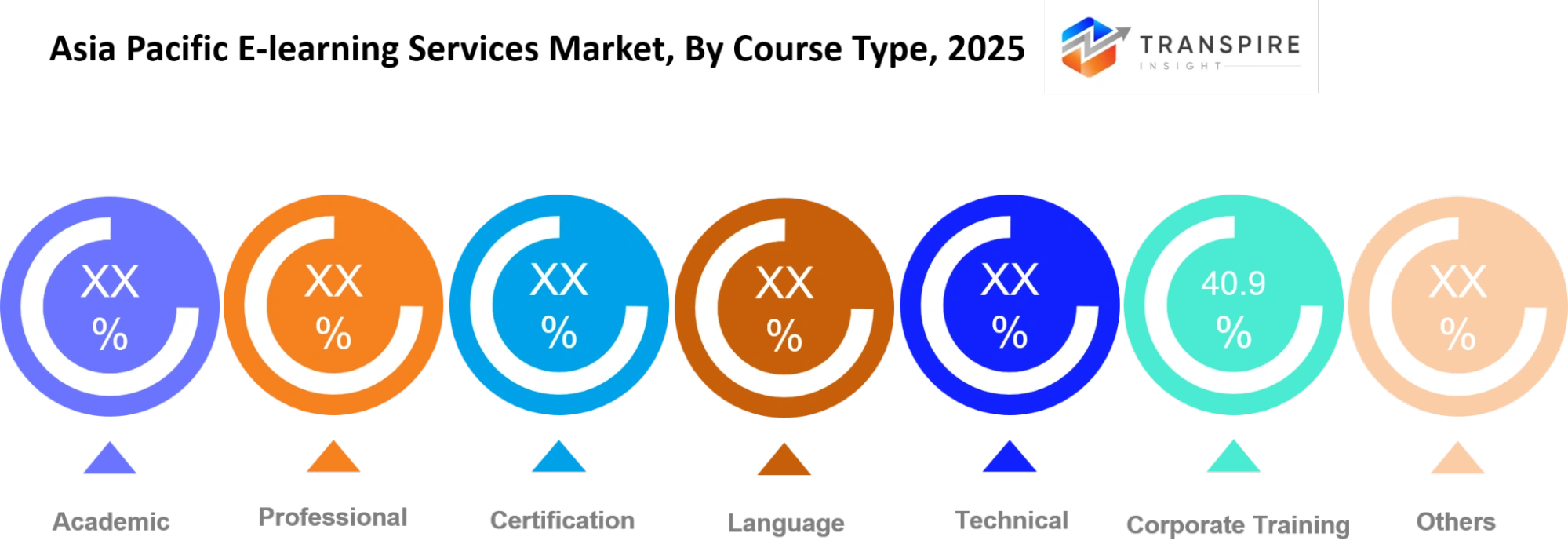
Asia Pacific E-learning Services Market by Course Type shows pretty strong movement toward professional and certification programs , kinda pushed by rising needs for structured workforce upskilling across both industrial and service areas . Corporate training and technical learning formats keep expanding at a steady pace, because organizations keep leaning into job-specific skill development.
Academic and language learning stay fairly consistent in adoption across institutions , even as digital education systems replace the classroom heavy routines . Certification based programs are getting more important all the time as companies standardize employee qualifications , and the structured modules help with consistent assessment too. This also improves training results across large enterprise environments where the scale is huge , and everyone needs the same baseline.
To learn more about this report, Download Free Sample Report
By Delivery Mode:
Asia Pacific E-learning Services Market by Delivery Mode is increasingly leaning toward self-paced and blended learning models , since organizations want flexibility and less disruption to everyday operations. These digital-first training systems make continuous access easy, so learners can finish modules without fixed schedules or location limits.
Instructor led formats still matter for specialized and compliance-heavy training , where direct guidance is really required. Blended delivery models keep growing by mixing live sessions with digital content. That tends to lift engagement, and it supports better retention of technical plus procedural knowledge across enterprise training programs.
By End User:
Asia Pacific E-learning Services Market by End User is pretty much led by enterprise adoption, you can see it in how more compliance training, safety certification, and structured skill development programs get pushed across manufacturing and service sectors. Big organizations are also starting to plug digital platforms right into workforce management systems, like it’s becoming the norm not just a nice add-on.
At the same time Higher education institutions and K-12 segments keep expanding their digital adoption, with structured online learning gradually swapping out the older classroom style in many regions. For individual learners, mobile-access learning systems keep feeding steady demand, particularly in urban areas where flexible and low-cost education options keep getting larger and easier to reach.
By Platform:
Asia Pacific E-learning Services Market by Platform is mainly driven by mobile-based systems, mostly because smartphone usage is so widespread and people prefer learning on the move in corporate and industrial settings. This mobile access also helps continuous training for distributed workforces, so the learning doesn’t really stop when someone is away.
Web-based platforms and learning management systems still hold strong adoption too, since organizations want centralized control, monitoring, and training reporting. Plus, integrated platforms that blend analytics with standardized content delivery give better visibility into employee progress and help keep learning management more organized across big enterprises, even when teams are spread out.
What are the Key Use Cases Driving the Asia Pacific E-learning Services Market?
Corporate training and compliance learning sort of dominate the Asia Pacific E-learning Services Market, mainly because many enterprises must keep building skills, but they can’t really stop day to day operations. Manufacturing plants, logistics hubs and industrial facilities rely on digital modules for training workers in safety procedures , equipment handling , and also regulatory standards. It’s a pretty clear use case, because demand keeps rising as organizations want to cut downtime while still keeping workforce readiness steady across several locations
At the same time, technical upskilling and certification programs are steadily expanding across IT services and industrial engineering, especially in large enterprises and mid sized firms. Healthcare institutions and financial services companies also lean into structured digital learning so they can standardize role based competencies. These efforts are picking up momentum, because companies want faster onboarding, plus a way to validate skills with real measurements
And then there are simulation based training and AI guided learning paths, which are getting attention as emerging use cases with strong potential. Maritime safety drills , equipment fault simulations , and predictive skill mapping are being trialed in more advanced enterprise environments. The idea is that these applications will help drive safer operations, and enable more efficient workforce planning as digital maturity grows throughout Asia Pacific industries.
|
Report Metrics |
Details |
|
Market size value in 2025 |
USD 105.8 Billion |
|
Market size value in 2026 |
USD 129.5 Billion |
|
Revenue forecast in 2033 |
USD 530.8 Billion |
|
Growth rate |
CAGR of 22.40% from 2026 to 2033 |
|
Base year |
2025 |
|
Historical data |
2021 - 2024 |
|
Forecast period |
2026 - 2033 |
|
Report coverage |
Revenue forecast, competitive landscape, growth factors, and trends |
|
Regional scope |
Asia Pacific (India, China, Japan, Australia, South Korea, Rest of Asia Pacific) |
|
Key company profiled |
Coursera, Udemy, BYJU'S, Unacademy, edX, LinkedIn Learning, Skillsoft, Pluralsight, Simplilearn, FutureLearn, Udacity, Moodle, Blackboard, Khan Academy, upGrad. |
|
Customization scope |
Free report customization (country, regional & segment scope). Avail customized purchase options to meet your exact research needs. |
|
Report Segmentation |
By Course Type (Academic, Professional, Certification, Language, Technical, Corporate Training, Others); By Delivery Mode (Self-paced, Instructor-led, Blended, Others); By End User (K-12, Higher Education, Enterprises, Individuals, Others); By Platform (Web-based, Mobile-based, LMS, Others). |
Which Regions are Driving the Asia Pacific E-learning Services Market Growth?
China basically sits at the top in the Asia Pacific E-learning Services Market, largely because big enterprise digitization plus pretty firm , state-backed policies for digital education push it forward. As factories keep expanding in manufacturing, retail, and technology, companies want more standardized workforce training setups, pretty quickly. Also, national investment in cloud infrastructure and enterprise software ecosystems helps learning platforms roll out in both public bodies and private organizations. All of this forms a kind of learning environment where continuous adoption stays easy, especially when integrated learning management systems connect with centralized compliance training networks, so updates feel seamless.
Japan and South Korea are more stable and structured in how they contribute to the Asia Pacific E-learning Services Market. Their focus leans toward precise corporate training and long-term skills building, not chasing huge, rapid scale. In practice, many enterprises favor automation-linked learning modules and certification processes that are quality-checked in a controlled manner. Because they keep investing steadily in modernization of enterprise software, platform usage stays consistent across mature industries, which then supports predictable revenue patterns for learning service providers.
India is the fastest-growing region in the Asia Pacific E-learning Services Market, mainly tied to the fast rise of digital-first jobs and IT-enabled services. Newer policy moves that back digital skilling and enterprise cloud adoption have helped platforms spread faster through mid-sized firms too. Demand has also jumped as organizations switch to subscription-based training models, mostly to manage large teams that are spread out across cities. This momentum points to a strong, long-horizon chance for vendors offering cost-efficient , scalable learning solutions, covering the period from 2026 to 2033.
Who are the Key Players in the Asia Pacific E-learning Services Market and How Do They Compete?
The competitive landscape in the Asia Pacific E-learning Services Market is still pretty moderately fragmented,like you see platform giants go head to head with more specialized enterprise learning vendors ,though it varies by country. In practice, rivalry seems to be pushed mostly by tech know-how, especially AI personalization, how well the platform integrates with enterprise systems, and whether it can scale cleanly across huge workforces. Subscription pricing also ramps up the tension, because many enterprises want softer cost structures rather than being locked into long term licensing deals. New entrants keep showing up too, and they tend to challenge well known providers by bringing niche content libraries and quicker rollout cycles, which sort of re-anchors how vendors are positioned traditionally.
For example, Coursera and Udemy go after the market using big content ecosystems, plus learning access models that feel flexible enough for enterprises and individual learners. SAP leans hard into enterprise integration, embedding learning modules right inside business workflow systems so compliance visibility and employee productivity improve at the same time. Microsoft strengthens its stance via cloud learning infrastructure and AI analytics, which help organizations map workforce skills across multiple industries. Skillsoft differentiates through enterprise centered certification programs ,while Adobe builds out its digital training offering by connecting creative software lessons with corporate upskilling programs. Overall these companies keep expanding through partnerships with enterprises ,integration into HR environments, and ongoing improvements to AI powered learning personalization, even when budgets get tight.
Company List
- Coursera
- Udemy
- BYJU'S
- Unacademy
- edX
- LinkedIn Learning
- Skillsoft
- Pluralsight
- Simplilearn
- FutureLearn
- Udacity
- Moodle
- Blackboard
- Khan Academy
- upGrad
Recent Development News
In May 2026, Coursera announced completion of its combination with Udemy." The merger created a unified global e-learning platform expanding AI-driven skills training capabilities across Asia Pacific enterprise and consumer markets, significantly strengthening scale in corporate upskilling demand in the region.
Source: https://investor.coursera.com/
In December 2025, Coursera announced an agreement to combine with Udemy in a $2.5 billion all-stock merger." The strategic transaction aimed to integrate enterprise learning, university partnerships, and marketplace content into a single AI-powered skills ecosystem, with strong downstream impact on Asia Pacific corporate training demand.
Source: https://investors.udemy.com/
What Strategic Insights Define the Future of the Asia Pacific E-learning Services Market?
The Asia Pacific E-learning Services Market is moving toward deeply integrated, AI-led learning ecosystems that sit inside day to day enterprise operations, not like some standalone training tools anymore. In the next five to seven years, adoption will be influenced by the need for ongoing workforce reskilling as automation ramps up across manufacturing, logistics, and services. Learning platforms will get more and more connected with HR systems and operational software, so skill development becomes a real time business function rather than that kind of periodic, “we train once” activity.
A less obvious risk is also building up, it’s vendor concentration, where a few global cloud and software providers control both the infrastructure and the learning delivery routes. That kind of setup makes dependency risk more pronounced for enterprises, and it can reduce pricing flexibility down the road. Another newer chance is using AI driven digital twins for workforce simulation training in high-risk industrial sites and maritime contexts, but this is still very early stage deployment, so nobody should assume it’s scaled yet.
Market participants should focus on building interoperable platforms that connect with enterprise systems, but they should also invest in localized, regulation specific content so they can reduce dependency on those dominant ecosystem providers.
Asia Pacific E-learning Services Market Report Segmentation
By Course Type
- Academic
- Professional
- Certification
- Language
- Technical
- Corporate Training
By Delivery Mode
- Self-paced
- Instructor-led
- Blended
By End User
- K-12
- Higher Education
- Enterprises
- Individuals
By Platform
- Web-based
- Mobile-based
- LMS
Frequently Asked Questions
Find quick answers to common questions.
The Asia Pacific E-learning Services Market size is USD 530.8 Billion in 2033.
Key segments for the Asia Pacific E-learning Services Market are By Course Type (Academic, Professional, Certification, Language, Technical, Corporate Training, Others); By Delivery Mode (Self-paced, Instructor-led, Blended, Others); By End User (K-12, Higher Education, Enterprises, Individuals, Others); By Platform (Web-based, Mobile-based, LMS, Others).
Major Asia Pacific E-learning Services Market players are Coursera, Udemy, BYJU'S, Unacademy, edX, LinkedIn Learning, Skillsoft, Pluralsight, Simplilearn, FutureLearn, Udacity, Moodle, Blackboard, Khan Academy, upGrad.
The Asia Pacific E-learning Services Market size is USD 105.8 Billion in 2025.
The Asia Pacific E-learning Services Market CAGR is 22.40% from 2026 to 2033.
- Coursera
- Udemy
- BYJU'S
- Unacademy
- edX
- LinkedIn Learning
- Skillsoft
- Pluralsight
- Simplilearn
- FutureLearn
- Udacity
- Moodle
- Blackboard
- Khan Academy
- upGrad
About the Authors

Mayur Shinde
I am Mayur Shinde, a Senior Research Analyst at Transpire Insight, specializing in the Automotive & Transportation and Information & Communication Technology (ICT) Industry. My work focuses on analyzing emerging market trends, technological advancements, competitive landscapes, and industry developments to deliver accurate, data-driven insights. I am passionate about transforming complex market information into clear, actionable content that helps businesses, professionals, and decision-makers stay informed and make confident strategic decisions.

Chakradhar Khansole
Chakradhar serves as the Research Director at Transpire Insight, bringing over 8 years of experience in technology, innovation, and strategic market intelligence. He specializes in transforming complex market data into actionable business insights that enable organizations to make informed, growth-oriented decisions. Recognized for his strategic vision and analytical expertise, Chakradhar leads high-impact research initiatives, delivering comprehensive market assessments, competitive intelligence, and forward-looking industry analysis.
Recently Published Reports
-
Apr 2026
3D Optical Profiler Market
3D Optical Profiler Market Size, Share & Analysis Report By Type (Desktop 3D Optical Profiler, and Portable 3D Optical Profiler), By Technology (Confocal Technology, and White Light Interference), By End-Use Industry (Manufacturing, Research Institutions, Automotive, Aerospace and Defense, Medical Devices, and Other), and Geography (North America, Europe, Asia-Pacific, Middle East and Africa, South and Central America), 2021 - 2031
-
Apr 2026
Depth Sensor Market
Depth Sensor Market Size, Share & Analysis Report By Type (Infrared Depth Sensors, Time-of-Flight (ToF) Sensors, Stereo Vision Sensors, Structured Light Sensors, Ultrasonic Depth Sensors), By Application (Automotive, Robotics, Gaming, Consumer Electronics, Industrial Automation, Healthcare, Security & Surveillance, Others), By End Users (Automotive Manufacturers, Consumer Electronics Companies, Healthcare Providers, Industrial Companies, Security Agencies, Gaming Companies, Robotics Companies, Others), and Geography (North America, Europe, Asia-Pacific, Middle East and Africa, South and Central America), 2021 – 2031
-
Apr 2026
Digital Manufacturing Market
Digital Manufacturing Market Size, Share & Analysis Report By Component (Hardware, Software, and Services), By Technology (Robotics, 3D Printing, Internet of Things (IoT), and Others), By Application (Automotive and Transportation, Aerospace and Defense, Consumer Electronics, Industrial Machinery, and Others), By Process Type (Computer-Based Designing, Computer-Based Simulation, Computer 3D Visualization, Analytics, and Others), and Geography (North America, Europe, Asia-Pacific, Middle East and Africa, South and Central America), 2021 – 2031
-
Apr 2026
Digital Visa Services Market
Digital Visa Services Market Size, Share & Analysis Report By Type (Individual Travelers, Group Travelers), By Application (Tourism, Business Travel, Others), and Geography (North America, Europe, Asia-Pacific, Middle East and Africa, South and Central America), 2021 – 2031