

Japan Small Language Model (SLM) Market Size & Forecast:
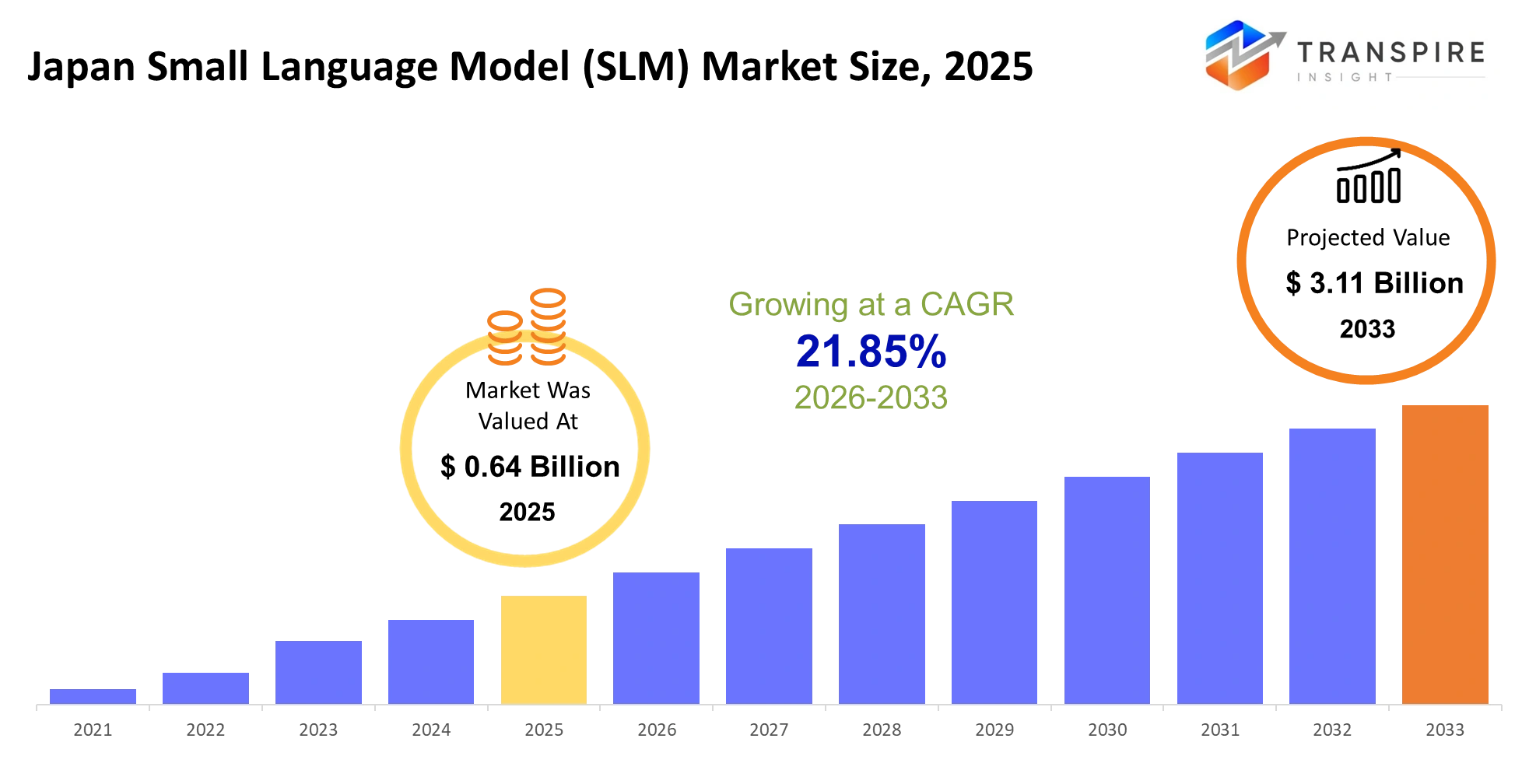
- Japan Small Language Model (SLM) Market Size 2025: USD 0.64 Billion
- Japan Small Language Model (SLM) Market Size 2033: USD 3.11 Billion
- Japan Small Language Model (SLM) Market CAGR: 21.85%
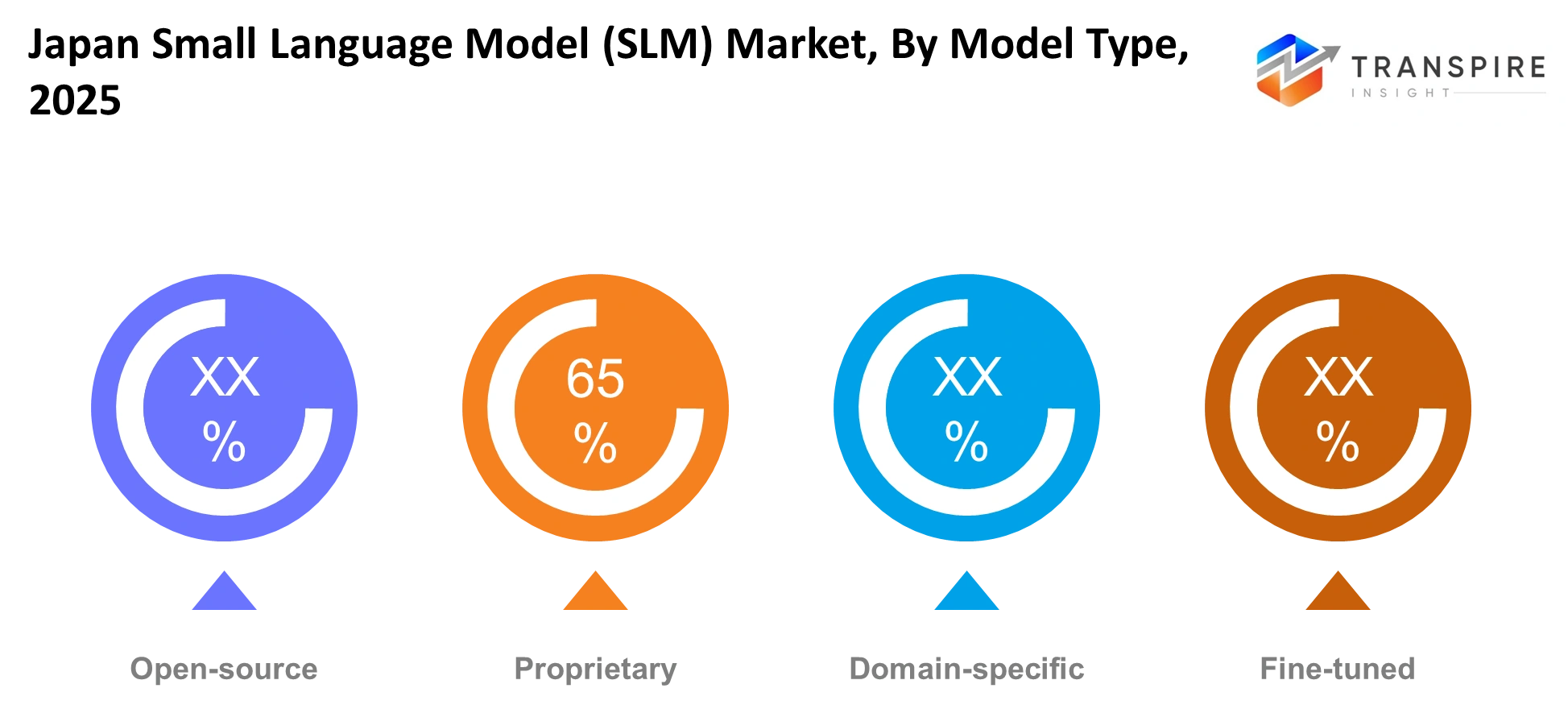
- Japan Small Language Model (SLM) Market Segments:By Model Type (Open-source, Proprietary, Domain-specific, Fine-tuned), By Application (Chatbots, Automation, Coding, Analytics), By End-User (Enterprises, Developers, Startups, Government).
To learn more about this report,  Download Free Sample Report
Japan Small Language Model (SLM) Market Summary:
The Japan Small Language Model (SLM) Market size is estimated at USD 0.64 Billion in 2025 and is anticipated to reach USD 3.11 Billion by 2033, growing at a CAGR of 21.85% from 2026 to 2033. The Japan Small Language Model (SLM) market is emerging as a rapidly growing segment within the broader artificial intelligence and natural language processing ecosystem. SLMs are compact AI models which function with lower power needs so they can be used in on-device applications and edge computing environments and privacy-protecting systems. The implementation of their fast and affordable domain-specific results has led to their increasing use throughout various business sectors.
Japan's advanced technology infrastructure together with its strong robotics industry and its early adoption of artificial intelligence technologies create an environment which drives SLM market expansion. The demand is especially strong in consumer electronics and healthcare and automotive and enterprise automation sectors which require immediate processing and data protection and rapid response times. The elderly population in Japan drives the adoption of AI-powered assistants and healthcare solutions which create additional demand for SLM deployment.
Key Market Trends & Insights:
- The adoption of small language models is accelerating because these models can operate effectively on edge devices which have limited computational resources. Japanese enterprises are increasingly leveraging SLMs for real-time applications because these systems enable faster processing and lower costs and better protection of sensitive information without using cloud services.
- The SLM market in Japan experiences its growth because people now demand AI solutions which protect their privacy. Organizations use on-device processing because they need to meet strict data protection regulations which apply to healthcare and finance and government sectors that handle sensitive information and require safe AI systems.
- SLM development now focuses on creating industry-specific models which companies design to meet the needs of different sectors including automotive and robotics and customer service. The tailored models improve the accuracy of Japanese language processing by enabling users to understand context and honorific language and industry-specific terms, which results in better user experiences and operational efficiency.
- Asian nations are rapidly expanding their SLM systems which work with IoT devices and smart devices and robotic systems. SLMs support faster decision-making and offline functionality at smart home assistants and industrial automation systems, which helps Japan maintain its position as a leader in robotics and connected technologies while reducing latency and connectivity issues.
- Startups and mid-sized enterprises in Japan can now access SLM technology because of improvements in model compression methods and open-source frameworks. The AI democratization movement enables companies to deploy cost-effective AI solutions which boosts innovation and drives experimentation with lightweight AI systems in multiple business and consumer use cases.
Japan Small Language Model (SLM) Market Segmentation
By Model Type
- Open-source: The Japanese market shows strong acceptance of open-source SLMs because they provide flexible system performance and transparent operations and affordable pricing. The available models for Japanese language development enable developers and enterprises to create custom solutions while eliminating licensing expenses which promote academic research and business development within corporate and startup environments.
- Proprietary: Large enterprises adopt proprietary SLMs because they need systems which provide optimal performance and strong security measures and specialized technical assistance. Organizations in finance and healthcare and automotive sectors use these models because they deliver precise results through system integration which meets enterprise requirements.
- Domain-specific: Specialized SLMs serve specific needs of industries which include healthcare and legal and manufacturing and customer service operations. The Japanese market uses these models to advance contextual comprehension while their technical features and cultural communication patterns help users with industry-specific language tasks.
- Fine-tuned: Base models need fine-tuning through specific datasets which create customized SLMs for enhanced task performance. Japanese organizations increasingly use fine-tuning to adapt models for local language complexity business workflows and personalized applications which ensures higher efficiency and relevance in outputs.
To learn more about this report, Download Free Sample Report
By Application
- Chatbots: The Japanese market employs SLMs to power chatbots which serve customer service needs and virtual assistant functions and e-commerce support services. The system uses lightweight design to deliver instant answers while working offline and achieving better conversational performance for Japanese speakers who use honorifics and context-based communication.
- Automation: SLMs automate document processing and data entry and workflow management by executing repetitive tasks in their main application area. Japanese enterprises use these models to enhance productivity while decreasing operational expenses and streamlining all business operations.
- Coding: SLMs now find their way into coding tools which help developers with the tasks of code generation and debugging and documentation creation. The Japanese industry uses them to achieve faster software development cycles because small teams and startups need lightweight AI-powered programming support.
- Analytics: SLMs enable analytics by processing structured data and unstructured data to extract their fundamental meaning. Japanese businesses use these models for insights generation, report summarization, and decision-making, benefiting from faster processing speeds and reduced computational requirements compared to larger models.
By End-User
- Enterprises: The SLM technology implementation in Japan receives most of its funding from large corporations which utilize the system for automated processes and customer interactions and internal work activities. Companies need AI solutions which can operate efficiently and expand their systems while protecting user data to meet their operational requirements.
- Developers: The developer community has expanded its activities to create applications and tools and AI platforms through the use of SLM technology. The Japanese market values SLM technology because it offers open-source access and users can easily customize the system to create their own experimental and quick development and localized projects.
- Startups: The low-cost and minimal infrastructure requirements of SLMs make them an attractive option for Japanese startups who want to establish their operations. The AI model development process enables startups to create innovative products which help them achieve business success while keeping their operational expenses low and their development speed high.
- Government: The public service operations of government agencies now use SLM technology to automate their processes and handle documents and communicate with citizens. The need for data security combined with local data processing capabilities creates SLMs as a secure and efficient solution which government bodies use in their administrative work and decision-making processes.
Country Insights
Japan operates as a sophisticated technological environment which develops Small Language Models (SLMs) because its advanced digital systems and substantial research funding and previous artificial intelligence implementation in various sectors. The country’s dedication to robotics and automation and smart technology development establishes an optimal setting for implementing lightweight AI systems which function during actual operational environments.
The SLM market in Japan requires local language support because it needs this particular language feature for its operations. Japanese language demands highly precise and specifically customized models because it consists of three writing systems (Kanji and Hiragana and Katakana) and various honorific expressions which depend on the context. The development of Japan-specific SLMs has increased because these models deliver better performance for business activities and customer interactions and communication.
SLM adoption in Japan receives a boost from the country’s stringent data protection laws and its preference for secure processing methods that operate directly on devices. Sectors such as healthcare and finance and government organizations select solutions which reduce data transmission to cloud environments because SLMs provide a suitable method for organizations to comply with regulations while maintaining operational effectiveness.
Recent Development News
- Japan has increased its commitment to developing its own artificial intelligence systems through international partnerships. Japan and ASEAN countries established a partnership in 2026 to develop their own native language artificial intelligence models which focus on creating systems that match their cultural needs and geographic requirements in order to decrease their dependence on foreign technologies.
- The Digital Agency of Japan has chosen NTT's lightweight artificial intelligence model "tsuzumi 2" to test as part of its Government AI program. The public sector now demonstrates a trend toward using compact language models which provide secure on-premise operation capabilities.
|
Report Metrics |
Details |
|
Market size value in 2025 |
USD 0.64 Billion |
|
Market size value in 2026 |
USD 0.78 Billion |
|
Revenue forecast in 2033 |
USD 3.11 Billion |
|
Growth rate |
CAGR of 21.85% from 2026 to 2033 |
|
Base year |
2025 |
|
Historical data |
2021 – 2024 |
|
Forecast period |
2026 – 2033 |
|
Report coverage |
Revenue forecast, competitive landscape, growth factors, and trends |
|
Country scope |
Japan |
|
Key company profiled |
OpenAI, Google, Microsoft, Meta, Anthropic, Cohere, Mistral AI, Hugging Face, IBM, NVIDIA, Amazon AWS, Oracle, SAP, Baidu, Tencent. |
|
Customization scope |
Free report customization (country, regional & segment scope). Avail customized purchase options to meet your exact research needs. |
|
Report Segmentation |
By Model Type (Open-source, Proprietary, Domain-specific, Fine-tuned), By Application (Chatbots, Automation, Coding, Analytics), By End-User (Enterprises, Developers, Startups, Government). |
Key Japan Small Language Model (SLM) Market Company Insights
The SLM ecosystem in Japan receives essential development support from major technology companies which include OpenAI and Google and Microsoft and Meta through their partnerships and cloud services and AI model delivery. The partnership between OpenAI and Japan's Digital Agency and its joint venture with SoftBank demonstrate how AI solutions for Japanese businesses and government institutions are becoming more specialized through strategic alliances between these organizations. The companies are developing AI systems which can grow to meet enterprise needs while delivering efficient performance through their development of lightweight models that can operate on edge devices and mobile devices.
The AI startup ecosystem is driving open-source innovation through its development of customizable SLMs which enable Japanese developers and startups to create specific solutions. The ecosystem receives support from established enterprise technology providers who include IBM, NVIDIA, Amazon AWS, Oracle and SAP through their AI infrastructure and cloud platforms and deployment tools. The SLM market in Japan faces increased competition as Asian technology companies Baidu and Tencent expand their AI operations worldwide and develop new local AI solutions.
Company List
- OpenAI
- Microsoft
- Meta
- Anthropic
- Cohere
- Mistral AI
- Hugging Face
- IBM
- NVIDIA
- Amazon AWS
- Oracle
- SAP
- Baidu
- Tencent
Japan Small Language Model (SLM) Market Report Segmentation
By Model Type
- Open-source
- Proprietary
- Domain-specific
- Fine-tuned
By Application
- Chatbots
- Automation
- Coding
- Analytics
By End-User
- Enterprises
- Developers
- Startups
- Government
Frequently Asked Questions
Find quick answers to common questions.
The approximate Japan Small Language Model (SLM) Market size for the market will be USD 3.11 Billion in 2033.
Key segments for the Japan Small Language Model (SLM) Market are By Model Type (Open-source, Proprietary, Domain-specific, Fine-tuned), By Application (Chatbots, Automation, Coding, Analytics), By End-User (Enterprises, Developers, Startups, Government).
Major Japan Small Language Model (SLM) Market players are OpenAI, Google, Microsoft, Meta, Anthropic, Cohere, Mistral AI, Hugging Face, IBM, NVIDIA, Amazon AWS, Oracle, SAP, Baidu, Tencent.
The Japan Small Language Model (SLM) Market size is USD 0.64 Billion in 2025.
The Japan Small Language Model (SLM) Market CAGR is 21.85%.
- OpenAI
- Microsoft
- Meta
- Anthropic
- Cohere
- Mistral AI
- Hugging Face
- IBM
- NVIDIA
- Amazon AWS
- Oracle
- SAP
- Baidu
- Tencent
Recently Published Reports
-
Apr 2026
3D Optical Profiler Market
3D Optical Profiler Market Size, Share & Analysis Report By Type (Desktop 3D Optical Profiler, and Portable 3D Optical Profiler), By Technology (Confocal Technology, and White Light Interference), By End-Use Industry (Manufacturing, Research Institutions, Automotive, Aerospace and Defense, Medical Devices, and Other), and Geography (North America, Europe, Asia-Pacific, Middle East and Africa, South and Central America), 2021 - 2031
-
Apr 2026
Depth Sensor Market
Depth Sensor Market Size, Share & Analysis Report By Type (Infrared Depth Sensors, Time-of-Flight (ToF) Sensors, Stereo Vision Sensors, Structured Light Sensors, Ultrasonic Depth Sensors), By Application (Automotive, Robotics, Gaming, Consumer Electronics, Industrial Automation, Healthcare, Security & Surveillance, Others), By End Users (Automotive Manufacturers, Consumer Electronics Companies, Healthcare Providers, Industrial Companies, Security Agencies, Gaming Companies, Robotics Companies, Others), and Geography (North America, Europe, Asia-Pacific, Middle East and Africa, South and Central America), 2021 – 2031
-
Apr 2026
Digital Manufacturing Market
Digital Manufacturing Market Size, Share & Analysis Report By Component (Hardware, Software, and Services), By Technology (Robotics, 3D Printing, Internet of Things (IoT), and Others), By Application (Automotive and Transportation, Aerospace and Defense, Consumer Electronics, Industrial Machinery, and Others), By Process Type (Computer-Based Designing, Computer-Based Simulation, Computer 3D Visualization, Analytics, and Others), and Geography (North America, Europe, Asia-Pacific, Middle East and Africa, South and Central America), 2021 – 2031
-
Apr 2026
Digital Visa Services Market
Digital Visa Services Market Size, Share & Analysis Report By Type (Individual Travelers, Group Travelers), By Application (Tourism, Business Travel, Others), and Geography (North America, Europe, Asia-Pacific, Middle East and Africa, South and Central America), 2021 – 2031