

Global Higher Education Market Size & Forecast:
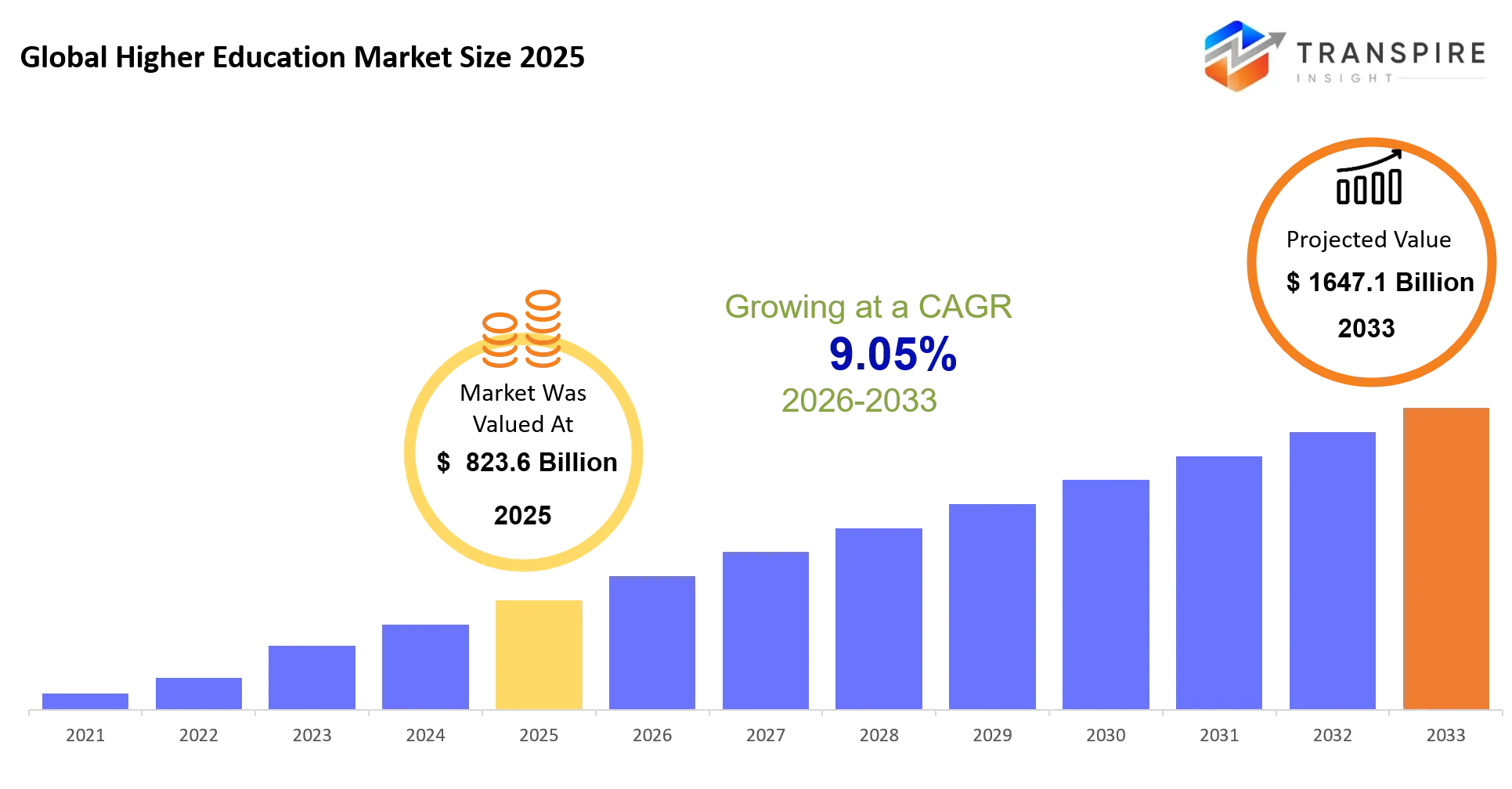
- Global Higher Education Market Size 2025: USD 823.6 Billion
- Global Higher Education Market Size 2033: USD 1647.1 Billion
- Global Higher Education Market CAGR: 9.05%
- Global Higher Education Market Segments: By Institution Type (Public Universities, Private Universities, Community Colleges, Distance Education Institutions, Technical Institutions, Research Universities, Liberal Arts Colleges, Others); By Mode (Offline Learning, Online Learning, Hybrid Learning, Part-time Learning, Full-time Learning, Executive Learning, Distance Learning, Others); By Course (STEM, Business Studies, Arts & Humanities, Healthcare, Law, Social Sciences, Professional Courses, Others); By Student Type (Domestic Students, International Students, Working Professionals, Undergraduate Students, Postgraduate Students, Research Scholars, Continuing Education Students, Others); By Funding (Government Funding, Private Funding, Endowments, Scholarships, Grants, Student Loans, Corporate Sponsorships, Others)
Global Higher Education Market Summary:
As per Transpire Insight Analysis, the Global Higher Education Market size is estimated at USD 823.6 Billion in 2025 and is anticipated to reach USD 1647.1 Billion by 2033, growing at a CAGR of 9.05% from 2026 to 2033.
The “university of the future” will exist as a technology-driven platform for workforce, research, and lifelong learning, shifting away from the traditional physical campus setting. It will feature an ecosystem of colleges and universities, along with online degree programs and workforce partnerships that provide career-focused education relevant to today’s ever-changing demands of the labour market. Over the last half-decade, a variety of technological and curricular innovations have driven a structural shift toward a model of flexible, higher education. The advent of online learning in recent years, post-COVID, spurred growth in digital and hybrid delivery formats and the corresponding technological infrastructure. Competency-based and career education programs are gaining momentum, and many employers also seek additional AI and Cybersecurity training options. This increased importance placed on job skills and lifelong training provides an excellent opportunity for revenue growth among the institutions and companies participating in the higher-education market.
Key Global Higher Education Market Insights:
The market is moving towards skill-based and technology-based learning ecosystems and is receiving adequate investments in digital infrastructure. Academic and employment-based certifications are being integrated into the curriculum to enhance graduate employment and enrollment.
- Public universities make up 47% of the world's student body, and there are growing collaborations with digital learning providers to increase access.
- Online higher education is expanding at a 15.7% CAGR, as flexible learning pathways and remote education for degrees increase.
- Over a third of institutions are expanding on AI-powered student support systems to boost retention and academic achievement.
- With the advent of cutting-edge virtual classrooms and digital assessment tools, the hybrid learning approach is gaining momentum in universities.
- As technology firms do more to partner with universities, the STEM fields get the biggest percentage of new enrollments.
- The trend of international student mobility is slowly picking up, with the help of cross-border degree relationships and online admission platforms.
- Business-supported learning programs are growing, as companies look for reskilling in new technology fields.
- As the labour market changes in response to new needs, universities are stepping up investment in micro-credentials and stackable certificates.
What are the Key Drivers, Restraints, and Opportunities in the Global Higher Education Market?
Driver:
Education is being increasingly pushed towards the market from the demand side, driven by high growth demand for workforce-ready talents across digital, healthcare, engineering, and business industries. The digital revolution in AI, cloud computing, automation, and high-tech health care requires highly skilled workers. Businesses and employees desire practical, work-oriented capabilities over academic knowledge, so universities need to restructure their curricula and offer industry partnership programs to cater to this market demand. This resulted in increased student enrollment in professional certificates, postgraduate, and professional development courses to generate extra revenue. In June 2026, Coursera expanded its micro-credential catalogue with specialised industry learning programs from Google DeepMind, Meta, and Microsoft. This workforce-focused launch delivers industry-aligned certificates and technical training programs to enhance job readiness and professional employability.
Restraint:
Increasing costs of and lack of equitable access to quality education systems. Tuition increases, increasing student loan amounts, and a disparity in investment mean many are excluded, particularly from higher education – the public sector is suffering budget cuts, and even the private sector is suffering accessibility. Similarly, inequalities in the quality of the digital infrastructure between nations impact the viability of online learning.
Opportunity:
Lifelong learning systems built with tech and the help of employers. The pace of technological change and the shortening shelf life of skills mean professionals must update their know-how throughout their careers. This fuels demand for lifelong learning, and high investments into AI-based educational technologies, modular and stackable credential pathways, and international degree mobility, especially in rapidly expanding emerging markets in the Asia Pacific, Latin America, and Africa, where the demand for higher education and digital skills is accelerating. In May 2026, 2U launched the edX app in ChatGPT. This product rollout integrates world-class modular university courses and professional upskilling pathways directly into OpenAI’s platform.
What Has the Impact of Artificial Intelligence Been on the Global Higher Education Market?
In higher education, artificial intelligence (AI) has quickly become an undeniable element across teaching, administration, student support, and institutional strategic planning. AI-powered learning systems are increasingly integrated at universities to provide individual courses, detect individual learning gaps, and change academic material based on students’ habits. AI ensures learning is a personalised and meaningful experience, boosting persistence and student success rates. AI can improve institutional efficiency in other areas as well, automating many administrative tasks such as admissions, student advising, course enrollment, scheduling and test assessment.
These predictive systems aid in the identification of students’ risk of dropping out, trends for course enrollment, and overall resource needs. Faculty members utilise content, curriculum and research AI applications. Moreover, AI tutors and chatbots are now available to support students with academic tasks anytime, anywhere. AI also has limitations; however. They may be expensive to integrate, compromise privacy and include algorithmic bias. Regardless, AI increases administrative efficiency, promotes educational performance and scalability of educational offerings.
In April 2026, Ellucian launched Ellucian Student. This unified AI-native higher education platform embeds agentic AI and a comprehensive campus knowledge graph to automate student lifecycles, streamline complex course enrollment workflows, and optimise administrative efficiency across modern university ecosystems.
Key Global Higher Education Market Trends:
The nature of higher education is changing from degree-based to lifelong learning systems for employability and skills validation.
The use of technology, flexible delivery modes and industry collaboration are changing the priorities of institutions around the world.
- Universities are gradually adopting flexible learning paths that continuously adapt to industry needs.
- There has been a significant growth in micro-credentials and stackable certificates as learners are looking to build targeted skills.
- Hybrid education models have become more than a response to emergencies and have become institutional strategies.
- Academic advising and personalised learning as tools of artificial intelligence are now commonplace at top-tier universities.
- Geographical barriers are being lowered, and participation in digital degrees is increasing across borders.
- Employers are getting to know competency-based qualifications in addition to university degrees.
- Institutions are increasingly turning to learning analytics to focus on optimising student retention and measuring student success.
- University/tech company collaborations are speeding up the creation of career-oriented programs.
Global Higher Education Market Segmentation
By Institution Type:
The public universities take the lion's share in the Global Higher Education Market, holding 47% share in the market. Strong government backing, a wide array of course offerings, research infrastructure and large numbers of students enrolled in public universities and institutions boost the market share of the segment. The private universities have a considerable share in the market with 23%. Their ability to cater niche requirements through customised educational programs, international accreditations and collaborations has resulted in this market share.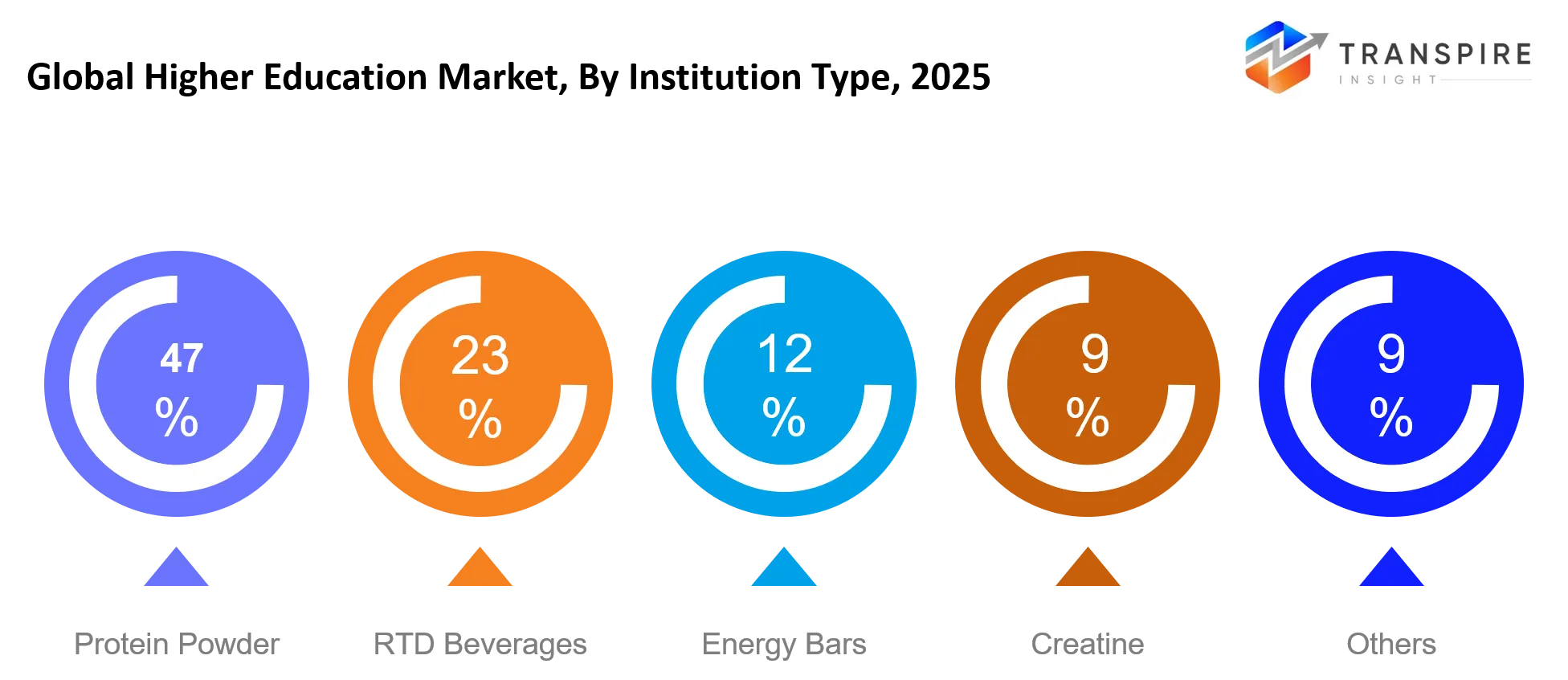
By Mode:
Offline Learning is still the largest mode because there are many infrastructure and laboratory facilities for face-to-face learning. Online Higher education is the fastest-growing segment at a CAGR of 15.7% because of growing demand for flexible, cheapest and worldwide education. Hybrid learning is evolving due to the combination of digital technologies with offline learning experiences. Part-time learning, full-time learning, Executive learning, and distance learning are also on the rise.
By Course:
Even today, the STEM courses hold the dominant share due to increased demand for the skills required in the technology, engineering, and science fields. There is also a continuous growth rate in enrollment for courses like Business Studies, Healthcare, Law, Social Sciences, Professional courses, Arts and Humanities, etc. As there is a demand for a skilled workforce in every area.
By Student Type:
Domestic students remain dominant through existing national education infrastructures, with their education primarily funded through public support. International students add both significant income for institutions and have the greatest role to play in academic collaboration around the globe. Working professionals will continue their rise to continuing education and skill training with the greatest uptake. Undergraduate students still make up the bulk of all learners, but postgraduates, research scholars, and continuing education students all have the greatest scope for further knowledge generation and workforce development.
By Funding:
Government Funding continues to be the main source of money for higher education, especially for public colleges and universities. Private funding, endowments, scholarships, grants, student loans and corporate sponsorships are also ever-growing sources of revenues to boost the financial health of an educational institution.
What are the Key Use Cases Driving the Global Higher Education Market?
The main application driving the market growth is workforce preparation by offering academic credentials, particularly at public universities and within STEM fields, with the degree curriculum more frequently developed in tandem with the demands of employers.
Universities are increasingly creating more programs to enhance a graduate's technical and professional abilities that are relevant in technology, healthcare, engineering and business industries.
There will continue to be expansion in: online and blended continuing education and professional upskilling programs; lifelong learning and industry–academia collaboration; and emerging initiatives like innovation hubs, startups, AI-driven education, and the stackability of micro-credentials.
|
Report Metrics |
Details |
|
Market size value in 2025 |
USD 823.6 Billion |
|
Market size value in 2026 |
USD 898.1 Billion |
|
Revenue forecast in 2033 |
USD 1647.1 Billion |
|
Growth rate |
CAGR of 9.05% from 2026 to 2033 |
|
Base year |
2025 |
|
Historical data |
2021 - 2024 |
|
Forecast period |
2026 - 2033 |
|
Report coverage |
Revenue forecast, competitive landscape, growth factors, and trends |
|
Regional scope |
United States; Canada; Mexico; United Kingdom; Germany; France; Italy; Spain; Denmark; Sweden; Norway; China; Japan; India; Australia; South Korea; Thailand; Brazil; Argentina; South Africa; Saudi Arabia; United Arab Emirates |
|
Key company profiled |
Pearson, Coursera, Blackboard, Instructure, Wiley, McGraw Hill, 2U, BYJU'S, Udemy, Cengage, Anthology, Google for Education, Microsoft Education, Chegg, Kaplan. |
|
Customization scope |
Free report customization (country, regional & segment scope). Avail customized purchase options to meet your exact research needs. |
|
Report Segmentation |
By Institution Type (Public Universities, Private Universities, Community Colleges, Distance Education Institutions, Technical Institutions, Research Universities, Liberal Arts Colleges, Others); By Mode (Offline Learning, Online Learning, Hybrid Learning, Part-time Learning, Full-time Learning, Executive Learning, Distance Learning, Others); By Course (STEM, Business Studies, Arts & Humanities, Healthcare, Law, Social Sciences, Professional Courses, Others); By Student Type (Domestic Students, International Students, Working Professionals, Undergraduate Students, Postgraduate Students, Research Scholars, Continuing Education Students, Others); By Funding (Government Funding, Private Funding, Endowments, Scholarships, Grants, Student Loans, Corporate Sponsorships, Others) |
Which Regions are Driving the Global Higher Education Market Growth?
North America occupies a dominant market share by 35%, attributed to a large university ecosystem, strong digital technologies, R & D capability. Huge investment for innovation and technology development, as well as academic excellence and academic competition across the globe by public and private stakeholders, robust international student immigration trend, collaboration between industry and academia and increasing investments in technologies and digital learning have further boosted dominance. In April 2026, Grey Decision Intelligence launched its April Demand Trends predictive analytics suite for universities. This product rollout leverages advanced tracking algorithms to show how massive AI search disruption alters global international student interest.
Europe is another promising region to capture due to established public education frameworks and significant government support, holding the share of 27%. Europe is different from North America in that it is a high contributor to affordability and openness, while valuing cross-border educational movement opportunities. Support through specific programs that offer collaborations and research funding to ensure a healthy environment is key to sustaining market sustainability.
In April 2026, the Central European University (CEU) launched an institutional collaboration with GitHub Inc. This open-access education initiative delivers joint curriculum frameworks, AI-ready teaching materials, and collaborative coding sandboxes to university classrooms.
Asia Pacific, at a share of 26%, is the highest growing region at 16.8% CAGR, driven by swift urbanisation, proliferation of middle-class income level & Internet penetration, enabling increasing participation in the higher education ecosystem and increasing initiatives from governments on digital education infrastructure and university modernisation programs. The growing popularity of STEM education, professional development courses, and increasing university-industry collaborations will offer significant potential for long-term growth.
In May 2026,Google expanded the Google AI Educator Series to India via localised higher education partnerships. This nationwide rollout delivers comprehensive, free digital training modules directly to faculty across thousands of universities to modernise teaching infrastructure, scale STEM education delivery, and accelerate university-industry integration.
Who are the Key Players in the Global Higher Education Market and how do they Compete?
Increasingly, the Global Higher Education Market is a competitive landscape fueled by digital learning capacities, quality of content, learner results and relevance to careers and careers. Educational publishers (Pearson, Wiley, McGraw Hill, Cengage, and Kaplan), Online Learning Platforms (Coursera, Udemy, 2U, Chegg, and BYJU'S), and Education Technology Providers (Blackboard, Anthology, Instructure, Google for Education, and Microsoft Education) compete on capabilities in scalable digital coursework, advanced adaptive learning technologies, deep academic content holdings, a portfolio of professional certifications, credentials based learning, online degrees through university and corporate partnerships, analytics, AI tools, as well as the establishment of technology partnerships for colleges and universities. Ongoing investment in technologies and the expanding global marketplace requires increasing investment in automation, AI, institutional partnerships, and personalised learning solutions in an increasingly dynamic and competitive higher education market.
Key Players are:
- Pearson
- Coursera
- Blackboard
- Instructure
- Wiley
- McGraw Hill
- 2U
- BYJU'S
- Udemy
- Cengage
- Anthology
- Google for Education
- Microsoft Education
- Chegg
- Kaplan.
Recent Development News
- In May 2026, OpenAI launched a nationwide research-driven deployment of ChatGPT Edu across Estonia in collaboration with the Ministry of Education, the University of Tartu, and Stanford. This academic initiative equips 4,600 educators and 20,000 students with localised, sovereign digital tools.
- In March 2026, Instructure launched IgniteAI Agent for its Canvas Learning Management System (LMS) ecosystem across the United States and Latin America. This automated solution orchestrates complex backend educational workflows.
- In January 2026, Anthropic announced a major global educational partnership with Teach for All. This initiative scales digital literacy by delivering specialised AI fluency workshops, classroom resources, and structured training tools.
What Strategic Insights Define the Future of the Global Higher Education Market?
The higher education market will continue to be shaped by an increasing confluence between academic training, labour markets, and the ongoing integration of digital learning ecosystems. Education providers that are most successful at integrating AI for personalised delivery, offering industry-relevant credentials and demonstrating career paths will be able to best capitalise on future demand. The market is shifting from a solely degree-oriented landscape to a continually upskilling model, in which learning becomes lifelong. However, one insidious risk remains-the increasingly sharp disparity between labour force need and university curriculum update cycles will only continue to erode institutional competitiveness and enrollment prospects. There's also significant latent demand in personalised and individualised learning via artificial intelligence, the internationalisation of digital degrees, and employer-paid training and education programs. These are an enormous opportunity area for universities to leverage.
Key Segmentations are:
By Institution Type
- Public Universities
- Private Universities
- Community Colleges
- Distance Education Institutions
- Technical Institutions
- Research Universities
- Liberal Arts Colleges
- Others
By Mode
- Offline Learning
- Online Learning
- Hybrid Learning
- Part-time Learning
- Full-time Learning
- Executive Learning
- Distance Learning
- Others
By Course
- STEM
- Business Studies
- Arts & Humanities
- Healthcare
- Law
- Social Sciences
- Professional Courses
- Others
By Student Type
- Domestic Students
- International Students
- Working Professionals
- Undergraduate Students
- Postgraduate Students
- Research Scholars
- Continuing Education Students
- Others
By Funding
- Government Funding
- Private Funding
- Endowments
- Scholarships
- Grants
- Student Loans
- Corporate Sponsorships
- Others
Regional Outlook
North America
- United States
- Canada
- Mexico
Europe
- Germany
- United Kingdom
- France
- Spain
- Italy
- Rest of Europe
Asia Pacific
- Japan
- China
- Australia & New Zealand
- South Korea
- India
- Rest of Asia Pacific
South America
- Brazil
- Argentina
- Rest of South America
Middle East & Africa
- Saudi Arabia
- United Arab Emirates
- South Africa
- Rest of the Middle East & Africa
Frequently Asked Questions
Find quick answers to common questions.
The Global Higher Education Market size was valued at USD 823.6 Billion in 2025 and is poised to reach USD 1647.1 Billion by 2033, expanding at a 9.05% CAGR.
Key Segments for the global voice and language intelligence Market are By Institution Type (Public Universities, Private Universities, Community Colleges, Distance Education Institutions, Technical Institutions, Research Universities, Liberal Arts Colleges, Others); By Mode (Offline Learning, Online Learning, Hybrid Learning, Part-time Learning, Full-time Learning, Executive Learning, Distance Learning, Others); By Course (STEM, Business Studies, Arts & Humanities, Healthcare, Law, Social Sciences, Professional Courses, Others); By Student Type (Domestic Students, International Students, Working Professionals, Undergraduate Students, Postgraduate Students, Research Scholars, Continuing Education Students, Others); By Funding (Government Funding, Private Funding, Endowments, Scholarships, Grants, Student Loans, Corporate Sponsorships, Others).
Growth is primarily driven by rising demand for workforce-ready skills, expansion of online and hybrid learning, AI-driven education technologies, and increasing enrollment in career-focused and lifelong learning programs.
The Global Higher Education Market is led by major Manufacturers, including Pearson, Coursera, Blackboard, Instructure, Wiley, McGraw Hill, 2U, BYJU'S, Udemy, Cengage, Anthology, Google for Education, Microsoft Education, Chegg, Kaplan.
North America holds 35% of the global market, supported by Advanced Educational infrastructure, strong research ecosystems, high international student inflows, and significant investments in digital learning technologies.
Key Opportunities include AI-powered personalised learning platforms, micro-credentials, lifelong learning programs, employer-funded training, online degree expansion, and growing higher education participation across emerging Markets.
- Pearson
- Coursera
- Blackboard
- Instructure
- Wiley
- McGraw Hill
- 2U
- BYJU'S
- Udemy
- Cengage
- Anthology
- Google for Education
- Microsoft Education
- Chegg
- Kaplan
About the Authors

Mayur Shinde
I am Mayur Shinde, a Senior Research Analyst at Transpire Insight, specializing in the Automotive & Transportation and Information & Communication Technology (ICT) Industry. My work focuses on analyzing emerging market trends, technological advancements, competitive landscapes, and industry developments to deliver accurate, data-driven insights. I am passionate about transforming complex market information into clear, actionable content that helps businesses, professionals, and decision-makers stay informed and make confident strategic decisions.

Chakradhar Khansole
Chakradhar serves as the Research Director at Transpire Insight, bringing over 8 years of experience in technology, innovation, and strategic market intelligence. He specializes in transforming complex market data into actionable business insights that enable organizations to make informed, growth-oriented decisions. Recognized for his strategic vision and analytical expertise, Chakradhar leads high-impact research initiatives, delivering comprehensive market assessments, competitive intelligence, and forward-looking industry analysis.
Recently Published Reports
-
Apr 2026
3D Optical Profiler Market
3D Optical Profiler Market Size, Share & Analysis Report By Type (Desktop 3D Optical Profiler, and Portable 3D Optical Profiler), By Technology (Confocal Technology, and White Light Interference), By End-Use Industry (Manufacturing, Research Institutions, Automotive, Aerospace and Defense, Medical Devices, and Other), and Geography (North America, Europe, Asia-Pacific, Middle East and Africa, South and Central America), 2021 - 2031
-
Apr 2026
Depth Sensor Market
Depth Sensor Market Size, Share & Analysis Report By Type (Infrared Depth Sensors, Time-of-Flight (ToF) Sensors, Stereo Vision Sensors, Structured Light Sensors, Ultrasonic Depth Sensors), By Application (Automotive, Robotics, Gaming, Consumer Electronics, Industrial Automation, Healthcare, Security & Surveillance, Others), By End Users (Automotive Manufacturers, Consumer Electronics Companies, Healthcare Providers, Industrial Companies, Security Agencies, Gaming Companies, Robotics Companies, Others), and Geography (North America, Europe, Asia-Pacific, Middle East and Africa, South and Central America), 2021 – 2031
-
Apr 2026
Digital Manufacturing Market
Digital Manufacturing Market Size, Share & Analysis Report By Component (Hardware, Software, and Services), By Technology (Robotics, 3D Printing, Internet of Things (IoT), and Others), By Application (Automotive and Transportation, Aerospace and Defense, Consumer Electronics, Industrial Machinery, and Others), By Process Type (Computer-Based Designing, Computer-Based Simulation, Computer 3D Visualization, Analytics, and Others), and Geography (North America, Europe, Asia-Pacific, Middle East and Africa, South and Central America), 2021 – 2031
-
Apr 2026
Digital Visa Services Market
Digital Visa Services Market Size, Share & Analysis Report By Type (Individual Travelers, Group Travelers), By Application (Tourism, Business Travel, Others), and Geography (North America, Europe, Asia-Pacific, Middle East and Africa, South and Central America), 2021 – 2031