
Global Executive Coaching Certification Market Summary:
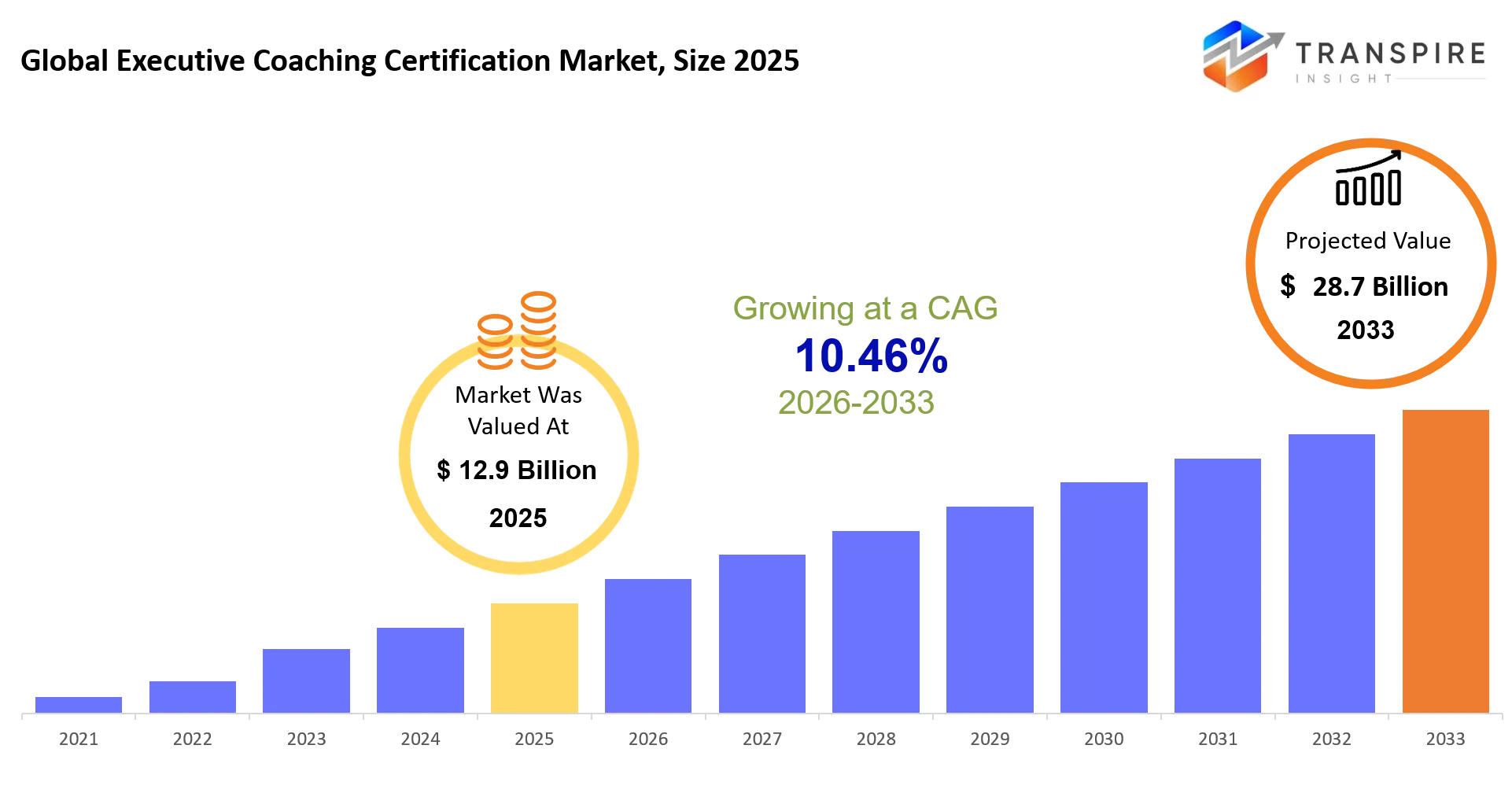
As per Transpire Insight Analysis, The Global Executive Coaching Certification Market size is estimated at USD 12.9 billion in 2025 and is anticipated to reach USD 28.7 billion by 2033, growing at a CAGR of 10.46% from 2026 to 2033, reflecting stronger enterprise spending on measurable leadership outcomes.
The Global Executive Coaching Certification market is a professional capabilities market that brings a capacity-building element to organizations that want to develop certified coaching talent for leadership development, succession planning, and performance improvement.
In the last 3-5 years, the market has moved from the transition of credentials away from the classroom to hybrid and digital delivery, making certification increasingly accessible to fast-paced executive populations and dispersed teams. A major structural shift has been the emergence of technology-enabled delivery, while the main external trigger has been persistent forces on organisations-remote work, digital transformation and increasing organisational complexity-that have driven the demand for stronger leadership pipelines. The growth has been fueled by a simple cause-and-effect logic: when companies are looking for ways to accelerate and scale up executive education capability more efficiently, certification programs win increasing adoption, institutional relevance, and renewal demand.
Global Hair Salon Services Market Size and Forecast
- Global Market Size 2025: USD 12.9 Billion
- Expected Market Value (2033): USD 28.7 Billion
- Forecast CAGR (2026–2033): 10.46%
- Leading Region in 2025: North America (44%)
- Fastest Growing Region: Asia Pacific (22% & CAGR 18.1%)
- Key Company Profiles: International Coaching Federation (ICF), EMCC Global, Coach U, Erickson Coaching International, Co-Active Training Institute, FranklinCovey, Center for Executive Coaching, iPEC Coaching, Korn Ferry, BetterUp, CoachHub, Marshall Goldsmith Stakeholder Centered Coaching, Harvard Business School Executive Education, INSEAD, Henley Business School
Key Global Executive Coaching Certification Market Insights:
The market is moving away from credential-based training and towards capability building—where employers seek certified coaches to positively affect leadership outcomes rather than simply taking a class.
- With firms making a connection between coaching, succession, and executive readiness, Executive Coaching Certification at 38% remains a leader.
- Leadership Coaching Certification at 20% is growing through pipeline programs and manager development in the HR sphere.
- The Business Coaching Certification is growing 15% as coaches are re-packaging coaching as performance and growth consulting.
- Team Coaching Certification at 10% is becoming more widespread as organisations are transitioning from individual development to group effectiveness.
- Virtual Coaching Certification at 8% is gaining momentum with the availability of hybrid coaching and digital access.
- The Advanced Coaching Certification at 5% is becoming a premium upskilling certification for experienced coaches.
- Others at 4% relate to niche tracks, and ICF and EMCC build trust with accreditation standards.
- BetterUp and CoachHub are moving towards tech-enabled delivery and are driving change in analytics, personalization, and scalable learner support.
- Harvard Business School Executive Education, INSEAD, and Henley Business School are expanding their markets through executive pedigree and cohort programs.
What are the Key Drivers, Restraints, and Opportunities in the Global Executive Coaching Certification Market?
Driver:
Demand is originating from companies where coaching certification is viewed as part of the leadership foundation for change, retention, and succession, where executive capacity is directly. This has been stimulated by the fact that corporate spend, in general, supports proportionally higher investment in such programs, and the boom in scale of digital coaching platforms means accreditation is more scalable across units and geographies. This underpins income via enterprise offerings, looped-in clients, and high-end certified programs.
In January 2026, Tinrate secured a €1.6 million seed funding round backed by Belfius. This milestone validates the accelerating demand for digital platforms that allow professional coaches, consultants, and enterprise advisors.
Restraint:
Growth is constrained by the poor quality of accreditation and the significant effort needed to demonstrate coaching efficacy at scale, leaving adoption fractured by employer and geography. This continues to be the case as coaching remains, to an extent, relationship-based, leading to wariness from buyers around difficult to demonstrate ROI.
Opportunity:
AI-powered coaching analytics and hybrid delivery are another large growth opportunity for the market, spiking heavily in the Asia Pacific and corporate learning budgets. Providers that incorporate virtual certification, one set of skills with one dashboard of measurable skills, can drive up adoption by distributed leadership teams, scale learning, build crisper performance management, and ultimately deliver greater enterprise value so that certification becomes relevant for the 21st-century workforce. In June 2026, Infopro Learning launched its standalone agentic coaching platform, OneGuru. This product launch delivers an "AI Skills Accelerator" that equips organisations with data-driven coaching insights to identify real-time skill gaps, scale workforce capabilities, and directly enhance modern performance management analytics.
What Has the Impact of Artificial Intelligence Been on the Global Executive Coaching Certification Market?
AI is transforming the way executive coaching certification is delivered by increasing delivery scalability and data intensity. Now used by providers to facilitate learner interaction, automate scheduling and assessment calculations, and enable content curation, automation is lowering administrative burdens and enabling shorter program cycles. It is also improving operations by enabling regular feedback, tracking learner progress, and providing management dashboards and reporting to enterprise clients. Importantly, the predictive capabilities of automation are allowing providers to identify when learners are disengaging, falling behind, or at risk of dropping out earlier in the learning journey. These insights enable providers to act before dropouts or disengagement impact outcomes in hybrid and virtual certification programs, which tend to have large virtual cohorts requiring tighter monitoring. Adoption is limited by automation failings and the need for new platform integration, which increase costs and make automation unattractive for smaller providers. Moving forward, the ability to automate processes while interpreting complex leadership behaviours continues to be a competitive advantage.
In July 2026, Tenor launched an enterprise-ready, SOC 2 Type II certified AI coaching application. This development successfully addresses integration trust barriers while delivering data-driven behavioral tracking.
Key Global Executive Coaching Certification Market Trends:
The market has evolved into an enterprise, measurable, and digital landscape over the past few years. Providers are now competing for access instead of credential title, on proof of outcomes, and on flexibility.
- With limited time, convenience has become a critical expectation for senior professionals when they buy online.
- Hybrid learning has replaced purely classroom-based formats as buyers seek less disruption and greater reach.
- Data-driven coaching is growing, and the programs are leveraging data to monitor progress and enhance learner accountability.
- With consumers seeking quality and transferability across employers, accreditation is gaining significance.
- Corporate programs are outpacing individual learning as companies seek coaching programs that reflect results.
- Leadership development is no longer about training but about building capability, which puts more value on executive-level certifications.
- Virtual coaching is becoming more common as distributed teams become the norm in their development models.
- The emphasis is on outcome proof, and employers are looking for observable behaviour change, not certificates.
Global Executive Coaching Certification Market Segmentation
By Certification Type:
Executive Coaching Certification dominates at 38%, with Leadership Coaching Certification at 20% and Business Coaching Certification at 15%, indicating neighbouring appeal for credentials rooted in roles and results. Team Coaching Certification at 10% and Virtual Coaching Certification at 8% demonstrate how online and collaborative modalities are expanding the scope, while Advanced Coaching Certification at 5% and Others at 4% reveal specialised, professional routes. The faster CAGR of 17.2% in Virtual Coaching Certification underscores how reach and volume are evolving priorities.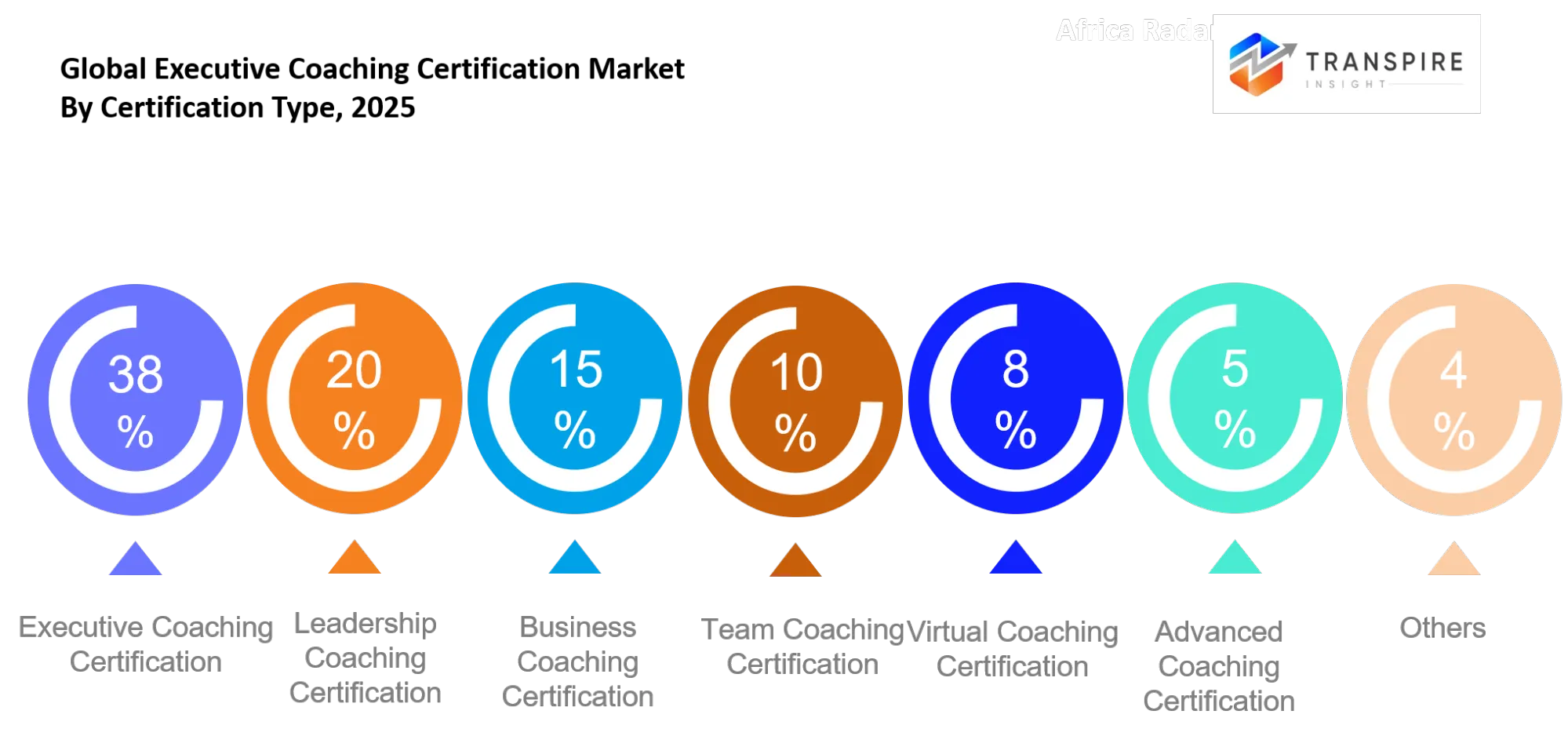
By Delivery Mode:
Online Learning, Live Virtual Courses, and Hybrid Learning have the greatest momentum, driven by decreasing time pressure on executives and an expansion in geographic coverage; Classroom Training holds its strength in immersing cohorts, and Corporate Programs are fundamental to meeting enterprise demand. Self-paced Learning facilitates learning amid busy schedules; University Programs maintain academic prestige, and these models prove that convenience, modularity, and organisational applicability count for as much as content.
By End User:
Corporate Executives are still the core buyers, but HR Professionals and Business Consultants are increasing adoption through certification to incorporate their own leadership programs/acknowledge and consult with clients. The Entrepreneurs, Leadership Coaches, Educational Institutions, and Government Organisations enhance, diversify, and lengthen the nature of demand by pushing the market beyond traditional corporate buyers to achieve multiple, steady channels of enrolment.
By Accreditation:
The ICF-accredited Programs and EMCC-accredited Programs have the best recognition. University Certifications, Private Certifications, Professional Associations, Corporate Certifications, and Global Certifications serve different needs of trust and portability of certification. This trend helps to explain that those purchasing certification are choosing credibility, international mobility, and employer acceptance, not cost.
By Application:
Leadership Development and Organisational Coaching are directly associated with management capability and succession planning. Career Development, Performance Enhancement, Talent Management, Change Management, and Executive Mentoring broaden the market into wider workforce transformation. As organisations formalise leadership pipelines, application demand is likely to shift toward tangible performance and change results.
What are the Key Use Cases Driving the Global Executive Coaching Certification Market?
The primary application is leader development for corporate executives. From this qualification, learning is used to accredit coaching skills that enhance decision-making, influence, and succession. This is most comparable to executive and leadership coaching programs, and provides the base for most new adoption.
Additional applications are improving performance, talent management, and change management, particularly in HR-supported programs and corporate learning environments (that are becoming both more numerous and more receptive to coaching).
Newer use cases are surfacing in virtual coaching, corporate hybrid programs, and institution-backed credentials for ID-level upskilling of a larger workforce. These newer formats are significant because they scale coaching, position more regionally, and adapt more readily to distributed learning systems.
|
Report Metrics |
Details |
|
Market size value in 2025 |
USD 12.4 Billion |
|
Market size value in 2026 |
USD 13.2 Billion |
|
Revenue forecast in 2033 |
USD 28.7 Billion |
|
Growth rate |
CAGR of 10.46% from 2026 to 2033 |
|
Base year |
2025 |
|
Historical data |
2021 - 2024 |
|
Forecast period |
2026 - 2033 |
|
Report coverage |
Revenue forecast, competitive landscape, growth factors, and trends |
|
Regional scope |
United States; Canada; Mexico; United Kingdom; Germany; France; Italy; Spain; Denmark; Sweden; Norway; China; Japan; India; Australia; South Korea; Thailand; Brazil; Argentina; South Africa; Saudi Arabia; United Arab Emirates |
|
Key company profiled |
International Coaching Federation (ICF), EMCC Global, Coach U, Erickson Coaching International, Co-Active Training Institute, FranklinCovey, Center for Executive Coaching, iPEC Coaching, Korn Ferry, BetterUp, CoachHub, Marshall Goldsmith Stakeholder Centered Coaching, Harvard Business School Executive Education, INSEAD, Henley Business School |
|
Customization scope |
Free report customisation (country, regional & segment scope). Avail customised purchase options to meet your exact research needs. |
|
Report Segmentation |
By Certification Type (Leadership Coaching Certification, Executive Coaching Certification, Business Coaching Certification, Team Coaching Certification, Life & Executive Coaching, Virtual Coaching Certification, Advanced Coaching Certification, Others); By Delivery Mode (Online Learning, Classroom Training, Hybrid Learning, Self-paced Learning, Live Virtual Classes, Corporate Programs, University Programs, Others); By End User (Corporate Executives, HR Professionals, Business Consultants, Entrepreneurs, Leadership Coaches, Educational Institutions, Government Organizations, Others); By Accreditation (ICF-accredited Programs, EMCC-accredited Programs, University Certifications, Private Certifications, Professional Associations, Corporate Certifications, Global Certifications, Others); By Application (Leadership Development, Organizational Coaching, Career Development, Performance Improvement, Talent Management, Change Management, Executive Mentoring, Others) |
Which Regions are Driving the Global Executive Coaching Certification Market Growth?
North America has the highest share with 44% because organisations buy coaching there as a leadership-system investment, not just an optional training. The strength here is in the high concentration of corporate budgets, mature executive education channels, and wide acceptance in HR and leadership teams of accredited programs. The country also benefits from a heavy penetration of large companies requiring standard, corporate-wide development for dispersed management levels, thus establishing a solid foundation for premium certification.
Europe accounts for 27% and holds steady as buyer behaviour is more institutional and accreditation-driven. Growth is modest, but demand is sustained by cultures of formal learning, cross-border talent mobility and unwavering adoption by large corporations. Many buyers seek portable credentials that ensure China and APAC can meet leadership compliance expectations. Therefore, Europe is a stronghold of quality, rather than volume.
In May 2026, the MASTERY project launched its European micro-credential certification pilot across multiple countries, including Finland, Bulgaria, Italy, Belgium, and Spain. This initiative validates and tracks specialised green skills via flexible, portable digital certificates tailored strictly to evolving compliance and labour market needs.
Asia Pacific leads with its volume share of 22% and 18.1% CAGR as firms lead the modernization of their leadership development to support increasing expansion, digital innovation, and local talent depth. Changes are driven by increased adoption of virtual learning models and global certification brands. The largest opportunity exists at the confluence of multinational growth, local consulting ecosystems, and mobile-first learning. No other region presents as compelling a case as Asia Pacific for the next wave of volume expansion.
In July 2026, Meta launched its Small Business Growth Academy across the Asia-Pacific region to deliver digital upskilling and AI-enabled tool training through a hybrid structure of local partner-led workshops and scaled mobile-first modules.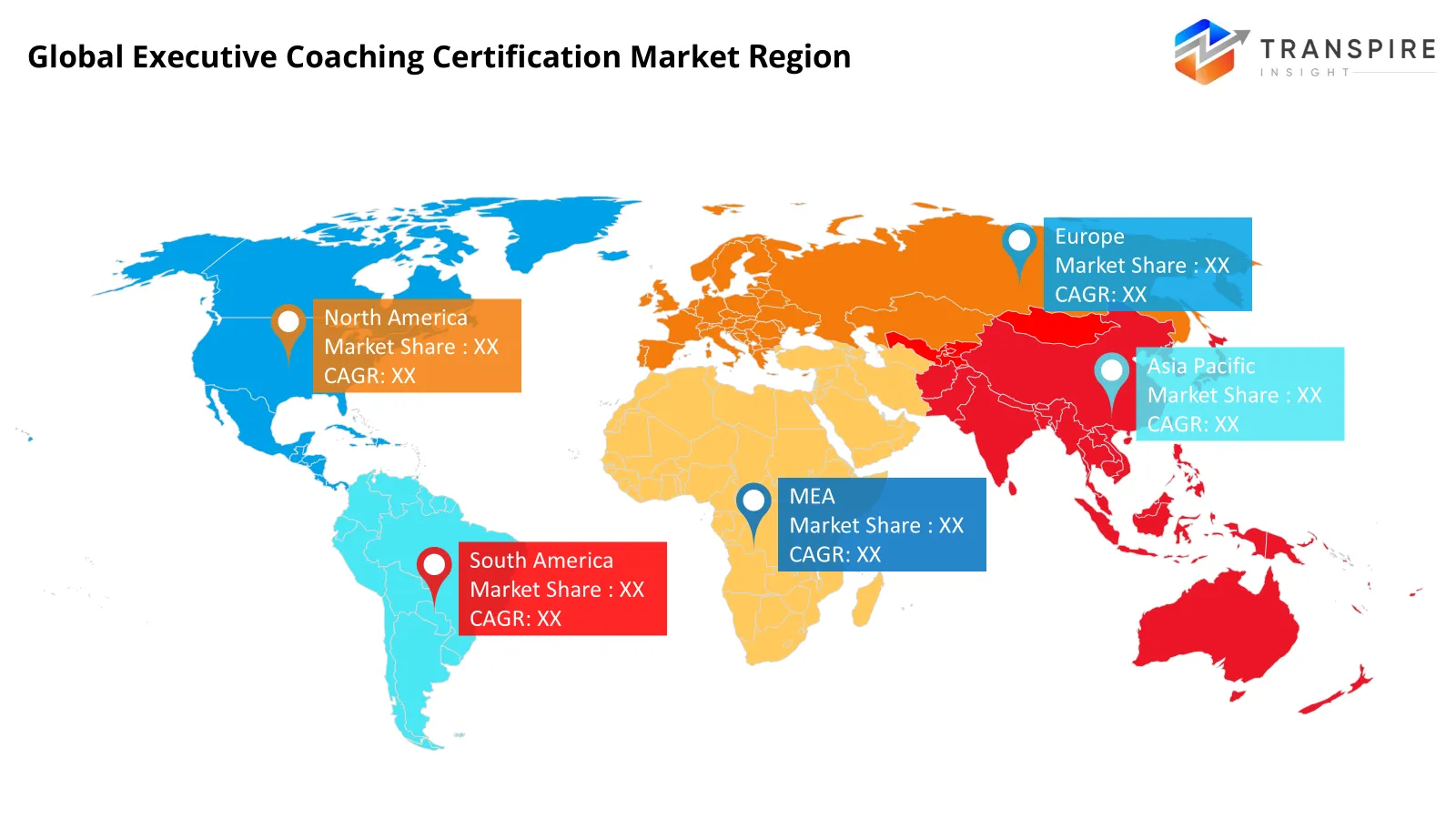
Who are the Key Players in the Global Executive Coaching Certification Market, and how do they compete?
Competitive rivalry in the delivery of executive coaching certification varies between three models of trust: accreditation, academic reputation, and technology-enabled access. Through accreditation and perceived professional standing, Institutional Bodies such as ICF and EMCC globally compete with each other, while through brand perception, access to alumni, and recognised executive learning programs, Harvard Business School Executive Education (HBS EE), INSEAD, and Henley Business School (HBS) are competing for market share. On the other hand, commercial providers such as BetterUp and Coach Hub compete on a competitive digital scale, learner access, analytics, and flexibility, while Korn Ferry and FranklinCovey settle for broad enterprise advisory capabilities. Smaller specialist competitive entrants like Coach U, Erickson Coaching International, Co-Active Training Institute, Centre for Executive Coaching, and iPEC Coaching focus on niche market positioning and individual practitioner identity. Marshall Goldsmith's Stakeholder Centred Coaching sought to add value as an outcome-based model. Overall, the competition for executive certification providers seems to revolve around scale, credibility, and specialist positioning rather than pricing.
Key Players are:
- International Coaching Federation (ICF)
- EMCC Global
- Coach U
- Erickson Coaching International
- Co-Active Training Institute
- FranklinCovey
- Centre for Executive Coaching
- iPEC Coaching
- Korn Ferry
- BetterUp
- CoachHub
- Marshall Goldsmith Stakeholder-Centered Coaching
- Harvard Business School Executive Education
- INSEAD
- Henley Business School
Recent Development News
- In March 2026, the International Coaching Federation secured a partnership with the U.S. Department of Veterans Affairs to add its best-in-class coaching credentials to support professional development under the GI Bill. This milestone enables veterans to utilise their federal education benefits to pursue accredited executive and professional coaching certifications.
https://coachingfederation.org
- In February 2026, the International Coaching Federation (ICF) signed a memorandum of understanding with the Standing Conference of Public Enterprises (SCOPE) to advance coaching-led leadership across India's public sector PSU Watch. This initiative integrates certified executive development frameworks directly into state-owned enterprises.
What Strategic Insights Define the Future of the Global Executive Coaching Certification Market?
The coaching certification market is shifting toward quantifiable blended learning and AI-enabled approaches that explicitly couple the value of professional credentials to workplace performance and business results. Long-term growth will require providers to offer data-driven validation, available on-demand via fully digital delivery, as well as deeper integration into corporate talent systems. A discreet, unanticipated risk is the commoditization of such credentials as more players are starting online programs that only providers with proven learner success and employer recognition can differentiate themselves. High-potential opportunities are surfacing via region-specific virtual certifications integrated into enterprise learning ecosystems, especially across Asia Pacific and MNCs. Leaders should enhance the quality of accreditation, apply innovative AI-enabled learning analytics, leverage partnership-driven scale, and build outcomes-oriented credentialing. By implementing these strategies, pricing leverage, fundamental learner credibility, employer acceptance, and long-term market growth can be optimally achieved.
Key Segmentations are:
By Certification Type
- Leadership Coaching Certification
- Executive Coaching Certification
- Business Coaching Certification
- Team Coaching Certification
- Life & Executive Coaching
- Virtual Coaching Certification
- Advanced Coaching Certification
- Others
By Delivery Mode
- Online Learning
- Classroom Training
- Hybrid Learning
- Self-paced Learning
- Live Virtual Classes
- Corporate Programs
- University Programs
- Others
By End User
- Corporate Executives
- HR Professionals
- Business Consultants
- Entrepreneurs
- Leadership Coaches
- Educational Institutions
- Government Organizations
- Others
By Accreditation
- ICF-accredited Programs
- EMCC-accredited Programs
- University Certifications
- Private Certifications
- Professional Associations
- Corporate Certifications
- Global Certifications
- Others
By Application
- Leadership Development
- Organizational Coaching
- Career Development
- Performance Improvement
- Talent Management
- Change Management
- Executive Mentoring
- Others
Regional Outlook
North America
- United States
- Canada
- Mexico
Europe
- Germany
- United Kingdom
- France
- Spain
- Italy
- Rest of Europe
Asia Pacific
- Japan
- China
- Australia & New Zealand
- South Korea
- India
- Rest of Asia Pacific
South America
- Brazil
- Argentina
- Rest of South America
Middle East & Africa
- Saudi Arabia
- United Arab Emirates
- South Africa
- Rest of the Middle East & Africa
Frequently Asked Questions
Find quick answers to common questions.
The global executive coaching certification market size was valued at USD 12.4 billion in 2025 and is poised to reach USD 28.7 billion by 2033, expanding at a 10.46% CAGR.
Key segments for the global executive coaching certification market are By Certification Type (Leadership Coaching Certification, Executive Coaching Certification, Business Coaching Certification, Team Coaching Certification, Life & Executive Coaching, Virtual Coaching Certification, Advanced Coaching Certification, Others); By Delivery Mode (Online Learning, Classroom Training, Hybrid Learning, Self-paced Learning, Live Virtual Classes, Corporate Programs, University Programs, Others); By End User (Corporate Executives, HR Professionals, Business Consultants, Entrepreneurs, Leadership Coaches, Educational Institutions, Government Organizations, Others); By Accreditation (ICF-accredited Programs, EMCC-accredited Programs, University Certifications, Private Certifications, Professional Associations, Corporate Certifications, Global Certifications, Others); By Application (Leadership Development, Organizational Coaching, Career Development, Performance Improvement, Talent Management, Change Management, Executive Mentoring, Others).
Growth is primarily driven by increasing demand for certified executive coaches, stronger recognition of coaching as a leadership development tool, broader adoption of coaching cultures inside organizations, and the need for performance improvement and career-transition support.
The global executive coaching certification market is led by major manufacturers, including International Coaching Federation (ICF), EMCC Global, Coach U, Erickson Coaching International, Co-Active Training Institute, FranklinCovey, Centre for Executive Coaching, iPEC Coaching, Korn Ferry, BetterUp, CoachHub, Marshall Goldsmith Stakeholder Centred Coaching, Harvard Business School Executive Education, INSEAD, and Henley Business School.
North America influences the market most strongly with a 44% share, supported by mature corporate spending, established executive education infrastructure, and high acceptance of credentialed coaching in leadership programs.
Commercial opportunities include AI-enabled coaching analytics, hybrid and virtual certification models, region-specific programs for Asia Pacific, and enterprise partnerships that tie certification to leadership pipelines and measurable skill dashboards.
- International Coaching Federation (ICF)
- EMCC Global
- Coach U
- Erickson Coaching International
- Co-Active Training Institute
- FranklinCovey
- Centre for Executive Coaching
- iPEC Coaching
- Korn Ferry
- BetterUp
- CoachHub
- Marshall Goldsmith Stakeholder-Centered Coaching
- Harvard Business School Executive Education
- INSEAD
- Henley Business School
About the Authors

Mayur Shinde
I am Mayur Shinde, a Senior Research Analyst at Transpire Insight, specializing in the Automotive & Transportation and Information & Communication Technology (ICT) Industry. My work focuses on analyzing emerging market trends, technological advancements, competitive landscapes, and industry developments to deliver accurate, data-driven insights. I am passionate about transforming complex market information into clear, actionable content that helps businesses, professionals, and decision-makers stay informed and make confident strategic decisions.

Chakradhar Khansole
Chakradhar serves as the Research Director at Transpire Insight, bringing over 8 years of experience in technology, innovation, and strategic market intelligence. He specializes in transforming complex market data into actionable business insights that enable organizations to make informed, growth-oriented decisions. Recognized for his strategic vision and analytical expertise, Chakradhar leads high-impact research initiatives, delivering comprehensive market assessments, competitive intelligence, and forward-looking industry analysis.
Recently Published Reports
-
Apr 2026
3D Optical Profiler Market
3D Optical Profiler Market Size, Share & Analysis Report By Type (Desktop 3D Optical Profiler, and Portable 3D Optical Profiler), By Technology (Confocal Technology, and White Light Interference), By End-Use Industry (Manufacturing, Research Institutions, Automotive, Aerospace and Defense, Medical Devices, and Other), and Geography (North America, Europe, Asia-Pacific, Middle East and Africa, South and Central America), 2021 - 2031
-
Apr 2026
Depth Sensor Market
Depth Sensor Market Size, Share & Analysis Report By Type (Infrared Depth Sensors, Time-of-Flight (ToF) Sensors, Stereo Vision Sensors, Structured Light Sensors, Ultrasonic Depth Sensors), By Application (Automotive, Robotics, Gaming, Consumer Electronics, Industrial Automation, Healthcare, Security & Surveillance, Others), By End Users (Automotive Manufacturers, Consumer Electronics Companies, Healthcare Providers, Industrial Companies, Security Agencies, Gaming Companies, Robotics Companies, Others), and Geography (North America, Europe, Asia-Pacific, Middle East and Africa, South and Central America), 2021 – 2031
-
Apr 2026
Digital Manufacturing Market
Digital Manufacturing Market Size, Share & Analysis Report By Component (Hardware, Software, and Services), By Technology (Robotics, 3D Printing, Internet of Things (IoT), and Others), By Application (Automotive and Transportation, Aerospace and Defense, Consumer Electronics, Industrial Machinery, and Others), By Process Type (Computer-Based Designing, Computer-Based Simulation, Computer 3D Visualization, Analytics, and Others), and Geography (North America, Europe, Asia-Pacific, Middle East and Africa, South and Central America), 2021 – 2031
-
Apr 2026
Digital Visa Services Market
Digital Visa Services Market Size, Share & Analysis Report By Type (Individual Travelers, Group Travelers), By Application (Tourism, Business Travel, Others), and Geography (North America, Europe, Asia-Pacific, Middle East and Africa, South and Central America), 2021 – 2031