
Middle East and Africa Food Certification Market Size & Forecast:
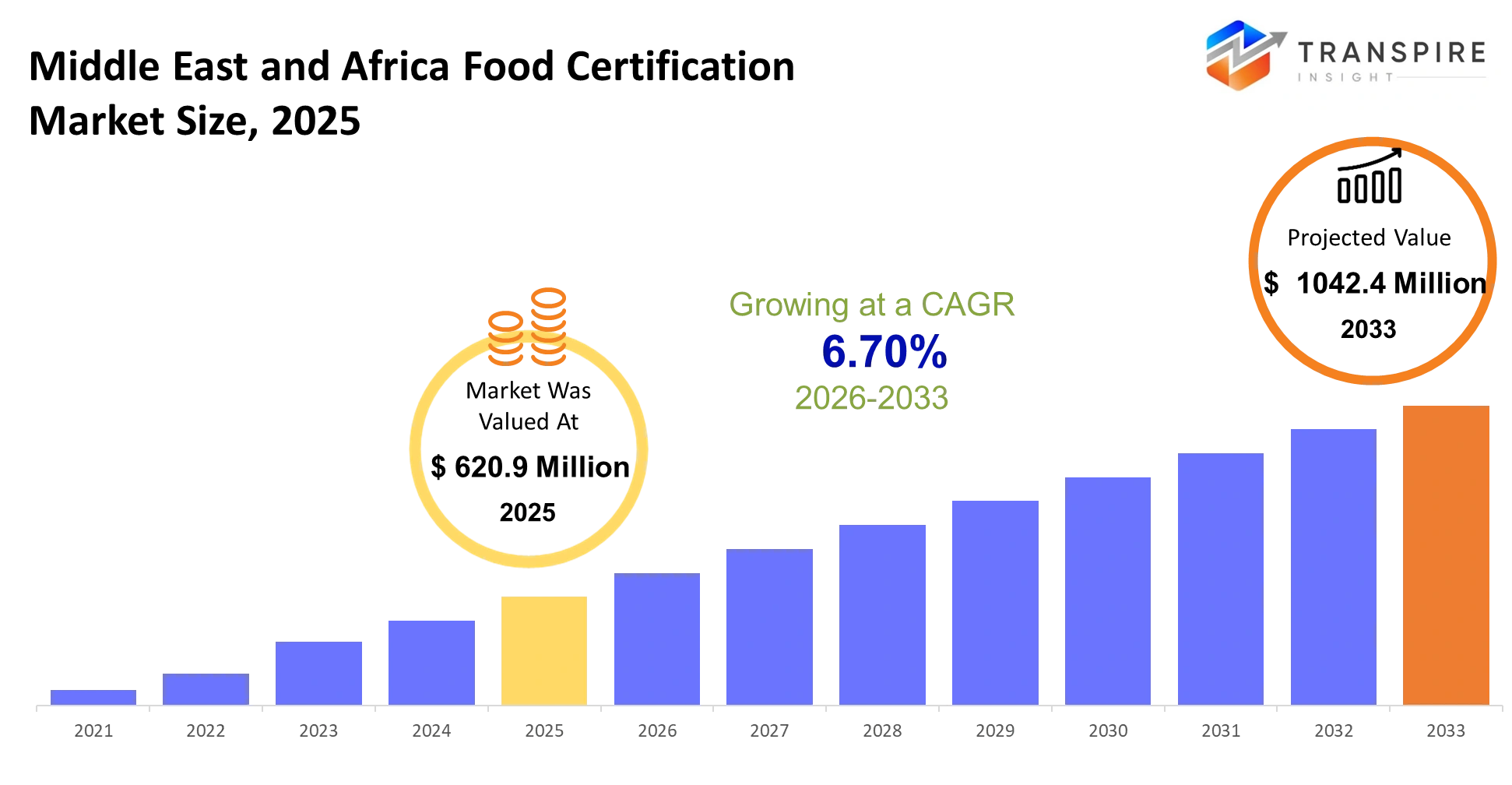
- Middle East and Africa Food Certification Market Size 2025: USD 620.9 Million
- Middle East and Africa Food Certification Market Size 2033: USD 1042.4 Million
- Middle East and Africa Food Certification Market CAGR: 6.70%
- Middle East and Africa Food Certification Market Segments: By Type (ISO, Organic, Halal, HACCP), By Application (Processing, Packaging, Distribution), By Certification Body (Third-party, Government), By Industry (Dairy, Meat, Beverages), By End-User (Food Manufacturers, Exporters, Retailers)
To learn more about this report,  Download Free Sample Report
Middle East and Africa Food Certification Market Summary:
The Middle East and Africa Food Certification Market size is estimated at USD 620.9 Million in 2025 and is anticipated to reach USD 1042.4 Million by 2033, growing at a CAGR of 6.70% from 2026 to 2033. Certification for food products in the Middle East and Africa (Saudi Arabia, United Arab Emirates, South Africa, and other parts of the Middle East and Africa) will become more organized and structured as governments and private organizations impose stringent regulations on production and imports. Consumers will insist on knowing where their food comes from, its halal authenticity, and whether the hygiene levels are adequate; hence brands will have no choice but to comply with stringent verification processes. The application of digital tracking technologies will transform the process of issuing certifications and labels. Exporters will be compelled to adjust their documentation procedures to keep up with evolving compliance requirements.
What Has the Impact of Artificial Intelligence Been on the Middle East and Africa Food Certification Market?
The implementation of artificial intelligence technology is having a transformative impact on the food certification industry in the Middle East and Africa. This development occurs because AI technology empowers Middle East and African food certification organizations to conduct market research more efficiently while analyzing data through its advanced capabilities. Machine learning models discover hidden patterns which lead to certification failures and compliance gaps while stakeholders use this information to develop proactive responses. The shift will build stronger consumer trust because people demand food safety information that proves their products meet quality standards.
Artificial intelligence in the Middle East and Africa food certification market uses predictive analytics to enhance demand forecasting and trend-prediction capabilities. Certification agencies and food producers will anticipate regulatory changes, seasonal demand shifts, and export requirements more effectively. Smart automation tools are streamlining inspection workflows, reducing manual errors and enhancing production efficiency. AI-powered supply chain optimization reduces operational costs through its ability to track product movement and detect risks while guaranteeing timely certification renewals which occur across international boundaries.
As competition intensifies, AI in Middle East and Africa food certification market environments will create new certification services through innovative personalized certification solutions. Businesses will customize their compliance approaches according to their product types, the regulations in different regions, and the needs of their customers. The adoption of intelligent systems will create a competitive edge for organizations which can use these systems to adapt to shifting market conditions while upholding their quality control requirements.
Key Market Trends & Insights:
- Saudi Arabia is a dominating country that leads the market for Middle East and Africa food certification with almost 30% market share in 2025 because of better compliance frameworks for halal certification.
- The UAE will be the fastest-growing region that will grow significantly till 2030 due to the growth of import-based certification demand.
- Certification services are leading the market for certification with over 45% market share in 2025 owing to mandatory compliance for exports and imports of food.
- Inspection and testing services are second largest services in market with increasing quality verification demands for processed foods.
- Digital certification platforms are leading growth segments in the market from 2025-2030 due to automation trends.
- Processed food certifications dominate the market with almost 40% share due to increasing demand for packaged foods.
- Organic and clean label food certification is leading applications with high growth rate because of emerging consumer demands for healthy foods.
- Food manufacturers dominate the Middle East and Africa food certification market, with over 50% market share.
- Export-oriented companies are fast-growing due to trade compliance requirements.
Middle East and Africa Food Certification Market Segmentation
By Type
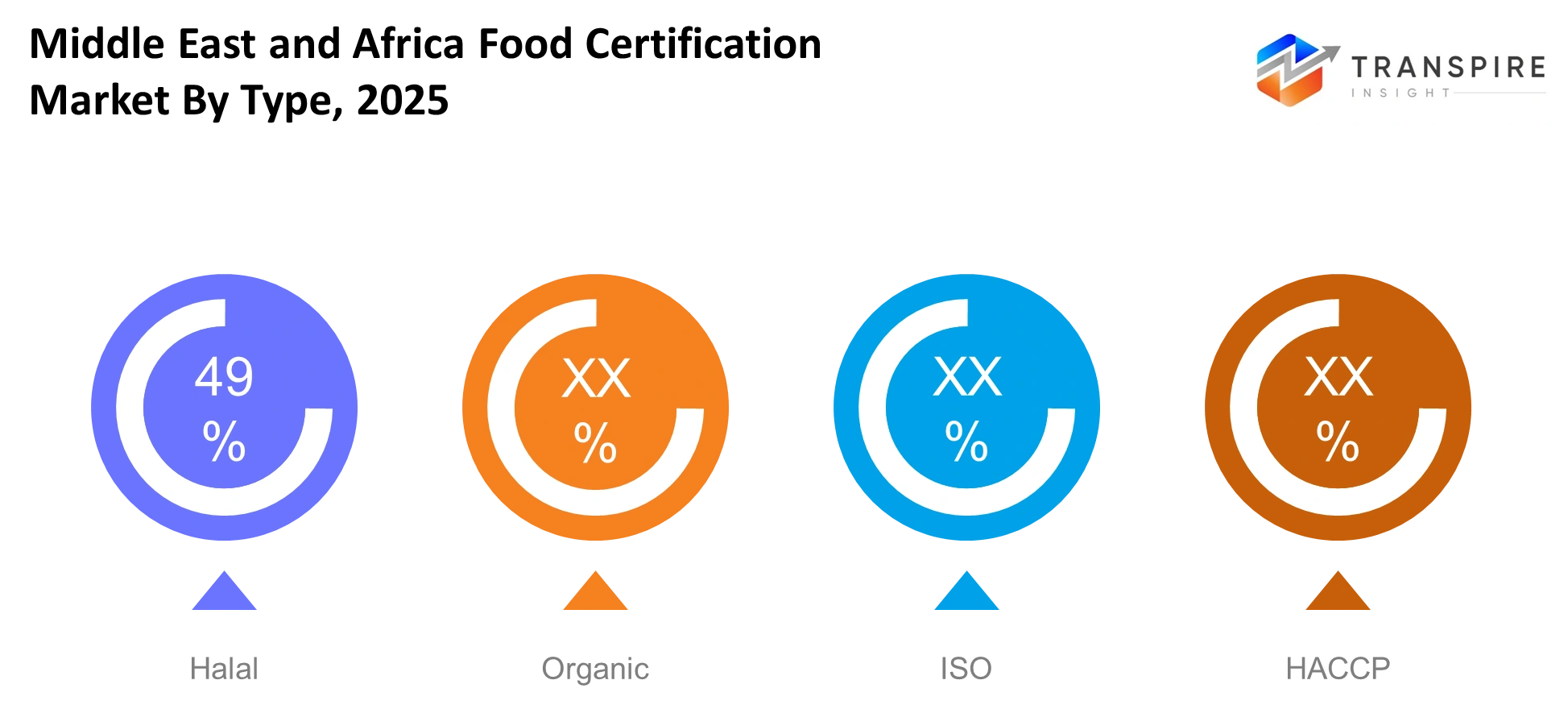
ISO certification will entail standardizing quality management systems and will be used by various companies to facilitate standardized practices. Organic certification will be crucial for verifying that organic food products have been produced without the use of any chemicals. Halal certification will be necessary in areas with stringent religious rules that must be adhered to, particularly for the processing of meat and meat products. HACCP certification will focus on hazard prevention and food safety throughout the entire production process.
Each form of certification will have its own significance and will overlap in many instances. Various types of certifications will be needed by organizations in order to ensure compliance with export laws. Consumers' awareness of the need for these certifications will drive increased demand for them.
To learn more about this report, Download Free Sample Report
By Application
The certification for process applications will demonstrate the significance of maintaining hygiene standards and ensuring ingredient safety and controlling operational processes. The packaging certification process will establish that all materials achieve safety standards while their labeling remains precise and their contents stay uncontaminated. The distribution certification process ensures that products are properly distributed throughout their distribution process.
All food product life cycle stages will require certification in accordance with their specific application-based classification system. The process stage remains essential because it establishes the standards for determining product quality.
By Certification Body
The third-party organizations will be independent and offer unbiased certification services to companies. On the other hand, the government will offer certifications to ensure that local food rules and regulations are met. This way, third-party organizations will complement government certifications to ensure there is credibility in the products. In most cases, the third-party organizations will cover international requirements, while government certifications will cover the national requirements.
Third-party and government organizations will continue playing complementary roles in certification process. Businesses will use third-party organizations in order to get recognized internationally. On the other hand, government certifications will be compulsory for businesses to enter the local market.
By Industry
Certification in the dairy industry will be based on hygiene, storage, and quality control considerations, given the fragile nature of the products involved. For the meat industry, issues such as halal compatibility and stringent safety requirements will dominate certification processes. In the beverages industry, certification will be aimed at ensuring ingredient quality, proper processing techniques, and accurate labeling.
Certification processes will vary depending on the risk level of each individual industry sector. Meat and dairy industries will receive more attention from certification authorities than other sectors, owing to a higher risk of contamination. With increasing beverage consumption, there will be a need for certification in the industry.
By End-User
The certification will be used by food producers to ensure compliance with the manufacturing process and to build customer trust. The exporters will rely on certification to meet international standards for trade and enter the international market. The retailers will use certified products to ensure compliance with quality standards.
The user categorization will reveal the role certification will play in each of the end users. Manufacturers will remain the largest users due to their active participation in the production process. The increasing need for certified products from the exporters will rise because of increased globalization.
What are the Main Challenges for the Middle East and Africa Food Certification Market Growth?
Technical difficulties and operational inefficiencies are among the factors hindering the steady development of the Middle East and Africa food certification market. There is complexity in certification, different standards from country to country, and the disintegration of supply chains, which results in inefficient verification. The data aspect also poses a challenge, as most certification systems continue to use manual methods of recording information rather than adopting digital platforms. Technical and operational inefficiencies in the Middle East and Africa food certification market often cause delays, a lack of transparency, and difficulty in expanding certification activities across multiple regions.
The manufacturing and commercialization obstacles also hamper the growth rate in the Middle East and Africa food certification market. Manufacturers face difficulties due to the complex nature of industry regulations, which require them to meet international safety standards and local authorities' demands, making the process costly and lengthy. Certifications are costly due to audit fees and compliance with international and regional laws.
Adoption barriers in the Middle East and Africa food certification market include limited infrastructure and knowledge in developing countries. Moreover, there are insufficient auditors, advanced laboratories, and web-based interfaces to conduct the certification process smoothly.
Moreover, the competitive landscape and regulatory changes add to the challenges faced by the Middle East and Africa food certification market. The different methods of quality assurance and the conventional routes for distributing goods act as barriers to the certification process, particularly when budget constraints prevail. In addition, rapid technological advancement requires regular updates to the certification process.
Country Insights
There is going to be an evolution in the market of food certification in the Middle East and Africa as the regulations will become more stringent in different nations. There will be an increased need for certified food safety and halal compliance. The firms will follow procedures to ensure their products comply with domestic and export certifications.
Increased commercial activities will make it necessary for organizations to follow the international standards for food certification. Digital technology will play a vital role in the documentation process, reducing errors.
Saudi Arabia and the UAE will lead due to strict laws and high demand for halal products. The South African countries will see slow but steady development due to effective food safety systems and export-oriented certification laws. The other Middle Eastern and African nations will follow slowly.
There will be differences in the certification methods adopted across different parts of the world, reflecting the cultural and legal backgrounds of each area. While cities will have more stringent conditions, new regions will become competent with time. Trade between nations will help standardise the certification process.
Recent Development News
In April 2026, SGS SA announced the implementation of Lean-based food safety optimization programs to improve certification readiness and compliance efficiency across food production systems facing cost and regulatory pressure. https://www.sgs.com
In April 2026, Directorate General of Foreign Trade expanded mandatory halal certification requirements to 35 export markets across the Middle East and Africa, increasing compliance obligations for food exporters and certification bodies. https://www.india-briefing.com
|
Report Metrics |
Details |
|
Market size value in 2025 |
USD 620.9 Million |
|
Market size value in 2026 |
USD 661.9 Million |
|
Revenue forecast in 2033 |
USD 1042.4 Million |
|
Growth rate |
CAGR of 6.70% from 2026 to 2033 |
|
Base year |
2025 |
|
Historical data |
2021 - 2024 |
|
Forecast period |
2026 - 2033 |
|
Report coverage |
Revenue forecast, competitive landscape, growth factors, and trends |
|
Regional scope |
Middle East and Africa (Saudi Arabia, United Arab Emirates, South Africa, Rest of Middle East and Africa) |
|
Key company profiled |
SGS, Bureau Veritas, Intertek, DNV, TÜV SÜD, TÜV Rheinland, Eurofins, UL Solutions, NSF International, Control Union, Kiwa, ALS Global, LRQA, BSI Group, FoodChain ID |
|
Customization scope |
Free report customization (country, regional & segment scope). Avail customized purchase options to meet your exact research needs. |
|
Report Segmentation |
By Type (ISO, Organic, Halal, HACCP), By Application (Processing, Packaging, Distribution), By Certification Body (Third-party, Government), By Industry (Dairy, Meat, Beverages), By End-User (Food Manufacturers, Exporters, Retailers) |
How Can New Companies Establish a Strong Foothold in the Middle East and Africa Food Certification Market?
New entrants may enter the market in the Middle East and Africa food certification niche through niche markets with under-satisfied demand levels. Companies will position themselves within the market in relation to the verification services offered to small exporters, organic certification services to local producers, and online audit services to SMEs. The success for these new firms will not come from competing on all aspects but from concentrating on certain compliance areas at relatively low cost in accordance with today’s standards.
The Middle East and Africa food certification market will experience growth through technology-based innovations. Companies that implement AI inspection tools alongside blockchain traceability and cloud-based document systems will improve accuracy while reducing operational time. The innovation strategies will address three major challenges which include slow approval processes and errors that occur during manual work and problems with transparency. Startups such as SafeTrace Africa are developing digital traceability systems while HalalVerify Tech creates technology for automated halal compliance monitoring which exporters will use.
Market entry will also be further enhanced through strategic collaboration. By working with regulatory bodies, food manufacturers, and export associations, firms can become familiar with regulatory requirements and build considerable credibility.
Flexibility and sustainability will become key drivers for success in the Middle East and Africa Food Certification Market. Every newcomer to the industry must assess changes in market dynamics, regulations, and consumer preferences to enhance service offerings. Client servicing and certification efficiency will also play a significant role in this regard.
Key Middle East and Africa Food Certification Market Company Insights
The market for food certification in the Middle East and Africa is projected to grow as food safety and compliance regulations become increasingly important. Corporations will establish formal certification programs to meet regulatory requirements and ensure the validity of their products. There will be an increased demand for halal, organic, and safety certifications in both local and export markets.
Regulatory compliance and digitization will facilitate the smooth operation of the certification process in all areas. Businesses will emphasize timely validation and enhanced traceability to fulfill customer demands. The market landscape will be characterized by increased organization as a result of evolving food production and distribution practices.
Well-known certifying bodies will use technology to diversify their service delivery. Multinational companies will leverage technology to ensure accurate audits and expedited certification. Regional bodies will focus on efficiency and offer products that will favor small and medium enterprises.
Competitive rivalry will continue because new players in the market will adopt innovative approaches such as using artificial intelligence in validating products and tracking products using blockchain. There will be a partnership between regulatory bodies and food producers, thereby giving them an added advantage. Efficiency of service delivery will set players apart in different parts of the globe.
Company List
- SGS
- Bureau Veritas
- Intertek
- DNV
- TÜV SÜD
- TÜV Rheinland
- Eurofins
- UL Solutions
- NSF International
- Control Union
- Kiwa
- ALS Global
- LRQA
- BSI Group
- FoodChain ID
What are the Key Use-Cases Driving the Growth of the Middle East and Africa Food Certification Market?
The most significant use cases have a significant influence on the development of the Middle East and Africa food certification market, particularly in the food production and processing industries. Certification confirms hygienic conditions, safe ingredients, and adherence to export requirements. The application of this use case is crucial for food processing companies seeking to enter the global market, as certification serves as a barrier to market entry.
Halal certification of meat and packaged food is another essential use case in the Middle East and Africa food certification market. Due to the increased interest in religiously acceptable products, businesses apply to food certification services to verify the authenticity of their products. Moreover, retail chains and fast-food restaurants also use certification as a tool to attract consumers.
Supply chain verification is now considered one of the most important applications behind the growth of the Middle East and Africa food certification market. The distributors and logistics companies are making use of food certifications to verify that food items are stored, handled, and transported properly. Such practices help avoid any kind of contamination and maintain transparency in their operations. The incorporation of digital technologies into supply chains makes this use case even more effective.
Other industries such as health care and hospitality are also contributing towards the growth of the Middle East and Africa food certification market. Hospitals and hotels prefer to source their food from certified suppliers. The growing importance of certification among these industries will offer many opportunities for certification firms.
Middle East and Africa Food Certification Market Report Segmentation
By Type
- ISO
- Organic
- Halal
- HACCP
By Application
- Processing
- Packaging
- Distribution
By Certification Body
- Third-party
- Government
By Industry
- Dairy
- Meat
- Beverages
By End-User
- Food Manufacturers
- Exporters
- Retailers
Frequently Asked Questions
Find quick answers to common questions.
The approximate Middle East and Africa Food Certification Market size for the market will be USD 1042.4 Million in 2033.
Key segments for the Middle East and Africa Food Certification Market are By Type (ISO, Organic, Halal, HACCP), By Application (Processing, Packaging, Distribution), By Certification Body (Third-party, Government), By Industry (Dairy, Meat, Beverages), By End-User (Food Manufacturers, Exporters, Retailers).
Major Middle East and Africa Food Certification Market players are SGS, Bureau Veritas, Intertek, DNV, TÜV SÜD, TÜV Rheinland, Eurofins, UL Solutions, NSF International, Control Union, Kiwa, ALS Global, LRQA, BSI Group, FoodChain ID.
The Middle East and Africa Food Certification Market size is USD 620.9 Million in 2025.
The Middle East and Africa Food Certification Market CAGR is 6.70%.
- SGS
- Bureau Veritas
- Intertek
- DNV
- TÜV SÜD
- TÜV Rheinland
- Eurofins
- UL Solutions
- NSF International
- Control Union
- Kiwa
- ALS Global
- LRQA
- BSI Group
- FoodChain ID
Recently Published Reports
-
Dec 2024
Baby Infant Formula Market
Baby Infant Formula Market Size, Share & Analysis Report By ype (Infant Milk, Follow On Milk, Specialty Baby Milk, Growing-Up Milk), By Ingredient (Carbohydrate, Fat, Protein, Minerals, Vitamins, and Others), By Product Form (Powder, Liquid, and Ready-to-feed), By Distribution Channels (Supermarket/Hypermarket, Specialty Store, Pharmacies, Online Retail, and Others), and Geography (North America, Europe, Asia-Pacific, Middle East and Africa, South and Central America), 2021 - 2031
-
Jan 2025
Edible Insects for Animal Feed Market
Edible Insects for Animal Feed Market Size, Share & Analysis Report By Type (Insect Powder, Insect Meal, Insect Bar, Insect Paste, Insect Oil, and Others), By Insect Type (Beetles, Cricket, Caterpillar, Hymenoptera, Orthoptera, Tree Bugs, and Others), By Application (Livestock, Pet Food, and Aquaculture), By Livestock Type (Poultry, Swine, and Others), and Geography (North America, Europe, Asia-Pacific, Middle East and Africa, South and Central America), 2021 - 2031
-
Jan 2025
Food Industry Disinfection and Bacterial Control Market
Food Industry Disinfection and Bacterial Control Market Size, Share & Analysis Report By Type (Chemical Disinfectants, Physical Disinfectants, and Biocides and Antimicrobials), By Application (Food Processing Equipment Surface Disinfection, Food Preparation Areas Surface Disinfection, Storage Areas Surface Disinfection, Anti-microbial Coatings Food Preservation, and Preservative Solutions Food Preservation), By End User (Meat and Poultry Processing, Dairy Processing, Seafood Processing, Bakery and Confectionery, Restaurants and Commercial Kitchens, and Food Service Providers), By Sales Channel (Online, Offline), and Geography (North America, Europe, Asia-Pacific, Middle East and Africa, South and Central America), 2021 - 2031
-
Jan 2025
Freeze Dried Food Market
Freeze Dried Food Market Size, Share & Analysis Report By Product Type (Fruits, Vegetables, Freeze-Dried Dairy Products, Freeze-Dried Meat and Seafood, Freeze-Dried Pet Food, and Prepared Meal), By Nature (Organic, and Conventional), By Form (Powdered, Granules, and Diced), By End Use (Breakfast Cereals, Dairy Products, Bakery & Confectionery, Nutritional Bars & Supplements, Powdered Beverages, Snacks, and Retail (Household)), and Geography (North America, Europe, Asia-Pacific, Middle East and Africa, South and Central America), 2021 - 2031