

Asia Pacific Child Care Market Size & Forecast:
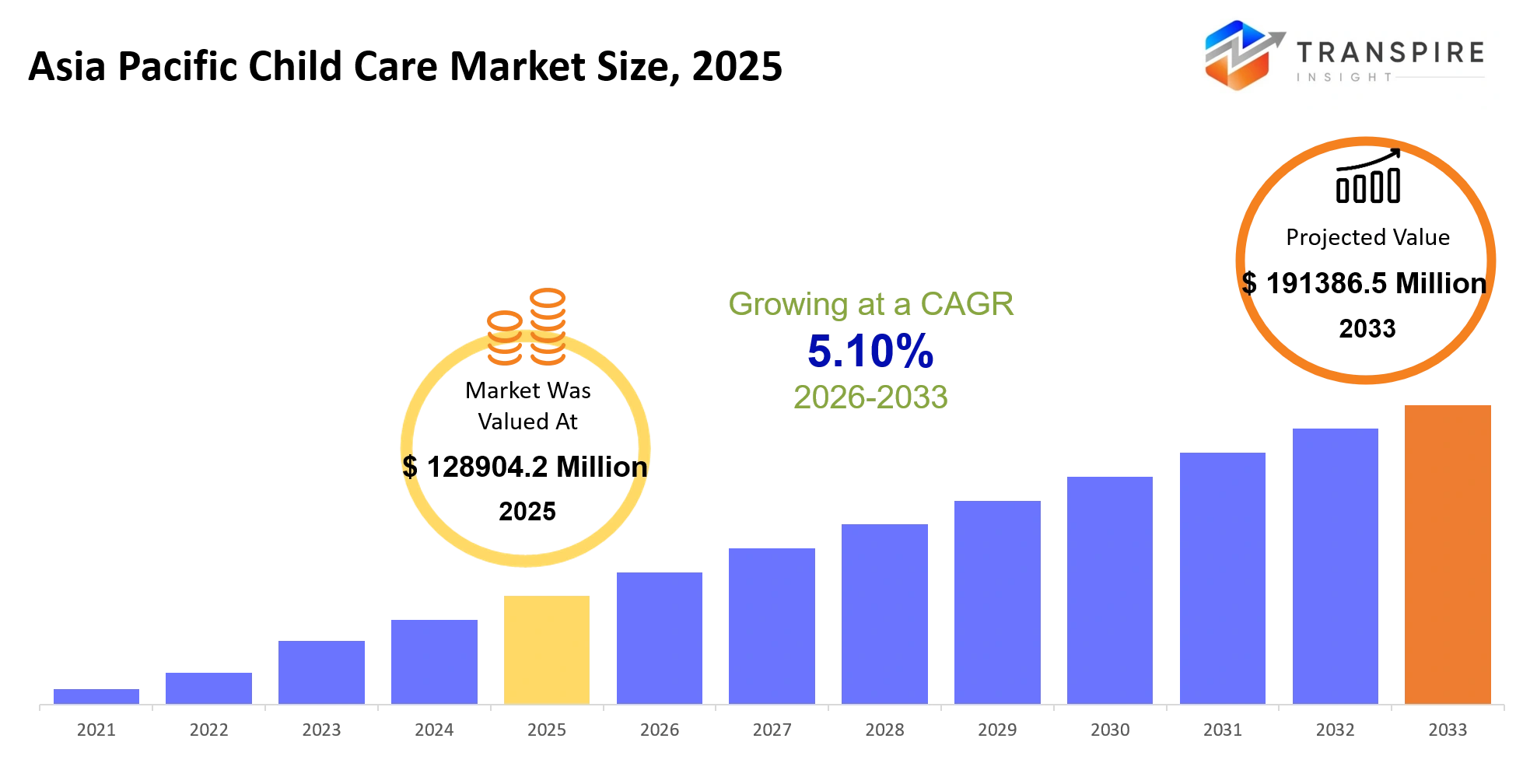
- Asia Pacific Child Care Market Size 2025: USD 128904.2 Million
- Asia Pacific Child Care Market Size 2033: USD 191386.5 Million
- Asia Pacific Child Care Market CAGR: 5.10%
- Asia Pacific Child Care Market Segments: By Service Type (Day Care, Preschool Education, After School Care, Infant Care, Special Needs Care, Others); By Provider Type (Private Centers, Public Centers, Home-Based Care, Corporate Childcare, Others); By Age Group (Infants, Toddlers, Preschoolers, School-Age Children, Others); By End User (Working Parents, Single Parents, Corporates, Others).
To learn more about this report,  Download Free Sample Report
Asia Pacific Child Care Market Summary
The Asia Pacific Child Care Market was valued at USD 128904.2 Million in 2025. It is forecast to reach USD 191386.5 Million by 2033. That is a CAGR of 5.10% over the period.
The Asia Pacific Child Care Market plays a real big role in enabling workforce participation, by giving structured care , supervision and early learning support for children while parents are at work. And beyond just basic caregiving, child care centers, preschools, and organized daycare services kinda help families juggle employment responsibilities with child development needs. So in a sense it becomes an essential component of the region’s social and economic infrastructure, even when people don’t always notice it.
Over the last three to five years, the market has seen a kind of structural shift toward formalized and professionally managed child care services , backed by stronger regulatory standards, digital enrollment systems , and curriculum based early education programs. One major trigger was the post-pandemic return to workplaces, which sped up the need for dependable child care solutions as dual income households restarted on site employment. This change has boosted enrollment across organized providers and also motivated investment in capacity expansion. With continued urbanization and female labor force participation turning into a stronger economic priority, operators are pushing for better earnings via premium services, longer-hour programs and integrated early learning offerings.
Key Market Insights
- China is kind of dominating the Asia Pacific Child Care Market, with an estimated 30%+ market share in 2025, backed by wide ranging urban childcare networks that really do keep expanding.
- India on the other hand is showing up as the fastest growing regional market through 2030, mainly because organized childcare centers are multiplying, and female workforce participation keeps increasing too.
- Meanwhile in Southeast Asia, several countries are seeing solid momentum, partly because governments are pushing early childhood development policies, along with better childcare accessibility, so demand is rising in a steady way.
- Australia and Japan still keep a substantial industry size, supported by premium childcare services plus regulated standards, and also strong public private involvement, which helps them stay consistent.
- And overall, center-based child care services are the biggest piece, taking roughly 45%+ market share in 2025, driven by structured learning, professional supervision, and a pretty clear day to day approach.
- Preschool and early education programs are like the second-largest segment, kind of benefiting from school readiness initiatives and curriculum based learning sort of thing.
- Employer-sponsored childcare solutions are projected to be the fastest growing segment during 2025–2030, backed by workplace retention strategies too, which makes sense.
- Early childhood education applications take the largest revenue share, and they’re exceeding 40% of market demand across major Asia Pacific economies.
- Development-focused childcare programs are starting to show up as the fastest-growing application area, it’s really pointing toward more focus on cognitive and social skill development.
- Dual-income households are still the leading end-user segment, contributing more than 50% of organized childcare enrollment, in practice.
What are the Key Drivers, Restraints, and Opportunities in the Asia Pacific Child Care Market?
The strongest growth driver is basically the expansion of dual income households across a lot of major Asia Pacific economies. Labor market participation among women has turned into an economic priority for governments and employers, and so it leads to more investment into childcare infrastructure, subsidies, and early childhood education programs. As more parents go back to office based , or hybrid work arrangements, families end up leaning on organized childcare services that offer both supervision and developmental learning. That shift supports higher enrollment levels right away, boosts occupancy rates for operators, and opens doors for premium options like extended hour care, language programs, and specialized early learning curricula.
The biggest restraint though is the persistent shortage of qualified childcare professionals. This issue feels structural because workforce development takes years of training, certification, plus retention efforts. A number of providers struggle with educator turnover, wage pressures, and also uneven staffing availability between urban and rural areas. Because of that, operators sometimes delay capacity expansion even with strong enrollment demand. Ultimately, the shortage reduces service availability, limits revenue growth, and raises operating costs across the whole sector.
Big opportunity is in those technology-enabled childcare ecosystems that kind of glue together enrollment management,parent communication, developmental assessments, and a personalized learning layer . you know, like a more connected setup overall. Places like Singapore, Australia, and South Korea are putting more money into digital early education platforms now, which helps with day to day operational efficiency but also backs up child development outcomes. And since governments keep emphasizing early childhood education quality, providers that pair hands-on physical care services with data-driven learning solutions are likely set up to take the next market expansion wave ,and also drive premium revenue growth.
What Has the Impact of Artificial Intelligence Been on the Asia Pacific Child Care Market?
Artificial intelligence and advanced digital technologies are starting to slowly transform childcare operations across the Asia Pacific region, mostly by making administrative work feel lighter, improving monitoring for child development ,and raising overall service quality. In many areas providers are using AI-enabled enrollment platforms, to automate admissions, attendance tracking, staff rostering, billing, and parent communications. Because of this, the admin workload drops ,so educators and managers can maybe focus more on actual child engagement, and on learning outcomes in a more direct way.
Then there are machine learning tools too, these get introduced to evaluate developmental progress, spot learning patterns, and support individualized educational activities. Some systems can actually gauge participation trends, language development indicators, and behavioral observations, which helps educators shape learning experiences to match those needs, rather than just using the same template everywhere. On top of that, predictive analytics gives operators a hand with forecasting enrollment demand , adjusting staffing levels, and managing resource allocation across a few centers at once.
From an operational angle , digital technologies also reduce paperwork, raise the accuracy of regulatory documents, and make compliance reporting smoother. Many providers mention faster administrative processing, stronger parent engagement, and improved use of staff capacity. There are also AI-powered communication systems that boost responsiveness via automated updates, follow-up reminders, and service notifications ,so parents are not left waiting around.
Still, adoption is not fully moving everywhere, because implementation costs can be high, data privacy rules are strict, and high-quality child development datasets are not always easy to find. Smaller childcare operators often don’t have enough funds or technical know-how to deploy advanced AI at scale, and this kind of gap ends up slowing wider technology adoption across the regional childcare ecosystem.
Key Market Trends
- Since 2021, employers across Australia, Singapore and Japan have expanded childcare support programs, like a sort of nudge to keep staff longer and boost day to day productivity, for many teams.
- Since around 2020, governments have beefed up licensing and quality standards, so some smaller operators got squeezed and had to either modernize facilities, or just leave the regulated childcare markets.
- Digital enrollment and parent communication platforms went from “optional tools” to basically part of the usual operating routine for leading childcare providers between 2021 and 2025, without much debate.
- Parents now more often lean toward curriculum-based early learning centers rather than old school daycare models, so spending is slowly moving toward education-focused childcare services.
- Bigger players, like Busy Bees and MindChamps, kicked acquisitions into a faster gear to widen their regional footprint and lock in stronger market positioning.
- Hybrid work first seemed to lower childcare attendance a bit in some urban areas during 2020–2021, but once people returned to the office, after 2022, enrollment momentum came back.
- Childcare providers have also put more money toward educator training and staff retention programs, because the workforce shortages kept getting worse across the whole region.
- Sometime after 2022, AI enabled administration tools started showing up , helping operators automate attendance tracking, billing processes, staffing allocation, and even parent engagement activity.
- More and more public funding initiatives now go after early childhood development results, not only basic care, so what they invest in is shifting across multiple countries , kind of all at once.
- Premium childcare offerings—language learning, STEM exposure, and developmental assessments—gained share as parents wanted educational results they could point to, not just supervision.
Asia Pacific Child Care Market Segmentation
By Service Type :
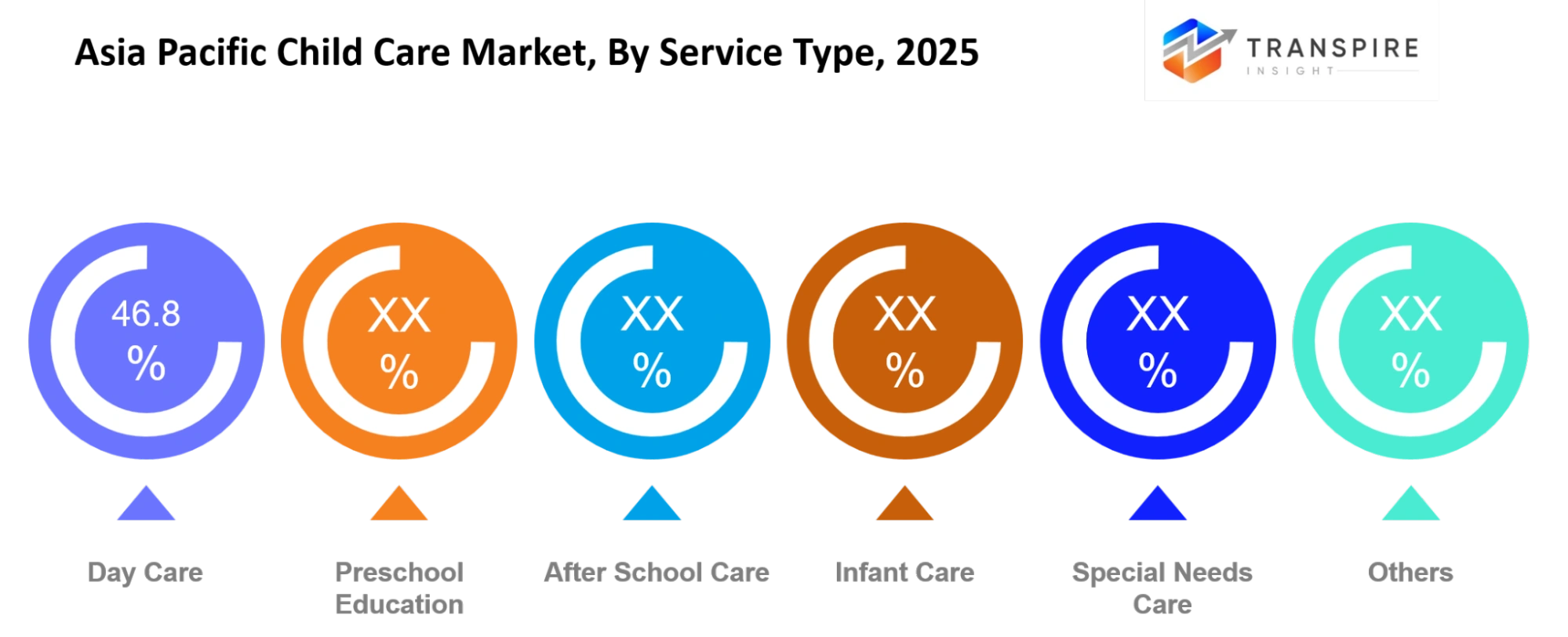
Day care services kinda focus on giving supervised care for children while parents are working, so families can handle the day to day stuff , but still have this safe, structured environment. Preschool education throws a bigger spotlight on early learning and things like social growth, communication skills, and getting kids ready for school via organized learning moments.
After-school care kinda follows school age children after their regular classes finish, by offering supervision, leisure activities , and a touch of academic support. Infant care is for very young children who need extra attention, plus feeding support and ongoing developmental monitoring. Special needs care goes for customized support for children facing physical, developmental, or learning hurdles. There are also other services like flexible care programs, holiday care, and community based childcare solutions that fit different family requirements.
To learn more about this report, Download Free Sample Report
By Provider Type :
Private centers run as standalone, or as part of a chain, and they function as childcare facilities with many options and learning programs. They often include adaptable schedules, more specialized educational activities, and modern facilities meant to match different parental expectations and childcare requirements. Public centers, on the other hand, are supported or managed by government authorities, and they try to improve childcare access for families.
Home based care happens inside a residential setting , usually with smaller groups of children. Corporate childcare services are created by employers, to help employees stay in the workforce and feel more steady overall. Other providers include nonprofit organizations, community groups, and faith based institutions, all of which offer childcare assistance across different local areas.
By Age Group :
Infants are basically the very youngest age group , and they really need ongoing watch, health monitoring, help with feeding and that early developmental push , all the time. Toddlers, on the other hand, tend to do better with structured routines, like more movement encouragement , more communication, small social moments , and beginner style learning tasks that match early childhood growth.
Preschoolers usually join programs that aim at foundational education, cognitive progress, creativity, and getting ready for actual schooling later. Then school age children often rely on childcare services either before school , after school , or during holidays, where there’s supervision plus extra enrichment stuff. Some other age brackets might include children who have specific developmental requirements or those in specialized childcare setups, made for particular stages of growth.
By End User :
Working parents show up as a big user group , because childcare lets them keep working while still making sure the child gets steady supervision, caring attention, and developmental support across the day. When childcare access is reliable, it helps keep work schedules stable, and it supports longer term career involvement too.
Single parents often lean on childcare services to juggle employment and family duties , especially when no extra household support is available. Corporates also make use of childcare options as part of employee support initiatives, which can help with retention, productivity, and that general sense of workplace comfort. Other end users, meaning guardians or sometimes extended family members, plus community organizations and institutions, might seek professional childcare arrangements so they can cover different caregiving requirements properly, without too many hiccups.
What are the Key Use Cases Driving the Asia Pacific Child Care Market?
The main thing that seems to drive adoption in the Asia Pacific Child Care Market is this sort of center-based childcare setup paired with early learning programs. Most working families depend on those services to keep kids safe and supervised, plus get developmental activities, and some educational preparation, all while they can stay full-time employed. In practice this particular use case generates the largest share of demand, largely because it covers both caring and learning needs in one place, kind of like a two in one solution.
After the usual childcare, you also see after-school programs and employer supported childcare services getting more common acceptance. School-age children increasingly join supervised learning and enrichment activities after regular school hours, not just waiting at home. Meanwhile, corporate childcare programs can help employers with workforce steadiness and employee retention too, so it’s not only about parents.
Some newer use cases include tech-enabled childcare models that fold in digital learning tools, developmental assessments , and parent engagement platforms. There are also specialized childcare programs for children with developmental needs, and those are getting more attention as governments and providers lean further into inclusive early childhood services, plus personalized learning support that actually fits the child.
|
Report Metrics |
Details |
|
Market size value in 2025 |
USD 128904.2 Million |
|
Market size value in 2026 |
USD 135094.6 Million |
|
Revenue forecast in 2033 |
USD 191386.5 Million |
|
Growth rate |
CAGR of 5.10% from 2026 to 2033 |
|
Base year |
2025 |
|
Historical data |
2021 - 2024 |
|
Forecast period |
2026 - 2033 |
|
Report coverage |
Revenue forecast, competitive landscape, growth factors, and trends |
|
Regional scope |
Asia Pacific (India, China, Japan, Australia, South Korea, Rest of Asia Pacific) |
|
Key company profiled |
Bright Horizons, KinderCare, Learning Care Group, G8 Education, Busy Bees, Goodstart Early Learning, Primrose Schools, KLAY, Maple Bear, MindChamps, EtonHouse, Safari Kid, Little Millennium, EuroKids, Goddard Systems. |
|
Customization scope |
Free report customization (country, regional & segment scope). Avail customized purchase options to meet your exact research needs. |
|
Report Segmentation |
By Service Type (Day Care, Preschool Education, After School Care, Infant Care, Special Needs Care, Others); By Provider Type (Private Centers, Public Centers, Home-Based Care, Corporate Childcare, Others); By Age Group (Infants, Toddlers, Preschoolers, School-Age Children, Others); By End User (Working Parents, Single Parents, Corporates, Others). |
Which Regions are Driving the Asia Pacific Child Care Market Growth?
East Asia still feels like the main region in the Asia Pacific Child Care Market , backed by a pretty extensive childcare infrastructure , really big urban populations and also pretty strong government involvement with early childhood development. In China , Japan , and South Korea, there are policies that basically push for easier childcare access, better workforce participation, and continuous quality enhancement across structured care networks . There are also public funding schemes, licensing guidelines, and curriculum expectations that help build trust in formal childcare. Plus there is a mature setup of private operators, educational institutions, and government- supported centers that keeps the regional lead going, even when things shift.
Oceania comes in as the second-largest contributor. Australia is the main revenue engine here. Compared with East Asia, the movement in this region is less about pure population size and more about high enrollment , adopting premium services, and having stable public support. Ongoing childcare subsidies, alongside regulatory oversight, set up a steadier operating climate for providers . Because households have solid spending power, and because people keep viewing early education as a long-term investment, the region stays a dependable source of market revenue.
South Asia is kinda emerging as the fastest-growing region, mostly pushed by India and also backed up by quick urban sprawl and shifting labor realities . Growth picked up further when more women moved into formal jobs and when employers started seeing childcare support as a pretty key workforce retention lever. Investments like organized childcare centers , digital sign-up platforms and early learning programs have helped widen the range of services across big cities. Between 2026 and 2033, this momentum should end up producing real, significant opportunities for operators, investors, and education-focused childcare providers trying to expand into underserved markets.
Who are the Key Players in the Asia Pacific Child Care Market and How Do They Compete?
Competition in the Asia Pacific child care market is still fairly moderately fragmented, like you see regional players, international childcare groups , plus nonprofit organizations all moving around with different service formats. What really drives it is mostly educational quality, how the curriculum is actually designed , plus access to services pricing structure and whether parents feel genuinely involved. The big providers tend to grow through multi-center networks, while the newer entrants usually try to stand out with specialized learning programs, technology integration , or maybe even a more premium childcare experience. Lately, market share gains seem to hinge on how well companies can bundle day care with developmental results they can measure.
MindChamps kinda sets itself apart with a learning framework rooted in research, one that leans heavily on cognitive development and school readiness. Its expansion plan is focused on franchise growth, and also rolling out premium preschool options in high-income urban areas. That way the brand can pull in families who are after structured educational outcomes , alongside the usual childcare support.
Busy Bees competes by pushing geographic diversification and doing acquisitions that increase operating scale across several countries. It gets a lot out of broad service coverage, plus the capacity to standardize quality practices across a large group of centers. Those strategic acquisitions also help reinforce local presence and they tend to improve operational efficiency at the same time.
Company List
- Bright Horizons
- KinderCare
- Learning Care Group
- G8 Education
- Busy Bees
- Goodstart Early Learning
- Primrose Schools
- KLAY
- Maple Bear
- MindChamps
- EtonHouse
- Safari Kid
- Little Millennium
- EuroKids
- Goddard Systems
Recent Development News
In December 2025, CuePilot AI secured funding of US$1.8 million. The investment will support expansion of its voice-first AI platform for preschools and daycare centers across India, Southeast Asia, and the Middle East, accelerating digital transformation in childcare operations.
Source: https://economictimes.indiatimes.com/
In January 2026, Asian Development Bank (ADB) entered a partnership with the International Development Research Centre (IDRC). The collaboration aims to advance scalable childcare service models in the Asia-Pacific region, supporting investment in accessible childcare infrastructure and workforce participation.
Source: https://www.adb.org/
What Strategic Insights Define the Future of the Asia Pacific Child Care Market?
Over the next five to seven years , the Asia Pacific Child Care Market is expected to drift toward a more integrated model that kind of mixed childcare , early education, workforce support and digital engagement. Under the hood, the main drive is the rising economic weight of labor force participation, especially for dual-income households, so governments and employers are basically nudged to handle childcare as essential social infrastructure—not really a take-it-or-leave-it discretionary service. In practice, this change will likely reward providers who can show steady educational outcomes while still offering more flexible care options.
There’s also a less obvious risk, kind of hiding in plain sight , workforce capacity constraints. Sure enrollment demand is expanding, but if there are shortages of qualified educators and caregivers , service availability can get squeezed. That would push up operating costs and maybe even delay center expansion in important urban markets. So even if growth projections stay strong , they could end up moving faster than the sector can realistically build enough staffing capacity.
On the other side, there’s an emerging opening: employer-linked childcare networks popping up in fast-growing markets like India and Southeast Asia. The groups that form partnerships with big employers and roll out technology-enabled childcare management platforms may be in a strong position to catch the next wave of demand. Market participants should really focus on scalable workforce development programs and technology investments that raise educator productivity , improve service quality, and strengthen parent engagement. At the same time, those investments need to help sustain expansion, not just promise it.
Asia Pacific Child Care Market Report Segmentation
By Service Type
- Day Care
- Preschool Education
- After School Care
- Infant Care
- Special Needs Care
By Provider Type
- Private Centers
- Public Centers
- Home-Based Care
- Corporate Childcare
By Age Group
- Infants
- Toddlers
- Preschoolers
- School-Age Children
By End User
- Working Parents
- Single Parents
- Corporates
Frequently Asked Questions
Find quick answers to common questions.
The Asia Pacific Child Care Market size is USD 191386.5 Million in 2033.
Key segments for the Asia Pacific Child Care Market are By Service Type (Day Care, Preschool Education, After School Care, Infant Care, Special Needs Care, Others); By Provider Type (Private Centers, Public Centers, Home-Based Care, Corporate Childcare, Others); By Age Group (Infants, Toddlers, Preschoolers, School-Age Children, Others); By End User (Working Parents, Single Parents, Corporates, Others).
Major Asia Pacific Child Care Market players are Bright Horizons, KinderCare, Learning Care Group, G8 Education, Busy Bees, Goodstart Early Learning, Primrose Schools, KLAY, Maple Bear, MindChamps, EtonHouse, Safari Kid, Little Millennium, EuroKids, Goddard Systems.
The Asia Pacific Child Care Market size is USD 128904.2 Million in 2025.
The Asia Pacific Child Care Market CAGR is 5.10% from 2026 to 2033.
- Bright Horizons
- KinderCare
- Learning Care Group
- G8 Education
- Busy Bees
- Goodstart Early Learning
- Primrose Schools
- KLAY
- Maple Bear
- MindChamps
- EtonHouse
- Safari Kid
- Little Millennium
- EuroKids
- Goddard Systems
About the Authors

Chetan Dhatrak
I’m Chetan Dhatrak, a Senior Research Analyst at Transpire Insight, specializing in the Consumer Goods, Foods and Beverages industry. I focus on analyzing market trends, consumer behavior, competitive landscapes, and industry developments to deliver accurate, data-driven insights. My research at Transpire Insight is built on credible sources and in-depth analysis, helping businesses and readers better understand market dynamics, emerging opportunities, and evolving consumer preferences. I’m committed to creating reliable, well-researched content that supports informed decision-making and reflects the latest developments in the consumer goods and food & beverage sectors.

Chakradhar Khansole
Chakradhar serves as the Research Director at Transpire Insight, bringing over 8 years of experience in technology, innovation, and strategic market intelligence. He specializes in transforming complex market data into actionable business insights that enable organizations to make informed, growth-oriented decisions. Recognized for his strategic vision and analytical expertise, Chakradhar leads high-impact research initiatives, delivering comprehensive market assessments, competitive intelligence, and forward-looking industry analysis.
Recently Published Reports
-
Apr 2026
Bottled Water Market
Bottled Water Market Size, Share & Analysis Report By Product Type (Still Bottled Water, Carbonated Bottled Water, Functional Bottled Water, and Others), By Packaging (PET, Cans, and Others), By Sales Channel (Supermarkets/Hypermarkets, Convenience Stores/Drug Stores, Grocery Stores/Club Stores, Foodservice, and Others) and Geography (North America, Europe, Asia-Pacific, Middle East and Africa, South and Central America), 2021 - 2032
-
Apr 2026
Color Cosmetic Packaging Market
Color Cosmetic Packaging Market Size, Share & Analysis Report By Application (Mascara Packaging, Liquid Packaging, and Liquid Face), By Type (Tubes & Bottles, Pens & Markers, Compacts & Containers, and Droppers & Pumps), and Geography (North America, Europe, Asia-Pacific, Middle East and Africa, South and Central America), 2021 - 2031
-
Apr 2026
External Microphone For Camera Market
External Microphone For Camera Market Size, Share & Analysis Report By Type (Shotgun Microphone, Lavalier Microphone, and Others), By Application (Digital Camera, Professional Video Camera, and Others), and Geography (North America, Europe, Asia-Pacific, Middle East and Africa, South and Central America), 2021 - 2031
-
Apr 2026
Foot Orthotic Insoles Market
Foot Orthotic Insoles Market Size, Share & Analysis Report By Type (Pre-fabricated, and Custom-made), By Material (Thermoplastic, Composite Carbon Fiber, and Others), By Distribution Channel (Drug Stores, Hospitals & Clinics, and Others), and Geography (North America, Europe, Asia-Pacific, Middle East and Africa, South and Central America), 2021 - 2031