

Europe Virtual Tour Software Market Summary
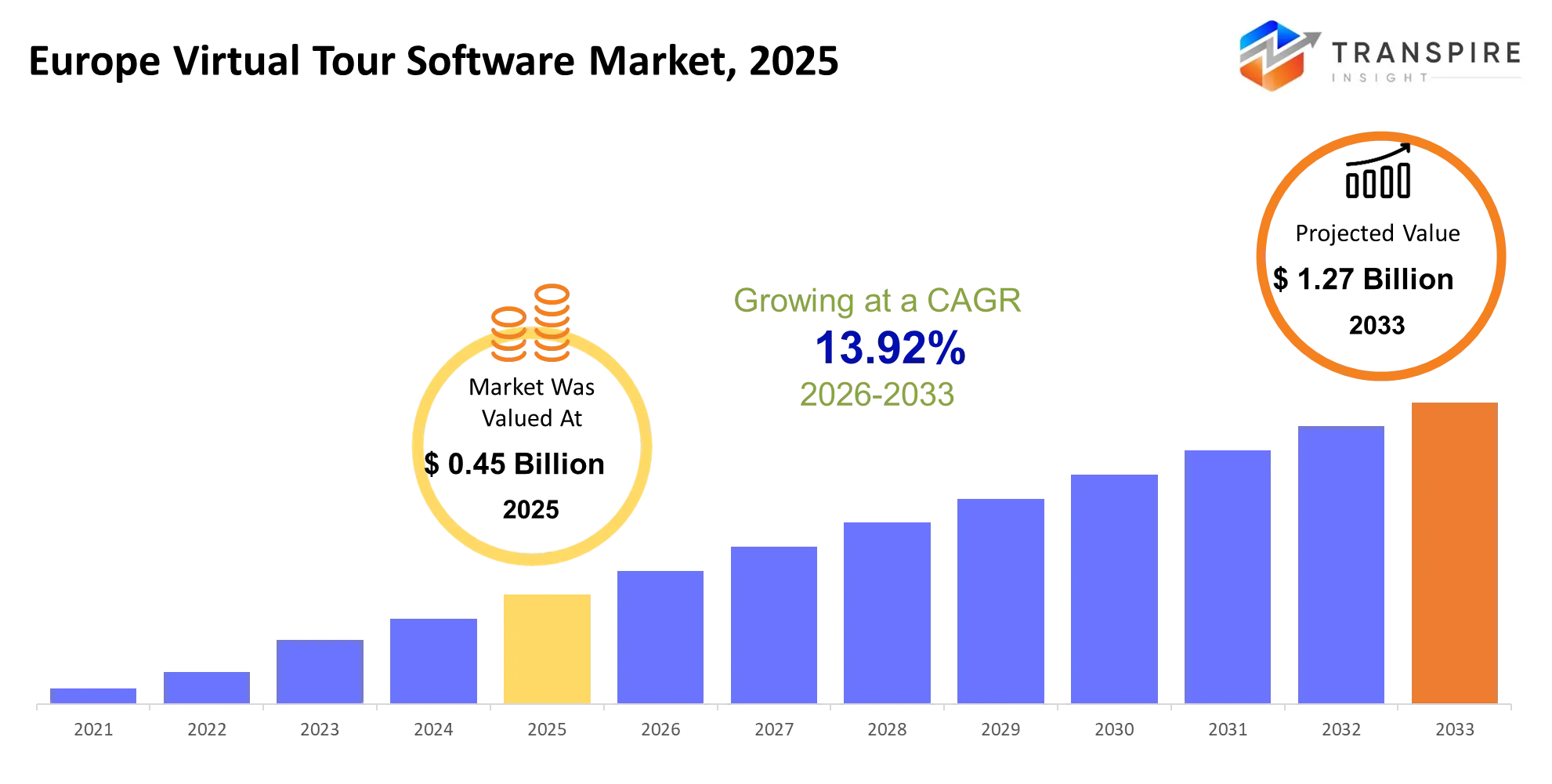
As per Transpire Insight Analysis the Europe Virtual Tour Software Market size is estimated at USD 0.45 Billion in 2025 and is anticipated to reach USD 1.27 Billion by 2033, growing at a CAGR of 13.92% from 2026 to 2033.
European firms use virtual tour software to show real places on a screen. People can look at homes, offices, hotels, museums, schools, shops, and event venues without going in person. Viewers, buyers, students, and guests can check details remotely and decide faster.
Many types of groups rely on these tours. Real estate offices use them to show listings. Hotels and tourism boards use them to attract travelers. Museums and universities share exhibits and campus spaces. Retailers and event planners also use immersive views to keep interest up and raise the chance of action.In the last few years, the tools have changed a lot. Early products focused on simple 360 views. Now many offer interactive 3D spaces, cloud hosting, virtual reality, and augmented reality. Some teams also use AI tools to help make tour content.
The pandemic made this shift happen sooner. When COVID-19 limited travel, viewing property, attending cultural events, and running classes moved online. Business gatherings also had to adapt, and virtual tours became more common.Better tools made it easier to roll out. New camera gear, improved phone cameras, stronger 3D modeling tools, and web based platforms reduced the work needed to start. This also helped vendors reach more clients with plans based on subscriptions. For businesses, the main benefit is clear. They can use remote sales support, digital promotion, visitor interaction, and virtual experiences at scale.
Europe Virtual Tour Software Market Size & Forecast:
- Europe Virtual Tour Software Market Size 2025: USD 0.45 Billion
- Expected Market Value 2033: USD 1.27 Billion
- Forecast CAGR: 13.92%
- Leading region in 2025: Not specified in the provided market data
- Fastest Growing region: Not specified in the provided market data
- Key Profile: Matterport, Kuula, 3DVista, CloudPano, Concept3D, EyeSpy360, My360, Pano2VR, Klapty, Roundme, Ricoh Tours, Google, Cupix, Nodalview, VPiX
Key Market Insights
- The market value is expected to go up. In 2025 it is USD 0.45 billion. By 2033 it could reach USD 1.27 billion. This growth tracks with more digital experiences being used.
- In Europe, buyers have changed what they ask for. They used to want simple panoramic tours. Now they lean toward interactive 3D spaces. They also want VR features. Spatial navigation matters more too. Multimedia content is richer than before.
- More firms are also using cloud tools. Cloud delivery is becoming more common. Teams want quicker rollouts. They want one place to manage content. Updates should be easier to push out. They also prefer less need for heavy infrastructure.
- Real estate still leads the uptake. Agents use immersive tours to help screen remote buyers. This can cut down on trips that do not need to happen.
- Tourism groups are digitizing activities as well. Many use virtual views before travelers go. People can preview attractions, heritage sites, museums, and full destinations first.
- Hotels are joining this shift too. More properties add immersive room and site tours to booking flows. Guests can check layouts before they reserve.
- Production is getting smoother with AI tools. AI can help process images. It can add tags on its own. Virtual staging is also being used. Content can be improved with less effort. This reduces manual work in tour creation.
- SaaS plans are helping smaller players join in. Pricing options make access easier for small agencies, retailers, museums, and hospitality operators. These groups used to face higher setup costs.
- Competition stays active among key vendors. Matterport, 3DVista, Kuula, CloudPano, and Cupix keep pushing forward. They compete with 3D capture. They also focus on browser based viewing. Integrations and analytics matter. They market immersive content features as well.
- Use is spreading beyond pure marketing. Adoption is now seen in training. It also shows up in education, virtual events, and facility records. Some teams use it for customer support. Others use it for remote property checks.
What are the Key Drivers, Restraints, and Opportunities in the Europe Virtual Tour Software Market?
Driver: A big pull for this market is the move to digital-first journeys in real estate, hospitality, tourism, education, and cultural spaces. COVID-19 sped up remote property viewings, online exhibit visits, digital trip planning, and virtual events. Many groups then treated immersive software as a usable engagement option, not just a test for marketing. Since then, better 360 cameras, newer phones, cloud services, and web based rendering have lowered the effort to make and share content. Subscription plans also help smaller groups launch virtual tours without large upfront spending. That widens the customer set and supports steady software income.
Restraint: Still, making strong virtual tours takes real work. Teams need camera setups that match the workflow, solid spatial capture, skilled editing, enough hosting, and ongoing updates. Smaller groups may hit tight budgets when they need advanced 3D work, VR features, analytics, or links to other systems. If teams use separate tools for parts of the job, the handoffs can slow things down. That can hurt take up for groups that want a straightforward digital setup.
Opportunity: There is a clear chance here with AI aided tour making. AI can help improve images, spot objects, add virtual staging, label navigation, translate text, and draft tour content. In Europe, real estate agencies show a strong use case. AI enabled steps can cut down on manual prep time. It also helps agencies with bigger property lists deliver immersive digital coverage more consistently.
What Has the Impact of Artificial Intelligence Been on the Europe Virtual Tour Software Market?
AI is reshaping virtual tour tools. It cuts down the work people used to do when they made, sorted, and customized immersive spaces. With AI image help, photos can look cleaner and more even. Panoramas can be improved. Lighting can be adjusted. Mismatched visuals can be fixed. Stuff that should not be in the scene can be removed. The same tools can also get the captured material ready for posting online.
In real estate, AI can virtually stage rooms. Empty spaces can be filled with furniture on a screen. It can also tag images and spot objects, which may help visitors find rooms faster. People may also be able to notice features and areas more easily. On top of that, machine learning can watch how visitors move through a tour. It can track which rooms are opened, the routes taken, how long someone stays, and what seems to hold attention. Teams can then adjust layouts and improve digital ads.
Other 3D tools link tours to digital twins, spatial data, and interactive maps. This can make remote reviews of properties easier. It can also support marketing for hotels and venues. Museums may be able to offer better visitor experiences. Facility records can be kept with less repeated on site work. AI language support can also help with translation and draft text for readers in multiple European languages, without writing every line from scratch.
Still, using AI is not simple all the time. Costs for setup can be high. Image output can vary in quality. Some platforms use formats that do not always match. There can be errors too, especially when spaces are complex and the system guesses. Teams also need a steady check step to review AI output before it goes live. This is especially important for business listings and for accurate building or site details.
Key Market Trends
- After 2020, more real estate firms began using remote previews. Some teams cut back on early in-person visits and switched to immersive digital views.
- In the last few years, 360-degree photos did not stay the same. They have turned into interactive 3D scenes. That change helps people move around and understand space better.
- Starting in 2021, cloud tools picked up speed. They make it easier to host content, refresh updates, work with others, and roll out the same setup across several locations.
- AI use also rose fast. Teams now rely on tools for image cleanup, virtual staging, labels, and content drafts. This can lower the amount of manual work needed to produce materials.
- In hospitality, tours are showing up more often in booking paths. Guests can look at rooms and shared spaces before they make a reservation.
- Tourism groups have broadened their online efforts too. Instead of only using promotional visuals, they now offer hands-on exploration for heritage sites, attractions, museums, and full destinations.
- SaaS pricing has helped smaller groups join in. With fewer upfront costs for servers and setup, agencies, stores, schools, and cultural organizations can adopt these tools.
- 3D digital twins are starting to matter more. Companies link tours with location data, building notes, tracking, and day-to-day use in operations.
- Competition is no longer just about the images. Strategies now lean on links between tools, analytics, mobile capture, browser support, AI features, and workflows that fit each sector.
- Virtual tours have also moved past simple promotion. They are now used for training, classes, events, remote checks, customer help, and record keeping for sites.
Europe Virtual Tour Software Market Segmentation
By Type:
Panoramic Tour Software helps you look around a place in one full view. It is used for homes, hotels, travel sites, and shops. Virtual Reality Tour Software works with a headset. It gives a deep, guided look for trips, lessons, museum visits, and property demos
Augmented Reality Tour Software places extra details over the real scene. It is used in museums, travel, stores, and training.Interactive Tour Software adds buttons and links. It also includes video, moving around, forms, and info panels. This can keep people engaged and help with leads.3D Virtual Tour Software builds a clear digital space. It supports property ads, hospitality needs, on site planning views, and digital twin work.
Web Based Tour Software lets people open the tour in a browser. No special app is needed.Immersive Tour Platforms bring together 3D space, media, directions, data tracking, and other connections.Virtual Event Tour Software makes online venues for shows and talks. It also fits product launches and visits from remote users.
By Application:
Real Estate helps with remote property viewings. It also supports lead checking and talks with buyers from other countries.Tourism shows places to visit online. It highlights landmarks and historic sites. It also shares attractions in digital form.Hospitality offers room tours and space tours. These help guests decide what to book.Museums bring shows to people at a distance. Visitors can explore exhibits and collections from home.Education supports campus walking online. It helps with orientation, training, and classes that work remotely.
Retail can display shops, items, and showrooms online. It can also present branded spaces in a digital format.Automotive delivers interactive vehicle views. It covers features, options, and dealer presentations.Events build digital spaces for public programs. These include exhibitions, talks, launches, and other promos.Real estate and hospitality still matter a lot in business use. Tourism, museums, education, retail, automotive, and events can also grow through online customer interactions.
By Deployment:
Cloud hosting keeps things in one place. You can reach it from anywhere. Updates go out faster. It can also scale when demand jumps. On-premise runs on your own hardware. You can manage the setup directly. It fits when security rules are very specific. SaaS is paid by subscription. You do not need a big upfront budget.
Web-based tools work in a browser. No install is needed on your device. Mobile-based options work on phones and tablets. Users can access the virtual experience from these devices. Hybrid uses cloud services plus local systems. This gives you some room to grow and some control. Private cloud uses dedicated infrastructure. It offers stronger access control and more control over data. Public cloud runs on shared, scalable hosting. It is easier to reach for a wide audience. Cloud, SaaS, and web-based options make rollout simpler. On-premise, private cloud, and hybrid setups fit groups that want tighter control over their infrastructure.
By Technology:
360-Degree Imaging lets you record wide views of a place for real estate, travel, hotels, museums, and shops. Virtual Reality uses a headset to show an immersive scene for learning, travel, museum visits, and property previews. Augmented Reality puts added digital details onto what you can already see in the real world.
3D Modeling makes detailed digital spaces for viewing and for digital twin work. Photogrammetry turns many photos into a 3D space model. AI can improve images, help with virtual staging, add tags on its own, generate content, translate text, and personalize what people see. Interactive Maps make it easier to get around homes, schools, museum halls, and event sites. Spatial Audio adds sound from different directions to make the experience feel more real.Overall, the direction is toward combined digital environments, not just simple image capture.
By End User:
Real estate agents can use virtual tours so people can view homes from far away. They can also check fit and interest. For buyers in other countries, these tours help with outreach.Hotels can show rooms and amenities with virtual views. This can help guests decide before they book.Tourism boards can share whole destinations. They can highlight things to do, local sites, and historic places. They can also point to visitor activities.Museums can give digital access to exhibitions. People can explore collections without being on site.Universities can promote campuses with virtual content. They can use it for student recruiting and onboarding. It can also support remote exploration for those who cannot visit.Retailers can set up virtual shops and showrooms. They can also build branded areas for online browsing.
Automotive dealers can display cars through virtual tours. They can cover features, add-ons, and dealer facilities remotely.Event organizers can create virtual venues. These can be used for trade shows, conferences, launches, and group events. They can also support remote attendance and online networking.For end users, immersive tools can be used for set business aims. These aims may include higher conversion, deeper visitor interest, recruitment efforts, product discovery, and remote participation.
By Region:
United Kingdom helps adoption in real estate, hotels, tourism, museums, schools, and live events. Germany creates chances via digital change, property tech, tourism, education, and business apps. France backs tourism, hotels, cultural groups, real estate, shops, and museums. Spain gains value from tourism and hotel software aimed at people abroad. Italy opens doors in cultural heritage, tourism, hotels, real estate, and museum work. The Netherlands supports property, tourism, education, retail, and digital business tools. Switzerland offers work in hotels, tourism, real estate, education, and top tier guest service. Austria supports tourism, hotels, cultural groups, education, and real estate promotion. How much gets adopted depends on how busy tourism is, how much tech money is spent, how fast property gets digitized, and what cultural assets exist.
What are the Key Use Cases Driving the Europe Virtual Tour Software Market?
Real estate is a top fit for virtual reality because agents can show houses, offices, and other commercial spaces to buyers who are not nearby. People can get a clear look first, then decide if they should schedule an in-person visit. This kind of viewing can speed up early checks. It also helps when sellers market to buyers in other countries and travel is hard at the start. Hotels do something similar with room and building tours. Those tours help guests feel ready before they book.
Tourism groups and museums are also pushing new online experiences. They create digital previews of places, let people explore history in a virtual way, and host online shows. Some teams also run hands on cultural activities through the screen. Schools are using comparable tools too. They offer campus tours, support student recruiting, run onboarding, and keep in touch with students who are far away. Retail shops and car dealers are following this trend as well. They use immersive showrooms to display stores, cars, products, and themed brand spaces on digital platforms.
More ideas are showing up too. These include virtual spaces for events, digital replicas of real sites, and remote documentation for facilities. There are also AI supported immersive environments that can make experiences feel more tailored. Event platforms can host fairs and conferences without forcing everyone to travel. Digital twins can link visual views of a space with real operating details. AI tools can help with translation, virtual staging, content labeling, and guided navigation for each user. These additions are expected to broaden use in the coming period.
|
Report Metrics |
Details |
|
Market size value in 2025 |
USD 0.45 Billion |
|
Market size value in 2026 |
USD 0.51 Billion |
|
Revenue forecast in 2033 |
USD 1.27 Billion |
|
Growth rate |
CAGR of 13.92% from 2026 to 2033 |
|
Base year |
2025 |
|
Historical data |
2021 - 2024 |
|
Forecast period |
2026 - 2033 |
|
Report coverage |
Revenue forecast, competitive landscape, growth factors, and trends |
|
Regional scope |
Europe |
|
Key company profiled |
Matterport, Kuula, 3DVista, CloudPano, Concept3D, EyeSpy360, My360, Pano2VR, Klapty, Roundme, Ricoh Tours, Google, Cupix, Nodalview, VPiX |
|
Customization scope |
Free report customization (country, regional & segment scope). Avail customized purchase options to meet your exact research needs. |
|
Report Segmentation |
By Type (360-Degree Tour Software, VR Tour Software, AR Tour Software, Interactive Tour Software, 3D Virtual Tour Software, Web-Based Tour Software, Immersive Tour Platforms, Virtual Event Tour Software); By Application (Real Estate, Tourism, Hospitality, Museums, Education, Retail, Automotive, Events); By Deployment (Cloud-Based, On-Premise, SaaS, Web-Based, Mobile-Based, Hybrid, Private Cloud, Public Cloud); By Technology (360-Degree Imaging, Virtual Reality, Augmented Reality, 3D Modeling, Photogrammetry, AI, Interactive Maps, Spatial Audio); By End User (Real Estate Agents, Hotels, Tourism Boards, Museums, Universities, Retailers, Automotive Dealers, Event Organizers); By Region (UK, Germany, France, Spain, Italy, Netherlands, Switzerland, Austria) |
Which Regions are Driving the Europe Virtual Tour Software Market Growth?
Germany is at the front of the Europe virtual tour software market. The tools are being taken up in real estate, auto firms, schools, tourism, and industry. One market study points to Germany as the biggest country in sales. The logic is simple: there are many types of buyers, and they want more lifelike views of buildings and spaces. Germany also has a well developed tech scene. Many local companies already use digital viewing to keep clients engaged and to support remote access. With wide company use, more digitized properties, and ongoing tech spending, Germany has a solid base for steady income.
The United Kingdom is another key part of the market. Still, its pace looks different from Germany. Growth in the UK leans more toward services. Hotels, travel sites, schools, and property owners all show steady interest in tours that let people explore spaces and places. The UK is forecast to grow at a 28.6% CAGR from 2024 to 2031. That suggests buyers are using these tools in more areas than just standard real estate. The country also has a wide digital economy and a strong creative tech industry. That helps keep demand for software and for paid virtual tour support.
France is seen as the quickest among the large countries. The outlook calls for a 30.7% CAGR from 2024 to 2031. Much of this comes from France’s tourism setup and its many cultural sites. The hospitality industry plays a role too. More groups are also using immersive options for museums and heritage places. French organizations can use virtual tours to draw in visitors from other countries. They can also cut back on the need for in person visits when people are first learning about a site.
Who are the Key Players in the Europe Virtual Tour Software Market and How Do They Compete?
The market still feels split. Many software firms stand apart in how fast you can make tours. They also compete on 3D digital twin quality, how much you can customize, the cost, analytics, and niche workflows for specific industries
Matterport is known for high-detail 3D digital twins. It has also pushed its reach in property tech. This ties to its link with CoStar Group, which finished buying Matterport in February 2025.
3DVista goes a different way. It uses a one-time license. It also includes advanced 3D models and works with VR. You can add interactive hotspots. It supports offline publishing and live guided tours, so you do not have to rely as much on ongoing subscription fees.
Kuula aims for simple tour building. It also rolls out updates often. Recent items include 32K image support. It supports multi-file uploads too. Tour editing was redesigned. Navigation tools were expanded as well.
CloudPano leans into flexibility and lower cost. It highlights custom branding and multimedia content. It also offers integrations and works across real estate, education, and industrial uses.
Nodalview focuses more on the real estate workflow. It combines property visuals with virtual tours. It adds lead generation and guided viewing. Its 2026 partnership with PriceHubble is meant to join immersive content with property data services.
Company List
- Matterport
- Kuula
- 3DVista
- CloudPano
- Concept3D
- EyeSpy360
- My360
- Pano2VR
- Klapty
- Roundme
- Ricoh Tours
- Cupix
- Nodalview
- VPiX
Recent Development News
- "In February 2025, CoStar Group completed its acquisition of Matterport. The transaction combines Matterport's 3D digital twin technology with CoStar's property-data ecosystem, strengthening the use of AI and spatial technology across real estate applications. https://matterport.com/es/news/costar-group-completes-acquisition-of-matterport-ushering-in-a-new-era-of-3d ([Matterport])."
- "In May 2025, 3DVista launched a redesigned app for desktop, mobile, and VR devices. The unified application improves access, performance, and workflow management for creators using virtual tours across multiple devices. https://www.3dvista.com/en/blog/discover-the-new-3dvista-app/ ([3DVista])."
- "In January 2026, Nodalview teamed up with PriceHubble to connect immersive property marketing with property-data services. The partnership gives real estate professionals a broader digital toolkit by combining Nodalview's visual content and virtual tours with PriceHubble's property insights. https://nodalview.com/blog/real-estate-revolution-nodalview-teams-up-with-pricehubble-to-elevate-your-services ([Nodalview])."
What Strategic Insights Define the Future of the Europe Virtual Tour Software Market?
Europe’s virtual tour software market is shifting. It is moving away from simple stand alone 360 viewing. More products now aim to work as full spatial platforms. These platforms bundle virtual tours with 3D models, AI tools, analytics, property data, and ways to interact. The main change is about purpose. Virtual tours are no longer only marketing media. They are becoming digital assets that help with sales, training, facility work, education, and remote teamwork.
There is also a risk that is easy to miss. Other tech could replace parts of the older tour tools. Generative 3D, Gaussian splatting, AI made scenes, and better phone capture can make standard tour software look less unique. At the same time, there is a chance to grow. Some firms can link virtual tours with property intelligence. This can matter for real estate platforms. It can support steps like automatic valuation, better lead checks, and more engaging listing pages.
Companies in the market should focus on practical goals. They should build for open connections. They should support AI help for making content. They should keep device options flexible. They should also make workflows that fit each vertical. Competing only on the sharpness of panoramic images or on subscription cost may not be enough. 3DVista’s move toward 3D models and Gaussian Splatting shows where the tools are headed.
Europe Virtual Tour Software Market Report Segmentation
By Type
- 360-Degree Tour Software
- VR Tour Software
- AR Tour Software
- Interactive Tour Software
- 3D Virtual Tour Software
- Web-Based Tour Software
- Immersive Tour Platforms
- Virtual Event Tour Software
By Application
- Real Estate
- Tourism
- Hospitality
- Museums
- Education
- Retail
- Automotive
- Events
By Deployment
- Cloud-Based
- On-Premise
- SaaS
- Web-Based
- Mobile-Based
- Hybrid
- Private Cloud
- Public Cloud
By Technology
- 360-Degree Imaging
- Virtual Reality
- Augmented Reality
- 3D Modeling
- Photogrammetry
- AI
- Interactive Maps
- Spatial Audio
By End User
- Real Estate Agents
- Hotels
- Tourism Boards
- Museums
- Universities
- Retailers
- Automotive Dealers
- Event Organizers
By Region
- UK
- Germany
- France
- Spain
- Italy
- Netherlands
- Switzerland
- Austria
Frequently Asked Questions
Find quick answers to common questions.
The expected Europe Virtual Tour Software Market size for the market will be USD 1.27 Billion in 2033.
Key segments for the Europe Virtual Tour Software Market are By Type (360-Degree Tour Software, VR Tour Software, AR Tour Software, Interactive Tour Software, 3D Virtual Tour Software, Web-Based Tour Software, Immersive Tour Platforms, Virtual Event Tour Software); By Application (Real Estate, Tourism, Hospitality, Museums, Education, Retail, Automotive, Events); By Deployment (Cloud-Based, On-Premise, SaaS, Web-Based, Mobile-Based, Hybrid, Private Cloud, Public Cloud); By Technology (360-Degree Imaging, Virtual Reality, Augmented Reality, 3D Modeling, Photogrammetry, AI, Interactive Maps, Spatial Audio); By End User (Real Estate Agents, Hotels, Tourism Boards, Museums, Universities, Retailers, Automotive Dealers, Event Organizers); By Region (UK, Germany, France, Spain, Italy, Netherlands, Switzerland, Austria).
Major Europe Virtual Tour Software Market players are Matterport, Kuula, 3DVista, CloudPano, Concept3D, EyeSpy360, My360, Pano2VR, Klapty, Roundme, Ricoh Tours, Google, Cupix, Nodalview, VPiX.
The Europe Virtual Tour Software Market size is USD 0.45 Billion in 2025.
The Europe Virtual Tour Software Market CAGR is 13.92% from 2026 to 2033.
- Matterport
- Kuula
- 3DVista
- CloudPano
- Concept3D
- EyeSpy360
- My360
- Pano2VR
- Klapty
- Roundme
- Ricoh Tours
- Cupix
- Nodalview
- VPiX
About the Authors

Mayur Shinde
I am Mayur Shinde, a Senior Research Analyst at Transpire Insight, specializing in the Automotive & Transportation and Information & Communication Technology (ICT) Industry. My work focuses on analyzing emerging market trends, technological advancements, competitive landscapes, and industry developments to deliver accurate, data-driven insights. I am passionate about transforming complex market information into clear, actionable content that helps businesses, professionals, and decision-makers stay informed and make confident strategic decisions.

Chakradhar Khansole
Chakradhar serves as the Research Director at Transpire Insight, bringing over 8 years of experience in technology, innovation, and strategic market intelligence. He specializes in transforming complex market data into actionable business insights that enable organizations to make informed, growth-oriented decisions. Recognized for his strategic vision and analytical expertise, Chakradhar leads high-impact research initiatives, delivering comprehensive market assessments, competitive intelligence, and forward-looking industry analysis.
Recently Published Reports
-
Apr 2026
3D Optical Profiler Market
3D Optical Profiler Market Size, Share & Analysis Report By Type (Desktop 3D Optical Profiler, and Portable 3D Optical Profiler), By Technology (Confocal Technology, and White Light Interference), By End-Use Industry (Manufacturing, Research Institutions, Automotive, Aerospace and Defense, Medical Devices, and Other), and Geography (North America, Europe, Asia-Pacific, Middle East and Africa, South and Central America), 2021 - 2031
-
Apr 2026
Depth Sensor Market
Depth Sensor Market Size, Share & Analysis Report By Type (Infrared Depth Sensors, Time-of-Flight (ToF) Sensors, Stereo Vision Sensors, Structured Light Sensors, Ultrasonic Depth Sensors), By Application (Automotive, Robotics, Gaming, Consumer Electronics, Industrial Automation, Healthcare, Security & Surveillance, Others), By End Users (Automotive Manufacturers, Consumer Electronics Companies, Healthcare Providers, Industrial Companies, Security Agencies, Gaming Companies, Robotics Companies, Others), and Geography (North America, Europe, Asia-Pacific, Middle East and Africa, South and Central America), 2021 – 2031
-
Apr 2026
Digital Manufacturing Market
Digital Manufacturing Market Size, Share & Analysis Report By Component (Hardware, Software, and Services), By Technology (Robotics, 3D Printing, Internet of Things (IoT), and Others), By Application (Automotive and Transportation, Aerospace and Defense, Consumer Electronics, Industrial Machinery, and Others), By Process Type (Computer-Based Designing, Computer-Based Simulation, Computer 3D Visualization, Analytics, and Others), and Geography (North America, Europe, Asia-Pacific, Middle East and Africa, South and Central America), 2021 – 2031
-
Apr 2026
Digital Visa Services Market
Digital Visa Services Market Size, Share & Analysis Report By Type (Individual Travelers, Group Travelers), By Application (Tourism, Business Travel, Others), and Geography (North America, Europe, Asia-Pacific, Middle East and Africa, South and Central America), 2021 – 2031