
Asia Pacific Virtual Reality (VR) Market Size & Forecast:
- Asia Pacific Virtual Reality (VR) Market Size 2025: USD 38.47 Billion
- Asia Pacific Virtual Reality (VR) Market Size 2033: USD 334.72 Billion
- Asia Pacific Virtual Reality (VR) Market CAGR: 31.06%
- Asia Pacific Virtual Reality (VR) Market Segments: By Device Type (Standalone VR Headsets, PC-Based VR, Console VR, Mobile VR, Tethered VR, Wireless VR, Mixed Reality Headsets, Others); By Application (Gaming, Healthcare, Education, Manufacturing, Real Estate, Retail, Defense & Aerospace, Others); By End User (Consumers, Enterprises, Educational Institutions, Healthcare Providers, Government Agencies, Defense Organizations, Others); By Technology (Immersive VR, Semi-Immersive VR, Non-Immersive VR, 3D Visualization, Motion Tracking, Haptic Feedback, Spatial Computing, Others).
Asia Pacific Virtual Reality (VR) Market Summary
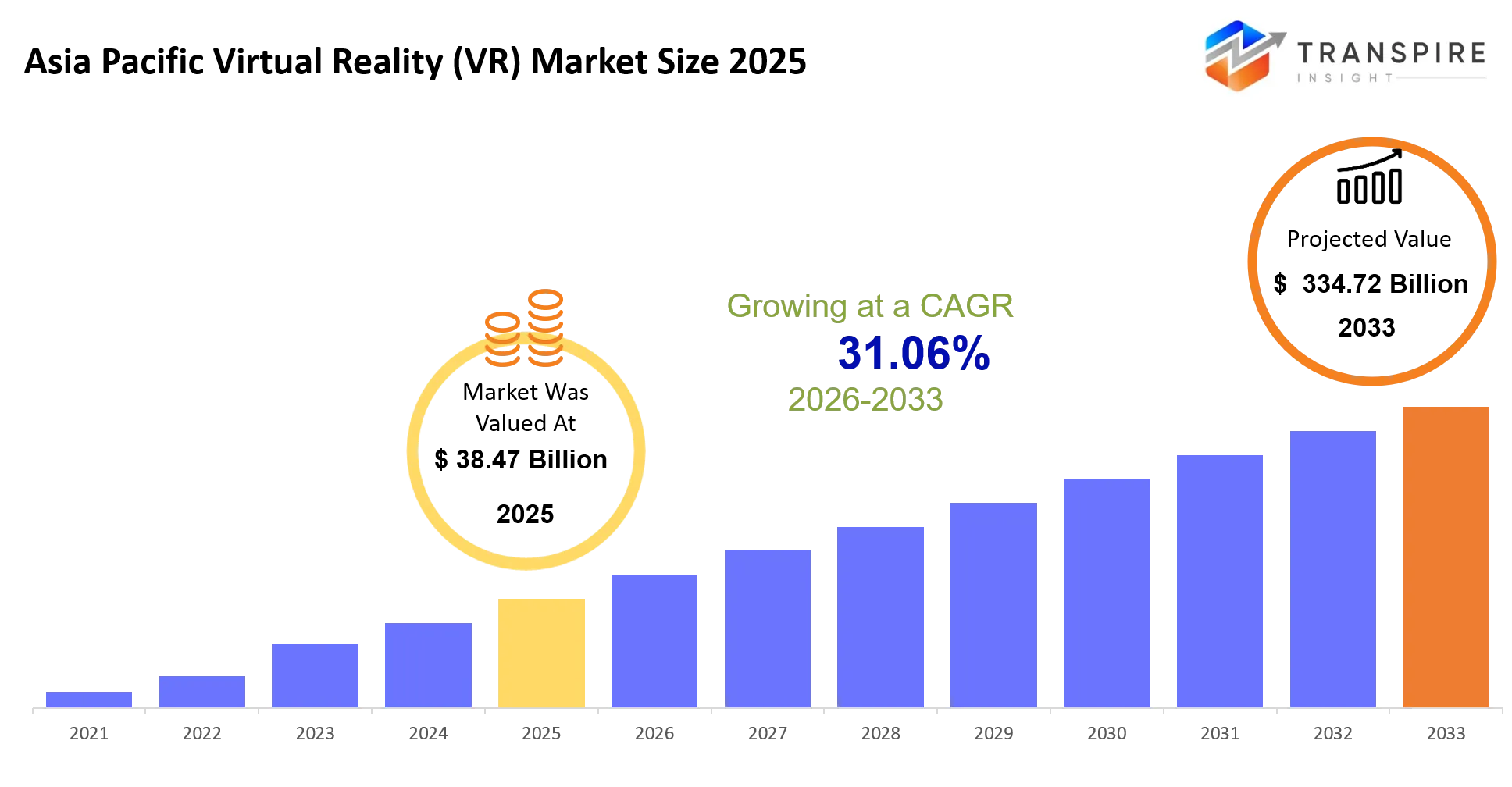
The Asia Pacific Virtual Reality (VR) Market was valued at USD 38.47 Billion in 2025. It is forecast to reach USD 334.72 Billion by 2033. That is a CAGR of 31.06% over the period.
The Asia Pacific Virtual Reality Market is an important online place for people to interact with each other and things in a very realistic way. This is used for things like learning, simulating things, visualizing things, training, having fun and working together across different types of businesses. Virtual reality technology lets people use computers to create worlds that help people learn better, work more efficiently, design new products and have a really good time.
Lots of companies are now using Reality to save money on training, make their workplaces safer and make decisions faster in complicated situations.
In the five years the Asia Pacific Virtual Reality Market has changed a lot. It used to be about games but now it is also used by companies and industries. Virtual Reality technology has gotten better with things like headsets, computers that can understand spaces and ways to send content over the internet. This has helped companies in healthcare, education, manufacturing and defense use Reality more. When the pandemic happened people started using technology to work from different places and this made companies invest more in Virtual Reality. Now that the cost of Virtual Reality equipment is going down and there is content available, companies are using Virtual Reality every day, which means people who make software, hardware and services for Virtual Reality can make money over and over again in the Asia Pacific region.
Key Market Insights
- East Asia has a part of the market because it has strong companies that make electronics and good digital systems.
- South Asia is going to be the region that grows the fastest until 2033. This is because many companies are using new digital technology.
- People like to use VR headsets because they are cheap and easy to carry around and they are also easy to set up.
- Mixed reality headsets are becoming very popular fast and this is because companies are finding new ways to use them.
- The biggest use of Reality is for gaming and this is because esports and entertainment are getting more popular.
- Hospitals are starting to use Reality for helping patients, teaching doctors and planning surgeries so the use of Virtual Reality in healthcare is growing very fast.
- Most of the money made from Reality comes from people who use it at home but companies are starting to use it more and more and this is going to keep growing.
- Many companies that make Virtual Reality technology are working on making environments that're very realistic and can understand what people are doing.
- Companies that make hardware are working with companies that make software. This is helping to make more content for Virtual Reality.
- Companies are competing with each other by making better hardware and by making platforms for developers and by offering services to companies and by making different kinds of content and all of these things are related to Virtual Reality.
What are the Key Drivers, Restraints, and Opportunities in the Asia Pacific Virtual Reality (VR) Market?
Driver
The biggest Driver comes from companies trying to change the way they do things with technology in areas like making things taking care of people, education and defense.These companies need training programs that really work and do not cost much so they can keep their workers knowledgeable and working well.New and better equipment, graphics and tools that let people work together over the internet have made it possible for companies to use virtual reality in a bigger way.As companies try to get better at what they do they are using reality more and more in important parts of their work.
Restraints
One thing that is holding this back is the Restraint.The cost of equipment and how hard it is to make content are problems.Good virtual reality systems are expensive and need a lot of money for special equipment making software putting it all together and teaching workers how to use it.Making content for companies and professionals needs skills, which makes it cost more.These problems mean that smaller companies are not using reality as much and it is taking longer for some areas to start using it.
Opportunities
There is a chance for companies that work with virtual reality and this is the Opportunity.When virtual reality works with technologies, like artificial intelligence digital copies of things and systems that can collect and analyze data, new ways to use it appear in areas like making things taking care of people and smart cities.Using copies of things helping machines from far away and working together in a virtual world are expected to create many new business opportunities.Companies that invest in virtual reality and related technologies may get ahead of their competitors.The Driver of all this change is still the thing that is making companies adopt virtual reality.The Driver is what makes companies want to use reality in the first place.
What Has the Impact of Artificial Intelligence Been on the Asia Pacific Virtual Reality (VR) Market?
Artificial intelligence is really changing the way virtual reality platforms work. It is making the content better, letting people have their experiences and making sure everything runs smoothly. Artificial intelligence systems can automatically create worlds, make sure they look good and give people what they want based on what they do. Schools and training places are using intelligence to make learning more fun and helpful in virtual reality.
Computer programs are getting better at tracking movement, recognizing gestures and responding to what's happening. In factories and other places where things are made artificial intelligence is used to simulate what might happen so people can practice fixing things and making processes better. Artificial intelligence is also used to create copies of real things. Doctors and hospitals are using virtual reality systems to help people get better, feel less stressed and plan for surgery. All of this makes things work better, saves money on training and makes simulations feel more real.
There are some problems with using artificial intelligence in virtual reality. It needs a lot of power to work. Can be expensive to set up. People are also worried about keeping their information safe. Some virtual reality applications that use intelligence need a lot of power and special knowledge to work. There is not good information to help artificial intelligence work well in some complicated situations, which makes it hard to use in some cases.
Key Market Trends
- Standalone headset shipments are going up. This is because users want to be able to move around. They also want options and simple setup.
- Mixed reality solutions are becoming more popular. This happened after more businesses started using them for more than gaming.
- Companies that make things are using twins. They combine these with visualization platforms.
- Hospitals are using VR to help patients rehab and get therapy. This is happening in cities.
- Schools are using immersive learning environments. This helps students develop skills.
- AI is helping create content. It is used for environments and training simulations.
- Defense groups are investing more in VR. They use it to prepare for missions and train.
- Retailers are creating shopping experiences. This helps customers engage more and see products better.
- Spatial computing is a focus for tech companies and investors.
- Different industries are working together. This is helping develop ecosystems and make more content available.
Asia Pacific Virtual Reality (VR) Market Segmentation
By Device Type
Standalone VR headsets are the most popular choice because they are easy to use and do not need extra computers.These headsets are becoming better with longer battery life, faster speeds, and clearer screens.Companies like standalone headsets because they cost less to set up and take care of.PC-based VR is used when you need super high-quality graphics and a lot of computer power.Engineering, design, and advanced training use PC-based VR for the best look and feel.Console VR connects to video game systems to bring immersive play to regular homes.
Growth in console VR depends on people buying new consoles and developers making exclusive games.Mobile VR is the cheapest option because it uses a phone inside a headset wrapper.Mobile VR is shifting to standalone systems but stays popular for beginners and classrooms.
By Application
Gaming is where the money is in the virtual reality market. This is because people really love playing with people and competing in esports.Game makers are always putting money into virtual reality by creating special games with action that feels real.Healthcare is another place where virtual reality is used. It helps patients get better, teaches doctors things and lets them plan surgeries without any risk.Medical clinics like using reality because it has been shown to really help patients recover faster.Schools are also using reality.
This is so students can learn about science and engineering by doing things.Learning in reality helps students remember things better, than just reading about them in a book.Factories use reality to teach workers how to do things safely and to design products before they are built.Big companies are getting upgrades and this is why more factories are buying virtual reality tools. Virtual reality is really changing the way factories work.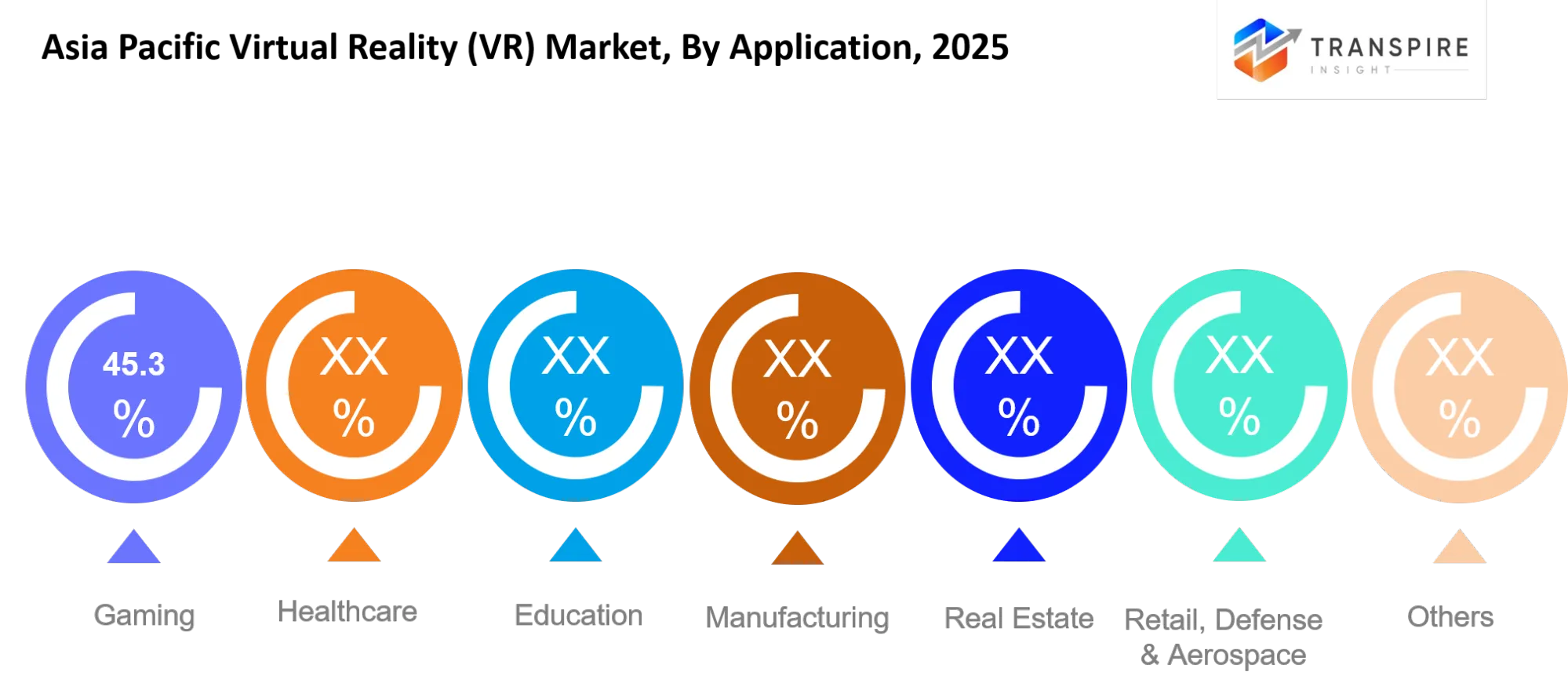
By End User
Everyday consumers represent the largest consumer base in the virtual reality industry owing to the proliferation of various gaming, health, entertainment, and social VR apps. Consumers have taken up VR headsets not only due to the immersive gameplay but also because of other uses such as virtual fitness and socialization that cannot be achieved with ordinary devices. The emergence of relatively inexpensive virtual reality hardware has been contributing to further expanding the target audience of VR devices.
As for end users, businesses appear to be the fastest-growing segment due to the recognition of the benefits of using VR for training and collaboration purposes. Organizations purchase VR technologies for conducting training sessions for their employees, collaborating with remote colleagues, demonstrating products, and simulating various operations.
By Technology
Immersive VR continues to be the most prevalent type of technology due to the creation of an entirely digital environment that enhances the realism of experiences for users. Immersive VR can be seen across different industries ranging from gaming, education, healthcare, military training, and even in the industrial sector. The improvements made in motion tracking, image quality, haptics, and rendering are ensuring more realistic and comfortable user experiences in immersive VR.
Spatial computing is increasingly growing in popularity owing to the development of digital solutions by companies. Spatial computing allows for the development of intelligent digital environments and interactive 3D models. Many large organizations have adopted spatial computing technology as an effective means of driving innovations and achieving digital transformations.
What are the Key Use Cases Driving the Asia Pacific Virtual Reality (VR) Market?
Gaming is the reason people are using this technology in this area. People really like to play games that feel real. They like to play with other people. This makes people want to buy the equipment and software they need to play these games.
Healthcare and education are two areas where this technology is being used more and more. Hospitals are using this technology to help people get better and to train doctors. Schools are using this technology to help students learn skills and remember what they learn.
There are some ways that people are using this technology. Some companies are making copies of their factories and machines. People are also using this technology to work from different places. Some companies are using this technology to make better ways of working with space and distance. Manufacturing companies are using this technology to plan how they will work. The military is using this technology to get ready for missions and to train their people. Gaming and other technologies, like reality, are becoming very important in these areas.
|
Report Metrics |
Details |
|
Market size value in 2025 |
USD 38.47 Billion |
|
Market size value in 2026 |
USD 50.39 Billion |
|
Revenue forecast in 2033 |
USD 334.72 Billion |
|
Growth rate |
CAGR of from 2026 to 2033 |
|
Base year |
2025 |
|
Historical data |
2021 - 2024 |
|
Forecast period |
2026 - 2033 |
|
Report coverage |
Revenue forecast, competitive landscape, growth factors, and trends |
|
Regional scope |
Asia Pacific |
|
Key company profiled |
Meta, Sony, HTC, Samsung Electronics, Apple, Microsoft, Google, NVIDIA, Qualcomm, Pico Interactive, Lenovo, Valve Corporation, Unity Technologies, Epic Games, Varjo |
|
Customization scope |
Free report customization (country, regional & segment scope). Avail customized purchase options to meet your exact research needs. |
|
Report Segmentation |
By Fuel Type (Diesel, Gasoline, Natural Gas), By Application (Power Generation, Marine, Oil & Gas, Industrial Machinery), By Power Output (Up to 1 MW, 1–5 MW, Above 5 MW) |
Which Regions are Driving the Asia Pacific Virtual Reality (VR) Market Growth?
East Asia is the leader when it comes to the market for immersive technologies. This is because East Asia has good capabilities when it comes to making consumer electronics. It has strong research ecosystems and it has put a lot of money into immersive technologies. Big technology companies are still helping to make hardware, develop software and create content. The fact that East Asia has digital infrastructure and a lot of people are using these technologies helps it stay ahead of the game.
East Asia has a lot of innovation ecosystems that help to make virtual reality solutions a reality.These innovation ecosystems support the creation of products and services.They also help to make these products and services available to people.
Southeast Asia is a growing part of the regional market. It is growing because many companies are changing the way they do things by using technology. More people are getting access to the internet and companies are investing more in technology. Many organizations in the healthcare education sectors are starting to use immersive technologies. The region is getting better at using technology and there are more startups, which helps.
South Asia is growing fast right now. This is because more people are getting smartphones. The government is helping to make digital technology more available and companies are using technology. Investing in education, making healthcare better with technology and using technology to make industries more efficient are all helping the market to grow. South Asia has a lot of people, which creates a lot of opportunities, for companies that make technology and for people who want to invest in these companies.
Who are the Key Players in the Asia Pacific Virtual Reality (VR) Market and How Do They Compete?
Competition within the market combines global technology companies, gaming platform providers, semiconductor manufacturers, and enterprise software developers. Competitive differentiation increasingly depends on ecosystem development, content availability, hardware innovation, and enterprise integration capabilities. Companies focus on expanding developer communities while enhancing immersive experiences through advanced hardware and software technologies.
Key participants include Meta Platforms, Sony Group Corporation, HTC Corporation, Samsung Electronics, and ByteDance. Meta focuses on standalone ecosystem expansion and software integration. Sony leverages gaming content and console ecosystems. HTC differentiates through enterprise-focused immersive solutions. Samsung benefits from display and semiconductor expertise. ByteDance expands consumer adoption through integrated content platforms and immersive technology investments.
Company List
- Meta Platforms
- Sony Group Corporation
- HTC Corporation
- Samsung Electronics
- Apple Inc.
- Microsoft Corporation
- Google LLC
- NVIDIA Corporation
- Qualcomm Incorporated
- Pico Interactive
- Lenovo Group Limited
- Valve Corporation
- Unity Technologies
- Epic Games, Inc.
- Varjo Technologies Oy
Recent Development News
In February 2026, Varjo launched Integrated XR Systems for secure and air-gapped environments. The solution combines XR-4 Series headsets, certified workstations, and software into a ready-to-deploy platform for defense, industrial, and professional training applications, accelerating enterprise adoption of immersive technologies across the Asia Pacific VR ecosystem.https://varjo.com
In February 2026, VITURE secured funding of USD 100 million in a new financing round. The investment, led by Legend Capital and strategic technology investors, will support next-generation XR product development, global expansion, and deeper ecosystem partnerships, strengthening innovation within the virtual and extended reality industry.https://en.prnasia.com
In January 2026, VITURE launched its flagship “The Beast” XR Glasses at CES 2026. The new device features Sony micro-OLED displays, an expanded field of view, and advanced tracking capabilities, enhancing immersive user experiences and supporting broader adoption of next-generation VR and XR technologies in consumer and enterprise markets.https://en.prnasia.com
What Strategic Insights Define the Future of the Asia Pacific Virtual Reality (VR) Market?
The Asia Pacific Virtual Reality (VR) Market is structurally moving toward enterprise-centric immersive computing ecosystems rather than remaining primarily a consumer entertainment market. Over the next five to seven years, growth will increasingly be driven by the convergence of spatial computing, artificial intelligence, digital twins, and industrial automation. As organizations seek more efficient ways to train employees, visualize complex data, and manage remote operations, VR will become an integrated component of digital transformation strategies across manufacturing, healthcare, education, and defense sectors.
A less visible risk lies in market concentration across hardware platforms and semiconductor supply chains. Dependence on a limited number of headset manufacturers and advanced chip suppliers could create pricing pressure, supply disruptions, and slower innovation if competitive diversity declines. At the same time, industrial metaverse applications in emerging economies, particularly across Southeast Asia and India, represent a significant opportunity as governments and enterprises accelerate investments in smart factories and workforce digitization.
Market participants should prioritize open-platform ecosystems and strategic partnerships that combine hardware, software, AI capabilities, and industry-specific content. Organizations that build scalable enterprise solutions rather than standalone devices will be better positioned to capture long-term value as immersive technologies become embedded in operational workflows.
Asia Pacific Virtual Reality (VR) Market Report Segmentation
By Device Type
- Standalone VR Headsets
- PC-Based VR
- Console VR
- Mobile VR
- Tethered VR
- Wireless VR
- Mixed Reality Headsets
- Others
By Application
- Gaming
- Healthcare
- Education
- Manufacturing
- Real Estate
- Retail
- Defense & Aerospace
- Others
By End User
- Consumers
- Enterprises
- Educational Institutions
- Healthcare Providers
- Government Agencies
- Defense Organizations
- Others
By Technology
- Immersive VR
- Semi-Immersive VR
- Non-Immersive VR
- 3D Visualization
- Motion Tracking
- Haptic Feedback
- Spatial Computing
- Others
Frequently Asked Questions
Find quick answers to common questions.
The Expected Asia Pacific Virtual Reality (VR) Market size for the Market will be USD 334.72 Billion in 2033.
Key Segments for the Asia Pacific Virtual Reality (VR) Market are By Device Type (Standalone VR Headsets, PC-Based VR, Console VR, Mobile VR, Tethered VR, Wireless VR, Mixed Reality Headsets, Others); By Application (Gaming, Healthcare, Education, Manufacturing, Real Estate, Retail, Defense & Aerospace, Others); By End User (Consumers, Enterprises, Educational Institutions, Healthcare Providers, Government Agencies, Defense Organizations, Others); By Technology (Immersive VR, Semi-Immersive VR, Non-Immersive VR, 3D Visualization, Motion Tracking, Haptic Feedback, Spatial Computing, Others).
Major Players are Meta, Sony, HTC, Samsung Electronics, Apple, Microsoft, Google, NVIDIA, Qualcomm, Pico Interactive, Lenovo, Valve Corporation, Unity Technologies, Epic Games, Varjo.
The Current Asia Pacific Virtual Reality (VR) Market size is USD 38.47 Billion in 2025.
The Asia Pacific Virtual Reality (VR) Market CAGR is 31.06% from 2026 to 2033.
- Meta Platforms
- Sony Group Corporation
- HTC Corporation
- Samsung Electronics
- Apple Inc.
- Microsoft Corporation
- Google LLC
- NVIDIA Corporation
- Qualcomm Incorporated
- Pico Interactive
- Lenovo Group Limited
- Valve Corporation
- Unity Technologies
- Epic Games, Inc.
- Varjo Technologies Oy
About the Authors

Mayur Shinde
I am Mayur Shinde, a Senior Research Analyst at Transpire Insight, specializing in the Automotive & Transportation and Information & Communication Technology (ICT) Industry. My work focuses on analyzing emerging market trends, technological advancements, competitive landscapes, and industry developments to deliver accurate, data-driven insights. I am passionate about transforming complex market information into clear, actionable content that helps businesses, professionals, and decision-makers stay informed and make confident strategic decisions.

Chakradhar Khansole
Chakradhar serves as the Research Director at Transpire Insight, bringing over 8 years of experience in technology, innovation, and strategic market intelligence. He specializes in transforming complex market data into actionable business insights that enable organizations to make informed, growth-oriented decisions. Recognized for his strategic vision and analytical expertise, Chakradhar leads high-impact research initiatives, delivering comprehensive market assessments, competitive intelligence, and forward-looking industry analysis.
Recently Published Reports
-
Apr 2026
3D Optical Profiler Market
3D Optical Profiler Market Size, Share & Analysis Report By Type (Desktop 3D Optical Profiler, and Portable 3D Optical Profiler), By Technology (Confocal Technology, and White Light Interference), By End-Use Industry (Manufacturing, Research Institutions, Automotive, Aerospace and Defense, Medical Devices, and Other), and Geography (North America, Europe, Asia-Pacific, Middle East and Africa, South and Central America), 2021 - 2031
-
Apr 2026
Depth Sensor Market
Depth Sensor Market Size, Share & Analysis Report By Type (Infrared Depth Sensors, Time-of-Flight (ToF) Sensors, Stereo Vision Sensors, Structured Light Sensors, Ultrasonic Depth Sensors), By Application (Automotive, Robotics, Gaming, Consumer Electronics, Industrial Automation, Healthcare, Security & Surveillance, Others), By End Users (Automotive Manufacturers, Consumer Electronics Companies, Healthcare Providers, Industrial Companies, Security Agencies, Gaming Companies, Robotics Companies, Others), and Geography (North America, Europe, Asia-Pacific, Middle East and Africa, South and Central America), 2021 – 2031
-
Apr 2026
Digital Manufacturing Market
Digital Manufacturing Market Size, Share & Analysis Report By Component (Hardware, Software, and Services), By Technology (Robotics, 3D Printing, Internet of Things (IoT), and Others), By Application (Automotive and Transportation, Aerospace and Defense, Consumer Electronics, Industrial Machinery, and Others), By Process Type (Computer-Based Designing, Computer-Based Simulation, Computer 3D Visualization, Analytics, and Others), and Geography (North America, Europe, Asia-Pacific, Middle East and Africa, South and Central America), 2021 – 2031
-
Apr 2026
Digital Visa Services Market
Digital Visa Services Market Size, Share & Analysis Report By Type (Individual Travelers, Group Travelers), By Application (Tourism, Business Travel, Others), and Geography (North America, Europe, Asia-Pacific, Middle East and Africa, South and Central America), 2021 – 2031