
France Virtual Reality (VR) Market Size & Forecast:
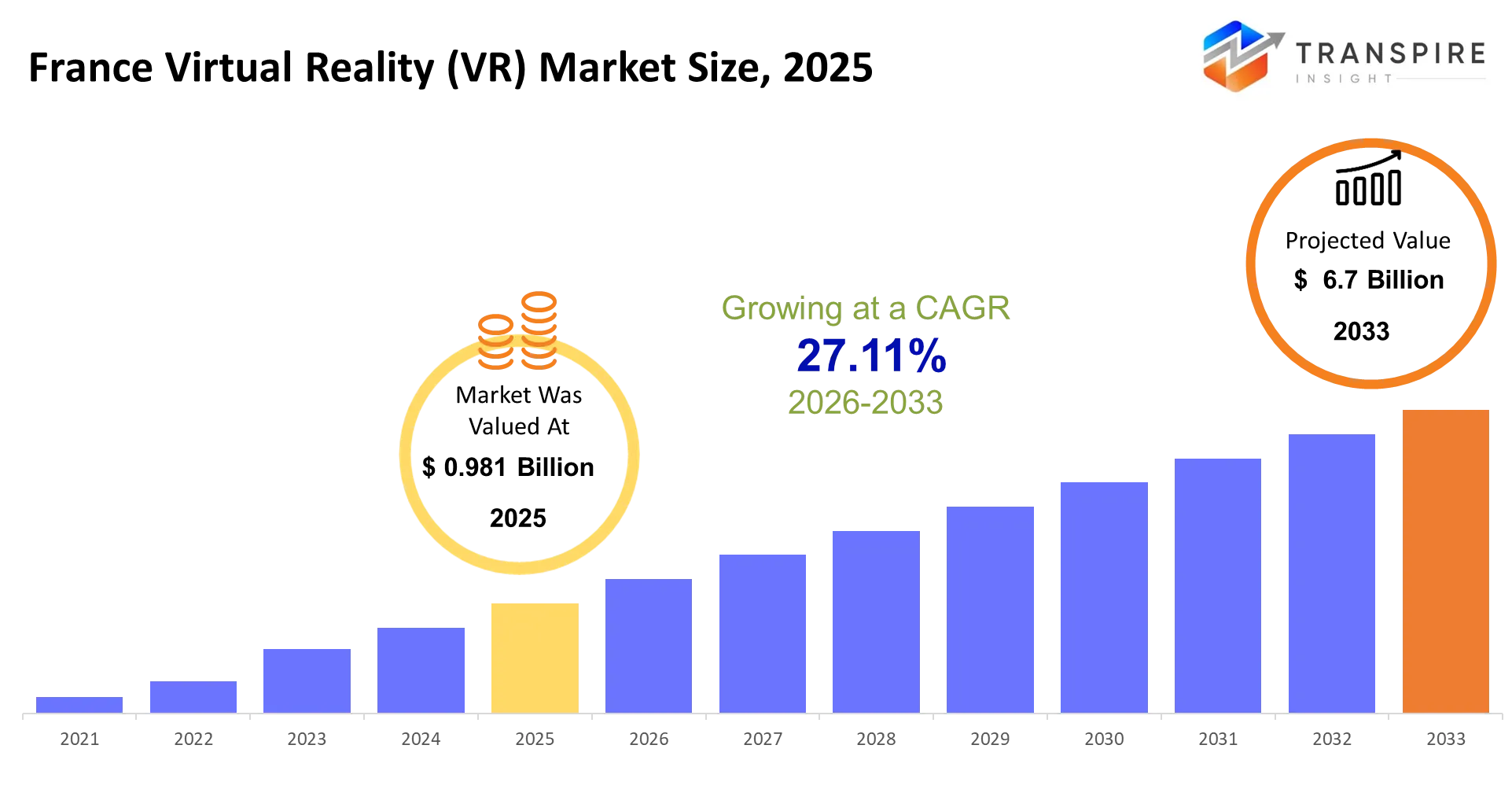
- France Virtual Reality (VR) Market Size 2025: USD 0.981 Billion
- France Virtual Reality (VR) Market Size 2033: USD 6.7 Billion
- France Virtual Reality (VR) Market CAGR: 27.11%
- France Virtual Reality (VR) Market Segments: By Type (Hardware, Software, Services, Others); By Application (Gaming, Healthcare, Education, Real Estate, Training & Simulation, Others); By End-User (Consumers, Enterprises, Healthcare Providers, Educational Institutions, Others); By Device (Head-mounted Displays, Sensors, Controllers, Others)
To learn more about this report,  Download Free Sample Report
France Virtual Reality (VR) Market Summary
The France Virtual Reality (VR) Market was valued at USD 0.981 Billion in 2025. It is forecast to reach USD 6.7 Billion by 2033. That is a CAGR of 27.11% over the period.
Virtual reality in France creates authentic world environments which users can experience through training activities and design testing and medical procedures and virtual product demonstrations. The technology enables businesses to decrease their need for physical product testing while their safety training programs become more effective and their decision-making process speeds up through the use of authentic digital environments. The market experienced its current transformation during the last three to five years because businesses began to adopt virtual reality technology for purposes other than entertainment.
The COVID-19 pandemic triggered the remote work requirement together with the subsequent increase in immersive technology usage for training and virtual meeting purposes. The implementation of VR systems established a direct relationship between operational needs and enterprise-wide deployment as businesses used VR systems to maintain their daily operations. The decline in hardware expenses together with the development of software ecosystems resulted in businesses shifting from initial testing to full-scale implementations which generated increased repeat sales together with wider market penetration.
Key Market Insights
- The France Virtual Reality (VR) Market currently experiences a transition from gaming-based demand towards enterprise use, as industrial applications generate more than 45% of total revenue for the year 2025.
- The 2020 to 2025 period saw hardware improvements which decreased headset prices by 30%, enabling small and medium-sized enterprises to acquire headsets with greater ease and use headsets on a broader scale.
- The France Virtual Reality (VR) Market receives advantages from government-supported digital transformation programs which drive development of Industry 4.0 technologies and immersive educational technology solutions.
- Enterprise VR solutions control more than 50% of the market because organizations need solutions for workforce training and simulation and remote collaboration purposes.
- The healthcare industry experiences rapid growth of VR applications which expand at a rate exceeding 30% each year because medical professionals use VR for surgical training and therapeutic purposes.
- The Île-de-France region controls about 35% of market share because it has a high number of technology companies and new businesses.
- The industrial growth of Western France, which leads to increased manufacturing cluster development, now represents the fastest economic growth period which will continue until 2033.
- The device segment is dominated by head-mounted displays which control more than 60% of market share and sensors show the most rapid expansion among all component categories.
- Business growth has outpaced consumer market growth because companies can prove their investment returns through better training results and improved operational effectiveness.
- The VR companies form alliances with automotive and aerospace and healthcare businesses to develop new products and establish permanent business contracts.
What are the Key Drivers, Restraints, and Opportunities in the France Virtual Reality (VR) Market?
The France Virtual Reality (VR) Market exists because businesses now use immersive technologies for their operational processes. The market developed after people started using cheap virtual reality equipment to create safe training programs which could operate at any scale. Companies now use VR to simulate hazardous environments which allows them to decrease workplace accidents while cutting training expenses thus achieving better operational performance and faster employee development which leads to higher company profits.
The most significant restraint is the high upfront investment required for system integration and content development. The barrier exists because it requires organizations to invest in specific hardware equipment while creating software solutions and training programs and developing their IT systems. These costs slow adoption among small and mid-sized enterprises and delay full-scale deployment which limits short-term market penetration.
A major opportunity lies in the expansion of VR in education and remote collaboration. Educational institutions and businesses are using VR platforms for interactive learning and virtual meetings because they want to create digital classrooms and hybrid work environments. Educational institutions now use immersive classrooms and virtual labs to develop new revenue streams that establish VR as an essential digital infrastructure solution.
What Has the Impact of Artificial Intelligence Been on the France Virtual Reality (VR) Market?
The implementation of artificial intelligence in virtual reality systems has created more intelligent and adaptable virtual environments because artificial intelligence drives the development of intelligent virtual reality environments. The use of AI-based automation allows virtual reality systems to create real-time scenario changes which enhance training programs used in healthcare and manufacturing industries. The AI algorithms present in this system can track user actions within virtual reality spaces which enables their automatic adjustment of difficulty settings and task patterns, thus decreasing the need for human input and improving training results.
The researchers use machine learning models to forecast user behavior patterns and create optimal system performance. The use of predictive analytics in industrial settings allows organizations to detect upcoming equipment breakdowns which will help them better plan their operations and decrease operational halts. Businesses achieve better productivity results because they reduce costs while operating in industries which require advanced operations management such as aerospace and automotive.
Natural language processing and computer vision AI technologies create more realistic virtual experiences because they allow users to interact with machines through more natural methods. The main problem with AI-VR system integration stems from its expensive nature which includes complicated technical processes. The adoption of technology faces obstacles at many organizations because their existing data systems and system incompatibilities create difficulties, which restrict their ability to implement solutions with proven long-term value.
Key Market Trends
- Enterprise adoption accelerated after 2020 when businesses started using VR simulations to replace conventional training methods which led to better safety and operational efficiency.
- Between 2021 and 2025 VR hardware underwent major advancements through the development of lighter headsets and better resolution which made it easier for users to interact with the technology.
- Healthcare institutions increasingly adopted VR for surgical training and therapy after they transitioned from experimental use to standardized medical applications.
- The automotive and aerospace industries adopted VR technology for their design and prototyping processes which resulted in measurable reductions of time needed to develop new products.
- People started using VR-based collaboration platforms after the pandemic ended which allowed remote teams to work together in virtual offices that shared virtual environments.
- Content development shifted toward industry-specific solutions which created enterprise use cases that operators could customize from standard applications.
- French VR startups saw increased investment activity during the period between 2022 and 2025 which led to new technological developments and stronger market competition.
- The combination of AI and cloud computing allowed VR applications to scale better because it enabled them to process data in real time while users accessed the system from remote locations.
- Educational institutions adopted VR-based learning tools which created immersive educational experiences that transformed traditional classroom learning methods.
France Virtual Reality (VR) Market Segmentation
By Type
The type-based segmentation shows hardware as the leading category which generates the largest market share because immersive experiences depend on high-performance devices such as head-mounted displays and tracking systems. Enterprises and consumers continue to invest in hardware because visual quality and comfort and processing capabilities have improved, which strengthens overall adoption. Organizations use software for their second most important requirement because they need custom applications which provide simulation and collaboration and visualization tools, while demand for services remains constant because organizations need help with implementation and integration. Hardware receives ongoing improvements through innovation, while software provides users with adaptable features and continuous value, and services ensure operational system performance over extended periods.
The future of type segments will reflect a shift toward integrated ecosystems where hardware, software, and services operate seamlessly. The hardware market will retain its top position because of ongoing product updates, although increased competition and reduced costs will create challenges for profit margins. Software will expand rapidly with cloud-based platforms and artificial intelligence integration, creating strong opportunities for scalable solutions. Service providers will gain importance by offering managed solutions and long-term support contracts, while developers and investors will prioritize segments that deliver recurring revenue and strong enterprise adoption.
By Application
The application-based segmentation identifies training and simulation as the leading use case because industries depend on immersive environments to improve workforce skills and operational risks. Virtual environments enable manufacturing aerospace and healthcare sectors to conduct safe repeatable training operations which results in high adoption rates. The gaming industry maintains a large market share because consumers remain engaged with ongoing content production, whereas healthcare and education sectors experience steady growth through their actual use cases. Organizations use training applications to achieve efficiency and safety improvements which leads to ongoing demand for these products.
Application segments will evolve toward hybrid use cases that integrate training and collaboration with real-time interaction capabilities. Digital transformation initiatives will make training and simulation the primary focus of industrial operations, while healthcare applications will grow because of increased usage in therapy and diagnostic procedures. Digital learning investments will enhance education, while the gaming industry will transform through better content and cross-platform gaming capabilities. Developers will create solutions for particular industries, while investors will select applications that provide evident returns on investment and future scalability.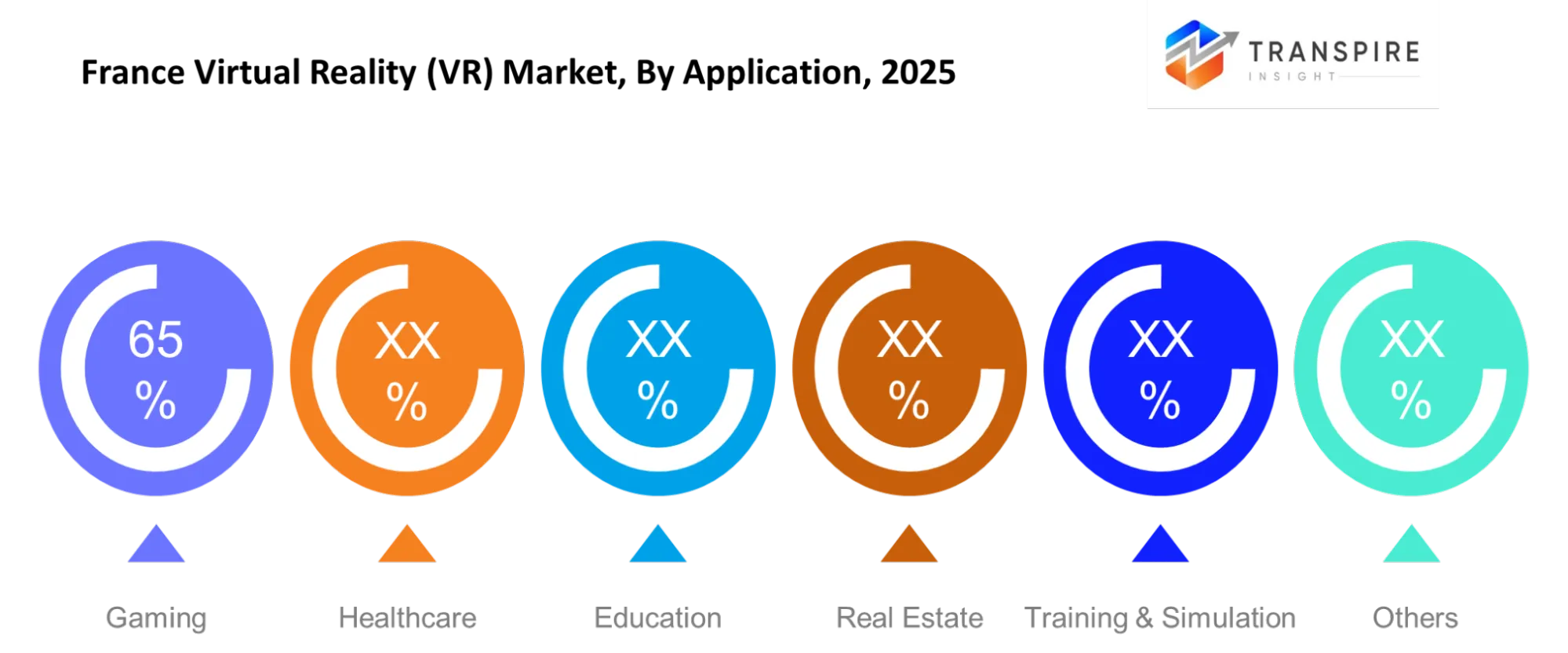
To learn more about this report, Download Free Sample Report
By End-User
The end-user segmentation establishes enterprises as the primary user group because companies devote significant resources to immersive technology investments which they use for training and design work and achieving operational efficiency. Enterprises generate the highest revenue share through their implementation of large-scale systems which produce measurable increases in productivity. The consumer market maintains strong presence through gaming and entertainment but healthcare providers and educational institutions emerge as expanding market segments which use specialized applications. Businesses maintain strong enterprise adoption because they focus on achieving operational efficiency and developing new business solutions.
The end-user market will experience growth because enterprises will depend more on digital technologies while they start entering public service areas. Enterprises will maintain their dominant position because they keep investing in employee development and remote work technologies. Healthcare organizations will increase their adoption of new technologies because their clinical validation processes become more reliable, while educational institutions will gain advantages from their digital transformation projects. Consumers will experience wider product access because device prices become more affordable, while investors will concentrate on business areas that show both growth potential and stable customer engagement.
By Device
The device-based segmentation shows head-mounted displays as the leading category because they serve as the primary interface for immersive experiences. The market segment maintains a substantial portion because display quality and portability and user comfort continue to experience ongoing enhancements. The system needs sensors and controllers to enable users to interact with the system while their movements get tracked, and haptic devices create realistic experiences. Virtual environments rely on head-mounted displays as their primary technology for delivering virtual environments to users.
Device segments will undergo development through performance enhancements and better user experience design. Head-mounted displays will maintain their market position because wireless technology advancements and lightweight designs will continue to improve. The importance of sensors will increase because their precision and responsiveness will develop better simulation capabilities. Controllers will develop toward methods that allow users to interact with systems while other devices will grow through new developments in tactile feedback technology. Product developers will develop integrated device ecosystems while buyers will choose solutions that provide both high performance and simple usability.
What are the Key Use Cases Driving the France Virtual Reality (VR) Market?
The primary application of training and simulation exists in manufacturing and aerospace and energy operations. Companies create immersive environments as training solutions to prepare workers for dangerous situations which include assembly lines and equipment handling and safety drills. Enterprises widely adopt this method because it decreases workplace accidents and reduces training time and decreases business expenses which results in steady income streams.
Healthcare and education represent two expanding application areas which educational institutions and healthcare providers currently adopt. Hospitals use virtual environments to conduct surgical planning and rehabilitation therapies which enhance treatment accuracy and patient results. Educational institutions use immersive learning for science and technical subjects to boost student engagement and knowledge retention through interactive experiences.
Virtual real estate visualization and immersive remote collaboration represent two emerging use cases. Property developers use digital walkthroughs to showcase projects to international buyers, reducing dependency on physical visits. Virtual meeting spaces have emerged as test environments which enterprises use to connect their remote teams because hybrid work models and digital infrastructure develop further.
|
Report Metrics |
Details |
|
Market size value in 2025 |
USD 0.981 Billion |
|
Market size value in 2026 |
USD 1.25 Billion |
|
Revenue forecast in 2033 |
USD 6.7 Billion |
|
Growth rate |
CAGR of 27.11% from 2026 to 2033 |
|
Base year |
2025 |
|
Historical data |
2021 - 2024 |
|
Forecast period |
2026 - 2033 |
|
Report coverage |
Revenue forecast, competitive landscape, growth factors, and trends |
|
Regional scope |
France |
|
Key company profiled |
Meta, Sony, HTC, Valve, Microsoft, Google, Apple, Samsung, NVIDIA, Qualcomm, Unity, Epic Games, Oculus, Pico, Lenovo |
|
Customization scope |
Free report customization (country, regional & segment scope). Avail customized purchase options to meet your exact research needs. |
|
Report Segmentation |
By Type (Hardware, Software, Services, Others); By Application (Gaming, Healthcare, Education, Real Estate, Training & Simulation, Others); By End-User (Consumers, Enterprises, Healthcare Providers, Educational Institutions, Others); By Device (Head-mounted Displays, Sensors, Controllers, Others) |
Which Regions are Driving the France Virtual Reality (VR) Market Growth?
The market in Île-de-France expands because financial resources and research laboratories and business offices of technology firms are present in the region. The public sector provides substantial financial resources which enable the swift implementation of immersive technologies through digital innovation and venture capital funding. The simulation and design tools which advanced enterprises in automotive and aerospace and media industries implemented show their progress. The startup ecosystem develops through academic and industrial partnerships which drive both innovation and commercialization success.
The industrial and manufacturing strengths of Auvergne-Rhône-Alpes create a stable second region which operates at a consistent power level. The region grows because existing industrial companies drive demand rather than newly established businesses. Companies use immersive technology to improve their operational processes and train employees which results in predictable income generation. The region demonstrates dependable market development through its economic stability and organized investment cycles.
Western France demonstrates its most rapid development progress through its recent upgrades to digital system capabilities and smart manufacturing technology. Regional authorities have increased funding for digital transformation, which has improved access for small and mid-sized enterprises. The growth of innovation hubs together with industrial modernization programs has led to faster technology implementation. The period from 2026 to 2033 will create significant market opportunities for new businesses and investors who seek scalable solutions at affordable costs.
Who are the Key Players in the France Virtual Reality (VR) Market and How Do They Compete?
The competitive landscape shows technology companies and platform providers who compete through their ability to create innovative products and maintain ecosystem control and deliver superior user experiences. The platform market experiences moderate competition because smaller developers enter the market with their unique products. The main competition factors include hardware capabilities and software compatibility and the strength of the developer ecosystem. The development of new products occurs at a fast pace because companies combine artificial intelligence with cloud platforms.
Meta develops a system that connects its hardware and software and developer resources to create a unified platform which helps protect user engagement and company control. Sony establishes its market position through its production of immersive content and its partnership with gaming companies which allow it to use its entertainment assets for audience retention. HTC develops enterprise solutions which include training and simulation products to create industry-based solutions that deliver value to their customers.
Microsoft creates a competitive edge through its enterprise integration approach which connects virtual reality tools with business tools and its cloud-based solutions. NVIDIA develops unique market advantages through its sophisticated graphics technology and artificial intelligence systems which support users in developing complex simulation environments. Apple creates premium user experiences through its complete hardware and software system which maintains consistent performance across its ecosystem. The strategies show that platform integration together with special use cases exists as the main factor which creates strategic advantages for businesses.
Company List
- Meta Platforms
- Sony
- HTC
- Valve Corporation
- Microsoft
- Apple
- Samsung Electronics
- NVIDIA
- Qualcomm
- Unity Technologies
- Epic Games
- Oculus
- Pico Interactive
- Lenovo
Recent Development News
In June 2025, Apple introduced major spatial computing updates through visionOS 26 for its Vision Pro platform. The update enhanced immersive experiences and expanded enterprise and developer capabilities.https://www.apple.com
In March 2025, Apple launched an immersive concert experience for Vision Pro users, expanding content ecosystems and improving user engagement in virtual environments.https://www.apple.com/newsroom
What Strategic Insights Define the Future of the France Virtual Reality (VR) Market?
The market is adopting enterprise solutions because training needs efficient solutions and remote work requires efficient training and advanced design tools. The upcoming development phase will use artificial intelligence and cloud computing integration to create systems that can scale and adapt through immersive technology. The current development path will establish unified digital workflows which businesses will use across different sectors.
Platform fragmentation becomes a hidden danger because different ecosystems create interoperability problems which prevent industries from adopting the technology. The development of hybrid work immersive collaboration platforms presents a new opportunity for engineering and industrial work environments. All market participants should develop solutions which enable cross-platform operations because these systems will provide future scalability while decreasing their need for proprietary ecosystems.
France Virtual Reality (VR) Market Report Segmentation
By Type
Hardware
Software
Services
Others
By Application
Gaming
Healthcare
Education
Real Estate
Training & Simulation
Others
By End-User
Consumers
Enterprises
Healthcare Providers
Educational Institutions
Others
By Device
Head-mounted Displays
Sensors
Controllers
Others
Frequently Asked Questions
Find quick answers to common questions.
The Confirmed 2033 market size figure in USD 6.7 Billion.
Key Segments for the France Virtual Reality (VR) Market are By Type (Hardware, Software, Services, Others); By Application (Gaming, Healthcare, Education, Real Estate, Training & Simulation, Others); By End-User (Consumers, Enterprises, Healthcare Providers, Educational Institutions, Others); By Device (Head-mounted Displays, Sensors, Controllers, Others).
Major France Virtual Reality (VR) Market Players are Meta, Sony, HTC, Valve, Microsoft, Google, Apple, Samsung, NVIDIA, Qualcomm, Unity, Epic Games, Oculus, Pico, Lenovo.
The Current France Virtual Reality (VR) Market size is USD 0.981 Billion in 2025.
The France Virtual Reality (VR) Market CAGR is 27.11% from 2026 to 2033.
- Meta Platforms
- Sony
- HTC
- Valve Corporation
- Microsoft
- Apple
- Samsung Electronics
- NVIDIA
- Qualcomm
- Unity Technologies
- Epic Games
- Oculus
- Pico Interactive
- Lenovo
Recently Published Reports
-
Apr 2026
3D Optical Profiler Market
3D Optical Profiler Market Size, Share & Analysis Report By Type (Desktop 3D Optical Profiler, and Portable 3D Optical Profiler), By Technology (Confocal Technology, and White Light Interference), By End-Use Industry (Manufacturing, Research Institutions, Automotive, Aerospace and Defense, Medical Devices, and Other), and Geography (North America, Europe, Asia-Pacific, Middle East and Africa, South and Central America), 2021 - 2031
-
Apr 2026
Depth Sensor Market
Depth Sensor Market Size, Share & Analysis Report By Type (Infrared Depth Sensors, Time-of-Flight (ToF) Sensors, Stereo Vision Sensors, Structured Light Sensors, Ultrasonic Depth Sensors), By Application (Automotive, Robotics, Gaming, Consumer Electronics, Industrial Automation, Healthcare, Security & Surveillance, Others), By End Users (Automotive Manufacturers, Consumer Electronics Companies, Healthcare Providers, Industrial Companies, Security Agencies, Gaming Companies, Robotics Companies, Others), and Geography (North America, Europe, Asia-Pacific, Middle East and Africa, South and Central America), 2021 – 2031
-
Apr 2026
Digital Manufacturing Market
Digital Manufacturing Market Size, Share & Analysis Report By Component (Hardware, Software, and Services), By Technology (Robotics, 3D Printing, Internet of Things (IoT), and Others), By Application (Automotive and Transportation, Aerospace and Defense, Consumer Electronics, Industrial Machinery, and Others), By Process Type (Computer-Based Designing, Computer-Based Simulation, Computer 3D Visualization, Analytics, and Others), and Geography (North America, Europe, Asia-Pacific, Middle East and Africa, South and Central America), 2021 – 2031
-
Apr 2026
Digital Visa Services Market
Digital Visa Services Market Size, Share & Analysis Report By Type (Individual Travelers, Group Travelers), By Application (Tourism, Business Travel, Others), and Geography (North America, Europe, Asia-Pacific, Middle East and Africa, South and Central America), 2021 – 2031