

Germany Real Estate Market Size & Forecast:
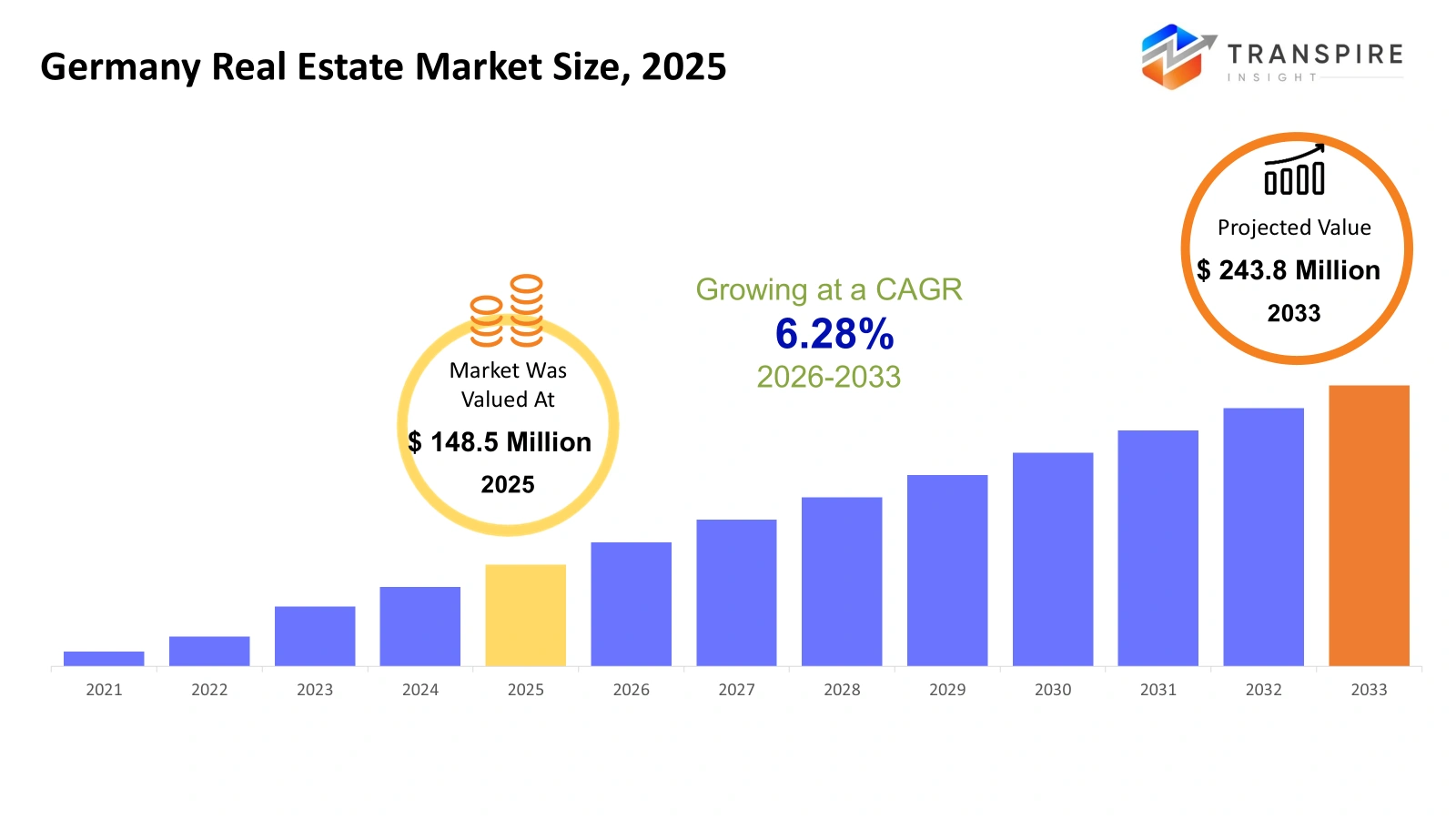
- Germany Real Estate Market Size 2025: USD 148.5 Million
- Germany Real Estate Market Size 2033: USD 243.8 Million
- Germany Real Estate Market CAGR: 6.28%
- Germany Real Estate Market Segments: By Property Type (Residential, Commercial, Industrial, Retail), By Transaction Type (Sale, Lease), By Region (Bavaria, North Rhine-Westphalia, Others).
To learn more about this report,  Download Free Sample Report
Germany Real Estate Market Summary:
The Germany Real Estate Market size was estimated at USD 148.5 Million in 2025 and is anticipated to reach USD 243.8 Million by 2033, growing at a CAGR of 6.28% from 2026 to 2033. The real estate market in Germany develops through organized urban planning which creates permanent investment patterns that support the growing need for housing. The residential market will experience demand fluctuations which depend on two main factors: urban migration patterns and the rising number of elderly people who want energy-efficient homes. Buyers will increasingly seek sustainable buildings that reduce long-term energy costs. Digital property platforms will continue changing property search and transaction processes, which will enable investors and homebuyers to access markets more quickly. Future transactions will receive new directions from regulatory changes which affect environmental standards and rental policy frameworks. Commercial property demand will gradually adjust as hybrid work models influence office space design, location preference, and flexible leasing structures.
Key Market Trends & Insights:
- The Germany real estate market will show strong activity through its three primary sectors which include residential properties and commercial properties and industrial properties. Urban population growth will maintain steady residential demand for housing. The commercial property market will develop flexible office spaces while expanding e-commerce distribution networks will create demand for logistics and industrial facilities.
- The location-based insights will demonstrate persistent interest in both major metropolitan areas and developing secondary cities. Business activity together with existing infrastructure will make urban centers attractive to investors. The smaller cities will become popular because they offer affordable housing and development incentives and they have better regional planning which improves their connectivity to other areas.
- The investment trends will show that institutional investors and property funds and private capital groups are increasing their market participation. Investors will continue to find long-term income stability attractive. The property market will experience balanced investment strategies through portfolio diversification which includes residential units and office spaces and logistics assets.
- The residential market demands housing for three types of users including families and businesses and shops and distribution centers. The urban population growth will continue to drive residential demand which depends on employment centers. Businesses will choose office spaces with adaptable designs because retail businesses will change their store formats according to new shopping patterns.
- The development activity in the German real estate market will concentrate on two areas which include upgrading existing structures and implementing environmentally sustainable building methods. Environmental regulations will lead to increased support for energy-saving buildings and renovation activities. Construction planners will develop mixed-use projects that include residential areas and business spaces and municipal facilities.
- The regulatory framework of the market will determine how properties get sold and how development projects get approved. The project development process will follow housing policies and zoning rules and energy efficiency standards. Developers and investors need to meet both environmental performance targets and building code requirements to operate in the German market.
Germany Real Estate Market Segmentation
By Property Type
Residential :The residential section of the Germany real estate market will keep serving as the main property market driver because major cities experience ongoing housing demand. The combination of urban population growth and limited housing development and stable rental market conditions will enable development activities to proceed. The residential property market in various German areas will experience constant activity because people will continue to buy apartments and family homes and multi-unit buildings.
Commercial:The commercial sector of Germany's real estate market will encompass office buildings and business parks and corporate property areas that companies and service organizations use for their operations. The three major cities of Berlin and Frankfurt and Munich will become business hubs which will create a greater demand for office spaces. Property investment will receive support from modern workspaces and flexible office areas and mixed-use commercial complexes.
Industrial :The industrial sector of the Germany real estate market will expand because logistics and manufacturing activities require additional warehouses and production spaces. The growth of e-commerce and supply chain distribution will create increased requirements for logistics centers near highways and transport systems. The industrial segment will depend on industrial parks and storage facilities and manufacturing plants as essential resources.
Retail :The retail sector of Germany's real estate market will comprise shopping centers and high street stores and retail parks which enable customers to make purchases. The demand for retail space will continue to match the patterns of consumer spending and tourist activity. Retail businesses in both major urban areas and suburban shopping centers will continue to compete for tenants who want businesses in areas with high customer visibility.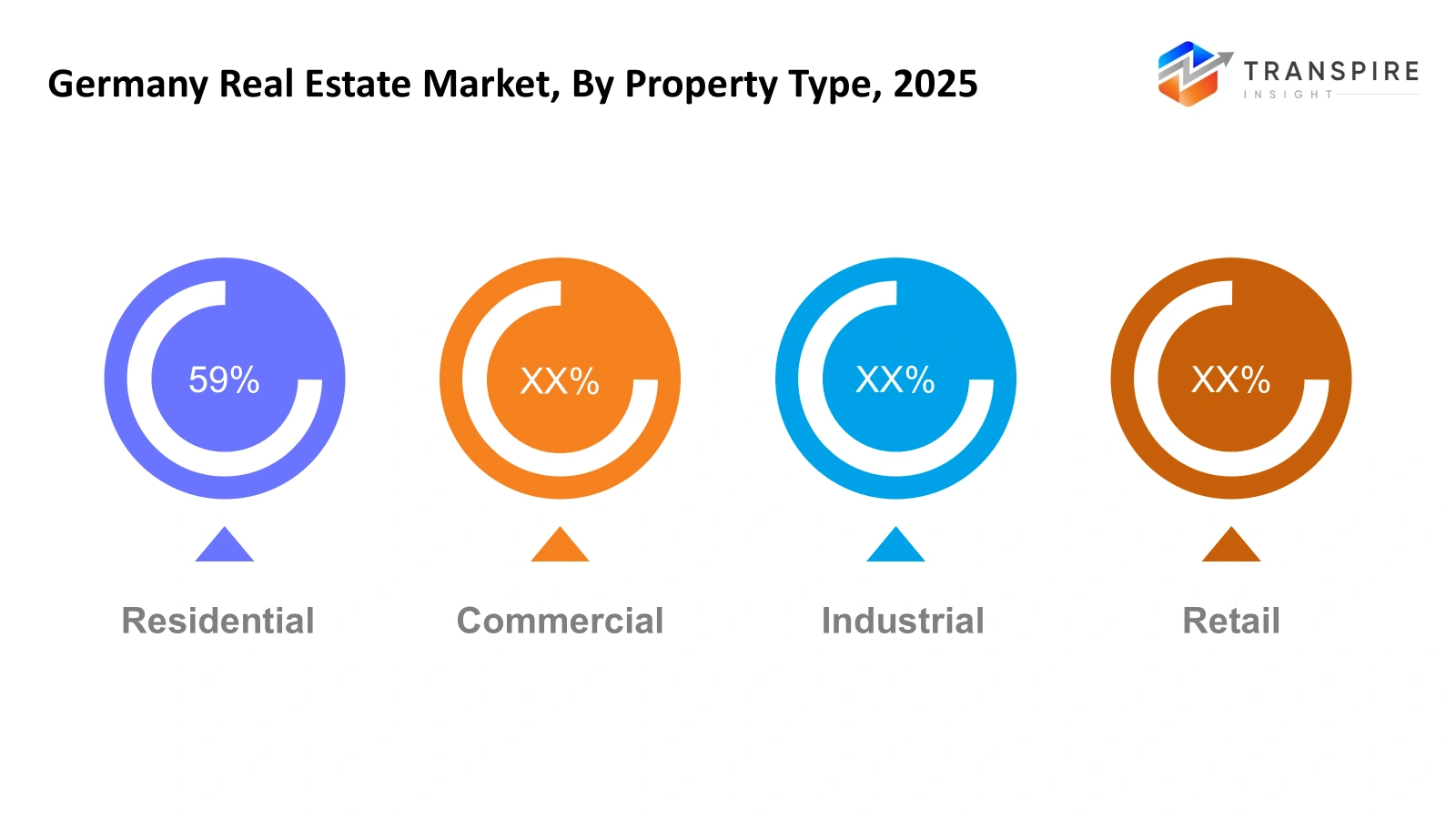
To learn more about this report, Download Free Sample Report
By Transaction Type
Sale:The Germany real estate market will execute property transactions through its sale procedure which enables buyers to acquire ownership from sellers. The transaction category will be driven by three types of purchases which include residential properties and commercial properties and investment partnerships. The sales process will involve institutional investors and private investors and property companies while they maintain their objective of acquiring properties for extended periods.
Lease:The Germany real estate market will execute lease transactions through rental agreements which property owners and tenants establish for residential and commercial properties. The demand for rental housing in major German cities will continue because most residents choose to rent their homes. The commercial leasing market will maintain its steady performance through office and retail and industrial leasing contracts.
By Region
Bavaria :The Bavaria regional segment of the Germany real estate market will experience growth because of its economic development and its two major cities which are Munich and Nuremberg. The three sectors which drive employment growth include technology companies and manufacturing industries and research institutions. The demand for both residential housing and commercial properties in Bavaria will increase because the population is growing and business activities are expanding.
North Rhine -Westphalia:The real estate market in North Rhine-Westphalia Germany shows active property demand because of its high population density and its three major cities which are Cologne, Düsseldorf, and Dortmund. The industrial history and logistics infrastructure and corporate presence will create demand for industrial facilities and office buildings and residential housing in this highly populated German region.
Others :The other regional segment of the Germany real estate market includes the states of Baden-Württemberg, Hesse, Saxony, and Lower Saxony. The three areas will generate national property activity through their residential and industrial and commercial construction projects. The development of regional infrastructure projects and the expansion of urban areas and the growth of tourism will create new property development opportunities in various smaller cities.
Country Insights
The German real estate market shows consistent demand for properties because the country maintains strong economic growth and industrial development and organized urban development throughout its cities. Major cities such as Berlin, Munich, and Frankfurt will continue attracting residential and commercial investment because of their high employment rates and ongoing infrastructure improvements.
The German real estate market will maintain constant activity because of existing housing requirements and business growth and established property regulations. New construction projects will receive more attention because of government mandates that focus on energy efficiency and environmentally friendly building practices. Urban redevelopment projects and improved transportation links will create additional property demand throughout both metropolitan areas and smaller cities.
Recent Development News
Germany real estate market recorded a gradual price recovery after an earlier slowdown. Residential property prices increased around 3.8% during early 2025, marking the second consecutive quarterly rise after a period of decline. Renewed buyer confidence and stabilization in financing conditions supported transactions across several cities in Germany.
Germany real estate market residential segment experienced renewed momentum as property prices increased in several major cities. Demand for apartments, multi-family housing, and urban residential assets strengthened despite economic uncertainty. Analysts observed that housing demand continued to expand in metropolitan regions while supply remained constrained.
|
Report Metrics |
Details |
|
Market size value in 2025 |
USD 148.5 Million |
|
Market size value in 2026 |
USD 159.2 Million |
|
Revenue forecast in 2033 |
USD 243.8 Million |
|
Growth rate |
CAGR of 6.28% from 2026 to 2033 |
|
Base year |
2025 |
|
Historical data |
2021 – 2024 |
|
Forecast period |
2026 – 2033 |
|
Report coverage |
Revenue forecast, competitive landscape, growth factors, and trends |
|
Country scope |
Germany |
|
Key company profiled |
Vonovia SE, Deutsche Wohnen, LEG Immobilien AG, Aroundtown SA, TAG Immobilien AG, Heimstaden Bostad AB, Engel & Völkers AG, Blackstone Group (Real Estate Investments), CBRE Group, JLL (Jones Lang LaSalle), Cushman & Wakefield, Savills plc, Colliers International, BNP Paribas Real Estate. |
|
Customization scope |
Free report customization (country, regional & segment scope). Avail customized purchase options to meet your exact research needs. |
|
Report Segmentation |
By Property Type (Residential, Commercial, Industrial, Retail), By Transaction Type (Sale, Lease), By Region (Bavaria, North Rhine-Westphalia, Others). |
Key Germany Real Estate Market Company Insights
The German real estate market will see active participation from established property developers and investment groups and asset management companies who will operate in residential and commercial and mixed-use property markets. The organization will maintain its strategic focus on developing sustainable asset management solutions which will ensure asset stability and fulfill urban housing needs and support the redevelopment of properties located in vital economic centers.
The German real estate market will experience increased activity from technology-based property platforms and institutional investors and regional developers who specialize in sustainable building practices and effective property management solutions. The market will show interest through its activities which include energy-efficient building construction and digital property management system implementation and redevelopment projects that enable urban expansion while meeting contemporary housing needs.
Company List
- Vonovia SE
- Deutsche Wohnen
- LEG Immobilien AG
- Aroundtown SA
- TAG Immobilien AG
- Heimstaden Bostad AB
- Engel & Völkers AG
- Blackstone Group (Real Estate Investments)
- CBRE Group
- JLL (Jones Lang LaSalle)
- Cushman & Wakefield
- Savills plc
- Colliers International
- BNP Paribas Real Estate
Germany Real Estate Market Report Segmentation
By Property Type
- Residential
- Commercial
- Industrial
- Retail
By Transaction Type
- Sale
- Lease
By Region
- Bavaria
- North Rhine-Westphalia
- Others
Frequently Asked Questions
Find quick answers to common questions.
The approximate size of the German real estate market will be USD 243.8 million in 2033.
The key segments of the Germany Real Estate Market are By Property Type (Residential, Commercial, Industrial, Retail), By Transaction Type (Sale, Lease), By Region (Bavaria, North Rhine-Westphalia, Others).
Major players in the German real estate market are Vonovia SE, Deutsche Wohnen, LEG Immobilien AG, Aroundtown SA, TAG Immobilien AG, Heimstaden Bostad AB, Engel & Völkers AG, Blackstone Group (Real Estate Investments), CBRE Group, JLL (Jones Lang LaSalle), Cushman & Wakefield, Savills plc, Colliers International, BNP Paribas Real Estate.
The current market size of the Germany Real Estate Market is USD 148.5 Million by 2025.
The Germany Real Estate Market CAGR is 6.28 %
- Vonovia SE
- Deutsche Wohnen
- LEG Immobilien AG
- Aroundtown SA
- TAG Immobilien AG
- Heimstaden Bostad AB
- Engel & Völkers AG
- Blackstone Group (Real Estate Investments)
- CBRE Group
- JLL (Jones Lang LaSalle)
- Cushman & Wakefield
- Savills plc
- Colliers International
- BNP Paribas Real Estate
Recently Published Reports
-
Apr 2026
Handling and Lifting Equipment Market
Handling and Lifting Equipment Market Size, Share & Analysis Report By Product (Cranes and Hoists, Forklifts, Conveyor Systems, Aerial Work Platforms, Others), By Application (E-Commerce, Automotive and Railway, Food and Beverages, Aviation, Others), and Geography (North America, Europe, Asia-Pacific, Middle East and Africa, South and Central America), 2021 - 2031
-
Apr 2026
HVAC Equipment Market
HVAC Equipment Market Size, Share & Analysis Report By Heating Equipment Type (Boilers and Furnaces, Heat Pumps, and Unitary Heaters), By Ventilation Equipment (Air Handling Units, Humidifiers and Dehumidifiers, Air Filters, and Fan Coiling Units), By Air Conditioning Equipment (Unitary Air Conditioners, Room Air Conditioners, Packaged Terminal Air Conditioners, and Chillers), By End User (Commercial, Residential, Industrial, and others), and Geography (North America, Europe, Asia-Pacific, Middle East and Africa, South and Central America), 2021 – 2031
-
Apr 2026
Refrigeration Valves Market
Refrigeration Valves Market Size, Share & Analysis Report By Type (Solenoid Valves, Expansion Valves, Check Valves, Service Valves, Others), By Application (Commercial Refrigeration, Industrial Refrigeration, Transport Refrigeration, Residential Refrigeration, Air Conditioning Systems), By End User (Food and Beverage Industry, Pharmaceutical Industry, HVAC Industry, Chemical Industry, Others), and Geography (North America, Europe, Asia-Pacific, Middle East and Africa, South and Central America), 2021 – 2031
-
Apr 2026
E-Commerce Packaging Materials Market
E-Commerce Packaging Materials Market By Material Type (Corrugated Boxes, Paper & Paperboard, Foam & Cushioning Materials, Plastic Packaging, Flexible Packaging, Protective Packaging, Others), By Product(Primary Packaging, Secondary Packaging, Tertiary Packaging), By Packaging Function (Protective Packaging, Branding & Presentation Packaging, Transit & Logistic Packaging, Sustainable Packaging, Tamper Evidence Packaging), By End-User (Retail & Consumer Goods, Electronic Appliances, Food & Beverages, Healthcare & Pharmaceutical, Fashion & Apparel, Home & Furnishing, Others); By Industry Analysis, Size, Share, Growth, Trends, and Forecasts 2021-2033