
Middle East and Africa Augmented Reality (AR) Market Size & Forecast:
- Middle East and Africa Augmented Reality (AR) Market Size 2025: USD 5868.4 Million
- Middle East and Africa Augmented Reality (AR) Market Size 2033: USD 53724.1 Million
- Middle East and Africa Augmented Reality (AR) Market CAGR: 31.90%
- Middle East and Africa Augmented Reality (AR) Market Segments: By Component (Hardware, Software, Services, AR Platforms, Sensors, Smart Glasses, Displays, Others); By Application (Gaming, Retail, Healthcare, Education, Manufacturing, Real Estate, Defense, Others); By Device Type (Smartphones, Tablets, AR Glasses, Head-Mounted Displays, Wearables, Smart Contact Lenses, Projection Systems, Others); By End User (Consumers, Enterprises, Healthcare Providers, Educational Institutions, Government, Industrial Users, Defense Organizations, Others)
Middle East and Africa Augmented Reality (AR) Market Summary
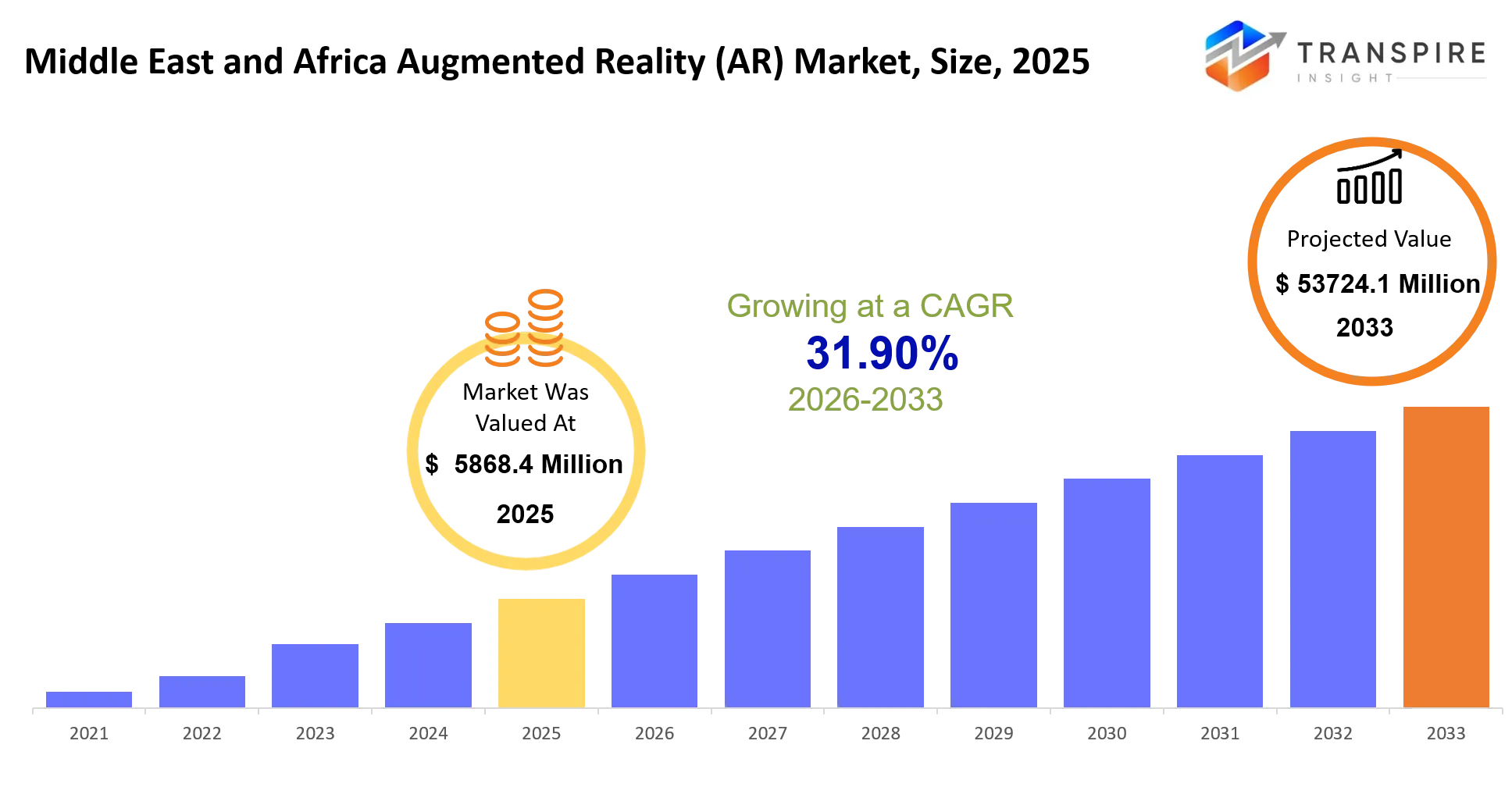
The Middle East and Africa Augmented Reality (AR) Market was valued at USD 5868.4 Million in 2025. It is forecast to reach USD 53724.1 Million by 2033. That is a CAGR of 31.90% over the period.
The Middle East and Africa Augmented Reality (AR) market lets companies, and also everyday users, slap digital stuff right over real surroundings, which kinda helps with training, maintenance upkeep, remote guidance, retail attractiveness, health visualization, and the everyday nuts-and-bolts of industrial tasks. In real life spaces, AR can cut down mistakes, speed up learning paths, and support quicker choices across areas like manufacturing, defense, education, and healthcare, too.
Over the last five years, things moved a bit, from early “try it once” mobile experiences toward enterprise level AR platforms, AI powered smart glasses, and hands on immersive industrial routines. A key structural shift is that more integrated XR ecosystems are showing up, with hardware , software and cloud providers working together, not as isolated pieces. After the COVID-19 period, digital transformation initiatives accelerated, so organizations started relying more on remote teamwork and virtual assistance tools. When enterprises looked for better workforce output and lower operating expenses, AR systems went from small proof-of-concepts into deployments that can actually scale. That change has grown recurring software income , increased demand for wearable devices, and nudged long-term funding across Gulf countries, South Africa, and other regional tech centers.
Key Market Insights
- The Gulf region kinda dominates the Middle East and Africa Augmented Reality (AR) Market, taking up nearly 45% of the regional revenue in 2025, like straight up.
- Saudi Arabia and the UAE are leading the deployment wave with smart city programs, digital government agendas, and Industry 4.0 investments.
- Africa is showing the fastest regional momentum through 2033 as mobile based AR applications keep spreading across education, plus retail kinds of settings.
- On the component side, hardware stays the top segment, with about 38% market share because of smart glasses, sensors, and display demand.
- Software comes in as the second biggest part, backed by enterprise visualization, remote guidance, and AR content management platforms.
- AR platforms are also expected to grow the fastest through 2033, since businesses want scalable rollouts and device management arrangements.
- In terms of application, manufacturing contributes over 25% of enterprise adoption, through maintenance guidance, assembly support, and workforce training applications.
- Healthcare is emerging as the fastest growing application area, where hospitals are adopting AR assisted diagnostics and surgical visualization tools, little by little.
- For end users, enterprise users hold the largest share, while educational institutions are expanding fast too, supported by immersive learning initiatives and related experiences.
- And yeah, major players like Microsoft, Meta, Google, Apple, and Qualcomm compete using AI integration, strategic partnerships, device innovation, and regional ecosystem expansion, all at once.
What are the Key Drivers, Restraints, and Opportunities in the Middle East and Africa Augmented Reality (AR) Market?
The strongest force really pushing market expansion is like the meeting point, of AR hardware artificial intelligence and enterprise digitalization efforts. If you look at Governments across the Gulf Cooperation Council they’ve put a lot of money into smart infrastructure, digital public services , and industrial modernization too. All these moves ended up generating demand for visualization tools that make the workforce faster and also improve operational precision. With AR solutions , technicians can pull up contextual details in real time, and that helps cut down downtime while also lowering training expenses. When deployment costs start falling , and when enterprise software ecosystems become more mature, then adoption moves past those one-off pilots, into big commercial rollouts, which boosts software subscriptions, hardware sales, and service revenues directly.
Still, high deployment costs are the biggest stubborn structural barrier. Enterprise-grade smart glasses, specialized sensors, content creation, and tying everything into existing IT infrastructure all need heavy upfront capital. On top of that, many organizations struggle with a shortage of people who can build AR systems, and also with system integrators who actually know the ecosystem. Those issues can’t be fixed overnight , because they are tied to ecosystem maturity, workforce development, and ongoing infrastructure investment. Because of this, adoption stays uneven between smaller enterprises and certain developing African markets, and that naturally caps the revenue upside.
AI-powered spatial computing is another big growth opening. The mix of computer vision, generative AI, and AR interfaces is basically birthing fresh applications in healthcare, industrial maintenance, logistics, and education. Gulf countries are actively backing AI ecosystems and immersive technologies, so conditions look more favorable for advanced AR deployments.
What Has the Impact of Artificial Intelligence Been on the Middle East and Africa Augmented Reality (AR) Market?
Artificial intelligence has, kind of, boosted the overall worth of augmented reality solutions in both enterprise and consumer settings. With computer vision methods, object recognition and scene mapping are now pretty much automated, plus contextual information can be pushed to users in a more natural, intuitive way. So people can interact with digital overlays as if theyre there with them, not just displayed at a distance. In manufacturing plants, AI driven AR setups help technicians follow maintenance workflows while also spotting equipment irregularities in real time, which is helpful in a practical sense. In healthcare, intelligent visualization tools are used to support better diagnostics, guide treatment planning, and even assist medical education, including simulated practice.
Machine learning models, meanwhile, have really reinforced predictive capabilities. When AR platforms analyze equipment performance information, they can foresee maintenance needs before failures happen, which cuts downtime and helps asset utilization. Retail organizations also benefit: AI enhanced AR apps can tailor product suggestions and enable virtual try-on scenarios, which tends to raise customer engagement and purchase conversion. Even schools and training centers are using adaptive learning environments, where content changes based on student performance and how learners interact with the material, sort of dynamically adapting in place.
On the operational side, the gains look like quicker task completion, higher workforce output, reduced training expenses, and more reliable decision making. Still, there’s a big constraint that keeps showing up, which is the expensive effort required to integrate AI, AR software, cloud infrastructure, and enterprise data systems. Access is another issue, too— limited availability of specialized datasets, along with a smaller pool of skilled talent, makes rollout slower, especially for many emerging markets across Africa.
Key Market Trends
- Enterprise AR rollouts went up big time after 2021, mostly because remote support and that digital workforce thing turned into the main operational focus.
- Smart glasses adoption kind of sped up in 2025, it was backed by new AI enabled launches and productivity apps for companies.
- Then Android XR showed up as a real ecosystem shift, with cooperation between Google, Samsung, and Qualcomm, sort of all aligning together.
- In parallel, industrial training programs that rely on immersive visualization tools started spreading more, across manufacturing and energy, between 2023 and 2026.
- AR glasses sales jumped around 180% year over year in 2025, which looks like stronger buy-in from both enterprises and regular consumers too.
- Also, AI driven visual recognition capabilities became baseline features in more advanced wearable devices that were released in 2025 and 2026.
- Healthcare orgs increased spending on surgical visualization and medical education platforms, using immersive technologies.
- Retail brands pushed more virtual product visualization and digital commerce experiences, and that improved engagement, plus purchase confidence.
- Major vendors then shifted investment away from standalone VR hardware, toward lighter AR plus AI enabled wearables.
- And strategic partnerships between platform providers, chipmakers, and eyewear brands got more intense, basically leaning into competitive differentiation.
Middle East and Africa Augmented Reality (AR) Market Segmentation
By Component
By component, Hardware is basically the base layer for augmented reality rollouts and it covers Sensors, Smart Glasses, Displays, and a bunch of other supporting gear that lets people visualize digital content right inside everyday surroundings. Smart Glasses are getting more attention in industrial operations, healthcare facilities, and training spaces, mostly because hands-free access makes the workflow run smoother, at least in practice. Displays also back interactive visualization, across retail stores, educational institutions and enterprise setups. Meanwhile Sensors help with spatial mapping, object recognition , and motion tracking accuracy which is kind of the whole point when you need things to feel “real”.
Then there’s Software which is crucial because it supports content creation, data processing, and application management across multiple industries. AR Platforms help organizations build, launch and manage immersive experiences at scale, not just one-offs. Services are there too, including consulting, integration, maintenance, and training assistance. Other component buckets exist as well, like connectivity solutions, tracking technologies, and customization tools they cover more specialized needs, and they can improve the overall solution performance plus the user experience overall, though sometimes it depends.
By Application
Gaming still counts as a key application area, because immersive visual experiences can lead to stronger user engagement and more interactive entertainment type opportunities, it feels kind of obvious. Retail also leans on augmented reality for virtual product visualization and customer engagement, plus shopping experiences that are more confident in the moment, so buyers feel better. In Healthcare, the focus is on medical training , diagnostics, and treatment planning through advanced visualization, it helps clinicians think clearer, even when the cases are complex. Education benefits too, from interactive learning content that boosts knowledge retention, and it also improves classroom participation.
Manufacturing then uses augmented reality for assembly guidance, equipment maintenance, quality inspections, and workforce training too. Real Estate makes use of digital property visualization and virtual walkthroughs, which support both buyers and developers during project evaluation . Defense organizations apply augmented reality for mission planning, simulation, and operational training, while other applications keep showing up across tourism, media, logistics , and public services as tech capabilities keep expanding.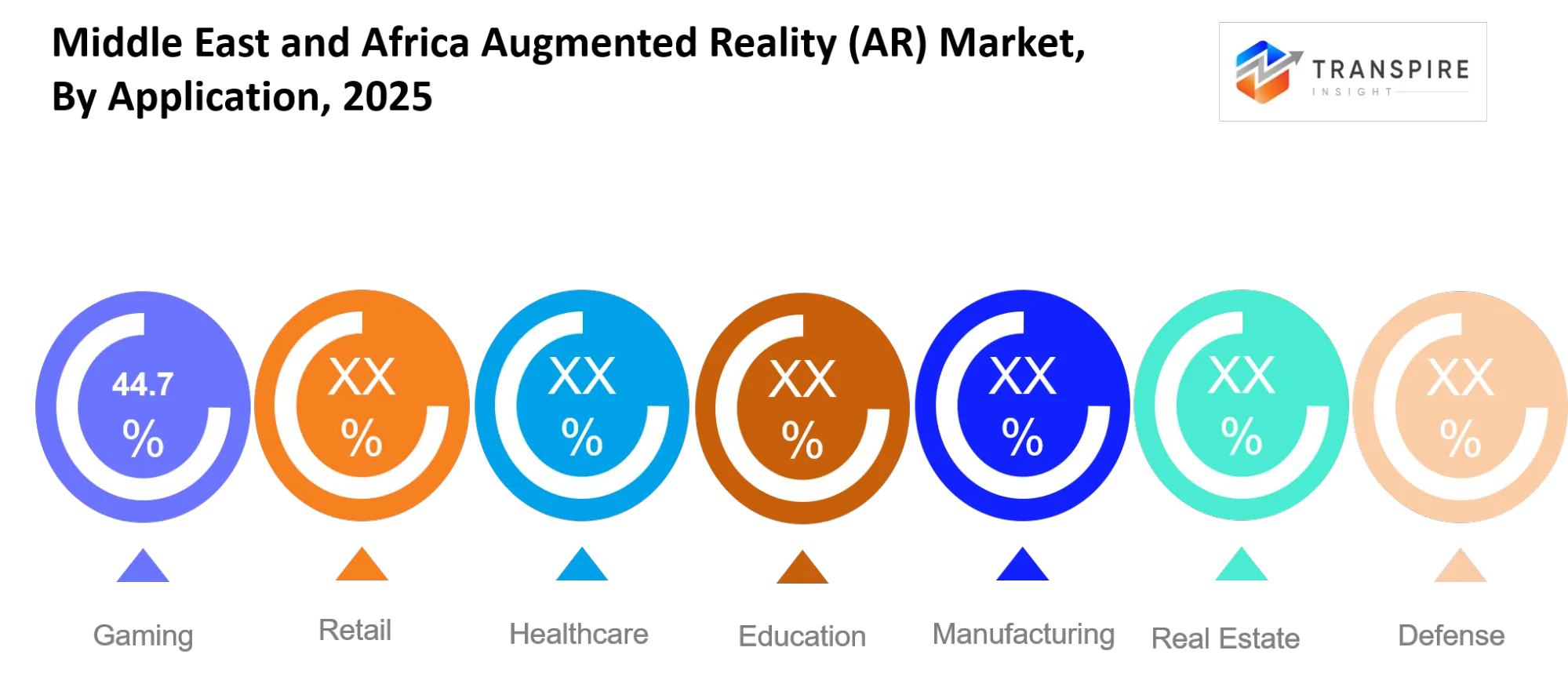
By Device Type
Smartphones seem like the most common device category, mainly because the mobile infrastructure thats already in place can handle large-scale access for augmented reality applications, pretty smooth right. Tablets give a wider viewing area, which helps with education, healthcare, and business presentations where finer visualization supports better user interaction , overall. AR glasses and head-mounted displays offer a more immersive setup for enterprise work, field services, training sessions and industrial settings, especially where you really need hands-free function.
Wearables keep growing too, mostly as lightweight connected devices that enable real-time information access and also some noticeable productivity uplift. Smart contact lenses are still kind of early in the development cycle, but they may have serious long-term value for advanced visualization use cases. Projection systems can also create a shared augmented experience across classrooms, event spaces, and industrial facilities, while the Other device categories cover specialized equipment built for industry specific operational needs.
By End User
Smartphones seem like the most widely used kind of device, mostly because the mobile infrastructure we already have already supports large-scale access to augmented reality apps and all that. Tablets offer more space to look at things, so they can help in education, healthcare, and business presentations where sharper visualization makes the whole interaction feel smoother, and in practice it matters.
AR Glasses plus Head-Mounted Displays give a more immersive feel for enterprise tasks, field services, training sessions, and industrial settings, and yeah those places often need hands-free operation.
Wearables keep growing too, via light connected devices that enable real-time data access, which then supports productivity gains. Smart Contact Lenses are still kind of an early-stage effort, but there’s long-term promise for advanced visualization use cases. Projection Systems help create shared augmented experiences across classrooms, event areas, and industrial sites. And other device categories include specialized equipment, made for industry-specific operational needs.
What are the Key Use Cases Driving the Middle East and Africa Augmented Reality (AR) Market?
Manufacturing is maybe the biggest use case , because augmented reality boosts worker productivity, cuts down operational mistakes, and speeds up technical training, kind of in one go. With digital work instructions, equipment upkeep direction, plus real-time visualization tools, industrial plants can move more smoothly, while also reducing downtime and those ongoing operational costs.
Healthcare and retail keep getting more attention across the region. Medical institutions are using immersive visualization for surgical planning, diagnostics, and professional training, and then retail orgs are rolling out virtual product demonstrations along with interactive shopping experiences, so customer engagement rises and purchasing decisions become more confident.
At the same time, new chances are popping up in smart city efforts, public infrastructure management, and advanced education programs. Defense organizations are even looking at immersive simulation systems for operational readiness and mission prep. And as artificial intelligence and spatial computing technologies keep maturing, additional applications will likely appear across government services, engineering design, and remote collaboration spaces.
|
Report Metrics |
Details |
|
Market size value in 2025 |
USD 5868.4 Million |
|
Market size value in 2026 |
USD 7734.7 Million |
|
Revenue forecast in 2033 |
USD 53724.1 Million |
|
Growth rate |
CAGR of 31.90% from 2026 to 2033 |
|
Base year |
2025 |
|
Historical data |
2021 - 2024 |
|
Forecast period |
2026 - 2033 |
|
Report coverage |
Revenue forecast, competitive landscape, growth factors, and trends |
|
Regional scope |
United States; Canada; Mexico; United Kingdom; Germany; France; Italy; Spain; Denmark; Sweden; Norway; China; Japan; India; Australia; South Korea; Thailand; Brazil; Argentina; South Africa; Saudi Arabia; United Arab Emirates |
|
Key company profiled |
Microsoft, Google, Apple, Meta, Qualcomm, PTC, Unity Technologies, Sony, Samsung Electronics, Lenovo, Epson, Vuzix, Magic Leap, Niantic, Snap |
|
Customization scope |
Free report customization (country, regional & segment scope). Avail customized purchase options to meet your exact research needs. |
|
Report Segmentation |
By Component (Hardware, Software, Services, AR Platforms, Sensors, Smart Glasses, Displays, Others); By Application (Gaming, Retail, Healthcare, Education, Manufacturing, Real Estate, Defense, Others); By Device Type (Smartphones, Tablets, AR Glasses, Head-Mounted Displays, Wearables, Smart Contact Lenses, Projection Systems, Others); By End User (Consumers, Enterprises, Healthcare Providers, Educational Institutions, Government, Industrial Users, Defense Organizations, Others) |
Which Regions are Driving the Middle East and Africa Augmented Reality (AR) Market Growth?
The Gulf Cooperation Council, or GCC, region leads the Middle East and Africa Augmented Reality market, and it holds the biggest slice of regional revenue. Saudi Arabia , and the United Arab Emirates in particular, keep putting money into smart city programs, digital government services, industrial automation, and upgraded healthcare infrastructure,so you end up seeing really strong demand for AR solutions. The national digital transformation strategies also give policy backing, funding levers, and innovation frameworks that kind of “push” enterprise adoption. On top of that, a fairly mature ecosystem of tech vendors , telecom operators, cloud providers, and innovation hubs keeps making deployments more practical across manufacturing, retail, education, and public sector use cases.
South Africa sits as the second-largest regional contributor, but it feels different from the GCC, mainly because it leans toward steady enterprise adoption, instead of huge government-led transformation efforts. The momentum comes from a diversified economy, a solid telecommunications setup, and ongoing investment coming from industrial, mining, healthcare, and education segments. Many organizations are still rolling out AR technologies to support workforce training, maintenance routines, and broader operational efficiency. This calm, consistent adoption approach becomes a kind of dependable revenue floor, and it helps keep market stability over time, even when parts of the continent experience rougher economic swings.
Meanwhile, the Rest of Africa is expected to post the fastest growth during the forecast period. Broadband coverage is widening, smartphone adoption keeps rising, and government-supported digital development programs have improved access to immersive technologies in places like Kenya, Nigeria, and Egypt.
Who are the Key Players in the Middle East and Africa Augmented Reality (AR) Market and How Do They Compete?
Competition in the Middle East and Africa Augmented Reality (AR) Market is still kind of moderately concentrated ,in the sense that big global technology firms end up controlling a lot of the key building blocks, like hardware platforms , operating systems , processors, and whole software surroundings . In practice, technical innovation is the main thing that decides who wins ,but more and more ecosystem integration starts to matter just as much . Well-known companies keep trying to hold their share by stretching their platforms and layering in AI, while more specialized AR developers plus wearable technology providers show up to challenge the bigger names with narrower ,very targeted solutions . Real success really comes down to how well a player can blend hardware , software , cloud services and developer support into something that feels seamless for the end user .
Microsoft stands out with enterprise-oriented mixed reality offerings, especially HoloLens, and also industrial collaboration features that tie into cloud tooling and productivity suites . PTC, on the other hand, is leaning heavily on industrial AR use cases that connect straight into product lifecycle management and engineering routines, so manufacturing teams and field-service customers can actually see measurable gains . Qualcomm takes the competitive lane through advanced AR chipsets and reference architectures that let device makers build lighter yet still high-performance wearable products . Plus, when they do strategic collaborations with hardware vendors and software developers , adoption can spread across several industries without too much friction.
Meta centers its approach around both consumer and enterprise wearable experiences, using AI-powered smart glasses and immersive computing platforms. Google extends reach via Android XR, and also through partnerships meant to keep an open environment for developers, along with hardware manufacturers .
Company List
Microsoft, Google, Apple, Meta, Qualcomm, PTC, Unity Technologies, Sony, Samsung Electronics, Lenovo, Epson, Vuzix, Magic Leap, Niantic, Snap
Recent Development News
In June 2025, Meta and EssilorLuxottica launched the Oakley Meta AI glasses product line. The launch expanded performance-focused smart eyewear offerings and strengthened adoption of AI-powered wearable AR technologies.https://about.fb.com
In May 2025, Google announced partnerships with Warby Parker and Gentle Monster for Android XR smart glasses development. The collaboration broadened the Android XR ecosystem and accelerated next-generation wearable AR innovation.https://techcrunch.com
In October 2025, Samsung unveiled Galaxy XR, the first device built on the Android XR platform developed with Google and Qualcomm. The launch established a new ecosystem for immersive AI-enabled experiences across headsets and future smart glasses.https://news.samsung.com
What Strategic Insights Define the Future of the Middle East and Africa Augmented Reality (AR) Market?
The market seems to be moving toward AI-native spatial computing environments where digital content becomes kind of a standard layer across enterprise operations , healthcare delivery , education , and even consumer interaction. The main thing pushing this shift is the overlap between advanced computer vision, cloud computing, wearable hardware, and those generative AI abilities. In the next few years, value creation is probably going to come more and more from software ecosystems and platform services, not just from hardware sales by themselves.
There’s also a quieter risk , ecosystem concentration. Right now a small set of big global technology companies kind of controls the critical pieces , like hardware, operating systems, AI models, and developer platforms. If everyone leans too much on that same handful of providers it could limit innovation “flexibility” , and also reduce pricing power for regional adopters.
At the same time, there’s an opening that’s starting to show up. Think about industry-specific AR applications built for Arabic-language markets, industrial training, healthcare visualization, and smart infrastructure initiatives. Market participants should really focus on partnerships with regional governments , educational institutions, and enterprise customers, while also putting money into localized content creation and AI-enhanced software capabilities. That combination should help secure a stronger, longer-term competitive position.
Middle East and Africa Augmented Reality (AR) Market Report Segmentation
-
By Component
Hardware
Software
Services
AR Platforms
Sensors
Smart Glasses
Displays
Others -
By Application
Gaming
Retail
Healthcare
Education
Manufacturing
Real Estate
Defense
Others -
By Device Type
Smartphones
Tablets
AR Glasses
Head-Mounted Displays
Wearables
Smart Contact Lenses
Projection Systems
Others -
By End User
Consumers
Enterprises
Healthcare Providers
Educational Institutions
Government
Industrial Users
Defense Organizations
Others
Frequently Asked Questions
Find quick answers to common questions.
The Expected Middle East and Africa Augmented Reality (AR) Market size for the Market will be USD 66.8 Billion in 2033.
Key segments for the Middle East and Africa Augmented Reality (AR) Market are By Component (Hardware, Software, Services, AR Platforms, Sensors, Smart Glasses, Displays, Others); By Application (Gaming, Retail, Healthcare, Education, Manufacturing, Real Estate, Defense, Others); By Device Type (Smartphones, Tablets, AR Glasses, Head-Mounted Displays, Wearables, Smart Contact Lenses, Projection Systems, Others); By End User (Consumers, Enterprises, Healthcare Providers, Educational Institutions, Government, Industrial Users, Defense Organizations, Others).
Major Middle East and Africa Augmented Reality (AR) Market Players are Microsoft, Google, Apple, Meta, Qualcomm, PTC, Unity Technologies, Sony, Samsung Electronics, Lenovo, Epson, Vuzix, Magic Leap, Niantic, Snap.
The Current Middle East and Africa Augmented Reality (AR) Market size is USD 53724.1 Million in 2025.
The Middle East and Africa Augmented Reality (AR) Market CAGR is 31.90% from 2026 to 2033.
- Microsoft
- Apple
- Meta,
- Qualcomm
- PTC
- Unity Technologies
- Sony
- Samsung Electronics
- Lenovo
- Epson
- Vuzix
- Magic Leap
- Niantic
- Snap
About the Authors

Mayur Shinde
I am Mayur Shinde, a Senior Research Analyst at Transpire Insight, specializing in the Automotive & Transportation and Information & Communication Technology (ICT) Industry. My work focuses on analyzing emerging market trends, technological advancements, competitive landscapes, and industry developments to deliver accurate, data-driven insights. I am passionate about transforming complex market information into clear, actionable content that helps businesses, professionals, and decision-makers stay informed and make confident strategic decisions.

Chakradhar Khansole
Chakradhar serves as the Research Director at Transpire Insight, bringing over 8 years of experience in technology, innovation, and strategic market intelligence. He specializes in transforming complex market data into actionable business insights that enable organizations to make informed, growth-oriented decisions. Recognized for his strategic vision and analytical expertise, Chakradhar leads high-impact research initiatives, delivering comprehensive market assessments, competitive intelligence, and forward-looking industry analysis.
Recently Published Reports
-
Apr 2026
3D Optical Profiler Market
3D Optical Profiler Market Size, Share & Analysis Report By Type (Desktop 3D Optical Profiler, and Portable 3D Optical Profiler), By Technology (Confocal Technology, and White Light Interference), By End-Use Industry (Manufacturing, Research Institutions, Automotive, Aerospace and Defense, Medical Devices, and Other), and Geography (North America, Europe, Asia-Pacific, Middle East and Africa, South and Central America), 2021 - 2031
-
Apr 2026
Depth Sensor Market
Depth Sensor Market Size, Share & Analysis Report By Type (Infrared Depth Sensors, Time-of-Flight (ToF) Sensors, Stereo Vision Sensors, Structured Light Sensors, Ultrasonic Depth Sensors), By Application (Automotive, Robotics, Gaming, Consumer Electronics, Industrial Automation, Healthcare, Security & Surveillance, Others), By End Users (Automotive Manufacturers, Consumer Electronics Companies, Healthcare Providers, Industrial Companies, Security Agencies, Gaming Companies, Robotics Companies, Others), and Geography (North America, Europe, Asia-Pacific, Middle East and Africa, South and Central America), 2021 – 2031
-
Apr 2026
Digital Manufacturing Market
Digital Manufacturing Market Size, Share & Analysis Report By Component (Hardware, Software, and Services), By Technology (Robotics, 3D Printing, Internet of Things (IoT), and Others), By Application (Automotive and Transportation, Aerospace and Defense, Consumer Electronics, Industrial Machinery, and Others), By Process Type (Computer-Based Designing, Computer-Based Simulation, Computer 3D Visualization, Analytics, and Others), and Geography (North America, Europe, Asia-Pacific, Middle East and Africa, South and Central America), 2021 – 2031
-
Apr 2026
Digital Visa Services Market
Digital Visa Services Market Size, Share & Analysis Report By Type (Individual Travelers, Group Travelers), By Application (Tourism, Business Travel, Others), and Geography (North America, Europe, Asia-Pacific, Middle East and Africa, South and Central America), 2021 – 2031