

Europe Paper Packaging Market Summary
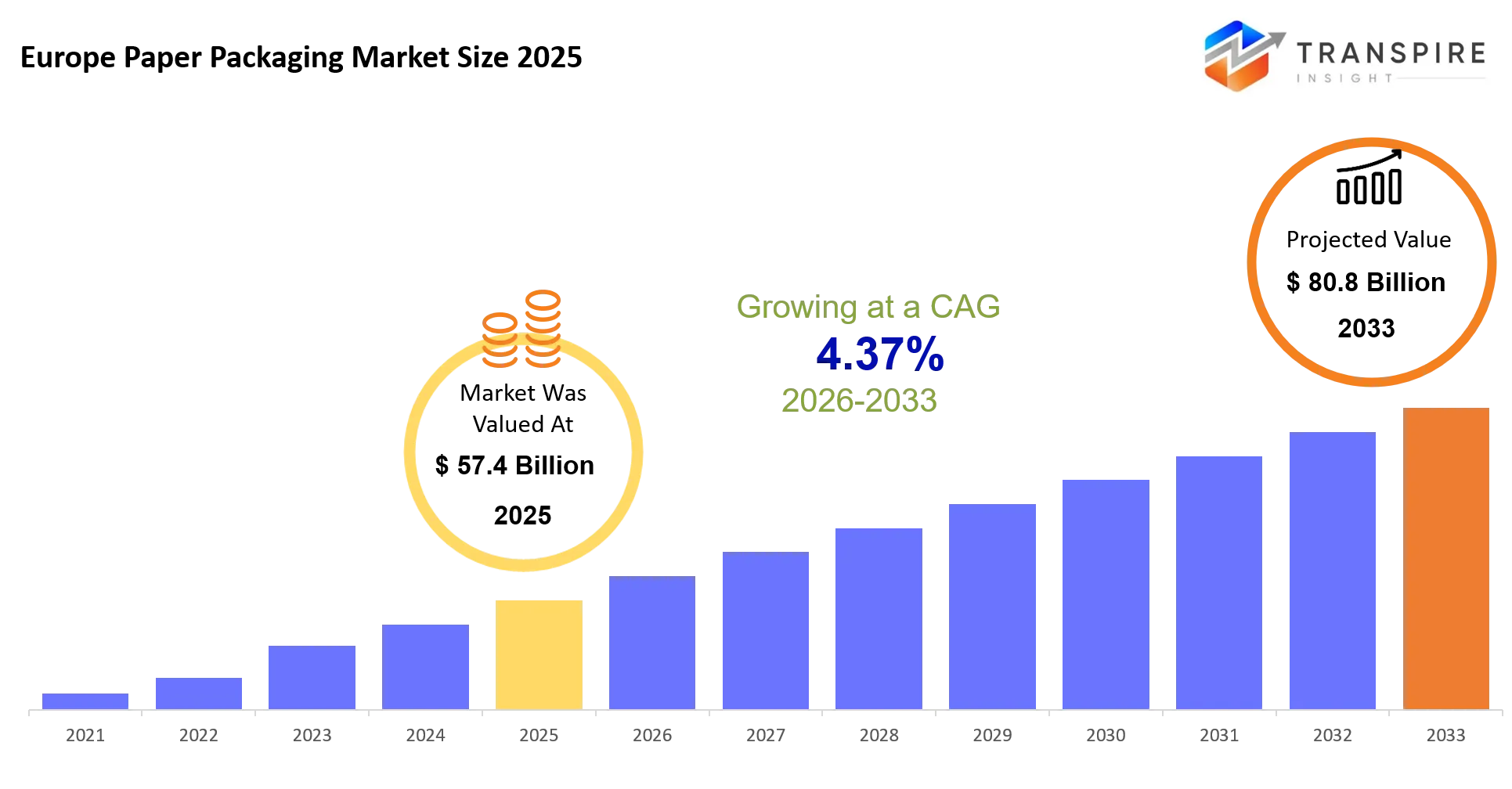
As per Transpire Insight Analysis theEurope Paper Packaging Market size is estimated at USD 57.4 Billion in 2025 and is anticipated to reach USD 80.8 Billion by 2033, growing at a CAGR of 4.37% from 2026 to 2033.
The Europe Paper Packaging Market, kind of plays this critical role in shielding products, also supporting efficient transport, while helping manufacturers , retailers, and logistics providers juggle sustainability goals and regulatory needs without fully losing packaging performance. Paper based solutions cover everything from food and beverages to pharmaceuticals and e-commerce, because they’re recyclable, fairly light in weight , and flexible enough to fit modern supply chain expectations. Over the past three to five years , the whole market has been moving away from usual paper formats toward higher performance fiber packaging , with better barrier properties and even digital printing options. This change seemed to speed up once the European Union tightened rules around single-use plastics, and packaging waste, so companies had to redesign their packaging collections around recyclable materials. As organizations put money into paper alternatives to stay compliant and keep consumer trust, demand didn’t just stay in basic cartons, it stretched into premium and more specialized uses. That kind of direction has nudged capacity expansion, material innovation, and longer term supply agreements, which ultimately builds more durable revenue potential across the European paper packaging value chain .
Europe Paper Packaging Market Size & Forecast:
- Europe Paper Packaging Market Size 2025: USD 57.4 Billion
- Expected Market Value 2033: USD 80.8 Billion
- Forecast CAGR: 4.37%
- Leading region in 2025: Germany
- Fastest Growing region: Eastern Europe (led by Poland and Romania)
- Key Profile: Smurfit Westrock, Mondi, DS Smith, International Paper, Stora Enso, Mayr-Melnhof, Sappi, Graphic Packaging, Sonoco, Huhtamaki, Billerud, UPM-Kymmene, Metsä Board, Rengo, Packaging Corporation of America
Key Market Insights
- In 2025 Germany, kinda ran the Europe paper packaging industry with about 22% market share, mainly because it has such a big food processing scene plus heavy industrial manufacturing.
- Meanwhile, Eastern Europe is expected to grow the quickest from 2025–2033, and a lot of that comes from more money going into packaging production in Poland, Romania and the nearby countries too
- When it comes to the product side, corrugated boxes took the lead in 2025 with close to 39% market share, and it looks like e-commerce fulfillment stayed pretty steady along with industrial logistics needs, all the time.
- Folding cartons ended up as the second-largest slice, partly since pharmaceutical, cosmetics, and premium consumer goods makers kept increasing their use of branded paper packaging, a bit more each year.
- For flexible paper packaging, the fastest growth is anticipated through 2033, helped by improvements in recyclable barrier coatings that are gradually swapping out plastic laminates in practice.
- On the application front, food and beverage packaging dominated in 2025, around 48% market share, and that matches the regulatory pressure on plastic packaging across Europe.
- E-commerce packaging is forecast to stay the fastest-growing application through 2033, as omnichannel retail keeps expanding and therefore raises demand for lightweight shipping materials.
- As for end users, food and beverage manufacturers stayed on top, roughly 44% market share over the period, helped by ongoing packaging conversion initiatives and similar moves.
- Finally, e-commerce and logistics companies are set to become the fastest-growing end-user category during 2025–2033, with demand backed by automated fulfillment network expansion, not just slow growth but more systems going live.
What are the Key Drivers, Restraints, and Opportunities in theEurope Paper Packaging Market?
The strongest growth driver is Europe's tightening packaging legislation, plus the circular economy framework, you know. The Packaging and Packaging Waste Regulation effectively sped up the replacement of those hard-to-recycle plastic formats with fiber-based alternatives across retail, food service, and consumer goods. Brand owners then reacted by reworking their packaging portfolios, and they also started signing long-term procurement agreements with paper converters. In practice, that move increased production capacity and it pushed investments into coated paper technologies. With better print quality and stronger barrier performance, the commercial use cases really widened. So revenue growth is shifting more and more toward value-added packaging, rather than plain commodity paper products.
The biggest brake though stays the volatility in recovered fiber, pulp, and energy costs. Paper mills need capital intensive equipment, and they cannot just flip production quickly when raw material availability changes. Capacity additions are not immediate either, because environmental approvals come first and the investment timelines are substantial. Based on a Transpire Insight review of regional procurement announcements and launch schedules, supply chain concentration remains the main execution risk. All these limits end up delaying new product commercialization, squeezing converter margins, and putting off expansion plans especially for smaller regional manufacturers operating with tight cost structures.
A huge opening lies in recyclable high barrier paper packaging, made for food, pharmaceuticals and personal care goods, you know. With water-based coatings plus fiber engineering, and digital converting tech, paper forms can now stand in for multi layer plastic formats, even in more demanding uses. Western European retailers keep putting money in plastic reduction programs, while Eastern Europe is bringing in new converting facilities and logistics hubs, kind of at the same time. The firms that blend advanced coating methods with automated manufacturing and nearby recycling partnerships will end up with better pricing influence, and also steadier long term supply contracts.
What Has the Impact of Artificial Intelligence Been on theEurope Paper Packaging Market?
Artificial intelligence is kind of reshaping paper packaging production, mostly by bumping up manufacturing precision, quality checks, and yeah supply chain coordination. With AI vision systems, the board gets inspected for quality, print registration, coating uniformity, and even converting defects all in real time, so the factory ends up wasting less material while production yields go up. At the same time, machine learning models help tune machine settings on their own based on paper grades, humidity, and how fast the line runs, which leads to more steady performance across different product lines, not just one. Then predictive analytics comes in for maintenance planning—corrugators, printers, and cutting equipment get attention before failures happen , interrupting everything.
On top of that digital forecasting platforms blend retailer orders, seasonal buying habits, and logistics info, so inventory planning improves and excess stock is reduced across the whole packaging value chain. In practice, this raises equipment availability, shortens production lead times, and pulls down operating costs while also improving delivery reliability for converters and brand owners. Digital twins are even used so manufacturers can “test” packaging designs before commercial production, lowering development cycles. Still, the rollout is uneven, because a lot of converting facilities keep running older equipment that doesn’t really have standardized digital connectivity.
So the integration costs are high, production data is scattered, and interoperability between equipment suppliers feels inconsistent , which basically keeps broad adoption limited across much of the European paper packaging industry.
Key Market Trends
- Since 2022, recyclable barrier coated paper sort of replaced multilayer plastic packaging in several food categories, and it’s been spreading through commercial use across European retail chains, yeah.
- Digital printing took off more quickly between 2023 and 2025, so production runs became shorter, customization felt faster, and converters could cut inventory costs a bit, too.
- Automated corrugated box production has been expanding all over Germany and Poland. Manufacturers actually invested in robotics to bump up throughput, and labor productivity, without making it overly complicated.
- Fiber recovery infrastructure got better after 2022, which makes it possible to use more recycled content packaging, but still keep the strength and not mess up print quality for industrial applications.
- Mondi and DS Smith also pushed investment into circular packaging innovation, basically concentrating on recyclable fiber solutions for consumer goods and e-commerce markets.
- Water based barrier coatings gained real commercial momentum during 2024–2025, helping paper packaging adoption for moisture sensitive food products, and even healthcare items as well.
- Eastern European converting capacity grew because multinational manufacturers set up production nearer to regional consumer goods and logistics hubs.
- Lightweight cartonboard designs lowered transportation costs while holding structural performance steady, and that improved supply chain efficiency across retail distribution networks.
- Smart manufacturing platforms increasingly blend AI driven quality inspection, along with predictive maintenance, cutting downtime and making production more consistent across European packaging plants.
Europe Paper Packaging Market Segmentation
By Product Type :
Corrugated boxes take the biggest share because a sturdy build helps with transportation , warehousing, and that whole e-commerce delivery across Europe. Food producers, industrial suppliers, and online merchants still lean on corrugated packaging for keeping products safe and for easier, efficient handling. Folding cartons also grab a notable portion of the market, mainly because they’re broadly used in food , pharma, cosmetics, and general consumer goods packaging. Better printing, plus stronger shelf visibility , makes demand rise for branded items.
Paper bags keep moving in to replace regular plastic carry bags in retail and grocery uses, especially as sustainability rules tighten . Paper cups and paper containers stay fairly steady too, driven by food service businesses that keep switching to recyclable packaging formats. Wrapping papers and pouches are also gaining more traction, thanks to upgrades in barrier coatings that help with product protection. Beyond that, other product types support specialized packaging requirements across industrial , luxury and smaller niche consumer uses.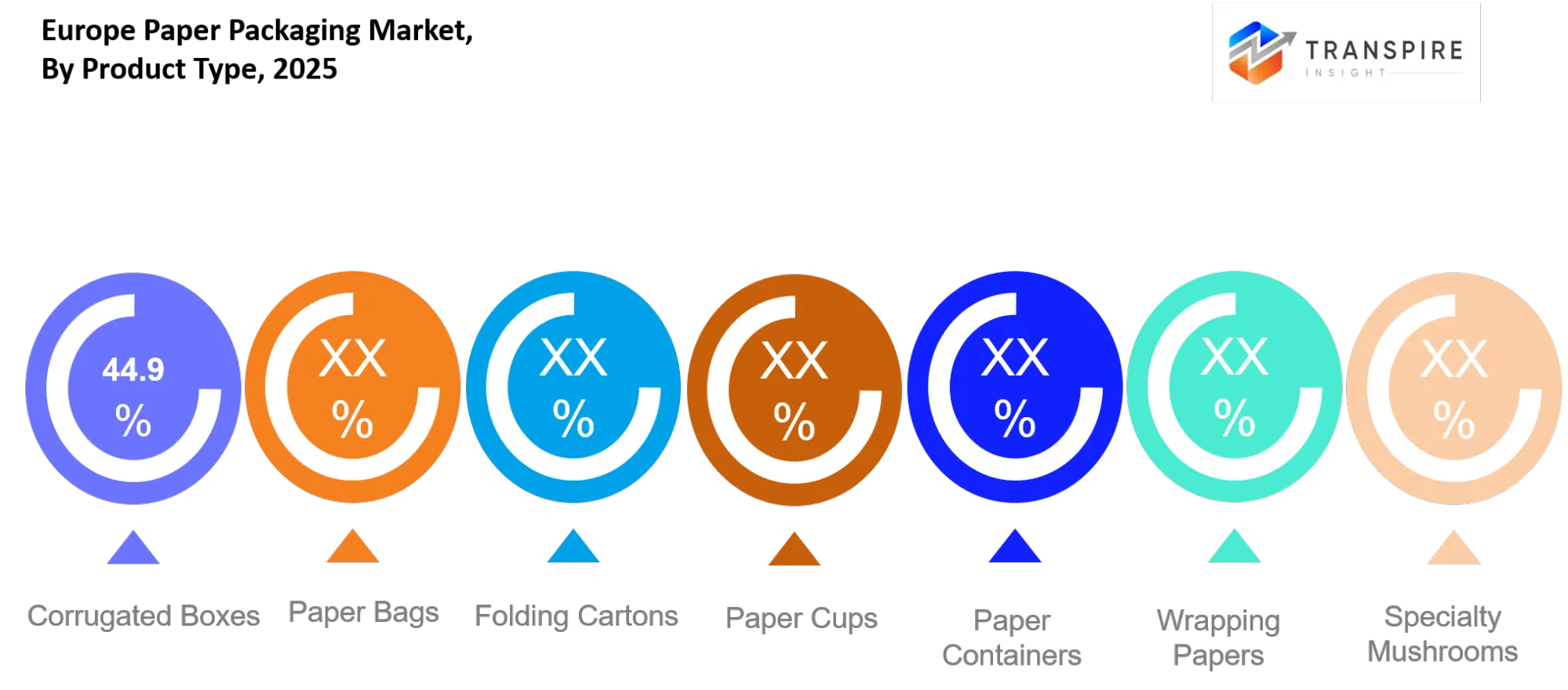
By Material :
Kraft paper stays as the go to option most of the time, since high strength durability and recyclability work together well for shipping cartons, industrial wrapping, and shop shelf use. It is also broadly available and performs pretty reliably, so companies can keep using it the same way across different fields, even when the process changes a bit. Recycled paper keeps moving ahead because makers try to cut down on raw material needs while still hitting circular economy goals and overall targets. Collection routes and recycling facilities all around Europe keep getting better, so more recycled fiber shows up for commercial production.
Virgin paper still matters, especially when food safety, hygiene, and a more premium look have to be guaranteed. Coated paper seems to get stronger adoption too, mostly because modern coatings boost moisture resistance and grease blocking, plus the print comes out better without basically blocking recyclability. Specialty paper then fills the gap for upscale packaging, luxury items, and technical uses that need particular performance traits. And with bleached, unbleached and other paper grades, manufacturers get extra flexibility to match what different customers ask for.
By End User :
Food and beverage companies sit as the biggest end user group, largely because packaged meals, drinks, and takeaway services basically need steady, compliant packaging solutions all the time. Strong rules push the move away from plastic formats and toward recyclable fiber based alternatives across supermarkets, and restaurants too. E commerce keeps growing fast, and the fulfillment centers end up needing lightweight, protective, cost efficient shipping materials, every day. Healthcare also adds pretty consistent pull, think pharmaceutical cartons and medical packaging that must satisfy strict quality requirements.
Retail businesses keep rolling out branded paper packaging that feels nicer for shoppers, while still backing the sustainability targets. Consumer goods manufacturers put money into appealing packaging, which helps shelf visibility, and also keeps the items protected. Industrial businesses want rugged transport packaging for machinery, components, and bulk product runs. Personal care brands are also coming out with recyclable packaging concepts, supporting environmental promises and a more premium brand positioning, at the same time.
By Application :
General packaging still seems to stay the main deal , largely because almost every manufacturing sector leans on paper based solutions for handling, transport, and how items are presented . Shipping use cases keep growing, too, as online retail keeps rolling along and regional logistics investments appear more often. Storage applications hold pretty steady , since products need protection during warehousing , and all the distribution steps that follow. Protective packaging also helps with safe transit, by cutting down product damage when people are moving items around , loading , unloading, and similar tasks.
Food packaging shows notable growth because regulatory shifts push recyclable materials across fresh foods, frozen products, bakery goods, and takeaway services. Pharmaceutical packaging stays on a steady expansion track , guided by strict quality expectations and secure handling requirements for the product. Gift packaging does well thanks to premium printing, personalization options, and the seasonal demand that retail tends to generate. Other applications keep developing, mainly because newer paper technologies improve strength, boost barrier performance, and widen how versatile the paper can be for different products.
By Packaging Type :
Rigid packaging pretty much takes the biggest share, mostly because cartons, boxes, and containers bring real structural strength during transport and they also look good for retail display. Secondary packaging is still kind of in the mix too, it groups items more efficiently for storage, distribution, and merchandising , even when the supply chain gets busy. And primary packaging stays just as necessary since it’s the layer that directly shields the product—especially across food, healthcare, and personal care industries. Meanwhile tertiary packaging basically helps with large-scale logistics, by making handling faster across warehouses and transportation networks.
Flexible packaging keeps growing quicker than the others, largely because lightweight paper materials boost shipping efficiency and cut down material usage. Semi rigid packaging sits in the middle, it gives that compromise between bendability and structural support, which works well for some consumer products. Custom packaging is gaining wider adoption too, because brands are pushing product differentiation , digital printing, and those more personalized customer experiences. As for the rest, other packaging formats keep serving specialized industrial and commercial requirements across European manufacturing sectors .
What are the Key Use Cases Driving the Europe Paper Packaging Market?
Food and beverage packaging still is the main thing, mainly because manufacturers want dependable, recyclable material for processed foods, drinks, bakery goods, and fresh produce. The big producers, the supermarket chains ,and private-label brands buy in huge amounts to satisfy packaging rules, but also to keep the product safe during distribution.
Healthcare and e-commerce keep growing too. Pharmaceutical companies are starting to use fiber-based cartons for medicines and medical items, while online retailers ramp up orders for tougher shipping formats so there’s less transport damage. At the same time retail brands roll out premium paper packaging, kind of to improve the whole product look and also to match sustainability commitments.
New chances are also forming around insulated paper packaging, specifically for temperature sensitive goods. There’s also fiber-based protective packaging being used for electronics and industrial tools. These areas tend to work well thanks to improved barrier coatings, lighter weight material design, and European packaging regulations that push recyclable alternatives in places where plastic solutions have, for years, been the default.
|
Report Metrics |
Details |
|
Market size value in 2025 |
USD 57.4 Billion |
|
Market size value in 2026 |
USD 59.9 Billion |
|
Revenue forecast in 2033 |
USD 80.8 Billion |
|
Growth rate |
CAGR of 4.37% from 2026 to 2033 |
|
Base year |
2025 |
|
Historical data |
2021 - 2024 |
|
Forecast period |
2026 - 2033 |
|
Report coverage |
Revenue forecast, competitive landscape, growth factors, and trends |
|
Regional scope |
Europe (Germany, United Kingdom, France, Italy, Spain and Rest of Europe) |
|
Key company profiled |
Smurfit Westrock, Mondi, DS Smith, International Paper, Stora Enso, Mayr-Melnhof, Sappi, Graphic Packaging, Sonoco, Huhtamaki, Billerud, UPM-Kymmene, Metsä Board, Rengo, Packaging Corporation of America . |
|
Customization scope |
Free report customization (country, regional & segment scope). Avail customized purchase options to meet your exact research needs. |
|
Report Segmentation |
By Product Type (Corrugated Boxes, Paper Bags, Folding Cartons, Paper Cups, Paper Containers, Wrapping Papers, Pouches, Others); By Material (Kraft Paper, Recycled Paper, Virgin Paper, Coated Paper, Specialty Paper, Bleached Paper, Unbleached Paper, Others); By End User (Food & Beverage, E-Commerce, Healthcare, Retail, Consumer Goods, Industrial, Personal Care, Others); By Application (Packaging, Shipping, Storage, Food Packaging, Pharmaceutical Packaging, Gift Packaging, Protective Packaging, Others); By Packaging Type (Flexible Packaging, Rigid Packaging, Semi-Rigid Packaging, Primary Packaging, Secondary Packaging, Tertiary Packaging, Custom Packaging, Others) |
Which Regions are Driving theEurope Paper Packaging Market Growth?
Germany ends up with the biggest chunk of the European market, roughly 22% of the regional revenue, which is kind of surprising if you think about how competitive it all is. On top of that, strong packaging rules, well built recycling systems and tight manufacturing standards push companies to keep investing in paper based packaging solutions. There’s also a dense set of paper mills, converters, packaging technology suppliers, and consumer goods manufacturers, and it all links up pretty smoothly… so raw material availability stays dependable. Looking ahead, ongoing work on recyclable barrier materials plus more automation should help Germany hang onto its regional leadership during the forecast window.
Western Europe stays near the top as the second most influential region, mainly because consumer industries are already mature, regulatory guidance is fairly predictable, and manufacturing output remains stable. In places like France, Italy, Spain, and the Netherlands, investment is spread across food processing, pharmaceuticals, retail, and industrial manufacturing rather than being locked into just one lane. Plus, long term sustainability policies nudge manufacturers to modernize converting facilities without sacrificing production efficiency. So in the end, this mix supports consistent revenue generation, and it keeps steady business expansion moving across the usual supply chains.
In Eastern Europe, analysts are expecting some of the fastest growth, mainly after new manufacturing investments kicked in logistics expansion, plus more packaging production capacity showing up across Poland, Romania, and a few nearby countries. At the same time, lower operating costs, and a generally better transport infrastructure , have pushed multinational consumer goods companies to set up extra production sites right inside the region, not elsewhere.Industrial exports keep climbing and the regional distribution routes are still widening, so demand for stronger paper packaging solutions keeps building up. All of this, taken together, should open up appealing possibilities for converters, equipment suppliers, and investors, who are looking for a longer term expansion period from 2026 through 2033.
Who are the Key Players in theEurope Paper Packaging Market and How Do They Compete?
Across the European paper packaging industry, competition is only sort of consolidated, in the sense that you can see a mix—multinational manufacturers on one hand, and regional converters on the other, who tailor their output to specialized customer needs. What decides who wins is usually production efficiency, recyclable material innovation, where they can serve from geographically, plus long-term business ties, not just price. Bigger groups keep pushing harder by putting money into technology and adding capacity, meanwhile the smaller regional players tend to fight with customized packaging solutions and quicker, local delivery.
Smurfit Westrock works with integrated corrugated packaging and recycling operations, so they can keep closer control over raw materials, and also push production efficiency. DS Smith leans into circular packaging design and builds close collaboration with consumer brands, with the aim of reducing packaging waste throughout retail supply chains. Mondi, instead, invests in recyclable barrier paper technologies that can replace plastic packaging, especially in food and consumer goods, while also expanding manufacturing capacity across Europe.
Stora Enso highlights renewable fiber materials and lightweight packaging options, trying to cut down material usage without losing performance. Metsä Board is known for premium fresh fiber cartonboards, with solid print quality and food-safety oriented features, which helps brand owners with product presentation. International Paper continues to broaden its converting capabilities and regional production networks, which strengthens supply reliability and improves service levels for multinational manufacturers active across European markets.
Company List
Mondi
DS Smith
Stora Enso
Sappi
Sonoco
Huhtamaki
Billerud
UPM-Kymmene
Metsä Board
Rengo
Packaging Corporation of America
Recent Development News
In April 2026, Mondi showcased multiple sustainable packaging innovations at interpack 2026 through new OEM collaborations. The partnerships expanded recyclable paper-based packaging solutions for food and consumer goods applications, strengthening technology adoption across the European packaging sector. Sourcehttps://www.mondigroup.com/
In January 2026, International Paper announced plans to separate its Europe, Middle East and Africa packaging business into an independent publicly traded company following the acquisition of DS Smith. The restructuring is expected to sharpen regional investment priorities and strengthen strategic focus within the European paper packaging industry.
Source https://www.internationalpaper.com/
What Strategic Insights Define the Future of theEurope Paper Packaging Market?
The Europe Paper Packaging Market seems to be moving toward a value driven model, where material performance recyclability, and digital manufacturing abilities are becoming more noticeable competitive edges than just raw production scale. The main engine of this whole shift is kind of a combo of tighter packaging rules, plus brand owners pledging to redesign their products, so circular material flows actually work in practice. There is also a quieter kind of risk too, not as obvious at first, from relying more on recycled fiber availability. Like, if regional collection rates wobble, or energy expenses move up and down, and pulp supply has its own little swings, then pricing pressure shows up and production capacity can end up uneven, even while demand still looks strong.
At the same time, an opportunity is taking shape in high barrier fiber packaging for pharmaceutical products, frozen food, and personal care. In these uses, advanced coating techniques are starting to stand in for the more complex plastic layouts. Firms that push early into barrier innovation, bring in automated converting lines, and also set up production capacity in the faster expanding Eastern European manufacturing areas, should end up with better odds to lock in long-term contracts. That should help improve profitability across the next decade, as markets tighten and customers get more selective.
Europe Paper Packaging Market Report Segmentation
By Product Type
- Corrugated Boxes
- Paper Bags
- Folding Cartons
- Paper Cups
- Paper Containers
- Wrapping Papers
- Pouches
By Material
- Kraft Paper
- Recycled Paper
- Virgin Paper
- Coated Paper
- Specialty Paper
- Bleached Paper
- Unbleached Paper
By End User
- Food & Beverage
- E-Commerce
- Healthcare
- Retail
- Consumer Goods
- Industrial
- Personal Care
By Application
- Packaging
- Shipping
- Storage
- Food Packaging
- Pharmaceutical Packaging
- Gift Packaging
- Protective Packaging
By Packaging Type
- Flexible Packaging
- Rigid Packaging
- Semi-Rigid Packaging
- Primary Packaging
- Secondary Packaging
- Tertiary Packaging
- Custom Packaging
Frequently Asked Questions
Find quick answers to common questions.
The Expected Europe Paper Packaging Market size for the Market will be USD 80.8 Billion in 2033.
Key Segments for theEurope Paper Packaging Market are By Product Type (Corrugated Boxes, Paper Bags, Folding Cartons, Paper Cups, Paper Containers, Wrapping Papers, Pouches, Others); By Material (Kraft Paper, Recycled Paper, Virgin Paper, Coated Paper, Specialty Paper, Bleached Paper, Unbleached Paper, Others); By End User (Food & Beverage, E-Commerce, Healthcare, Retail, Consumer Goods, Industrial, Personal Care, Others); By Application (Packaging, Shipping, Storage, Food Packaging, Pharmaceutical Packaging, Gift Packaging, Protective Packaging, Others); By Packaging Type (Flexible Packaging, Rigid Packaging, Semi-Rigid Packaging, Primary Packaging, Secondary Packaging, Tertiary Packaging, Custom Packaging, Others).
Major Europe Paper Packaging Market Players are Smurfit Westrock, Mondi, DS Smith, International Paper, Stora Enso, Mayr-Melnhof, Sappi, Graphic Packaging, Sonoco, Huhtamaki, Billerud, UPM-Kymmene, Metsä Board, Rengo, Packaging Corporation of America.
The Current Europe Paper Packaging Market size is USD 57.4 Billion in 2025.
The Europe Paper Packaging Market CAGR is 4.37% from 2026 to 2033.
- Smurfit Westrock
- Mondi
- DS Smith
- International Paper
- Stora Enso
- Mayr-Melnhof
- Sappi
- Graphic Packaging
- Sonoco
- Huhtamaki
- Billerud
- UPM-Kymmene
- Metsä Board
- Rengo
- Packaging Corporation of America
About the Authors

Kartik bhong
I am Kartik Bhong, a Senior Research Analyst at Transpire Insight, specializing in the Packaging, Manufacturing, and Construction industry. My work focuses on analyzing market trends, emerging technologies, industry regulations, and competitive landscapes to deliver accurate, data-driven insights. I am passionate about transforming complex industry information into clear, practical content that helps businesses, professionals, and decision-makers stay informed and make confident strategic decisions. Through continuous research and a strong commitment to accuracy, I strive to create reliable, well-researched content that reflects the latest developments across these dynamic industries and supports the vision of Transpire Insight in delivering valuable market intelligence.

Chakradhar Khansole
Chakradhar serves as the Research Director at Transpire Insight, bringing over 8 years of experience in technology, innovation, and strategic market intelligence. He specializes in transforming complex market data into actionable business insights that enable organizations to make informed, growth-oriented decisions. Recognized for his strategic vision and analytical expertise, Chakradhar leads high-impact research initiatives, delivering comprehensive market assessments, competitive intelligence, and forward-looking industry analysis.
Recently Published Reports
-
Apr 2026
Pharmaceutical Cold Chain Packaging Market
Pharmaceutical Cold Chain Packaging Market By Material (Plastic,(Polyethylene (PE), Polypropylene (PP), Polyethylene Terephthalate (PET), Expanded Polystyrene (EPS), Polyurethane (PU),Others), Paper, Metal, Others), By Product (Small Boxes, Pallets, Large Sized Pallet Containers, Others), By End Use (Biopharmaceutical Companies, Clinical Research Organizations, Hospitals, Research Institutes, Logistics and Distribution Companies, Others)”, By Industry Analysis, Size, Share, Growth, Trends, and Forecasts 2026-2033
-
Apr 2026
Active & Intelligent Packaging Market
Active & Intelligent Packaging Market By Type (Active Packaging, Smart Packaging), By Material (Polymer-Based, Paper & Board-Based, Metal-Based, Glass-Based), By Technology (Time-Temperature Indicators, Freshness Indicators, RFID, Antimicrobial Packaging, Modified Atmosphere Packaging), By Application (Food & Beverages, Pharmaceutical, Cosmetics & Personal Care, Electronics & Consumer Goods, Others), By Industry Analysis, Size, Share, Growth, Trends, and Forecasts 2026-2033
-
Apr 2026
Biodegradable Cut Flower Packaging Market
Biodegradable Cut Flower Packaging Market By Material Type (Paper & Paperboard, Biodegradable Plastics, Natural Fibers, Molded Pulp, Others), By Product Type (Sleeves, Wraps, Boxes & Cartons, Bags & Pouches, Inserts & Holders), By Application (Roses, Carnations, Tulips, Chrysanthemums, Mixed Flowers, Others) and By Distribution Channel (Direct Sales, Distributors & Wholesalers, Online Channels), By Industry Analysis, Size, Share, Growth, Trends, and Forecasts 2026-2033
-
May 2026
Pharmaceutical Packaging Market
Pharmaceutical Packaging Market By Material Type (Plastic, Glass, Metal, Paper & Paperboard, Others), By Packaging Type (Bottles, Blister Packs, Vials, Ampoules, Pouches & Sachets, Others) and By End User (Hospitals & Clinics, Retail Pharmacies, Online Pharmacies, Pharmaceutical Manufacturers), By Industry Analysis, Size, Share, Growth, Trends, and Forecasts 2026-2033