

Global E-Commerce Packaging Market Size & Forecast:
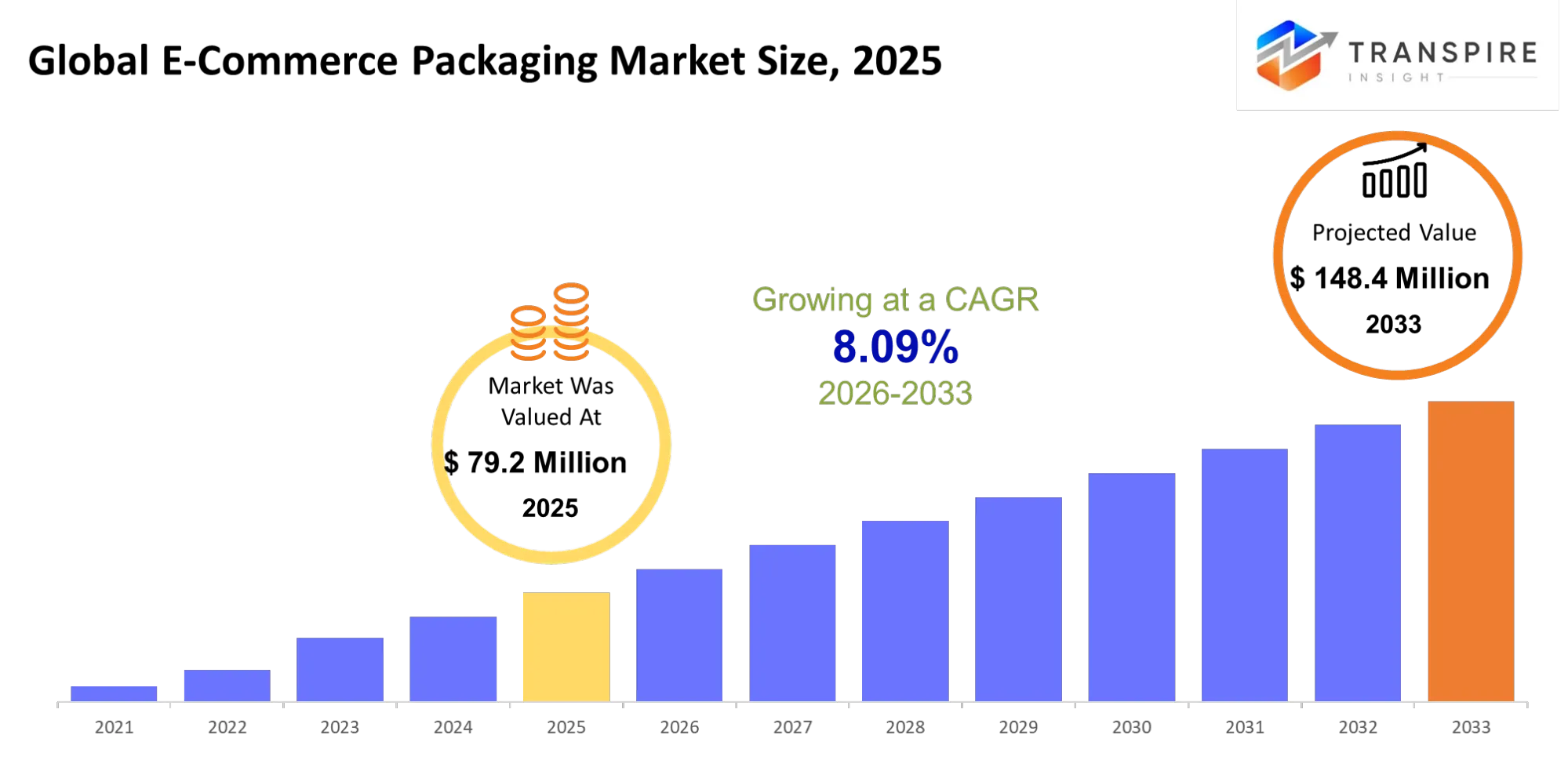
- Global E-Commerce Packaging Market Size 2025: USD 79.2 billion
- Global E-Commerce Packaging Market Size 2033: USD 148.4 billion
- Global E-Commerce Packaging Market CAGR: 8.09%
- Global E-Commerce Packaging Market Segments: By Packaging Type (Corrugated Boxes, Mailers, Protective Packaging, Flexible Packaging, Bags & Pouches, Labels & Tapes, Others); By Material (Paper & Paperboard, Plastic, Biodegradable Materials, Molded Fiber, Others); By End User (Fashion, Electronics, Food & Beverage, Healthcare, Personal Care, Others); By Packaging Function (Primary Packaging, Secondary Packaging, Tertiary Packaging, Others); By Distribution Channel (Direct Sales, Online Platforms, Distributors, Others)
Global E-Commerce Packaging Market Summary:
As per Transpire Insight Analysis, the Global E-Commerce Packaging Market size is estimated at USD 79.2 billion in 2025 and is anticipated to reach USD 148.4 billion by 2033, growing at a CAGR of 8.09% from 2026 to 2033.
The global e-commerce packaging market is really important for stores. It helps them keep products get things to people faster and make customers happy. Packaging is not about protecting things anymore. It is also used to help people know what brand something is make shipping cheaper, and be kind to the environment.
A big change in the e-commerce packaging market is that people want packaging that's good for the earth and can be recycled. This is because of rules to help the environment and people wanting products that're eco-friendly. More people are shopping online because of e-commerce companies and better ways to get things to people. This means there is a need for packaging that is strong and does not cost too much.
As online stores get orders and need to get things to people faster, they are using new kinds of packaging and smart technologies to make things work better, stop products from getting broken and not hurt the environment. This is making the e-commerce packaging market grow. It will keep growing for a long time. The e-commerce packaging market is getting bigger because of this. The e-commerce packaging market will have opportunities to grow in the future.
Key Market Insights:
The market of packaging for e-commerce is rapidly changing in the direction of fast delivery of goods, product safety, and sustainable packaging options. There are innovations in packaging materials and automation technologies.
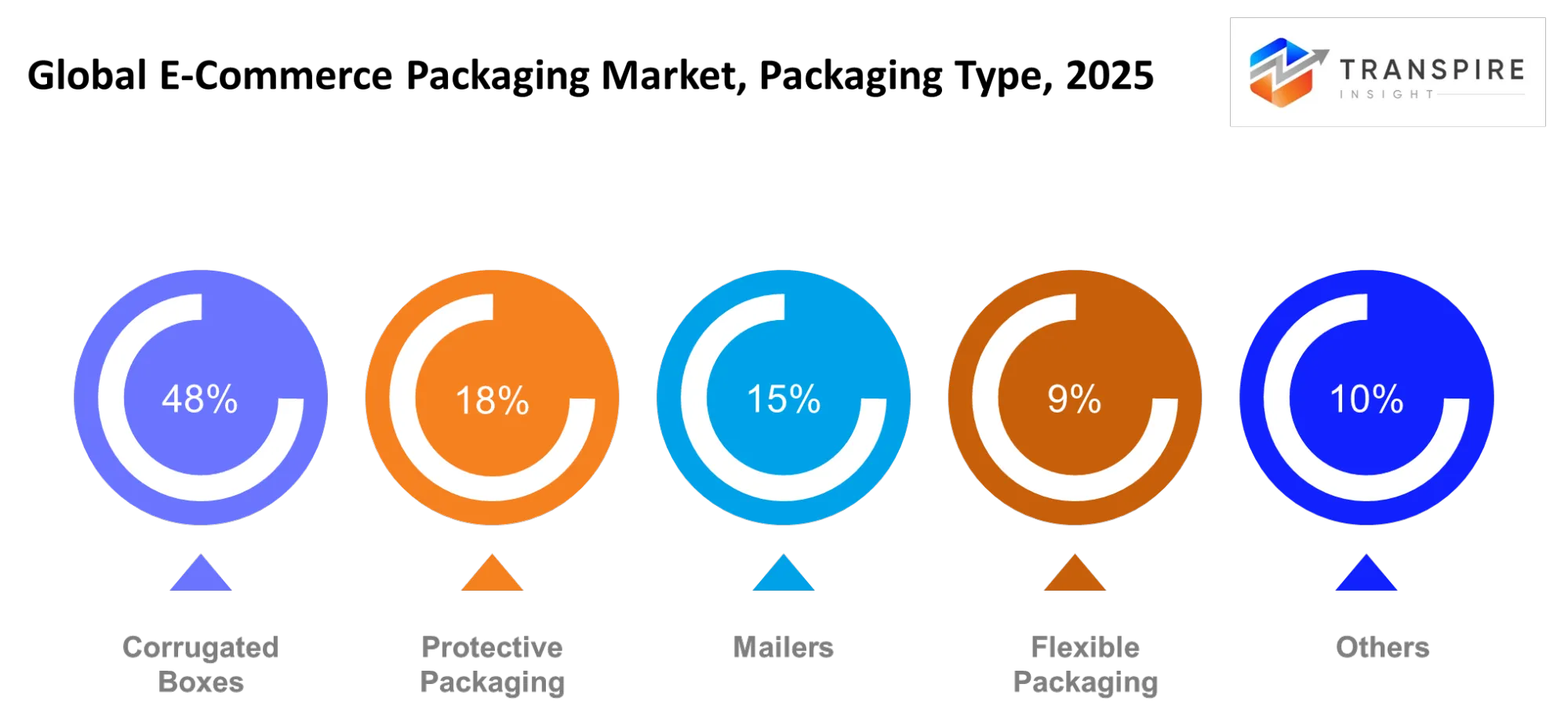
- Corrugated boxes continue to be the most popular packaging option with a share of 48%, thanks to such qualities as durability, lightness, and suitability for shipping many types of products.
- Protective packaging comprises 18% of the total market volume. The development of recyclable cushioning packaging materials helps protect products from damage during shipping.
- Mailers make up 15% of the total market volume, as there is an increase in the shipment of apparel, accessories, and other small products via online retail.
- Flexible packaging takes up 9% of the total market, and its popularity increases as it helps decrease the weight of packaging, increase storage efficiency, and decrease the cost of shipping.
- Sustainable packaging is the most rapidly developing segment of the market, with the anticipated growth of 16.3% per year, due to regulations and consumers' demand.
- Companies that produce packaging invest in automation of processes and digital printing.
- Right-size packaging becomes more popular among e-commerce companies as it helps save material and money on shipping.
What are the Key Drivers, Restraints, and Opportunities in the Global E-Commerce Packaging Market?
Drivers
The growing popularity of online shopping is driving the development of the international e-commerce packaging market. In recent years, customers have begun demanding more timely delivery and protective and convenient packaging. Additionally, the development of direct-to-consumer brand channels, increased use of smartphones, and improving digital payments systems have boosted the demand for online purchases. Packaging is used not only for the protection of products but for cost reduction and logistics optimisation. Thus, the increasing number of orders led to the growing demand for innovative packaging in industries including electronics, fashion, health care, and food & beverages sectors.
Restraints
Nevertheless, the rising price of raw materials and increasing stringency of the regulatory framework on plastic packaging can negatively affect the industry's performance in the upcoming years. The increasing price of paper, cardboard, resin and other packaging materials increases production costs. Moreover, compliance with sustainability standards also demands significant investments. For instance, many small and medium-sized companies involved in packaging production do not have an opportunity to upgrade their production facilities and change their production materials.
Opportunities
An opportunity exists in the increasing use of sustainable and intelligent packaging. Companies have created sustainable packaging that is recyclable and biodegradable and reduces weight to fulfil environmental obligations. Moreover, technologies like smart labelling and QR code packaging, as well as automatic packaging machinery, will help companies improve visibility and interaction with customers. An increase in e-commerce in emerging markets, with support from investments in logistics infrastructure and internet availability, is expected to bring about long-term growth for packaging companies.
What Has the Impact of Artificial Intelligence Been on the Global E-Commerce Packaging Market?
Through artificial intelligence, the e-commerce packaging industry is benefiting through increased production efficiency, reduced wastage and optimisation of the packaging process through the recommendation of the right packaging size according to analysis of order patterns, product size and shipping requirements, which ensures minimal packaging materials are used, thus saving on transportation costs. Artificial intelligence is being used in demand forecasting and inventory planning, where companies get the right packaging needs and the right stock to prevent shortages and material wastage and ensure quick fulfilment of orders during peak demand periods.
In manufacturing plants, artificial intelligence quality control tools detect any defects in packaging that can lead to product returns and ensure consistency of the packaging process. Through a combination of quality inspection tools and automated packaging machines, manufacturers are able to increase production rate and retain product quality.
However, the use of AI-powered packaging requires considerable expenditure on software, automation technology, and training for employees. Small and medium-sized packaging enterprises still find it difficult to incorporate AI technology into their production facilities due to high implementation costs and lack of compatibility with old manufacturing technology.
Key Market Trends:
The global packaging market for the e-commerce industry experiences an extensive evolution due to the growing concern about sustainability, efficiency, and customer experience. Technological progress and changes in customer behaviour continue to evolve the packaging strategy for the supply chain.
- Package manufacturing companies replace traditional materials with recyclable, biodegradable, and paper-based packaging to satisfy environmental laws and customers' demands.
- Retail companies use right-sized packaging to save material, maximise shipment space, and reduce shipping costs.
- Automated systems become a part of the process of packaging to increase the speed of production, minimise manual work, and provide packaging quality.
- Digital printing technology is widely used, allowing brands to create custom packaging designs to engage more customers.
- Integrating smart packaging elements like QR codes, digital tracking, and authentication labels is becoming a trend to make products trackable and provide a better customer experience after purchase.
- The growth of same-day and next-day deliveries stimulates companies to invent durable but lightweight packaging resistant to complicated logistics processes.
- The importance of packages that facilitate the return process grows.
Global E-Commerce Packaging Market Segmentation
By Packaging Type
Corrugated boxes have the highest market share of 48%. They are considered the best option to ship products safely in various industries due to their great strength, lightness and recyclability. The products they can carry include electronics, consumer goods, food products, and home products. Protective packaging has an 18% share, mailers - 15%, flexible packaging has 9% of the market, while other types take 10%. Moreover, sustainable packaging is becoming the fastest-growing segment of the packaging industry due to increased environmental consciousness and tighter packaging legislation.
By Material
Paper and paperboard are leading by material because of their high recyclability, low costs and suitability for sustainable packaging programs. Plastics are commonly used for moisture resistance, lightweight and flexibility in shipping processes as protective packaging and mailers. Biodegradable materials and moulded fibre products become more and more popular due to the efforts made by retailers to cut down plastic usage in order to comply with environmental norms. Renewables will change the future of packaging production significantly.
By End Users
The fashion industry can be considered as among the biggest consumers of packaging in the context of e-commerce owing to frequent purchases and a large volume of shipments. Packaging in the electronics industry should be strong enough to prevent products from getting damaged during transit, and that of the food and beverage industry should be secure enough to keep the products fresh and in a good state. Demand for packaging in healthcare and personal care industries has been rising significantly owing to the growing need for securing products. With more and more people shopping online for diverse products, demand for custom packaging solutions is projected to rise steadily.
By Packaging Function
As per packaging functions, secondary packaging constitutes a substantial proportion of demand since it helps ensure security during storage, handling, and transportation processes. Primary packaging still plays a critical role in protecting products and improving their appearance, and tertiary packaging contributes to easy handling of products in bulk. Companies have been opting for packaging types that help save costs in terms of shipment and warehousing, and decrease risks of product damage.
By Distribution Channel
According to the channel of distribution, direct sales remain significant because big retailers and manufacturers have developed long-term agreements regarding their packaging suppliers. There has been rapid growth in the online channel due to customised packaging services, quick procurement processes, and more available products for companies of different sizes. Distributors still act as useful partners in terms of prompt delivery and a regional supply chain network, while other sales channels help in meeting specific customers' needs. The trend of digitalising procurement processes will positively affect online distribution channel operations in the future.
What are the Key Use Cases Driving the Global E-Commerce Packaging Market?
Corrugated cartons continue to be used widely since they offer protection for products that are delivered via online stores. Corrugated cartons are used extensively in electronic products, household items, fashion items, and consumer appliances to prevent damage during storage and transportation.
The market continues to grow within sectors including food and beverages, health care, and personal care since packaging in such sectors helps maintain product integrity and hygiene. The need for customised packaging and protection materials is increasing to improve customer satisfaction and build a good corporate image.
The applications that are growing in popularity include those involving sustainable packaging, smart packaging, and automated packaging systems. Recyclable packaging and technology-driven packaging systems are gaining importance to enhance supply chain efficiencies and meet the evolving demands of customers and environmental requirements.
|
Report Metrics |
Details |
|
Market size value in 2025 |
USD 79.2 Billion |
|
Market size value in 2026 |
USD 86.1 Billion |
|
Revenue forecast in 2033 |
USD 148.4 Billion |
|
Growth rate |
CAGR of 8.09% from 2026 to 2033 |
|
Base year |
2025 |
|
Historical data |
2021 - 2024 |
|
Forecast period |
2026 - 2033 |
|
Report coverage |
Revenue forecast, competitive landscape, growth factors, and trends |
|
Regional scope |
United States; Canada; Mexico; United Kingdom; Germany; France; Italy; Spain; Denmark; Sweden; Norway; China; Japan; India; Australia; South Korea; Thailand; Brazil; Argentina; South Africa; Saudi Arabia; United Arab Emirates |
|
Key company profiled |
Smurfit Westrock, DS Smith, Mondi, Amcor, Sealed Air, International Paper, Sonoco Products, Pregis, Ranpak, Berry Global, Huhtamaki, ProAmpac, Stora Enso, UFP Packaging, Packaging Corporation of America |
|
Customization scope |
Free report customization (country, regional & segment scope). Avail customized purchase options to meet your exact research needs. |
|
Report Segmentation |
By Packaging Type (Corrugated Boxes, Mailers, Protective Packaging, Flexible Packaging, Bags & Pouches, Labels & Tapes, Others); By Material (Paper & Paperboard, Plastic, Biodegradable Materials, Molded Fiber, Others); By End User (Fashion, Electronics, Food & Beverage, Healthcare, Personal Care, Others); By Packaging Function (Primary Packaging, Secondary Packaging, Tertiary Packaging, Others); By Distribution Channel (Direct Sales, Online Platforms, Distributors, Others) |
Which Regions are Driving the Global E-Commerce Packaging Market Growth?
North America
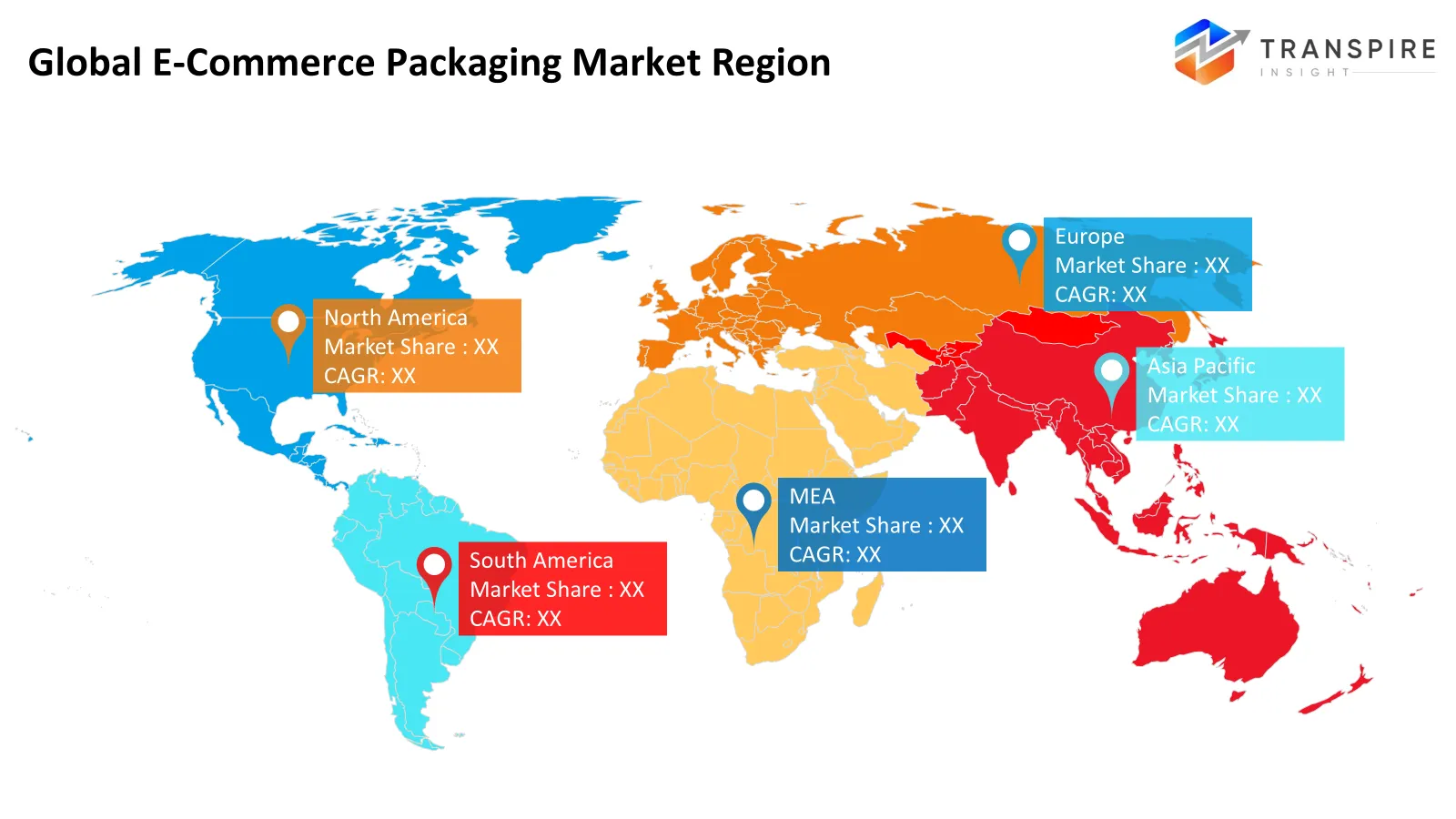
North America captures 29% of the total market share and is set to emerge as the fastest-growing region at a CAGR of 15.2%. Factors that are driving growth include increasing utilisation of automated packaging solutions, artificial intelligence-powered warehousing operations, and high-speed fulfilment networks that enable faster deliveries. Increased focus on smart packaging solutions and eco-friendly materials is enabling organisations to optimise logistics as well as create better customer experiences. With the growing popularity of online shopping across various types of products, North America promises many growth opportunities for packaging companies.In March 2025, Ranpak has extended its range of AI-powered automated paper-based packaging systems for big e-commerce warehouses like Amazon to increase the efficiency of packaging, reduce the usage of plastics, and optimize fulfillment operations in North America.
Europe
Europe occupies 23% of the total global packaging for e-commerce market due to the efforts of sustainability in packaging and the circular economy within its borders. The packaging firms in the Europe region are working toward making use of recyclable materials and paper-based packaging along with sustainable methods of packaging. There is an increased consumer interest in buying sustainable and eco-friendly products; hence, the retailers use such types of packaging to protect the environment from wastage.In May 2025, Mondi has increased production capabilities of its re/cycle MailerBAG at its Poland plant in response to growing demands for sustainable e-commerce packaging for retailers across Europe.
Asia Pacific
The Asia Pacific holds 40% of the market share of global packaging for e-commerce owing to its robust manufacturing sector, burgeoning online retail industry, and efficient supply chain. Nations like China, India, and Japan still have high transactions through e-commerce, which increases the need for affordable and durable packaging. The Asia Pacific region also enjoys having large-scale production facilities, a low cost of manufacturing, and investment in innovations in the field of packaging. As a result, the region retains its dominance in the global market despite the increasing demand from e-commerce companies in domestic and foreign markets.
Who are the Key Players in the Global E-Commerce Packaging Marketand how do they Compete?
The market for packaging in global e-commerce is characterised by high levels of competition, where the firms engage in innovating products, being sustainable in manufacturing and packaging, efficient in production processes, and extending their operations geographically to enhance their competitive advantage. Competition is based on the ability to offer durable and lightweight packaging with a reduced environmental impact according to the needs of e-retailers and e-logistics firms.
The company International Paper is characterised by developing products in the field of paper packaging that are strong but at the same time are environmentally sustainable. Smurfit Westrock engages in developing innovative corrugated packaging and product innovations while increasing its capacity globally. DS Smith engages in developing circular packaging solutions and collaborates with retailers to develop efficient packaging solutions and designs. The competition strategies of Mondi Group include creating flexible packaging and paper packaging materials in line with sustainability objectives in various industries. The strategy employed by Sealed Air includes the use of innovative protective packaging materials to reduce damage during transportation and increase efficiency in the process of fulfilling orders. Pregis concentrates on protective and environmentally friendly packaging products with the help of automation technology. At the same time, Sonoco Products Company increases its portfolio of packaging products through innovations and cooperation and can serve the needs of global e-commerce companies.
Global E-Commerce Packaging Market companies
- Smurfit Westrock
- DS Smith
- Mondi
- Amcor
- Sealed Air
- International Paper
- Sonoco Products
- Pregis
- Ranpak
- Berry Global
- Huhtamaki
- ProAmpac
- Stora Enso
- UFP Packaging
- Packaging Corporation of America
Recent Development News
In February 2025, International Paper completed its acquisition of DS Smith, which formed one of the largest companies that offer sustainable packaging in the world. This will help them become one of the leaders in the world of global corrugated packaging as well as expand its reach in Europe and North America, as well as offer better packaging for e-commerce companies.
https://www.internationalpaper.com
In April 2025, Amcor plc finalised its merger with Berry Global to form a global leader in packaging with a wider range of sustainable and recyclable packaging products. This will ensure that innovations increase along with their manufacturing capabilities, as well as help them serve e-commerce brands all over the world.
In January 2026, International Paper announced their plan to separate its European packaging business into a new publicly held company in order to help it concentrate more on North America.
What Strategic Insights Define the Future of the Global E-Commerce Packaging Market?
The world market for packaging of goods in the e-commerce industry will most likely shift towards more environmentally friendly and technologically advanced, as well as cost-effective, packaging due to the continuous development of online trade in developed countries and in emerging markets. Investing in eco-friendly materials, modern packaging technologies, and automation will allow enterprises to remain competitive and meet customers' expectations and regulations.
One of the latent risks for the market is the instability of material prices and environmental regulations, which may increase production costs and complicate long-term business planning for packaging manufacturers. At the same time, innovations in the field of biodegradable packaging materials and their optimisation through artificial intelligence and digital supply chains create good opportunities for success.
To ensure sustainable development, it is important for packaging companies to pay attention to environmentally friendly products, the creation of regional production facilities, and cooperation with e-commerce and logistics.
Global E-Commerce Packaging Market Segmentation
By Packaging Type
- Corrugated Boxes
- Mailers
- Protective Packaging
- lexible Packaging
- Bags & Pouches
- Labels & Tape
By Material
- Paper & Paperboard
- Plastic
- Biodegradable Materials
- Molded Fiber
By End User
- Fashion
- Electronics
- Food & Beverage
- Healthcare
- Personal Care
By Packaging Function
- Primary Packaging
- Secondary Packaging
- Tertiary Packaging
By Distribution Channel
- Direct Sales
- Online Platforms
- Distributors
By Regional Analysis
North America
- United States
- Canada
- Mexico
Europe
- Germany
- United Kingdom
- France
- Italy
- Spain
- Russia
- Rest of Europe
Asia Pacific
- China
- Japan
- India
- South Korea
- Australia
- Rest of Asia Pacific
South America
- Brazil
- Argentina
- Rest of South America
Middle East & Africa
- Saudi Arabia
- United Arab Emirates
- Qatar
- South Africa
- Rest of the Middle East & Africa
Frequently Asked Questions
Find quick answers to common questions.
The global e-commerce packaging market size was valued at USD 79.2 Billion in 2025 and is poised to reach USD 148.4 Billion by 2033, expanding at an 8.09% CAGR.
Key segments for the global e-commerce packaging market are By Packaging Type (Corrugated Boxes, Mailers, Protective Packaging, Flexible Packaging, Bags & Pouches, Labels & Tapes, Others); By Material (Paper & Paperboard, Plastic, Biodegradable Materials, Molded Fiber, Others); By End User (Fashion, Electronics, Food & Beverage, Healthcare, Personal Care, Others); By Packaging Function (Primary Packaging, Secondary Packaging, Tertiary Packaging, Others); By Distribution Channel (Direct Sales, Online Platforms, Distributors, Others).
Growth is primarily driven by the global e-commerce packaging market is predominantly propelled by factors such as fast growth in online retailing, higher requirements for security and sustainability of packaging materials, growth of logistics and delivery network infrastructure, and consumers' preferences for convenience, safety, and eco-friendly packaging solutions.
The global market is led by major manufacturers including Smurfit Westrock, DS Smith, Mondi, Amcor, Sealed Air, International Paper, Sonoco Products, Pregis, Ranpak, Berry Global, Huhtamaki, ProAmpac, Stora Enso, UFP Packaging, and Packaging Corporation of America.
Asia-Pacific is a dominant market in terms of e-commerce packaging, accounting for 40% of the entire market because of its vast customer base, increasing manufacturing industry, urbanisation trend, and rising number of e-commerce companies.
The global e-commerce packaging market offers strong commercial opportunities through the increasing demand for sustainable and recyclable packaging, smart packaging with tracking features, and customised packaging that enhances brand value. The rapid growth of online shopping and cross-border e-commerce is also creating demand for lightweight, durable, and cost-effective packaging solutions, opening new revenue opportunities for packaging manufacturers.
- Smurfit Westrock
- DS Smith
- Mondi
- Amcor
- Sealed Air
- International Paper
- Sonoco Products
- Pregis
- Ranpak
- Berry Global
- Huhtamaki
- ProAmpac
- Stora Enso
- UFP Packaging
- Packaging Corporation of America
About the Authors

Kartik bhong
I am Kartik Bhong, a Senior Research Analyst at Transpire Insight, specializing in the Packaging, Manufacturing, and Construction industry. My work focuses on analyzing market trends, emerging technologies, industry regulations, and competitive landscapes to deliver accurate, data-driven insights. I am passionate about transforming complex industry information into clear, practical content that helps businesses, professionals, and decision-makers stay informed and make confident strategic decisions. Through continuous research and a strong commitment to accuracy, I strive to create reliable, well-researched content that reflects the latest developments across these dynamic industries and supports the vision of Transpire Insight in delivering valuable market intelligence.

Chakradhar Khansole
Chakradhar serves as the Research Director at Transpire Insight, bringing over 8 years of experience in technology, innovation, and strategic market intelligence. He specializes in transforming complex market data into actionable business insights that enable organizations to make informed, growth-oriented decisions. Recognized for his strategic vision and analytical expertise, Chakradhar leads high-impact research initiatives, delivering comprehensive market assessments, competitive intelligence, and forward-looking industry analysis.
Recently Published Reports
-
Apr 2026
Pharmaceutical Cold Chain Packaging Market
Pharmaceutical Cold Chain Packaging Market By Material (Plastic,(Polyethylene (PE), Polypropylene (PP), Polyethylene Terephthalate (PET), Expanded Polystyrene (EPS), Polyurethane (PU),Others), Paper, Metal, Others), By Product (Small Boxes, Pallets, Large Sized Pallet Containers, Others), By End Use (Biopharmaceutical Companies, Clinical Research Organizations, Hospitals, Research Institutes, Logistics and Distribution Companies, Others)”, By Industry Analysis, Size, Share, Growth, Trends, and Forecasts 2026-2033
-
Apr 2026
Active & Intelligent Packaging Market
Active & Intelligent Packaging Market By Type (Active Packaging, Smart Packaging), By Material (Polymer-Based, Paper & Board-Based, Metal-Based, Glass-Based), By Technology (Time-Temperature Indicators, Freshness Indicators, RFID, Antimicrobial Packaging, Modified Atmosphere Packaging), By Application (Food & Beverages, Pharmaceutical, Cosmetics & Personal Care, Electronics & Consumer Goods, Others), By Industry Analysis, Size, Share, Growth, Trends, and Forecasts 2026-2033
-
Apr 2026
Biodegradable Cut Flower Packaging Market
Biodegradable Cut Flower Packaging Market By Material Type (Paper & Paperboard, Biodegradable Plastics, Natural Fibers, Molded Pulp, Others), By Product Type (Sleeves, Wraps, Boxes & Cartons, Bags & Pouches, Inserts & Holders), By Application (Roses, Carnations, Tulips, Chrysanthemums, Mixed Flowers, Others) and By Distribution Channel (Direct Sales, Distributors & Wholesalers, Online Channels), By Industry Analysis, Size, Share, Growth, Trends, and Forecasts 2026-2033
-
May 2026
Pharmaceutical Packaging Market
Pharmaceutical Packaging Market By Material Type (Plastic, Glass, Metal, Paper & Paperboard, Others), By Packaging Type (Bottles, Blister Packs, Vials, Ampoules, Pouches & Sachets, Others) and By End User (Hospitals & Clinics, Retail Pharmacies, Online Pharmacies, Pharmaceutical Manufacturers), By Industry Analysis, Size, Share, Growth, Trends, and Forecasts 2026-2033