

Europe Mobility as a Service [MaaS] Market Summary
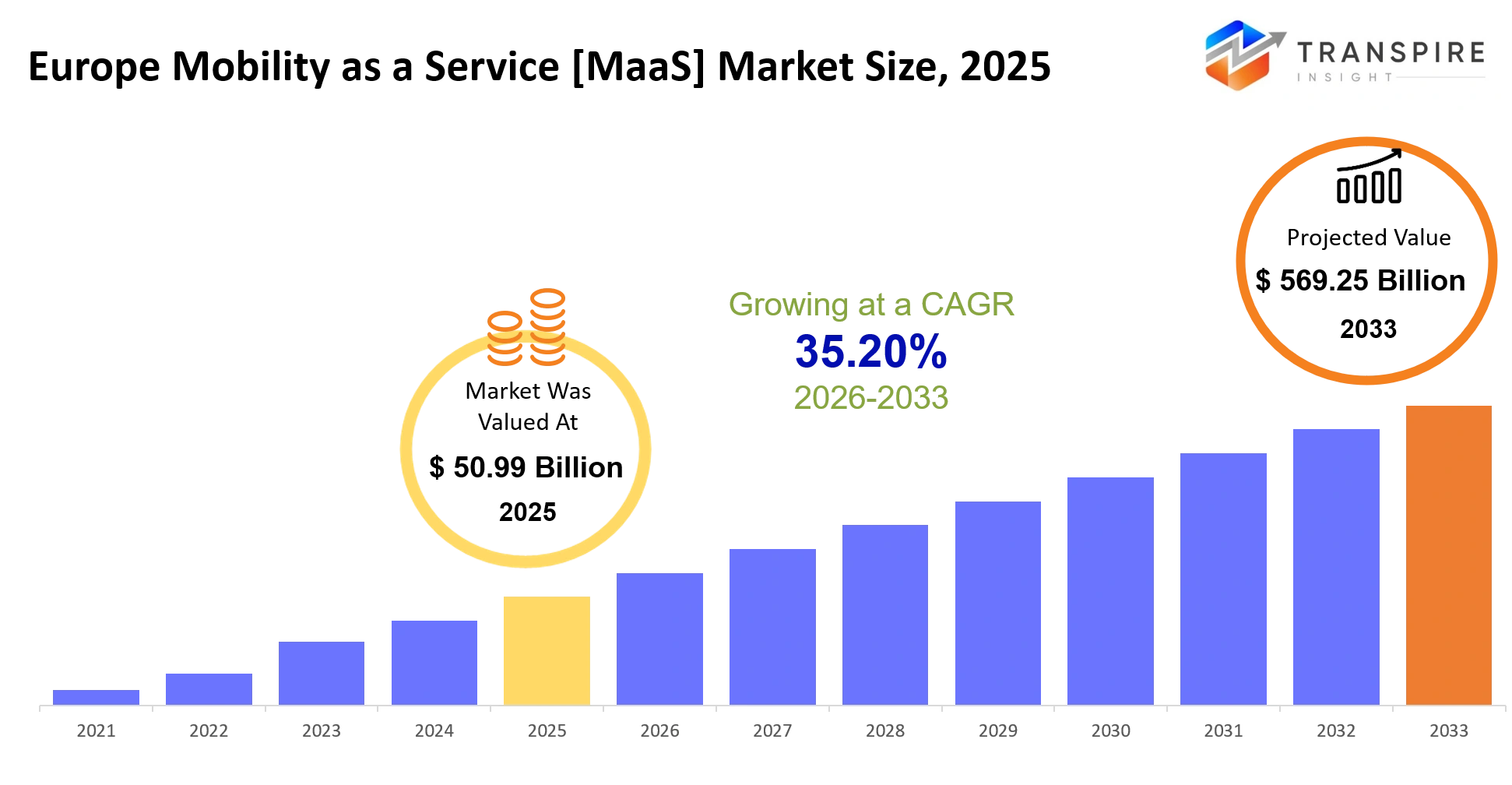
As per Transpire Insight Analysis the Europe Mobility as a Service [MaaS] Market size is estimated at USD 50.99 Billion in 2025 and is anticipated to reach USD 569.25 Billion by 2033, growing at a CAGR of 35.20% from 2026 to 2033.
The Europe Mobility as a Service (MaaS) Market is basically used by travelers to plan , book, and pay for several transport options through one single digital place, which helps reduce the usual need for private vehicle ownership, while also making the whole trip feel more efficient across both city and regional routes. What’s interesting is that public transport operators, ride hailing providers, bike sharing services, car sharing companies, and rail networks are getting more connected together, so users can switch between transport modes with fewer roadblocks, kind of seamless most of the time.
Over the past five years, the market has slowly moved away from those stand alone mobility applications, and it’s now more about integrated digital ecosystems, often backed by open data frameworks and multimodal ticketing. Then the COVID-19 pandemic showed up as a big catalyst, basically pushing transport providers to speed up digital service delivery, and also adopt more flexible mobility services , sooner than planned.
That whole shift has made municipalities and private operators expand their partnerships, so the result is wider service reach, stronger platform engagement, and more repeat income paths through subscription models, integrated payments, and value added mobility services , too.
Europe Mobility as a Service [MaaS] Market Size & Forecast:
- Europe Mobility as a Service [MaaS] Market Size 2025: USD 50.99 Billion
- Expected Market Value 2033: USD 569.25 Billion
- Forecast CAGR: 35.20%
- Leading country in 2025: Germany
- Fastest-growing country: United Kingdom (UK)
- Key Profile: Uber, Bolt, FREE NOW, Moovit, Whim (MaaS Global), Siemens Mobility, SkedGo, Citymapper, Via Transportation, BlaBlaCar, Bird, Lime, Deutsche Bahn, Arriva Group, Keolis.
Key Market Insights
- In 2025 Western Europe sort of held the market in a big way, with about 68% market share, helped by a pretty mature digital infrastructure across Germany, the United Kingdom, France and the Netherlands.
- Meanwhile, Central and Eastern Europe is showing as the fastest-growing regional market during 2025–2033 ,mostly because smart city investments keep stacking up, and integrated public transport systems are expanding as well.
- On the service side integrated mobility platforms were out front with nearly 58% market share in 2025, since operators kind of stitched transit, ride hailing, micromobility, and payments together inside one app.
- Ride hailing and shared mobility integration stayed second-largest ,because existing transport networks make it easier for multimodal service partnerships to move quicker across metro areas.
- For the model type, subscription-based MaaS platforms are projected to expand the fastest through 2033, backed by recurring revenue styles and flexible commuter packages.
- If we look at applications, urban passenger transportation took the lead with around 64% share in 2025, which basically signals strong rollouts across crowded metropolitan corridors.
- Corporate mobility management is expected to be the quickest-growing application through the forecast window, as employers manage travel costs better for staff and align more closely with sustainability targets.
- For end users, individual consumers made up the top segment with roughly 61% in 2025, mostly due to unified journey planning and the ease of digital payments.
- Enterprise and corporate users should see the fastest end-user growth through 2033, fueled by integrated fleet, employee, and business travel management solutions.
What are the Key Drivers, Restraints, and Opportunities in the Europe Mobility as a Service [MaaS] Market?
The main growth driver is government-backed digital mobility policy sort of paired with city level decarbonization goals. In Europe, a bunch of places have sped up integrated ticketing schemes, more open mobility data standards, and smart transit funding ever since the European Green Deal and the national digital mobility efforts really started picking up steam. Transit agencies now tend to work with private mobility operators rather than just competing with them, which oddly enough expands platform reach and bumps up the number of finished rides per rider. Subscription packages, one-spot payments, and multimodal route planning help keep customers coming back while also generating steady, recurring platform income for mobility providers.
The largest restraint though is still the fragmented transport governance across Europe. Local transit authorities, payment systems, and even data standards vary a lot from one country to another, and also between municipalities. So, integration turns into this longer sequence of commercial talks, software tuning, and regulatory sign off. These hurdles cannot be taken away fast because transport infrastructure spending has to stretch across multiple budget cycles. From the Transpire Insight look at regional procurement postings and launch timing, supply chain concentration is still the main execution risk. If platform integration drags, commercial rollout slows, service launches get postponed, and the upside revenue that could come from cross border mobility ecosystems basically gets suppressed.
The strongest, kind of long term opportunity is in AI enabled multimodal mobility platforms, sort of tied in with Mobility Data Spaces and 5G connectivity. Germany, the Netherlands , Finland, and the Nordic markets keep putting money into intelligent transport infrastructure and open mobility ecosystems, which makes sense. Because of that, these moves help real time pricing , predictive route optimization , and dynamic capacity management. Connected electric vehicles and autonomous shuttle pilots will also get even more traction, and digital identity services will make the integrated mobility ecosystems feel more solid while opening up extra subscription , analytics , and enterprise software income.
What Has the Impact of Artificial Intelligence Been on the Europe Mobility as a Service [MaaS] Market?
Artificial intelligence is, in a way, changing mobility platforms by automating trip planning, doing network monitoring, optimizing fares, and handling disruptions across multimodal transport systems. The AI keeps checking traffic conditions, public transport timetables, weather, and passenger demand so it can suggest more efficient travel mixes, pretty much in real time. Alongside that, machine learning models forecast passenger volumes, which helps operators assign vehicles, tune service frequency, and get better fleet utilization before congestion even starts, you know. Predictive analytics also makes maintenance scheduling smarter for connected vehicles and for transport infrastructure, so fewer unexpected service interruptions happen, and overall reliability goes up.
On top of that, digital twins plus cloud based analytics further help with network planning, because they can simulate how passengers behave before any infrastructure or timetable change is rolled out. With these abilities, operating costs typically go down, asset utilization improves, and passengers tend to feel more satisfied due to journeys that are steadier and more reliable. Still, full scale deployment has some sticky problems. The integration costs can be high, since operators need to link legacy ticketing platforms, transportation databases, and several private mobility providers into one unified digital environment, not easy.
Also, there are data interoperability gaps, regional standards that don’t match well in practice, and cybersecurity requirements that can limit AI accuracy across cross border transport networks. Because of all that, large scale implementation is slower even though there’s strong technology investment across the European mobility ecosystem.
Key Market Trends
- Since 2021, multimodal ticketing platforms started replacing standalone transport applications across a lot of major European cities, so at the same time journey planning feels easier and the digital payments part kinda runs smoother, more or less.
- Germany, France, and the Netherlands expanded the Mobility Data Space initiatives from 2022 into 2025, which helped with interoperability between public operators and private providers, not just one side.
- Shared micro mobility partnerships kinda picked up pace after 2023, and operators began folding bicycles , e-scooters, and ride hailing into one unified mobility platform, rather than keeping them separate.
- By 2024, subscription based mobility packages gained traction. The idea was to encourage recurring customer engagement, instead of treating every trip like a one-off ticket purchase, you know.
- Uber, FREE NOW, and regional transit agencies also broadened integrated booking partnerships, and that improved first mile and last mile connectivity across metropolitan networks.
- Between 2022 and 2025, cloud native mobility platforms increasingly replaced legacy transport software, which cut down deployment times for new digital services, in general.
- By 2025, AI powered demand forecasting became a standard planning tool. That let operators fine tune fleet allocation during peak travel periods, without too much guesswork.
- After 2022, contactless payments plus digital identity integration accelerated across European transport systems, making passenger convenience better and transactions faster, overall.
- And across the forecast period, sustainability regulations keep nudging multimodal transport adoption. So public transit operators can collaborate more strongly with private mobility providers, even as the ecosystem keeps evolving.
Europe Mobility as a Service [MaaS] Market Segmentation
By Service Type :
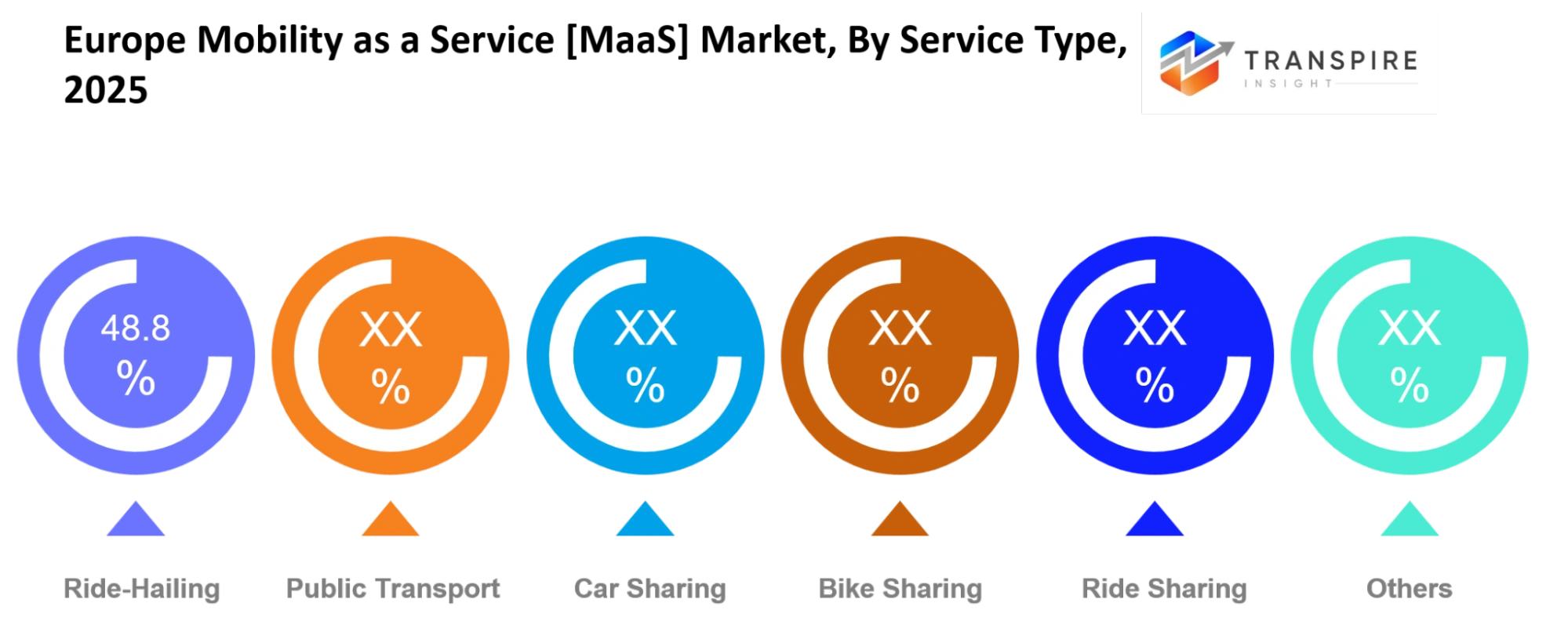
Ride-hailing held the biggest share because flexible booking, short waiting times, and digital payment options sort of matched day-to-day urban travel needs, quite well. Public transport stayed a major contributor too, since integrated ticketing and real-time schedules helped create smooth connections between buses, metro systems , and regional rail services. Car sharing got wider acceptance in cities where parking costs and congestion charges basically push people to rethink their routines. Bike sharing also kept expanding, via smart city programs and dedicated cycling infrastructure.
Ride sharing in particular made commuting more cost efficient for regular travelers, especially when they move across metropolitan business districts. Other mobility services, like scooter sharing and demand-responsive transport, also backed broader multimodal networks. Digital integration across different transport options created smoother journeys and generally encouraged higher platform usage. Continuous service partnerships will likely strengthen network reach, and improve customer retention across European transport systems.
By Platform :
Integrated mobility platforms held the largest portion of the market because travelers liked having one, single interface to plan, book and pay for all kinds of transport services. With real time updates, a unified payment system, and route optimization the overall experience got smoother, for daily commuters and also for the occasional traveler, even when they aren't fully familiar. Mobile applications kept strong adoption too, mainly because many people have smartphones, and the location based services help a lot. Meanwhile web platforms stayed useful for travel planning, especially when it comes to corporate bookings or advance scheduling.
Other digital platforms tackled more specialized transport needs by using tailored mobility solutions. Platform developers kept working on interoperability with transport operators and payment providers, so things fit together more easily. Cloud based technologies also helped with quicker service integration and better day to day operational efficiency. And overall, continued digital investment should make platform performance stronger and improve customer engagement.
By Payment Model :
Subscription based services led that segment, because a predictable monthly fee kinda pushes people into using the platform more often, and yes it also builds customer loyalty. Flexible travel packages pulled in commuters who want access to several transport modes without doing separate bookings, which is kinda the point. Pay as you go models stayed popular with occasional users, and with visitors who need more flexibility than a fixed plan, maybe. Corporate plans grew too, as companies aimed to streamline employee travel administration and keep transportation expenses under control.
Other payment approaches still helped with specific needs across the different regional transit networks. Secure digital wallets, plus contactless payment systems, made transactions easier across the connected mobility services. With a more unified payment setup the booking hassle went down and the overall user experience felt better. Ongoing innovation should keep widening payment flexibility, and also open more chances for recurring revenue.
By End User :
Individual consumers were the biggest end user group, honestly because each day commuting generates a steady kind of platform activity in urban centers. There was also easy access to multi modal transport and digital payments, which bumped up convenience for normal everyday travel. On the corporate side, business traveler management and employee mobility programs helped companies push further into the market, kinda like an extra lever. Tourists also started adopting more, since integrated transport platforms make it less complicated to move between several locations in one run.
Government agencies, backed rollout through smart mobility initiatives, along with extra digital transport investments. Then the other user categories basically leaned into integrated mobility services, for more specialized transit needs. When public authorities and private operators collaborated, service availability improved and operational coordination got smoother, not perfect but better. Finally, long term investment will keep enlarging participation across a mix of customer groups, so it should grow wider than just one audience.
By Transportation Mode :
Road transport kind of dominated the segment there, because buses, taxis, ride-hailing services, shared vehicles, and micro mobility solutions handled most of the daily passenger movement. The strong urban road networks and also broad digital connectivity helped support an efficient multimodal integration though. Rail transport stayed in a pretty important spot, with high-capacity regional and intercity travel, plus integrated ticketing systems kept things aligned. Air mobility still looked like an emerging category, with more gradual investment in advanced urban mobility projects.
Water transport supported mobility services in coastal cities and also on inland waterways where passenger ferry networks remained significant. Other transportation modes contributed more specialized solutions, for local and regional travel needs. Integrated journey planning improved the coordination across the various transport options. And even with that, continued infrastructure investment will likely strengthen multimodal connectivity and operational efficiency across European mobility networks.
What are the Key Use Cases Driving the Europe Mobility as a Service [MaaS] Market?
Daily city commuting is still the biggest use case, mainly because integrated mobility platforms sort of blend public transport with ride hailing, plus shared mobility… all in the same booking moment. Some individual riders, and even city transport authorities back the shift because unified ticketing helps cut down travel confusion, makes route planning smoother, and boosts passenger comfort across metropolitan corridors.
Corporate mobility management, and the general stuff around business travel coordination, keeps growing at bigger companies. Employers lean on these integrated transport platforms to handle employee travel spending, while tourism operators move toward multimodal booking options to make it easier for guests to move between airports, railway stations, hotels, and the main attractions.
More emerging scenarios are showing up too, like mobility services tied to autonomous shuttle pilots, and smart city traffic control programs. Municipal authorities are also looking at Mobility as a Service platforms for demand responsive transport in suburban districts, where digital coordination can raise service reliability, while still supporting longer term sustainable mobility aims.
|
Report Metrics |
Details |
|
Market size value in 2025 |
USD 50.99 Billion |
|
Market size value in 2026 |
USD 68.94 Billion |
|
Revenue forecast in 2033 |
USD 569.25 Billion |
|
Growth rate |
CAGR of 35.20% from 2026 to 2033 |
|
Base year |
2025 |
|
Historical data |
2021 - 2024 |
|
Forecast period |
2026 - 2033 |
|
Report coverage |
Revenue forecast, competitive landscape, growth factors, and trends |
|
Country scope |
Europe (Germany, United Kingdom, France, Italy, Spain and Rest of Europe) |
|
Key company profiled |
Uber, Bolt, FREE NOW, Moovit, Whim (MaaS Global), Siemens Mobility, SkedGo, Citymapper, Via Transportation, BlaBlaCar, Bird, Lime, Deutsche Bahn, Arriva Group, Keolis. |
|
Customization scope |
Free report customization (country, regional & segment scope). Avail customized purchase options to meet your exact research needs. |
|
Report Segmentation |
By Service Type (Ride-Hailing, Public Transport, Car Sharing, Bike Sharing, Ride Sharing, Others); By Platform (Mobile Applications, Web Platforms, Integrated Mobility Platforms, Others); By Payment Model (Subscription-Based, Pay-as-You-Go, Corporate Plans, Others); By End User (Individual Consumers, Corporate Users, Tourists, Government Agencies, Others); By Transportation Mode (Road Transport, Rail Transport, Air Mobility, Water Transport, Others). |
Which Regions are Driving the Europe Mobility as a Service [MaaS] Market Growth?
In 2025 Western Europe contributed around 68% of the regional market, so it basically became the biggest source of industry income. Policies on public transport stayed strong, open mobility data programs moved forward, and the rules for digital ticketing also lined up pretty well, which made it easier for integrated mobility platforms to spread across Germany, France, the Netherlands , and the United Kingdom. In practice, technology providers, transport operators, payment companies, plus municipal authorities have built what feels like a mature mobility ecosystem, and they did it with steady spending on smart transport infrastructure. As modernization keeps going, multimodal integration moves ahead, and sustainability ambitions remain on track, the region should keep its leadership position through most of the forecast period.
Northern Europe is the next largest regional market. The reason is that transport planning tends to focus more on long-term operational efficiency, not so much on quick network expansion. Places like Sweden, Denmark, Finland, and Norway can lean on stable regulatory frameworks, advanced digital infrastructure , and continued public funding for intelligent transport systems. There is also solid economic resilience, which helps local governments keep paying for integrated mobility services even when conditions shift. Altogether this steadier approach to investment supports reliable revenue channels for technology providers and for mobility platform operators.
Central and Eastern Europe is projected to see the fastest growth through 2033 , as transport modernization programs keep accelerating across Poland , the Czech Republic , Romania, and Hungary. In the recent period, investment in digital public transport systems, smart city initiatives , and integrated payment infrastructure has been improving the general conditions for multimodal mobility platforms, like really making things easier in practice. At the same time, expanding urban populations and European infrastructure funding are still pushing cities to modernize transport services through connected digital ecosystems that feel more and more seamless. Overall, these changes should create attractive opportunities for platform developers, technology vendors, and investors who are looking for expansion somewhere between 2026 and 2033 .
Who are the Key Players in the Europe Mobility as a Service [MaaS] Market and How Do They Compete?
Competition across the mobility ecosystem is still, kind of moderately fragmented, mainly because public transport operators, technology providers, ride hailing businesses, and mobility platform developers each focus on slightly different customer needs. In practice, technology integration and overall service quality seem more decisive than pricing, by itself. The older transport technology firms keep pushing their digital ecosystems forward. Meanwhile newer platform players are rolling out more flexible mobility models ,and also smoother user experiences, you know the kind that feels simple and fast. At the same time, strategic partnerships with municipal authorities and transport operators have turned into a real competitive edge.
Siemens Mobility leans into intelligent transport technologies that basically connect public transit systems with digital mobility platforms. The idea is to help cities improve network coordination and also the passenger experience. Uber differentiates a lot through wide ride hailing coverage, plus partnerships with transit agencies, so public transport can land inside a single booking platform. FREE NOW, on the other hand, expands multimodal offerings by bundling taxis, micromobility, and shared transport options into one application. That tends to boost customer convenience across many European cities, even when people switch modes often.
Moovit builds its advantage via AI driven journey planning and real time transit information, which helps with route accuracy and operational efficiency. SkedGo focuses on multimodal journey planning software for governments and transport operators, and it provides flexible platform integration across different transport networks. Ongoing investment in artificial intelligence, cloud based mobility platforms, and regional partnerships helps these companies grow their service capabilities while also adapting to changing transport policies and evolving digital infrastructure development.
Company List
- Uber
- Bolt
- FREE NOW
- Moovit
- Whim (MaaS Global)
- Siemens Mobility
- SkedGo
- Citymapper
- Via Transportation
- BlaBlaCar
- Bird
- Lime
- Deutsche Bahn
- Arriva Group
- Keolis
Recent Development News
In April 2025, Lyft announced the acquisition of FREE NOW from BMW Group and Mercedes-Benz Mobility for €175 million. The acquisition marked Lyft's entry into the European mobility market, expanding operations across more than 150 cities in nine countries and strengthening multimodal mobility platform competition.
Source: https://www.reuters.com/
In May 2025, Uber and May Mobility announced a multi-year strategic partnership to deploy autonomous vehicles on the Uber platform. The collaboration supports large-scale autonomous mobility deployment and reinforces the transition toward AI-enabled Mobility as a Service ecosystems, with broader expansion planned beyond the initial launch.
Source: https://investor.uber.com/
What Strategic Insights Define the Future of the Europe Mobility as a Service [MaaS] Market?
Over the next five to seven years, the Europe Mobility as a Service (MaaS) Market will, kind of, move toward fully connected mobility ecosystems where transport operators, payment providers and digital platforms swap real time data through standardized frameworks. The strongest structural pull will be the ongoing blending of public transport with shared mobility services, backed by digital infrastructure investment and cross-border interoperability programs. There is also a quieter risk, more like, market concentration around just a few platform operators and technology providers, and that could dampen competition, plus make innovation slower, if interoperability rules start drifting across countries.
An emerging opportunity is the commercial rollout of AI enabled mobility orchestration together with Mobility Data Spaces, especially across Central and Eastern Europe, as transport modernization really starts to accelerate. Market participants should keep their focus on open platform collaborations, scalable cloud architecture and payment systems that can interoperate, so long term competitiveness stays strong while integration costs go down and regional service coverage can expand.
Europe Mobility as a Service [MaaS] Market Report Segmentation
By Service Type
- Ride-Hailing
- Public Transport
- Car Sharing
- Bike Sharing
- Ride Sharing
By Platform
- Mobile Applications
- Web Platforms
- Integrated Mobility Platforms
By Payment Model
- Subscription-Based
- Pay-as-You-Go
- Corporate Plans
By End User
- Individual Consumers
- Corporate Users
- Tourists
- Government Agencies
By Transportation Mode
- Road Transport
- Rail Transport
- Air Mobility
- Water Transport
Frequently Asked Questions
Find quick answers to common questions.
The expected Europe Mobility as a Service [MaaS] Market size for the market will be USD 569.25 Billion in 2033.
Key segments for the Europe Mobility as a Service [MaaS] Market are By Service Type (Ride-Hailing, Public Transport, Car Sharing, Bike Sharing, Ride Sharing, Others); By Platform (Mobile Applications, Web Platforms, Integrated Mobility Platforms, Others); By Payment Model (Subscription-Based, Pay-as-You-Go, Corporate Plans, Others); By End User (Individual Consumers, Corporate Users, Tourists, Government Agencies, Others); By Transportation Mode (Road Transport, Rail Transport, Air Mobility, Water Transport, Others).
Major Europe Mobility as a Service [MaaS] Market players are Uber, Bolt, FREE NOW, Moovit, Whim (MaaS Global), Siemens Mobility, SkedGo, Citymapper, Via Transportation, BlaBlaCar, Bird, Lime, Deutsche Bahn, Arriva Group, Keolis.
The Europe Mobility as a Service [MaaS] Market size is USD 50.99 Billion in 2025.
The Europe Mobility as a Service [MaaS] Market CAGR is 35.20% from 2026 to 2033.
- Uber
- Bolt
- FREE NOW
- Moovit
- Whim (MaaS Global)
- Siemens Mobility
- SkedGo
- Citymapper
- Via Transportation
- BlaBlaCar
- Bird
- Lime
- Deutsche Bahn
- Arriva Group
- Keolis
About the Authors

Mayur Shinde
I am Mayur Shinde, a Senior Research Analyst at Transpire Insight, specializing in the Automotive & Transportation and Information & Communication Technology (ICT) Industry. My work focuses on analyzing emerging market trends, technological advancements, competitive landscapes, and industry developments to deliver accurate, data-driven insights. I am passionate about transforming complex market information into clear, actionable content that helps businesses, professionals, and decision-makers stay informed and make confident strategic decisions.

Chakradhar Khansole
Chakradhar serves as the Research Director at Transpire Insight, bringing over 8 years of experience in technology, innovation, and strategic market intelligence. He specializes in transforming complex market data into actionable business insights that enable organizations to make informed, growth-oriented decisions. Recognized for his strategic vision and analytical expertise, Chakradhar leads high-impact research initiatives, delivering comprehensive market assessments, competitive intelligence, and forward-looking industry analysis.
Recently Published Reports
-
Apr 2026
ATV & UTV Market
ATV & UTV Market Size, Share & Analysis Report By Type (ATV, and UTV), By Variants (Less Than 400 CC, 400 CC To 800 CC, and More Than 800 CC), and Geography (North America, Europe, Asia-Pacific, Middle East and Africa, South and Central America), 2021 - 2031
-
Apr 2026
Automotive Central Gateway Module Market
Automotive Central Gateway Module Market Size, Share & Analysis Report By Type (Ethernet Central Gateway Module, CAN Central Gateway Module, LIN Central Gateway Module, and FlexRay), By Application (Powertrain Control, Body Control, Infotainment System, Advanced Driver Assistance Systems (ADAS), and Others), By End User (Passenger Vehicles, and Commercial Vehicles), and Geography (North America, Europe, Asia-Pacific, Middle East and Africa, South and Central America), 2021 - 2031
-
Apr 2026
Automotive Engine Oil Filter Market
Automotive Engine Oil Filter Market Size, Share & Analysis Report By Filter Type (Fuel Filter, Engine Oil Filter, Hydraulic Oil Filter, and Others), By Filter Media (Cellulose, Synthetic, and Micro), By Sales Channel (OEMs, and Aftermarket), By Vehicle Type (Passenger Cars, Light Commercial Vehicles, Heavy Duty Trucks, Buses and Coaches, and Off-road Vehicles), and Geography (North America, Europe, Asia-Pacific, Middle East and Africa, South and Central America), 2021 - 2031
-
Apr 2026
Automotive Parts Aluminium Die Casting Market
Automotive Parts Aluminium Die Casting Market Size, Share & Analysis Report By Production Process (Pressure Die Casting, Vacuum Die Casting, Squeeze Die Casting, Gravity Die Casting), By Application (Body Parts, Engine Parts, Transmission Parts, Battery And Related Components, Other Application Types), and Geography (North America, Europe, Asia-Pacific, Middle East and Africa, South and Central America), 2021 - 2031
Our Clients



