
Rail Transport Market Summary:
According to Transpire Insights, a detailed research report on the market reflects that the passenger rail transport application segment dominates the Global Rail Transport Market, accounting for approximately 64% of the total market share worldwide. Deutsche Bahn AG leads the global market with approximately USD 62 billion in annual revenue and an estimated 12–16% global market share, making it the leading contributor to global rail transport market development through continuous investment in high-speed rail networks, digital railway technologies, sustainable mobility solutions, advanced signaling systems, expanding rail infrastructure, and operational innovation, thereby accelerating overall market growth and long-term industry dynamics.
Market Snapshot
- Market Value (2025): USD 633.8 Billion.
- Expected Market Value (2026): USD 682 Billion.
- Estimated Market Value (2033): USD 1138.88 Billion.
- Forecast CAGR (2026–2033): 7.60%.
- Leading Region in 2025: Asia Pacific
- Second-largest Region: Europe
- Fastest Growing Region: North America
Introduction
Rail transport globally involves the movement of passengers and freight via railway networks. This mode of transport is reliable, efficient and sustainable on urban, regional and international routes. The market includes passenger rail services, freight rail operations, metro systems, high-speed rail and dedicated industrial rail corridors, serving a wide range of commercial and public transportation needs. The global market is growing as more money is spent on railway infrastructure, digital signalling technology, intermodal logistics, and smart mobility solutions. Many industries are increasingly focusing on ways to cut down carbon emissions, boost supply chain efficiency and provide greener transport options, and this is driving the continued adoption of rail. Operational performance is constantly being improved by rail automation, electrification and modern rolling stock. Rail transport is a vital component of economic development worldwide. It is also an integral part of transportation networks.
For instance:-
- North America: Government investments in modernizing rail infrastructure, expanding freight corridors and advanced signalling systems and network safety improvements continue to boost operational efficiency and long-term rail transport market growth.
- Europe: Green mobility initiatives, cross-border railway modernization, high-speed rail expansion and digital rail technologies provide high policy support and accelerate the development of sustainable rail transport across the region.

Key Market Highlights:-
- Asia Pacific is expected to grow at a rapid CAGR in the Global Rail Transport Market by holding around43% of the share during the forecast period.
- Europe is anticipated to hold roughly21% share of the Global Rail Transport Market over the predicted timeframe.
- North America is anticipated to hold nearly 29.9%share of the Global Rail Transport Market over the predicted timeframe.
- 4 By Rail Type, the Passenger Rail dominated the market and holds nearly 45% share in 2025 and is projected to grow at a substantial CAGR during the forecast period.
- By Propulsion Type, the Diesel dominated the market and holds close to 70% share in 2025 and is projected to grow at a substantial CAGR during the forecast period.
- 6 By Component, the rolling stock dominated the market and holds about 45% share in 2025 and is projected to grow at a substantial CAGR during the forecast period.
- The Indian Prime Minister’s GatiShakti initiative, Dedicated Freight Corridors, Amrit Bharat Station Scheme, and the Kavach safety system are bolstering the railway modernization, enhancing freight efficiency, improving passenger mobility, and driving long-term growth in the Global Rail Transport Market.
How is Technology Driving Growth in the Global Rail Transport Market?
Technological advancements are transforming the Global Rail Transport Market, making it more efficient, safe and sustainable, and enhancing the passenger experience. Artificial intelligence, IoT and predictive maintenance allow real time monitoring of rail infrastructure and rolling stock and cut down on downtime and maintenance costs. Advanced signalling technologies such as Communications-Based Train Control (CBTC) and Positive Train Control (PTC) increase network capacity and improve operational safety. Railway electrification, hydrogen-powered locomotives and battery-electric trains are all increasing to help achieve decarbonization goals and sustainable transportation. Smart ticketing solutions, digital freight tracking and automated inspection systems are also helping to streamline passenger services and logistics, providing innovation and long term market growth.
Market Drivers
Market Dynamics The global rail transport market is driven by increased government investments for modernization of railway infrastructure network electrification and dedicated freight corridor development. The increasing demand for affordable, sustainable and energy-efficient transport is driving a shift from road to rail for passenger and freight services. The increasing adoption of advanced signaling systems, artificial intelligence, digital traffic management, and predictive maintenance technologies is improving operational efficiency and network safety. The growth of high-speed rail projects, urban metro systems, and intermodal logistics networks also contribute to the market growth. Moreover, the industry’s long-term outlook has been improving on the back of investments in low-emission rail technologies driven by strict environmental regulations and global decarbonization initiatives.
For Instance:
Asia-Pacific: Infrastructure development fueled by large scale public investments in high-speed rail networks, dedicated freight corridors, urban metro expansion and railway electrification driving expansion of regional markets.
Restrain
High capital investment requirements for railway infrastructure, rolling stock and advanced signalling systems are challenges for the Global Rail Transport Market. Limited network capacity, aging infrastructure and connectivity gaps constrain operational flexibility and service expansion. Furthermore, the considerable competition between road and air transport for time-sensitive logistics also hinders market growth. Supply chain disruptions, raw material costs and lengthy project approval processes also continue to constrain infrastructure development and investment returns.
Analysis of Prices and Consumer Behaviour
The market for rail transport services is dominated by passenger rail services (~64% of the total market) that are primarily propelled by increasing urbanization, expanding metro networks and rising demand for affordable, reliable and sustainable public transport. The faster travel times, premium onboard amenities and advanced rail infrastructure are expected to make average ticket prices for high-speed rail services about 30-40% higher than those for conventional rail services. Lower operating costs, higher energy efficiency and government investments in railway electrification have made electric rail about 58% of total rail operations. Passenger rail services constitute about 64% of total market demand. Freight rail continues to expand with increasing intermodal logistics and industrial commerce. According to consumer buying behaviour, approximately 57% of passengers are concerned about affordability, punctuality, safety and service reliability when choosing rail transport. Around 35% of freight customers prefer long-term transportation contracts to optimise logistics costs, to ensure stability of the supply chain and to secure consistent rail freight capacity on domestic and international trade routes.
Top Companies in the Global Rail Transport Market
- CRRC Corporation
- Siemens Mobility
- Alstom
- Hitachi Rail
- Stadler Rail
- Wabtec Corporation
- CAF
- Hyundai Rotem
- Talgo
- Bombardier Transportation
- Knorr-Bremse
- Mitsubishi Heavy Industries
- Trinity Industries
- Progress Rail
- Deutsche Bahn
Rail Transport Market Segmentation
The Global Rail Transport Market share is divided into five categories: By Rail Type, By Propulsion Type, By Component, By Application, By End User
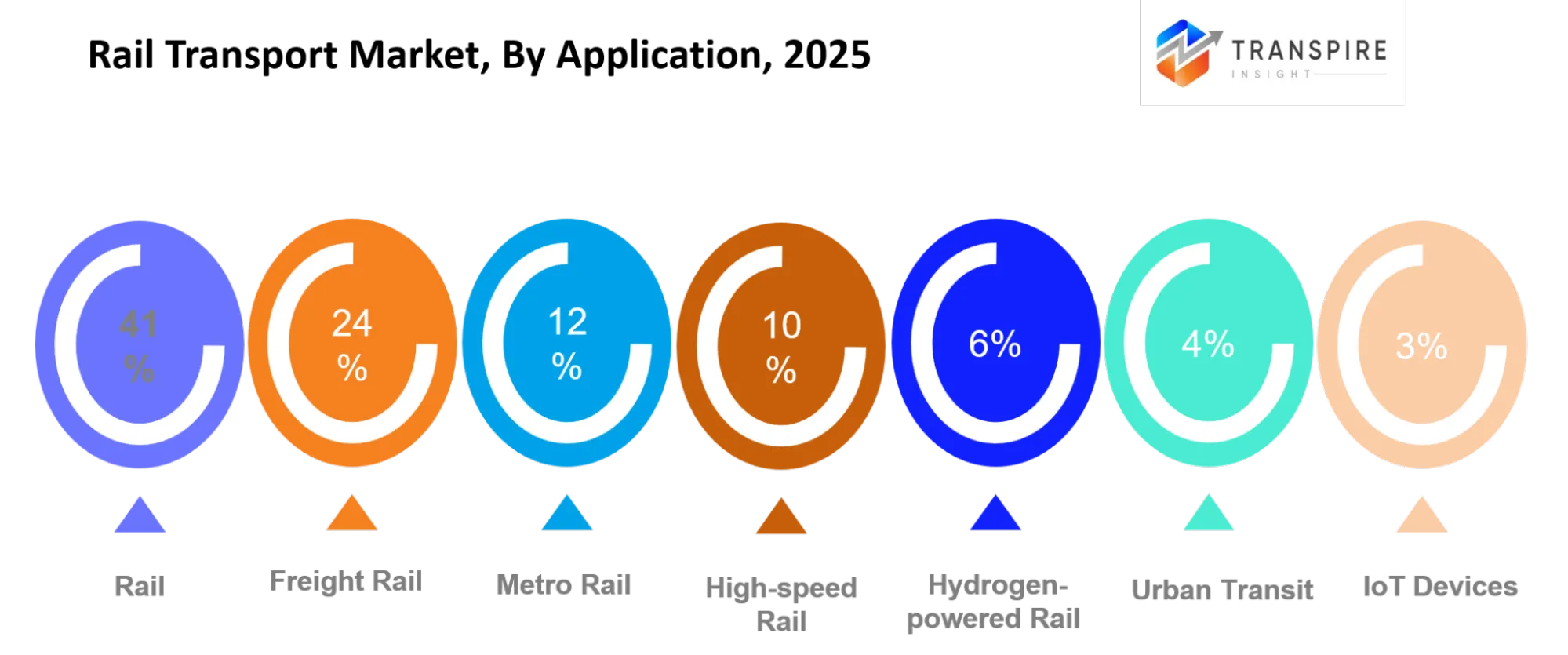
The Passenger Rail dominated the market, accounting for nearly 45% in 2025 and is expected to rise at a significant CAGR during the forecast period.
The Global Rail Transport Market is segmented by rail type into passenger rail, freight rail, high-speed rail, metro rail, light rail, monorail, regional rail, others. Among these, the Passenger Rail dominated the market, accounting for nearly 45% in 2025 and expected to increase at a significant CAGR during the forecast period. The passenger rail market continues to grow as a result of factors such as rising urbanization, government investment in railway infrastructure, affordable mobility, expanding metro networks, and growing demand for sustainable public transportation.
The Diesel dominated the market, accounting for close to 70% in 2025, and is expected to rise at a significant CAGR during the forecast period
The Global Rail Transport Market is segmented by propulsion type into diesel, electric, hybrid, hydrogen-powered, battery electric, lng-powered, solar-assisted, others. Among these, the Diesel dominated the market, accounting for close to 70% in 2025 and expected to increase at a significant CAGR during the forecast period. The diesel rail market is still supported by the extensive existing diesel rail infrastructure, low initial deployment costs, reliable long distance operations and high demand for freight transportation.
The rolling stock dominated the market, accounting for about 45% in 2025 and is expected to rise at a significant CAGR during the forecast period.
The Global Rail Transport Market is by component into rolling stock, rail infrastructure, signaling systems, electrification systems, maintenance equipment, rail control systems, passenger information systems, others. Among these, the rolling stock dominated the market, accounting for about 45% in 2025 and expected to increase at a significant CAGR during the forecast period. The market's continued growth is fuelled by railway modernization, fleet replacement programs, growing passenger and freight operations, and increased investments in advanced rolling stock technologies.
Regional Segment Analysis of the Global Rail Transport Market
- Europe (Germany, France, U.K., Italy, Spain, Rest of Europe)
- North America (U.S., Canada, Mexico)
- Asia-Pacific (China, Japan, India, Rest of APAC)
- South America (Brazil and the Rest of South America)
- The Middle East and Africa (UAE, South Africa, Rest of MEA)
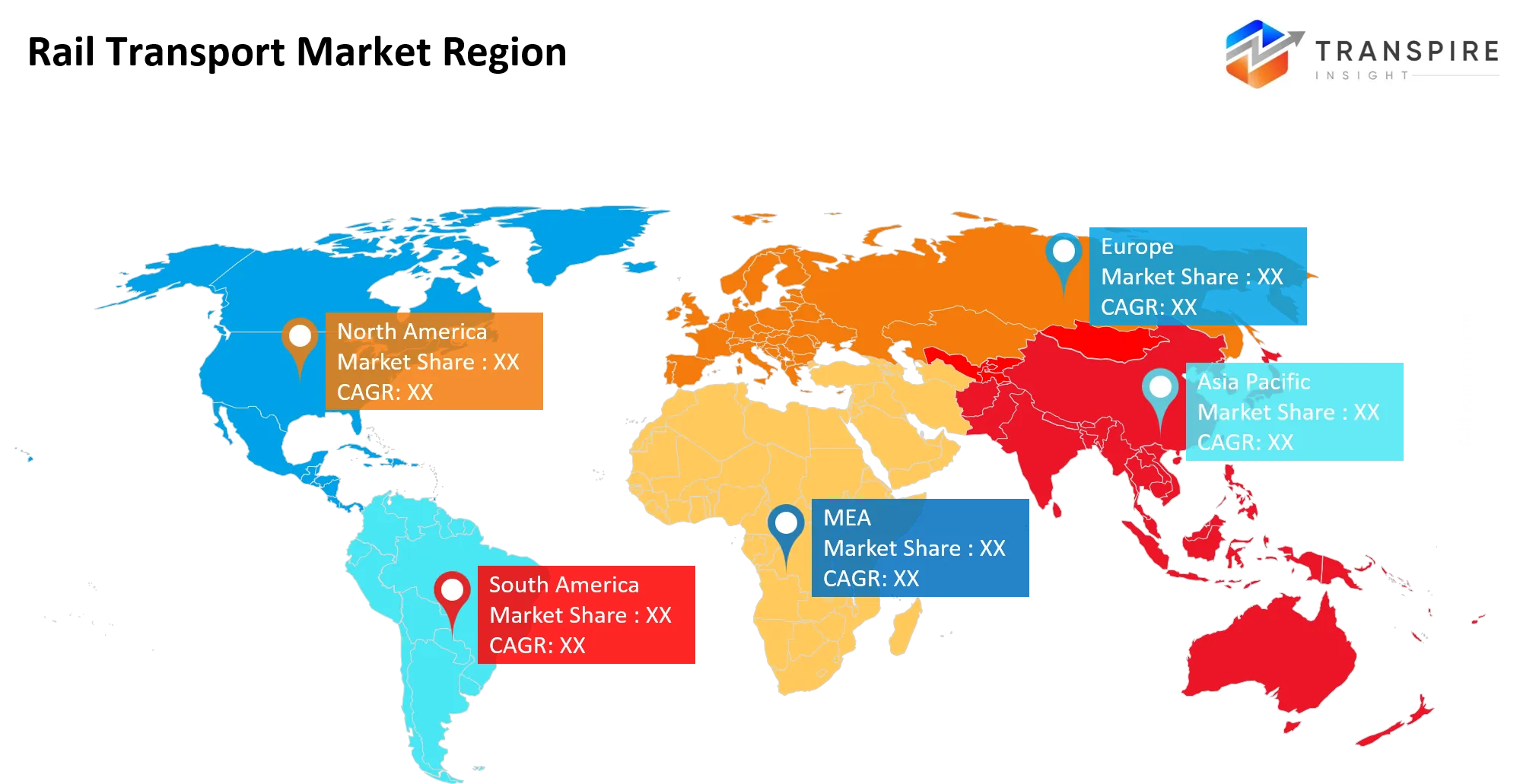
Asia Pacific is expected to grow at a rapid CAGR in the Global Rail Transport Market, holding around 43% of the share during the forecast period.
The Global Rail Transport Market is dominated by the Asia Pacific region owing to the massive expansion of railway infrastructure, rapid urbanization and rising government investments in high-speed rail networks, metro systems and dedicated freight corridors. Countries such as China, India and Japan are rapidly modernizing their rail systems with electrification, state-of-the-art signaling technologies and smart transportation initiatives. Increasing passenger mobility demand, industrial development, and growing freight transportation requirements further substantiate the leading position of the region and support significant market growth during the forecast period.
Europe is the fastest-growing region in the Global Rail Transport Market during the period, holding roughly 21% share.
The Global Rail Transport Market is booming in Europe, driven by the strong support of governments for sustainable mobility, large railway modernization programs and increasing investments in high-speed rail and digital signalling infrastructure. The market growth is fuelled by the region’s push to reduce carbon emissions, expand cross-border rail connectivity and promote electric transport system. Positive regulatory frameworks, smart rail initiatives and increasing demand for efficient passenger and freight transport solutions are also fortifying Europe’s market position.
North America is the fastest-growing region in the Global Rail Transport Market during the period, holding nearly 29.9% share.
North America holds a strong position in the Global Rail Transport Market owing to heavy investments in freight rail infrastructure, network modernization and advanced rail technologies. There is a growing demand in the region for efficient cargo transportation, intermodal logistics solutions and supply chain optimization in various industries. Government support for improving rail safety, digital signaling systems and sustainable transport initiatives is also contributing to market growth. In addition, steady freight activity and growing connectivity by railway continue to act as a catalyst for regional expansion.
Strategies for Market Growth in Non-Leading Regions:
Emerging markets would benefit from expansion of railway infrastructure in non-leading regions, modernization programs and adoption of advanced rail technology in an efficient and scalable manner. Development of metro systems, freight corridors, rail manufacturing capabilities and local development of railway networks can reduce dependence on external infrastructure support and improve overall transportation efficiency. Strategic partnerships among regional governments, railway operators, technology providers, logistics companies and infrastructure developers will enhance market penetration and speed up growth of the rail transport industry. Workforce training and technical skill development will be needed to increase expertise in railway operations, digital signaling, maintenance systems, and sustainable transportation solutions. Moreover, flexible financing models, public-private partnerships, and long-term infrastructure investment plans will make rail transport solutions more available and promote uptake in developing regions. The integration of smart rail technologies and digital logistics platforms, along with the creation of collaborative initiatives with governments, transportation authorities and industrial sectors, will improve connectivity, enhance operational efficiency and support the sustainable global growth of the rail transport market.
Future Market Trends for the Global Rail Transport Market:-
- Green Propulsion and Sustainability: Global railway networks are decarbonizing, reducing emissions and promoting sustainable transportation solutions through the increasing use of hydrogen, hybrid, LNG and electrified rail systems.
- Digitalization and Smart Infrastructure: Artificial intelligence, IoT-based predictive maintenance, automated signaling and smart rail management systems improve operational efficiency, safety, reliability and network capacity.
- High-Speed Rail and Freight Modernization: Investment is increasing in high-speed rail, urban metro expansion, dedicated freight corridors and intermodal logistics infrastructure, improving global connectivity and supporting efficient movement of passengers and cargo.
Recent Development
In January 2026 –
Rail Freight Solutions Expansion: Leading rail operators and logistics companies are transforming freight transportation through dedicated freight corridors, double-stack container technology and intermodal solutions to improve supply chain efficiency.
In March2026 –
Alternative Fuel Locomotives Gain Traction Railway manufacturers and operators ramp up adoption of hydrogen, hybrid and LNG-powered locomotives to meet decarbonization goals and advocate for sustainable rail transportation.
Market Segment
This study forecasts revenue at global, regional and country levels from 2020 to 2033. Transpire Insights has segmented the Global Rail Transport Market based on the below-mentioned segments:
Global Rail Transport Market, By Rail Type
- Passenger Rail
- Freight Rail
- High-speed Rail
- Metro Rail
- Light Rail
- Monorail
- Regional Rail
- Others
Global Rail Transport Market, By Propulsion Type
- Diesel
- Electric
- Hybrid
- Hydrogen-powered
- Battery
- LNG-powered
- Solar-assisted
- Others
Global Rail Transport Market, By Component
- Rolling Stock
- Rail Infrastructure
- Signaling Systems
- Electrification Systems
- Maintenance Equipment
- Rail Control Systems
- Passenger Information Systems
- Others
Global Rail Transport Market, By Application
- Urban Transit
- Intercity Transport
- Freight Transportation
- Mining
- Tourism
- Industrial Transport
- Military Logistics
- Others
Global Rail Transport Market, By End User
- Government
- Public Transport Operators
- Logistics Companies
- Mining Companies
- Industrial Enterprises
- Tourism Operators
- Defense
- Others
Global Rail Transport Market, By Regional Analysis
North America
- US
- Canada
- Mexico
Europe
- Germany
- UK
- France
- Italy
- Spain
- Russia
- Rest of Europe
Asia Pacific
- China
- Japan
- India
- South Korea
- Australia
- Rest of Asia Pacific
South America
- Brazil
- Argentina
- Rest of South America
Middle East & Africa
- UAE
- Saudi Arabia
- Qatar
- South Africa
- Rest of the Middle East & Africa
Frequently Asked Questions
Find quick answers to common questions.
The market growth is driven by infrastructure investments, railway modernization, sustainable transportation demand, digital technologies, and expanding passenger and freight networks
Passenger rail dominates the market due to urbanization, expanding metro systems, government investments, and increasing demand for efficient public transportation solutions
Asia Pacific leads the market due to large-scale railway infrastructure development, high-speed rail expansion, urban mobility projects, and government support
AI, IoT, predictive maintenance, smart signaling, and automation are improving railway safety, operational efficiency, capacity, and sustainable transportation performance
Future trends include hydrogen-powered trains, railway electrification, digital infrastructure, high-speed rail expansion, and advanced freight transportation solutions worldwide
- CRRC Corporation
- Siemens Mobility
- Alstom
- Hitachi Rail
- Stadler Rail
- Wabtec Corporation
- CAF
- Hyundai Rotem
- Talgo
- Bombardier Transportation
- Knorr-Bremse
- Mitsubishi Heavy Industries
- Trinity Industries
- Progress Rail
- Deutsche Bahn
About the Authors

Mayur Shinde
I am Mayur Shinde, a Senior Research Analyst at Transpire Insight, specializing in the Automotive & Transportation and Information & Communication Technology (ICT) Industry. My work focuses on analyzing emerging market trends, technological advancements, competitive landscapes, and industry developments to deliver accurate, data-driven insights. I am passionate about transforming complex market information into clear, actionable content that helps businesses, professionals, and decision-makers stay informed and make confident strategic decisions.

Chakradhar Khansole
Chakradhar serves as the Research Director at Transpire Insight, bringing over 8 years of experience in technology, innovation, and strategic market intelligence. He specializes in transforming complex market data into actionable business insights that enable organizations to make informed, growth-oriented decisions. Recognized for his strategic vision and analytical expertise, Chakradhar leads high-impact research initiatives, delivering comprehensive market assessments, competitive intelligence, and forward-looking industry analysis.
Recently Published Reports
-
Apr 2026
ATV & UTV Market
ATV & UTV Market Size, Share & Analysis Report By Type (ATV, and UTV), By Variants (Less Than 400 CC, 400 CC To 800 CC, and More Than 800 CC), and Geography (North America, Europe, Asia-Pacific, Middle East and Africa, South and Central America), 2021 - 2031
-
Apr 2026
Automotive Central Gateway Module Market
Automotive Central Gateway Module Market Size, Share & Analysis Report By Type (Ethernet Central Gateway Module, CAN Central Gateway Module, LIN Central Gateway Module, and FlexRay), By Application (Powertrain Control, Body Control, Infotainment System, Advanced Driver Assistance Systems (ADAS), and Others), By End User (Passenger Vehicles, and Commercial Vehicles), and Geography (North America, Europe, Asia-Pacific, Middle East and Africa, South and Central America), 2021 - 2031
-
Apr 2026
Automotive Engine Oil Filter Market
Automotive Engine Oil Filter Market Size, Share & Analysis Report By Filter Type (Fuel Filter, Engine Oil Filter, Hydraulic Oil Filter, and Others), By Filter Media (Cellulose, Synthetic, and Micro), By Sales Channel (OEMs, and Aftermarket), By Vehicle Type (Passenger Cars, Light Commercial Vehicles, Heavy Duty Trucks, Buses and Coaches, and Off-road Vehicles), and Geography (North America, Europe, Asia-Pacific, Middle East and Africa, South and Central America), 2021 - 2031
-
Apr 2026
Automotive Parts Aluminium Die Casting Market
Automotive Parts Aluminium Die Casting Market Size, Share & Analysis Report By Production Process (Pressure Die Casting, Vacuum Die Casting, Squeeze Die Casting, Gravity Die Casting), By Application (Body Parts, Engine Parts, Transmission Parts, Battery And Related Components, Other Application Types), and Geography (North America, Europe, Asia-Pacific, Middle East and Africa, South and Central America), 2021 - 2031
Our Clients



